Berlinfographicsby Berlin Experiences

The city todayCycling and the Mobilitätsgesetz · as of September 2026

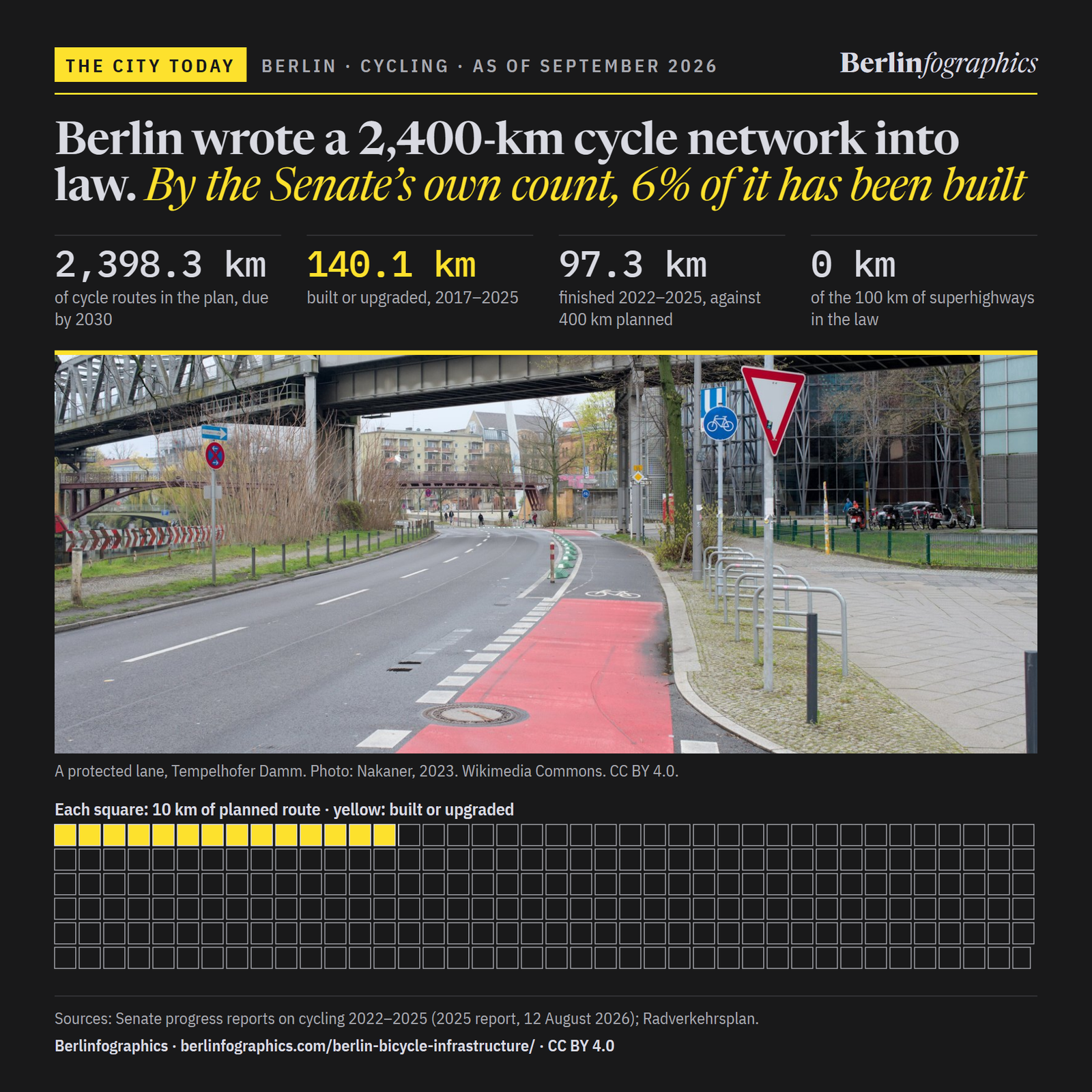
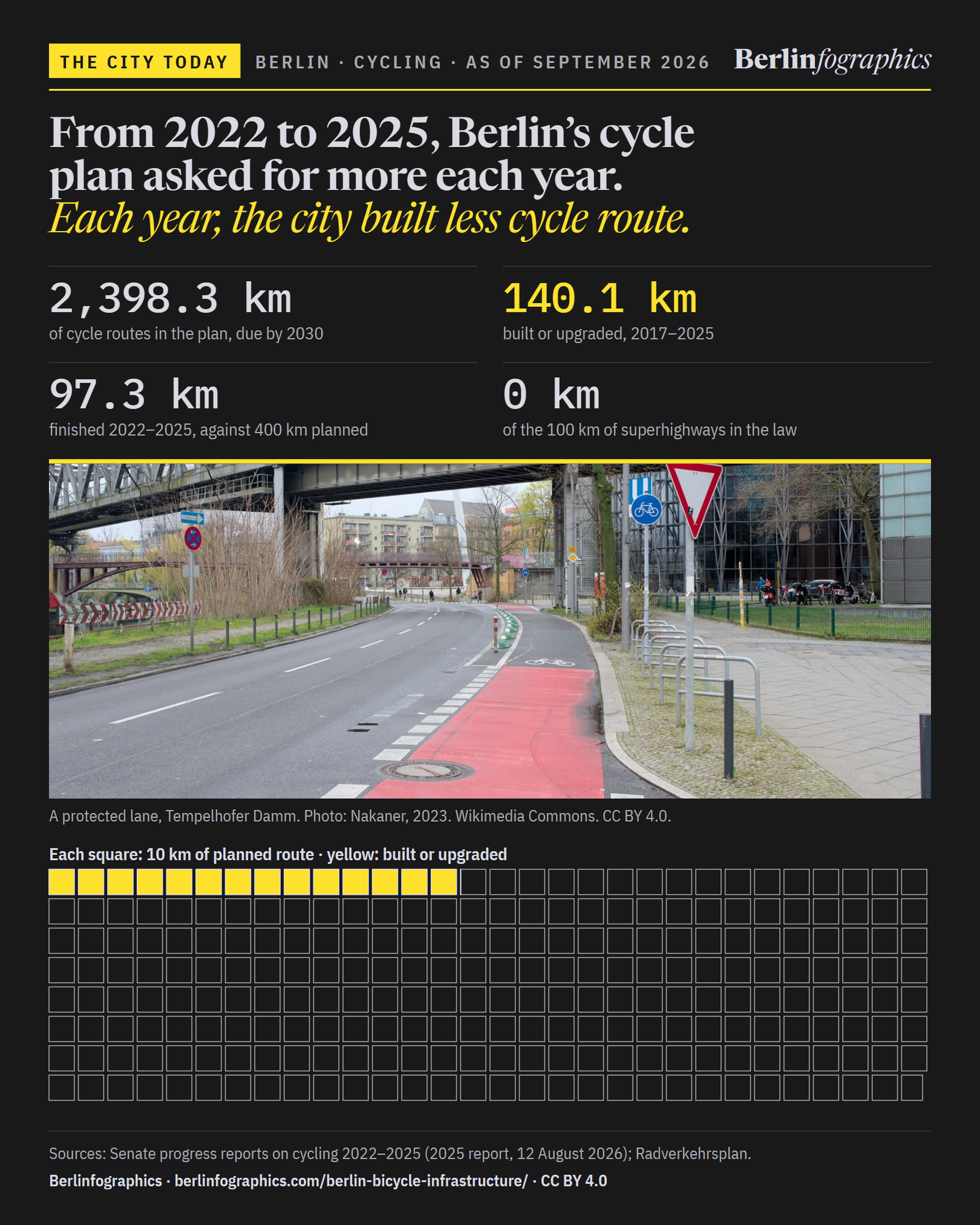
Berlin wrote a 2,400-km cycle network into law. By the Senate’s own count, 6% of it has been built

In 2016 campaigners gathered 105,425 signatures in three and a half weeks. Two years later Berlin passed Germany’s first Mobilitätsgesetz, a mobility law, and its cycle plan gave the city until 2030 to build the network. The Senate’s progress report for 2025, sent to the Abgeordnetenhaus on 12 August 2026, shows how far it has got.

Scroll from the petition to the streets

Cyclists fill a tree-lined Berlin street on the ADFC Sternfahrt, the cycling club’s annual ride from across the city to the Brandenburger Tor, 6 June 2021.Leonhard Lenz, 2021. Wikimedia Commons. CC0.
01The network the law demands

2,398.3 km of cycle routes, due by 2030. By the end of 2025, 140.1 km had been built or upgraded

Every route below is in the cycle plan the Senate made binding in December 2021. The Senate counts what it finished on them from 2017 on; lanes that already existed before then are not in the count.

2,400km in lawBerlin
the planned cycle network
First a field of yellow dots, one for every hundred signatures the cycling petition gathered. Then a map of Berlin with every route of the planned cycle network: first the priority network, then the supplementary network. It then turns into a grid of squares, one for every 10 km of planned route, with the squares built or upgraded so far filled in yellow, first for the whole network and then split into the priority and supplementary networks.
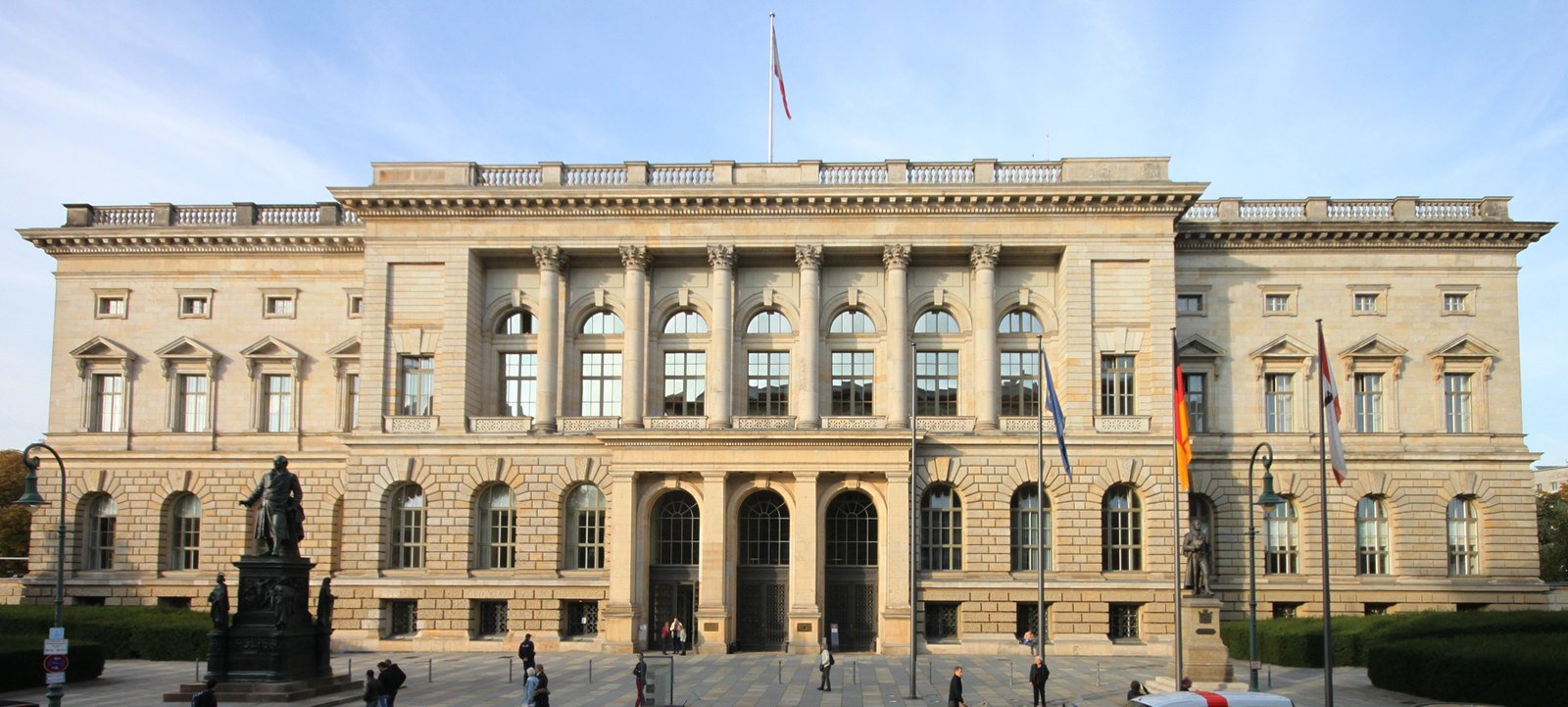
The long sandstone front of a nineteenth-century parliament building with a columned centre, flags and a statue on the forecourt.

The Abgeordnetenhaus, Berlin’s state parliament, 2014. · Abghs, 2014. Wikimedia Commons. CC BY-SA 4.0.

Network: Geoportal Berlin, dl-de/zero-2.0 · Map: © OpenStreetMap contributors, ODbL

14 June 2016

105,425 signatures in three and a half weeks

The Initiative Volksentscheid Fahrrad, a citizens’ campaign for a cycling referendum, collected 105,425 signatures in three and a half weeks (each dot stands for a hundred of them) and handed them in on 14 June 2016.

Source: Initiative Volksentscheid Fahrrad

28 June 2018

Germany’s first Mobilitätsgesetz

On 28 June 2018 the Abgeordnetenhaus, Berlin’s state parliament, passed the Berliner Mobilitätsgesetz, the first law of its kind in Germany.

Source: Berliner Mobilitätsgesetz · Initiative Volksentscheid Fahrrad

December 2021

870.5 km of priority routes

In December 2021 the city’s cycle plan made the network binding. Its backbone is the priority network: 870.5 km of main routes across the city.

Source: Senate progress report 2022 · Radverkehrsplan · Senate progress report 2025

due 2030

2,398.3 km in all, due by 2030

Add the supplementary network, 1,527.8 km of local routes, and the plan comes to 2,398.3 km. Under the Mobilitätsgesetz it is to be built by 2030.

Source: Senate progress report 2025 · Radverkehrsplan

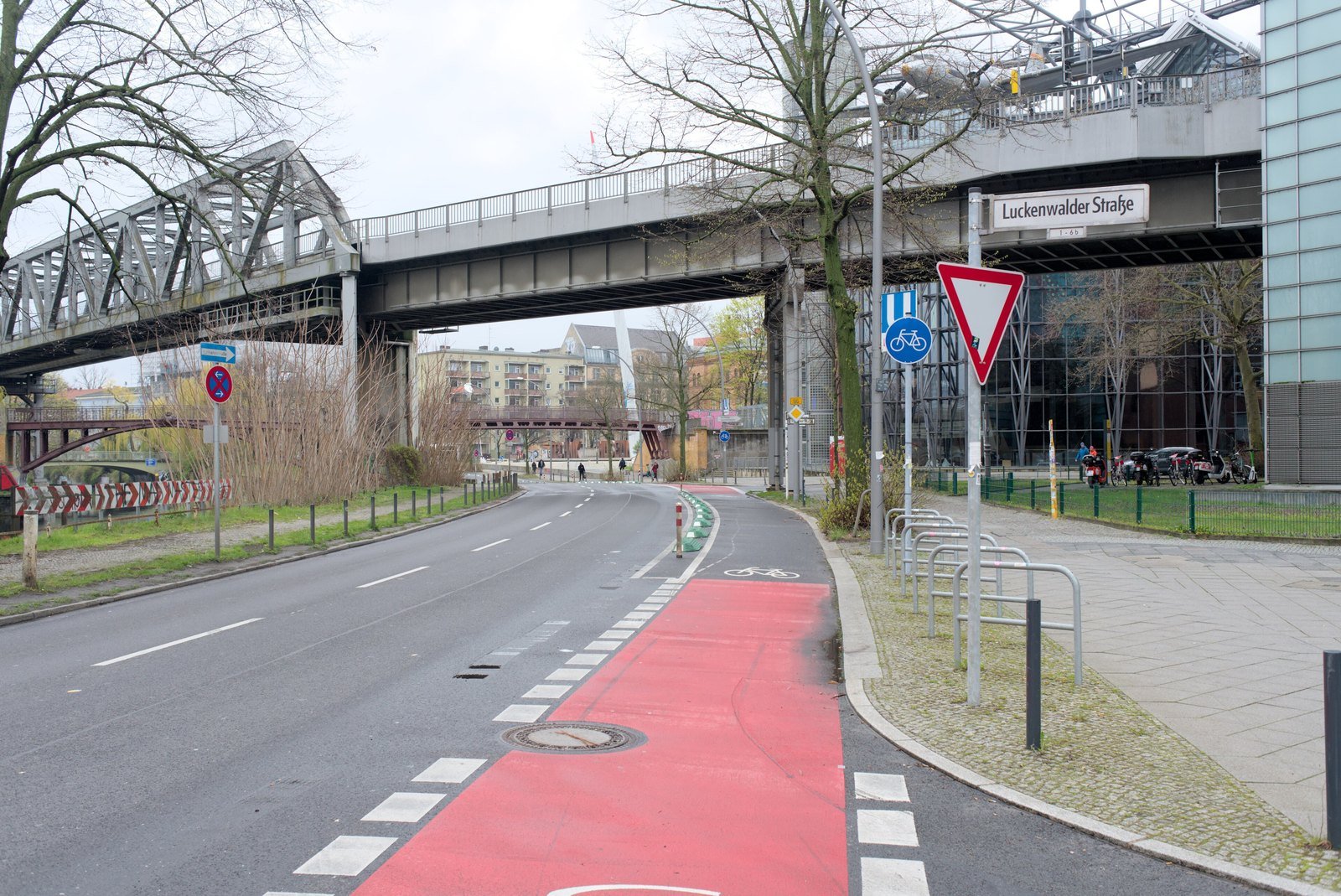
A red-surfaced cycle lane curves under a railway bridge, separated from the car lanes by white kerbs and posts.
A protected lane on Tempelhofer Damm, 2023.Nakaner, 2023. Wikimedia Commons. CC BY 4.0.

2017–2025

140.1 km built or upgraded: 6%

Each square is 10 km of planned route. By the end of 2025, the Senate counted 140.1 km of the network as newly built or upgraded since 2017: 5.84%.

Source: Senate progress report 2025

2017–2025

Even the main routes: 9%

On the priority network, 78.2 km is done, 8.99%. On the supplementary network, 61.9 km, 4.05%. Five years remain before the deadline.

Source: Senate progress report 2025

02Fast lanes, then a stricter count

In 2020 the pandemic brought 25.9 km of pop-up lanes. From 2022, a street with a lane on each side counts once, not twice

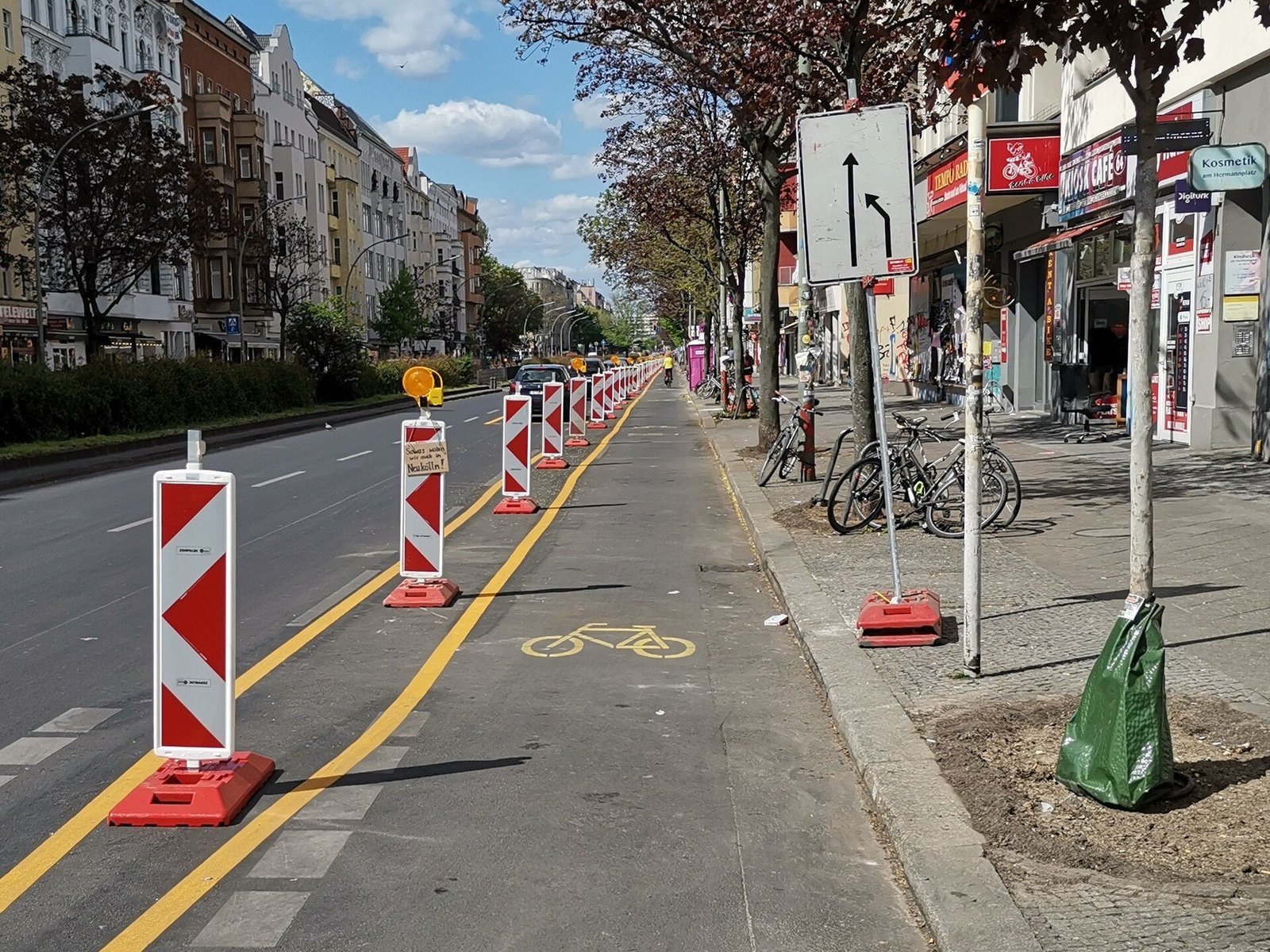
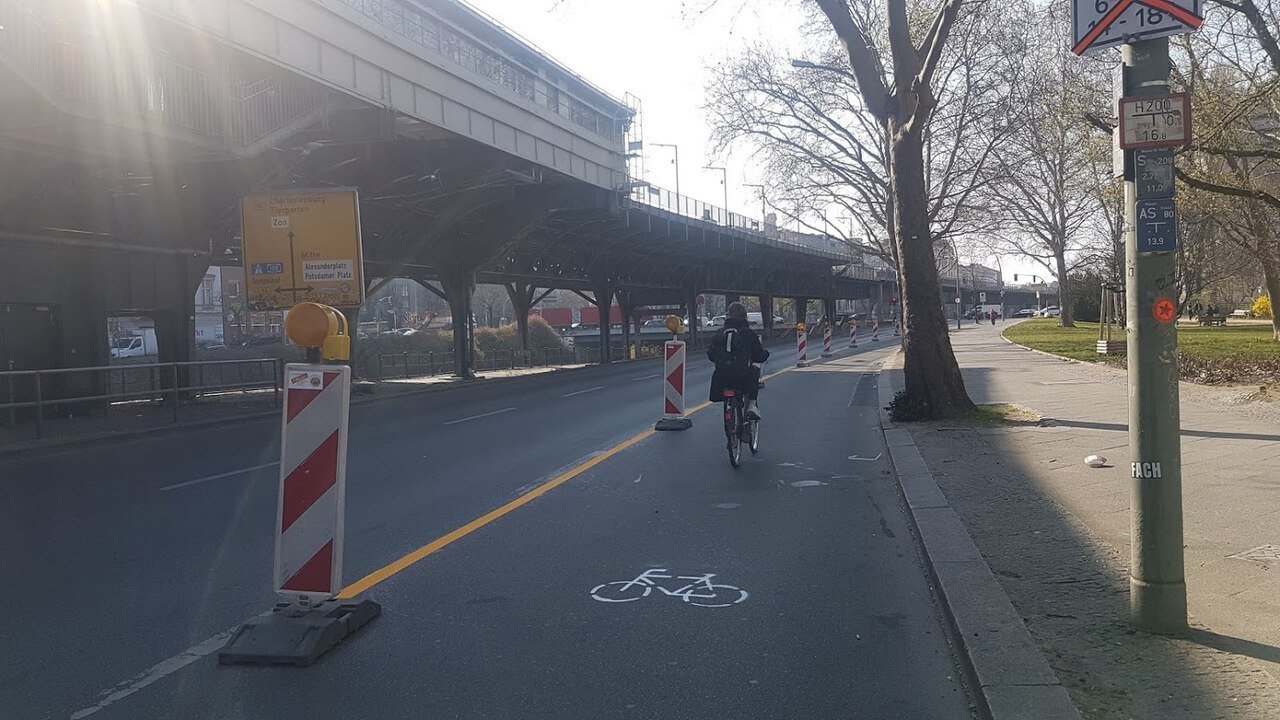
In 2020 25.9 km of temporary cycle lanes went down in seven districts. Two years later the Senate changed how it counts. Until 2021 a cycle lane on each side of a 1-km street counted as 2 km. Since 2022 it counts as 1 km. So totals from before 2022 cannot be set beside later ones.

One street, 1 km long, with a lane on each side

A wide street lined with shops and trees; a cycle lane marked with yellow lines and a yellow bicycle symbol is separated from the traffic by a row of red-and-white warning beacons.
A pop-up cycle lane on Kottbusser Damm, 2020: a lane taken from the road with yellow lines and red-and-white beacons.SupapleX, 2020. Wikimedia Commons. CC BY-SA 4.0.
A cyclist rides along a temporary lane marked with a yellow line and warning beacons beneath an elevated railway.
A temporary cycle lane on Hallesches Ufer, under the elevated U-Bahn, 26 March 2020.Nicor, 2020. Wikimedia Commons. CC BY-SA 4.0.
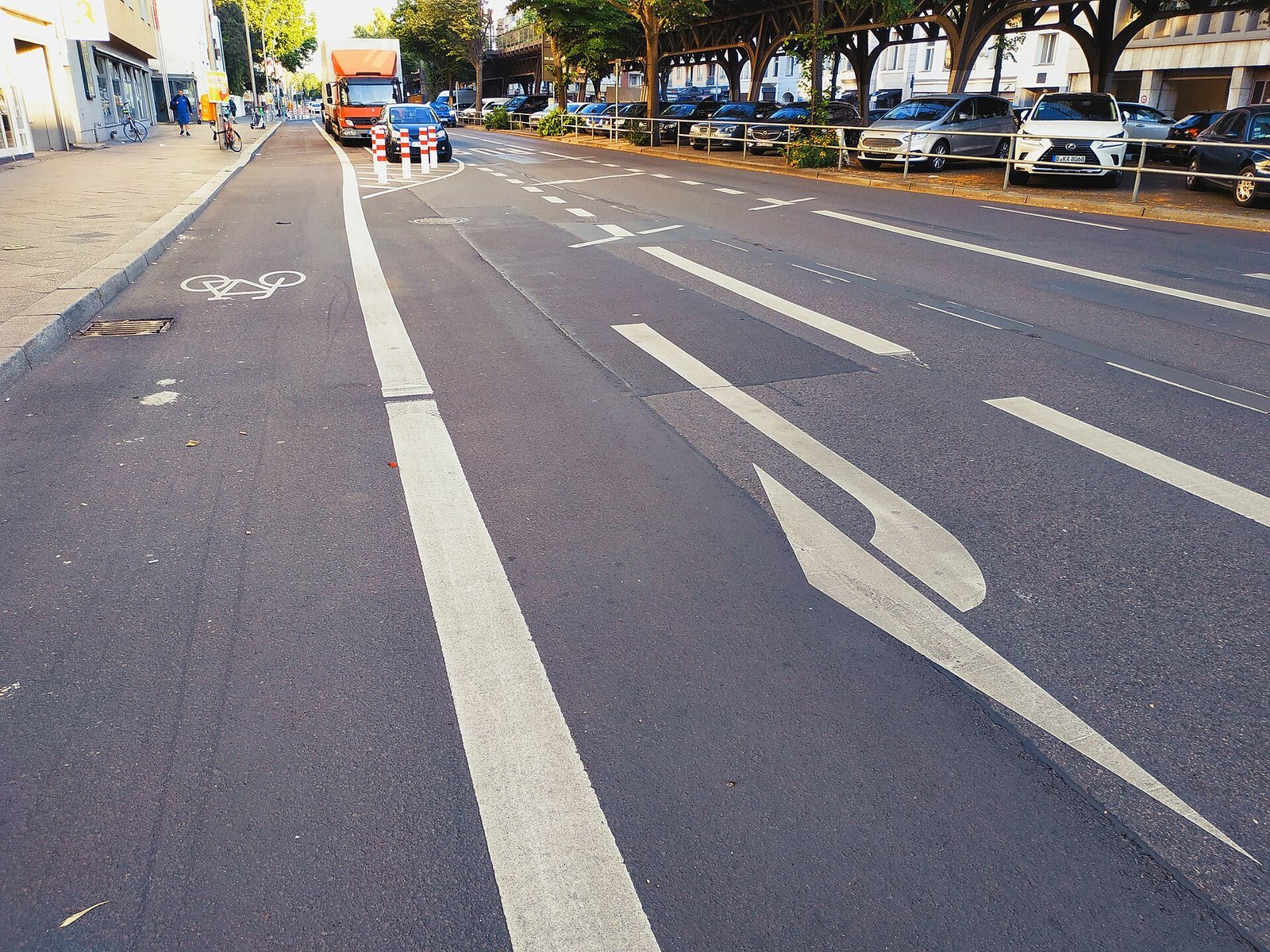
A broad cycle lane marked with solid white lines and a bicycle symbol runs beside the car lanes of a street under an elevated railway.
A wide painted cycle lane in Bülowstraße, 22 June 2022.IgorCalzone1, 2022. Wikimedia Commons. CC BY-SA 4.0.

03The plan against the streets

The plan called for 400 km in four years. Berlin built 97 — and less every year

The Radverkehrsplan, the city’s cycle plan, set a target for the network every year from 2022. Against it stand the Senate’s own reports of every cycle route finished, on the network or off it.

400km planned2022–2025
the plan’s targets
Paired bars for each year of the plan so far: the cycle plan's target for the network each year as an empty dashed bar, the cycle routes built or upgraded anywhere in the city as a yellow bar, and the part of them on the planned network as a blue bar; then the four years added up.
Dashed: the plan’s target for the network · yellow: all cycle routes finished · blue: of which on the network
A broad cycle lane marked with solid white lines and a bicycle symbol runs beside the car lanes of a street under an elevated railway.
A cycle lane in Bülowstraße, June 2022.IgorCalzone1, 2022. Wikimedia Commons. CC BY-SA 4.0.

2022

2022: 26.5 km built against a target of 40 km

The plan asked for 40 km of network in 2022. The city finished 26.5 km of cycle routes; 17.5 km of it on the planned network.

Source: Radverkehrsplan · Senate progress report 2022 · Berlinfographics fact-check

A red-surfaced cycle lane curves under a railway bridge, separated from the car lanes by white kerbs and posts.
A protected lane on Tempelhofer Damm, 2023.Nakaner, 2023. Wikimedia Commons. CC BY 4.0.

2023

2023: 26.0 km built against a target of 60 km

The plan asked for 60 km of network in 2023. The city finished 26.0 km of cycle routes, less than the year before; 18.5 km of it on the planned network.

Source: Radverkehrsplan · Senate progress report 2023 · Berlinfographics fact-check

2024

2024: 23.6 km built against a target of 100 km

The plan asked for 100 km of network in 2024. The city finished 23.6 km of cycle routes, less than the year before; 20.4 km of it on the planned network. On the network itself, that was the best year.

Source: Radverkehrsplan · Senate progress report 2024 · Berlinfographics fact-check

2025

2025: 21.2 km built against a target of 200 km

The plan asked for 200 km of network in 2025. The city finished 21.2 km of cycle routes, less than the year before; 16.1 km of it on the planned network.

Source: Radverkehrsplan · Senate progress report 2025 · Berlinfographics fact-check

2022–2025

400 km planned, 97.3 km built

Added up, the plan asked for 400 km in four years. The city finished 97.3 km of cycle routes of every kind, about a quarter; on the planned network, 72.5 km.

Source: Radverkehrsplan · Berlinfographics fact-check · Senate progress report 2022 · Senate progress report 2023 · Senate progress report 2024 · Senate progress report 2025

04Lanes kept apart from traffic

In four years Berlin finished 24.6 km of lanes protected from traffic

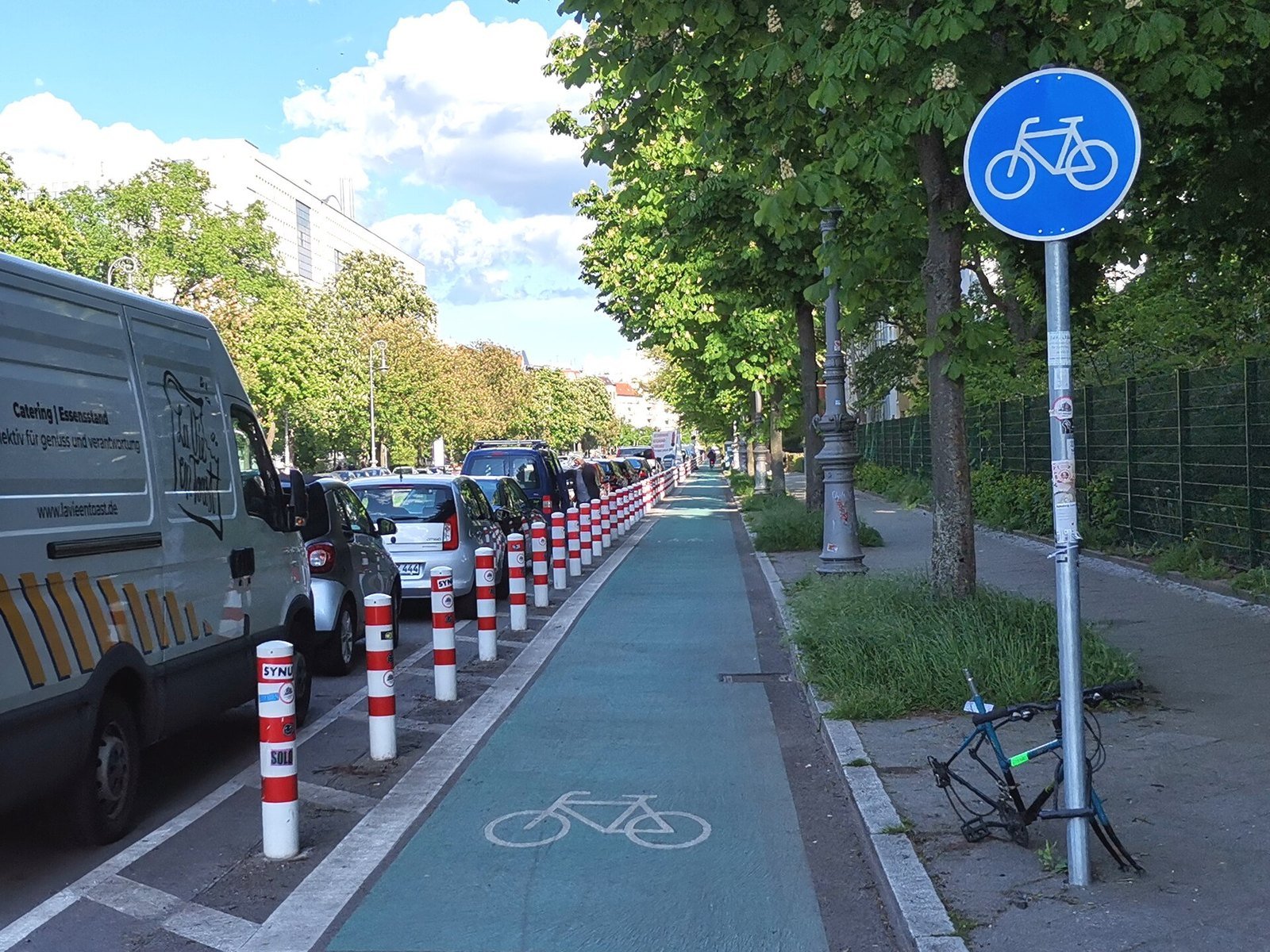
On main roads the law asks for cycle lanes kept apart from cars, by kerbs or bollards, like the one on Tempelhofer Damm. The Senate’s reports count them separately: 7.5 km in 2022, 4.8 km in 2023, 8.2 km in 2024, 4.1 km in 2025.

Protected lanes finished each year, km

A red-surfaced cycle lane curves under a railway bridge, separated from the car lanes by white kerbs and posts.
What the law asks for on main roads: a lane kept apart from traffic. Tempelhofer Damm at Luckenwalder Straße, 2023.Nakaner, 2023. Wikimedia Commons. CC BY 4.0.
A green-painted cycle lane with a bicycle symbol and a blue cycle-path sign, separated from a row of parked vans and cars by red-and-white bollards.
A green-surfaced protected lane in Hasenheide, on the boundary of Kreuzberg and Neukölln, 19 May 2021, kept apart from parked cars by red-and-white posts.SupapleX, 2021. Wikimedia Commons. CC BY-SA 4.0.

05The cycle superhighways

Not one kilometre of the cycle superhighways in the law has been built

The Mobilitätsgesetz asks for at least 100 km of cycle superhighways, subject to available funding. Feasibility studies found nine routes, 134 km in all. In summer 2024 the Senate ended work on six of them for lack of money. The first, Königsweg – Kronprinzessinnenweg (about 14 km), was filed for planning approval at the end of 2025; that procedure takes at least 1.5–2 years. Built so far: 0 km.

The routes found feasible, and what became of them

Yellow: RSV 3 Königsweg – Kronprinzessinnenweg, filed for planning approval · struck through: shelved in summer 2024

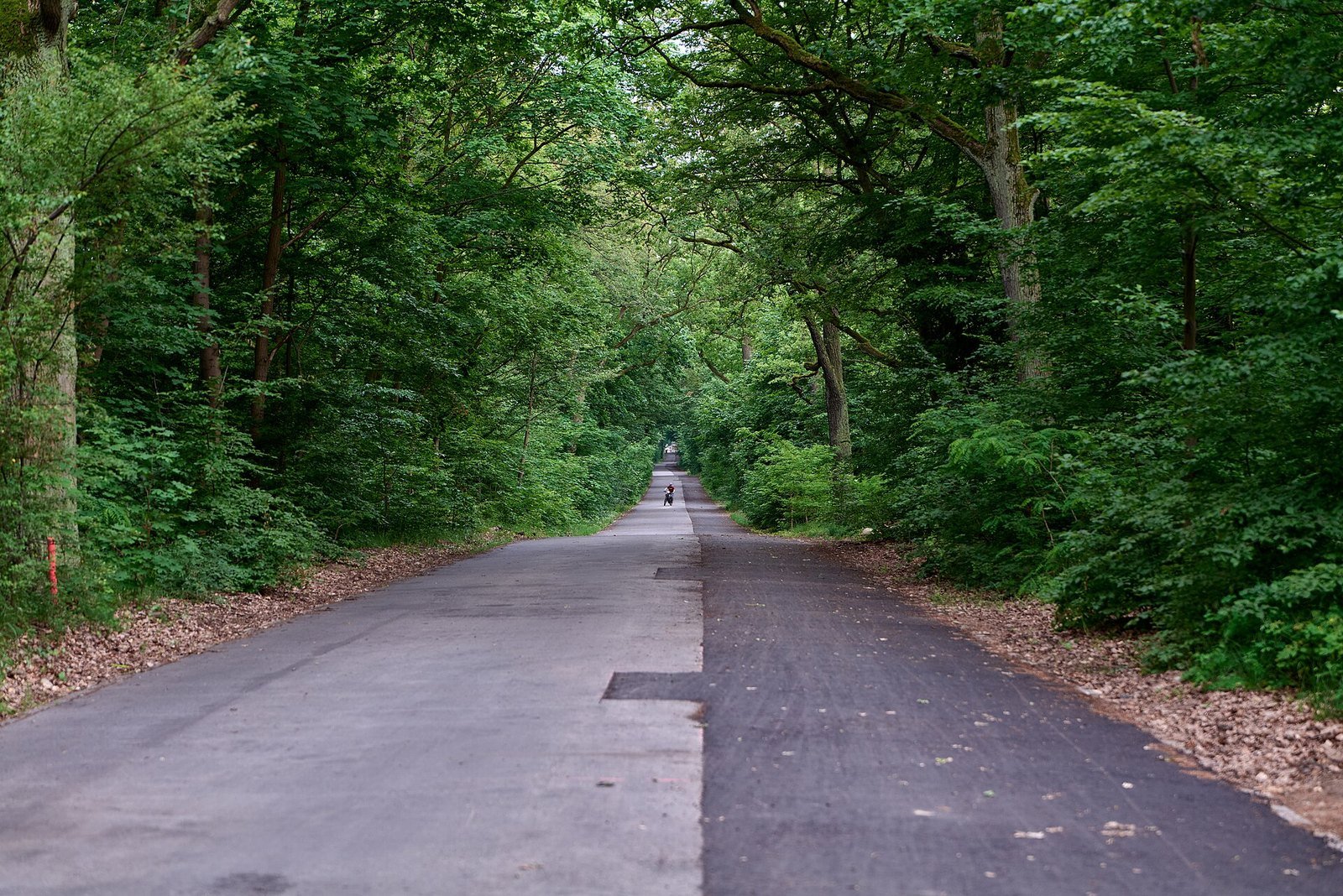
A straight, empty asphalt road runs into the distance between tall green woodland on both sides.
Kronprinzessinnenweg running straight through the Grunewald at Nikolassee, 25 May 2024: part of the route of the first planned cycle superhighway, Königsweg – Kronprinzessinnenweg.Leonhard Lenz, 2024. Wikimedia Commons. CC0.

06The money

In 2025 the Senate spent €19.5m of the €82.4m it had for cycling — less than a quarter

These are the transport department’s cycling budget lines. Of the €82.4m available, €48.0m came from SIWA, the city’s investment fund, marked as money available from 2025 on. €19.5m was spent.

spentavailableof which SIWA fund
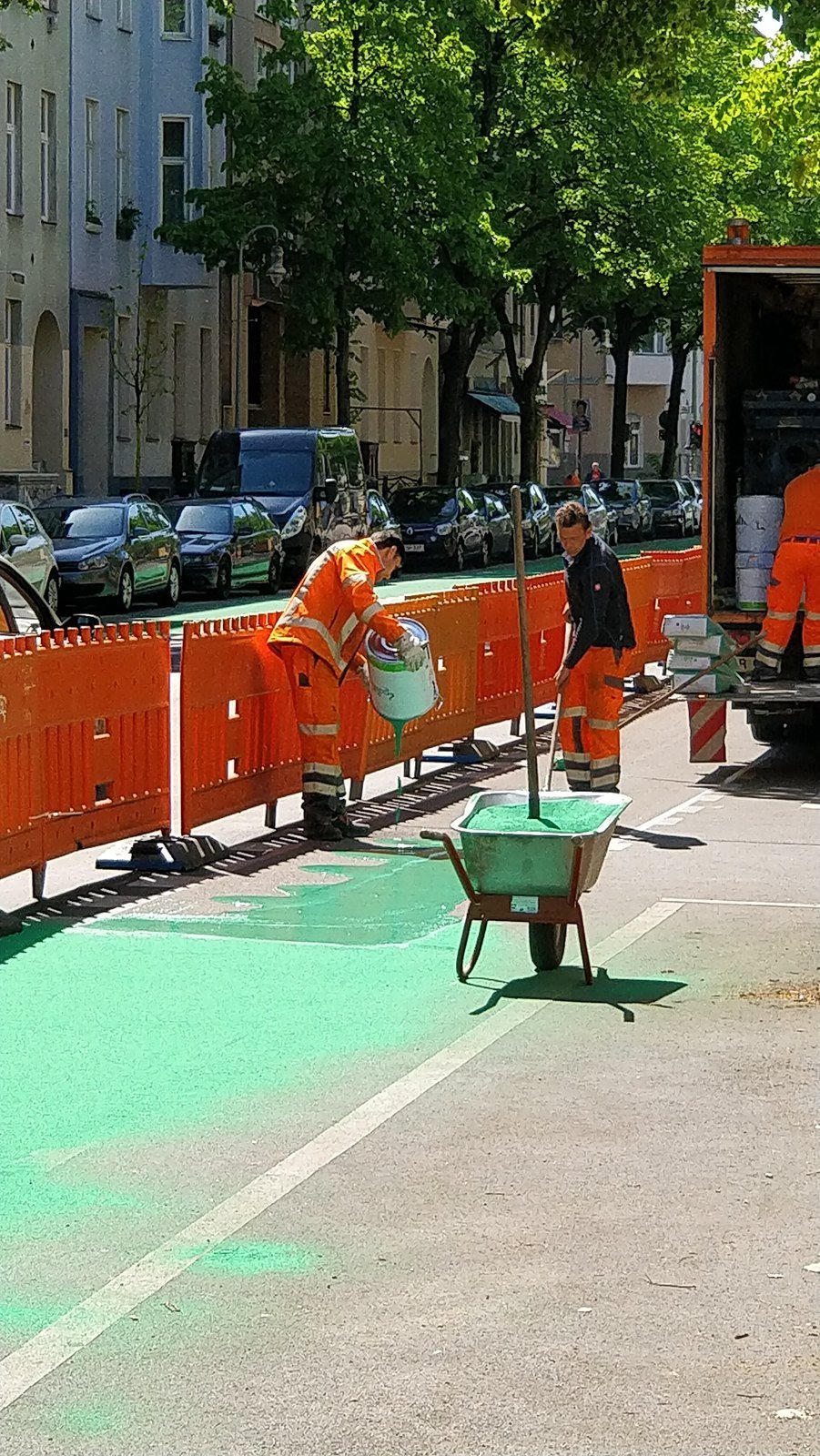
Workers in orange overalls behind orange barriers pour green paint onto a cycle lane, with a wheelbarrow of green surfacing and a lorry beside them.
Road workers pour green surfacing for a new cycle lane in Großbeerenstraße, 30 April 2019.Jcornelius, 2019. Wikimedia Commons. CC BY-SA 4.0.

07Vision Zero

In 2025, 563 cyclists were seriously injured on Berlin’s roads and five were killed

“Vision Zero”, the aim that no one should be killed or seriously injured on the roads, is one of the cycle plan’s three strategic goals. In 2025 the Senate counted 563 cyclists seriously injured and five killed.

Each mark is one cyclist, 2025

seriously injuredkilled
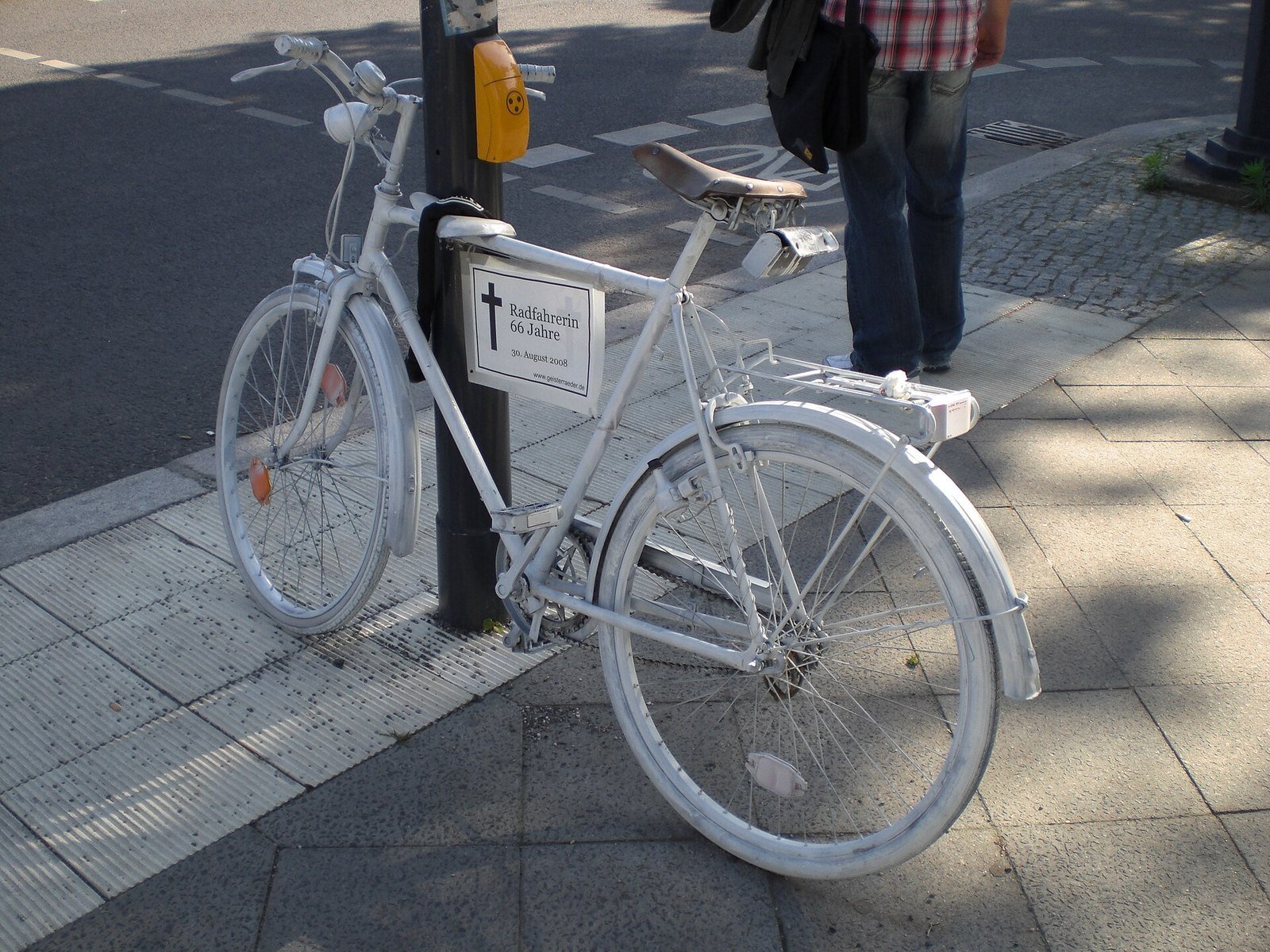
A bicycle painted entirely white is chained to a traffic-light post at a street corner, with a small black-bordered sign on its frame.
A ghost bike, painted white and chained to a traffic-light post where a cyclist was killed, Berlin, 2009.Bukk, 2009. Wikimedia Commons. Public domain.
Mobilitätsgesetz · 2018

Berlin’s cycling law is still in force. Every year since 2022, the city has built less cycle route than the year before.

Press & citation

Use this Berlinfographic

Free to publish under CC BY 4.0 — in print, online, on Wikipedia and in teaching, commercially or not — with credit to Berlinfographics and a link to this page.

Berlin's Unbuilt Cycle Network, 2016–2025: ready-to-use landscape image

Ready-to-use image

The infographic as one image: headline, key figures, chart, sources and credit, 2,400 × 1,350 px PNG. Please use it unedited.

Download landscape (PNG)
Berlin's Unbuilt Cycle Network, 2016–2025: square version

Square format

A 1:1 version for social media and narrow columns, 1,800 × 1,800 px.

Download square (PNG)
Berlin's Unbuilt Cycle Network, 2016–2025: portrait version

Portrait 4:5

For Instagram and LinkedIn feeds, 1,620 × 2,025 px.

Download portrait (PNG)

Credit line

Berlinfographics (berlinfographics.com), CC BY 4.0

Citation

Berlinfographics (2026). “Berlin's Unbuilt Cycle Network, 2016–2025”. Berlin Experiences. https://berlinfographics.com/berlin-bicycle-infrastructure/

Wikipedia

{{cite web |title=Berlin's Unbuilt Cycle Network, 2016–2025 |url=https://berlinfographics.com/berlin-bicycle-infrastructure/ |website=Berlinfographics |publisher=Berlin Experiences |date=2026-11-06 |access-date=2026-11-06}}