Berlinfographicsby Berlin Experiences

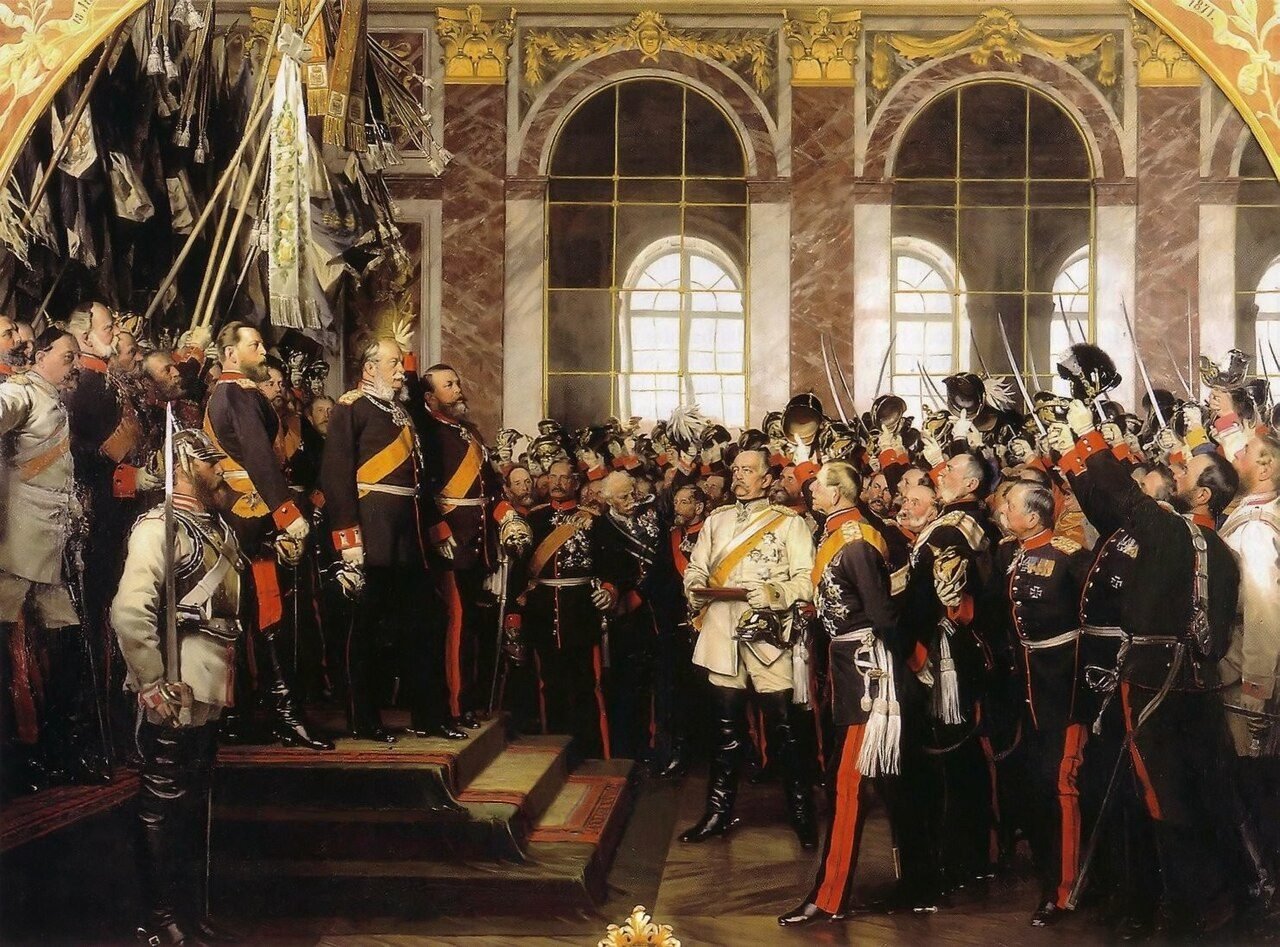
Anton von Werner, “Die Proklamierung des Deutschen Kaiserreiches” (The proclamation of the German Empire), third version, 1885: Wilhelm I on the dais in the Hall of Mirrors at Versailles, Bismarck in white at the centre. Shown whole.Anton von Werner, 1885 (third version). Via Wikimedia Commons (Public domain).

The Prussian courtPainters to the court · 1711–1915

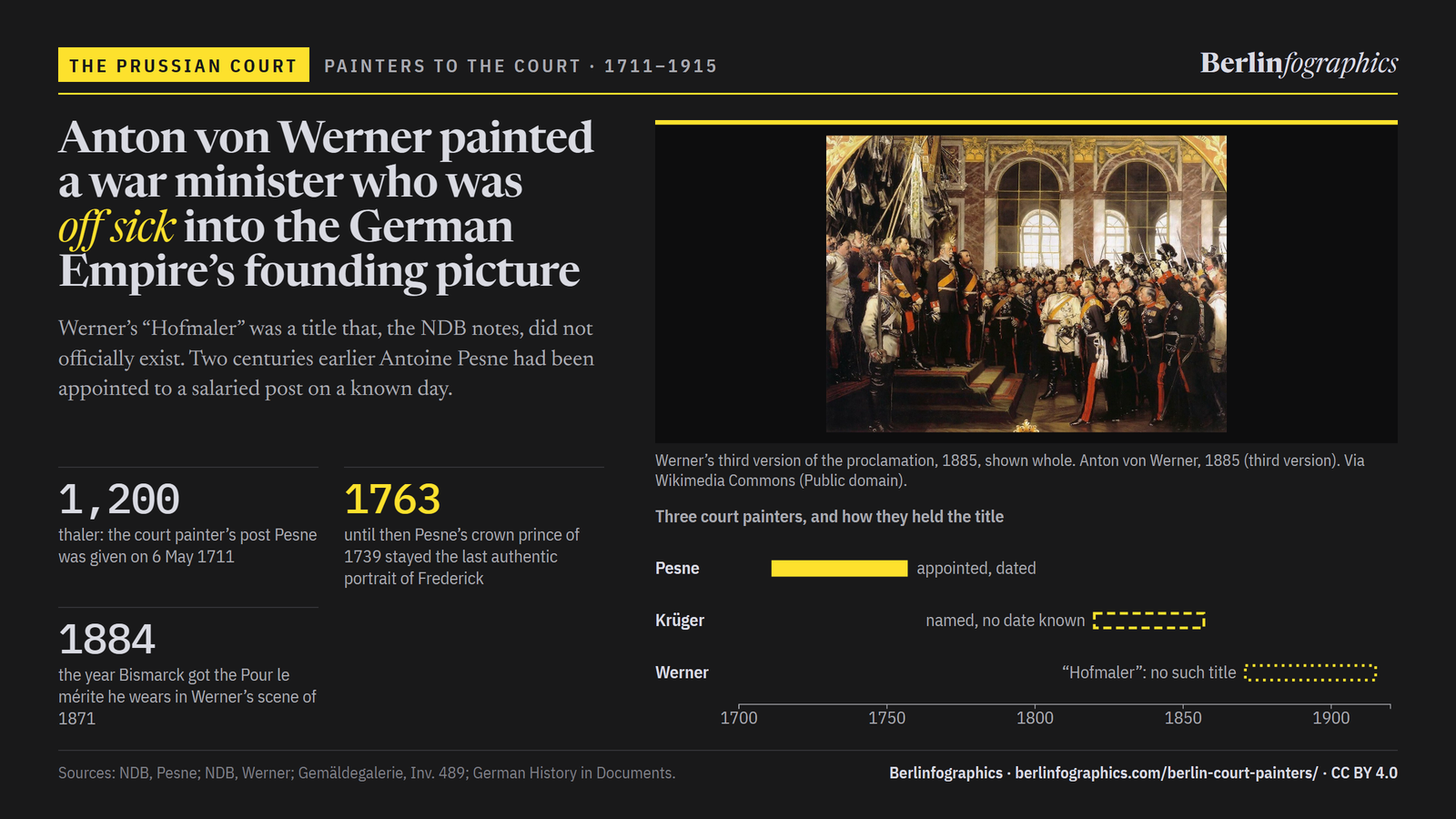
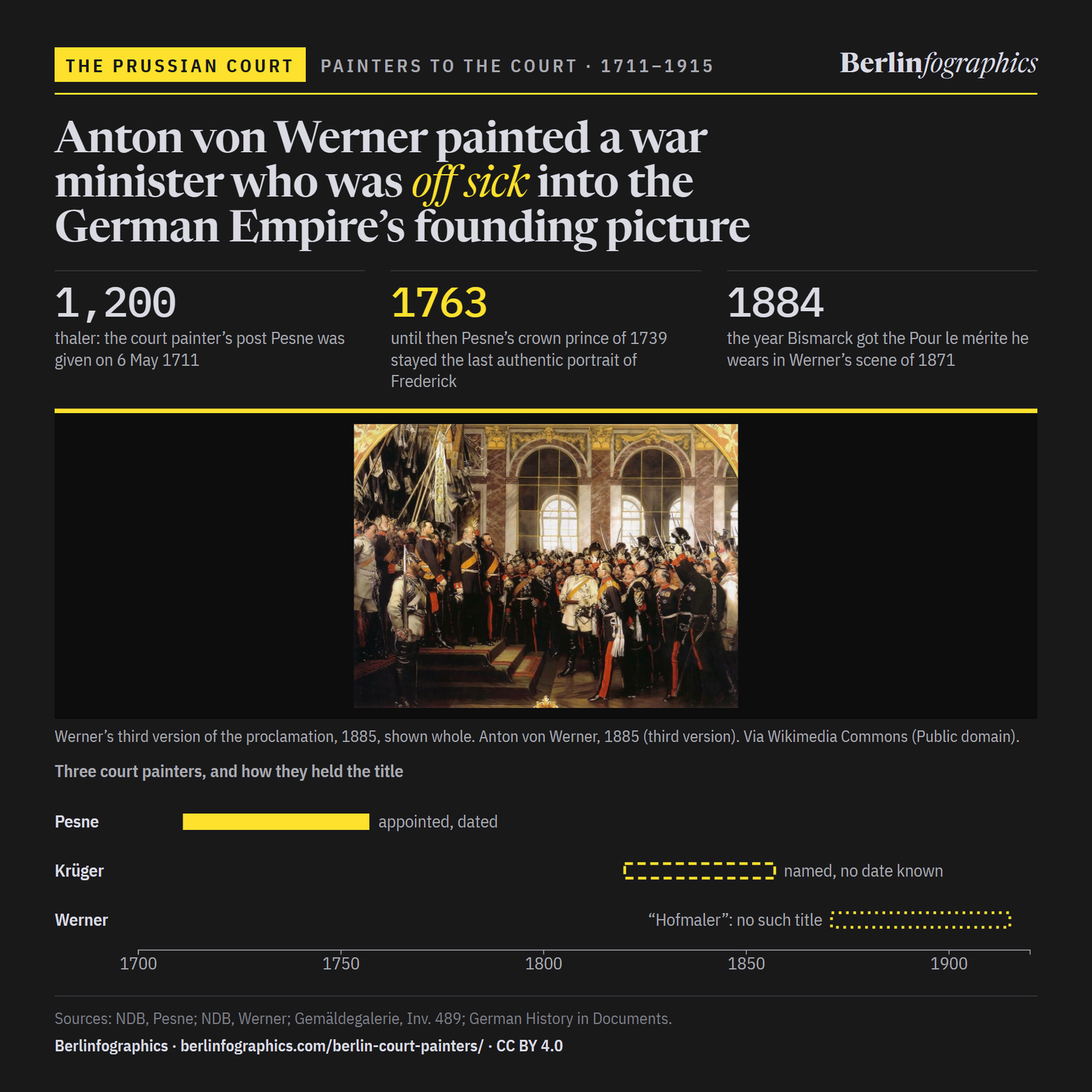
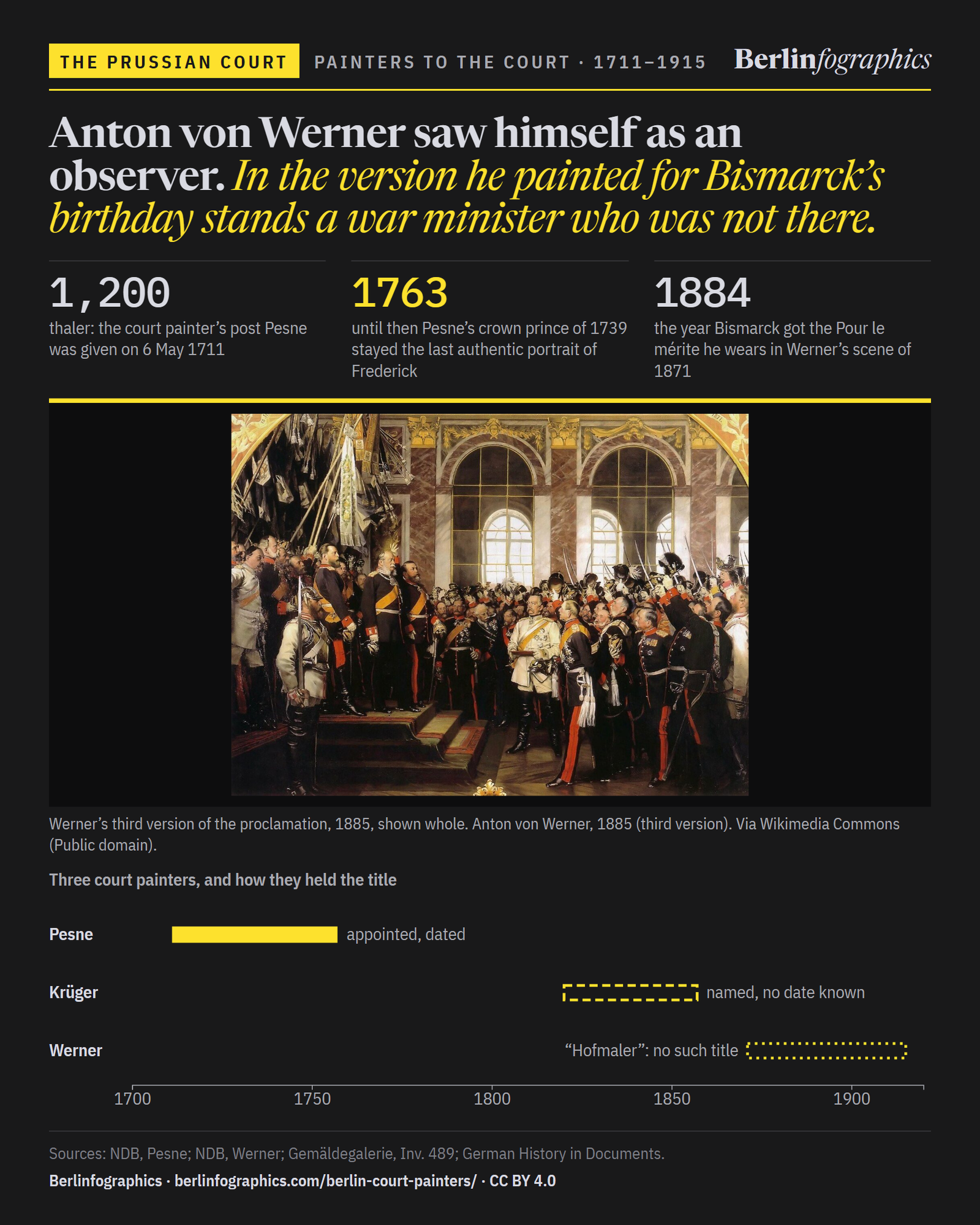
Anton von Werner painted a war minister who was off sick into the German Empire’s founding picture

He was the Kaiserreich’s “Hofmaler” — a title that, the Neue Deutsche Biographie notes, did not officially exist. The first, Antoine Pesne, was appointed on 6 May 1711 to a post paid 1,200 thaler. Between them came Franz Krüger, who pushed the king to the edge of his own parade.

Scroll: two centuries of court painting
01Versailles, 18 January 1871 · Friedrichsruh, 1885

The Empire’s founding picture was a birthday present for Bismarck

Werner went to the war of 1870 as a picture reporter and stood in the Hall of Mirrors at Versailles on 18 January 1871, when Wilhelm I was proclaimed German Emperor. Because he had been there, the NDB says, people wrongly assumed that all his war pictures were drawn from life. The best-known versions of his “Proclamation” are the one for the Berlin palace, of 1877, destroyed in the Second World War, and the third, of 1885, which still hangs in the Bismarck-Museum at Friedrichsruh.

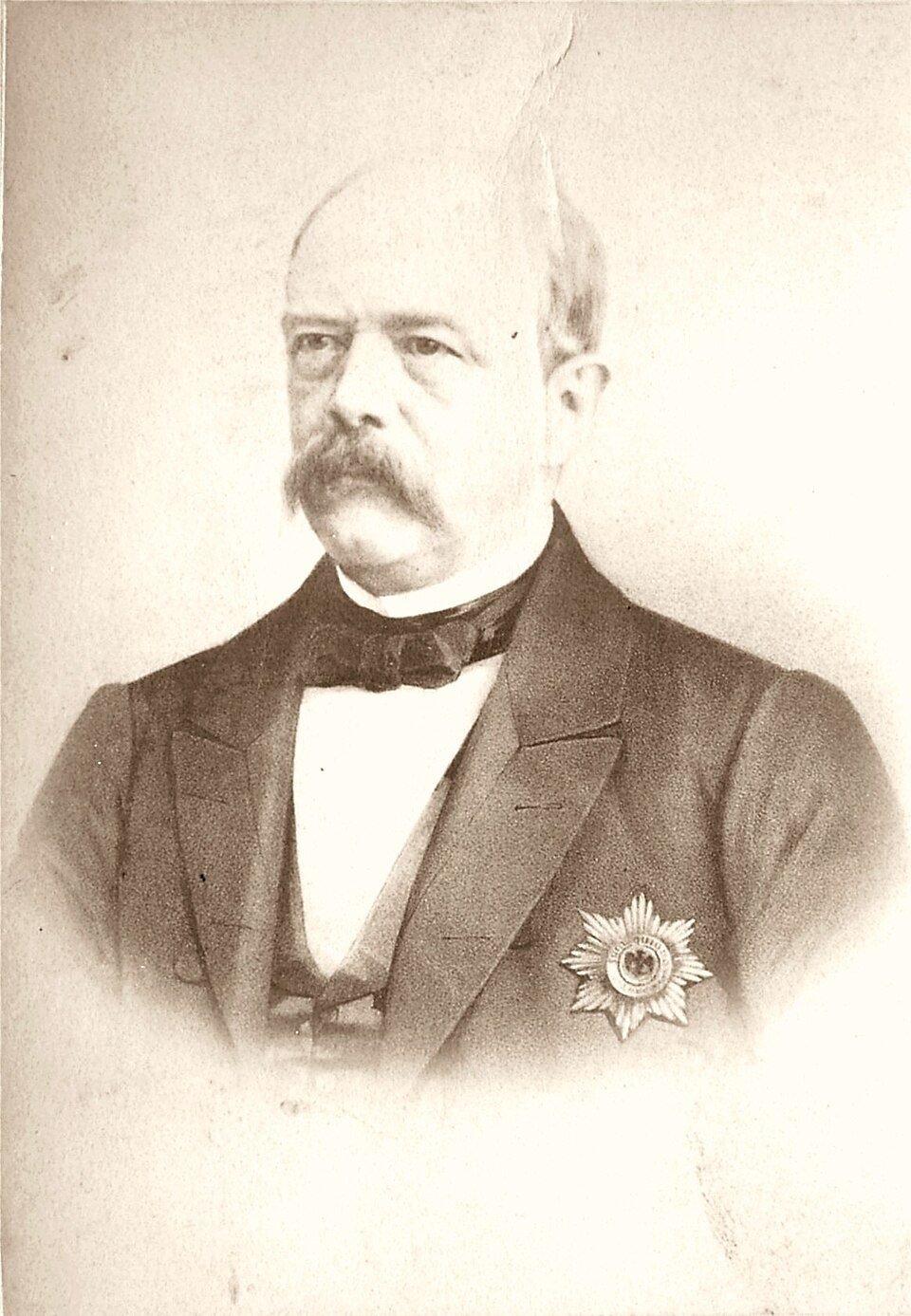
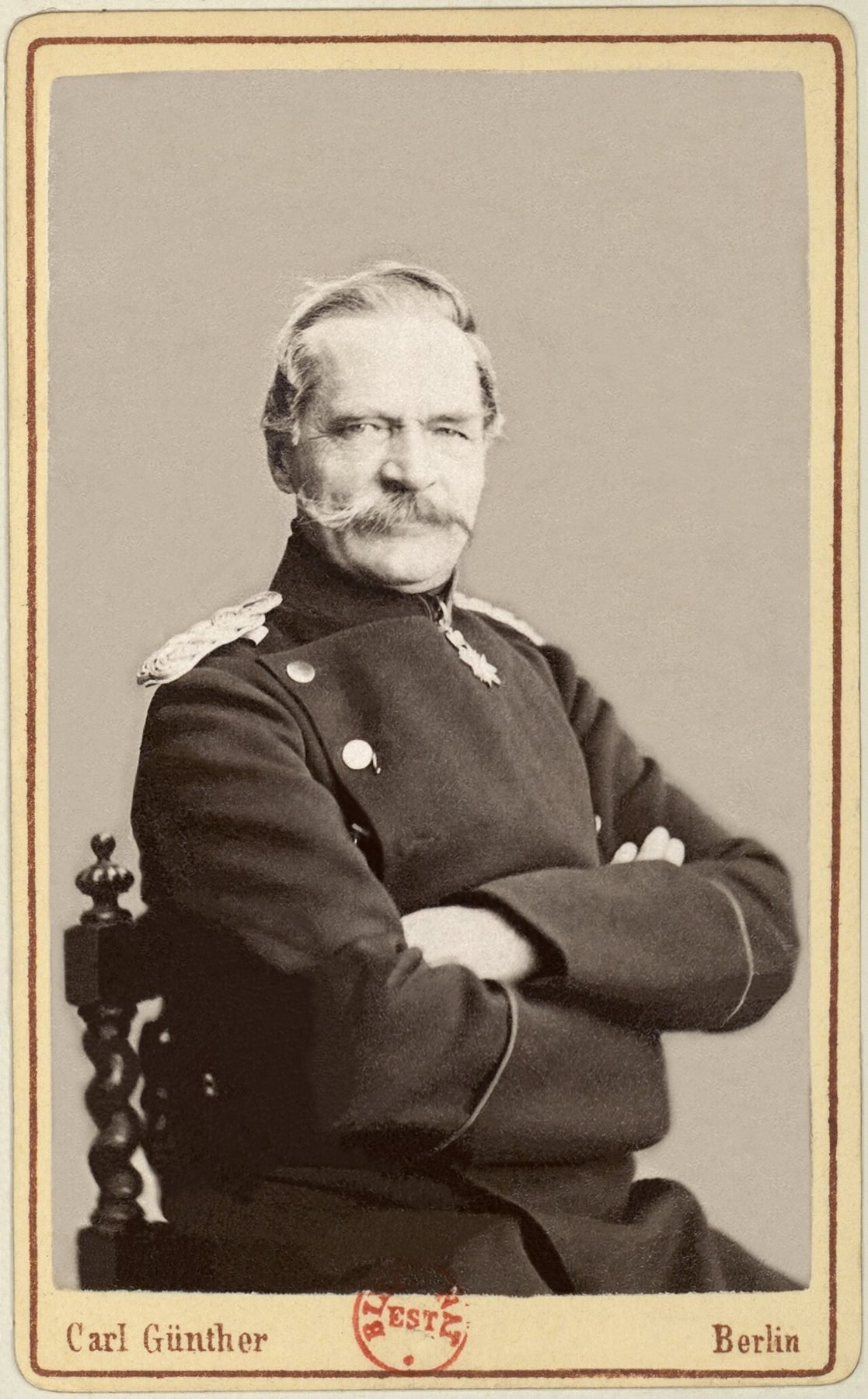
The royal family commissioned that third version in February 1885 as a present for Bismarck’s 70th birthday on 1 April 1885. Bismarck takes the centre in the white cuirassier’s uniform he did not wear that day. Albrecht von Roon, the war minister, was not present “on account of a bout of catarrh” — Werner put him in anyway. Every face looks as it did in the 1880s, not as on the day.

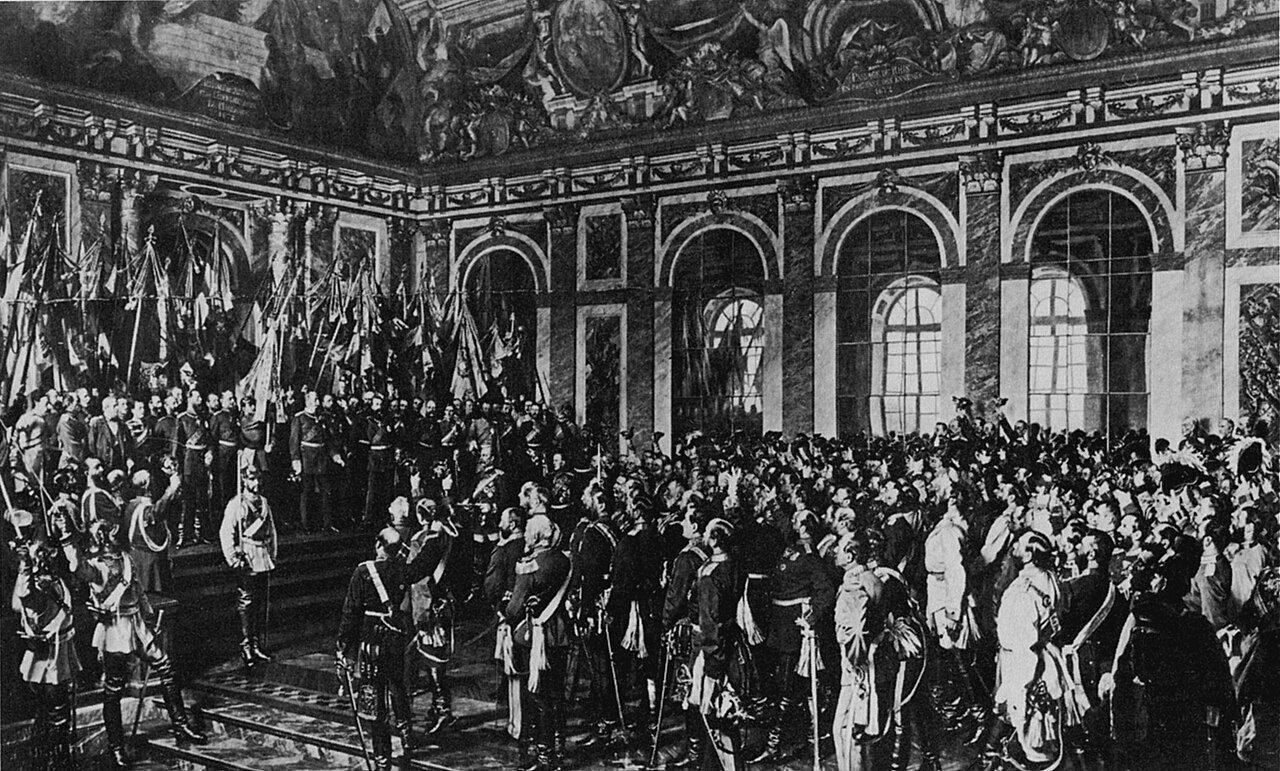
A monochrome reproduction of a wide painting: the king on a raised platform at the left, a mass of officers with raised swords filling the hall.
Werner’s first version, 1877, painted for the Berlin palace and destroyed in the Second World War; it survives in reproductions.Anton von Werner, 1877. Wikimedia Commons. Public domain.

What the 1885 picture knows that the day did not

RoonThe war minister was absent that day, ill with catarrh. He is in the crowd.
The white uniformBismarck did not wear his white cuirassier’s uniform on the day. He wears it here.
The Pour le mériteBismarck received the order in 1884. It is on his uniform.
Photograph of a bald man with a heavy white moustache in a dark coat, wearing the star of an order.
Otto von Bismarck, cabinet photograph published by Carl Krause, Berlin.Kunstverlag Carl Krause Co. Berlin, 19th century. Wikimedia Commons. Public domain.
Cabinet photograph of an elderly officer with a white moustache, seated in a dark uniform with his arms folded.
Albrecht von Roon, Prussian war minister, photographed by Carl Günther in the 1870s. He was not at Versailles on the day of the proclamation; Werner put him in the third version anyway.Carl Günther, 1870s. Bibliothèque nationale de France (Gallica). Wikimedia Commons. Public domain.

02Two centuries at court

From a salaried post to a title that did not officially exist

Three painters held the Prussian court’s eye across 9 reigns. Only the first was appointed on a day the record gives.

9reigns, three paintersThe Prussian court
1711–1915
A time line from the late 17th century to 1920: the reigns of nine Prussian kings along the top, and below them the lives of three court painters, Antoine Pesne, Franz Krüger and Anton von Werner, each with his years at court marked — a solid bar for Pesne’s dated appointment, a dashed bar for Krüger, named court painter on no known date, and a dotted bar for Werner, called “Hofmaler” in a title that did not officially exist.
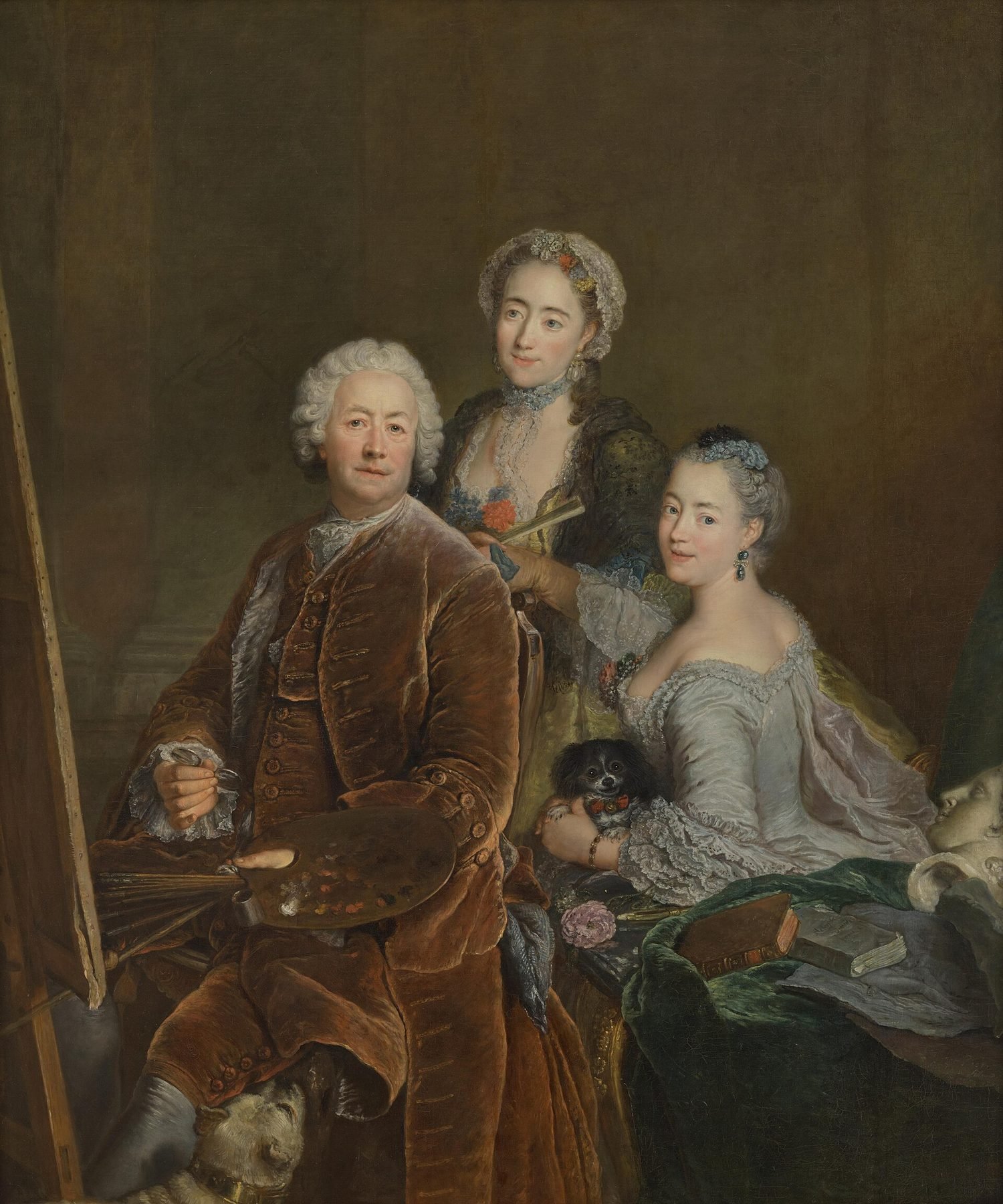
An old painter in a brown velvet coat sits at his easel with palette and brushes; his two daughters lean in behind him, one holding a small black-and-white dog.
Pesne at seventy-one, with his daughters, 1754.Antoine Pesne, 1754. Via Wikimedia Commons (Public domain).

6 May 1711 · Berlin

Pesne becomes Prussia’s court painter

Antoine Pesne, born in Paris in 1683, was called to Berlin in 1710 and appointed court painter on 6 May 1711, in the post of the late Augustin Terwesten. It paid 1,200 thaler.

Source: NDB, Pesne · Gemäldegalerie, Inv. 489

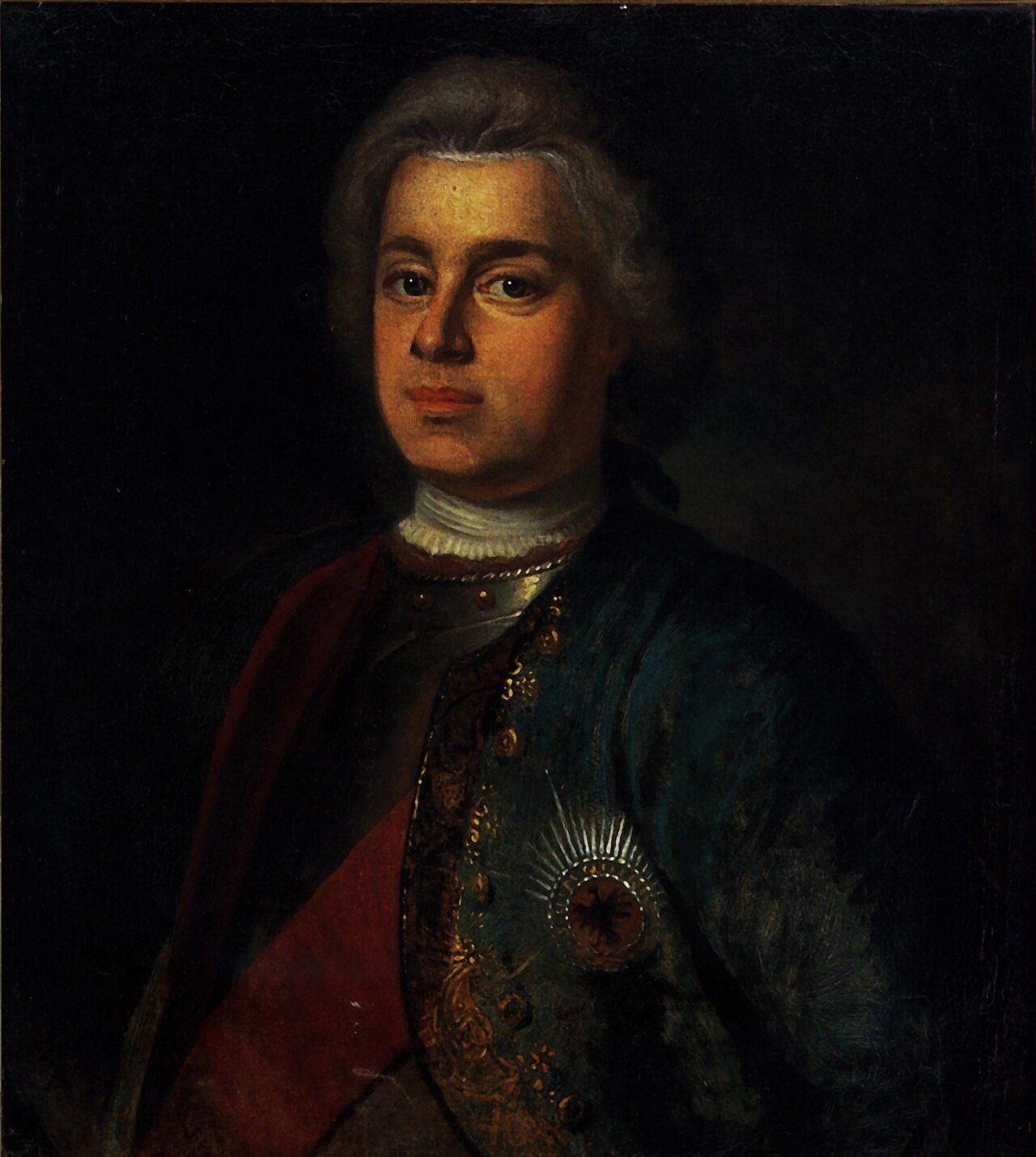
Half-length portrait of a young man in a powdered wig and a dark coat with the star of an order.
Friedrich Wilhelm I, by Friedrich Wilhelm Weidemann.Friedrich Wilhelm Weidemann, 1720. Wikimedia Commons. Public domain.

1713 · a new king

Half pay — and he stays

When the thrifty Friedrich Wilhelm I came to the throne in 1713, Pesne was one of the few court artists kept on. His salary was cut by half; he stayed in Berlin.

Source: Gemäldegalerie, Inv. 489 · NDB, Pesne

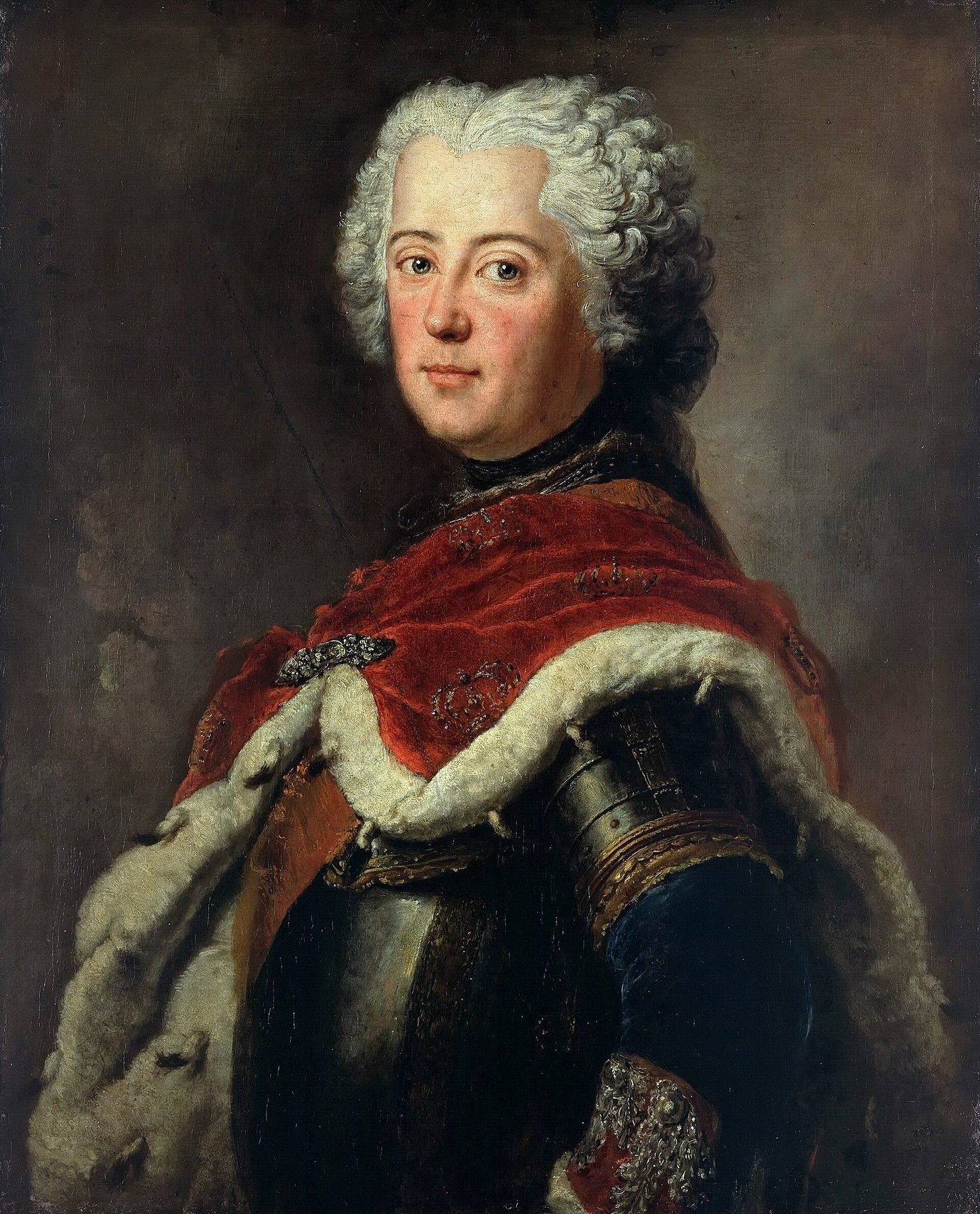
Half-length portrait of a young man with a powdered wig turning his head to face us, in dark armour with an orange sash and a red, ermine-trimmed cloak, before a cloudy sky.
Pesne’s crown prince, painted at Rheinsberg, 1739–40.Antoine Pesne, c. 1739–1740. Via Wikimedia Commons (Public domain).

1736–1740 · Rheinsberg

The last true portrait of Frederick until 1763

From 1736 Pesne worked often at the crown prince’s court at Rheinsberg. There, in 1739, he painted Frederick — the last authentic portrait of him, the Gemäldegalerie says, until 1763.

Source: Gemäldegalerie, Inv. 489

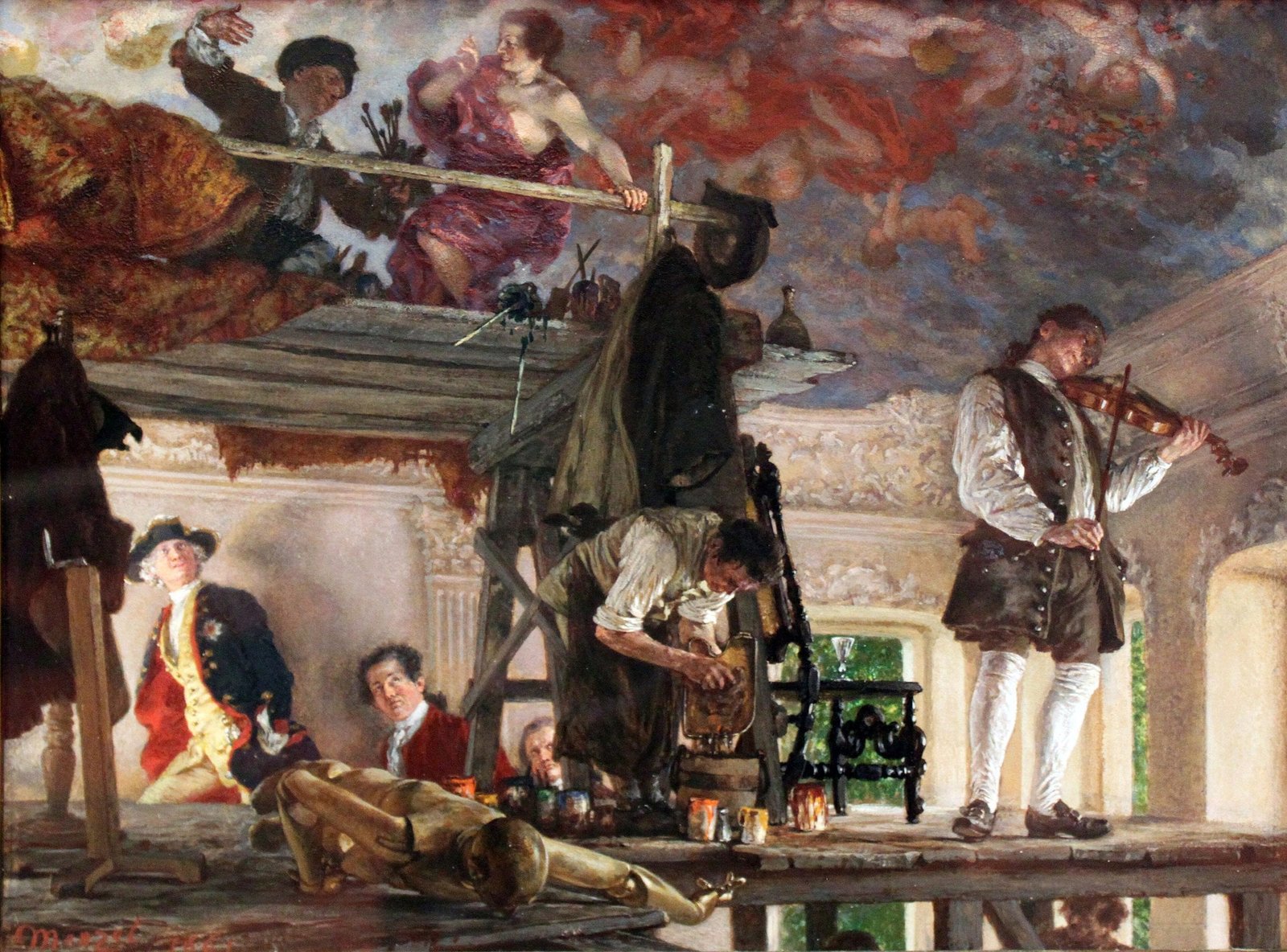
A busy gouache: painters on a tall wooden scaffold under a ceiling painting of clouds and figures; a musician plays on a plank; below, a young man in a blue coat climbs up into the light.
Menzel’s Pesne on the scaffold at Rheinsberg, 1861.Adolph von Menzel, 1861. Wikimedia Commons. Public domain.

1742–1757

Ceilings for the king, then a cooling

For the new king he painted ceilings at Charlottenburg (1742), Potsdam (1746) and Sanssouci (1747). Around 1749 the two fell out, and Pesne worked for the court only now and then. He died in Berlin on 5 August 1757, 46 years after his appointment.

Source: NDB, Pesne

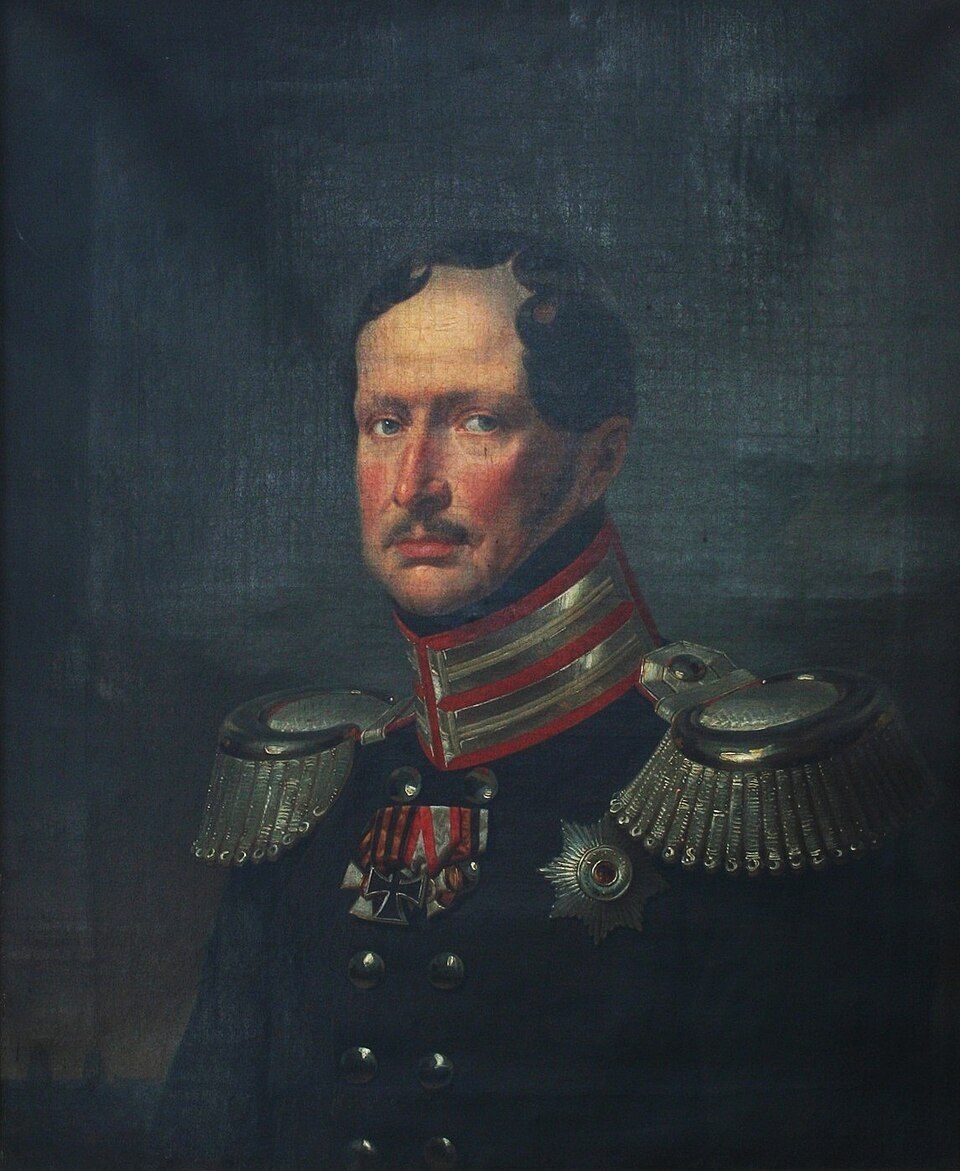
Half-length portrait of a middle-aged king with a moustache in a dark uniform with a red collar, epaulettes and a star.
Friedrich Wilhelm III, by Krüger.Franz Krüger, c. 1830. Via Wikimedia Commons (Public domain).

1820–1826

“Pferde-Krüger” rides into favour

Franz Krüger’s horses made his name: Berliners called him “Pferde-Krüger”, Horse Krüger. Commissions from the court multiplied from 1820, mostly portraits on horseback. He was named court painter — the museum gives no date — and in 1826 became a member and professor of the Academy.

Source: Nationalgalerie, A II 648 · NDB/ADB, Krüger

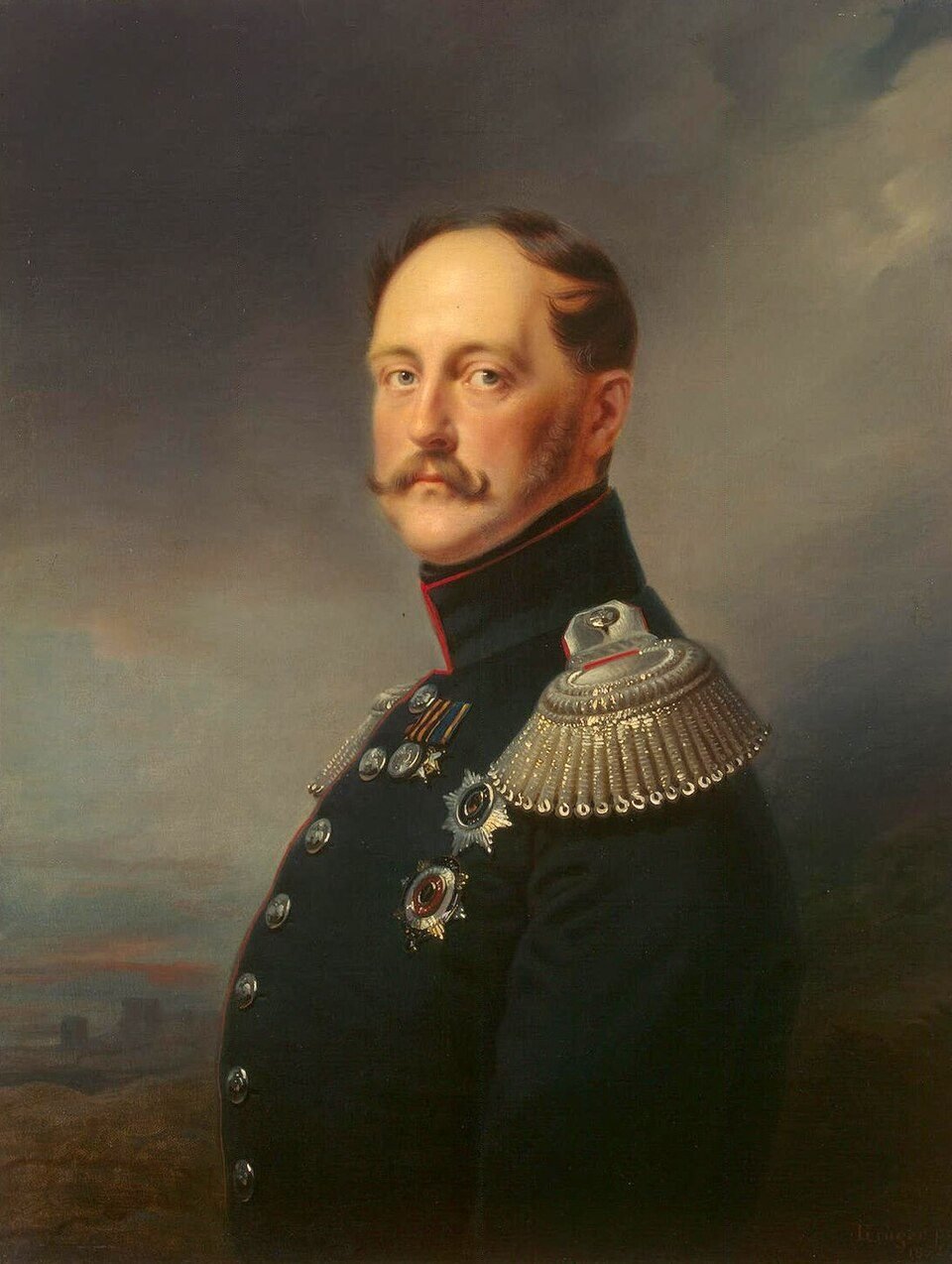
Half-length portrait of a tall, balding man with a moustache in a dark green uniform with epaulettes and orders.
Nicholas I, painted by Krüger, 1852.Franz Krüger, 1852. Wikimedia Commons. Public domain.

1824–1830

A future tsar orders a parade — and gets a crowd

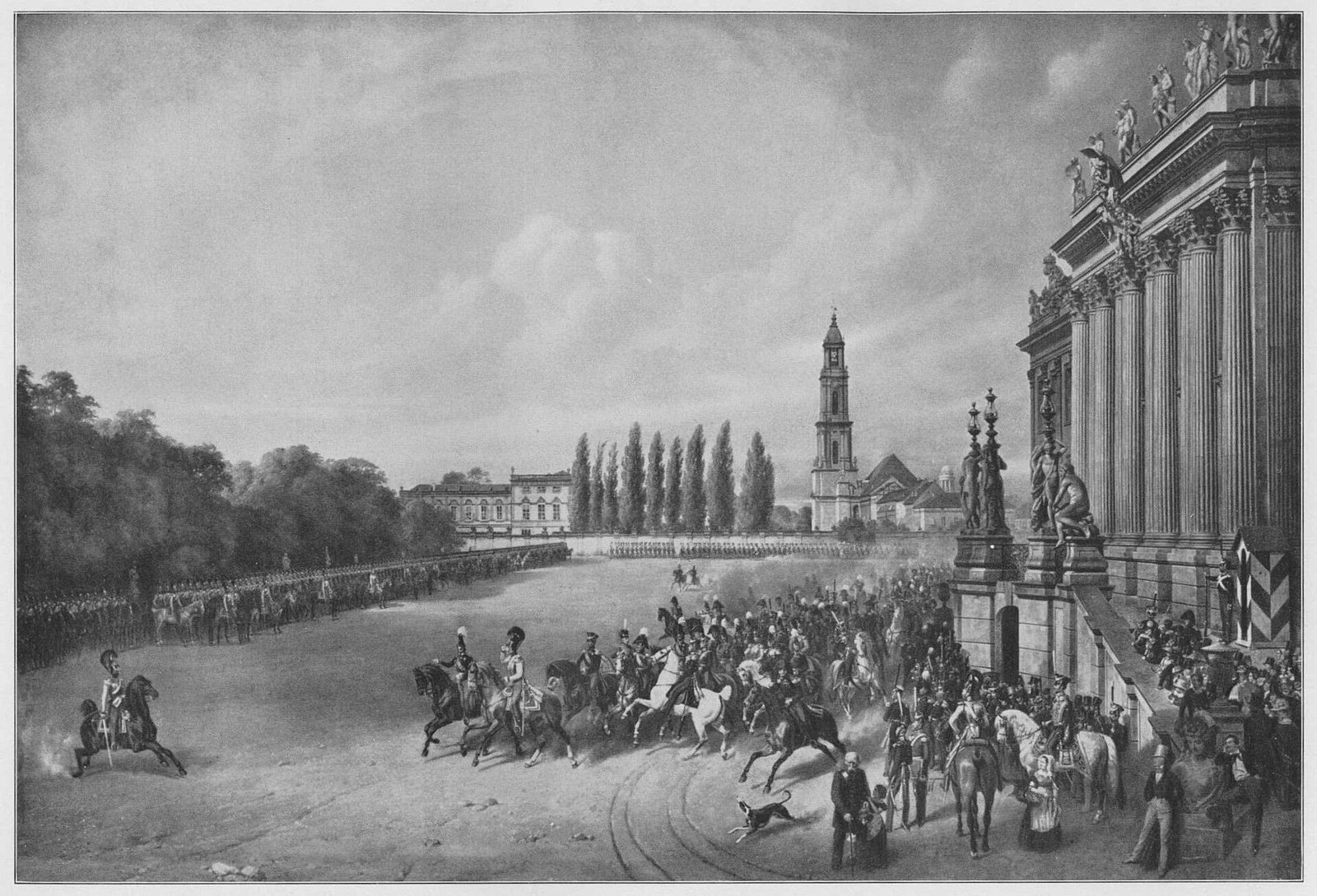
In 1824 Grand Duke Nicholas, the Prussian king’s son-in-law and later Tsar Nicholas I, ordered the “Parade auf dem Opernplatz”. Krüger finished it in 1830 — and moved the king to the edge of his own parade.

Source: Nationalgalerie, A II 648 · Nationalgalerie, A II 649

A monochrome reproduction of a wide painting: cavalry ride into a broad square before a palace, a church tower behind; a few spectators stand at the right.
The companion piece, 1848–49.Franz Krüger, 1849, as reproduced in the catalogue of the 1906 Centenary Exhibition, Berlin. Wikimedia Commons. Public domain.

1847–1857

After 1848, the crowd is kept back

In 1847 Nicholas ordered a companion piece. Finished in 1848–1849, after the March revolution, it keeps the Berliners at the edge, watched by gendarmes. Krüger died in Berlin on 21 January 1857, still court painter.

Source: Nationalgalerie, A II 649 · NDB/ADB, Krüger

A monochrome reproduction of a wide painting: the king on a raised platform at the left, a mass of officers with raised swords filling the hall.
The first version, 1877, for the Berlin palace.Anton von Werner, 1877. Wikimedia Commons. Public domain.

18 January 1871 · Versailles

Werner is in the room when the Empire is proclaimed

Anton von Werner, born in Frankfurt an der Oder in 1843, went to the war as a picture reporter and saw the proclamation at Versailles. His first painting of it, for the Berlin palace, followed in 1877.

Source: NDB, Werner

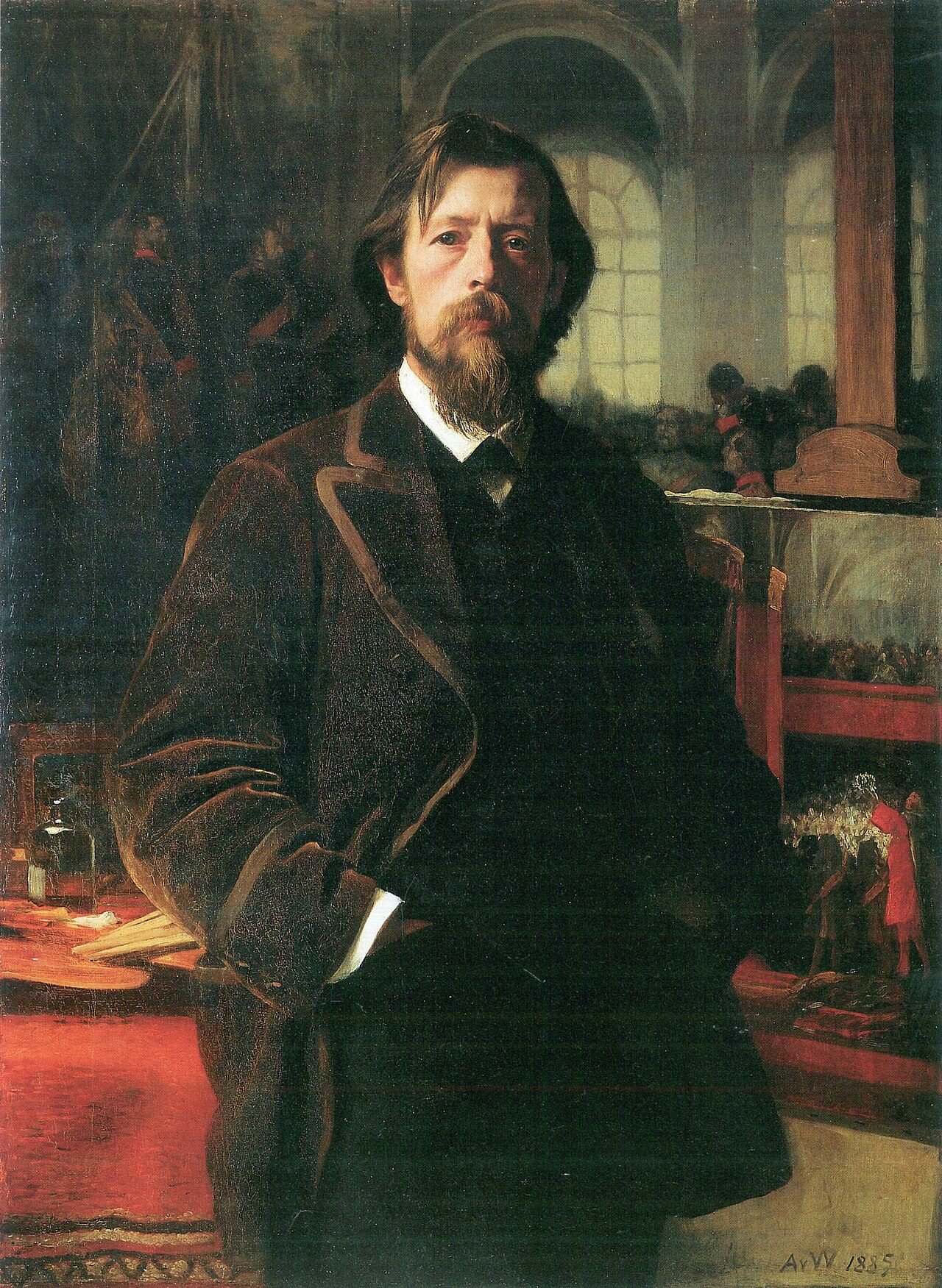
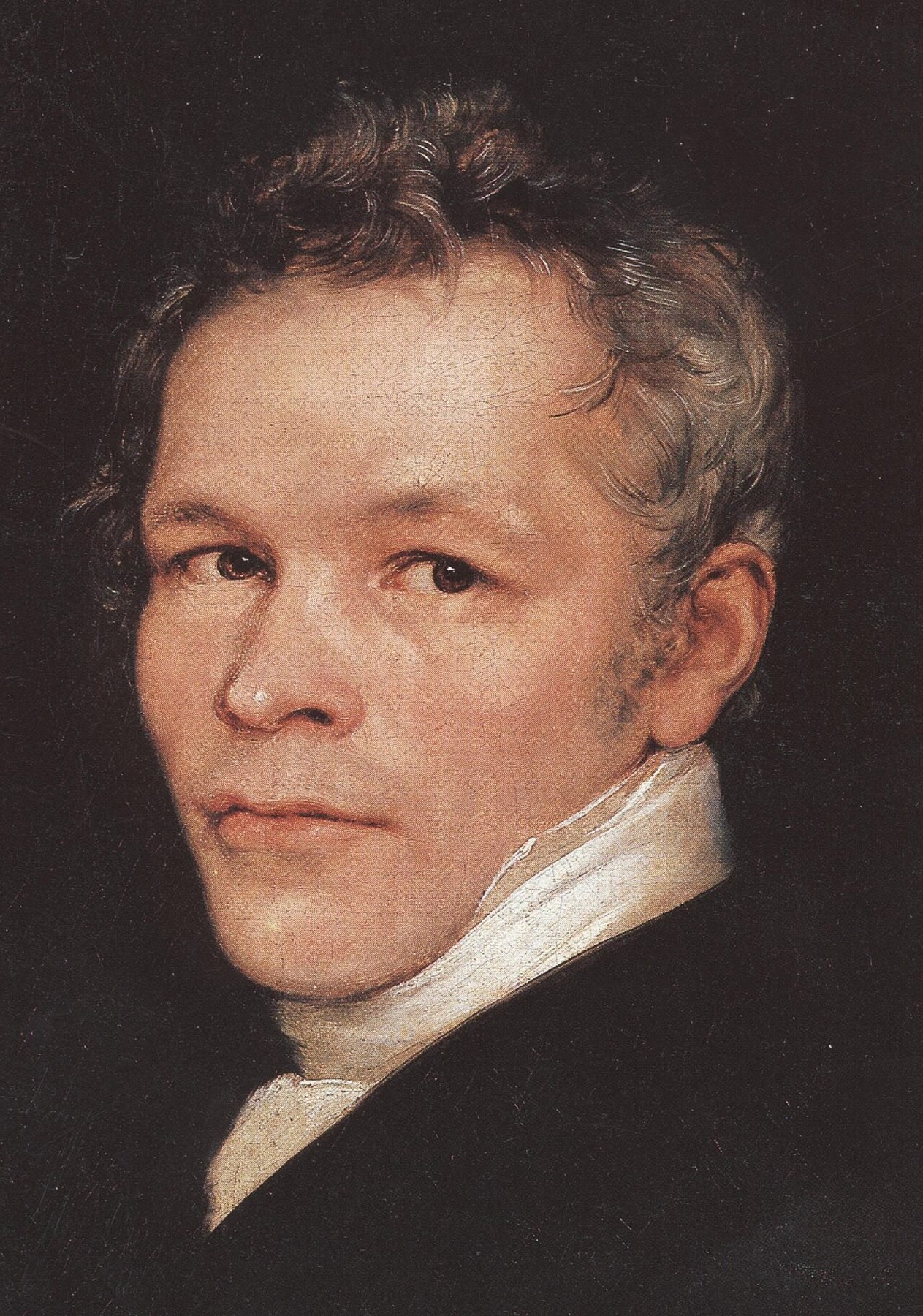
A bearded man in a dark suit stands in a richly furnished room, one hand in his pocket, looking out at us.
Werner, self-portrait, 1885.Anton von Werner, 1885. Via Wikimedia Commons (Public domain).

6 April 1875

Director of the art school for 40 years

On 6 April 1875 he was appointed director of the Royal Academic Hochschule für die bildenden Künste — Berlin’s state art school. He held the post until his death, 40 years later.

Source: NDB, Werner · de.wikipedia (corroboration)

A crowded hall of mirrors: officers in dark uniforms raise swords and helmets towards a dais on the left where the old king stands; in the centre a tall man in a white uniform and high boots holds a document.
Werner’s third version of the proclamation, 1885.Anton von Werner, 1885 (third version). Via Wikimedia Commons (Public domain).

1 April 1885 · Friedrichsruh

The third version: a present for Bismarck

The royal family commissioned the third version in February 1885 for Bismarck’s birthday — with Roon added, though he had been absent ill.

Source: German History in Documents · NDB, Werner

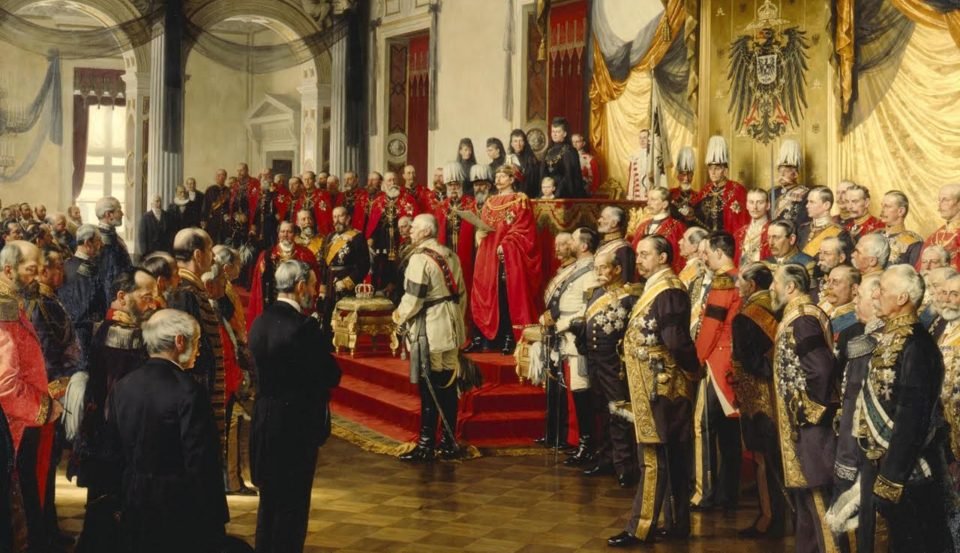
A white and gold hall packed with officers and deputies; the young emperor reads from a paper on a throne dais under a canopy.
Wilhelm II opens the Reichstag, 1893.Anton von Werner, 1893. Wikimedia Commons. Public domain.

1893–1915

“Hofmaler” — a title that did not officially exist

As “Hofmaler” Werner could attend every court festivity, though the title, the NDB notes, did not officially exist. He finished Wilhelm II’s opening of the Reichstag in 1893 and died in Berlin on 4 January 1915.

Source: NDB, Werner

Half-length portrait of a young man with a powdered wig turning his head to face us, in dark armour with an orange sash and a red, ermine-trimmed cloak, before a cloudy sky.
Antoine Pesne, “Friedrich der Große als Kronprinz” (Frederick the Great as crown prince), 1739–40, painted at Rheinsberg: the crown prince in a blackened cuirass with the orange sash of the Black Eagle and an ermine-lined coronation mantle. 80.8 × 63.3 cm, Gemäldegalerie, Berlin, Inv. 489. Shown whole.Antoine Pesne, c. 1739–1740. Via Wikimedia Commons (Public domain).

03Rheinsberg, 1739

Pesne’s crown prince stayed the last true portrait of Frederick until 1763

An inscription on the back says it was painted at Rheinsberg by Pesne in 1739; a later hand added the day Frederick came to the throne in 1740. The crown prince wears a blackened cuirass, the orange sash of the Black Eagle and an ermine-lined coronation mantle. With it, the Gemäldegalerie writes, Pesne had already made at Rheinsberg the standard image of the ruler — copied in his own studio many times over.

The Berlin Gemäldegalerie bought the picture in 1841 for 15 Louis d’or. Contemporary sources, the NDB adds, speak of “up to 38” or “some 46” pupils of Pesne’s; one of them, Christian Bernhard Rode, finished after his death the huge “Rape of Helen” he had been commissioned to paint for the Neues Palais.

A busy gouache: painters on a tall wooden scaffold under a ceiling painting of clouds and figures; a musician plays on a plank; below, a young man in a blue coat climbs up into the light.
Adolph Menzel, “Kronprinz Friedrich besucht den Maler Pesne auf dem Malgerüst in Rheinsberg” (Crown Prince Frederick visits the painter Pesne on his scaffold at Rheinsberg), 1861, gouache. 24 × 32 cm, Alte Nationalgalerie, Berlin, Inv. F.V. 46. Shown whole.Adolph von Menzel, 1861. Wikimedia Commons. Public domain.

A century later Adolph Menzel painted Pesne at work at Rheinsberg: on the scaffold under his ceiling “Apollo vertreibt die Finsternis” (Apollo drives out darkness) of 1740, as the crown prince comes in below. In the middle of the scaffold stands a carved baroque chair — Menzel’s own, which, the Nationalgalerie says, only visitors to his studio would have known. Menzel made himself “the painter of Frederick the Great”. Read our story of Menzel’s Berlin →

04Unter den Linden, 1824–1830

Krüger pushed the king to the edge of his own parade

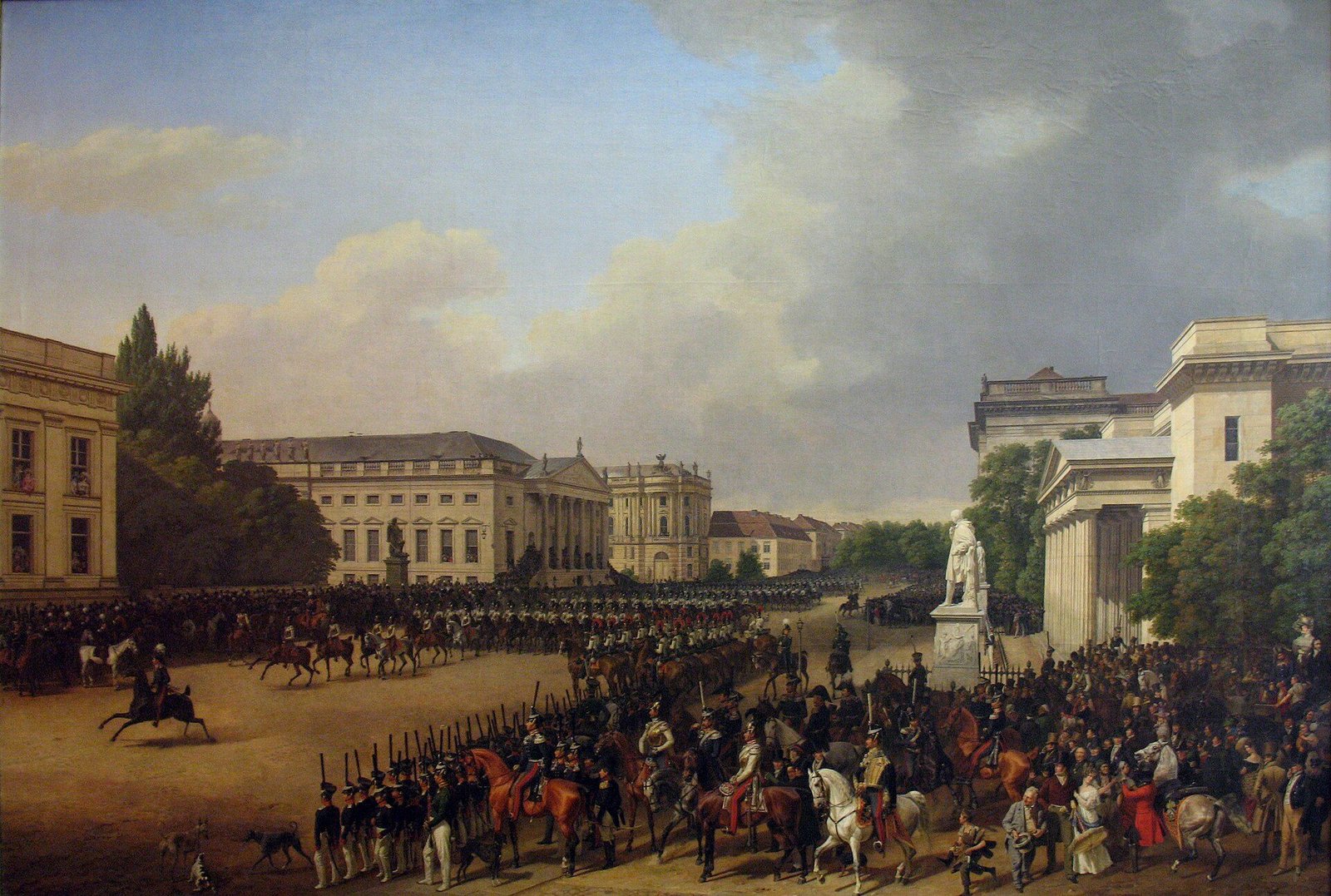
Grand Duke Nicholas, later Tsar Nicholas I, ordered the picture in 1824. He rides at the head of the 6th Brandenburg Cuirassiers towards King Friedrich Wilhelm III, who salutes from horseback opposite the Neue Wache. But Krüger moved the monarch to the edge. The foreground belongs to Berlin’s middle class: sculptors, singers, the architect Schinkel among them, and a shoemaker’s boy the painter took particular care over.

The canvas — 249 × 374 cm — hung first in the Winter Palace in St Petersburg. Shortly before the First World War the Tsar gave it back to the Kaiser, and in 1928 it came to the Nationalgalerie. Krüger, the NDB says, put the crowd that earlier painters left on the margins into the front of the picture, facing us; by his own count he painted about 5,000 portraits, most of them for Berlin’s middle class. He was the most popular painter of Biedermeier Berlin.

Half-length portrait of a tall, balding man with a moustache in a dark green uniform with epaulettes and orders.
Nicholas I, by then Emperor of Russia, in a portrait by Franz Krüger of 1852. As a grand duke he had ordered the Parade.Franz Krüger, 1852. Wikimedia Commons. Public domain.
Portrait of a man with dark curly hair in a dark coat and white cravat, against a landscape.
Karl Friedrich Schinkel, painted by Carl Joseph Begas, 1826. Krüger put the architect into the crowd of his Parade.Carl Joseph Begas, 1826. Wikimedia Commons. Public domain.
A wide sunny street scene: ranks of cavalry ride past the opera house and a classical guardhouse; in the foreground, a long row of well-dressed men and women stand and talk with their backs to the parade.
Franz Krüger, “Parade auf dem Opernplatz in Berlin” (Parade on the Opernplatz), 1824–30: Grand Duke Nicholas leads his cuirassiers towards King Friedrich Wilhelm III, who salutes from the edge; Berliners fill the foreground. 249 × 374 cm, Alte Nationalgalerie, Berlin, Inv. A II 648. Shown whole.Franz Krüger, 1824–1830. Via Wikimedia Commons (Public domain).

In 1847, in St Petersburg, Nicholas ordered a companion piece: the handover of the same regiment to him at Potsdam on 20 April 1817. Krüger finished it in 1848–1849, after the March revolution. This time the public plays no central part. A few onlookers stand on the palace steps, watched by gendarmes, and an invalid in front pointedly turns away — the split in Prussian society, the museum suggests, reflected in the picture.

A monochrome reproduction of a wide painting: cavalry ride into a broad square before a palace, a church tower behind; a few spectators stand at the right.
Franz Krüger, “Parade in Potsdam im Jahre 1817” (Parade in Potsdam, 1817), 1848–49, the companion piece the Tsar ordered in 1847, as reproduced in the catalogue of the 1906 Centenary Exhibition. 249 × 374 cm, Alte Nationalgalerie, Berlin, Inv. A II 649. Shown whole.Franz Krüger, 1849, as reproduced in the catalogue of the 1906 Centenary Exhibition, Berlin. Wikimedia Commons. Public domain.

Eight canvases from this story at their true relative sizes

05Berlin, 1875–1915

As “Hofmaler” he could go to any court festivity — in a title that did not officially exist

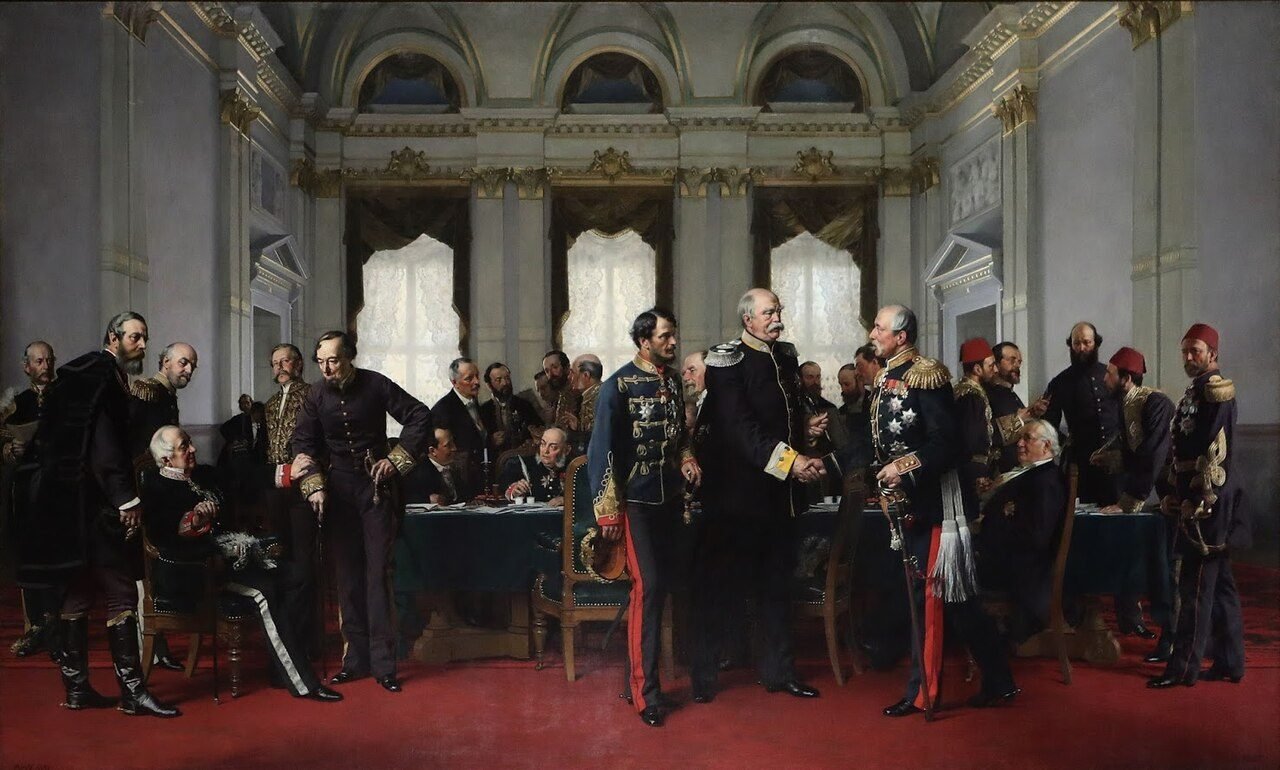
Werner moved to Berlin after the war and on 6 April 1875 became director of the state art school, a post he kept for 40 years. He painted the Empire’s ceremonies as group portraits: the Congress of Berlin, finished in 1881 and today in the Berliner Rathaus, and Wilhelm II opening the Reichstag, finished in 1893.

Court festivities were a genre of their own for him. As “Hofmaler” he had access to them at any time — though the title, the NDB notes, did not officially exist. Like Adolph Menzel, the NDB says, Werner saw himself as an observer; but where Menzel freed the picture from outward reality, Werner put the concrete detail first.

A bearded man in a dark suit stands in a richly furnished room, one hand in his pocket, looking out at us.
Anton von Werner, self-portrait, 1885.Anton von Werner, 1885. Via Wikimedia Commons (Public domain).
Diplomats in black tailcoats and uniforms gather round a table in a grand hall; at the centre two men shake hands.
Anton von Werner, “Der Berliner Kongress” (The Congress of Berlin), completed 1881, today in the Berliner Rathaus.Anton von Werner, 1881. Wikimedia Commons. Public domain.
A white and gold hall packed with officers and deputies; the young emperor reads from a paper on a throne dais under a canopy.
Anton von Werner, “Eröffnung des Reichstags durch Wilhelm II.” (Wilhelm II opens the Reichstag), completed 1893.Anton von Werner, 1893. Wikimedia Commons. Public domain.
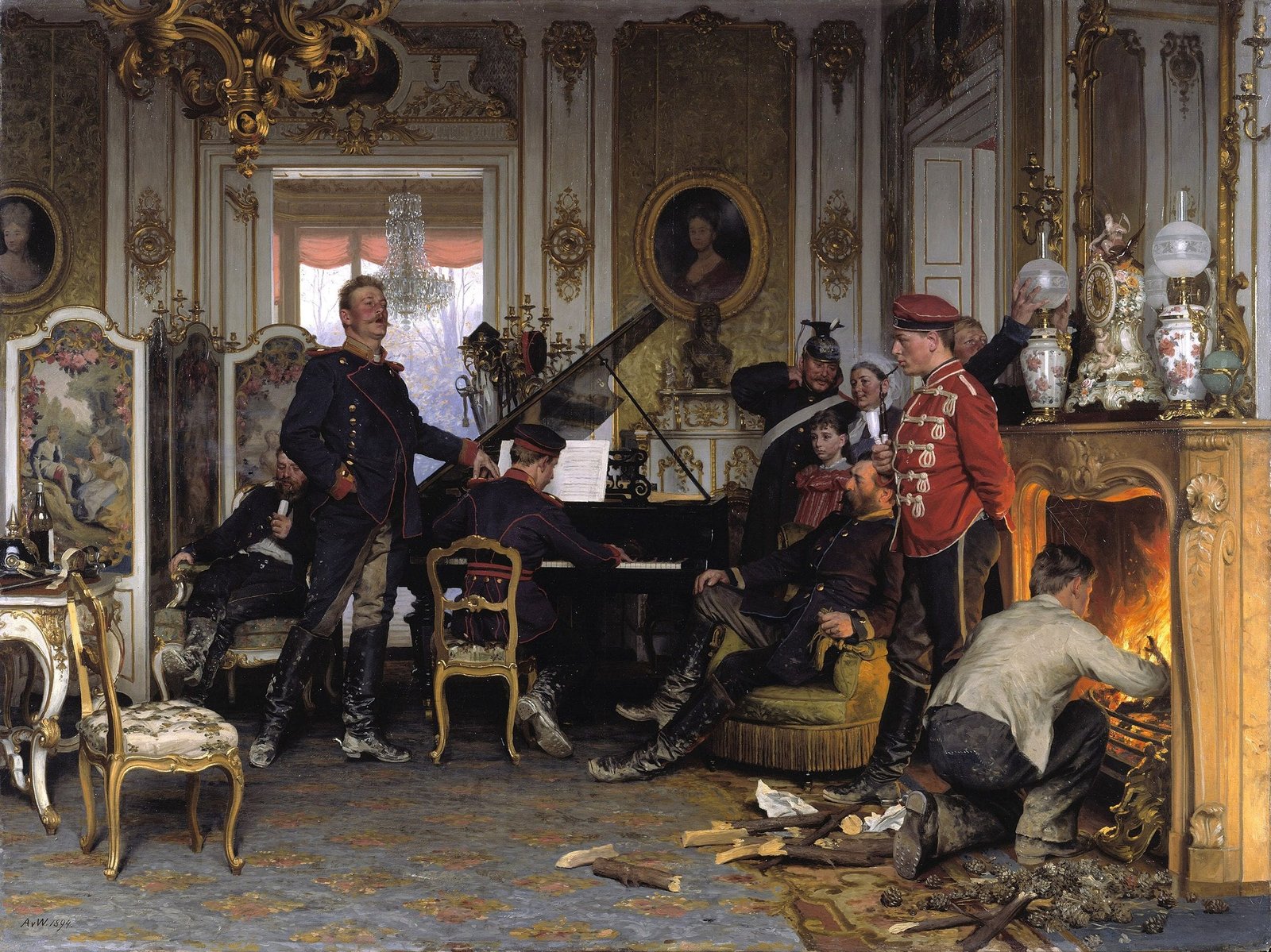
A gilded French salon full of German soldiers in boots: one plays the piano, two officers sing beside it, a soldier kneels at the fireplace; a woman and a girl look in from the doorway.
Anton von Werner, “Im Etappenquartier vor Paris” (In quarters outside Paris), 1894: two uhlans sing Schubert at the piano while the fire is laid, and the concierge and her little daughter appear at the door. 120 × 158 cm, Alte Nationalgalerie, Berlin, Inv. A I 521. Shown whole.Anton von Werner, 1894. Via Wikimedia Commons (Public domain).

Even his most homely war picture answers a charge. On 24 October 1870, quartered in a requisitioned château at Brunoy outside Paris, he sketched two uhlans singing Schubert while the fire was laid. He painted it in 1894 and wrote to the Nationalgalerie in September 1894 that the house, its furniture and clocks had been “still completely intact” that October — an answer, the museum’s curator notes, to later reports of looting by German troops.

06Not court painters in Prussia

Our earlier sheet made two more painters Prussian court painters. The records do not

Tischbein painted Goethe in Rome, not kings in Berlin

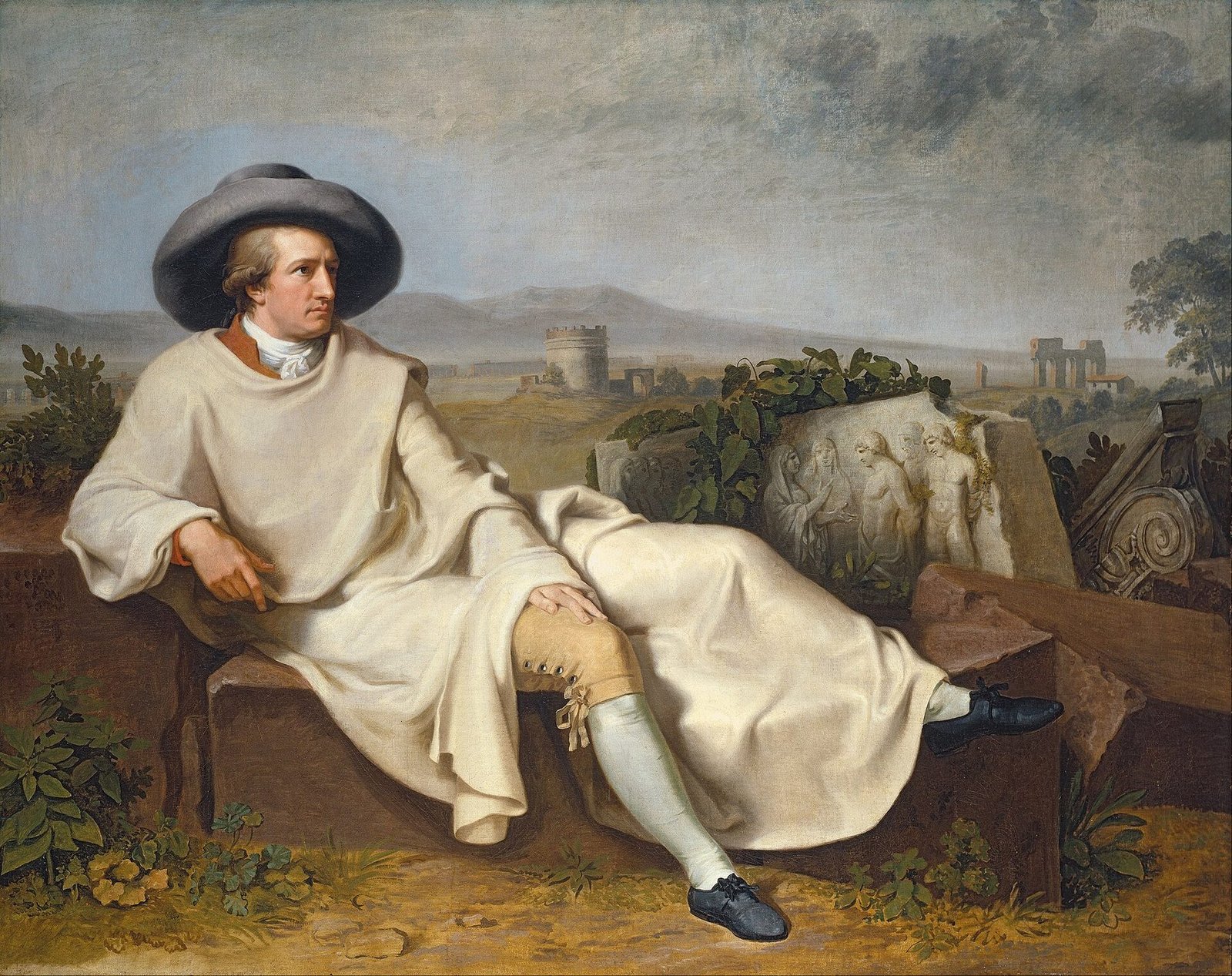
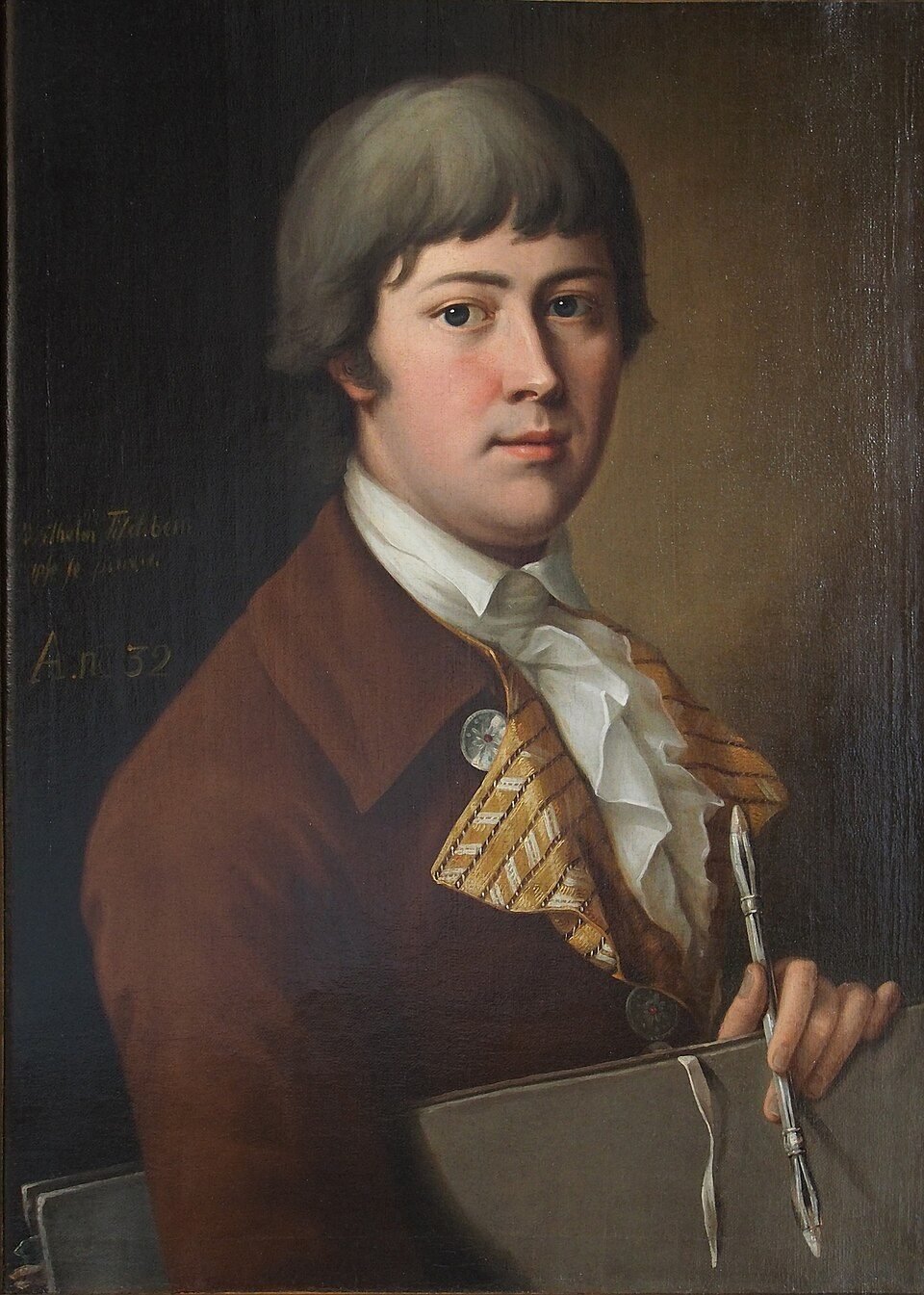
Johann Heinrich Wilhelm Tischbein worked in Berlin as a portrait painter from 1777 and left for Italy in 1779. At the end of 1786 Goethe lodged with him in Rome; in 1787 the two went to Naples, where Tischbein became director of the academy in 1789. The court painter’s post he did hold came in 1808 — from the Duke of Oldenburg. His Goethe, 166 × 210.3 cm, is the portrait that shaped our picture of Goethe more than any other, says the Städel; look closely and Goethe seems to have two left feet.

A man in a wide grey hat and a long white travelling cloak reclines on fallen stone blocks in a broad landscape with ruins.
Johann Heinrich Wilhelm Tischbein, “Goethe in der römischen Campagna” (Goethe in the Roman Campagna), 1787, Städel Museum, Frankfurt.Johann Heinrich Wilhelm Tischbein, 1787. Via Wikimedia Commons (Public domain).
Portrait of a young man with grey-powdered hair in a brown coat, holding a portfolio.
Johann Heinrich Wilhelm Tischbein, self-portrait, 1783.Johann Heinrich Wilhelm Tischbein, 1783. Via Wikimedia Commons (Public domain).

Magnus painted Berlin society — and the most famous Jenny Lind

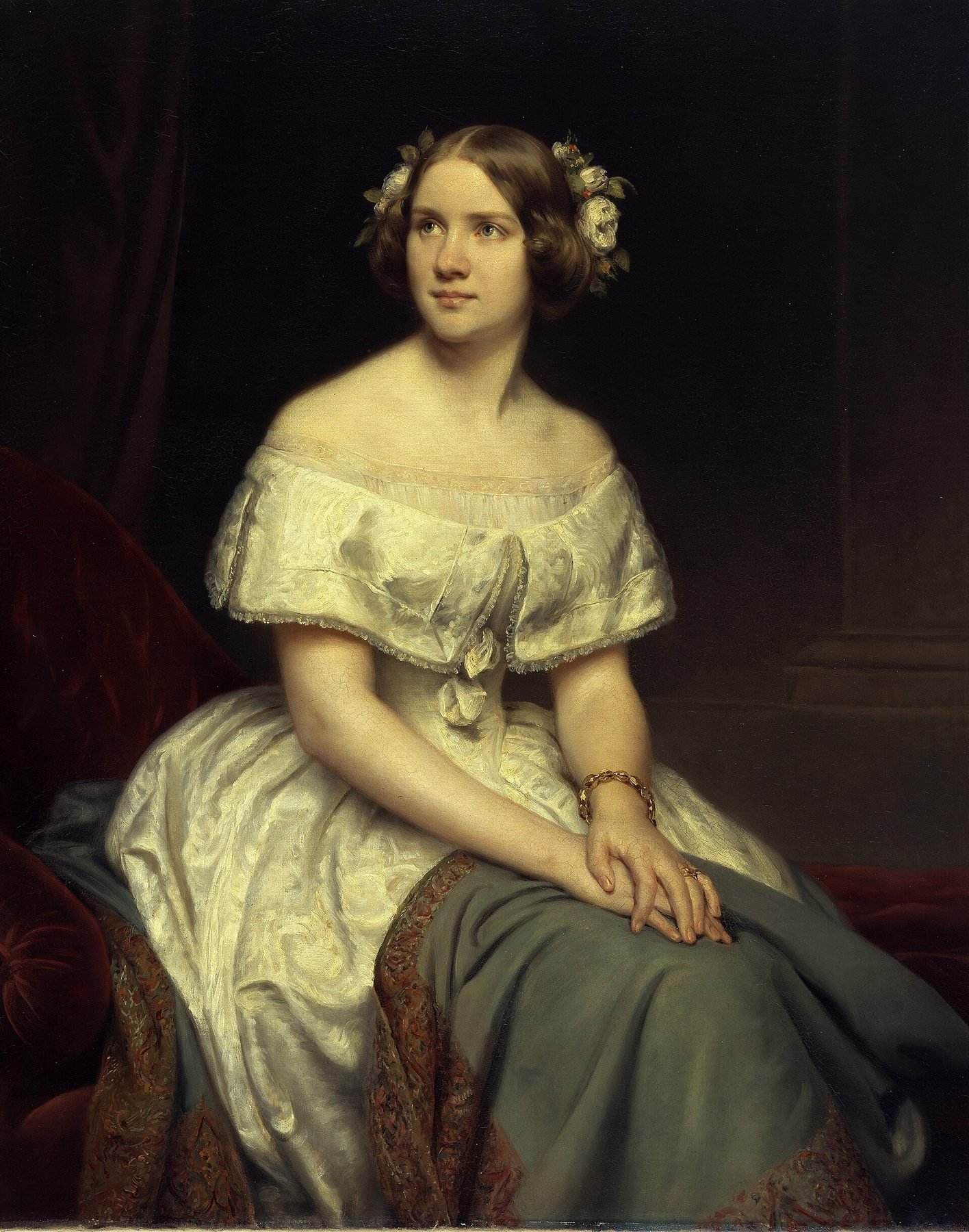
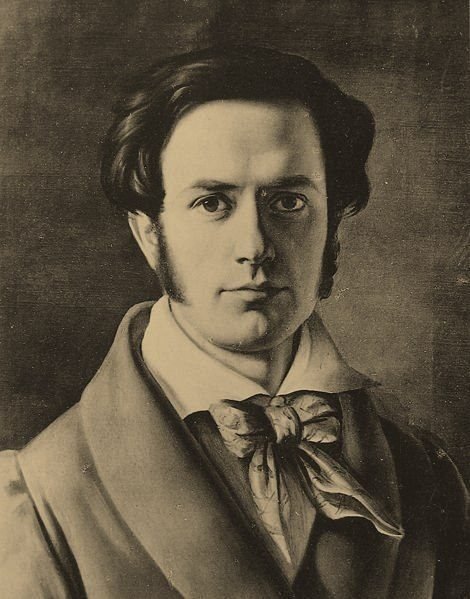
Eduard Magnus, from a Berlin banking family, joined the Academy in 1837 and became a professor in 1844; no record we found makes him a court painter. In the spring of 1846 the soprano Jenny Lind asked him for a portrait. It became the best known of all her portraits; at that year’s Academy exhibition, the sculptor Schadow noted, no portrait drew more attention. A replica Magnus made in 1860/61 is in London.

A young woman with roses in her hair, in a white off-the-shoulder dress, sits with her hands folded and looks upward.
Eduard Magnus, portrait of the singer Jenny Lind, 1846, Alte Nationalgalerie, Berlin. 119 × 94.5 cm, Alte Nationalgalerie, Berlin, Inv. A I 250. Shown whole.Eduard Magnus, 1846. Alte Nationalgalerie, Berlin. Wikimedia Commons. Public domain.
Monochrome reproduction of a portrait of a young man with full dark hair, a high collar and a loosely tied bow.
Eduard Magnus, self-portrait, 1824–27, Alte Nationalgalerie, Berlin.Eduard Magnus, 1824–1827. Alte Nationalgalerie, Berlin. Wikimedia Commons. Public domain.
Painters to the Prussian court · 1711–1915

In 1711 Prussia gave Pesne a court painter’s post worth 1,200 thaler. Its most famous court painter, two centuries later, held a title that officially did not exist.

An old painter in a brown velvet coat sits at his easel with palette and brushes; his two daughters lean in behind him, one holding a small black-and-white dog.
Antoine Pesne, self-portrait at the easel with his daughters Henriette Joyard and Marie de Rège, 1754: Prussia’s court painter at seventy-one.Antoine Pesne, 1754. Via Wikimedia Commons (Public domain).

Corrected from our earlier sheet

  • Tischbein was never court painter in Prussia: he left Berlin for Italy in 1779 and became court painter in Oldenburg in 1808.
  • No source we found gives Eduard Magnus a court appointment; his Jenny Lind was painted in 1846, not later.
  • Werner did not turn down a court title: the NDB says the title “Hofmaler” did not officially exist.
  • It is the future Tsar Nicholas I who leads the regiment in Krüger’s Parade, which measures 249 × 374 cm.
  • Krüger became professor in 1826; the court had been giving him work since 1820.
  • Pesne took over the post of Augustin Terwesten; his crown prince belongs to the Gemäldegalerie (Inv. 489).
  • Werner’s 1885 Proclamation is no eyewitness record: it adds Roon and dresses Bismarck in a uniform he did not wear.
  • The reigns include Friedrich III, emperor and king for part of 1888.

Press & citation

Use this Berlinfographic

Free to publish under CC BY 4.0 — in print, online, on Wikipedia and in teaching, commercially or not — with credit to Berlinfographics and a link to this page.

Painters to the Prussian court, 1711–1915: ready-to-use landscape image

Ready-to-use image

The infographic as one image: headline, key figures, chart, sources and credit, 2,400 × 1,350 px PNG. Please use it unedited.

Download landscape (PNG)
Painters to the Prussian court, 1711–1915: square version

Square format

A 1:1 version for social media and narrow columns, 1,800 × 1,800 px.

Download square (PNG)
Painters to the Prussian court, 1711–1915: portrait version

Portrait 4:5

For Instagram and LinkedIn feeds, 1,620 × 2,025 px.

Download portrait (PNG)

Credit line

Berlinfographics (berlinfographics.com), CC BY 4.0

Citation

Berlinfographics (2026). “Painters to the Prussian court, 1711–1915”. Berlin Experiences. https://berlinfographics.com/berlin-court-painters/

Wikipedia

{{cite web |title=Painters to the Prussian court, 1711–1915 |url=https://berlinfographics.com/berlin-court-painters/ |website=Berlinfographics |publisher=Berlin Experiences |date=2026-11-07 |access-date=2026-11-07}}