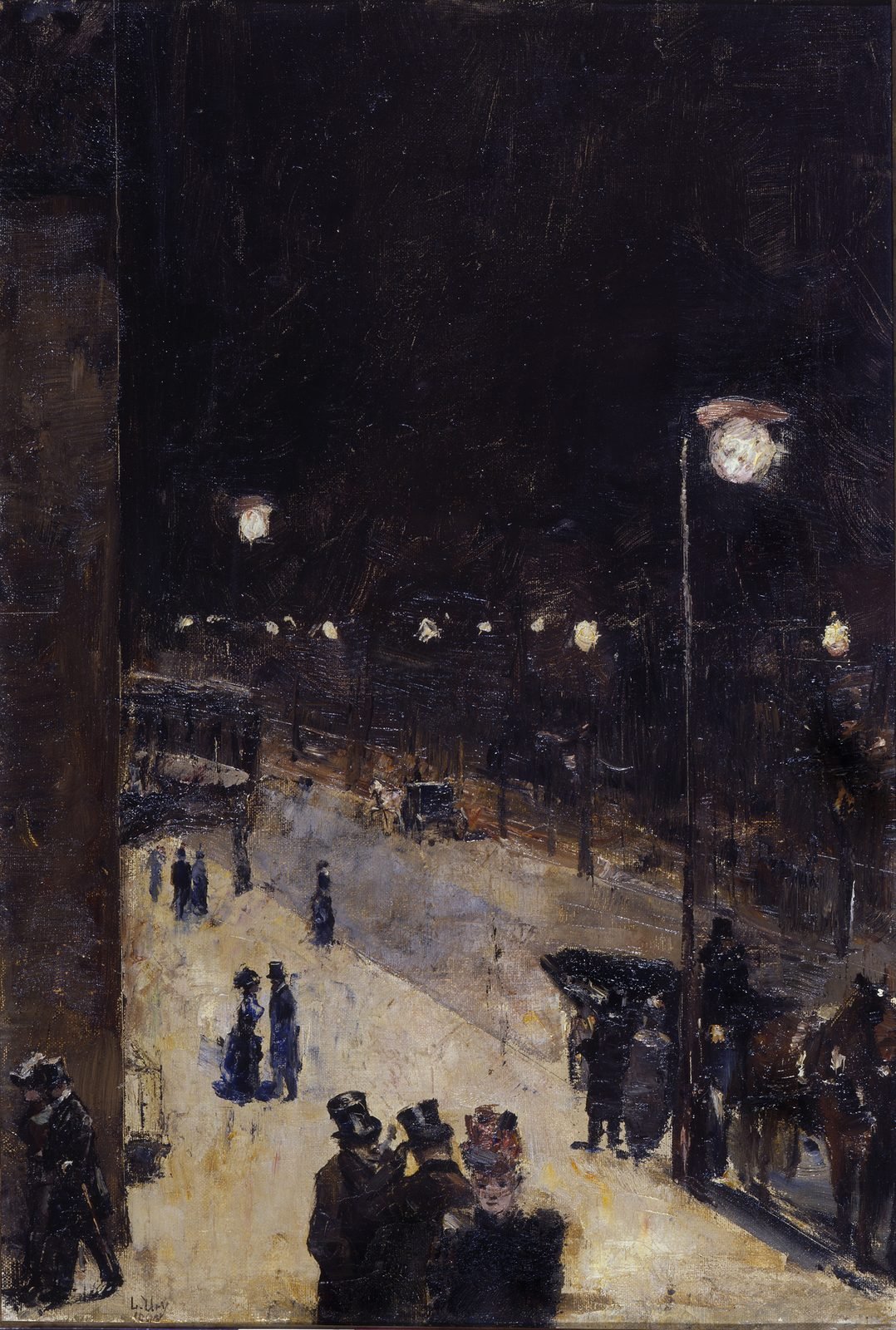
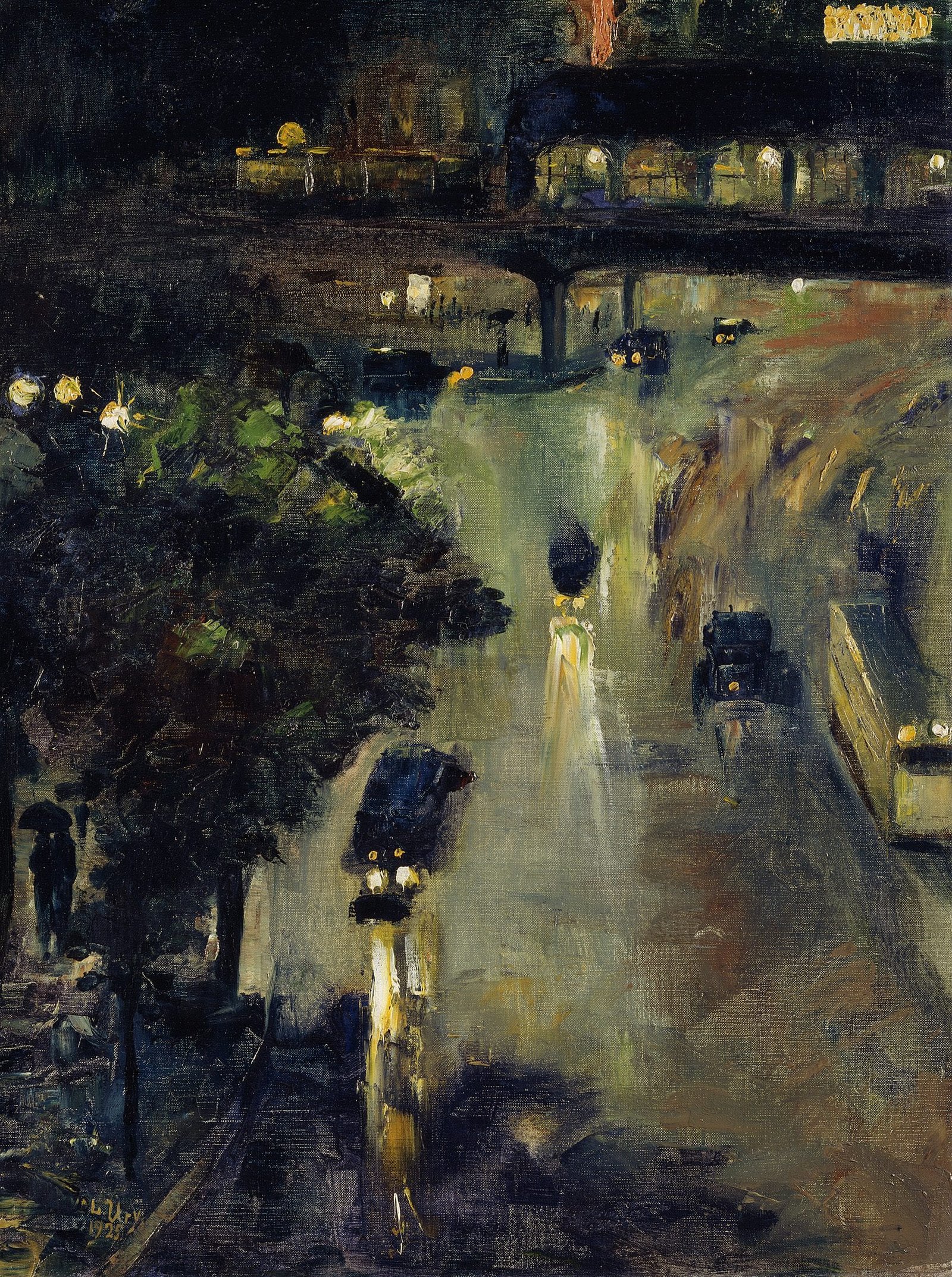
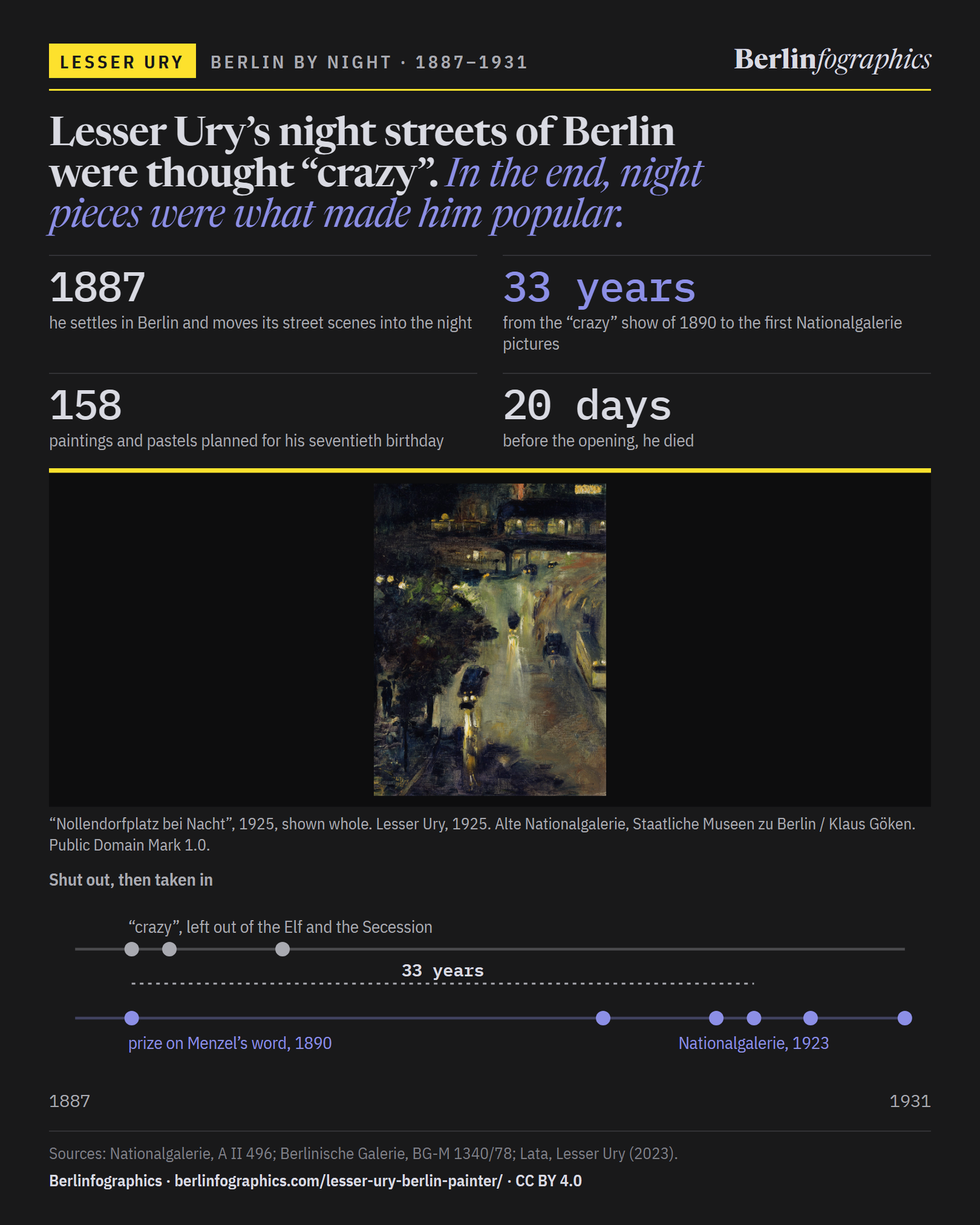
Lesser Ury, “Nollendorfplatz bei Nacht” (Nollendorfplatz at night), 1925, oil on canvas, 72.5 × 54.5 cm. Alte Nationalgalerie, Berlin, Inv. A II 496. Painted from his own window. Shown whole.Lesser Ury, 1925. Alte Nationalgalerie, Staatliche Museen zu Berlin / Klaus Göken. Public Domain Mark 1.0.
Lesser UryBerlin by night · 1887–1931
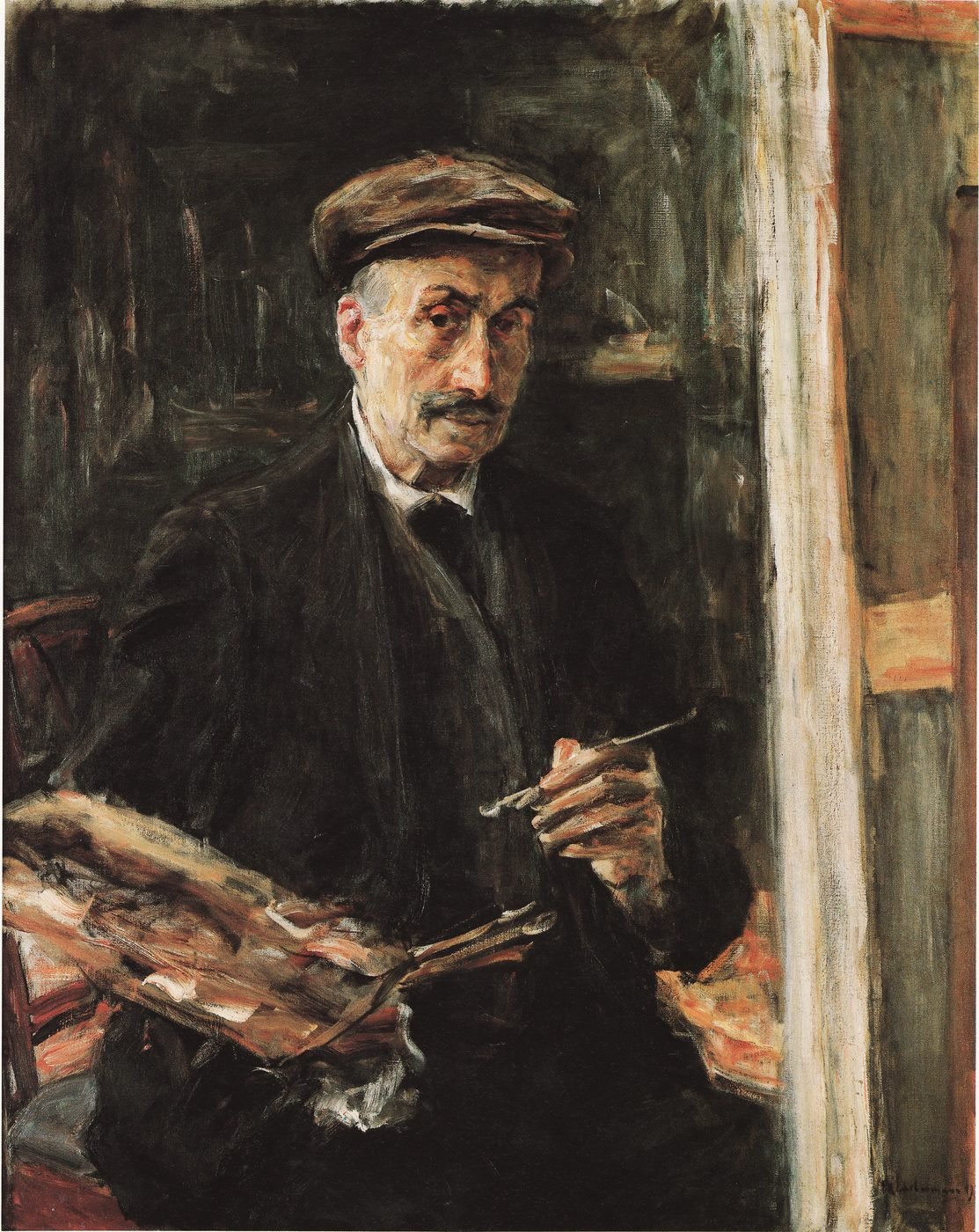
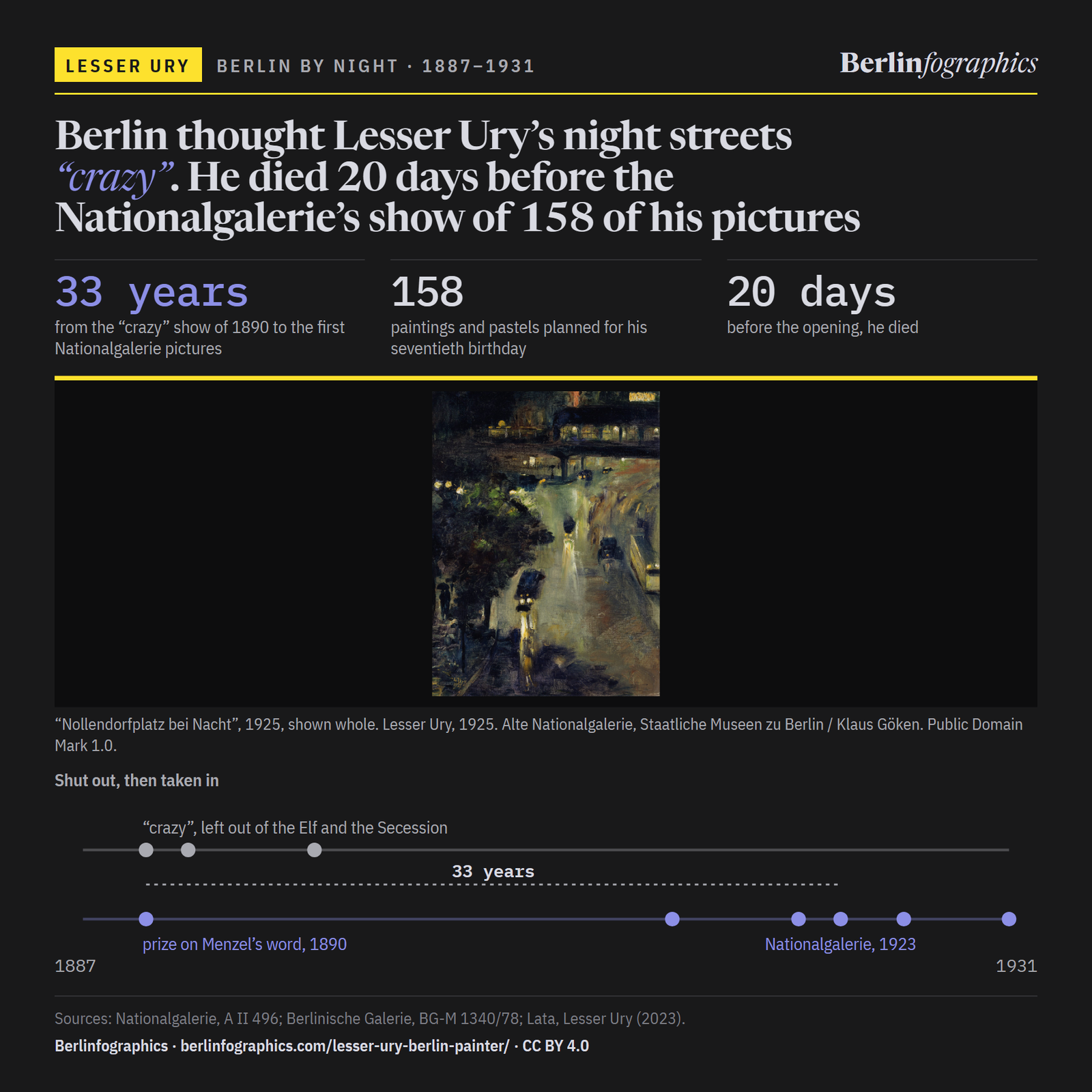
He settled in Berlin in 1887 and did something new: he moved its street scenes into the night — wet roads, lamps and their reflections. Max Liebermann’s circle shut him out, and the Nationalgalerie took its first Ury pictures only in 1923. From 1901 he painted the Nollendorfplatz from his own fourth-floor window.
Scroll: his city, street by street
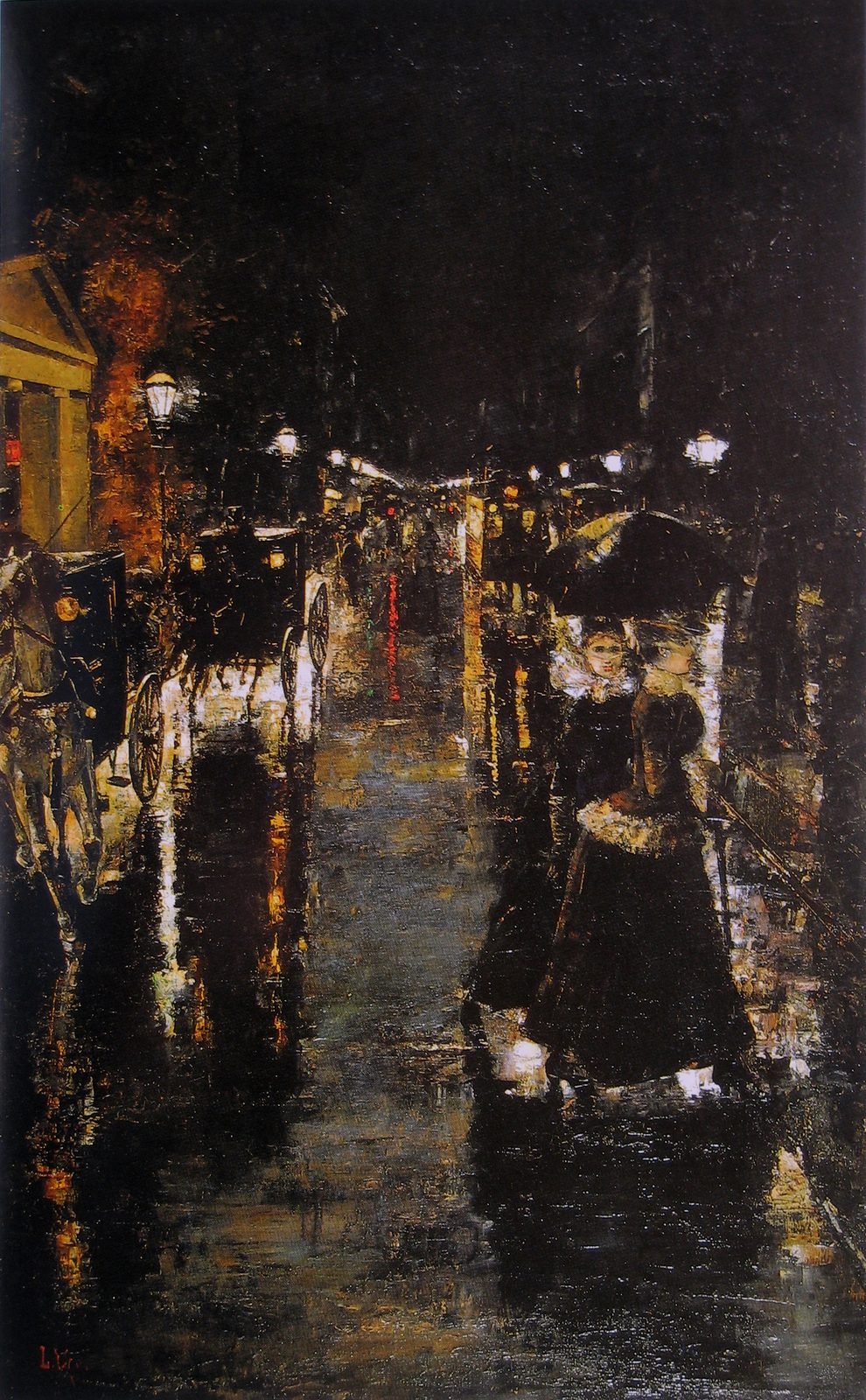
01Fritz Gurlitt’s gallery, 1890
In 1890 the dealer Fritz Gurlitt showed a larger group of Ury’s pictures for the first time. The criticism came down like hail. The paint, laid on partly with a palette knife, the unfamiliar cropping that caught a single moment, the figures cut off at the edges: visitors shook their heads, and his pictures, the art historian Sabine Lata writes, were thought “crazy”.
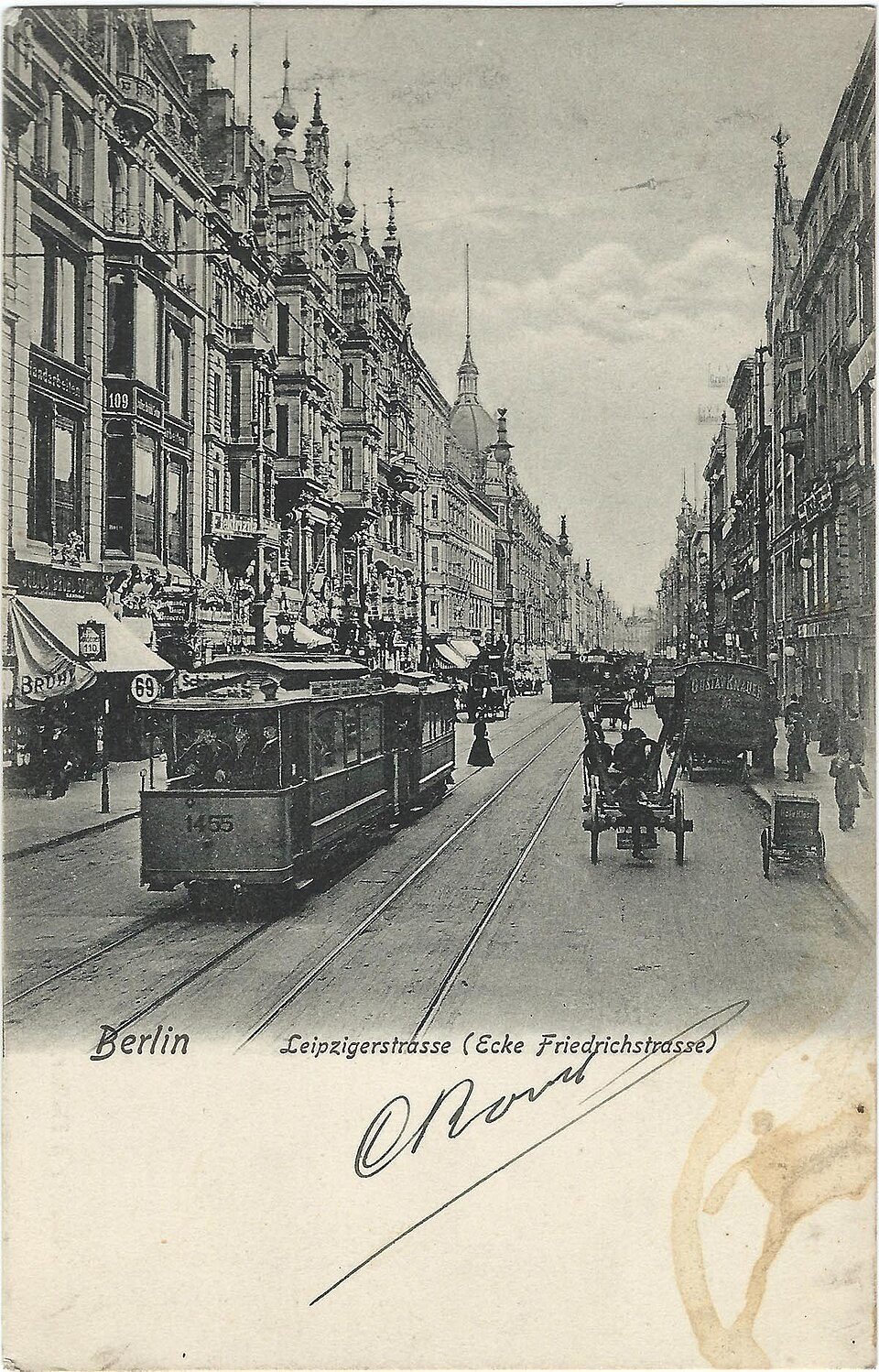
What was new, she writes, was that Ury moved some of his street scenes into the night. One picture in that show was his view down the Leipziger Straße of 1889, now in the Berlinische Galerie: a night scene in very dark tones, broken by painted white, yellow and red lights and their reflections. It met rejection and incomprehension.
“Ich habe in den fünfundvierzig Jahren, die ich in Berlin bin, alle Verwandlungen und Richtungen mitangesehen.”
“In the forty-five years I have been in Berlin I have watched every transformation and every movement.” From an article in the magazine Der Querschnitt that appeared shortly after his death, in which Ury spoke for himself (quoted by Lata).


02The map
1861 · Birnbaum
Lesser Ury was born on 7 November 1861 in Birnbaum, into a Jewish family. His mother brought him and his brothers to Berlin, the capital of the newly founded German Empire, and opened a shop for linen goods in the Dresdener Straße, in the poor old quarter of the Luisenstadt.
Source: Berlinische Galerie · Lata, Lesser Ury (2023)
1888
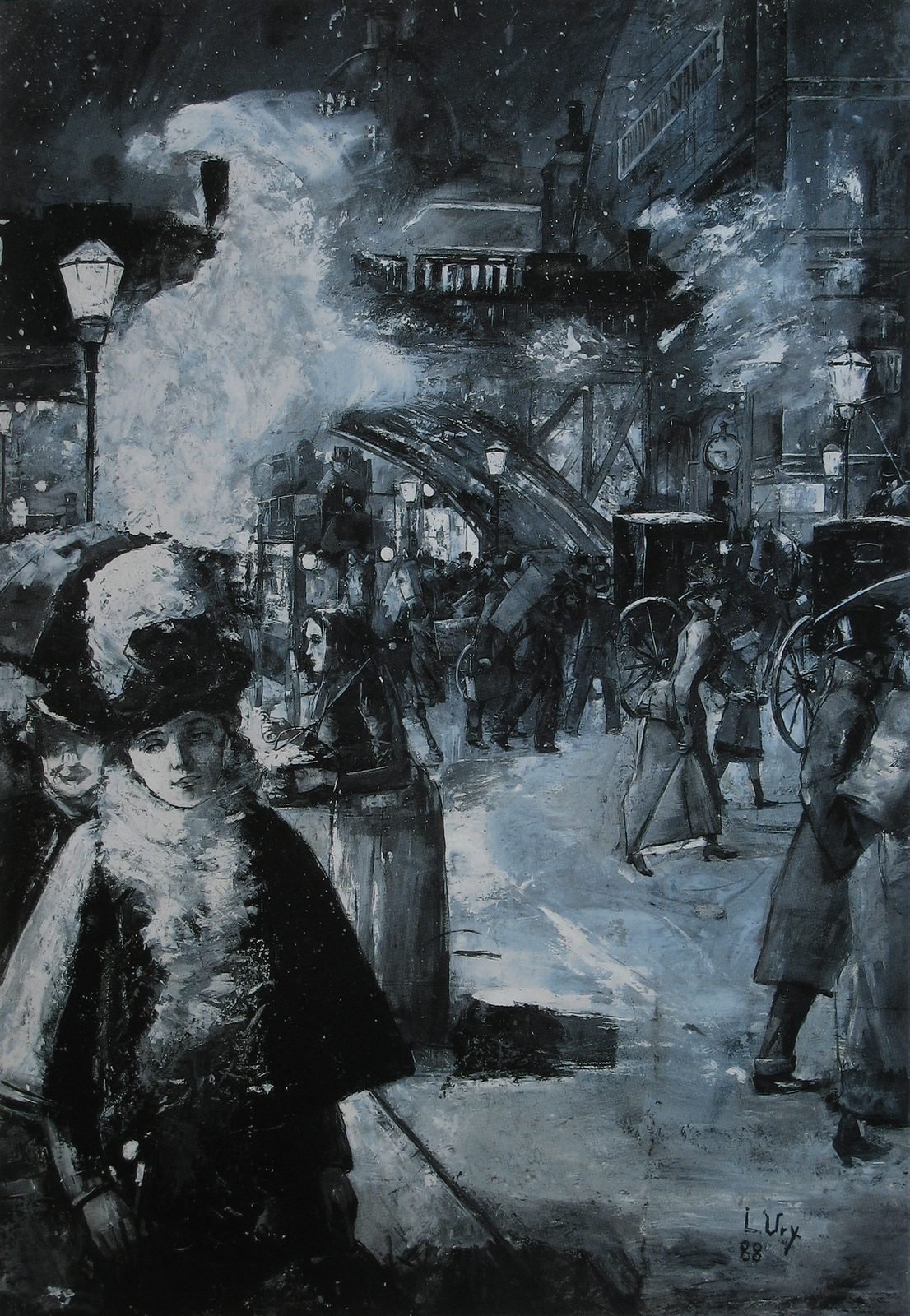
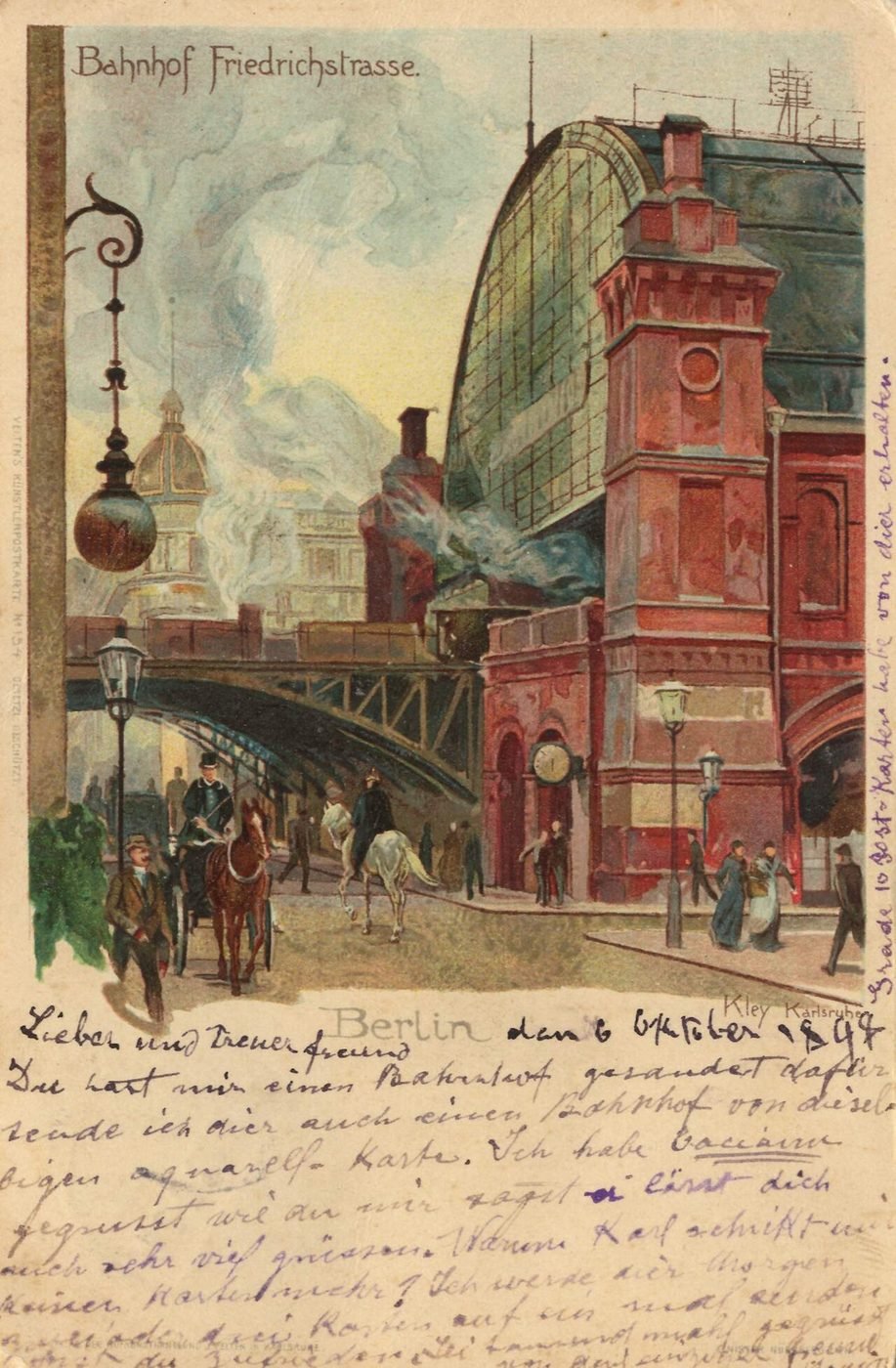
After years of study in Brussels and Paris, Ury came back to Berlin for good in 1887, and his first Berlin street pictures followed at once. At Bahnhof Friedrichstraße in 1888 he painted evening in falling snow, lights shining everywhere and steam rising — in greys alone.
Source: Lata, Lesser Ury (2023)
1889
A year later he looked down the Leipziger Straße after dark: very dark tones broken by white, yellow and red lights on the wet road. When it was shown in 1890, the paint laid on partly with a knife met rejection and incomprehension.
Source: Lata, Lesser Ury (2023) · Berlinische Galerie, BG-M 1340/78
Unter den Linden
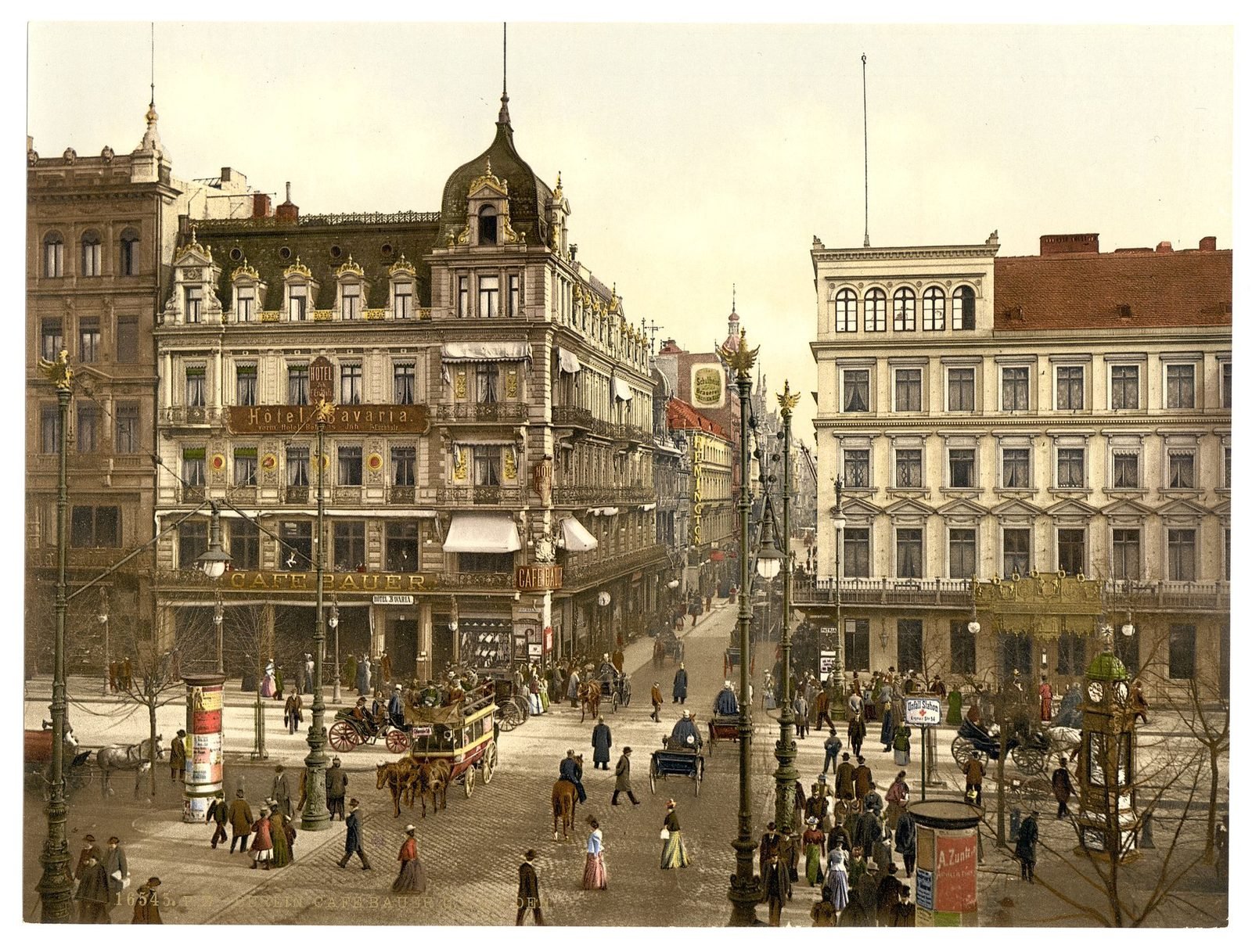
On the corner of Friedrichstraße and Unter den Linden stood the Café Bauer, the first coffee house in Berlin lit by electricity. After 1910 Ury went back to the street and café pictures of his early years, and to motifs like these: Unter den Linden, the Leipziger Straße, the Café Bauer.
Source: Lata, Lesser Ury (2023)
1901
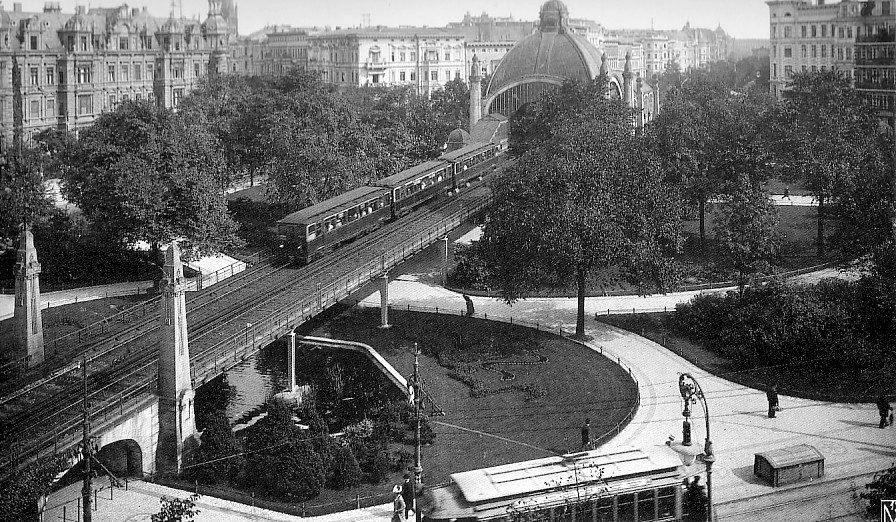
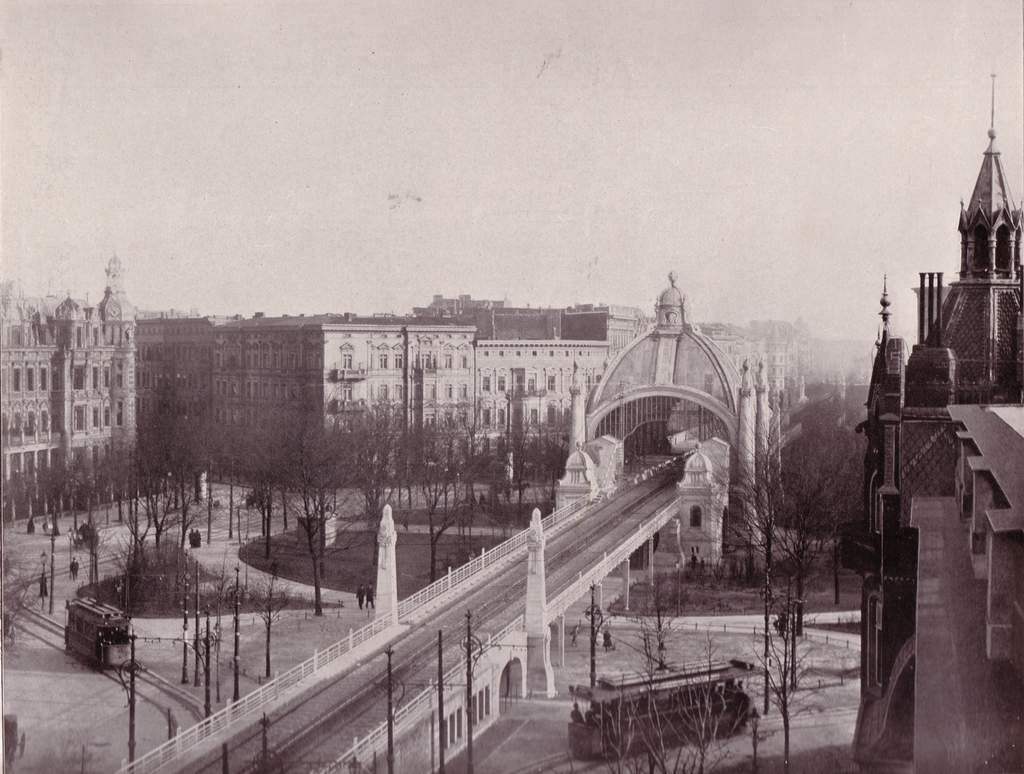
From 1901 until his death Ury had his flat and studio in the house at Nollendorfplatz 1, in Schöneberg, by the elevated railway. The house was destroyed in the Second World War.
Source: Nationalgalerie, A II 496 · Lata, Lesser Ury (2023)
1925
Towards the end of his life he seldom went out, and painted the view from his windows over and over. This one, of 1925, looks down from the fourth floor at night, the Hochbahn station in the background. The Nationalgalerie bought it from him in 1926.
Source: Nationalgalerie, A II 496 · Lata, Lesser Ury (2023)
Today
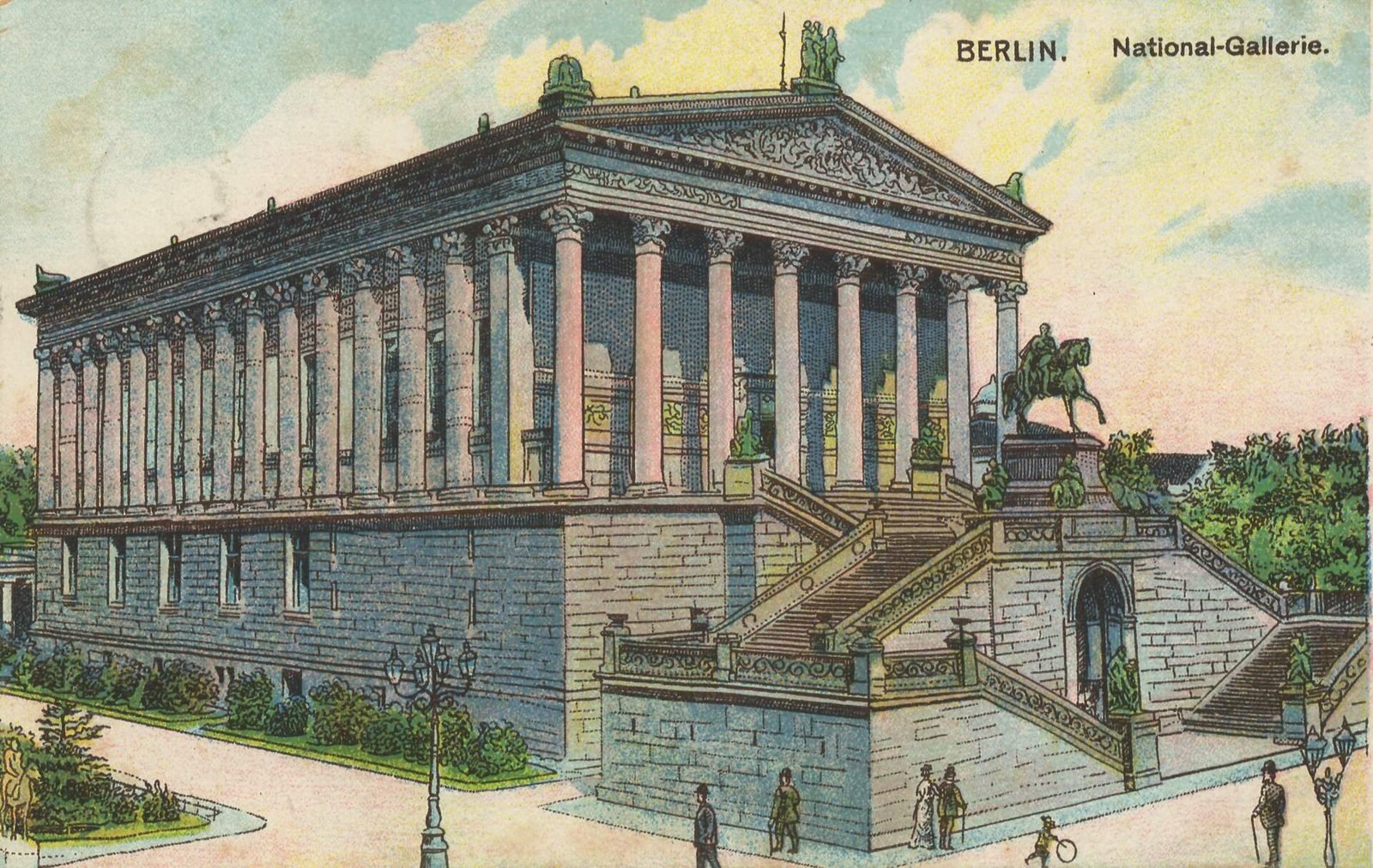
The Nationalgalerie took its first Ury pictures in 1923, two early works received by exchange from the painter, and bought the Nollendorfplatz from him three years later. The Leipziger Straße has been in the Berlinische Galerie since 1978; the Friedrichstraße gouache belongs to the Stiftung Stadtmuseum Berlin.
Source: Nationalgalerie, A II 402 · Nationalgalerie, A II 401 · Nationalgalerie, A II 496 · Berlinische Galerie, BG-M 1340/78 · Lata, Lesser Ury (2023)
18 October 1931
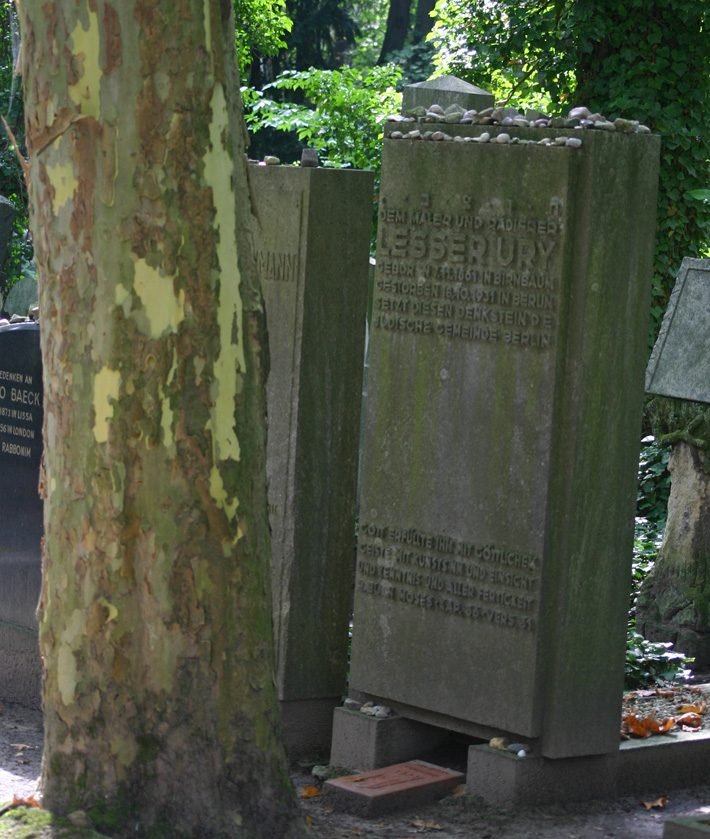
Ury died on 18 October 1931, shortly before his seventieth birthday. The Jewish community of Berlin gave him a grave in the row of honour of its cemetery at Weißensee, 8.7 km from the Nollendorfplatz as the crow flies.
Source: Lata, Lesser Ury (2023) · Berlinische Galerie · © OpenStreetMap contributors
03Liebermann, the Secession and the Nationalgalerie
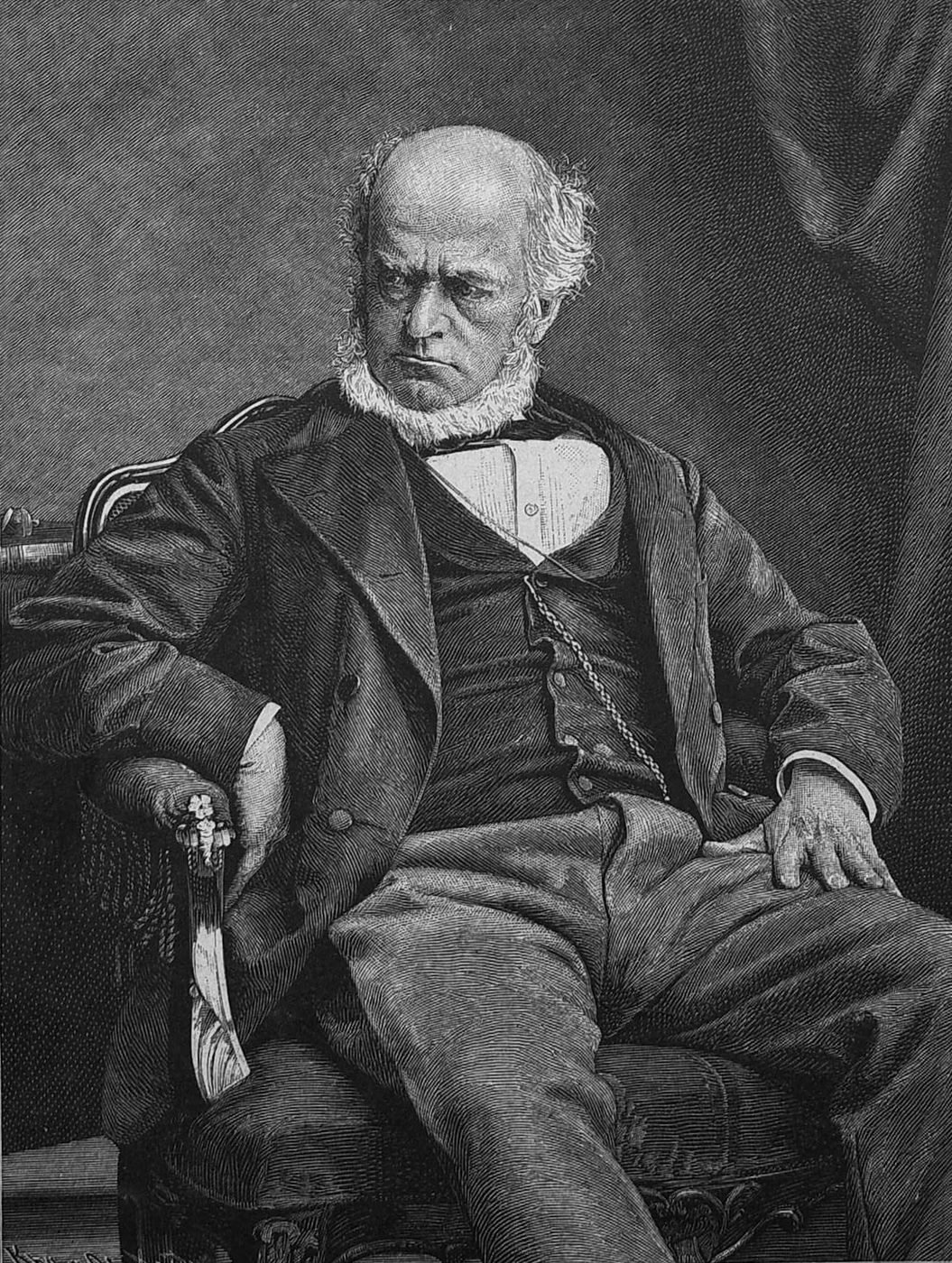
At first Max Liebermann, established and wealthy, did help the penniless young painter. Then word reached him that Ury was telling acquaintances he had improved the light in Liebermann’s “Flachsscheuer in Laren” (1887). When Liebermann co-founded the modern group of the “Elf” — the Eleven — in 1892, he left Ury out; when the Berliner Secession was founded in 1898 with Liebermann as its president, Ury was left out again. The Nationalgalerie’s own catalogue speaks of a lasting conflict between the two.
There were allies. In 1890, on the word of Adolph Menzel, he won the Michael Beer Prize of the Royal Academy of Arts. From 1915 he could show with the Secession, which made him an honorary member in 1921; on his sixtieth birthday that year a Berlin city councillor hailed him as the “artistic glorifier of the imperial capital”. In 1923 Ludwig Justi, the Nationalgalerie’s director, took the first Ury pictures for the museum, and in 1926 the museum bought two more from the painter.
Shut out, taken in: 1887–1931
shut out or attackedtaken in


04Brussels, Paris, Volluvet, 1882–1884
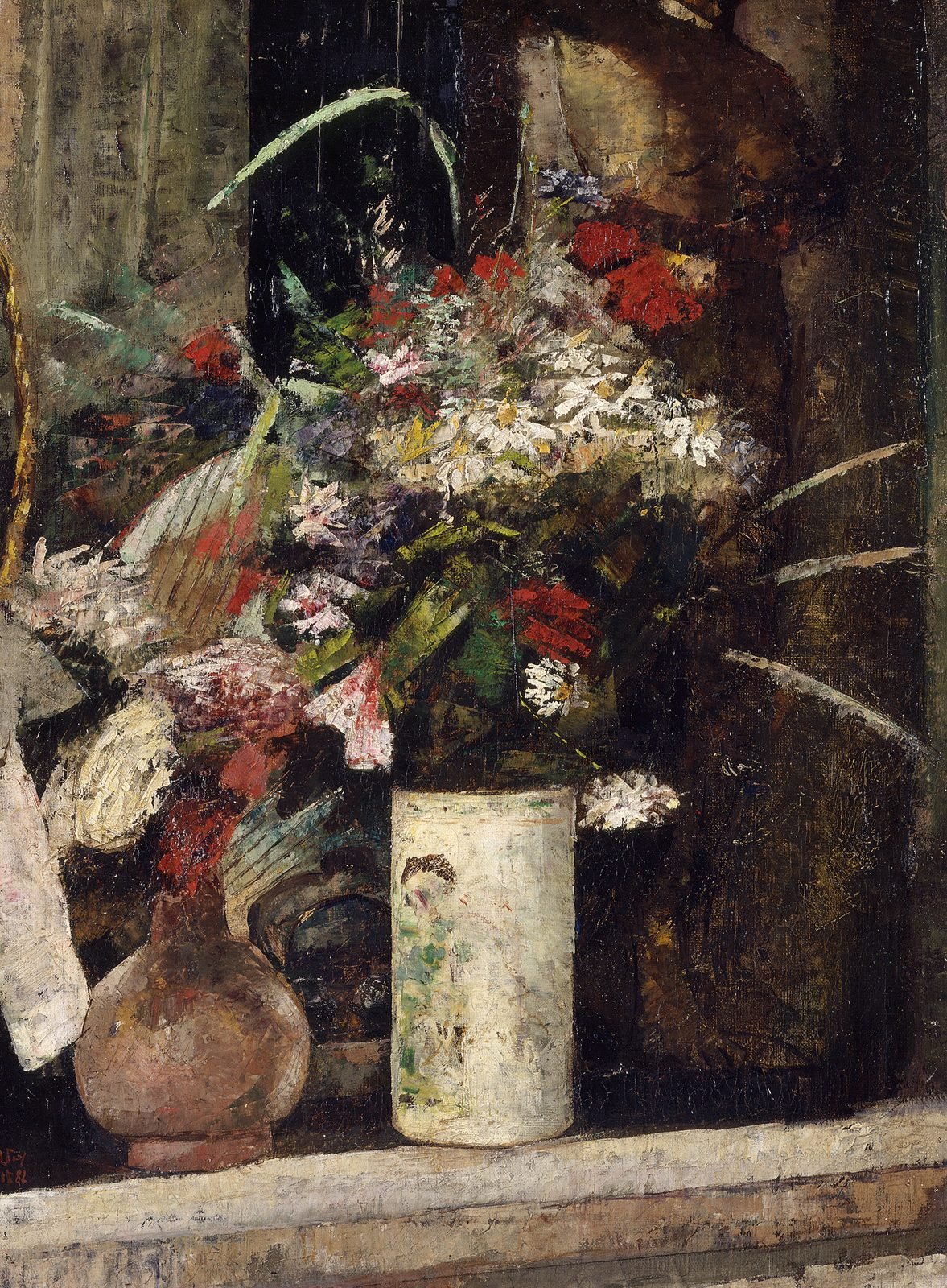
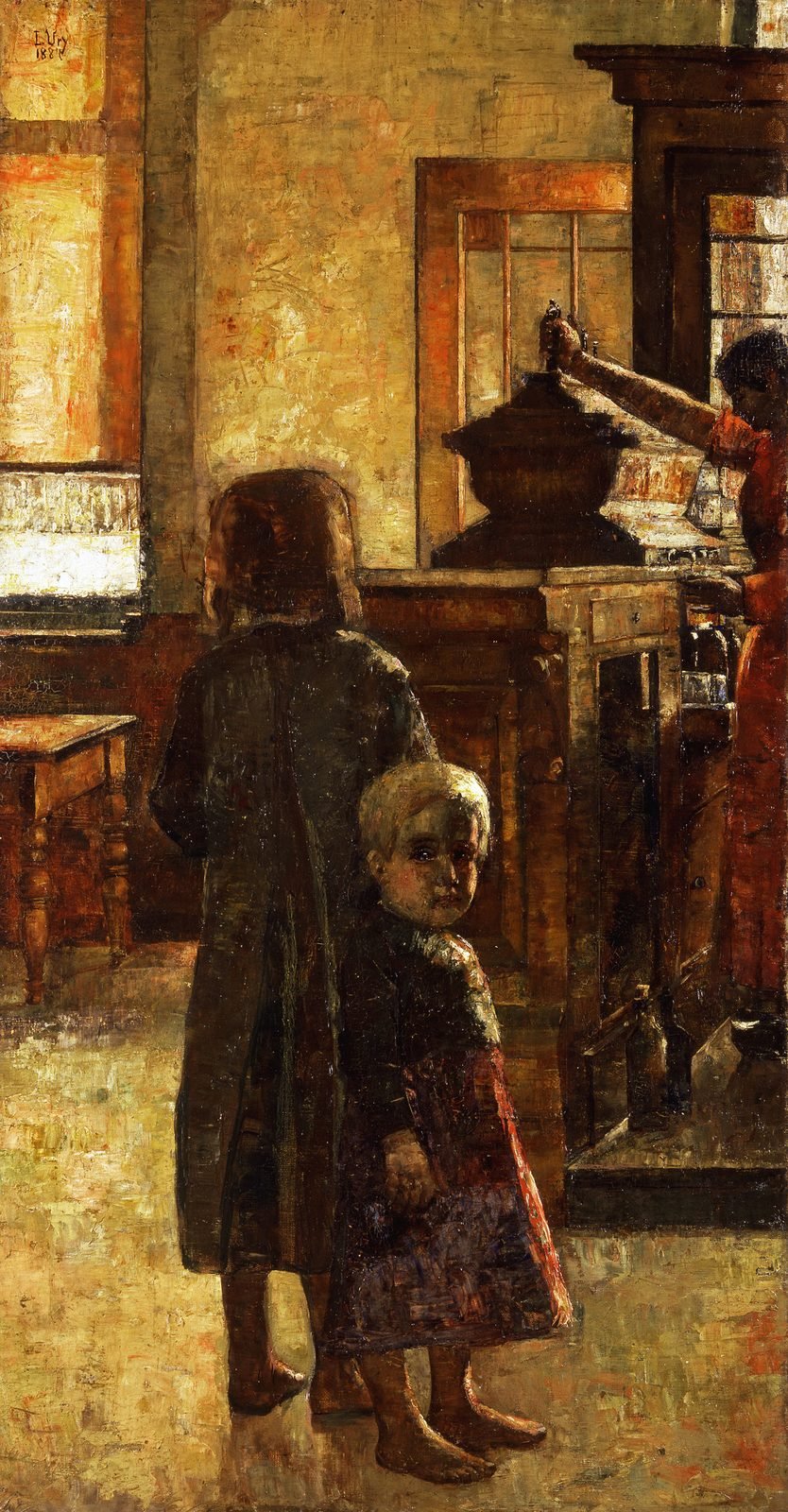
In 1882 Ury enrolled at the Académie Royale des Beaux-Arts in Brussels. In Paris, the Nationalgalerie’s catalogue says, the twenty-year-old painted this still life of flowers on a mantelpiece, an early masterpiece. Unlike the Impressionists, the young Ury worked with strong contrasts of light and dark.
From 1882 to 1884 he lived in the Flemish village of Volluvet, today a suburb of Brussels, and painted its tavern. Both pictures came to the Nationalgalerie in 1923, by exchange from the painter himself.


05Rheingau, 1924
The Nationalgalerie’s catalogue is plain about it: above all, these modern night pieces made Ury’s art popular. Around the turn of the century he was known in Berlin chiefly for his city scenes — hurrying, faceless passers-by on wet streets, often in the evening. But on his travels he painted landscapes, in Berlin he took portrait commissions, and in the 1890s he finished monumental biblical canvases such as “Jerusalem” (1896).
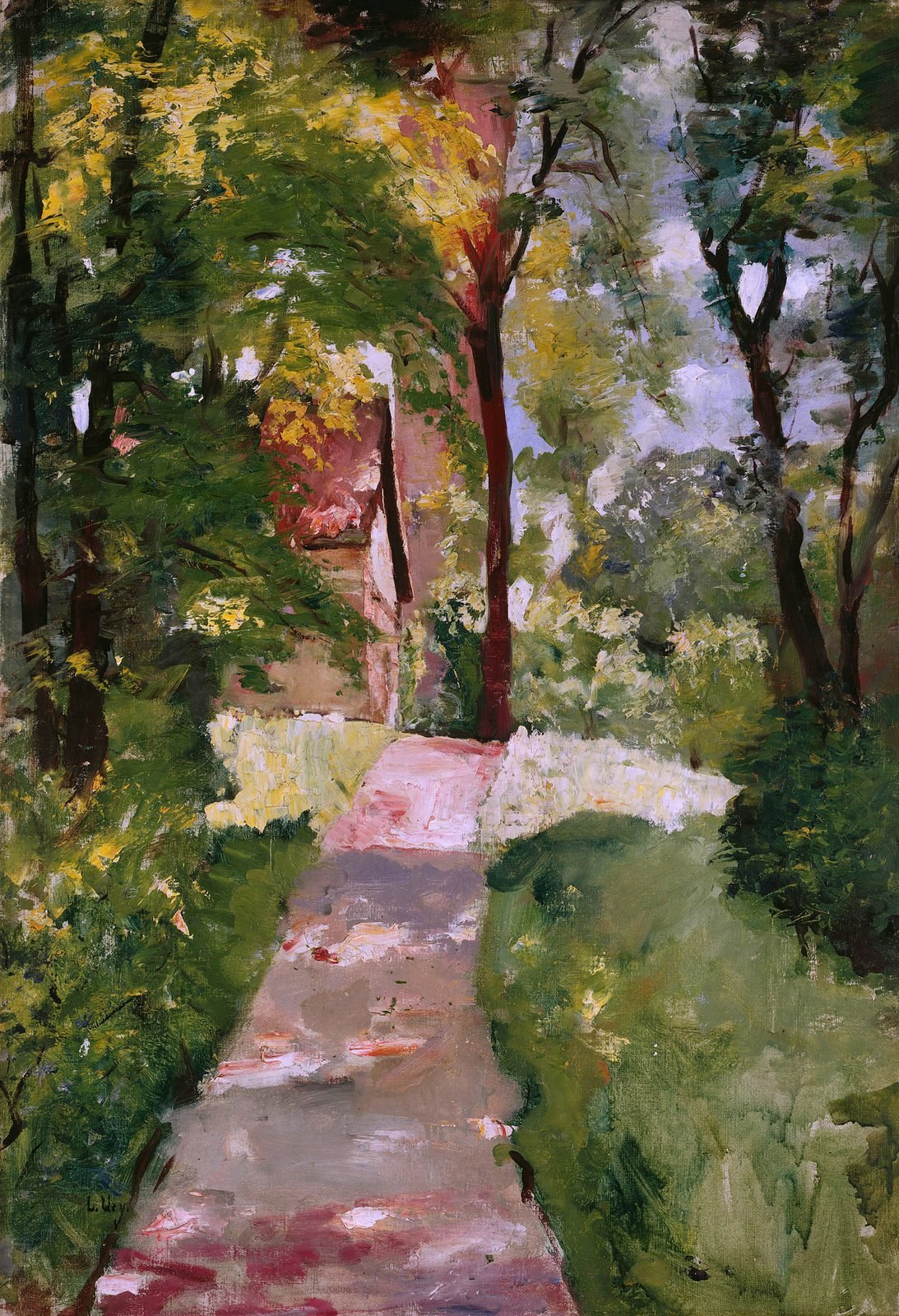
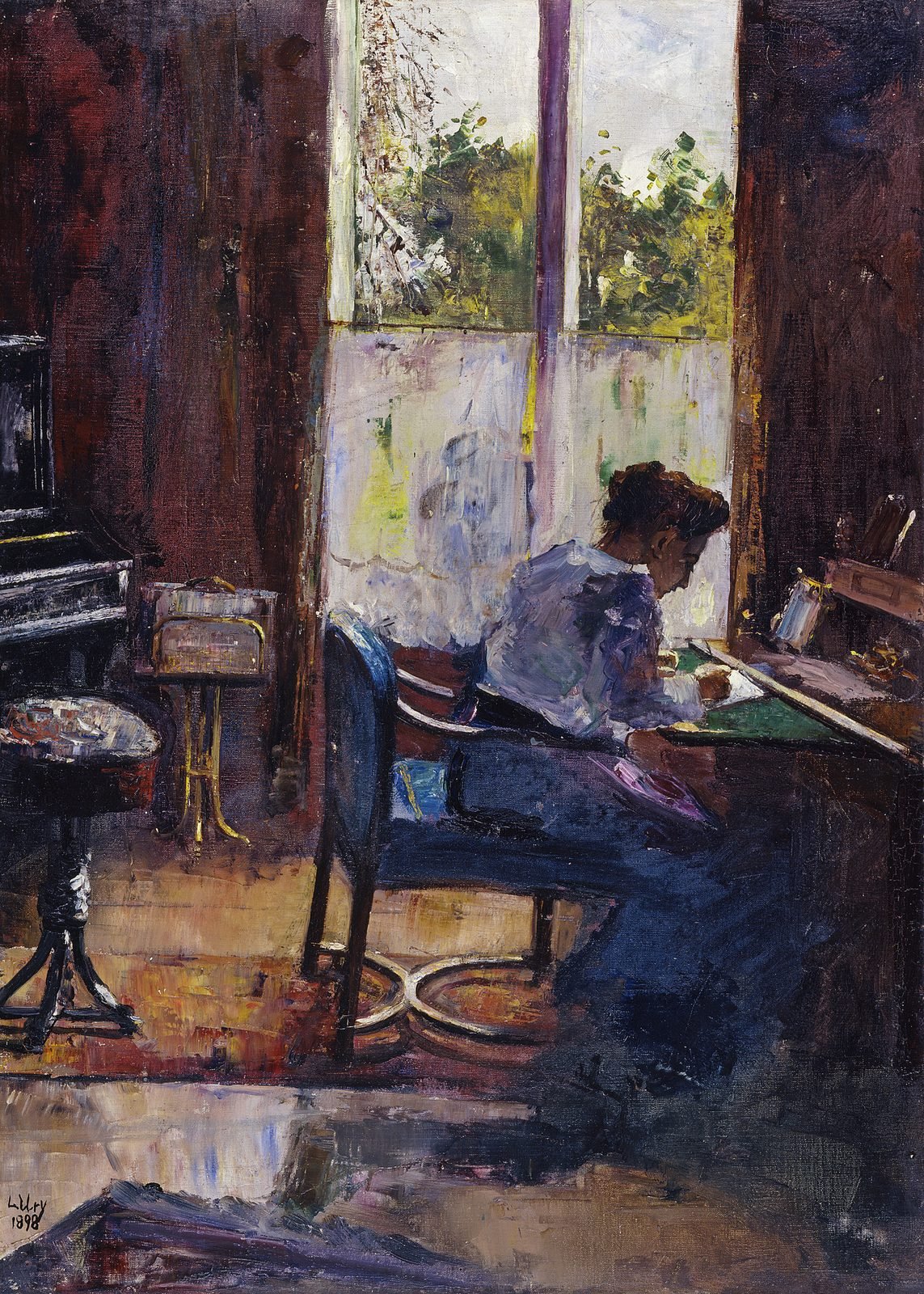
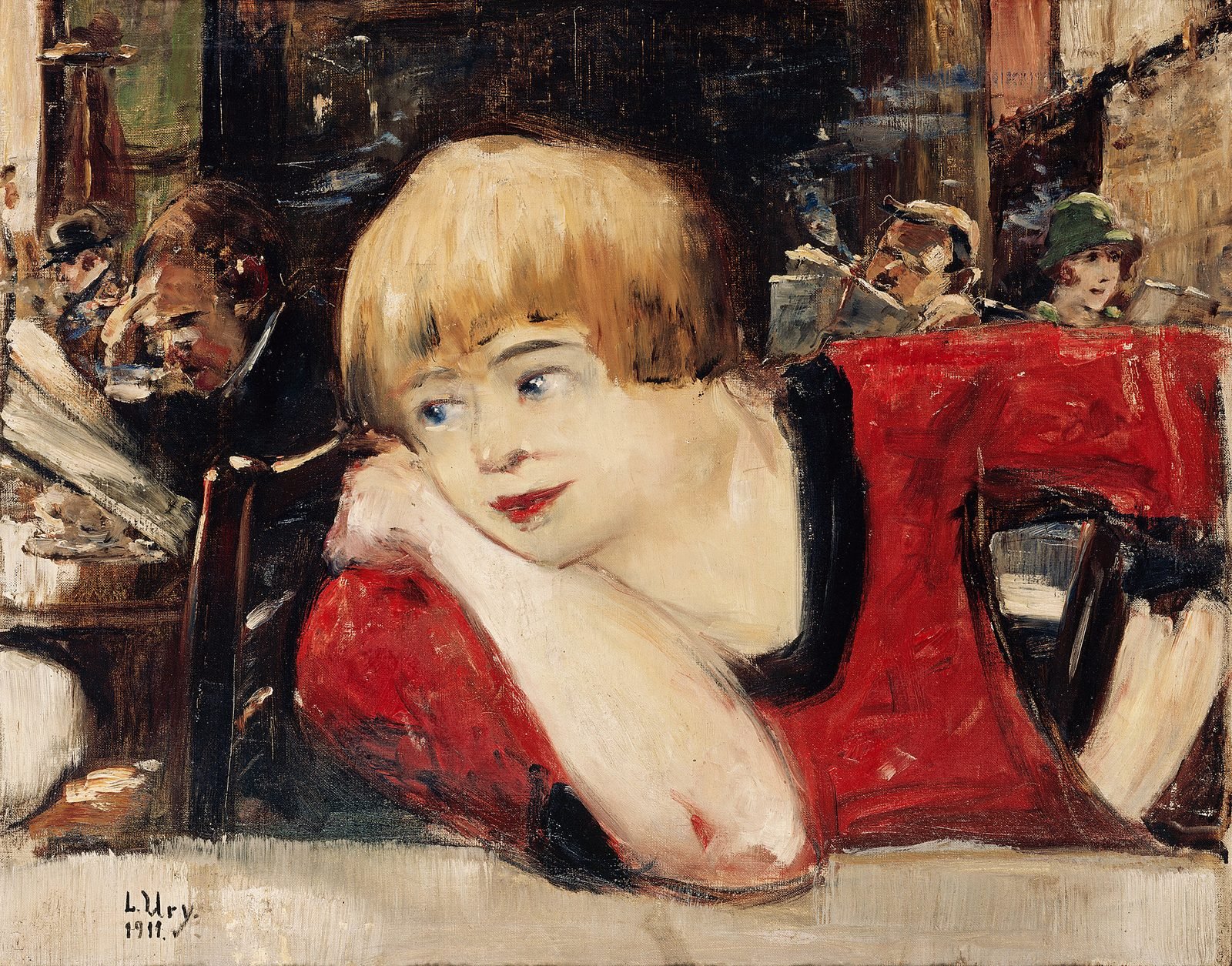
“Morgensonne” (morning sun), painted in 1924 at Schloss Reichartshausen on the Rhine, came from a summer of Rhine landscapes a critic described as painted “in full, blazing sun”. The Nationalgalerie bought it from him in 1926. Indoors he painted quiet rooms with a single woman, and cafés: a close-up face-to-face with a model, like the woman in red, is unusual in his work, the museum notes.


06Nollendorfplatz 1, 1901–1931
Ury painted the reflections of street lamps, advertising lights and car headlamps on rain-wet streets countless times, the Nationalgalerie writes. Set his small Berlin street of 1889 beside the Nollendorfplatz of 1925: the early picture’s black and beige, the night lightened only by the cold glare of electric street lamps, has become a bright, lively surface of yellow, rust-red and blue. Even the pavement on the left, with a couple strolling under an umbrella beneath the trees, is lit in colour.


He painted it from the fourth floor of Nollendorfplatz 1, looking across to the station of the elevated railway. In his last year, 1931, he was still painting the view from his studio window at different times of day.


The Nationalgalerie planned 158 of his paintings and pastels for his seventieth birthday. He died 20 days before the opening.
Ludwig Justi had planned the retrospective to open on 7 November 1931, Ury’s birthday. He died on 18 October 1931; the exhibition opened late.


Press & citation
Free to publish under CC BY 4.0 — in print, online, on Wikipedia and in teaching, commercially or not — with credit to Berlinfographics and a link to this page.
Ready-to-use image
The infographic as one image: headline, key figures, chart, sources and credit, 2,400 × 1,350 px PNG. Please use it unedited.
Download landscape (PNG)
Square format
A 1:1 version for social media and narrow columns, 1,800 × 1,800 px.
Download square (PNG)
Portrait 4:5
For Instagram and LinkedIn feeds, 1,620 × 2,025 px.
Download portrait (PNG)Credit line
Berlinfographics (berlinfographics.com), CC BY 4.0
Citation
Berlinfographics (2026). “Lesser Ury's Berlin at night”. Berlin Experiences. https://berlinfographics.com/lesser-ury-berlin-painter/
Wikipedia
{{cite web |title=Lesser Ury's Berlin at night |url=https://berlinfographics.com/lesser-ury-berlin-painter/ |website=Berlinfographics |publisher=Berlin Experiences |date=2026-11-07 |access-date=2026-11-07}}
Our infographics, charts and texts are licensed CC BY 4.0: free to republish, including commercially, with credit to Berlinfographics and a link. Photographs keep their own licences, named in each caption. How to credit
Topics: The Second World War · Cold War Berlin · Nazi Berlin · Persecution & the Holocaust · Weimar Berlin · Prussia & the Kaiserreich · Architecture & the built city · Culture, science & society · Reunified Berlin · Unusual facts
Contact: info@berlinfographics.com · Press: press@berlinfographics.com · Imprint · Privacy