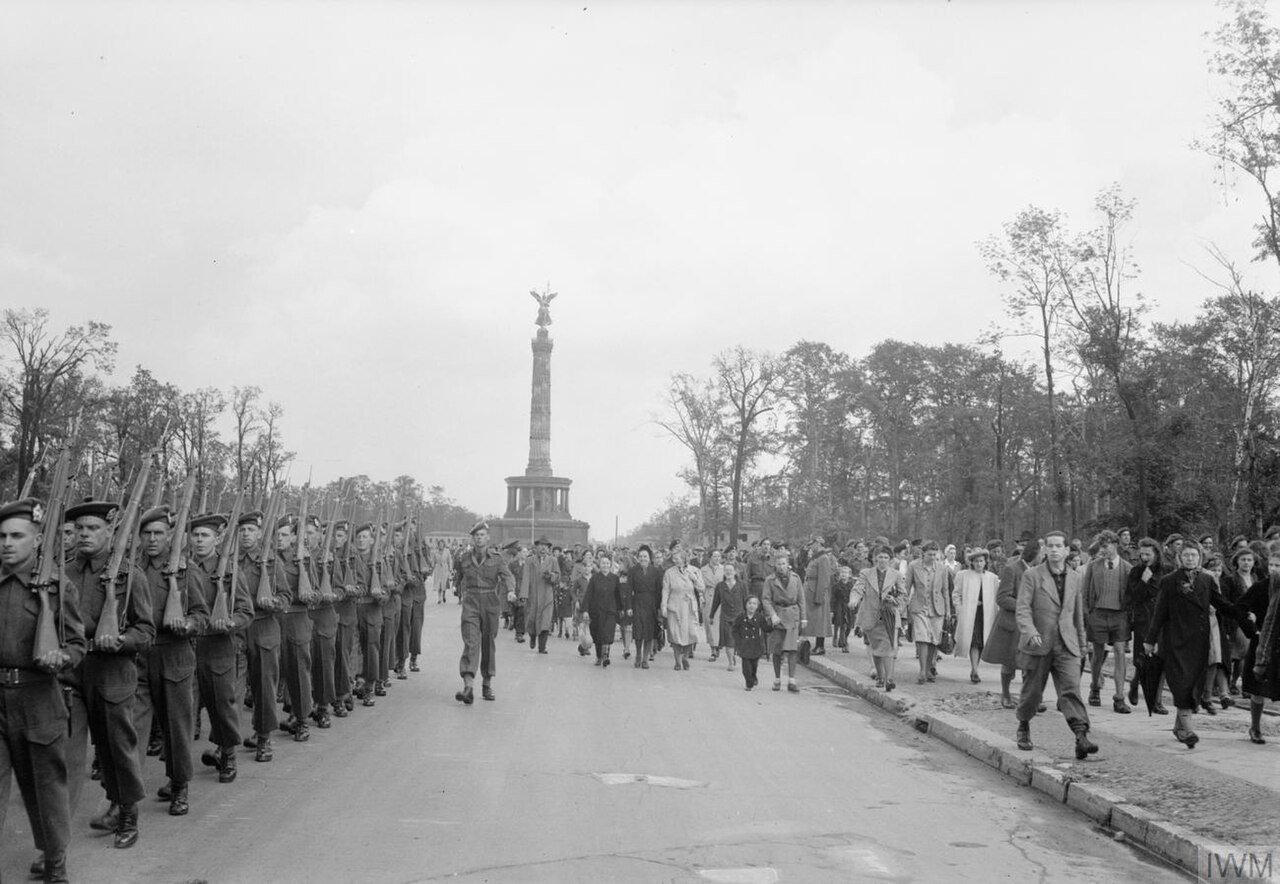
British troops march along the Charlottenburger Chaussee through the Tiergarten on 6 July 1945, away from the Victory Column, with Berliners walking beside them. Two months after the battle, trees still line the road.Photo: Sgt C. H. Hewitt and Capt. E. G. Malindine, No. 5 Army Film & Photographic Unit, 1945. Imperial War Museum BU 8632, via Wikimedia Commons. Public domain.
The Tiergarten
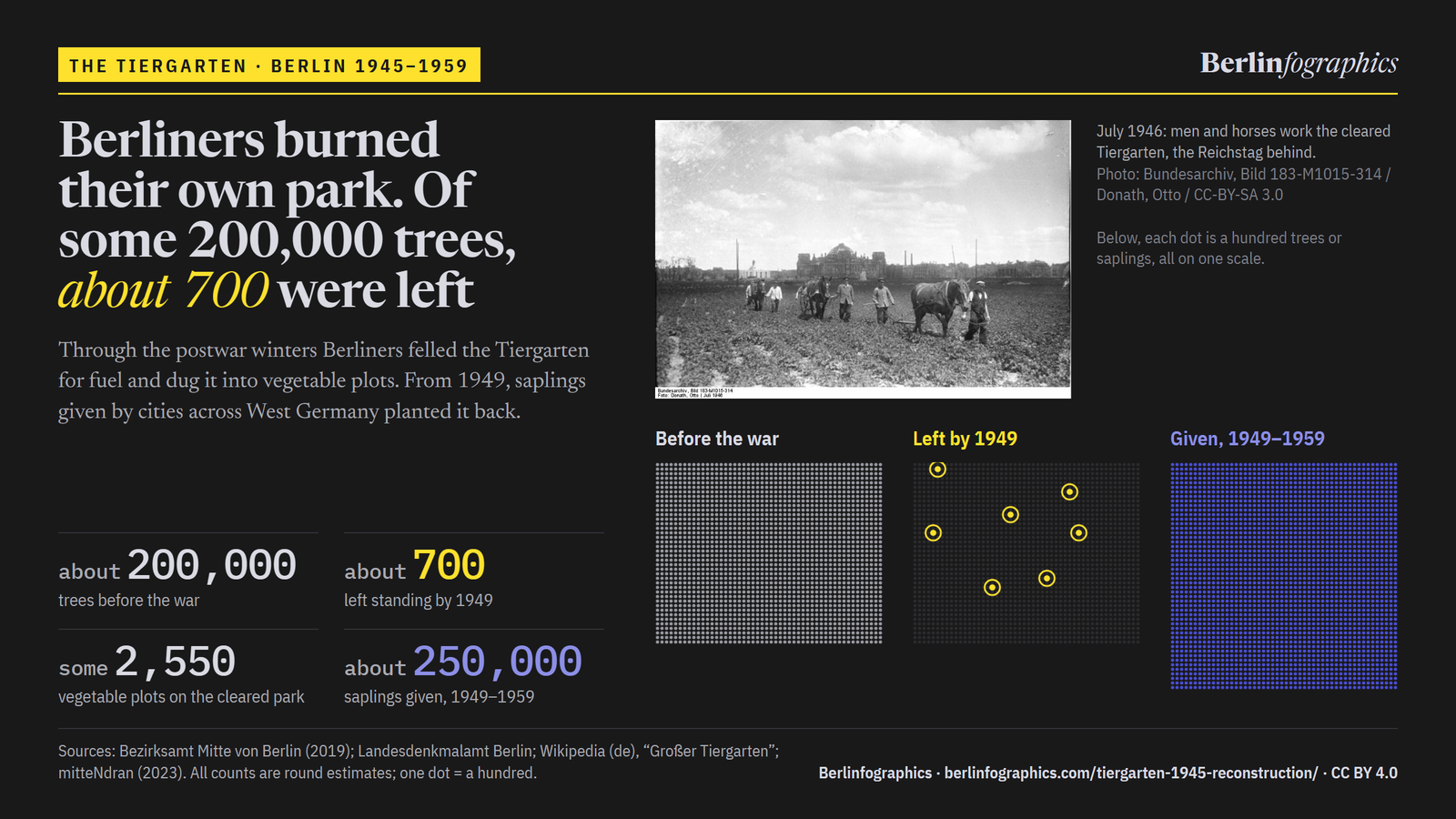
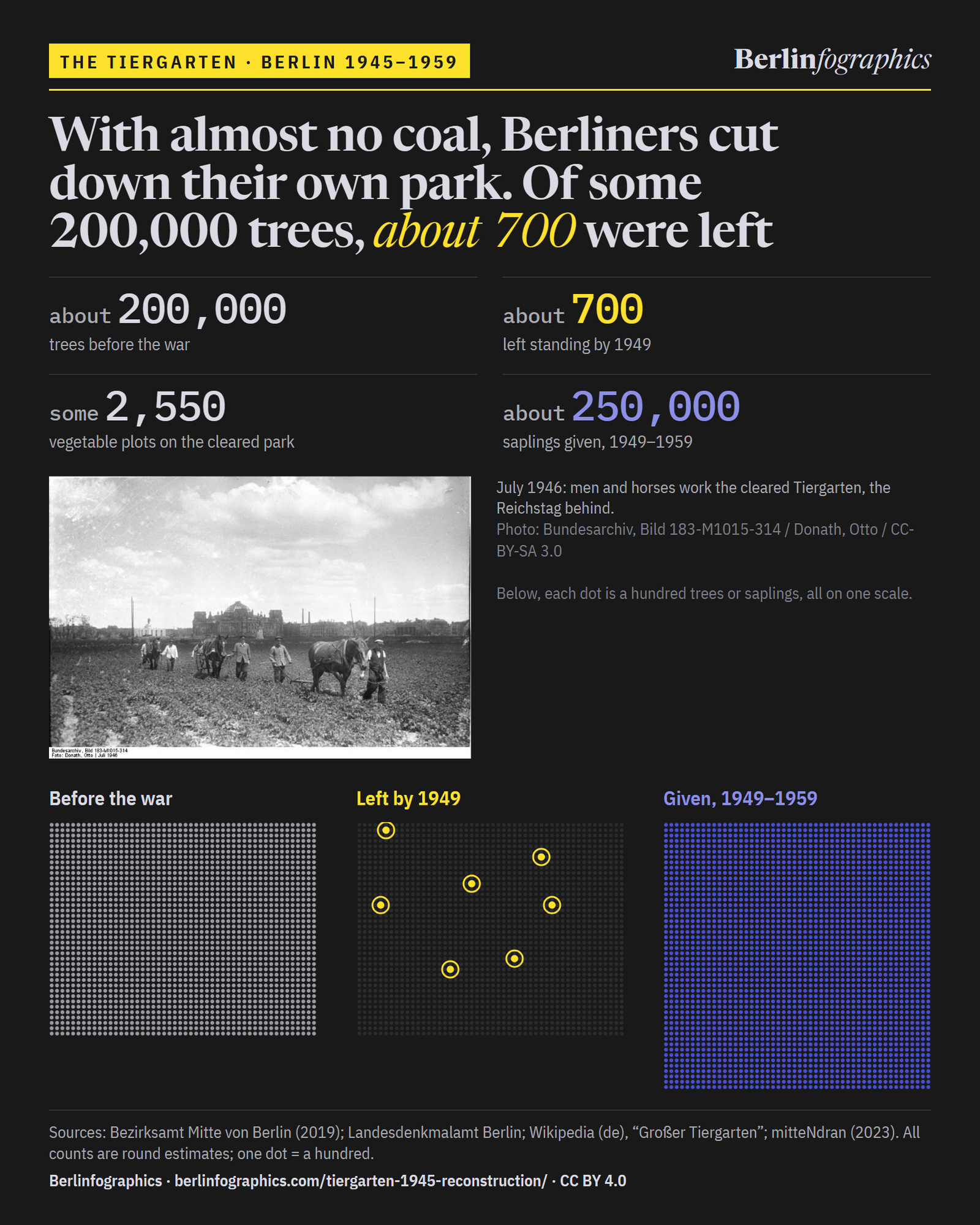
The war damaged the Tiergarten; the cold finished it. Through the postwar winters Berliners felled their great park for fuel and dug its ground into some 2,550 vegetable plots. From 1949, cities across West Germany sent saplings to plant it back.
011935–1945
Berlin’s great park covers about 210 hectares between the Brandenburg Gate and the Zoo. Before the war it held roughly 200,000 trees, a round figure, not a census.
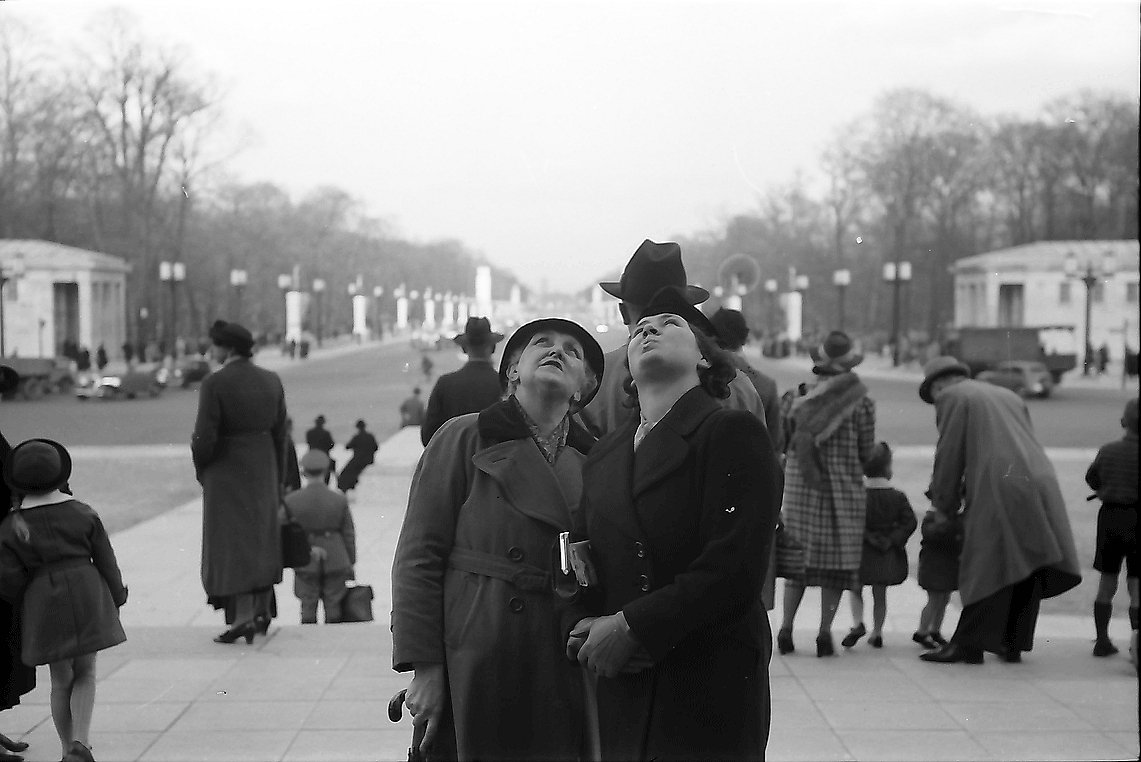
The Nazi regime remade it for its capital. In 1938–39, on Albert Speer’s orders, the Victory Column was moved from the Königsplatz to the Großer Stern on the new east–west axis. The square was widened from 80 to 200 metres across.


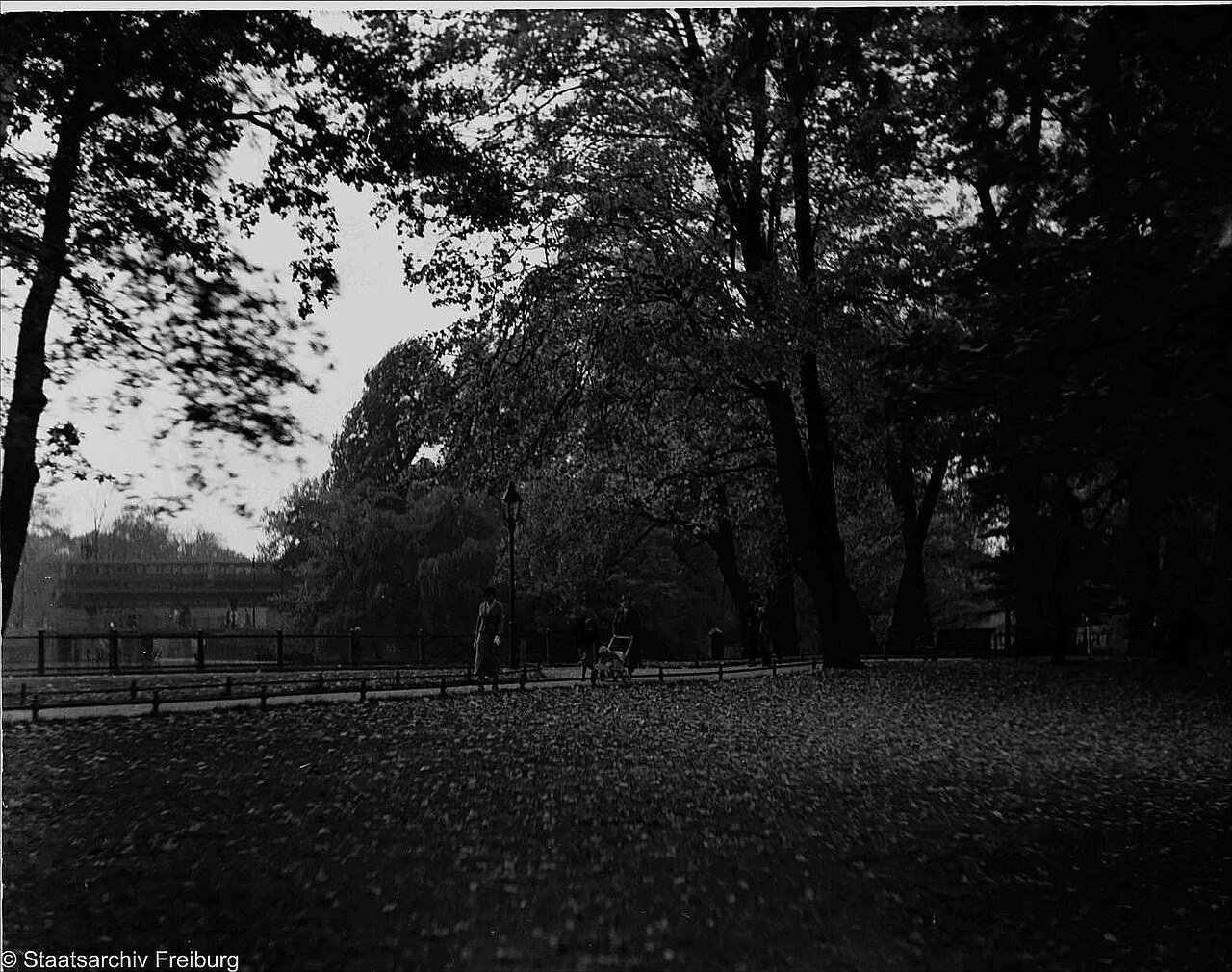
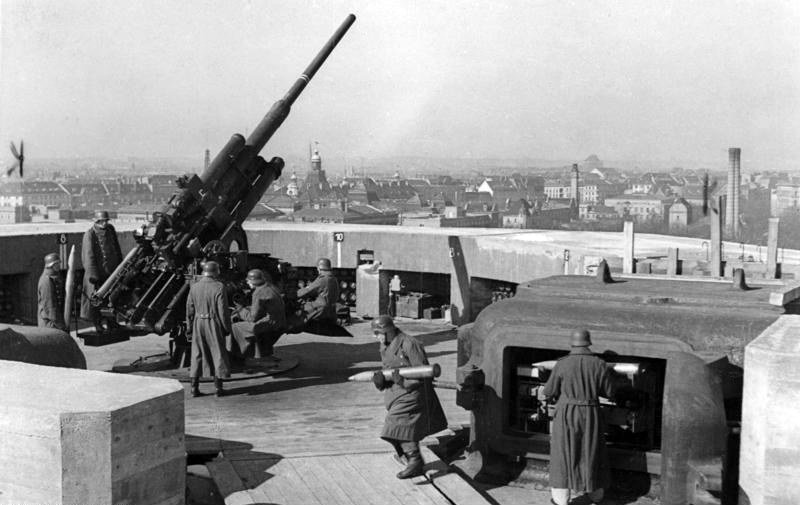
In April 1941 the first of Berlin’s flak towers was finished beside the Zoo, at the park’s south-western corner. Allied air raids damaged the Tiergarten heavily, and in the spring of 1945 the battle for the city reached the government quarter on its eastern edge.

The Tiergarten before the war
Round figures from the sources named. One dot stands for a hundred.
Before 1939
Each dot is a hundred trees: the whole Tiergarten as it stood before the war, about 200,000 trees on some 210 hectares.
July 1945
Bombing and the fighting had broken the wood, but this photograph shows trees still standing along the Charlottenburger Chaussee. Then came the first winter of peace, with almost no coal, and in 1945–46 Berliners began to fell the park for fuel.
By 1949
When replanting began, roughly 700 trees were still standing: about one in every 286. Even the stumps were dug out and burned.
After the war
With the trees gone, the cleared ground was handed out for vegetables: some 2,550 plots by the count most often given (others round it to 2,500). Each square here is one plot. They count plots, not area.
17 March 1949
On 17 March 1949 the mayor, Ernst Reuter, planted the first new tree: a linden.
1949–1959
Saplings came from across West Germany, about 250,000 in all. Bremen sent 30,000 young trees, which arrived on 6 December 1949. Each blue dot is a hundred saplings; the lighter ones are Bremen’s. The programme ran until 1959.
021945–1948
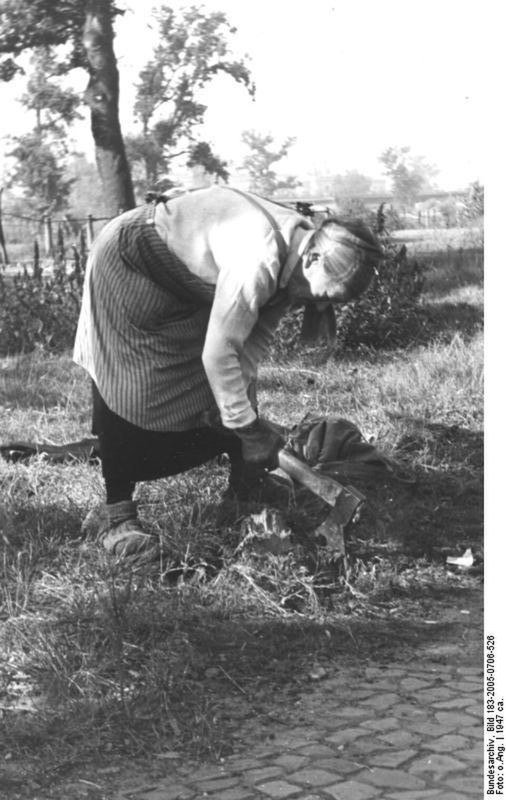
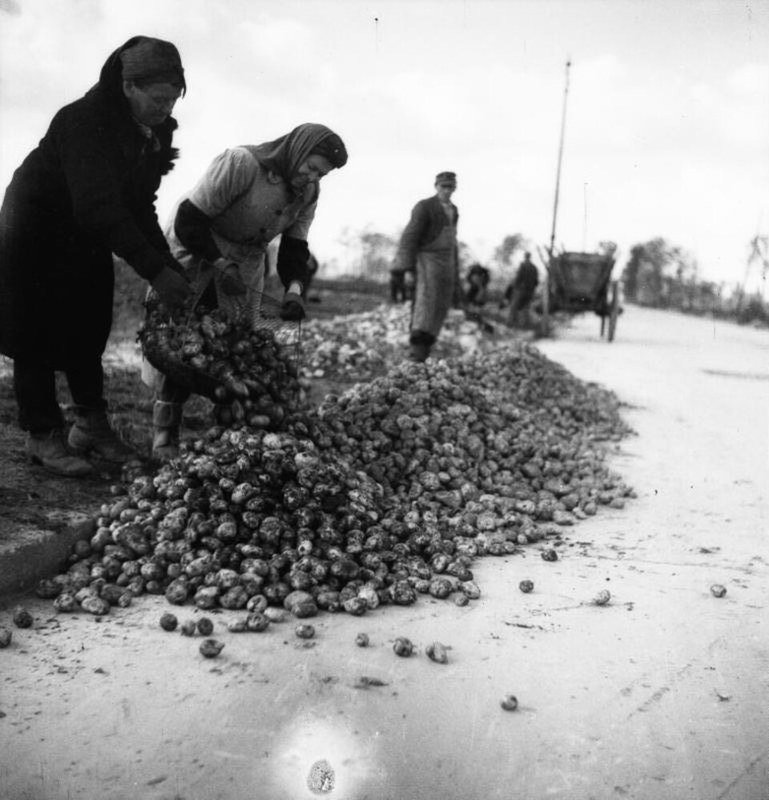
Berlin in 1945 had almost no coal. The Landesdenkmalamt records that in the winter of 1945–46 Berliners all but clear-felled the Tiergarten, and the felling went on through the hard winters that followed.
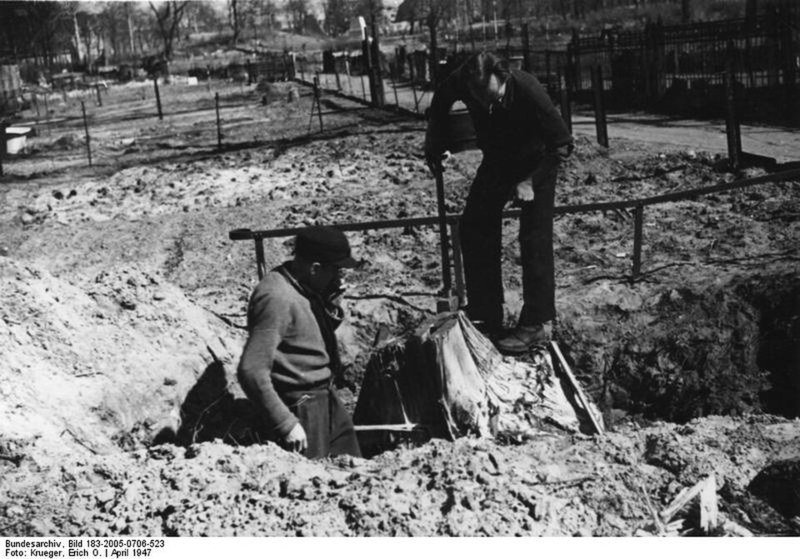
Even the stumps were dug out for firewood. By the time replanting began in 1949, of some 200,000 trees about 700 were standing.


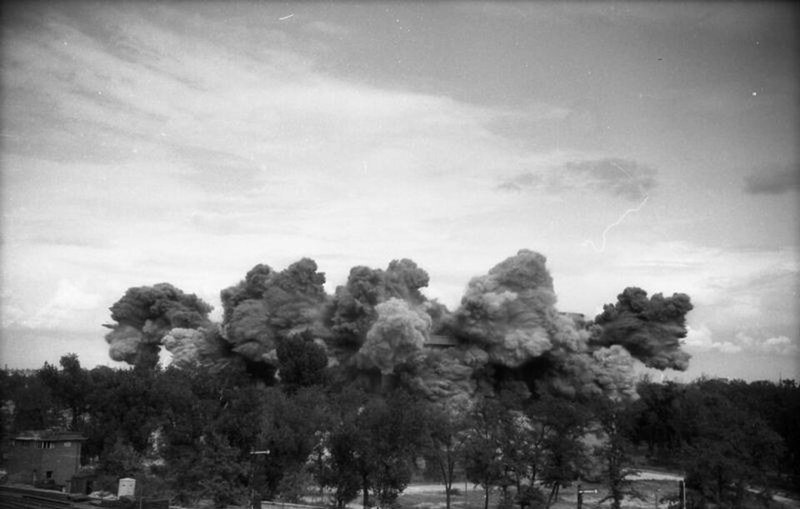
The concrete outlived the wood. The Zoo flak tower was blown up in stages; the gun tower came down on 30 July 1948.

031946–1949
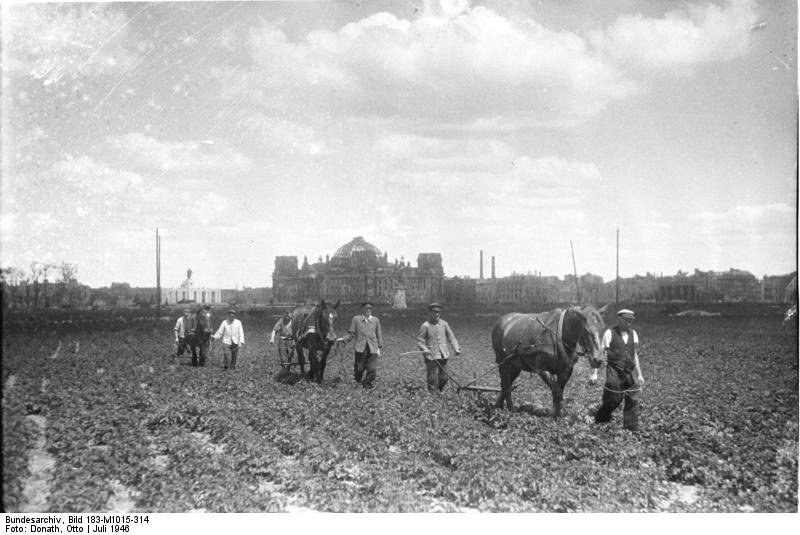
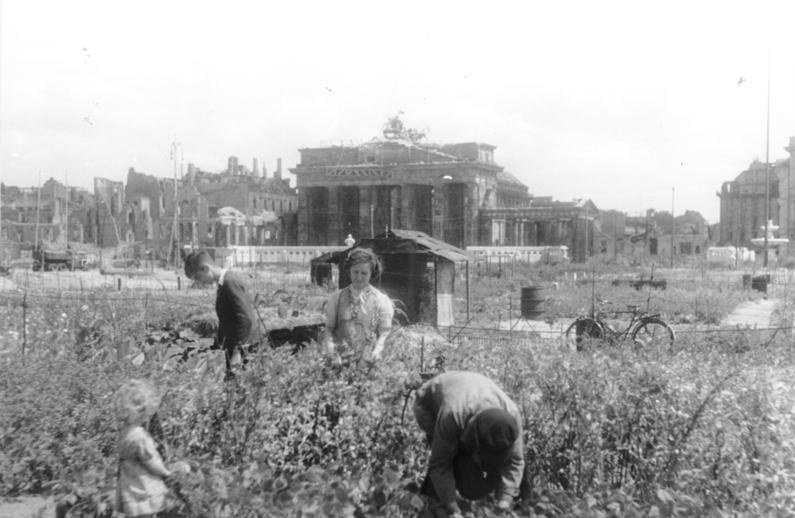
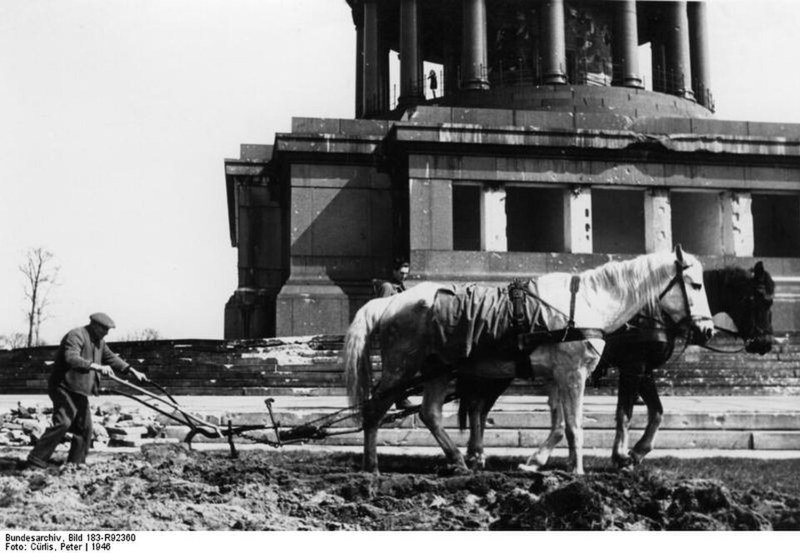
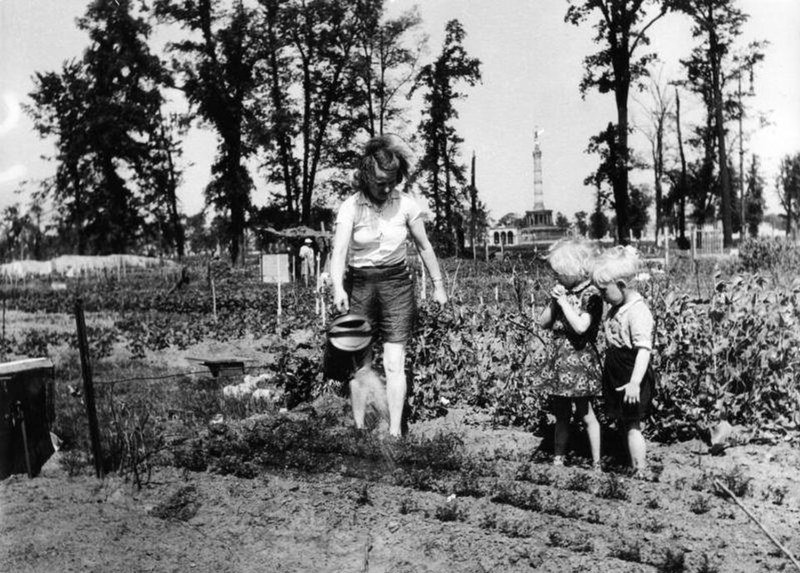
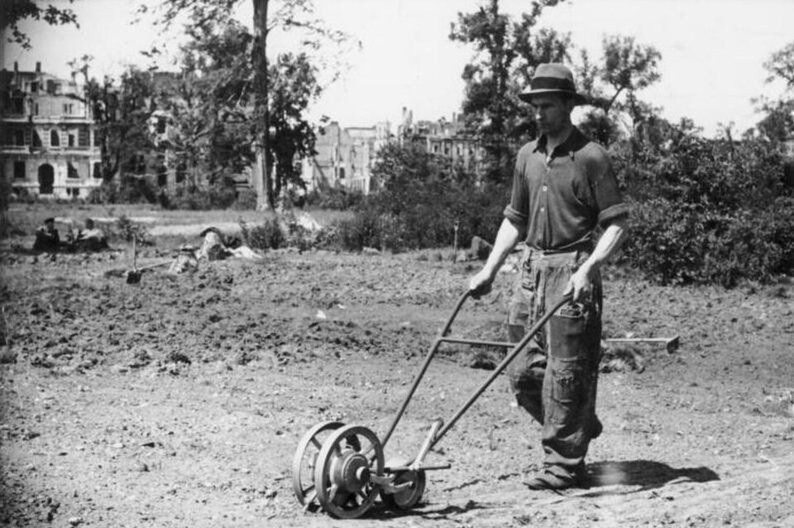
The cleared ground was not left empty. Food was desperately short, and the park was divided into vegetable plots: some 2,550 of them, by the count most often given. Horses pulled ploughs where the woodland paths had run.

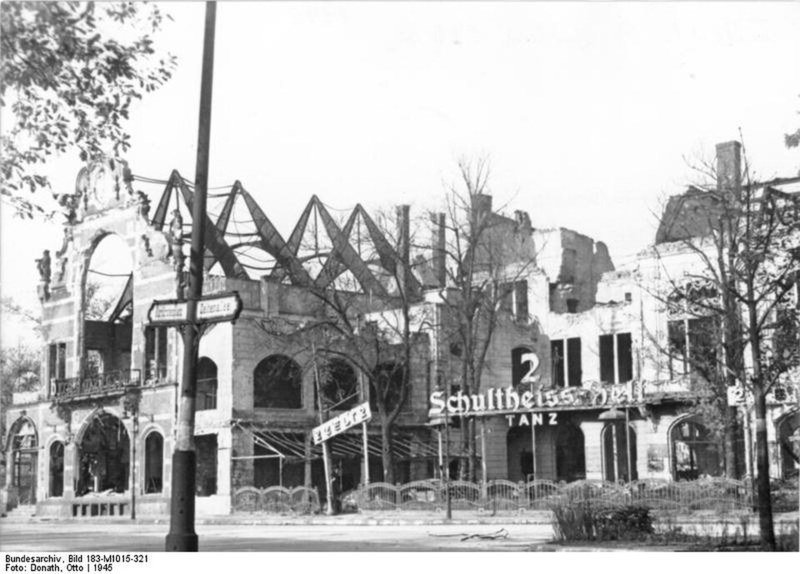
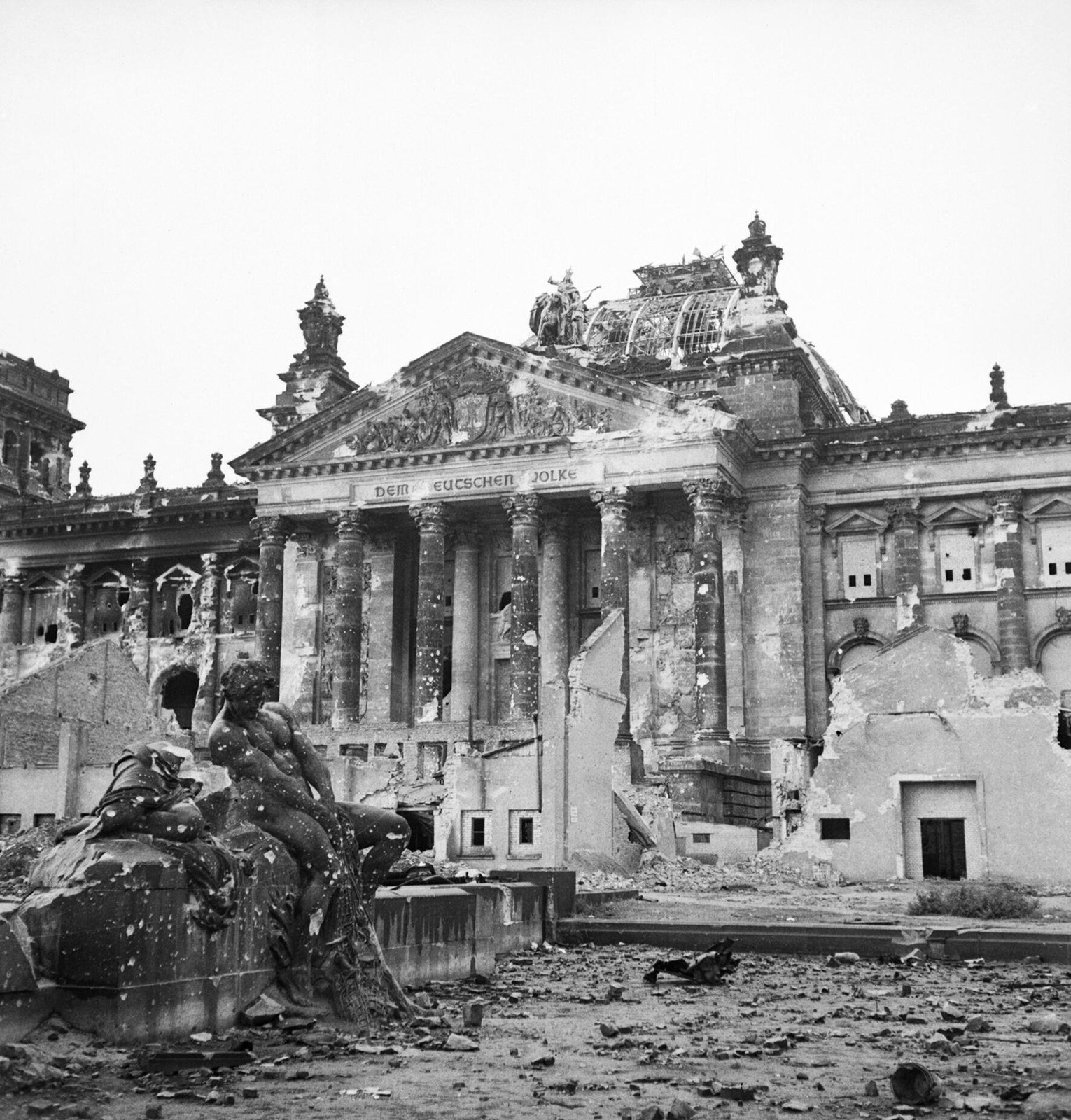
The photographs of those years show plots fenced with wire and scrap, sheds, a bathtub, and the ruins of the government quarter on every horizon: the Reichstag, the Brandenburg Gate, the Victory Column on its new site.
Where Speer had widened a square for parades, Berliners ploughed for potatoes.


The plots were a stopgap. As soon as the city could find trees to plant, they were cleared again for the park.
041949–1959
On 17 March 1949, Ernst Reuter, the mayor, planted the first new tree, a linden. It was the start of a replanting that ran until 1959 and depended almost entirely on gifts.
Bremen’s mayor, Wilhelm Kaisen, was so shaken on a visit to Berlin that his city sent 30,000 young trees; they arrived on 6 December 1949. In all, about 250,000 donated saplings came from across West Germany, Bremen’s gift about 12 per cent of them.
The British gave too. Their commandant appealed for plants, and the British and their royal family sent more than 5,000 trees and shrubs for a new Englischer Garten in the north of the park, handed over by Reuter on 29 May 1952.

The park, 1935–1960, at true time

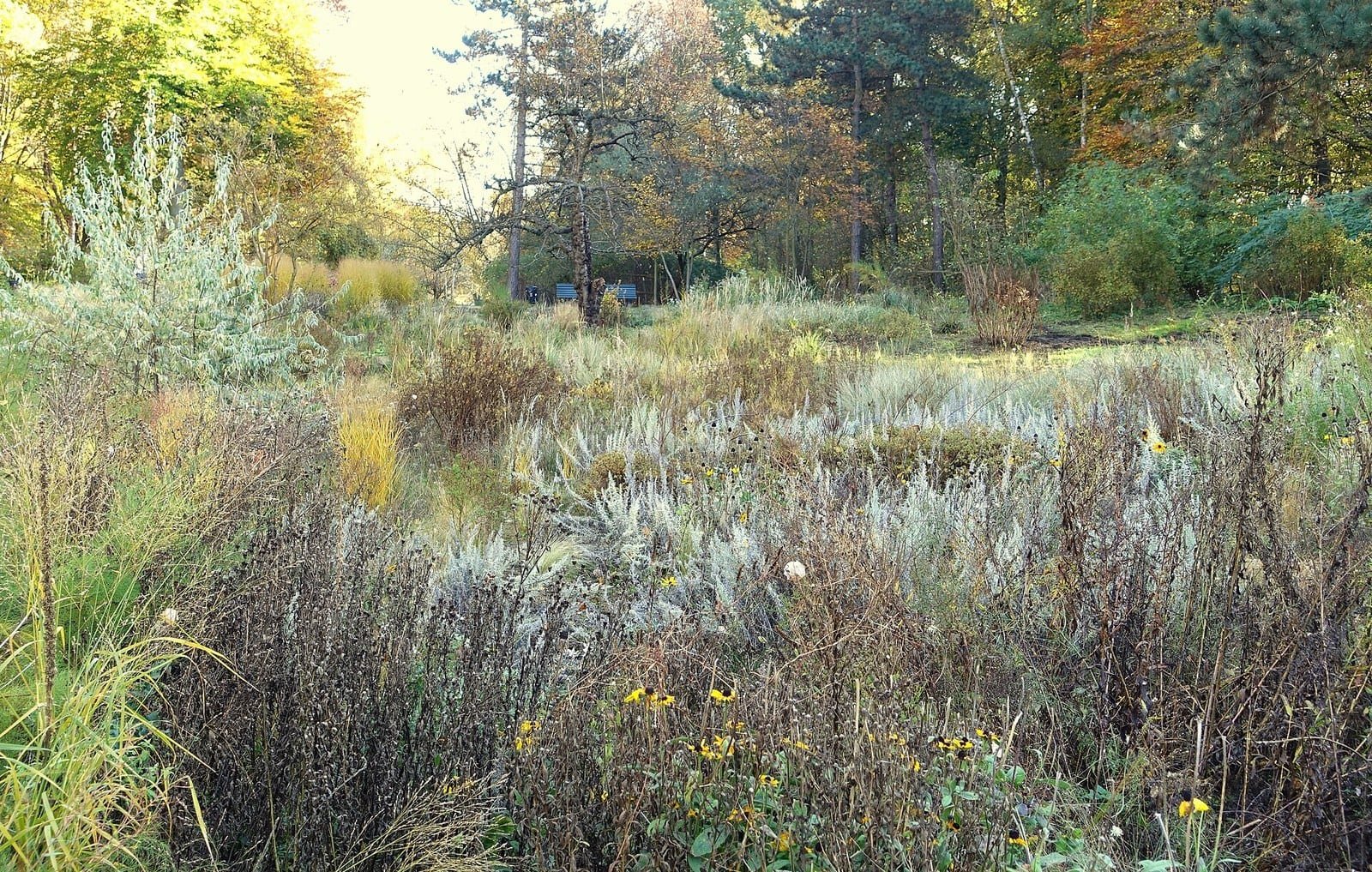
Of the old wood, about 700 trees were left. Nearly all of the Tiergarten Berliners walk through today was planted after 1949.
Press & citation
Free to publish under CC BY 4.0 — in print, online, on Wikipedia and in teaching, commercially or not — with credit to Berlinfographics and a link to this page.
Ready-to-use image
The infographic as one image: headline, key figures, chart, sources and credit, 2,400 × 1,350 px PNG. Please use it unedited.
Download landscape (PNG)
Square format
A 1:1 version for social media and narrow columns, 1,800 × 1,800 px.
Download square (PNG)
Portrait 4:5
For Instagram and LinkedIn feeds, 1,620 × 2,025 px.
Download portrait (PNG)Credit line
Berlinfographics (berlinfographics.com), CC BY 4.0
Citation
Berlinfographics (2026). “The Tiergarten felled and replanted, 1945–1959”. Berlin Experiences. https://berlinfographics.com/tiergarten-1945-reconstruction/
Wikipedia
{{cite web |title=The Tiergarten felled and replanted, 1945–1959 |url=https://berlinfographics.com/tiergarten-1945-reconstruction/ |website=Berlinfographics |publisher=Berlin Experiences |date=2026-11-05 |access-date=2026-11-05}}
Our infographics, charts and texts are licensed CC BY 4.0: free to republish, including commercially, with credit to Berlinfographics and a link. Photographs keep their own licences, named in each caption. How to credit
Topics: The Second World War · Cold War Berlin · Nazi Berlin · Persecution & the Holocaust · Weimar Berlin · Prussia & the Kaiserreich · Architecture & the built city · Culture, science & society · Reunified Berlin · Unusual facts
Contact: info@berlinfographics.com · Press: press@berlinfographics.com · Imprint · Privacy