Berlinfographicsby Berlin Experiences

Building workers among the crowd in East Berlin, 17 June 1953. Behind them, faces at every window.Photo: Bundesarchiv, Bild 146-2003-0031 / CC BY-SA 3.0 de

The uprising of June 1953

80 building workers walked off a site in East Berlin on 16 June 1953. By 21 June, about a million East Germans had joined them.

They were striking against a pay cut by decree. On 17 June the strike became a rising against the ruling SED across the GDR; by 21 June it had reached about 700 towns and villages. Soviet tanks put it down. At least 55 people died.

80
building workers set off along the Stalinallee, 16 June, 8:30
~700
towns and villages, 16 June – 21 June
~1m
people on strike or in the streets
≥55
dead, each documented by researchers in 2004
01East Berlin, May–June 1953

The government ordered a pay cut and called it a norm

On 28 May 1953 the GDR’s leadership raised the work norms, the output a worker had to deliver for the same pay, by at least 10 per cent.

On 9 and 10 June the ruling party announced a softer “New Course”. It did not take back the higher norms.

On 15 June and 16 June the gangs on East Berlin’s big building sites struck. The biggest site of all was the Stalinallee, the regime’s “first socialist street”.

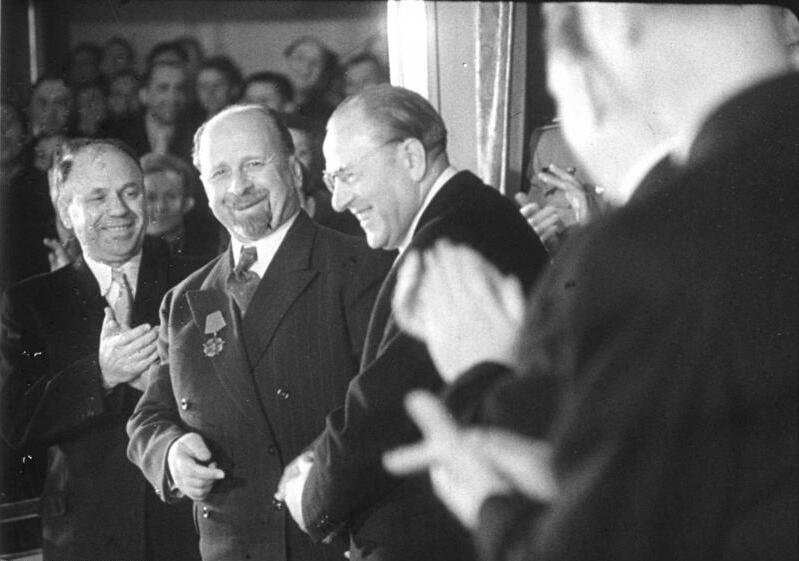
Black-and-white photograph of smiling men in suits applauding; one wears a medal on his lapel.
Walter Ulbricht (centre, with the medal), General Secretary of the ruling SED, and Prime Minister Otto Grotewohl receive the Karl Marx Order at the State Opera, 8 May 1953, three weeks before the norm increase.Photo: Bundesarchiv, Bild 183-19634-0001 / Unknown / CC BY-SA 3.0 de

02East Berlin, 16–17 June

From 80 men to 150,000 people in just over a day

At about 8:30 on 16 June the first 80 building workers set off along the Stalinallee. By 9:30 there were 2,000. At about 13:30 the head of the march reached the House of Ministries on Leipziger Straße, right on the sector boundary, and soon more than 10,000 people stood outside. That same day the government withdrew the norm increase. It was too late.

„Für morgen rufen wir den Generalstreik aus!““We call a general strike for tomorrow!”, a worker announced to the crowd outside the House of Ministries.

The crowd in East Berlin, 16 June – 17 June: each circle’s area is the number of people

Times and counts from the Bundesarchiv. At 11:00 it counts 150,000 marching; it also gives 100,000 East Berliners on the streets that day (inner ring).

Before 7:00 on 17 June, more than 10,000 people were already waiting at Strausberger Platz. At about 11:00 some 150,000 were marching, by the Bundesarchiv’s count; it also gives 100,000 on the streets of East Berlin that day. In front of the House of Ministries stood about 20,000, and some hundreds broke in.

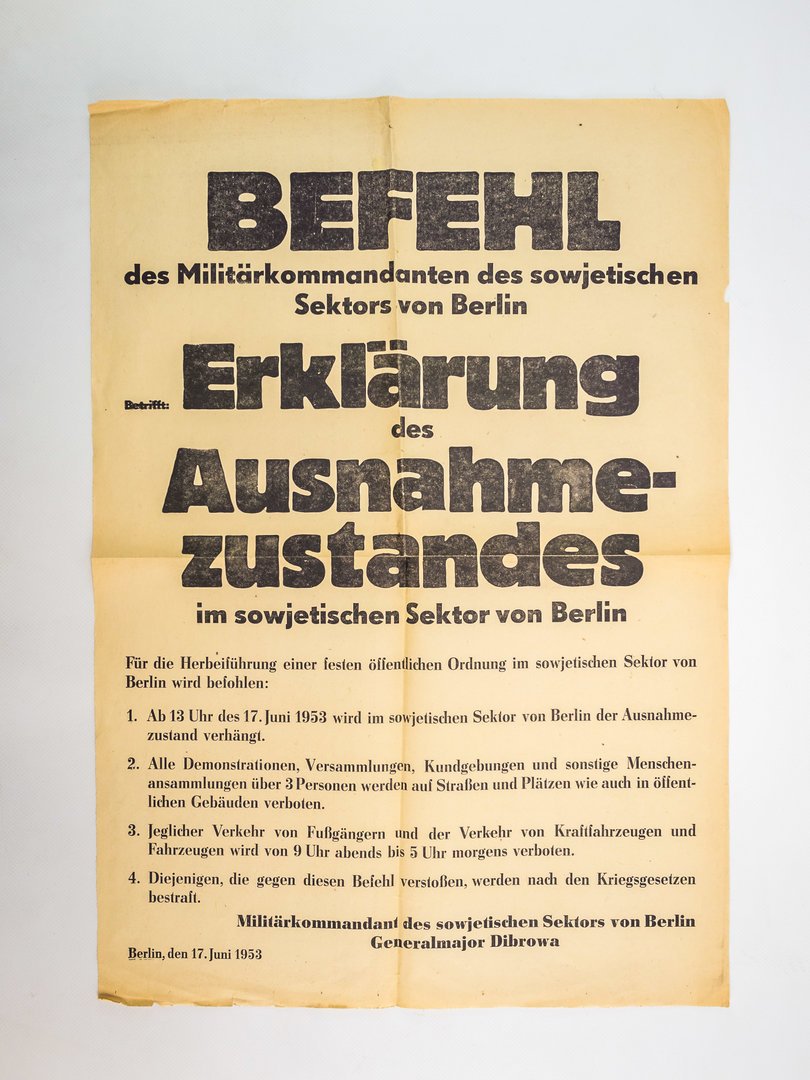
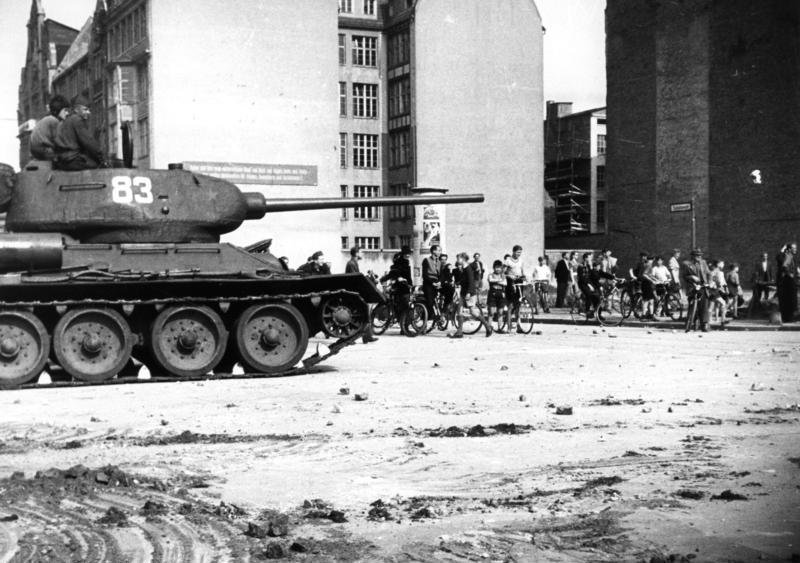
Soviet armoured cars came in from about 9:00, heavy tanks from 11:30. The first shots were fired at 12:00. At 13:00 the Soviet commandant put the sector under a state of emergency. In East Berlin alone the Soviet army deployed three divisions with 600 tanks. At least seven people were shot dead in Berlin that day.

A long, pale stone government building with rows of square windows and a colonnade at street level, under a clear sky.
The House of Ministries on Leipziger Straße, built as Göring’s Air Ministry and today the Federal Finance Ministry. The marchers reached it at about half past one on 16 June. The square in front is now named Platz des Volksaufstandes von 1953.Photo: Jensens, 2008. Wikimedia Commons. Public domain.
A yellowed poster headed BEFEHL in heavy black type, announcing the state of emergency in the Soviet sector of Berlin, in four numbered points, signed by the military commandant.
DocumentThe order of the Soviet military commandant of East Berlin, Major-General Dibrowa, 17 June 1953: a state of emergency from 13:00; no gathering of more than three people; no one on the streets from nine at night to five in the morning.Document: Order of the Soviet commandant of the Soviet sector of Berlin, 17 June 1953 (DDR Museum object 1017147). Wikimedia Commons. Public domain.
Black-and-white photograph of a tank numbered 83 on a rubble-strewn square, a crowd of young men with bicycles behind it.
A Soviet T-34 tank in East Berlin, 17 June 1953. Young men with bicycles watch from across the square.Photo: Bundesarchiv, B 145 Bild-F005191-0040 / CC BY-SA 3.0 de

03The GDR, 16–21 June

One strike became a rising across the country

The GDR’s own records, now in the Bundesarchiv, trace the uprising town by town. Scroll on to follow it from one street in East Berlin to about 700 towns and villages, and to what it cost.

The GDR in June 1953

A map of the GDR with the towns where the Bundesarchiv documents the uprising, changing as you read: the strike in East Berlin, the rising across the country, the prisons opened, martial law, the dead and the arrests.

Map: Natural Earth (public domain); towns © OpenStreetMap contributors.

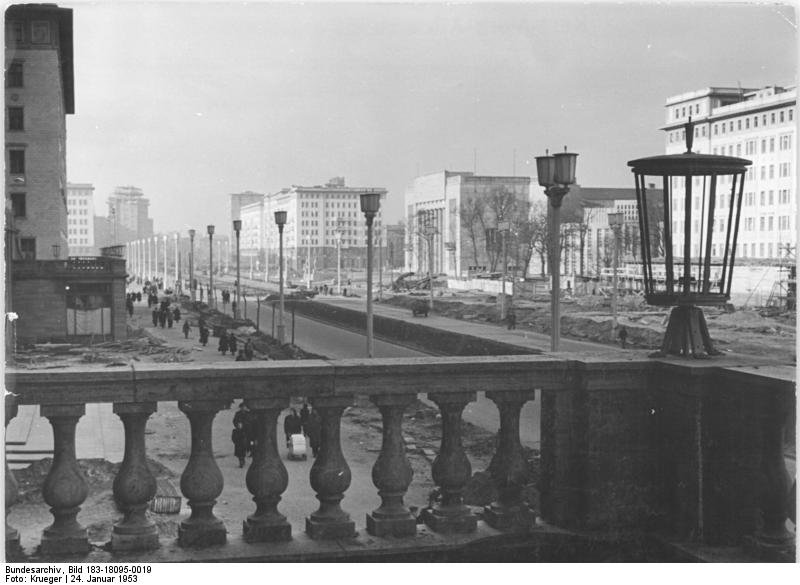
Black-and-white photograph from a stone balcony with lamps over a wide avenue under construction, new apartment blocks along both sides and building sites between them.
The Stalinallee under construction, January 1953: the view from a finished block towards Strausberger Platz. The building gangs on this street struck first.Photo: Bundesarchiv, Bild 183-18095-0019 / Krueger / CC BY-SA 3.0 de

15 June – 16 June

It began on one street

Gangs on East Berlin’s big building sites struck over the norms. On the Stalinallee the first 80 set off at about 8:30 on 16 June.

A rusted steel tank track rearing up from a cobbled strip in a lawn, a bronze plaque beside it, modern apartment buildings behind.
The memorial to 17 June 1953 on Dresden’s Postplatz, where demonstrators were penned in on the day of the rising: a length of tank track rising from the paving.Photo: Bybbisch94, 2019. Wikimedia Commons. CC BY-SA 4.0.

17 June – 21 June

About 700 towns and villages rose

Strikes and marches reached about 700 of the GDR’s 5,585 towns and villages, about one in eight. About a million people took part. Well over 1,000 works struck, and crowds stormed more than 250 public buildings.

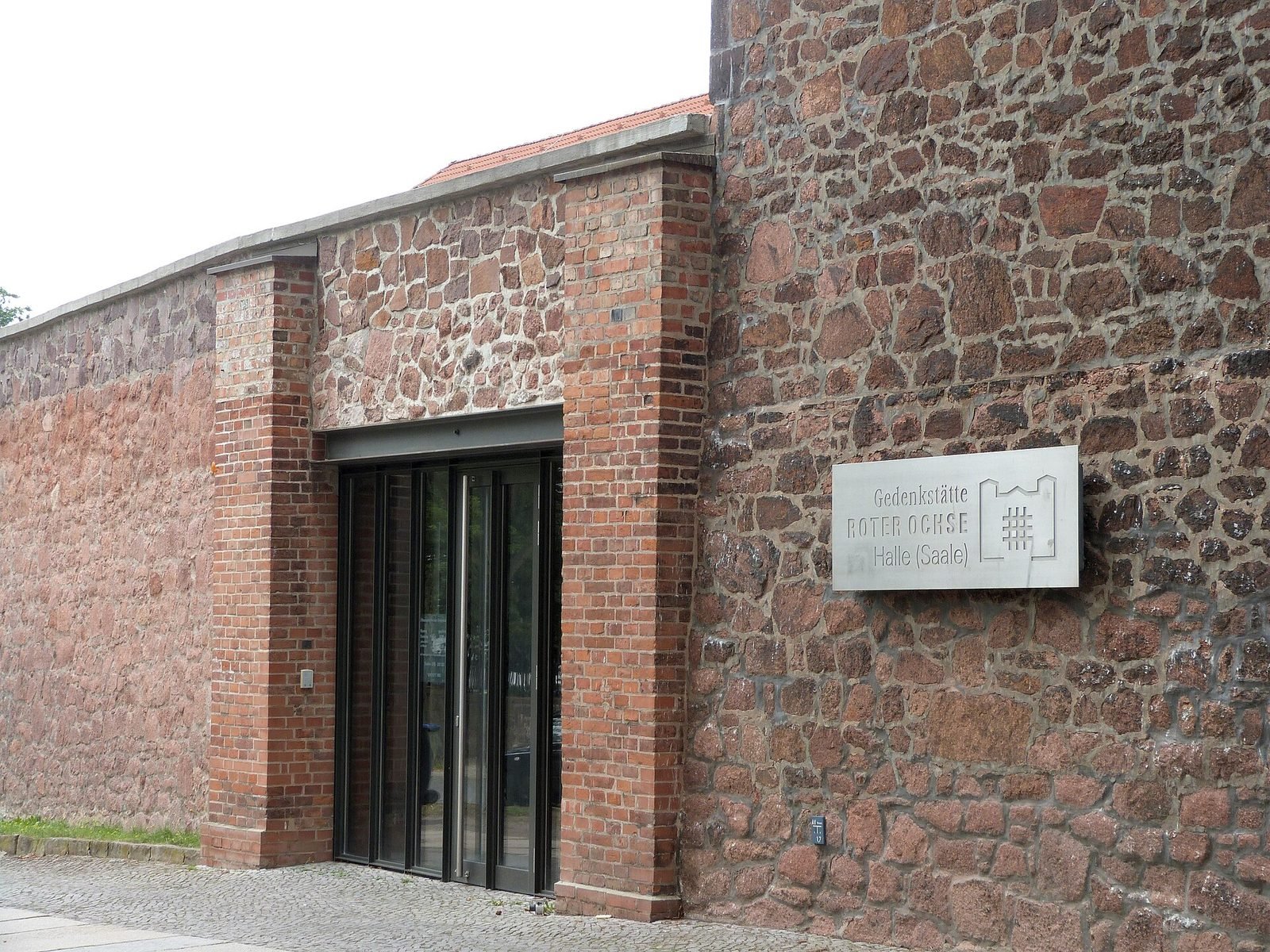
Colour photograph of a high red sandstone and brick wall with a glass entrance and a metal sign reading Gedenkstätte Roter Ochse.
The Roter Ochse prison in Halle, today a memorial. On 17 June 1953 crowds tried and failed to storm it; across the city the remand prison in Kleine Steinstraße was emptied.Photo: Catatine, 2016. Wikimedia Commons. CC BY-SA 4.0.

17 June – 20 June

Crowds opened the prisons

Demonstrators gathered outside at least 22 prisons and freed almost 1,400 prisoners from twelve of them. In Halle all 245 inmates of the remand prison were out by four in the afternoon. More than 1,200 were soon locked up again.

Black-and-white photograph of a heavy tank driving down a street in front of a domed neo-baroque court building, men in shirtsleeves watching in the foreground.
A Soviet heavy tank passes the former Reichsgericht in Leipzig, around 17 June 1953, as people watch from the pavement.Photo: Bundesarchiv, Bild 175-14676 / CC BY-SA 3.0 de

17 June – 18 June

Soviet tanks and martial law

Soviet commanders put 167 of the GDR’s 217 districts under a state of emergency. No more than three people could gather, and a night curfew held across the country.

17 June onwards

At least 55 dead

Researchers documented 55 deaths in 2004, four of them women. Most were demonstrators and bystanders shot down; others died in custody or were executed. At least 5 were functionaries or police.

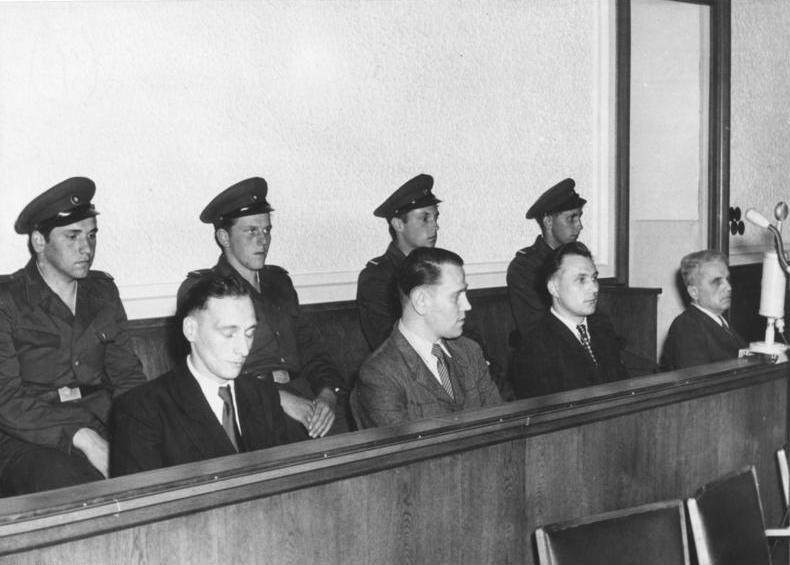
Black-and-white photograph of four men in suits seated in a dock, four uniformed police officers standing behind them, a microphone in front.
Four defendants before the GDR Supreme Court, June 1954. The official caption called them western agents and ringleaders of a “fascist putsch”; the trials ran into 1955.Photo: Bundesarchiv, Bild 183-25018-0007 / Peter Heinz Junge / CC BY-SA 3.0 de

17 June – 1955

About 15,000 arrests

By 6 July the Stasi and police had arrested about 10,000 people, and by 1955 about 15,000. GDR courts passed about 1,800 sentences, Soviet tribunals 500–700.

04Leipzig, Dresden, Halle, Magdeburg, Jena

In Halle the crowd emptied a prison. Leipzig stayed under emergency rule for almost a month

Up to 60,000 people filled the Hallmarkt in Halle on the evening of 17 June; the remand prison in Kleine Steinstraße was emptied of all 245 inmates. In Magdeburg about 50,000 demonstrated, and the SED’s district headquarters was stormed. In Leipzig about 40,000 marched, and the Soviet army declared martial law over the district in the afternoon; the state of emergency in the city lasted until 11 July 1953.

Black-and-white photograph of a heavy tank driving down a street in front of a domed neo-baroque court building, men in shirtsleeves watching in the foreground.
A Soviet heavy tank passes the former Reichsgericht in Leipzig, around 17 June 1953, as people watch from the pavement.Photo: Bundesarchiv, Bild 175-14676 / CC BY-SA 3.0 de
A rusted steel tank track rearing up from a cobbled strip in a lawn, a bronze plaque beside it, modern apartment buildings behind.
The memorial to 17 June 1953 on Dresden’s Postplatz, where demonstrators were penned in on the day of the rising: a length of tank track rising from the paving.Photo: Bybbisch94, 2019. Wikimedia Commons. CC BY-SA 4.0.

In Dresden about 60,000 demonstrated, but Soviet troops held the public buildings. In Jena about 30,000 gathered by one o’clock, and crowds stormed the Stasi office and the police prison.

A dark cut-out metal plaque on a white wall with capital letters: Zum Gedenken an die Opfer des Volksaufstandes am 17. Juni 1953 in Magdeburg.
“In memory of the victims of the people’s uprising of 17 June 1953 in Magdeburg”: the cast plaque on the Platz des 17. Juni, Magdeburg.Photo: Olaf2, 2006. Wikimedia Commons. CC BY-SA 3.0.
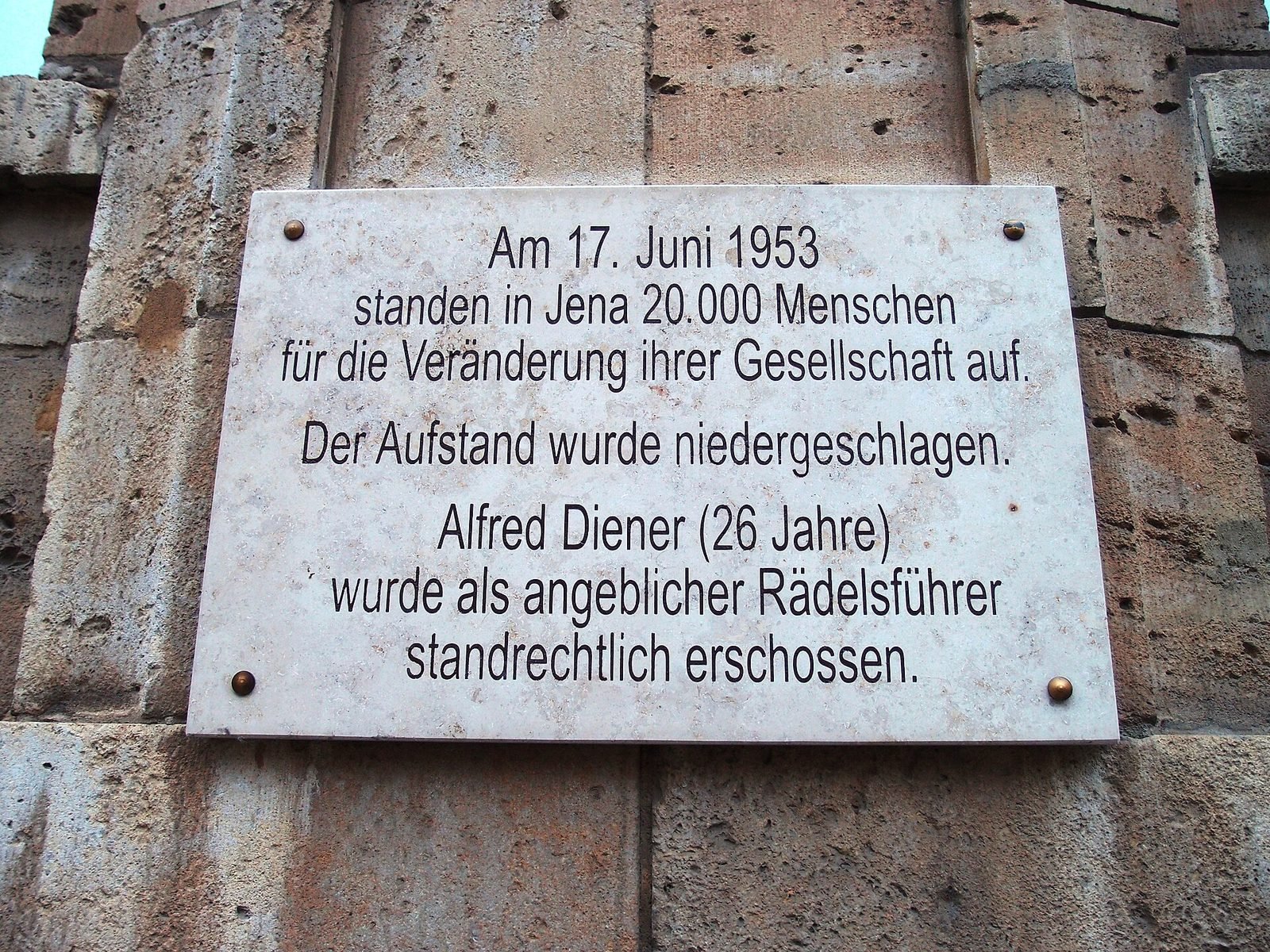
A pale stone plaque with black lettering on a weathered sandstone wall, commemorating the Jena uprising and Alfred Diener.
The plaque on the Holzmarkt in Jena to Alfred Diener, 26, shot on 18 June 1953 as an alleged ringleader after a Soviet military tribunal sentenced him. Its count of the crowd is lower than the Bundesarchiv’s.Photo: Evergreen68, 2012. Wikimedia Commons. CC BY-SA 3.0.

05Bonn and East Berlin, 1953–1989

West Germany made the day a holiday. The Stasi never forgot it

On 3 July 1953 the Bundestag made 17 June the Day of German Unity. It stayed West Germany’s national day until the Unification Treaty of 1990 replaced it with 3 October. In the East the date stayed a fear. On 31 August 1989 the Stasi’s chief asked his generals:

„Ist es so, dass morgen der 17. Juni ausbricht?““Is it the case that 17 June will break out tomorrow?”

Black-and-white photograph of a column of young men in suits walking two by two across a cobbled square, one carrying a flag, past a church and a half-timbered building.
A students’ silent march for 17 June on the cathedral square in Braunschweig, West Germany, 1961. From 1953 until 1990 the date was West Germany’s Day of German Unity.Photo: Bundesarchiv, B 145 Bild-F010569-0005 / Renate Patzek / CC BY-SA 3.0 de

80 building workers struck over a pay cut. It took 600 Soviet tanks in East Berlin alone, and at least 55 lives, to end what they began.

Press & citation

Use this Berlinfographic

Free to publish under CC BY 4.0 — in print, online, on Wikipedia and in teaching, commercially or not — with credit to Berlinfographics and a link to this page.

The East German Uprising, June 1953: ready-to-use landscape image

Ready-to-use image

The infographic as one image: headline, key figures, chart, sources and credit, 2,400 × 1,350 px PNG. Please use it unedited.

Download landscape (PNG)
The East German Uprising, June 1953: square version

Square format

A 1:1 version for social media and narrow columns, 1,800 × 1,800 px.

Download square (PNG)
The East German Uprising, June 1953: portrait version

Portrait 4:5

For Instagram and LinkedIn feeds, 1,620 × 2,025 px.

Download portrait (PNG)

Credit line

Berlinfographics (berlinfographics.com), CC BY 4.0

Citation

Berlinfographics (2026). “The East German Uprising, June 1953”. Berlin Experiences. https://berlinfographics.com/1953-uprising/

Wikipedia

{{cite web |title=The East German Uprising, June 1953 |url=https://berlinfographics.com/1953-uprising/ |website=Berlinfographics |publisher=Berlin Experiences |date=2026-11-09 |access-date=2026-11-09}}