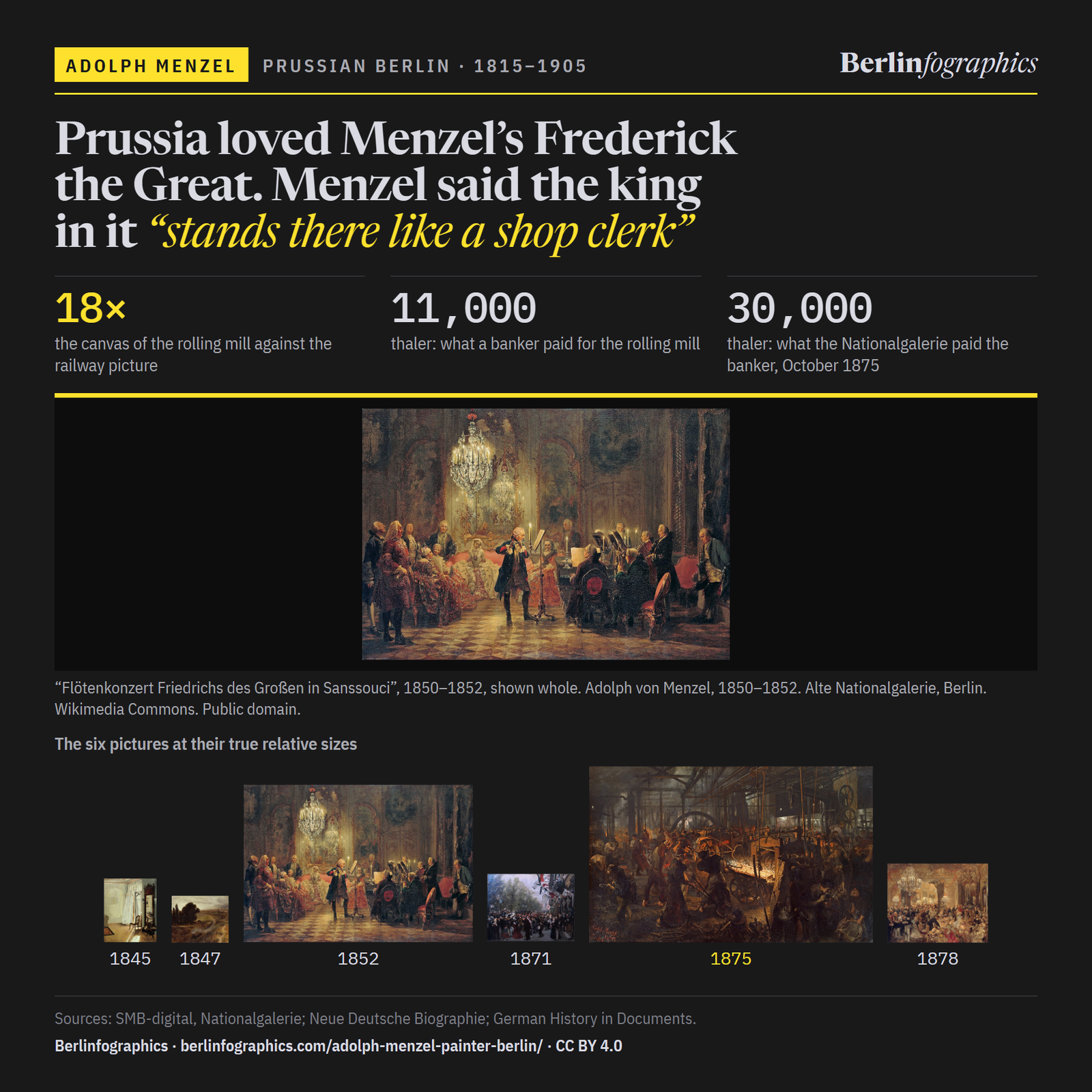
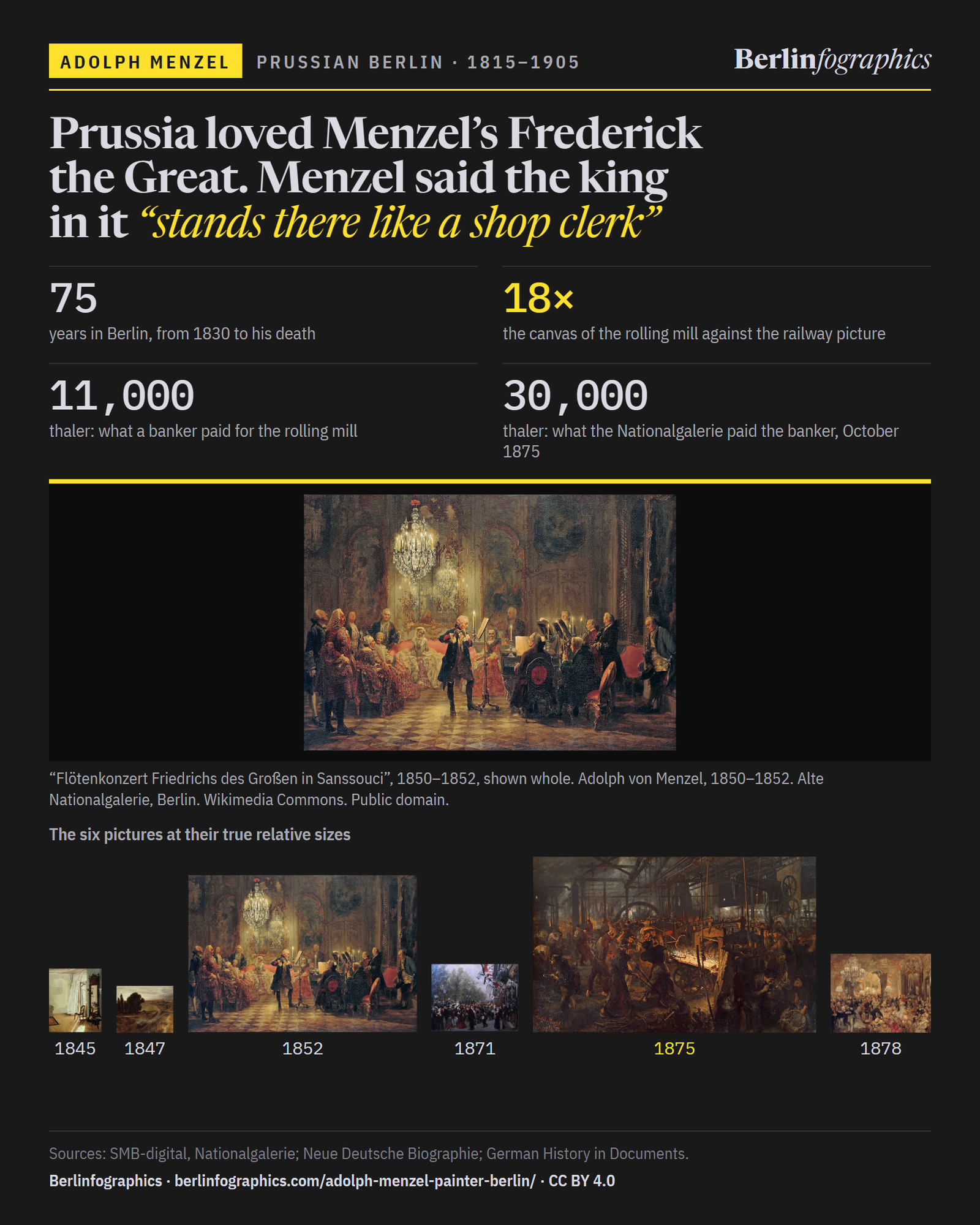
Adolph Menzel, “Flötenkonzert Friedrichs des Großen in Sanssouci” (Frederick the Great’s flute concert at Sanssouci), 1850–52, oil on canvas. Frederick plays; his sister Wilhelmine listens from the pink sofa; Carl Philipp Emanuel Bach is at the harpsichord. Shown whole.Adolph von Menzel, 1850–1852. Alte Nationalgalerie, Berlin. Wikimedia Commons. Public domain.
Adolph MenzelPrussian Berlin · Six pictures
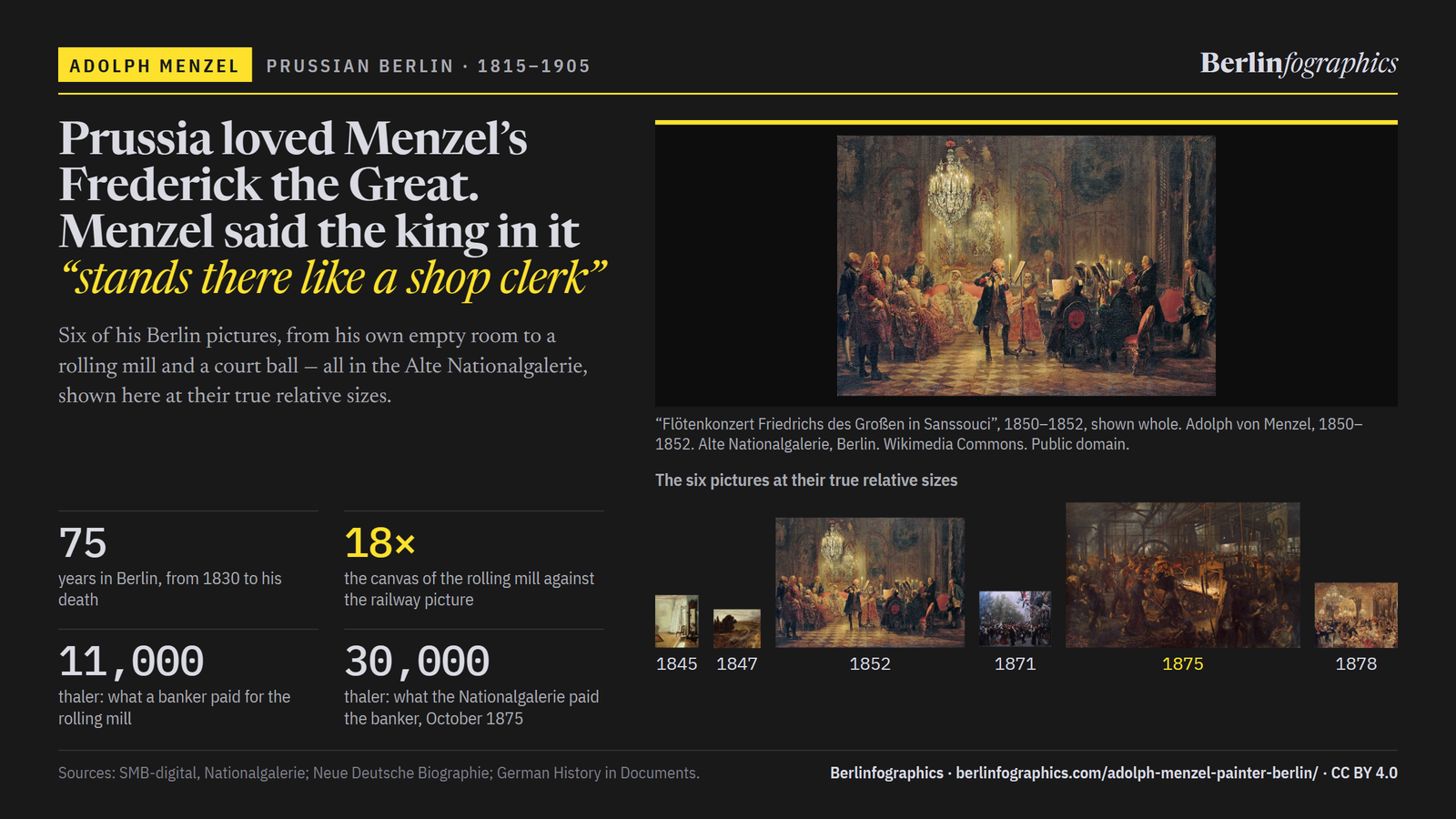
Adolph Menzel came to Berlin in 1830 and painted it for 75 years: a railway at the city’s edge, a king leaving for war, a court ball, and a rolling mill a banker bought for 11,000 thaler and sold to the Nationalgalerie for 30,000 thaler. All six pictures here belong to the Alte Nationalgalerie.
Scroll: six pictures, to scale
01Sanssouci, 1850–1852
Menzel worked out the composition in 1848. In the spring of 1850 the Potsdam sugar manufacturer Ludwig von Jacobs ordered the picture, and at the beginning of August 1852 it was finished — and at once Menzel’s most popular work. Reproduced thousands of times, it came to prop up the official legend of Prussia, the museum’s catalogue says, without the painter’s doing.
It shows an evening concert in the music room at Sanssouci for Frederick’s sister Wilhelmine, on her last visit to Potsdam in 1750. Carl Philipp Emanuel Bach is at the harpsichord. Menzel gave the king the sharp features of the old “Alter Fritz” — an anachronism: Frederick is 38 here.
“Der König steht da wie ein Kommis, der Sonntags Muttern etwas vorflötet […]. Überhaupt habe ich’s bloß gemalt des Kronleuchters wegen.”
“The king stands there like a shop clerk piping a tune to his mum on a Sunday […]. Anyway, I only painted it for the sake of the chandelier.” Quoted in the Nationalgalerie’s catalogue entry for the picture.

02The wall
1815 · Breslau
Adolph Menzel was born in Breslau on 8 December 1815. In 1830 the family moved to Berlin; when his father died in 1832, he took over the lithographic press at 17 and kept his mother and siblings.
Source: Neue Deutsche Biographie
1845
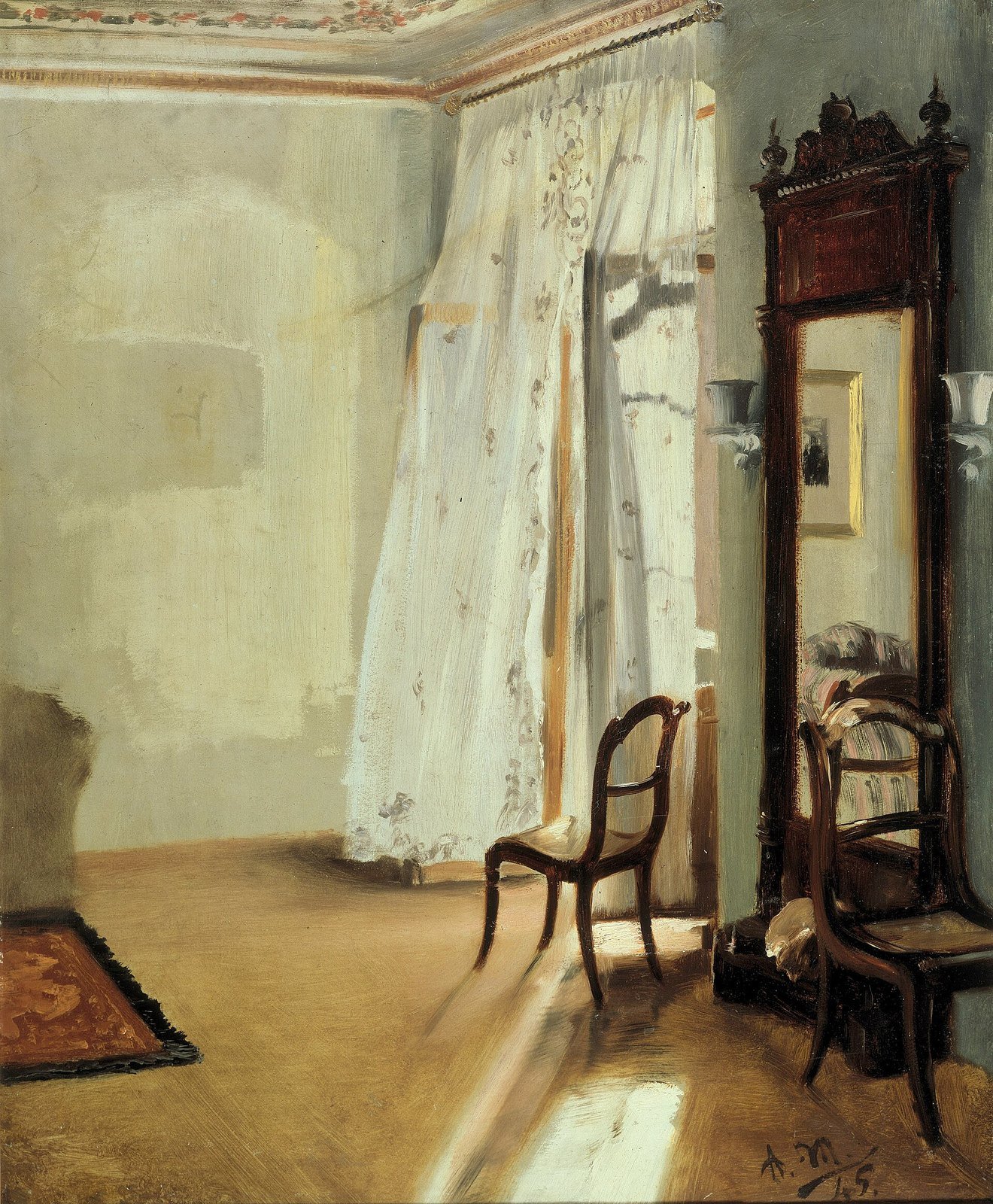
A room of the family flat in the Schöneberger Straße, then at the southern edge of Berlin, almost empty. It opens the series of painted interiors he made only until about 1848. 58 × 47 cm.
Source: SMB, Inv. A I 744
1847
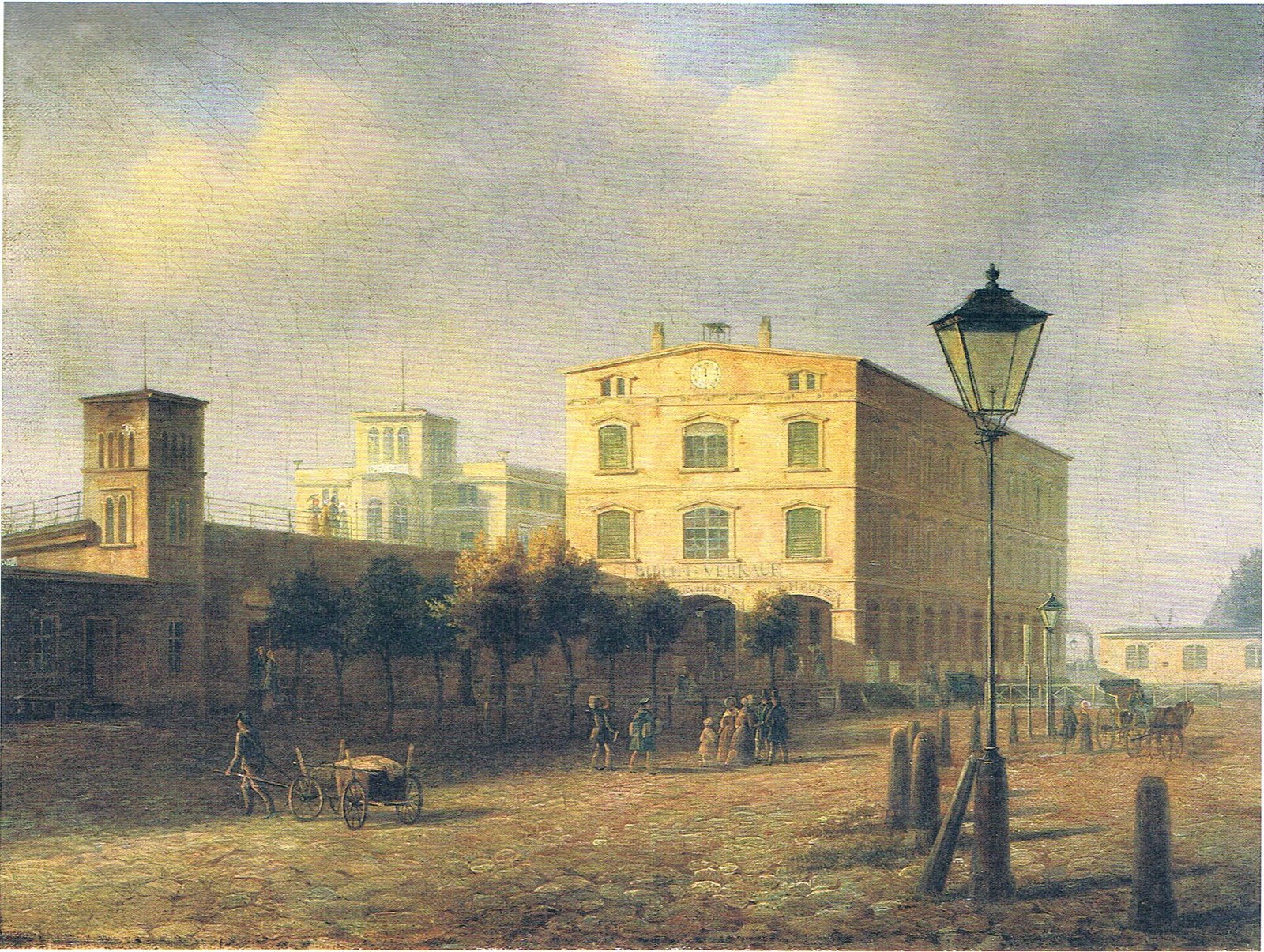
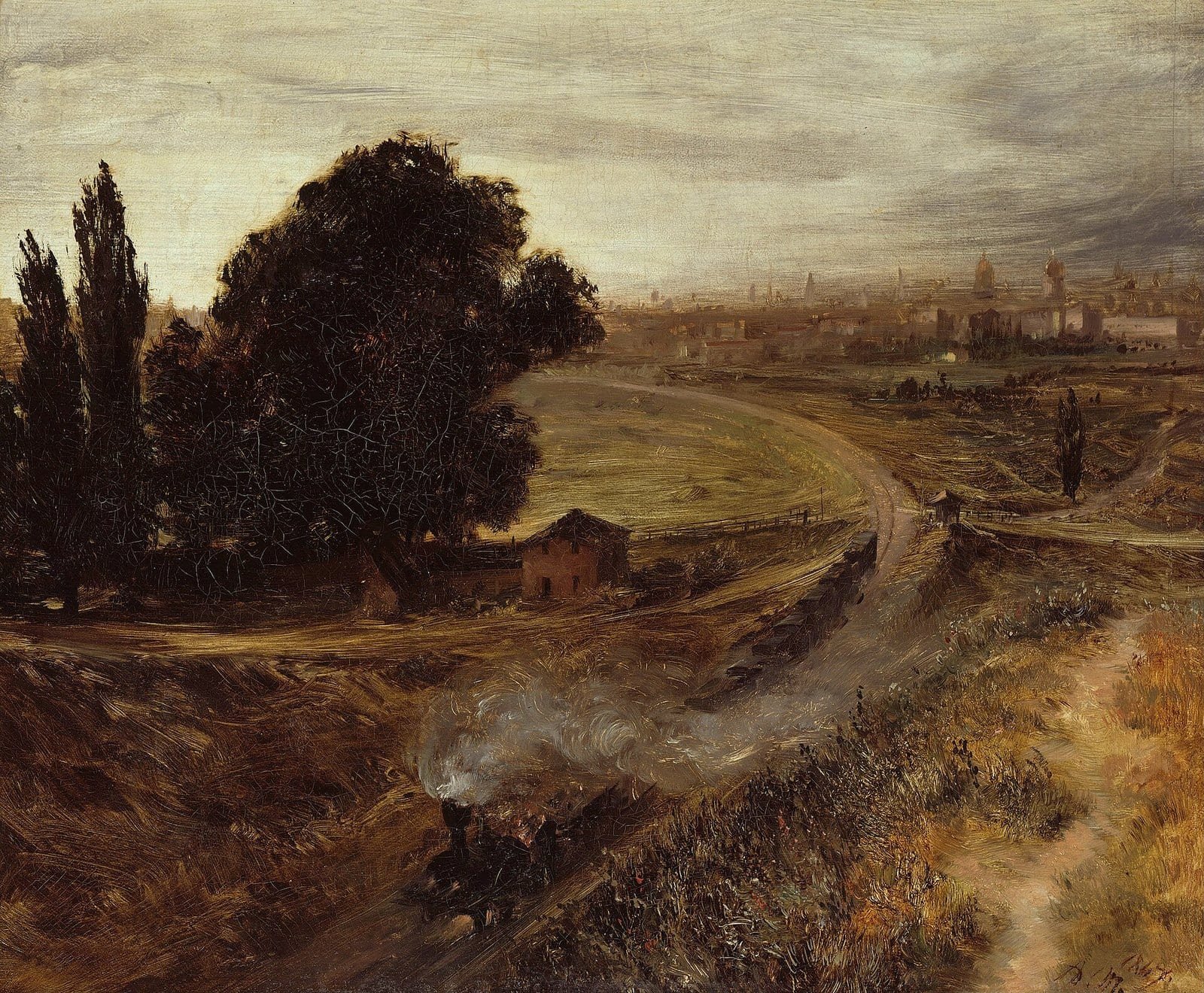
The line to Potsdam had run since 1838; Menzel took it to visit his best friend. Of all his pictures, it is the only one to show the railway in a landscape. 42 × 52 cm — the smallest of the six.
Source: SMB, Inv. A I 643
1850–1852
Ordered in 1850, finished in August 1852. At 142 × 205 cm it is a history painting’s size — the scale he would later give to factory work.
Source: SMB, Inv. A I 206
31 July 1870
Back in Berlin as war with France broke out, Menzel watched from the window of a restaurant on Unter den Linden as the king drove to the Potsdamer Bahnhof. He painted it the next year. 63 × 78 cm.
Source: SMB, Inv. A I 323
1872–1875
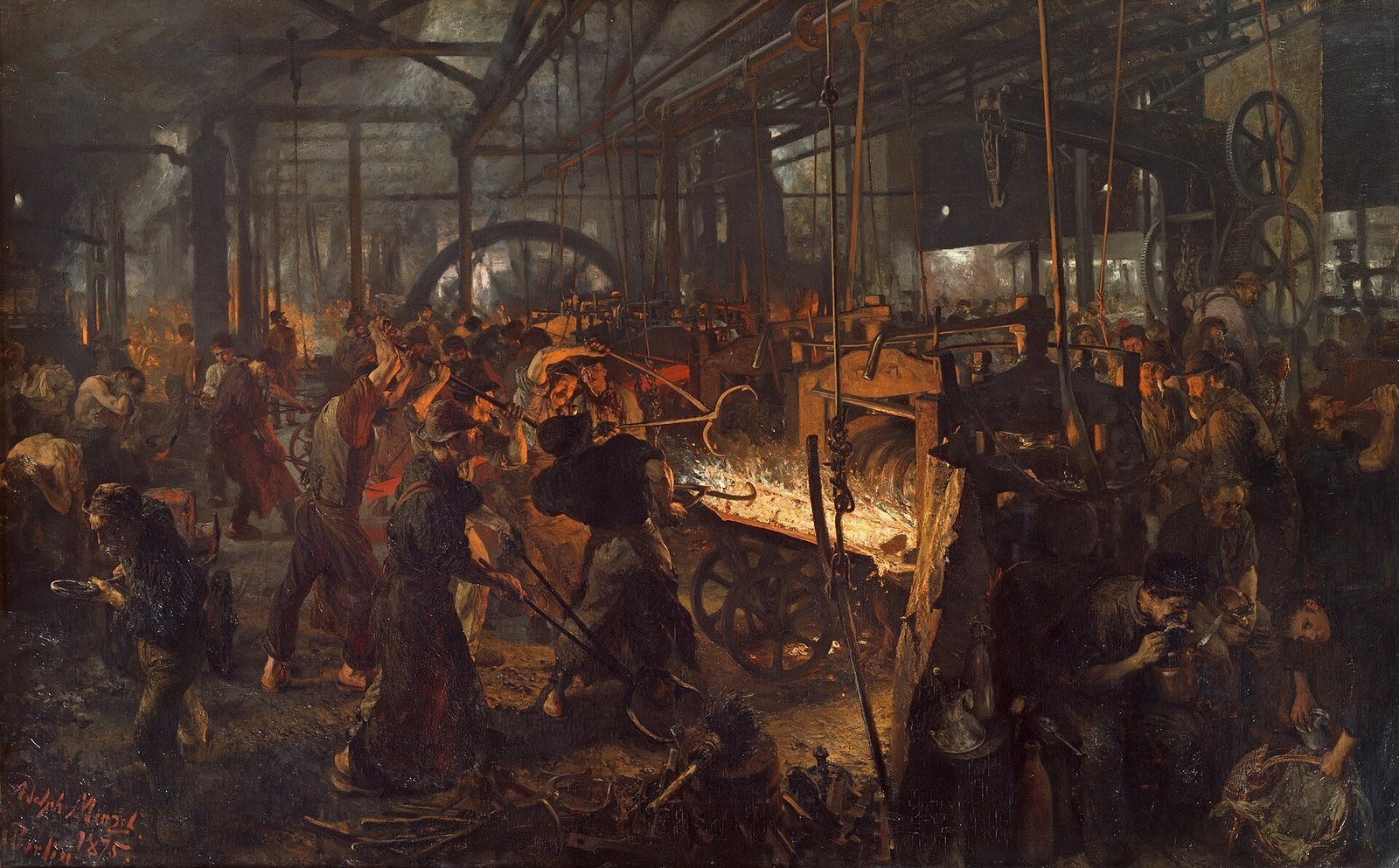
In the late summer of 1872 he travelled to Königshütte in Upper Silesia to draw the works. The result, 158 × 254 cm, is the largest of the six.
Source: SMB, Inv. A I 201
1878
Already under way in September 1876, the year after the rolling mill: the other end of the same society. 71 × 90 cm.
Source: SMB, Inv. A I 902
All six
Hung side by side at their true sizes, the six show where Menzel put his effort: Das Eisenwalzwerk covers 4.01 m², Berlin-Potsdamer Eisenbahn 0.22 m².
Source: SMB, Inv. A I 201 · SMB, Inv. A I 643
1905 · Berlin
Menzel died on 9 February 1905, ennobled since 1898. Two years earlier the Nationalgalerie had bought the Balkonzimmer, in 1903.
Source: Neue Deutsche Biographie · SMB, Inv. A I 744
03The rolling mill
No industrialist ordered it. Menzel gave a factory the large format that history painting had kept for itself — without precedent even in Europe, the museum’s catalogue says. In the late summer of 1872 he went to Königshütte in Upper Silesia to study the works and the men’s movements; in Berlin factories such as Borsig in Moabit he could draw more. The white-hot bloom in the picture is about to become a railway rail.
The banker Adolph von Liebermann bought it in stages while it was being painted and took delivery early in 1875. Money trouble followed; by October 1875 he had to sell it to Max Jordan, the Nationalgalerie’s director, for 30,000 thaler — 2.7 times what it had cost him.
The rolling mill’s two prices


From first idea to the wall: three pictures

04Unter den Linden, 31 July 1870
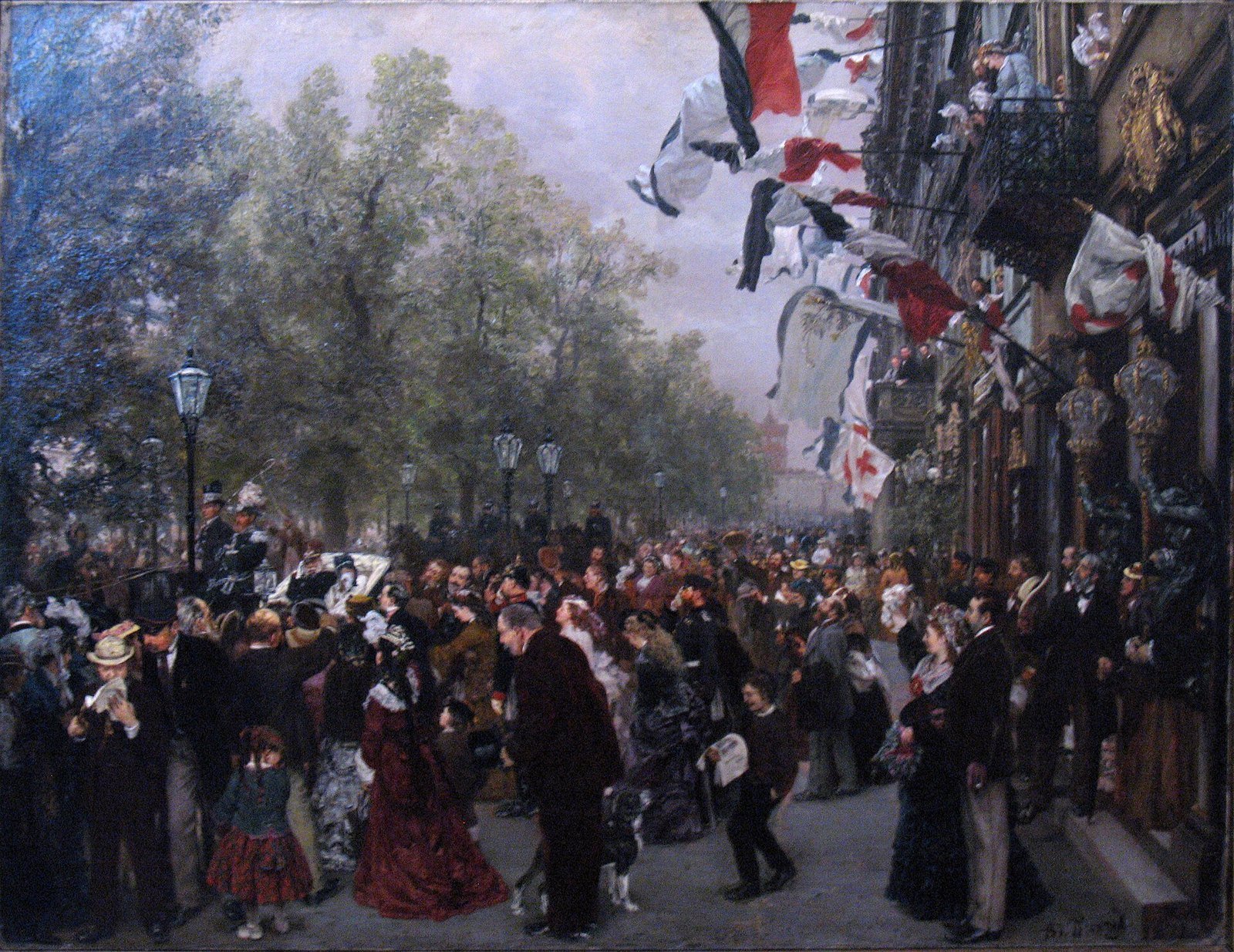
When war with France broke out, Menzel cut short his summer away and came back to Berlin. From the window of a restaurant on Unter den Linden he saw the commotion as Wilhelm I drove to the Potsdamer Bahnhof. The banker Magnus Herrmann, a friend, ordered the picture.
The carriage has almost left the frame. The king’s friendly wave and the sobbing queen hardly suggest a historic hour; the brick tower of the new Rathaus rises behind, while the royal palace is a shadow. Among the flags, the “sceptical patriot” — the catalogue’s phrase — slipped in a Red Cross flag.


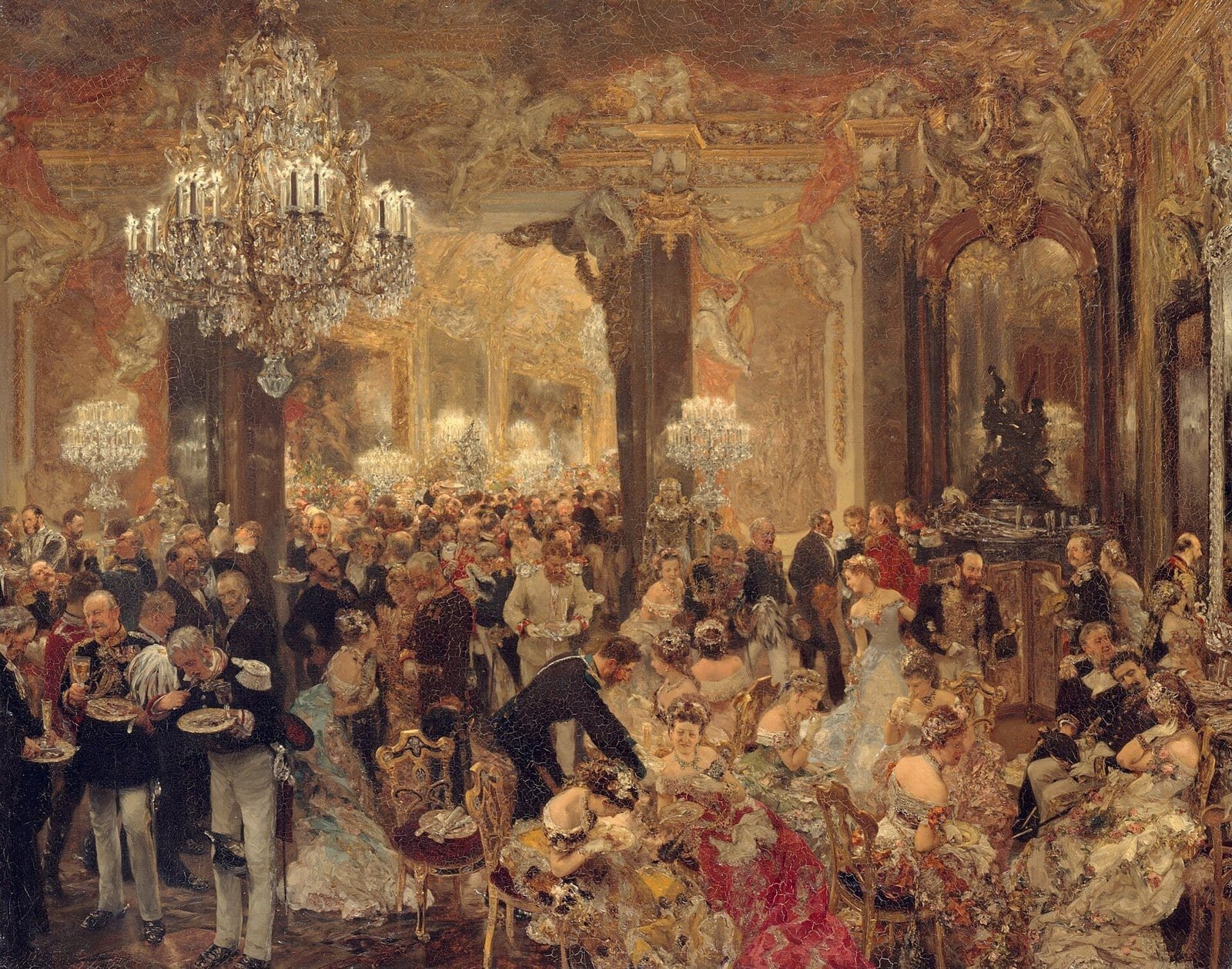
05The court, 1878
With the rolling mill and the ball supper, the museum writes, Menzel caught both poles of Gründerzeit society; the second picture was already under way in September 1876. He went to the great court balls into old age and was allowed to sketch, sometimes climbing on a table to do it. Every face is an individual and none is a portrait; the gilded hall, which would have had to be in the Berlin palace, was invented.

It was first shown in Paris, in 1879. Edgar Degas was so struck by it that he sketched a copy in oil from memory — today in the Musée d’Art Moderne et Contemporain de Strasbourg.


06The edge of the city
“Das Balkonzimmer” shows a room of the flat in the Schöneberger Straße, at what was then the southern edge of Berlin, where Menzel lived with his mother and siblings. The room is strikingly empty. Bought for the Nationalgalerie in 1903, two years before his death, it became, in the museum’s words, the very image of the young Menzel’s art.

“Die Berlin-Potsdamer Bahn” was painted from about where the S-Bahn station Großgörschenstraße stands today, looking across building land to the domes of the Gendarmenmarkt. Menzel, the museum’s catalogue says, was the first in Germany to see such provisional ground outside the city gates as a subject.


He painted the king’s flute and the mill’s fire with the same attention. All six now belong to one museum on the Museum Island.

Press & citation
Free to publish under CC BY 4.0 — in print, online, on Wikipedia and in teaching, commercially or not — with credit to Berlinfographics and a link to this page.
Ready-to-use image
The infographic as one image: headline, key figures, chart, sources and credit, 2,400 × 1,350 px PNG. Please use it unedited.
Download landscape (PNG)
Square format
A 1:1 version for social media and narrow columns, 1,800 × 1,800 px.
Download square (PNG)
Portrait 4:5
For Instagram and LinkedIn feeds, 1,620 × 2,025 px.
Download portrait (PNG)Credit line
Berlinfographics (berlinfographics.com), CC BY 4.0
Citation
Berlinfographics (2026). “Adolph Menzel paints Berlin”. Berlin Experiences. https://berlinfographics.com/adolph-menzel-painter-berlin/
Wikipedia
{{cite web |title=Adolph Menzel paints Berlin |url=https://berlinfographics.com/adolph-menzel-painter-berlin/ |website=Berlinfographics |publisher=Berlin Experiences |date=2026-11-05 |access-date=2026-11-05}}
Our infographics, charts and texts are licensed CC BY 4.0: free to republish, including commercially, with credit to Berlinfographics and a link. Photographs keep their own licences, named in each caption. How to credit
Topics: The Second World War · Cold War Berlin · Nazi Berlin · Persecution & the Holocaust · Weimar Berlin · Prussia & the Kaiserreich · Architecture & the built city · Culture, science & society · Reunified Berlin · Unusual facts
Contact: info@berlinfographics.com · Press: press@berlinfographics.com · Imprint · Privacy