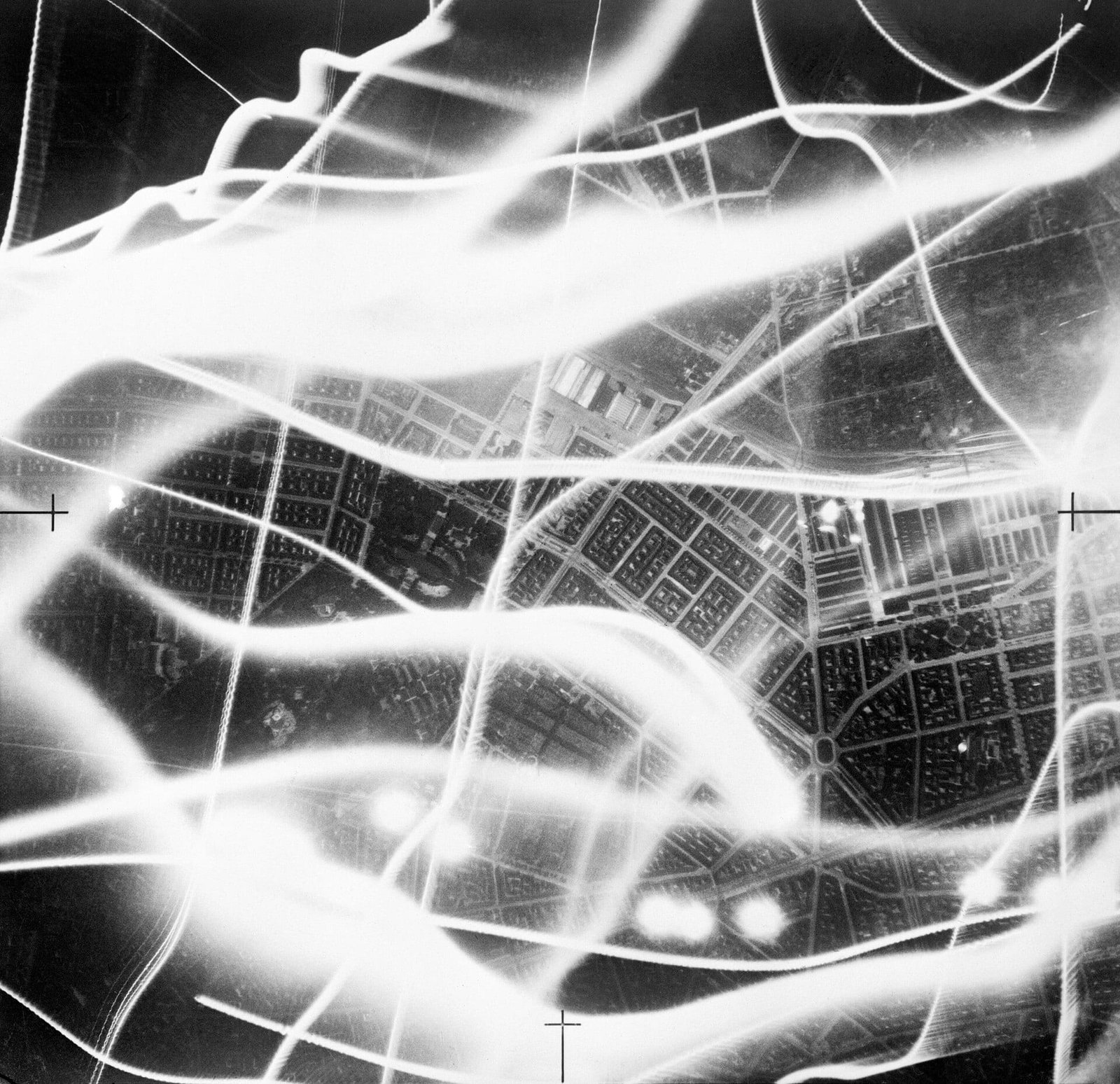
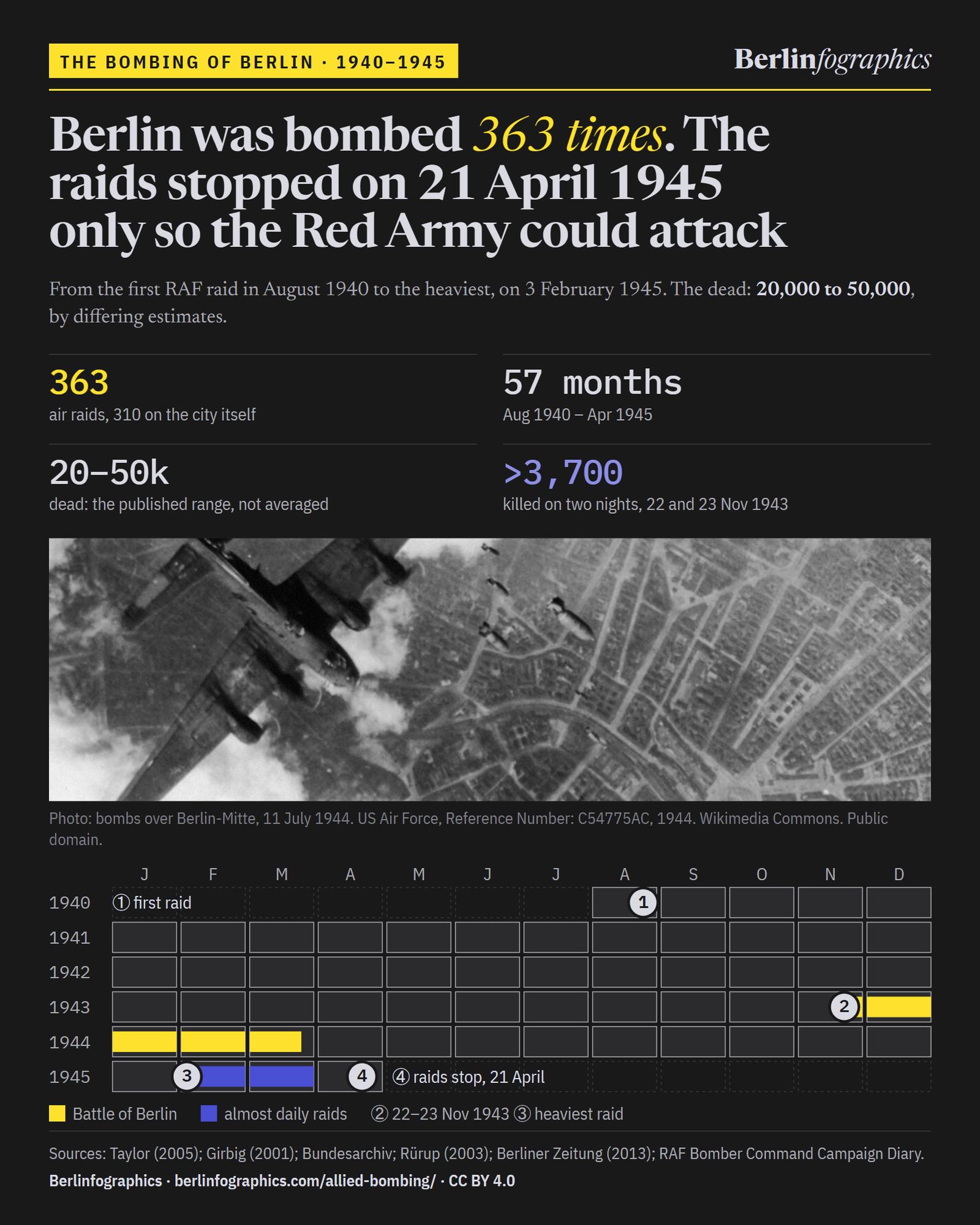
Bombs falling over Berlin-Mitte, 11 July 1944. A damaged American B-17 is in the frame; Alexanderplatz is the pale square at lower right.Photo: US Air Force, Reference Number: C54775AC, 1944. Wikimedia Commons. Public domain.
The bombing war
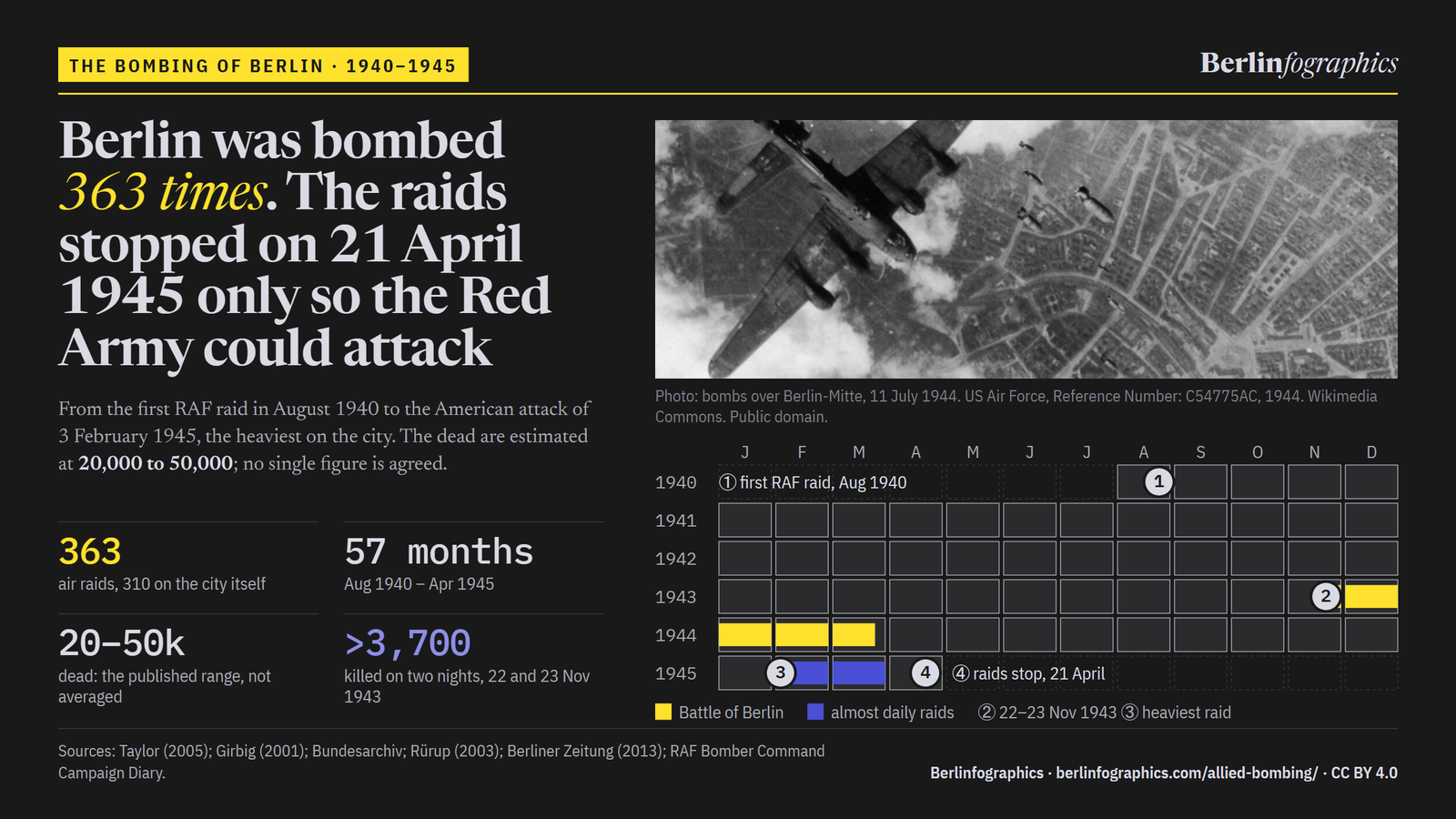
From the first RAF raid in August 1940 to the American attack of 3 February 1945, the heaviest on the city, the bombing killed between 20,000 and 50,000 people, by differing estimates.
01Berlin, August 1940
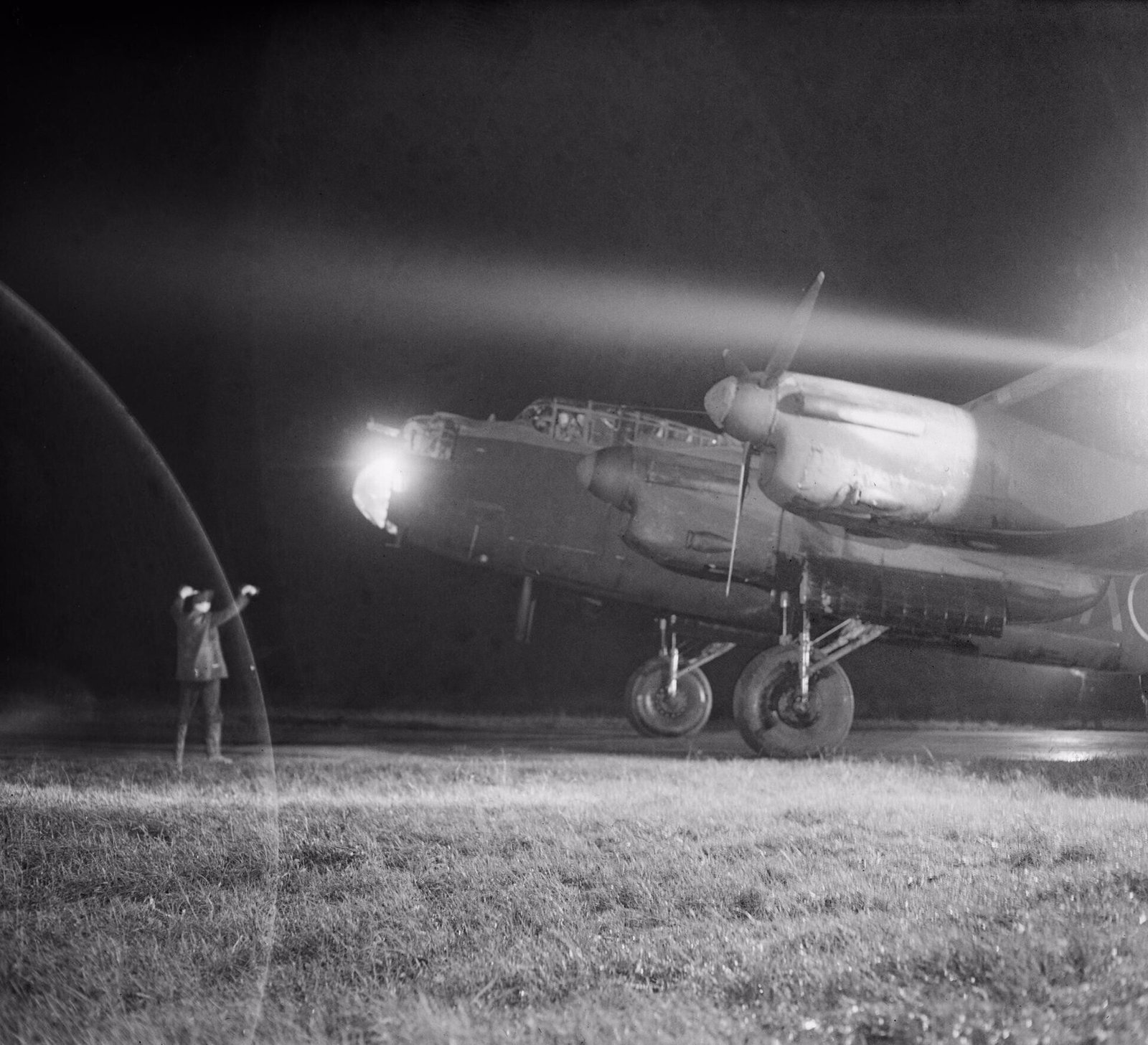
On the night of 25/26 August 1940, British bombers attacked the German capital for the first time.
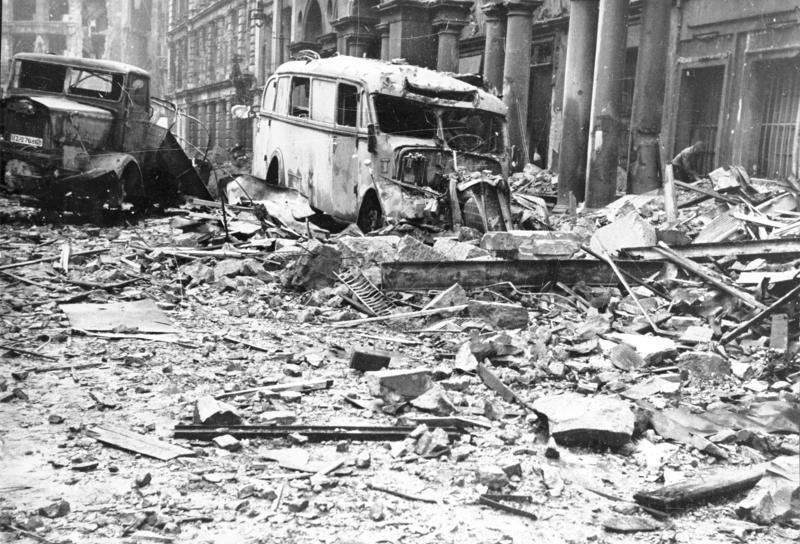
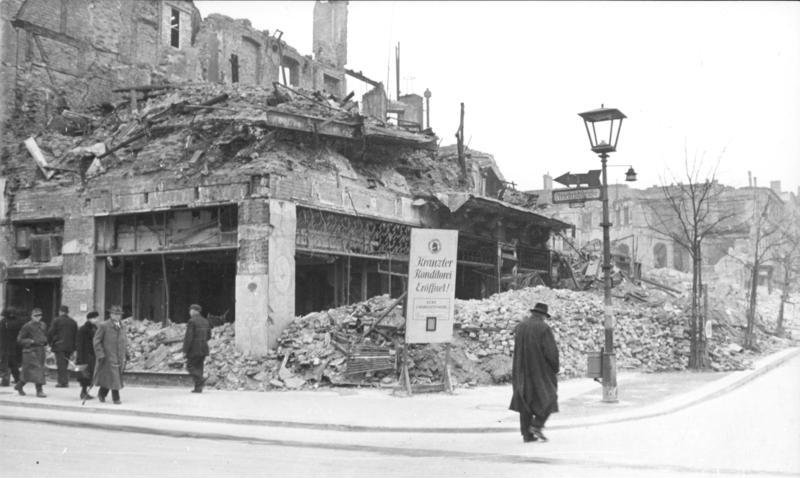
They came back within days. The photograph shows a flat in Kreuzberg burned out by incendiaries a few nights after the first raid; the archive records the street and house number.
It was the start of 57 months under the bombs, and 363 raids.


The bombing of Berlin, 1940–1945
Each cell is a month; spans and numbered events sit at their true dates. No monthly count of raids or bombs is drawn: none is verified.

August 1940 – April 1945
From August 1940 to April 1945, Berlin was raided 363 times, by the count of the historians Frederick Taylor and Werner Girbig. The Bundesarchiv counts “more than 350”.

125/26 August 1940
British bombers attack Berlin for the first time.

18 Nov 1943 – 25 Mar 1944
The RAF's winter of heavy night raids, from the first raid on 18 November 1943 to the last large raid, which ended on 25 March 1944.

222 and 23 November 1943
Two RAF night raids killed more than 3,700 people and burned out the Kaiser-Wilhelm-Gedächtniskirche.


3Feb 1945 – Mar 1945
In February and March 1945 the Allies bombed the capital almost daily. On 3 February 1945 came the heaviest raid of all: nearly 1,000 American B-17s attacked the government and newspaper districts in Mitte and Kreuzberg. Roland Freisler, president of the Volksgerichtshof, was among the dead.

421 April 1945
The British and Americans ended their raids so that the Red Army could begin its ground offensive on the city.
02Charlottenburg, November 1943
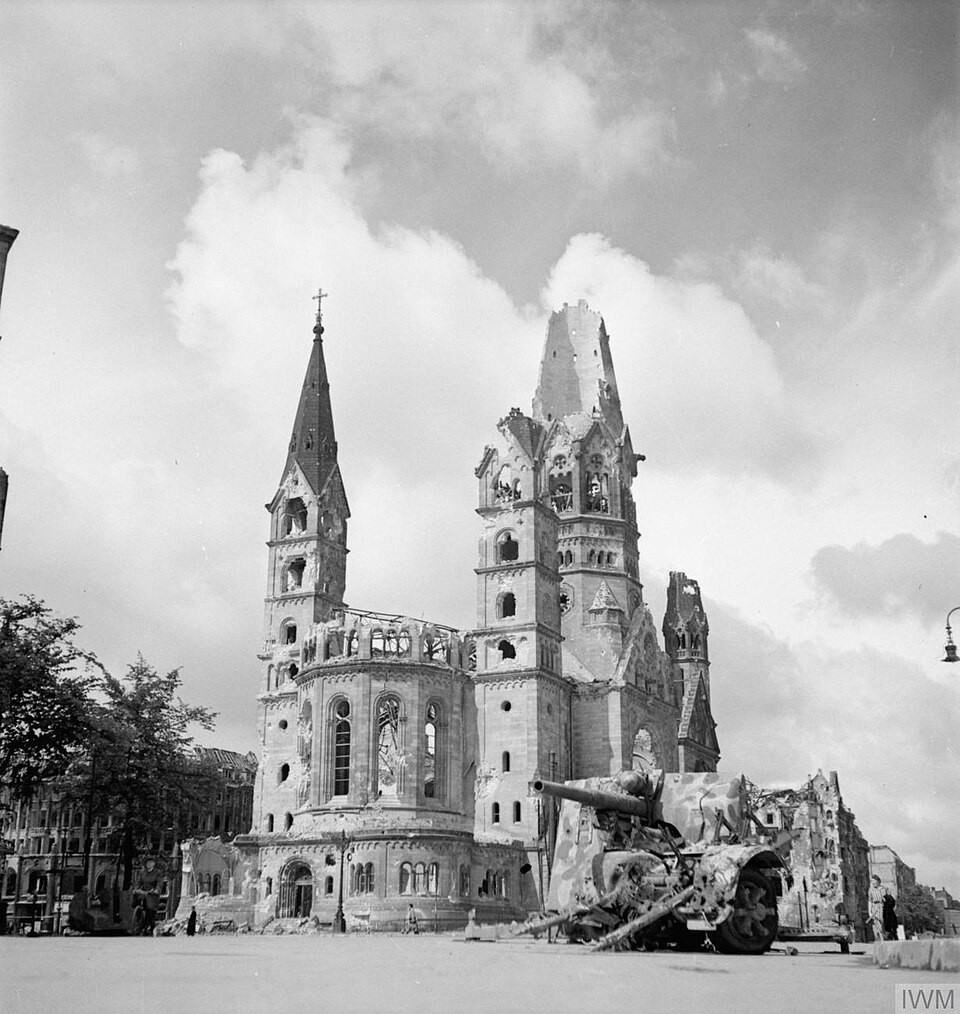
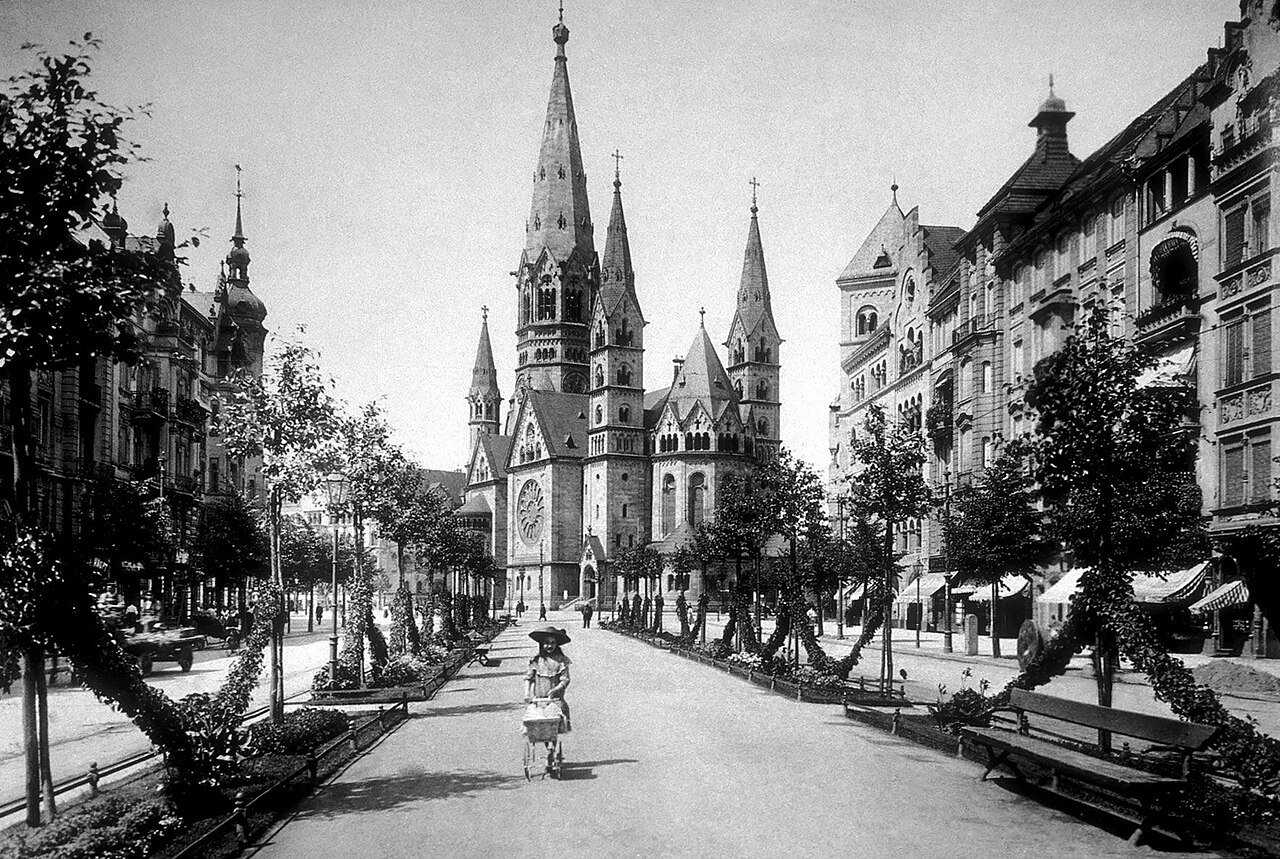
The RAF raids of 22 and 23 November 1943 came in the first week of the Battle of Berlin. More than 3,700 people died, by the Berliner Zeitung’s count; the historian Reinhard Rürup puts it at nearly four thousand. The memorial church at the end of the Kurfürstendamm burned out.

Its broken tower still stands on the Breitscheidplatz, kept as a memorial. Every raid left Berliners bombed out of their homes, and streets, stations and railways to be propped up and cleared.


03The dead
Published estimates of the number of people killed in Berlin by the bombing range from 20,000 to 50,000 (Rürup, 2003). Recent German studies suggest the lower part of this range.
The range is drawn whole, with no figure picked from its middle. For scale, the two November nights of 1943 are drawn on the same axis: more than 3,700 dead.
Scale from zero. The arrow marks a lower bound: “more than”.
04The count
The usual count, from the historian Frederick Taylor, is 363 air raids. Werner Girbig’s history of the air war over the capital breaks it down: 363 on the Berlin region, 310 of them on the city itself. The Bundesarchiv, more cautiously, says Berlin was bombed “more than 350” times.
The city answered with flak, some of it mounted on concrete towers like the one at the Zoo, which carried heavy guns high above the rooftops.

Air raids on Berlin, August 1940 – April 1945

05Mitte and Kreuzberg, 3 February 1945
On 3 February 1945, nearly 1,000 American B-17s attacked the government and newspaper districts in Mitte and Kreuzberg. Roland Freisler, president of the Volksgerichtshof, was among the dead.


By then the raids came almost daily: through February and March 1945, the Bundesarchiv records, the Allies bombed the capital nearly every day.
0621 April 1945
On 21 April 1945, the British and Americans ended their raids on Berlin. The reason was not mercy: the Red Army was about to begin its ground offensive on the city.

Berlin was bombed 363 times in 57 months. Between 20,000 and 50,000 people died; no one has been able to count them more exactly.
Press & citation
Free to publish under CC BY 4.0 — in print, online, on Wikipedia and in teaching, commercially or not — with credit to Berlinfographics and a link to this page.
Ready-to-use image
The infographic as one image: headline, key figures, chart, sources and credit, 2,400 × 1,350 px PNG. Please use it unedited.
Download landscape (PNG)
Square format
A 1:1 version for social media and narrow columns, 1,800 × 1,800 px.
Download square (PNG)
Portrait 4:5
For Instagram and LinkedIn feeds, 1,620 × 2,025 px.
Download portrait (PNG)Credit line
Berlinfographics (berlinfographics.com), CC BY 4.0
Citation
Berlinfographics (2026). “The bombing of Berlin, 1940–45”. Berlin Experiences. https://berlinfographics.com/allied-bombing/
Wikipedia
{{cite web |title=The bombing of Berlin, 1940–45 |url=https://berlinfographics.com/allied-bombing/ |website=Berlinfographics |publisher=Berlin Experiences |date=2026-11-05 |access-date=2026-11-05}}
Our infographics, charts and texts are licensed CC BY 4.0: free to republish, including commercially, with credit to Berlinfographics and a link. Photographs keep their own licences, named in each caption. How to credit
Topics: The Second World War · Cold War Berlin · Nazi Berlin · Persecution & the Holocaust · Weimar Berlin · Prussia & the Kaiserreich · Architecture & the built city · Culture, science & society · Reunified Berlin · Unusual facts
Contact: info@berlinfographics.com · Press: press@berlinfographics.com · Imprint · Privacy