Berlinfographicsby Berlin Experiences

1685–1809Prussia · Berlin’s Huguenots

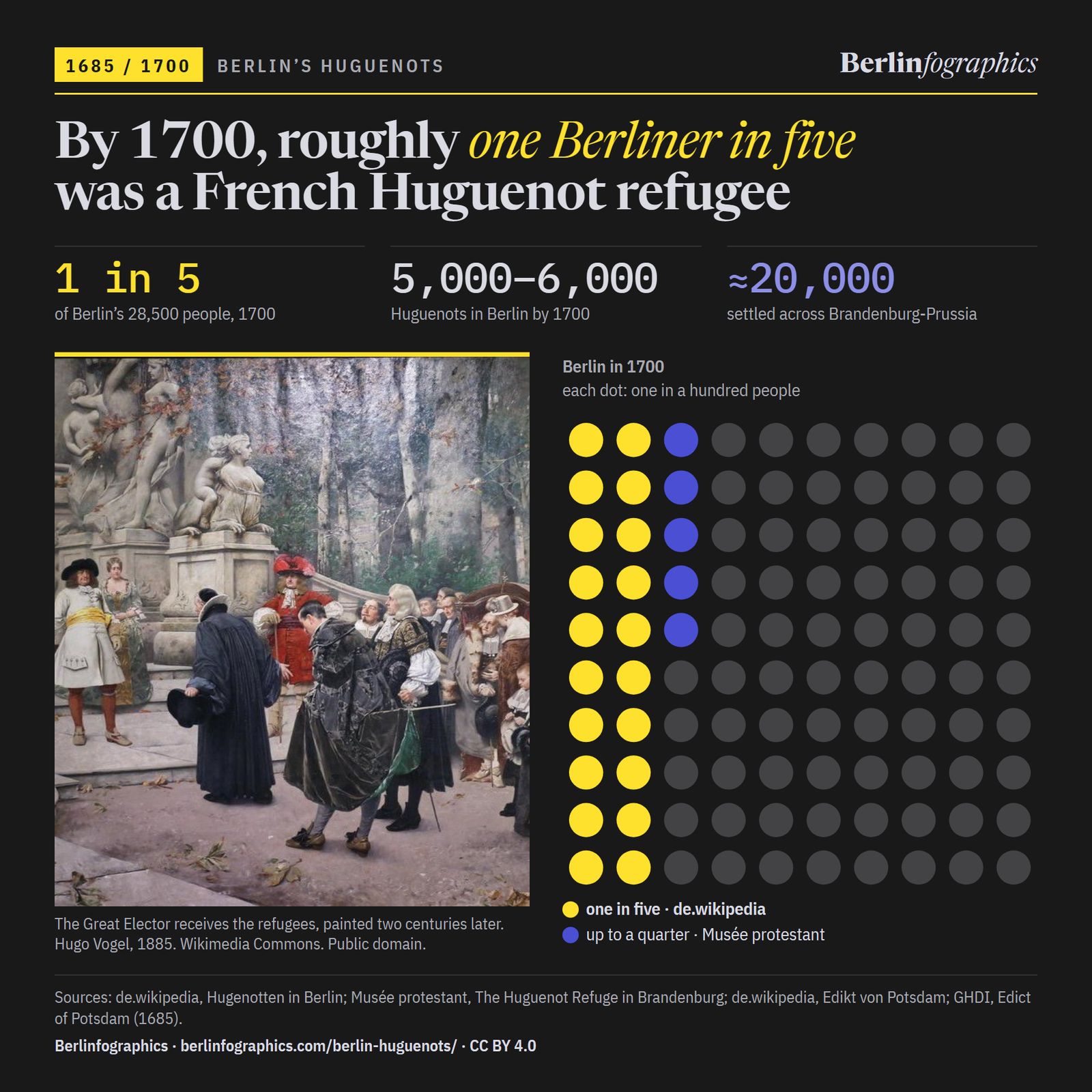
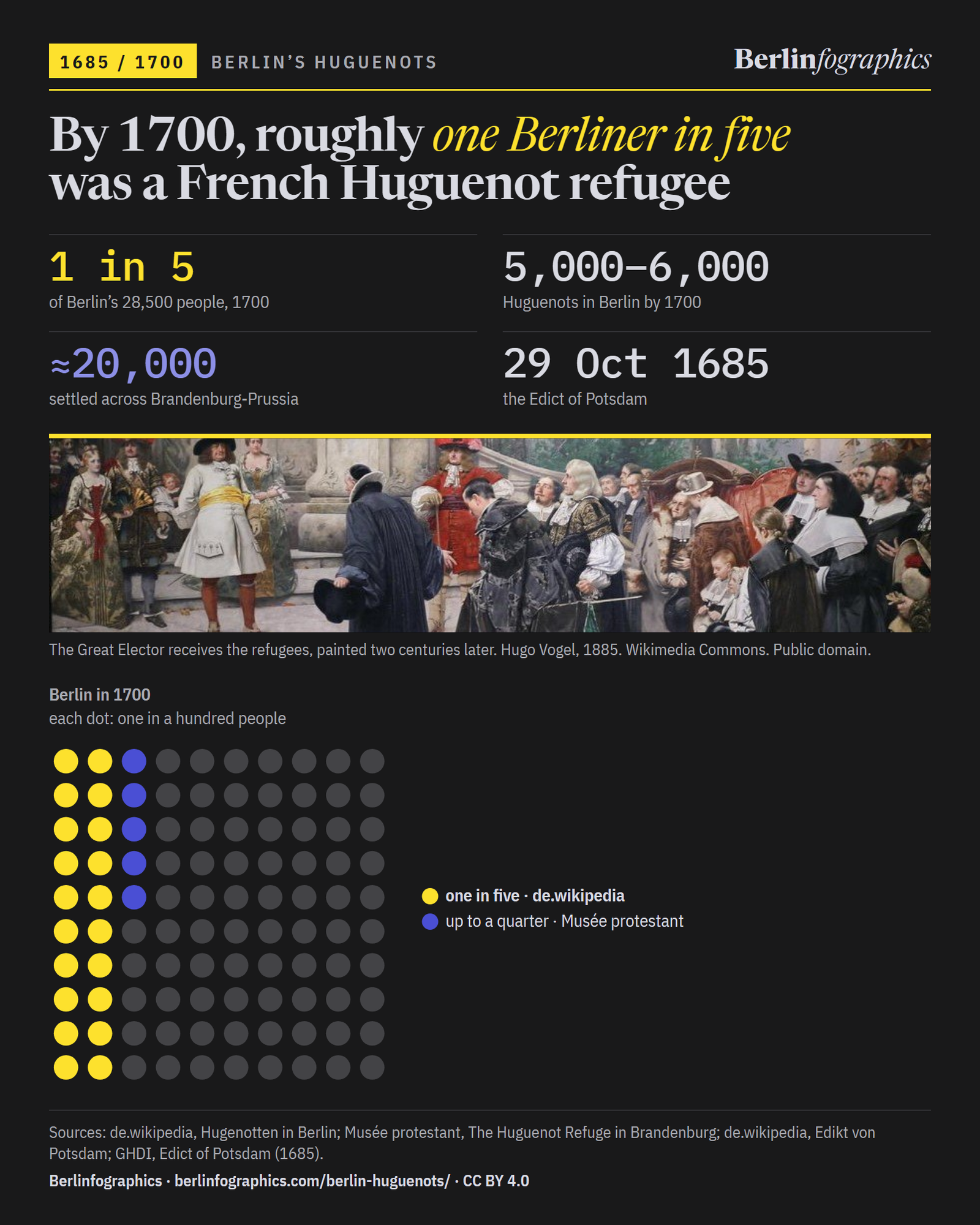
By 1700, roughly one Berliner in five was a French refugee

Berlin had 28,500 inhabitants. Between 5,000 and 6,000 of them were Huguenots — Protestants who had fled Louis XIV’s France after an edict signed at Potsdam invited them in.

Scroll for the invitation, the numbers and the church

The Französischer Dom on the Gendarmenmarkt: the domed tower Gontard added in 1780–85 beside the Huguenots’ church.Richard Mortel from Riyadh, Saudi Arabia, 2018. Wikimedia Commons. CC BY 2.0.
01Potsdam · 29 October 1685

When Louis XIV outlawed their faith, the Elector of Brandenburg offered them a home

In October 1685 Louis XIV revoked the Edict of Nantes, which had tolerated France’s Protestants, the Huguenots. The sources date his Edict of Fontainebleau differently: signed on 18 October 1685, says de.wikipedia; 22 October 1685, the day it was registered, says en.wikipedia.

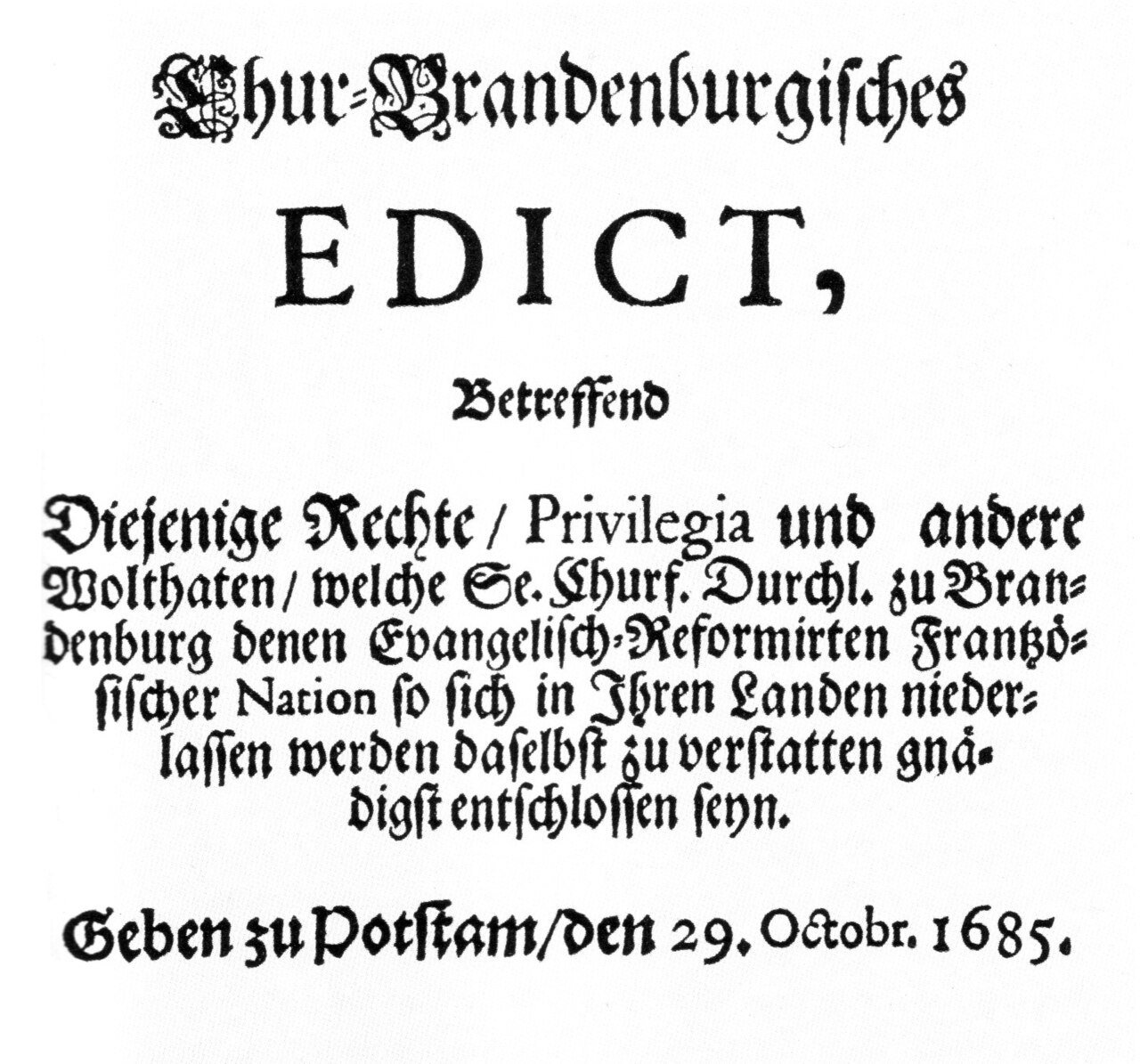
At Potsdam, Frederick William, Elector of Brandenburg — the Great Elector — answered with an edict of his own, dated 29 October 1685. Its title promised rights, privileges and other benefits to Reformed Protestants “of the French nation” who settled in his lands.

That date is by Brandenburg’s calendar, which was still the old Julian one. In France, already on the Gregorian calendar, the same day was 8 November 1685.

A printed title page in black-letter type with the word EDICT in large roman capitals, dated at the foot.
The printed edict: the rights, privileges and other benefits the Elector grants to Reformed Protestants “of the French nation” who settle in his lands. Given at Potsdam, 29 October 1685.Der Große Kurfürst Friedrich Wilhelm (The Great Elector), 1685. Wikimedia Commons. Public domain.
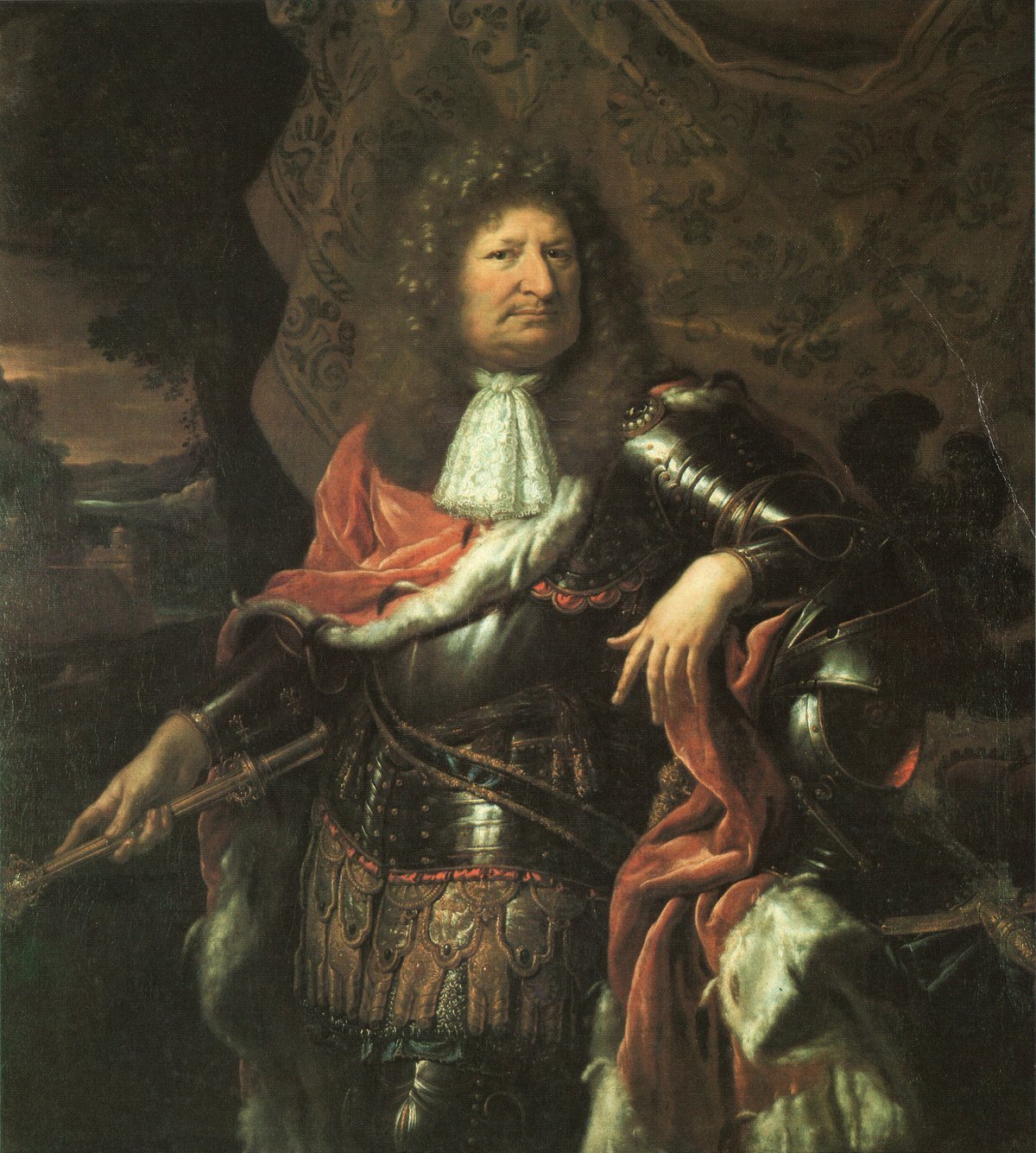
A portrait of a long-haired man in armour with a lace cravat and an ermine-lined red mantle.
Frederick William, the Great Elector, in armour and electoral mantle: Gedeon Romandon’s portrait of 1687.Gedeon Romandon, 1687. Wikimedia Commons. Public domain.
A painting of a courtly garden scene: a prince in white with a yellow sash stands on palace steps as a crowd of refugees in dark clothes, among them a pastor, a bowing man, women and children, gathers before him.
The Great Elector receives Huguenot refugees at Potsdam Palace, as Hugo Vogel imagined the scene two centuries later, in 1885.Hugo Vogel, 1885. Wikimedia Commons. Public domain.

Years free of charges, by the edict

02What the edict promised

Free building materials, up to ten years without charges, and the guilds thrown open

The edict did more than tolerate the refugees; it gave them a start. Its clauses 5–7 and 11 offered materials to build with, years free of charges on the houses they repaired or built, free admission to the craft guilds that normally kept outsiders out, and a French pastor in each town where they settled.

A refugee who repaired a house paid no charges on it for six years; one who built a new house, for ten.

Source: “Edict of Potsdam”, issued by Frederick William, the Great Elector, 29 October 1685 — German History in Documents and Images (GHI Washington), English translation

03The city in 1700

A city of 28,500 — and one in five of them had come from France

28,500Berliners, 1700one dot≈285
A field of one hundred dots, each one in a hundred Berliners of the year 1700. As you read, one fifth of them turn yellow for the Huguenots; a range and a second estimate of a quarter are marked; finally the field becomes the refugees settled across Brandenburg-Prussia, with Berlin’s share in yellow.
Huguenots in Berlina higher estimate, or elsewhere in Brandenburg-Prussiaother Berliners
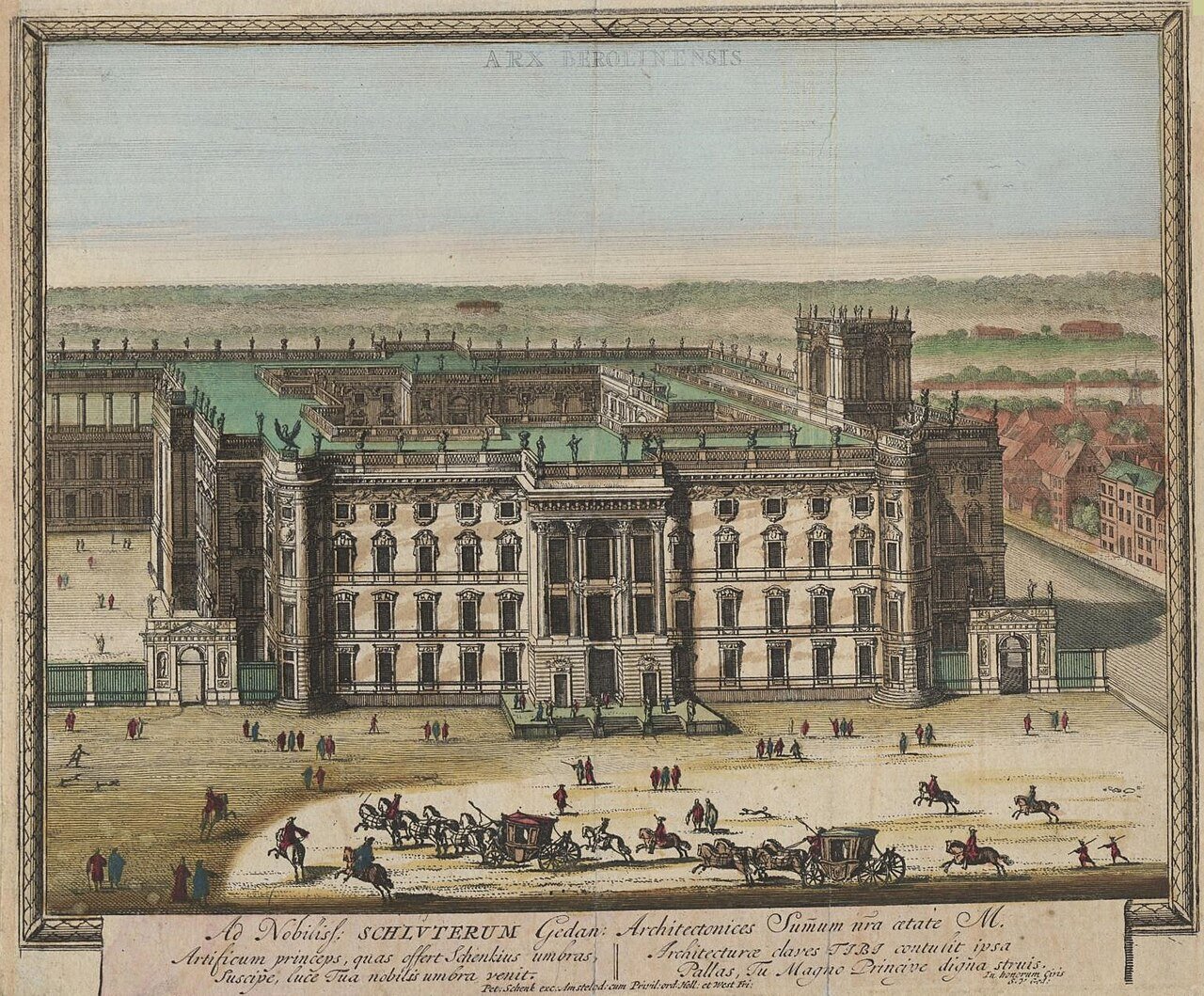
A detailed copper engraving of a long baroque palace on a river, with boats and figures in the foreground.
Berlin’s palace on the Spree, engraved in 1702: the court city the refugees joined.Kupferstich von P. Schenk nach einer Zeichnung von S. Blesendorf, 1702. Wikimedia Commons. Public domain.

1700

A city of 28,500

In 1700 Berlin counted 28,500 inhabitants. Each dot here is one in a hundred of them: about 285 people.

Sources: de.wikipedia, Hugenotten in Berlin

A painting of a courtly garden scene: a prince in white with a yellow sash stands on palace steps as a crowd of refugees in dark clothes, among them a pastor, a bowing man, women and children, gathers before him.
Huguenot refugees received by the Great Elector at Potsdam, as Hugo Vogel imagined it in 1885.Hugo Vogel, 1885. Wikimedia Commons. Public domain.

1700

One in five: French refugees

Of those 28,500, says de.wikipedia’s history of Berlin’s Huguenots, about one in every five was a French refugee: 20 dots, or about 5,700 people.

Sources: de.wikipedia, Hugenotten in Berlin

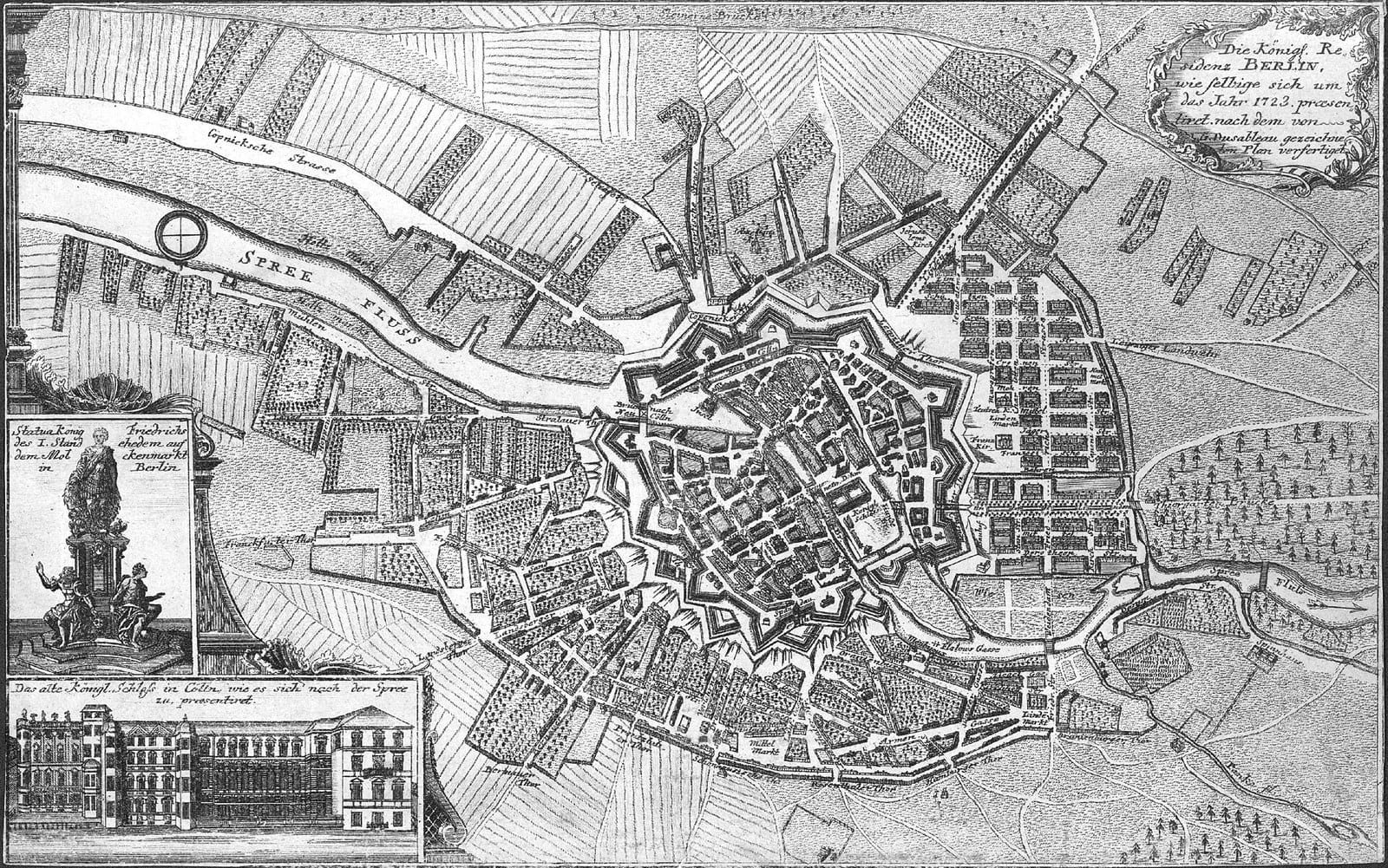
An engraved city plan: a star-shaped fortress on a river at the centre, grids of new streets and gardens around it, a palace view and a statue in insets at lower left.
Berlin about 1723, after Dusableau’s plan: the old fortress, and the new quarters where the refugees settled.Abraham Guibert Dusableau, 1723. Wikimedia Commons. Public domain.

by 1700

Between 5,000 and 6,000

Counted as people rather than a share, the usual figure for Berlin is 5,000–6,000 Huguenots by 1700. The outlined dots show the width of that range.

Sources: de.wikipedia, Hugenotten in Berlin

1700

Or as many as one in four

The Musée protestant, the online museum of French Protestantism, puts it higher: in 1700, it says, a quarter of Berlin’s population was of French origin. Its extra share is drawn in blue.

Sources: Musée protestant, The Huguenot Refuge in Brandenburg

A portrait of a long-haired man in armour with a lace cravat and an ermine-lined red mantle.
Frederick William, the Great Elector, into whose lands they came: Gedeon Romandon’s portrait of 1687.Gedeon Romandon, 1687. Wikimedia Commons. Public domain.

1685 onwards

About 20,000 across Brandenburg-Prussia

Berlin’s refugees were part of a wider settlement: about 20,000 people came to the Elector’s lands as a whole. At the same scale that is 70 dots. Between 25 % and 30 % of them lived in Berlin.

Sources: de.wikipedia, Edikt von Potsdam · de.wikipedia, Hugenotten in Berlin

04Gendarmenmarkt · 1701–1785

They built a church of their own on the new market square — and eight decades later a king gave it a tower

The colony organised fast. A decree of 1 December 1689 founded its own school, the Collège français.

On 1 July 1701 the foundation stone of a French church was laid on the market square of the Friedrichstadt, a new quarter beyond the old town walls — today’s Gendarmenmarkt. Cayart began it and Quesnay finished it; it was consecrated on 1 March 1705.

Between 1780 and 1785 Gontard added the domed tower beside it, built for Frederick the Great. The tower is the Französischer Dom — the “French Cathedral” — and it has stood over the square ever since; the refugees’ church is the low building behind it.

A snowy square with a marble statue of a poet in front of a domed tower and portico; a lower building with a red roof stands to its left.
The Gendarmenmarkt in winter, 2009. Behind the domed tower stands the church the Huguenots built in 1701–05; Schiller’s statue is in front.zahi, 2009. Wikimedia Commons. CC BY 3.0.
A half-length portrait of an elderly man in a blue uniform coat with a star on the breast, looking out at the viewer.
Frederick the Great, for whom Gontard built the tower, in Anton Graff’s portrait of 1781.Anton Graff, 1781. Wikimedia Commons. Public domain.

From the edict to the end of the colony’s privileges, 1685–1809

A detailed copper engraving of a long baroque palace on a river, with boats and figures in the foreground.
The Berlin palace, engraved by P. Schenk after S. Blesendorf in 1702: the court city the refugees joined.Kupferstich von P. Schenk nach einer Zeichnung von S. Blesendorf, 1702. Wikimedia Commons. Public domain.
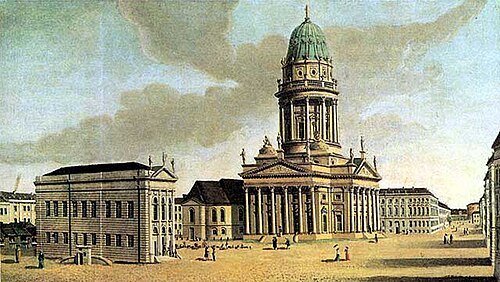
A painted town square: a tall domed tower with a temple portico, a smaller church behind it and a plain playhouse at left.
The Gendarmenmarkt by Carl Traugott Fechhelm, 1788: the new domed tower before the French church, and the French comedy house.Carl Traugott Fechhelm., 1788. Wikimedia Commons. Public domain.
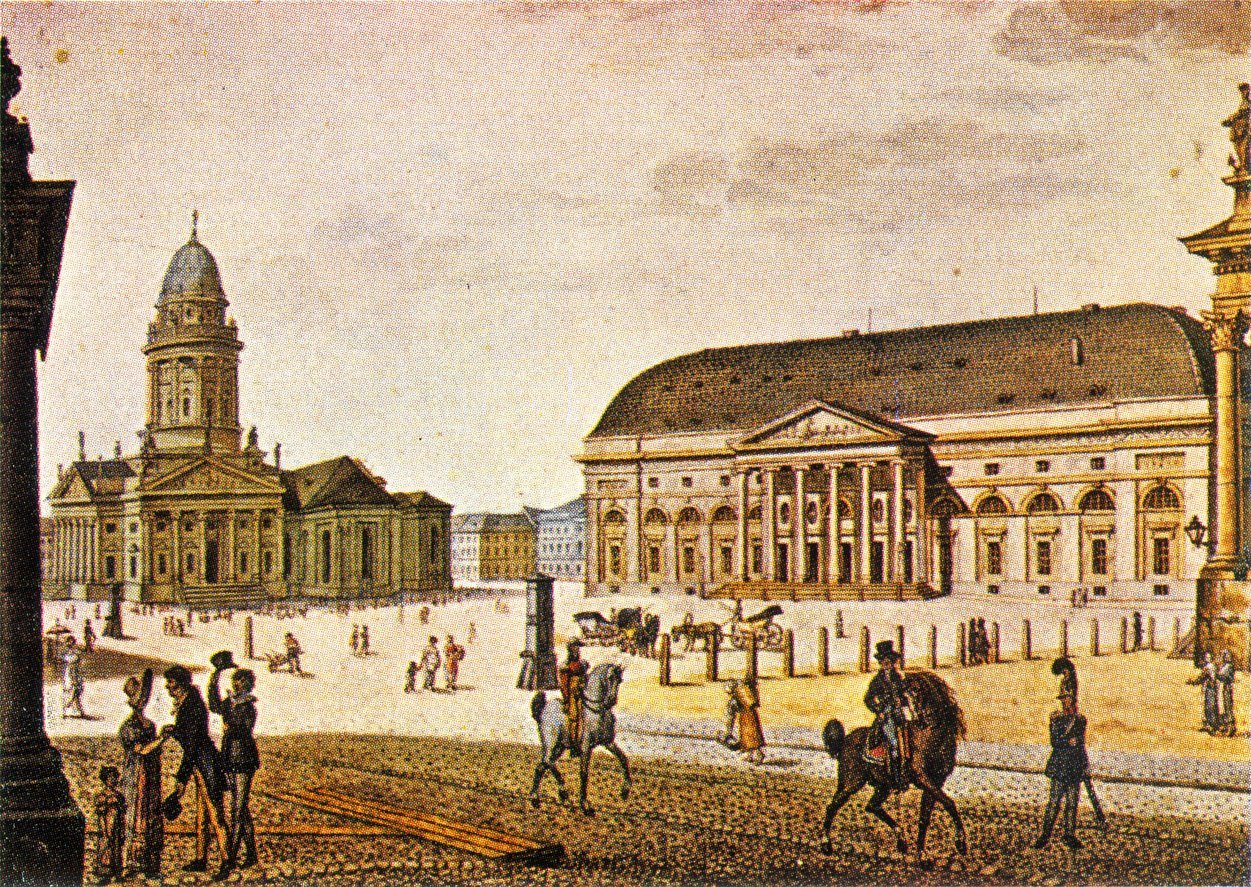
A coloured print of a broad square: a domed church tower at left, a long columned theatre at right, riders and strollers in front.
The Gendarmenmarkt in 1815, by Friedrich August Calau: a domed tower at left, the theatre at right.Friedrich August Calau, 1815. Wikimedia Commons. Public domain.
An engraved city plan: a star-shaped fortress on a river at the centre, grids of new streets and gardens around it, a palace view and a statue in insets at lower left.
“The royal residence Berlin as it presented itself about the year 1723”, after Abraham Guibert Dusableau’s plan: the old star-shaped fortress of Berlin and Cölln, with the new planned quarters spreading beyond its walls.Abraham Guibert Dusableau, 1723. Wikimedia Commons. Public domain.

The city they settled

Dusableau’s plan shows Berlin a generation after the edict: the old fortress on the Spree, and the planned grids of new streets beyond its walls, where the refugees built their church.

A painting of a sunlit city of red roofs seen from a rooftop balustrade, two domed towers on the skyline.
Eduard Gaertner’s rooftop panorama of Berlin, 1834, looking south-west: the twin domes of the Gendarmenmarkt rise over the city.Eduard Gaertner, 1834. Wikimedia Commons. Public domain.

051685–1809

For 124 years the French colony kept privileges of its own

The edict’s refugees lived in Berlin as a French colony with its own church, school and pastors. It lost that privileged status only in 1809, 124 years after the edict that drew them. By then the towers of the Gendarmenmarkt were part of Berlin’s skyline.

1 in 5
Berliners a French refugee, 1700
≈20,000
settled across Brandenburg-Prussia
124 yrs
of colony privileges, to 1809
Berlin · 1685 / 1700

Fifteen years after Louis XIV outlawed their faith, one Berliner in five was a French refugee. Their tower still stands over the Gendarmenmarkt.

Press & citation

Use this Berlinfographic

Free to publish under CC BY 4.0 — in print, online, on Wikipedia and in teaching, commercially or not — with credit to Berlinfographics and a link to this page.

Berlin’s Huguenots, 1685–1809: ready-to-use landscape image

Ready-to-use image

The infographic as one image: headline, key figures, chart, sources and credit, 2,400 × 1,350 px PNG. Please use it unedited.

Download landscape (PNG)
Berlin’s Huguenots, 1685–1809: square version

Square format

A 1:1 version for social media and narrow columns, 1,800 × 1,800 px.

Download square (PNG)
Berlin’s Huguenots, 1685–1809: portrait version

Portrait 4:5

For Instagram and LinkedIn feeds, 1,620 × 2,025 px.

Download portrait (PNG)

Credit line

Berlinfographics (berlinfographics.com), CC BY 4.0

Citation

Berlinfographics (2026). “Berlin’s Huguenots, 1685–1809”. Berlin Experiences. https://berlinfographics.com/berlin-huguenots/

Wikipedia

{{cite web |title=Berlin’s Huguenots, 1685–1809 |url=https://berlinfographics.com/berlin-huguenots/ |website=Berlinfographics |publisher=Berlin Experiences |date=2026-11-05 |access-date=2026-11-05}}