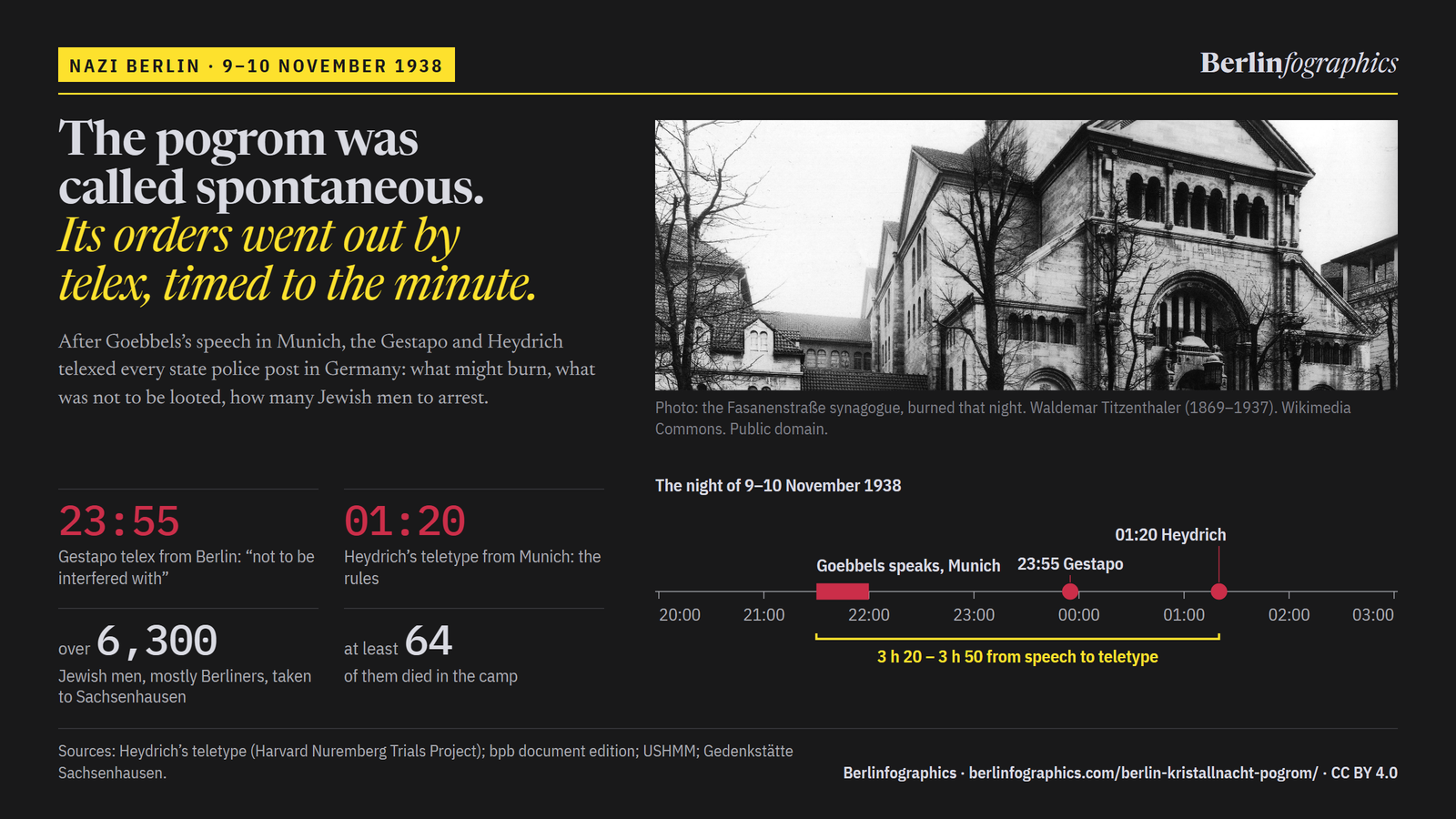
The synagogue in the Fasanenstraße, Charlottenburg, photographed by Waldemar Titzenthaler, who died in 1937. It was set on fire in the night to 10 November 1938.Waldemar Titzenthaler (1869–1937). Wikimedia Commons. Public domain.
The November pogrom · Berlin · 1938
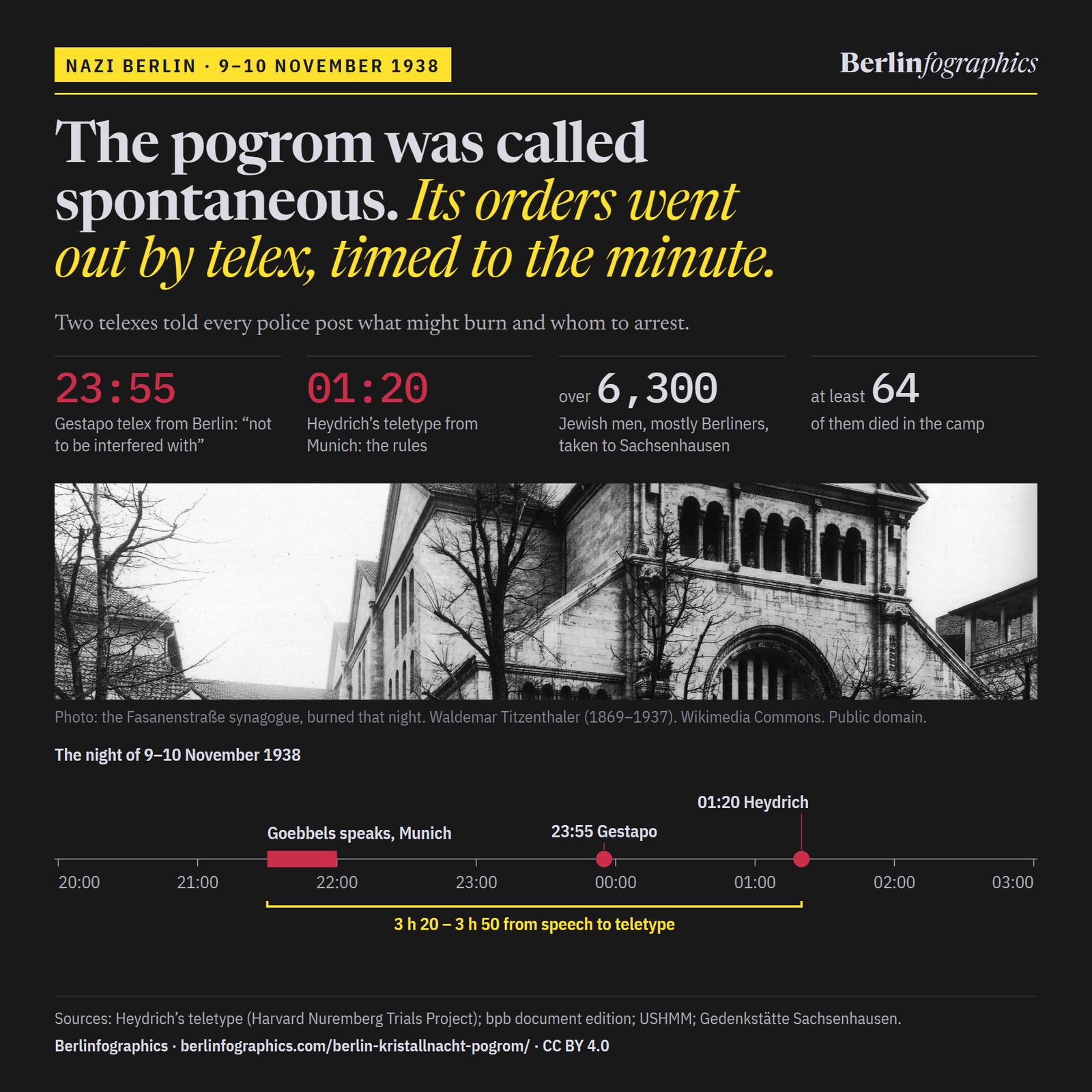
Goebbels gave the signal in a Munich speech on the evening of 9 November 1938. Before dawn, two telexes had told every state police post in Germany what might burn, what was not to be looted, and how many Jewish men to arrest. By morning Berlin’s synagogues were burning and its Jewish shops were wrecked.
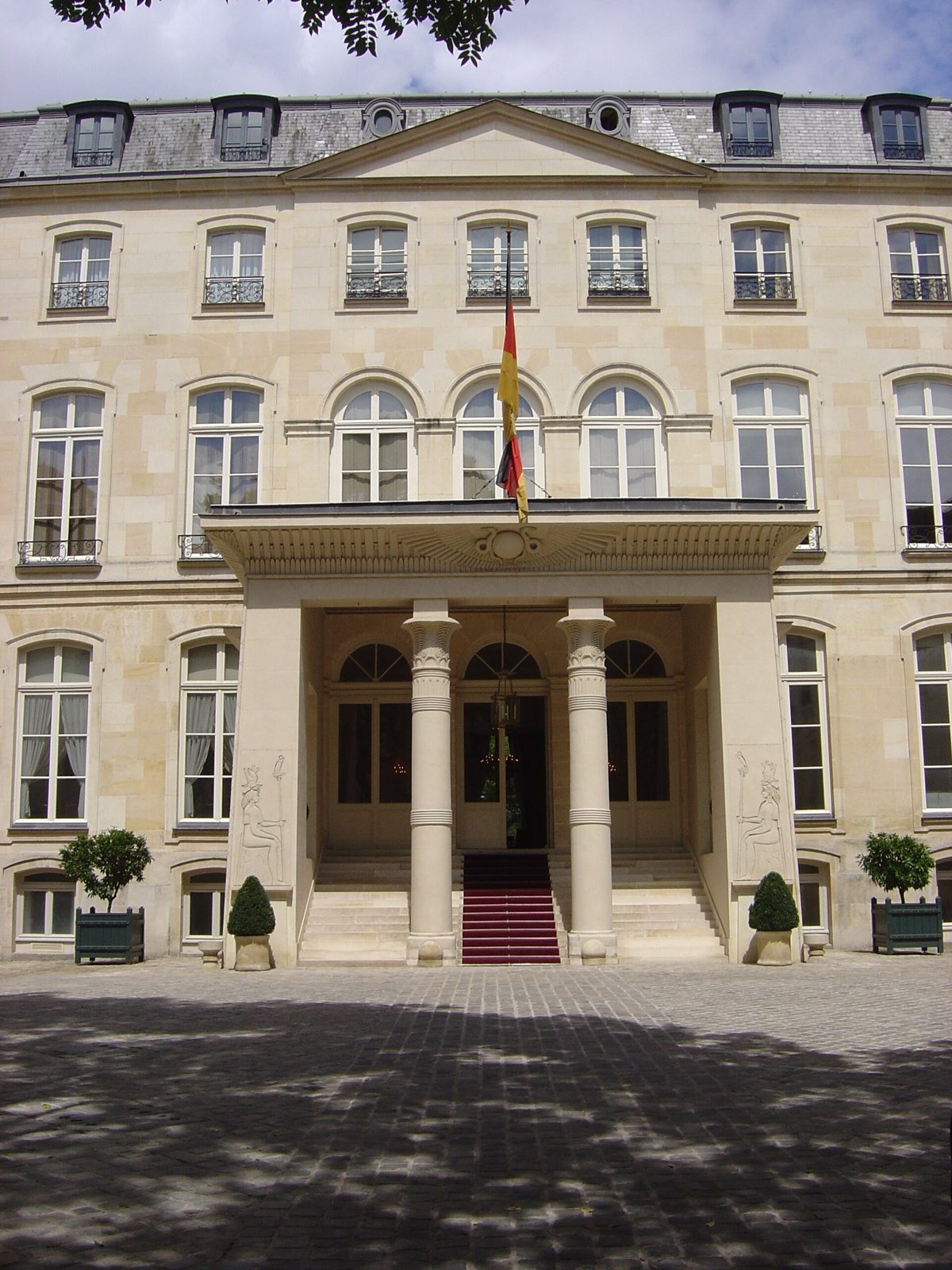
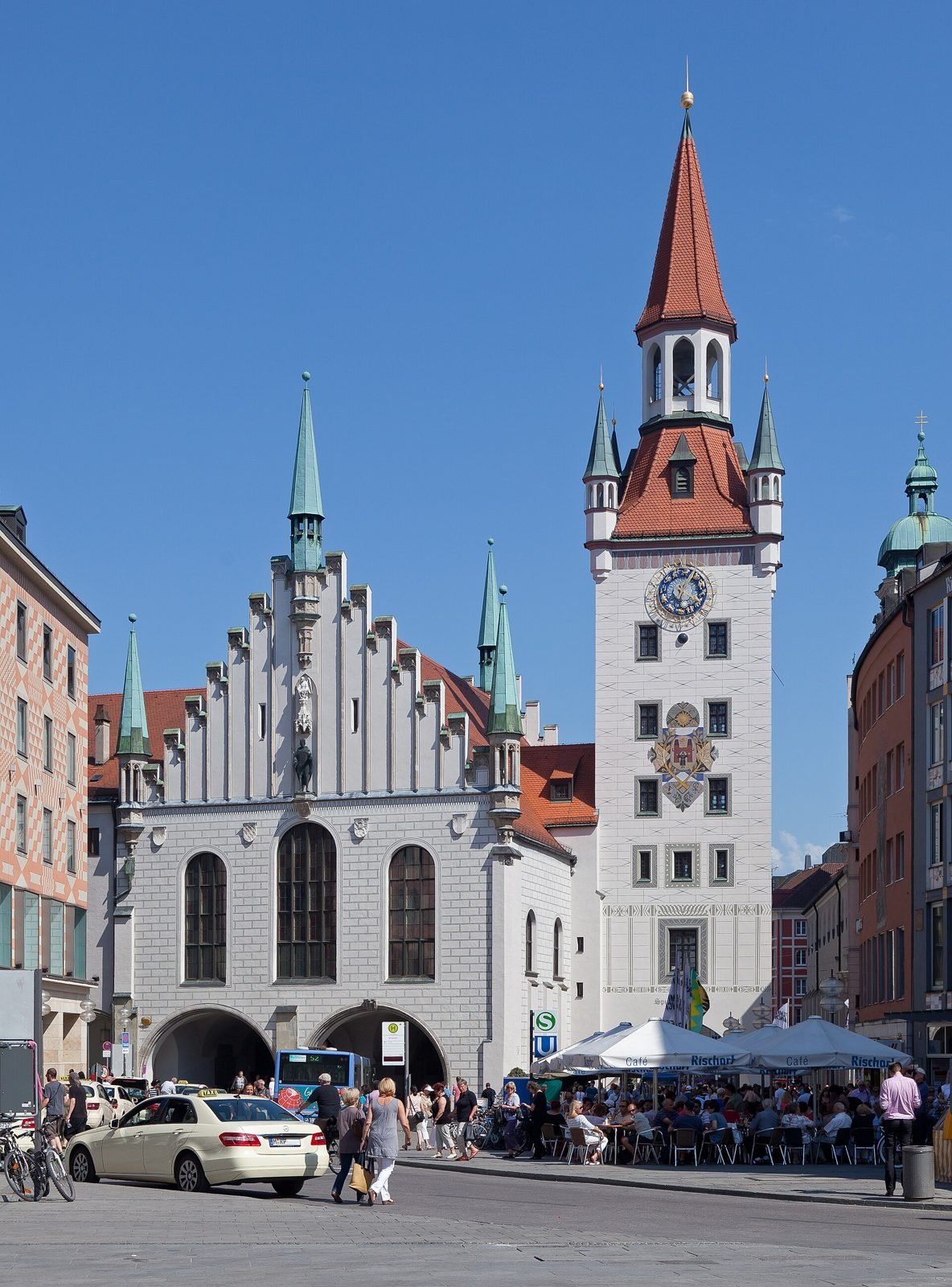
01Paris · Munich · Berlin
The regime called the pogrom the people’s spontaneous answer to a murder in Paris. Its own records say otherwise. Goebbels told the party leaders in Munich that the party was not to be seen preparing or organising “demonstrations”, but was not to stop them either. They understood, the party’s own supreme court recorded in February 1939, that the party should “in reality organise and carry them out”.
They telephoned their regions that night. Then the police were brought in, by telex. Each message below is timed as it was stamped.
The night of 9–10 November 1938
7 November, morning · Paris
Herschel Grynszpan, 17, shoots the German diplomat Ernst vom Rath at the embassy in Paris.
9 November, afternoon · Paris
He dies of his wounds. The Nazi leaders, gathered in Munich for the anniversary of the 1923 putsch, hear the news that evening.
9 November, about 21:30–22:00 · Munich
In the Altes Rathaus Goebbels tells the party leaders that the party must not be seen to organise ‘demonstrations’, nor stop them.
9 November, 23:55 · Berlin
The Gestapo telexes every state police post: actions against the Jews are not to be interfered with. Prepare to arrest 20,000 to 30,000 Jews.
10 November, 01:20 · Munich
Heydrich’s teletype sets the rules: synagogues may burn where the fire cannot spread; Jewish shops and homes may be destroyed, not looted; arrest as many Jews as the cells will hold.
10 November, 01:40 · Munich
Goebbels’s party propaganda office sends the regional party leaders a written summary of the speech.
10 November, 02:56 · Munich
The Deputy Führer’s staff forbids setting fire to Jewish shops.
10 November, by day · Berlin
The Fasanenstraße synagogue has burned. On the Kurfürstendamm, Erich Kästner sees men in SS breeches and civilian jackets smash shop windows.
02Charlottenburg · Mitte
The synagogue in the Fasanenstraße, in Charlottenburg, was set on fire in the night to 10 November. Its ruin was pulled down after the war, and the Jewish community centre stands on the site. Across the city the historians Christoph Kreutzmüller and Bjoern Weigel count at least 3,000 Jewish shops destroyed.


The men who did it were not a crowd. On the Kurfürstendamm and the Tauentzienstraße the writer Erich Kästner watched men in SS breeches and high boots, but in civilian jackets and hats, smashing the shop windows with iron bars on both sides of the street.
The uniform trousers stayed on. Only the jackets were civilian.

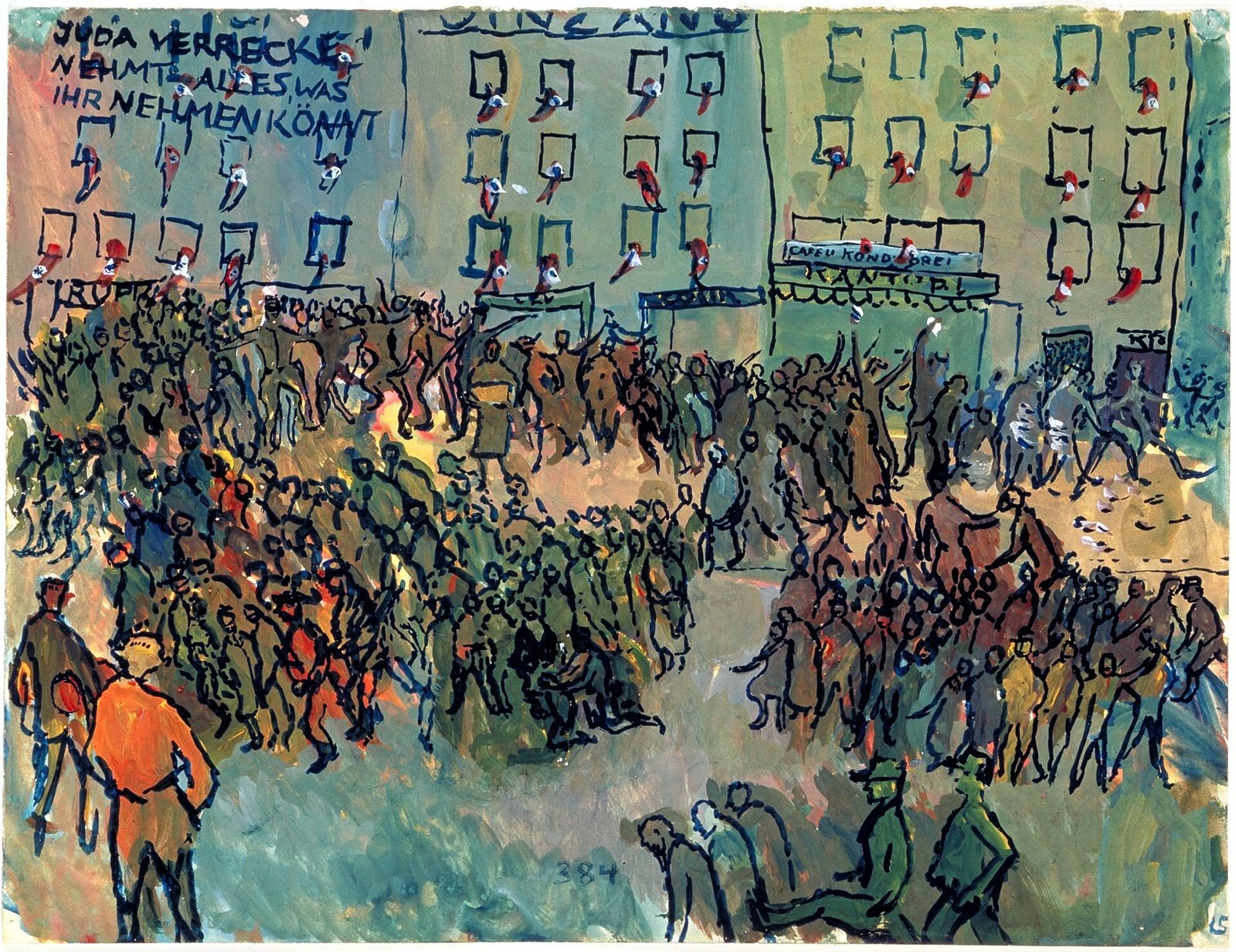
A Berliner’s painting
Charlotte Salomon was twenty-one and living in Berlin in November 1938. Her father was among the Jewish men taken to Sachsenhausen. Within months she had left for the south of France, where she painted her life in hundreds of gouaches. In this one the crowd fills the street under the flags, and the slogans it shouted are written into the sky.

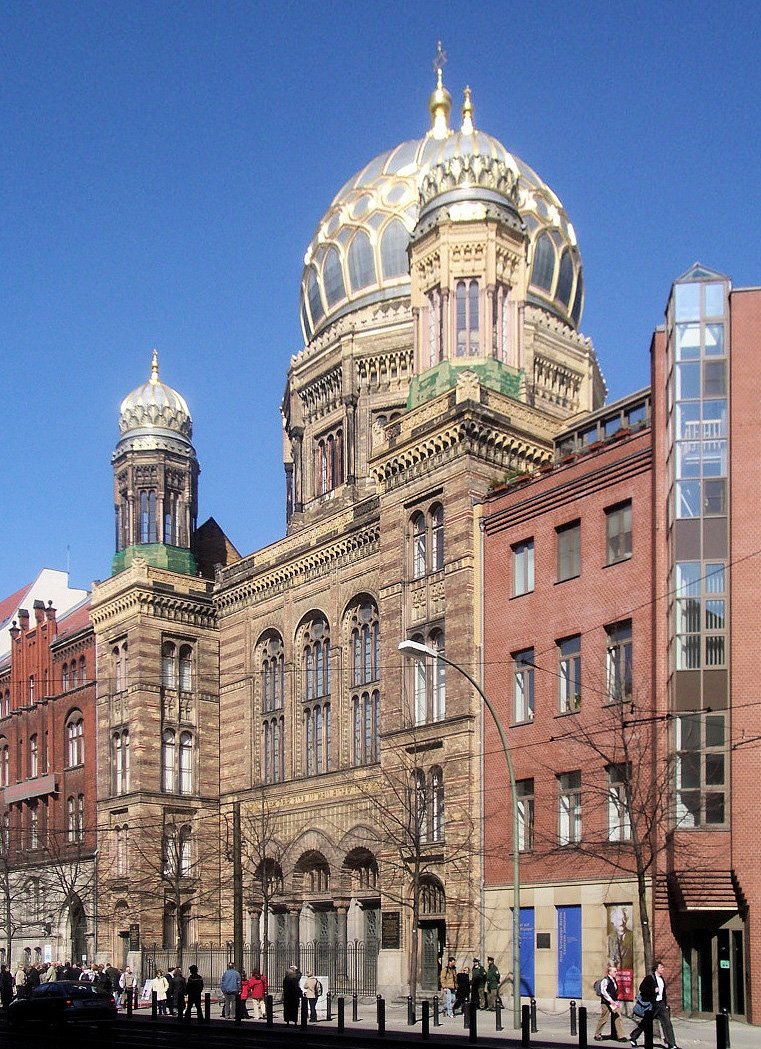
At the Neue Synagoge on the Oranienburger Straße, officers of the 16th police precinct stood up to the SA, pointing out that the building was a protected monument, and called the fire brigade. Their chief, Wilhelm Krützfeld, is honoured by a plaque on the building as the man who saved it. How much of the credit is his alone is contested: the memorial museum that tells the story names the officers of the precinct.


0311 November 1938 – 13 February 1939
On 11 November Heydrich reported 815 shops destroyed across the Reich, and called the figures incomplete. The next day, at Göring’s meeting, he gave 7,500. Berlin alone accounts for at least 3,000. The count of the dead rose in the same way, and no one count is final: the figures are shown here with the names of those who gave them.
Two counts that kept growing
Each group has its own scale. Heydrich’s figures are for the whole Reich; the Berlin figure is the historians’ count for the city. The death toll is contested: the regime counted 36, then 91; the Topographie des Terrors gives about 400 murdered or driven to suicide. Deaths in the camps afterwards are counted separately.
04Sachsenhausen · November 1938 – spring 1939
The telex at 23:55 had told the police to prepare the arrest of 20,000 to 30,000 Jews across the Reich. By 11 November Heydrich reported about 20,000 arrested. From Berlin, the men were sent to the concentration camp at Sachsenhausen, north of the city.
At least 64 of them died there. Most were released by the spring of 1939, on condition that they leave Germany at once.

6,300 men: one dot each
Each dot is one of the more than 6,300 Jewish men the Sachsenhausen memorial counts. The 64 lit dots at the end are the men known to have died in the camp, a minimum.
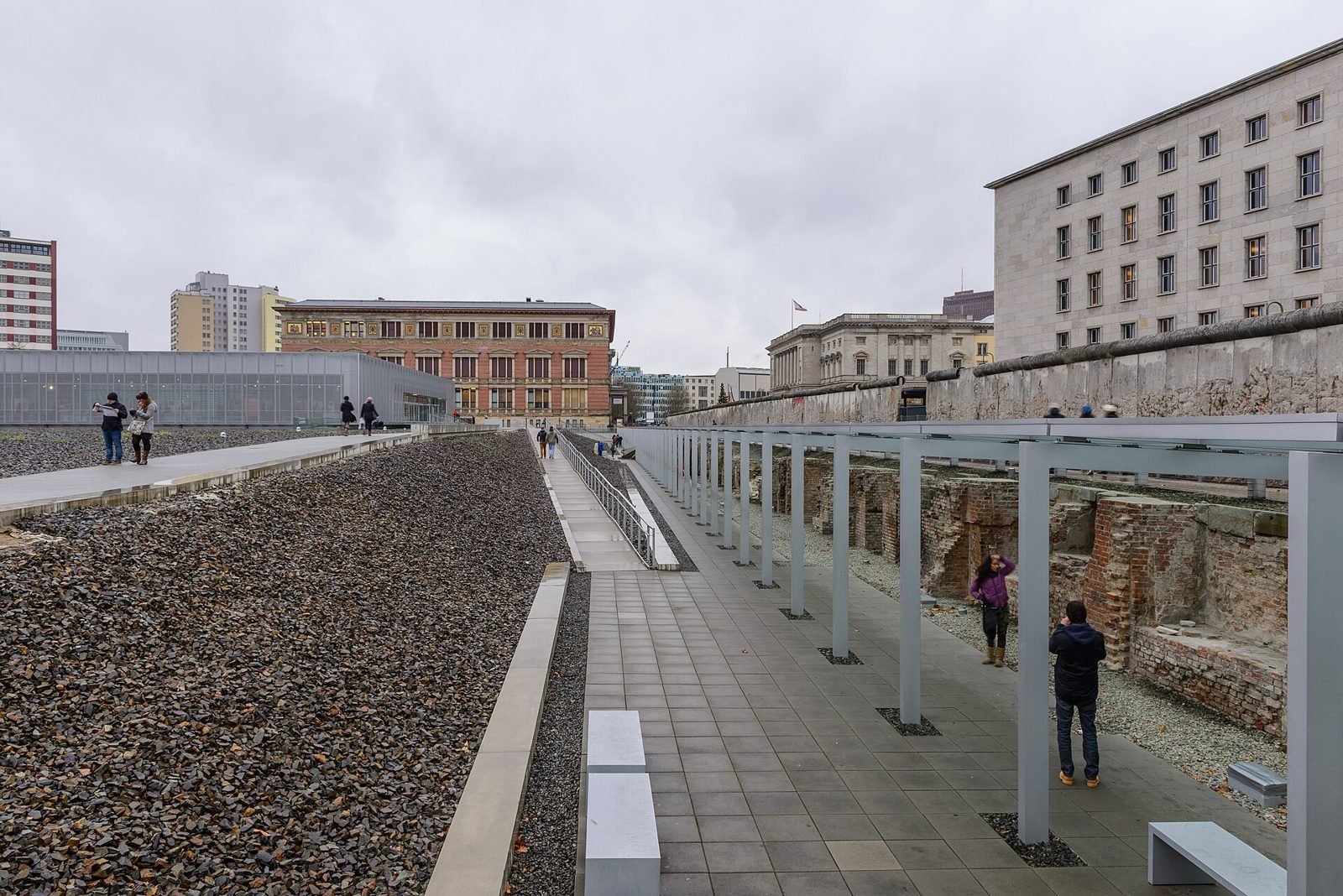
05Reich Aviation Ministry · 12 November 1938
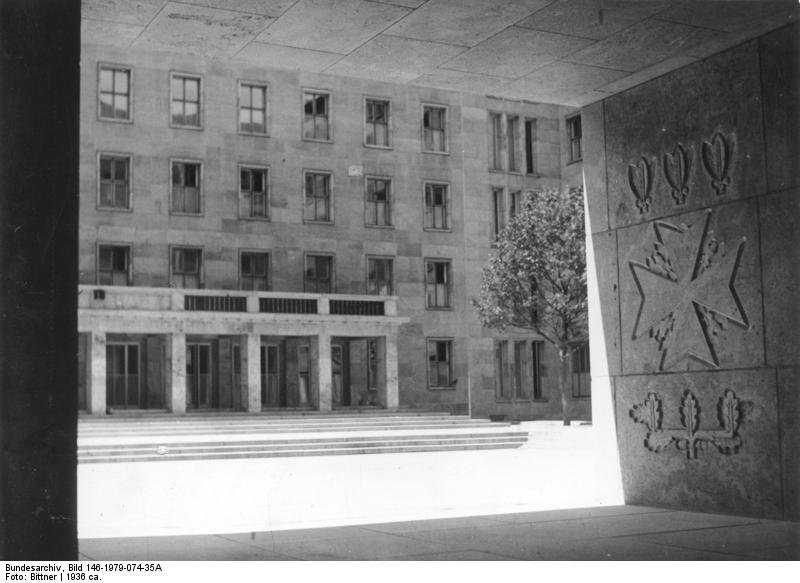
On 12 November, Göring chaired a meeting at the Reich Aviation Ministry from 11:00 to 14:40. The insurers would have to pay out for the damage, but the payments would be confiscated by the state. And Germany’s Jews were to pay a collective “atonement” fine.

From the stenographic record of the meeting (Nuremberg document 1816-PS), as edited by the bpb and translated by the German Historical Institute.
No order that night said “pogrom”. The orders said how: which fires might burn, which windows might break, how many men the cells would hold.
The regime called it spontaneous. The telexes are stamped 23:55 and 01:20.
Press & citation
Free to publish under CC BY 4.0 — in print, online, on Wikipedia and in teaching, commercially or not — with credit to Berlinfographics and a link to this page.
Ready-to-use image
The infographic as one image: headline, key figures, chart, sources and credit, 2,400 × 1,350 px PNG. Please use it unedited.
Download landscape (PNG)
Square format
A 1:1 version for social media and narrow columns, 1,800 × 1,800 px.
Download square (PNG)
Portrait 4:5
For Instagram and LinkedIn feeds, 1,620 × 2,025 px.
Download portrait (PNG)Credit line
Berlinfographics (berlinfographics.com), CC BY 4.0
Citation
Berlinfographics (2026). “The November pogrom in Berlin, 1938”. Berlin Experiences. https://berlinfographics.com/berlin-kristallnacht-pogrom/
Wikipedia
{{cite web |title=The November pogrom in Berlin, 1938 |url=https://berlinfographics.com/berlin-kristallnacht-pogrom/ |website=Berlinfographics |publisher=Berlin Experiences |date=2026-11-09 |access-date=2026-11-09}}
Our infographics, charts and texts are licensed CC BY 4.0: free to republish, including commercially, with credit to Berlinfographics and a link. Photographs keep their own licences, named in each caption. How to credit
Topics: The Second World War · Cold War Berlin · Nazi Berlin · Persecution & the Holocaust · Weimar Berlin · Prussia & the Kaiserreich · Architecture & the built city · Culture, science & society · Reunified Berlin · Unusual facts
Contact: info@berlinfographics.com · Press: press@berlinfographics.com · Imprint · Privacy