Berlinfographicsby Berlin Experiences

Runners finishing at the Brandenburger Tor, 25 September 2022: the day Eliud Kipchoge ran 2:01:09 here.Photo: Lear 21, 2022. Wikimedia Commons. CC BY-SA 4.0.

The Berlin Marathon

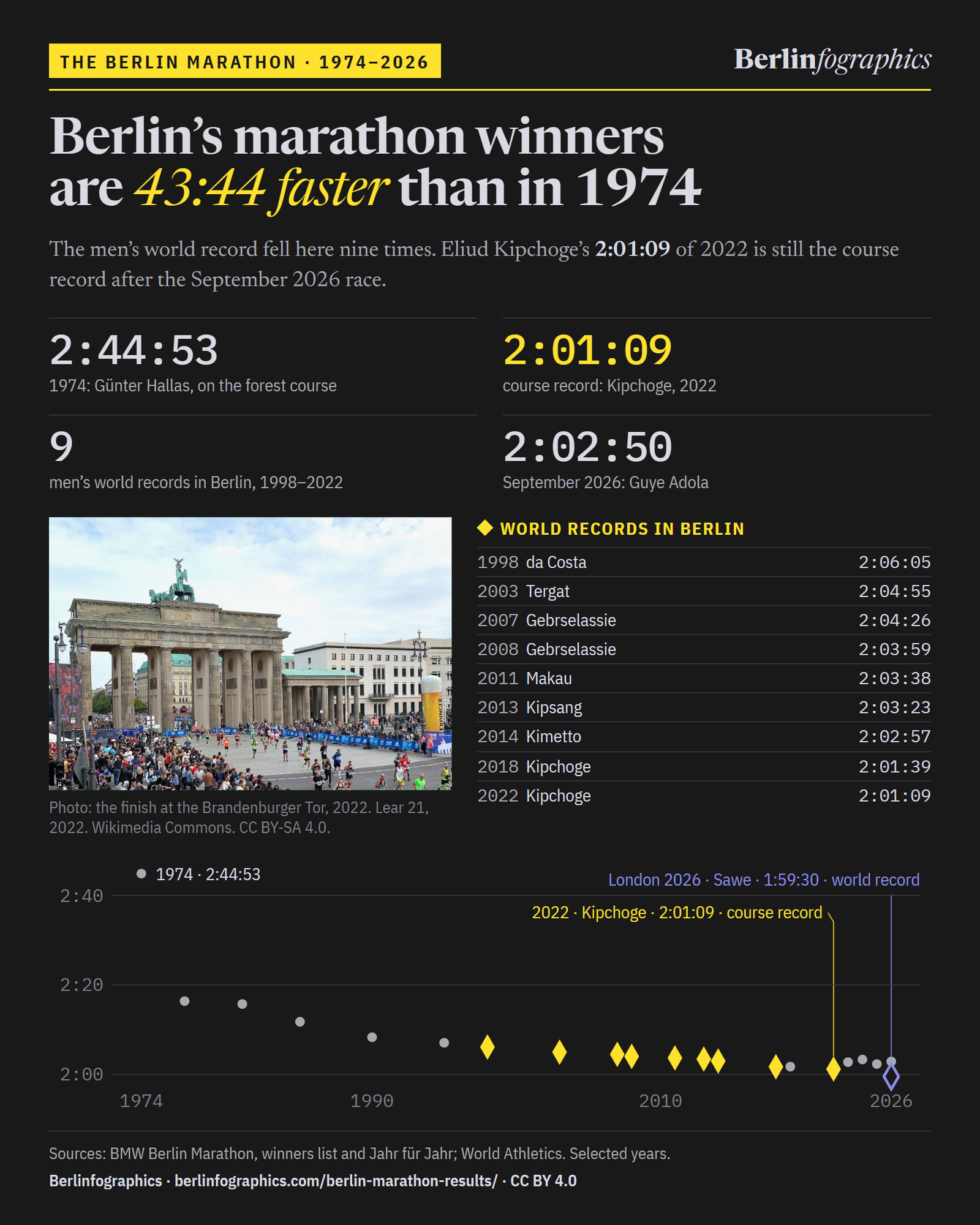
Berlin’s marathon began in the woods in 1974. Its winners have since run 43:44 faster, and broken the men’s world record nine times

Günter Hallas won the first race, around the Grunewald, in 2:44:53. In 2022 Eliud Kipchoge won in 2:01:09, still the course record after the September 2026 race. The world record has moved on: Sabastian Sawe ran 1:59:30 in London in April 2026.

43:44
taken off the winning time, 1974 to 2022
9
men’s world records set in Berlin, 1998–2022
2:01:09
the course record, Kipchoge 2022: unbeaten in the four races since
22,861
finishers in 1990, against 244 in 1974
01Grunewald, 13 October 1974

The first Berlin Marathon was a run along the forest for 244 finishers

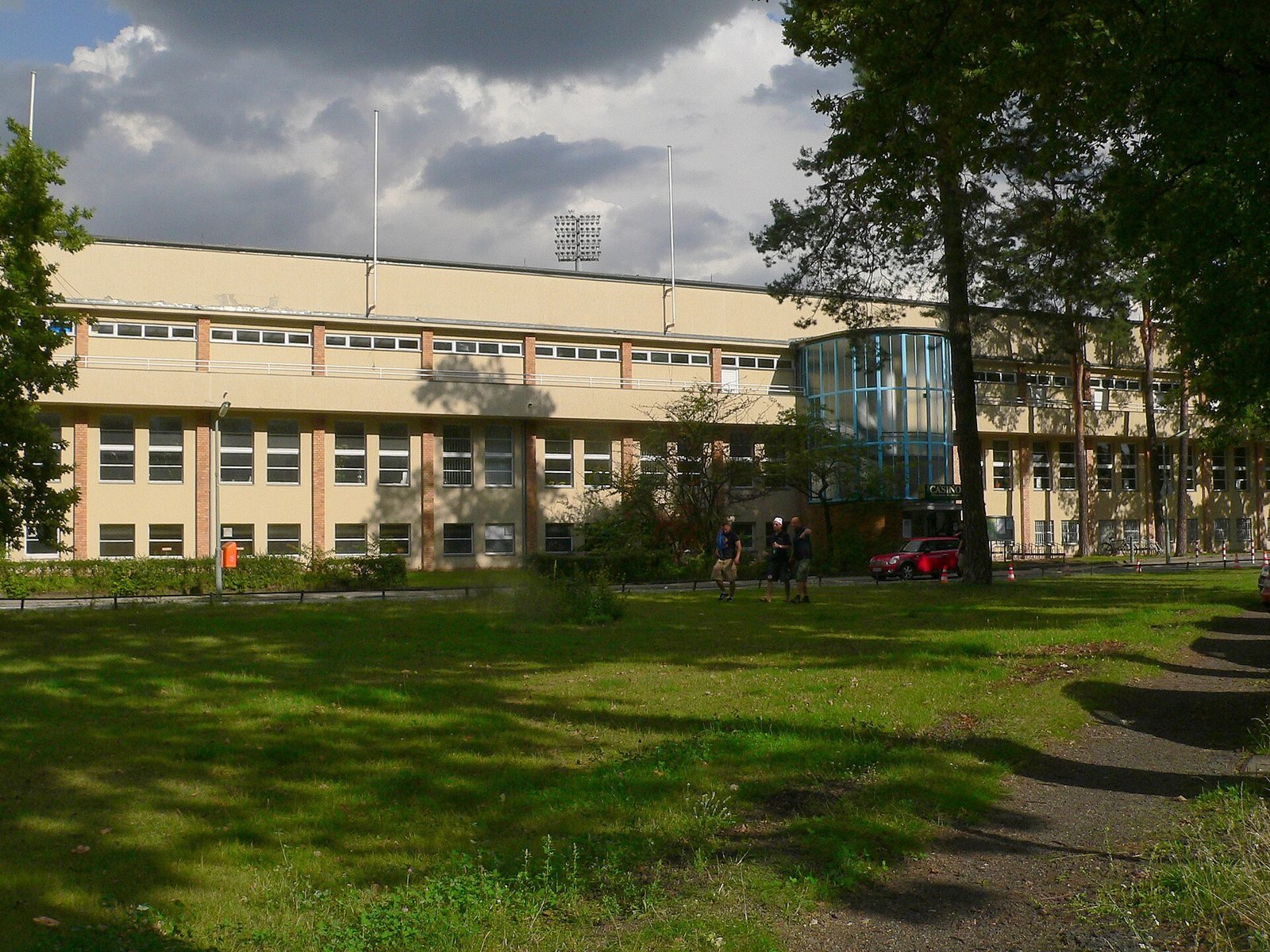
On 13 October 1974, 286 runners entered the first Berlin Marathon. It started at the Mommsenstadion, in Westend in West Berlin, and ran along the Grunewald, the forest on the city’s western edge. 244 finished. The winner, Günter Hallas, a Berlin club runner, took 2:44:53.

The race stayed at the forest’s edge until 1980. In 1977, at the German championships held alongside it, Christa Vahlensieck ran 2:34:48: a women’s world record, and the first of Berlin’s world records. The men’s race that year went to Norman Wilson in 2:16:21.

16 years later, 22,861 people finished it.

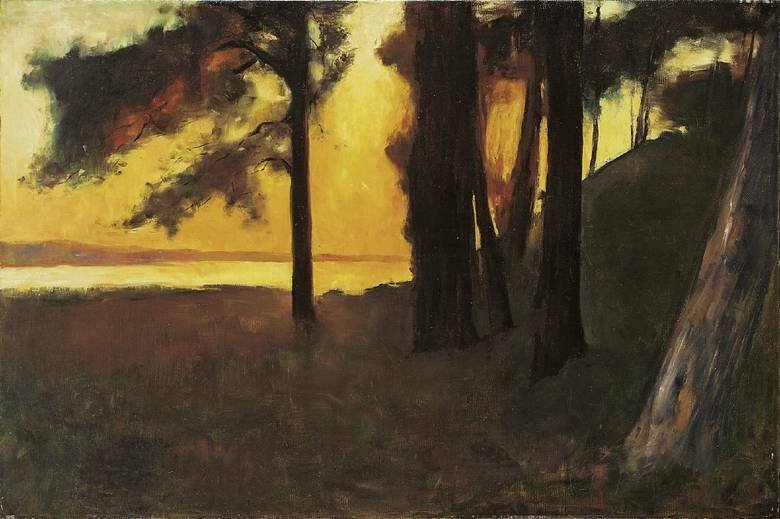
An impressionist painting of a lake at sunset framed by dark pine trees, the sky orange and violet.
The Grunewald, the forest on Berlin’s western edge where the first races ran: Lesser Ury’s “Sunset at the Grunewaldsee”, about 1900.Painting: Lesser Ury, 1900. Wikimedia Commons. Public domain.
A long, low pale stadium building with a flat roof behind a lawn and trees, under a cloudy sky.
The Mommsenstadion in Westend, start and finish of the race until 1980, photographed in 2010.Photo: Fridolin freudenfett (Peter Kuley), 2010. Wikimedia Commons. CC BY-SA 3.0.

Where the race ran: Berlin, with the line of the Wall

A map of Berlin from OpenStreetMap: the city boundary, the line of the former Wall, the Grunewald and the Tiergarten, with the Mommsenstadion, the Reichstag and the Brandenburger Tor marked.

The line of the Wall is shown by the Berliner Mauerweg, the trail that follows it. Map: © OpenStreetMap contributors, ODbL.

A long, low pale stadium building with a flat roof behind a lawn and trees, under a cloudy sky.
The Mommsenstadion, 2010.Photo: Fridolin freudenfett (Peter Kuley), 2010. Wikimedia Commons. CC BY-SA 3.0.

1974–1980

A West Berlin race on the forest’s edge

Start and finish were at the Mommsenstadion. The course ran along the Grunewald; the city centre was never on it.

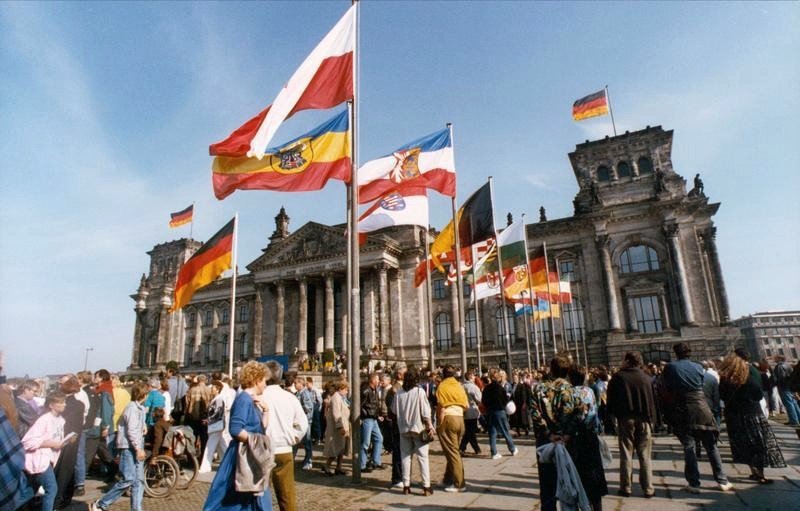
A row of flags on tall poles in front of the Reichstag building, with people on the lawn.
Flags in front of the Reichstag, 3 October 1990.Photo: Bundesarchiv, Bild 183-1990-1003-417 / Unknown / CC-BY-SA 3.0 de

1981

Into the city, with a start in front of the Reichstag

In 1981 the race moved into the city. From 1981 to 1986 it started on the lawn in front of the Reichstag.

People standing on top of the Berlin Wall in front of the Brandenburg Gate.
The Wall at the Brandenburger Tor, November 1989.Photo: Sue Ream, photographer (San Francisco, California), 1989. Wikimedia Commons. CC BY 3.0.

1981–1989

Past the Wall, and only in the West

From 1981 to 1989 the route also ran past the Wall. Every step of it was in West Berlin.

Runners on a broad tree-lined avenue running towards the Brandenburg Gate in the distance.
Unter den Linden towards the Brandenburger Tor, 2022.Photo: Unmarcheprovencal, 2022. Wikimedia Commons. CC BY-SA 4.0.

30 September 1990

Through the Brandenburger Tor, days before reunification

On 30 September 1990 the marathon ran through East and West for the first time. 25,000 runners passed through the Brandenburger Tor; 22,861 finished, from 61 countries. Steve Moneghetti won in 2:08:16.

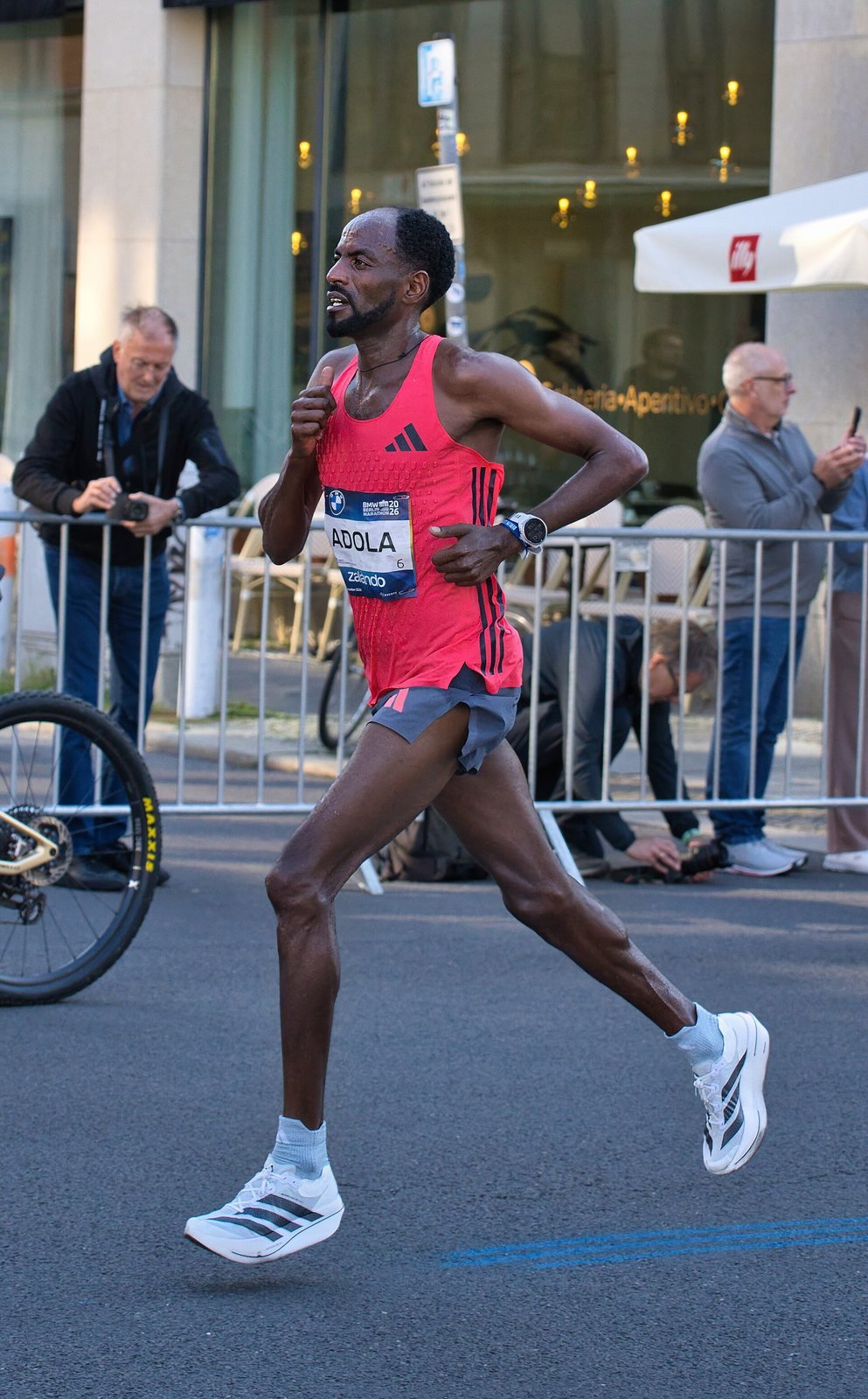
A runner in a pink vest runs alone along a street lined with barriers and spectators.
Guye Adola alone in front at the Gendarmenmarkt, kilometre 40.5, on his way to winning the September 2026 race.Photo: Photogoddle, 2026. Wikimedia Commons. CC BY-SA 4.0.

Since 1990

The finish is at the Brandenburger Tor

The race now ends at the Brandenburger Tor. In September 2026 the winner, Guye Adola, came through the old East Berlin centre alone in the last kilometres.

02World records, 1998–2022

Berlin broke the men’s world record nine times in 24 years

Ronaldo da Costa set the first men’s world record in Berlin in 1998, in 2:06:05. Between then and 2022, eight more followed on the same streets. Counting the women’s records, the organisers listed 12 by 2022, more than any other race by their count.

Scroll through the winning times. Each yellow diamond is a world record set in Berlin.

Men’s winning times, 1974–2026

Men's winning times in the Berlin Marathon in selected years from 1974 to 2026, with the world records set in Berlin marked.
Winning timeWorld record in BerlinWorld record elsewhere

1974

2:44:53 in the woods

The first winning time was 2:44:53: Günter Hallas, on the forest course.

Runners on a broad tree-lined avenue running towards the Brandenburg Gate in the distance.
Unter den Linden towards the Brandenburger Tor, 2022.Photo: Unmarcheprovencal, 2022. Wikimedia Commons. CC BY-SA 4.0.

1977–1990

The city course took the time down fast

2:16:21 in 1977, 2:15:42 in 1981, the first year in the city, and 2:11:43 in 1985. In 1990, through the Brandenburger Tor, Moneghetti ran 2:08:16.

1998

The first men’s world record: 2:06:05

Ronaldo da Costa won in 2:06:05, a world record. From here the time scale covers ten minutes instead of almost fifty.

A runner with arms raised crosses a finish line between advertising boards as photographers watch.
Paul Tergat, 2003.Aalexej, 2003. Wikimedia Commons. Public domain.
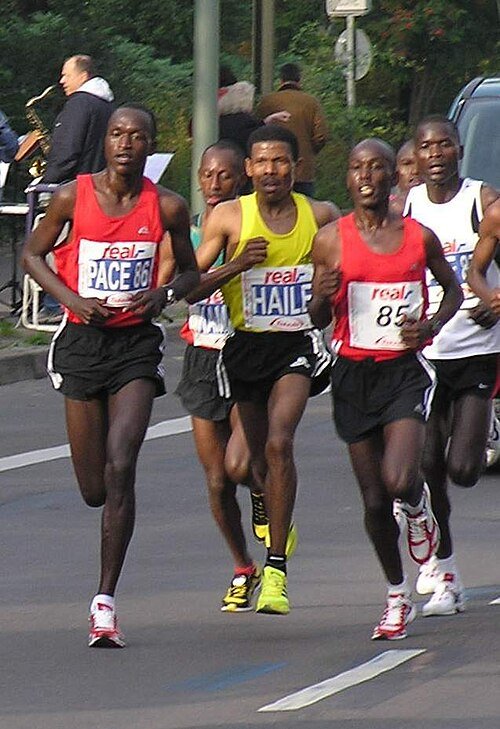
A tight pack of elite runners on a city street, their bibs printed with their names.
Haile Gebrselassie, 2008.Inductor, 2008. Wikimedia Commons. Public domain.

2003–2008

Three world records in six years

Paul Tergat ran 2:04:55 in 2003. Haile Gebrselassie took it to 2:04:26 in 2007 and 2:03:59 a year later.

A lone runner on a wide street behind a car carrying a large clock, with buildings and spectators behind.
Patrick Makau, 2011.Ramon Smits, 2011. Wikimedia Commons. CC BY 2.0.
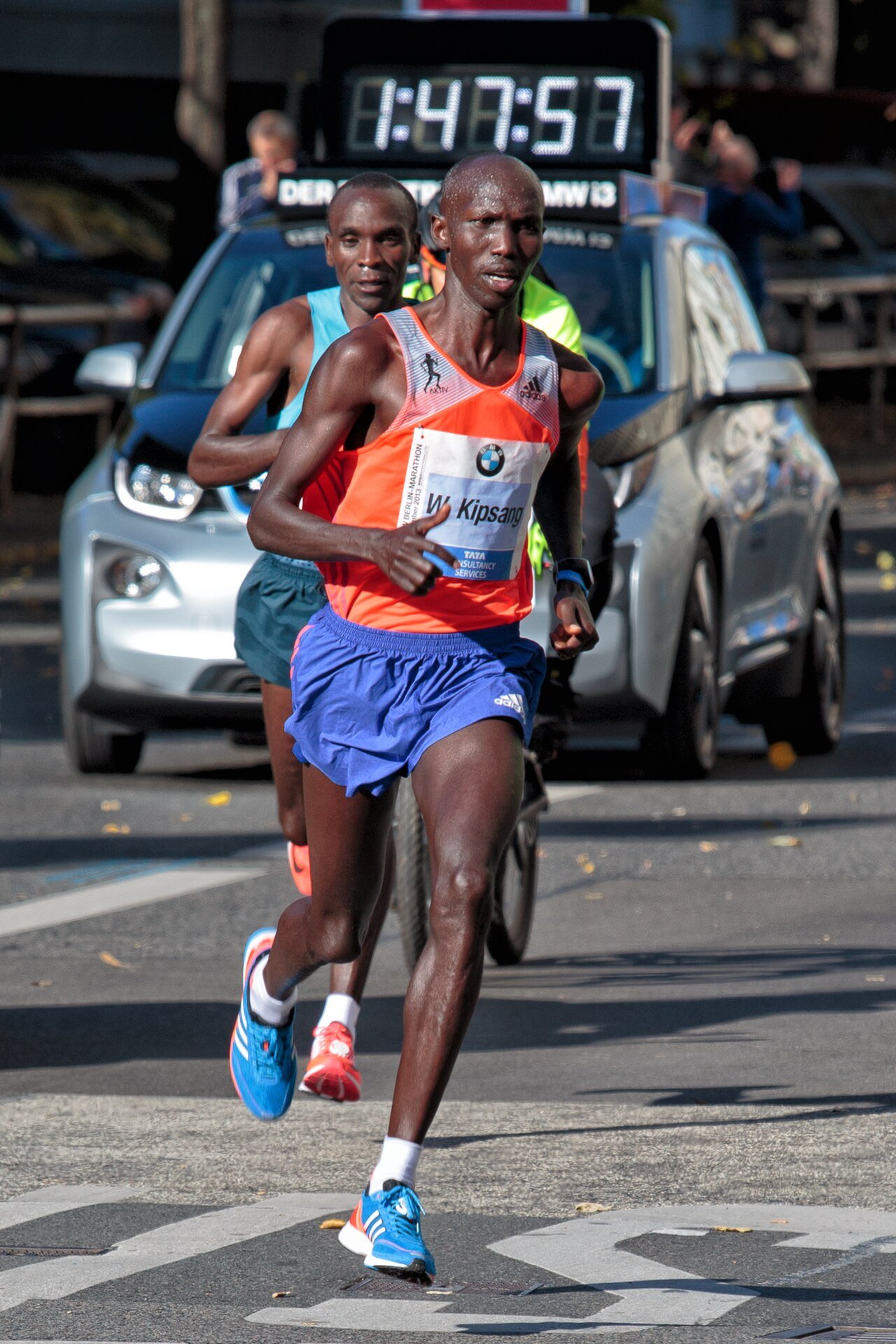
A runner in an orange vest and blue shorts on a city street, with a car carrying a clock behind him.
Wilson Kipsang, 2013.Avda, 2013. Wikimedia Commons. CC BY-SA 3.0.
Head-and-shoulders portrait of a runner in a yellow and white vest, his hand on his chest.
Dennis Kimetto, 2013.Eastfrisian, 2013. Wikimedia Commons. CC BY 3.0.

2011–2014

Three more in four years

Patrick Makau, 2:03:38. Wilson Kipsang, 2:03:23. Dennis Kimetto, 2:02:57: the first time under 2 hours 3 minutes.

A runner in a white vest and orange shorts running past spectators on a city street.
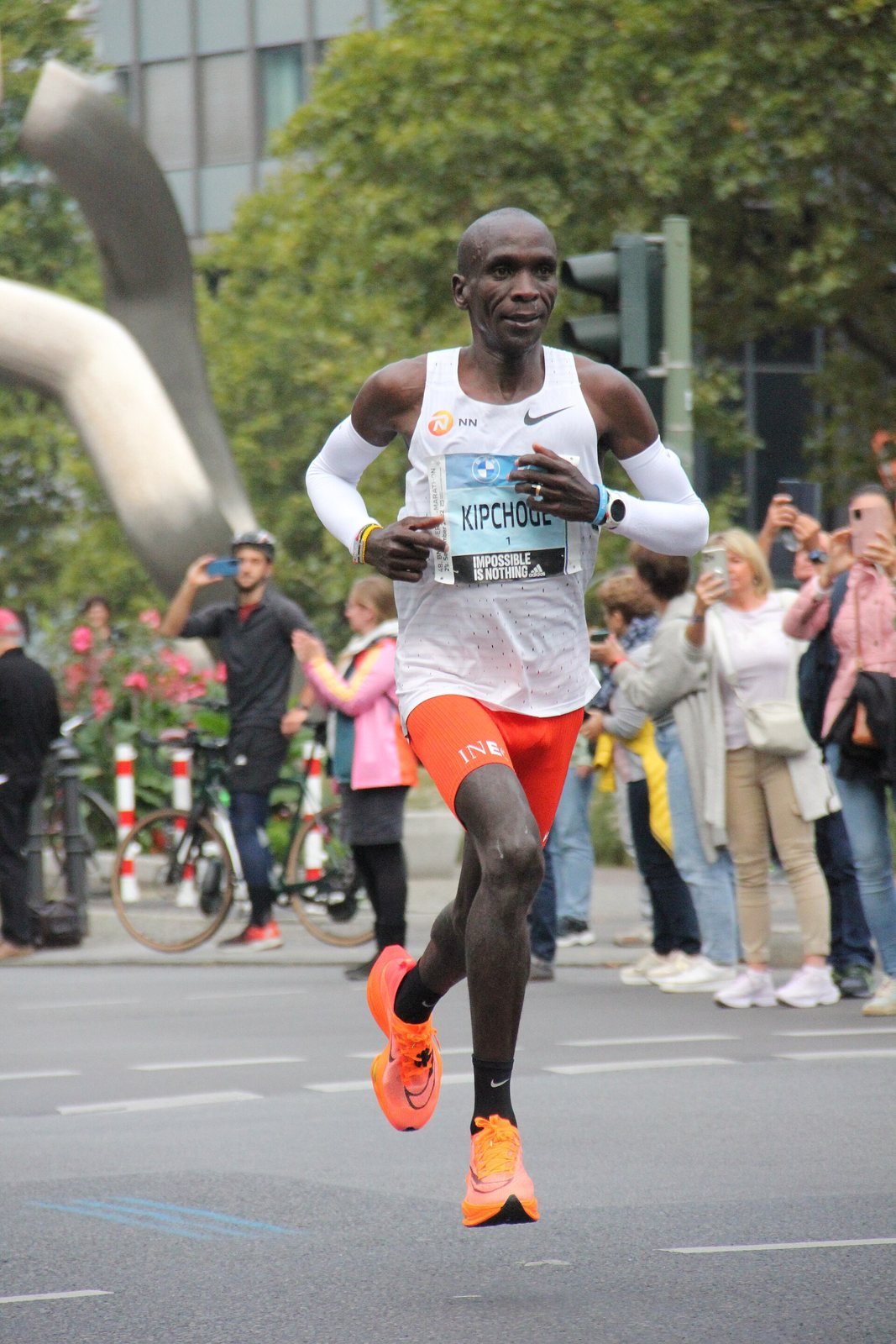
Eliud Kipchoge, 2022.Desitlicheresguruweil, 2022. Wikimedia Commons. CC BY-SA 4.0.
A runner in an Ethiopian vest holds a green, yellow and red flag behind him on a blue track.
Kenenisa Bekele, Berlin 2009.André Zehetbauer from Schwerin, Deutschland, 2009. Wikimedia Commons. CC BY-SA 2.0.

2018–2019

Kipchoge’s record, and Bekele two seconds behind it

Eliud Kipchoge ran 2:01:39 in 2018. A year later Kenenisa Bekele won in 2:01:41, two seconds slower.

A runner in a white vest and orange shorts running past spectators on a city street.
Eliud Kipchoge, 2022.Photo: Desitlicheresguruweil, 2022. Wikimedia Commons. CC BY-SA 4.0.

25 September 2022

2:01:09, just 1:09 above two hours

Eliud Kipchoge broke his own record with 2:01:09, 1:09 above two hours. No one has run faster in Berlin since.

A runner in a white and blue kit striding past barriers and spectators.
Kelvin Kiptum, Chicago 2023.Chad Veal, 2023. Wikimedia Commons. CC BY-SA 4.0.
A runner in a red vest with the name Sawe on his bib, photographers behind him.
Sabastian Sawe, Berlin 2025.Leonhard Lenz, 2025. Wikimedia Commons. CC0.

2023–2026

The record left Berlin. The course record did not

Kelvin Kiptum took the world record to Chicago in 2023 with 2:00:35; Sabastian Sawe ran 1:59:30 in London in April 2026. Berlin’s winners since 2022: 2:02:42, 2:03:17, 2:02:16 and, in September 2026, 2:02:50.

03The race against the record

When Kipchoge finished in 2022, the 1974 winner would still have had 11.2 km to run

Put the winners of fifty years on one road, each at his own average pace, and stop the clock at 2:01:09, when Kipchoge crossed the line in 2022. Hallas would be at 31.0 km. The world-record holder, Sabastian Sawe, would already have been home for 99 seconds, at his London pace.

Each runner at his average pace over the full 42.195 km; diamonds are world records. Distances are worked out from the winning times.

04Women’s world records, 1977–2023

The women’s world record fell in Berlin four times

Christa Vahlensieck in 1977 (2:34:48), Tegla Loroupe in 1999 (2:20:43), Naoko Takahashi in 2001, the first woman under two hours twenty (2:19:46), and Tigst Assefa in 2023, with 2:11:53.

In September 2026 Tigst Assefa won again in 2:11:04, beating her own course record and finishing 68 seconds outside the women’s world record of 2:09:56.

A woman runner in white and black kit striding along a street, a pacer beside her.
Tigst Assefa at kilometre 25 in 2023, on her way to a women’s world record.Photo: IgorCalzone1, 2023. Wikimedia Commons. CC BY-SA 4.0.
A smiling woman runner in a race vest.
Tegla Loroupe, photographed in 2007. She set the women’s world record in Berlin in 1999.Photo: Eastfrisian, 2007. Wikimedia Commons. CC BY-SA 3.0.
A woman runner in a race vest running on a road.
Naoko Takahashi racing in Nagoya in 2008. In Berlin in 2001 she became the first woman under 2:20.Photo: Steve Nelson, 2008. Wikimedia Commons. CC BY-SA 3.0.

Thirteen world records in one race

1977 · women
Christa Vahlensieck
2:34:48
1998 · men
Ronaldo da Costa
2:06:05
1999 · women
Tegla Loroupe
2:20:43
2001 · women
Naoko Takahashi
2:19:46
2003 · men
Paul Tergat
2:04:55
2007 · men
Haile Gebrselassie
2:04:26
2008 · men
Haile Gebrselassie
2:03:59
2011 · men
Patrick Makau
2:03:38
2013 · men
Wilson Kipsang
2:03:23
2014 · men
Dennis Kimetto
2:02:57
2018 · men
Eliud Kipchoge
2:01:39
2022 · men
Eliud Kipchoge
2:01:09
2023 · women
Tigst Assefa
2:11:53

The organisers counted 12 world records by 2022; Assefa’s run in 2023 made thirteen.

0527 September 2026

The world record has left Berlin. Kipchoge’s 2:01:09 still rules its streets

On 27 September 2026 Guye Adola won in 2:02:50, a personal best and his second Berlin win after 2021. It was 101 seconds slower than the course record.

1st
Guye Adola
2:02:50
2nd
Gemechu Dida
2:03:19
3rd
Gabriel Geay
2:03:59

A year earlier Sabastian Sawe had won here in 2:02:16; seven months later, in London, he became the first man to break two hours in a record-eligible marathon. Berlin’s course record, from 2022, is 99 seconds slower than his world record.

A runner in a pink vest runs alone along a street lined with barriers and spectators.
Guye Adola alone in front at the Gendarmenmarkt, kilometre 40.5, on his way to winning the September 2026 race.Photo: Photogoddle, 2026. Wikimedia Commons. CC BY-SA 4.0.
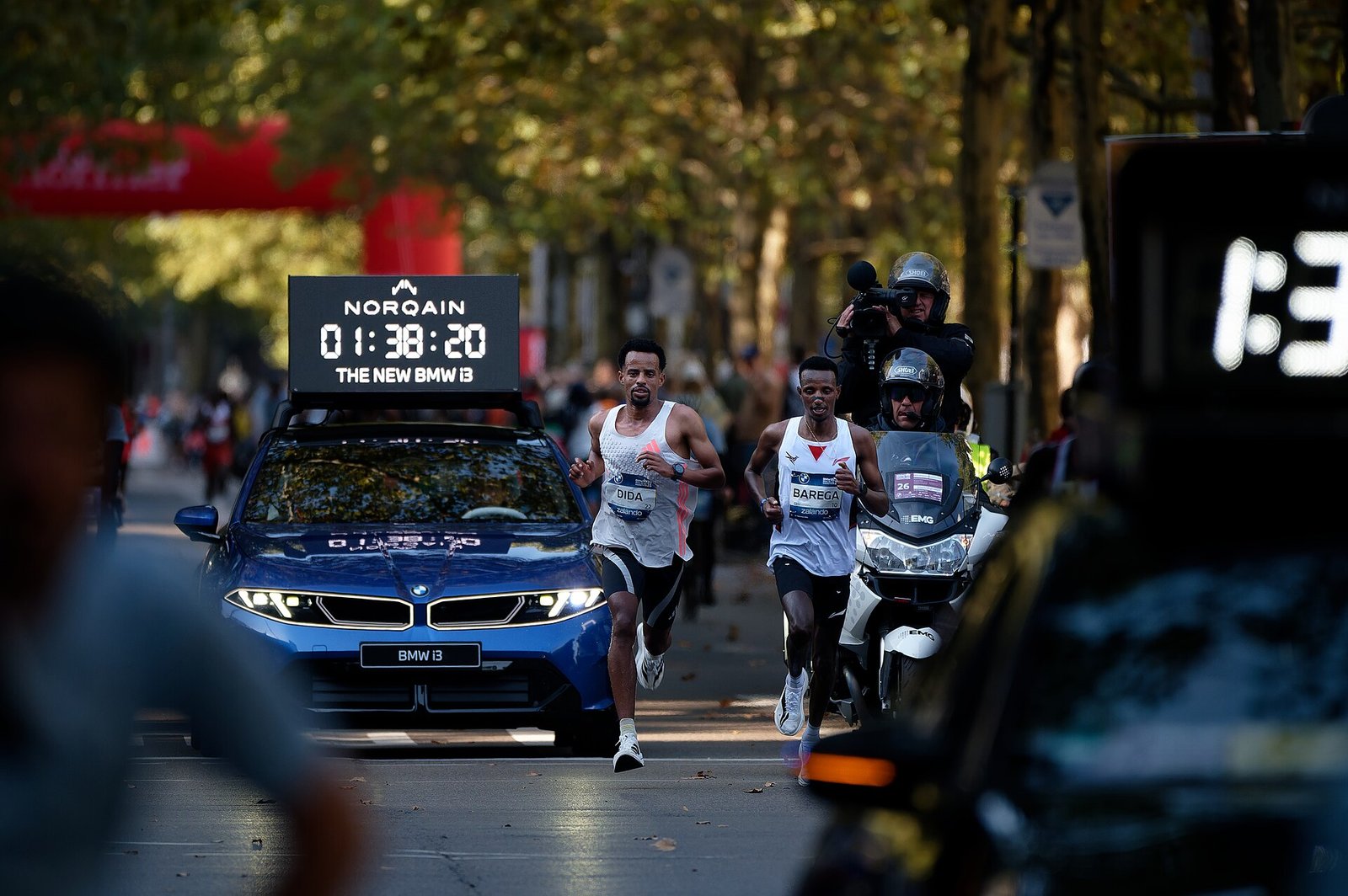
Two runners and pacers behind a car with a large digital clock on its roof, a motorbike camera alongside.
Gemechu Dida and Selemon Barega around kilometre 34 of the 2026 race, behind the timing car.Photo: Laurens R. Krol, 2026. Wikimedia Commons. CC BY 4.0.
Runners fill a tree-lined street while spectators watch from the pavement.
The mass field passing Fehrbelliner Platz in Wilmersdorf, 21 September 2025.Photo: Leonhard Lenz, 2025. Wikimedia Commons. CC0.

A race that began as a run along the woods for 244 finishers gave the men’s marathon nine world records in 24 years. The first record-eligible marathon under two hours was run in London. The fastest ever run in Berlin is still 2:01:09.

Press & citation

Use this Berlinfographic

Free to publish under CC BY 4.0 — in print, online, on Wikipedia and in teaching, commercially or not — with credit to Berlinfographics and a link to this page.

The Berlin Marathon, 1974–2026: ready-to-use landscape image

Ready-to-use image

The infographic as one image: headline, key figures, chart, sources and credit, 2,400 × 1,350 px PNG. Please use it unedited.

Download landscape (PNG)
The Berlin Marathon, 1974–2026: square version

Square format

A 1:1 version for social media and narrow columns, 1,800 × 1,800 px.

Download square (PNG)
The Berlin Marathon, 1974–2026: portrait version

Portrait 4:5

For Instagram and LinkedIn feeds, 1,620 × 2,025 px.

Download portrait (PNG)

Credit line

Berlinfographics (berlinfographics.com), CC BY 4.0

Citation

Berlinfographics (2026). “The Berlin Marathon, 1974–2026”. Berlin Experiences. https://berlinfographics.com/berlin-marathon-results/

Wikipedia

{{cite web |title=The Berlin Marathon, 1974–2026 |url=https://berlinfographics.com/berlin-marathon-results/ |website=Berlinfographics |publisher=Berlin Experiences |date=2026-11-07 |access-date=2026-11-07}}