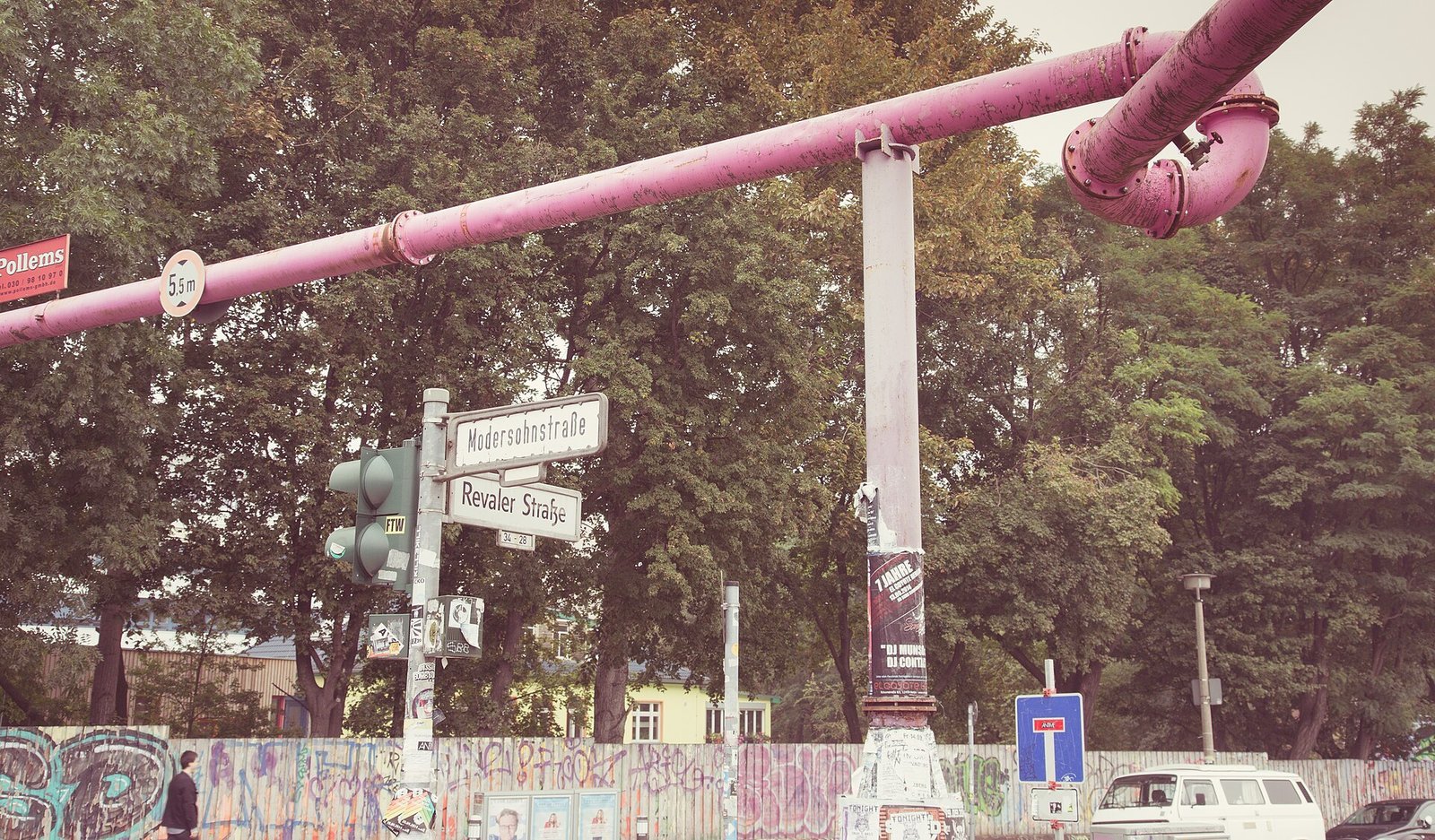
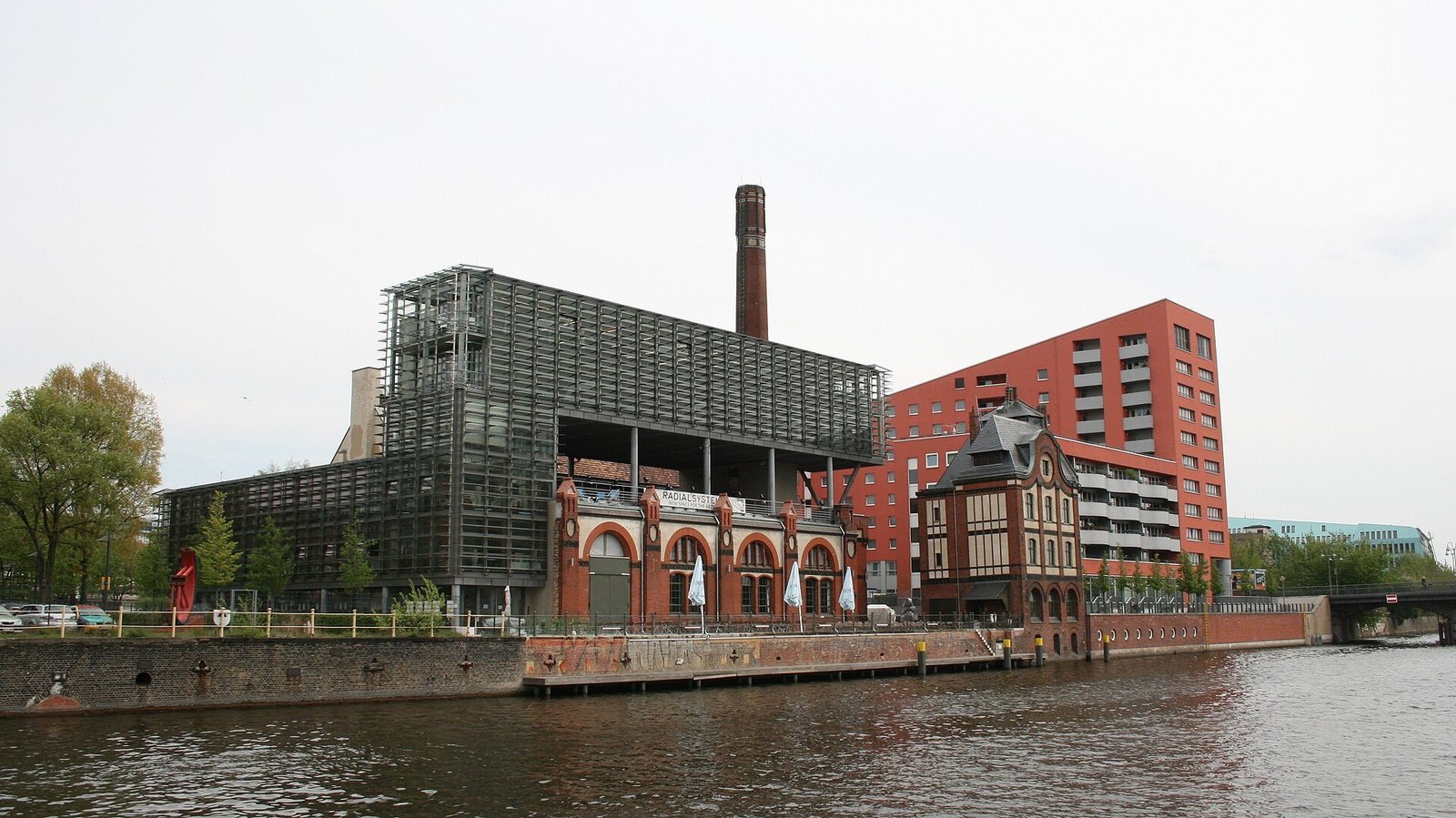
Pink groundwater pipes in front of the Rotes Rathaus, the city hall, September 2014.Photo: Tony Webster, 2014. Wikimedia Commons. CC BY 2.0.
The pink pipes
Every building pit that goes deeper must pump the water out or be sealed against it. The pumped water climbs into pipes that cross the streets overhead, on their way to the Spree and the canals.
01The ground beneath Berlin
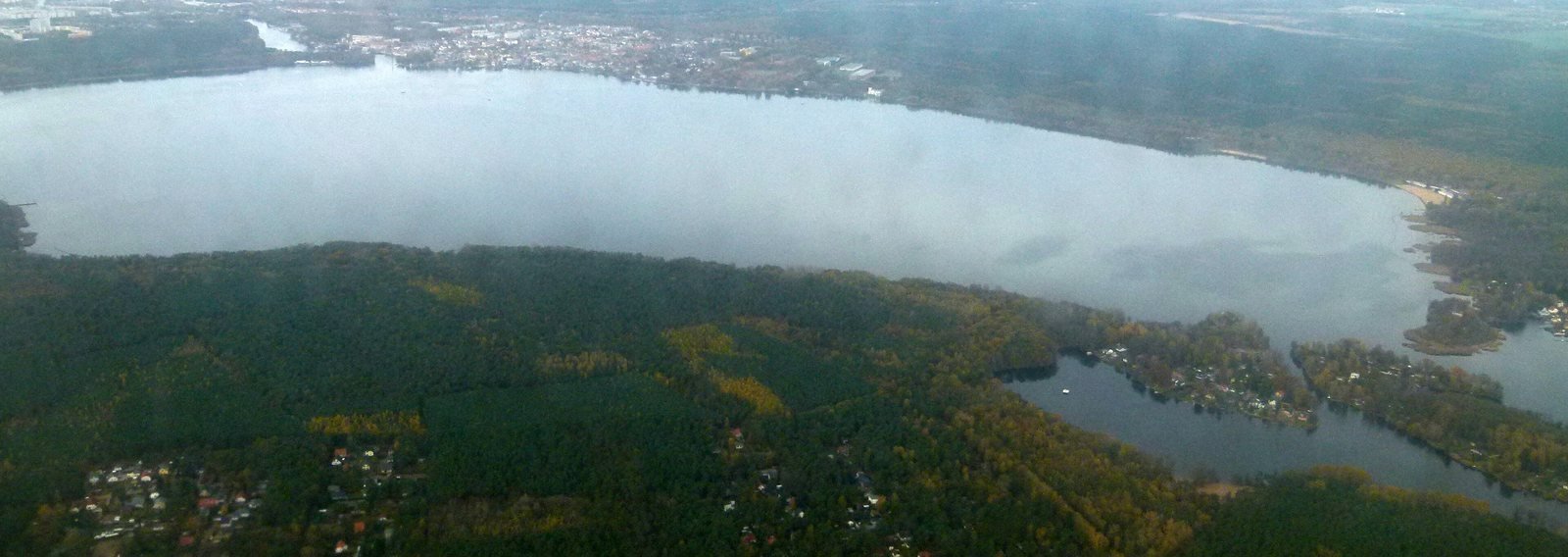
Berlin’s landscape was shaped by the Weichselian ice age. Its meltwater cut the Warsaw–Berlin glacial valley, which runs through the city from the Spandauer Forst to the Müggelsee and is filled mostly with sand and gravel. The Spree flows along it, and the old centre sits in it.
In that valley the groundwater lies between half a metre and seven metres below ground, the Umweltatlas finds, and closer to the surface the nearer you get to the Spree and the Havel. On the plateaus to the north and south it can lie tens of metres down.
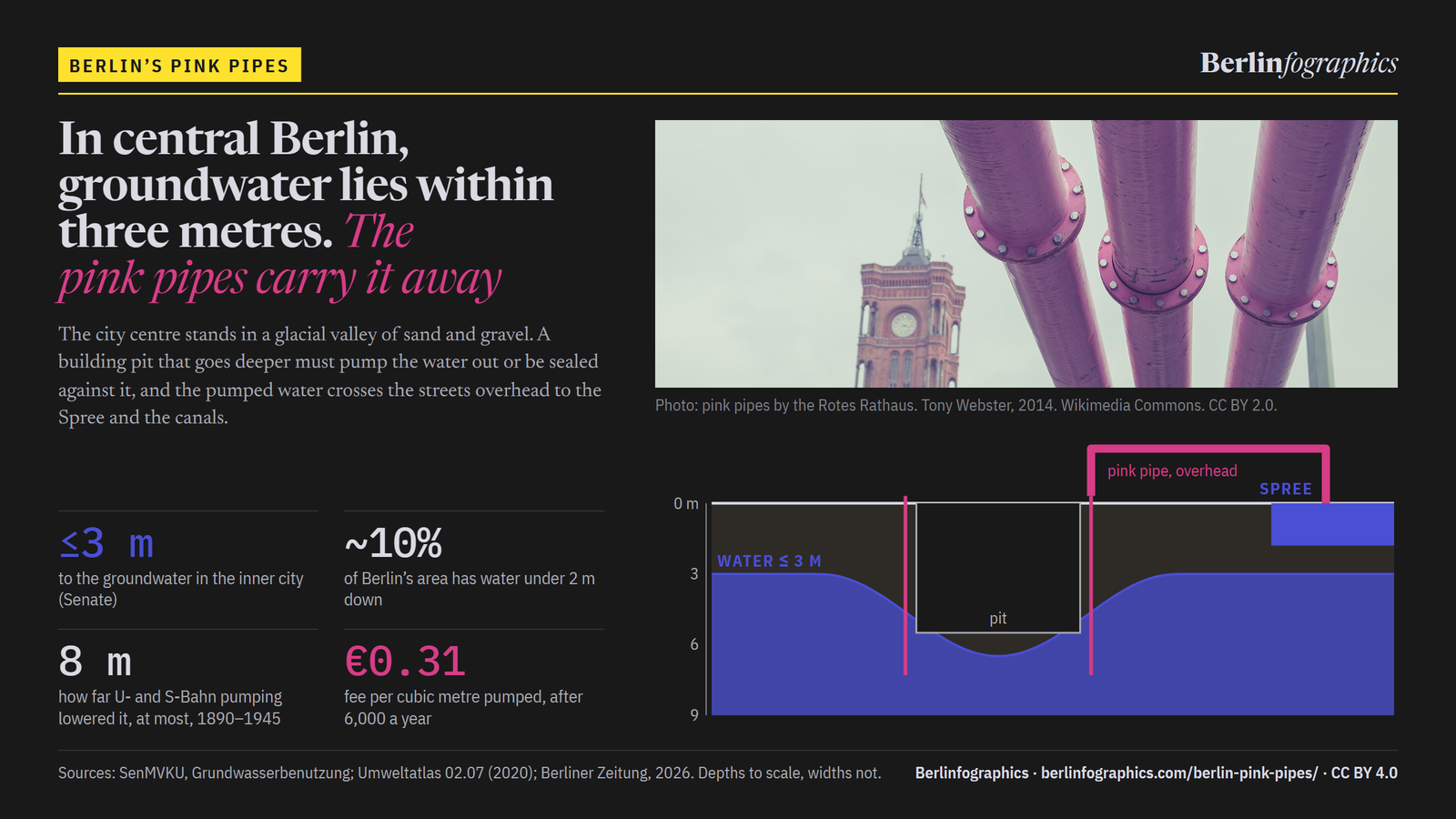
In the inner city, the Senate tells builders to expect water at no more than three metres.
How far down is the groundwater?
Under a Berlin street, depths to scale
Depths below the street are drawn to one true scale. Widths, the pit and the pipe’s height are schematic.
The inner city
In the inner city the Senate tells builders to expect groundwater no more than 3 m down. Near the Spree and the Havel it lies closer still.
The glacial valley
Across the whole valley, from the Spandauer Forst to the Müggelsee, the Umweltatlas finds the water between half a metre and seven metres down, mostly 2–7 m, measured at low water.
A pit deeper than the water
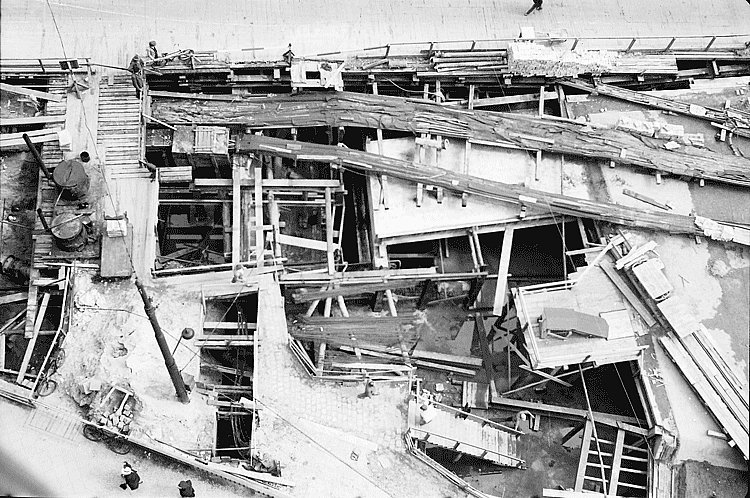
Dig below that level and the pit fills with water. One answer is to pump: wells around the site draw the water table down until the bottom is dry. Above 6,000 cubic metres a year this needs a permit.
1890–1945
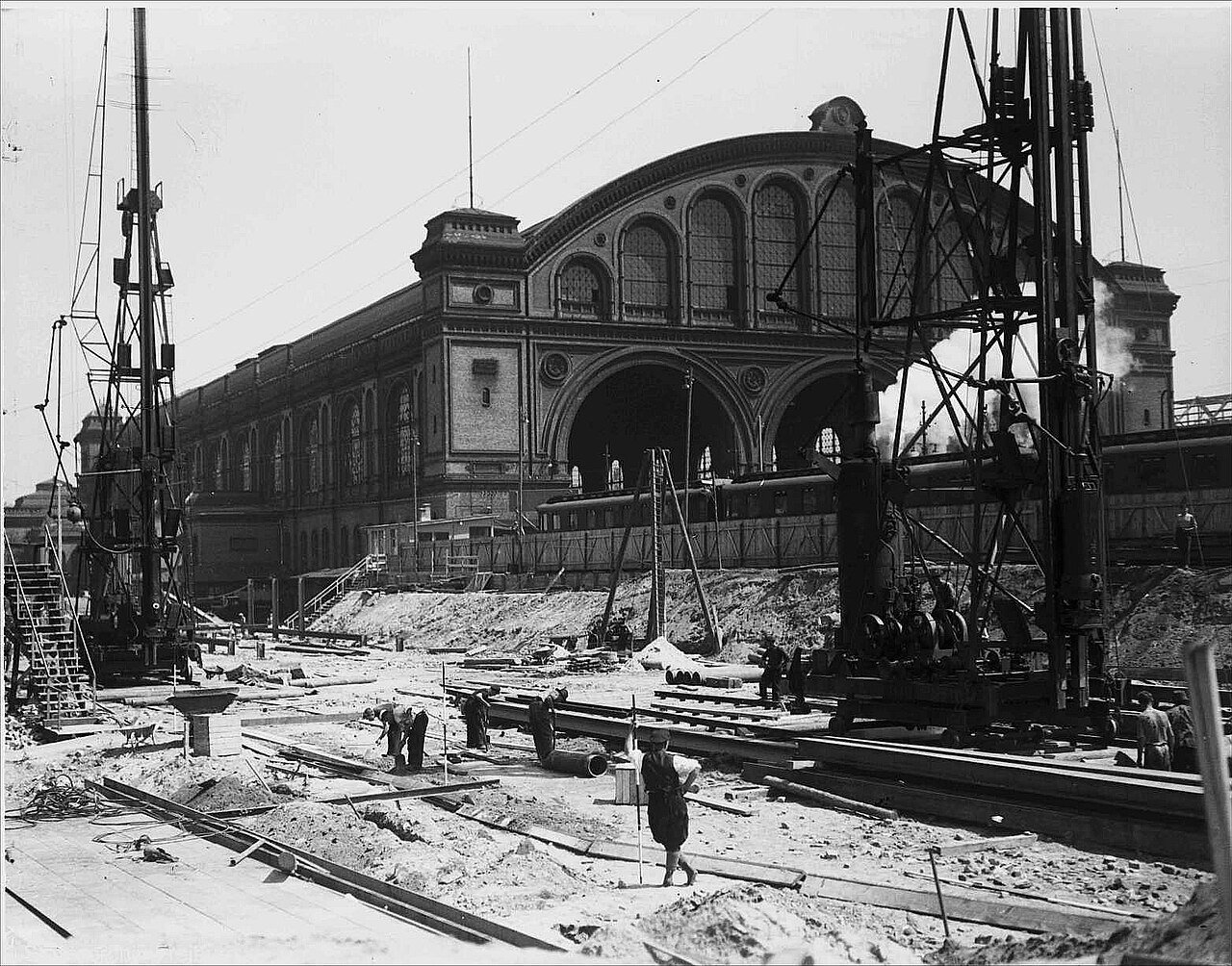
Big dewatering for the U- and S-Bahn, at Alexanderplatz and Friedrichstraße, and for other large buildings lowered the inner city’s groundwater by up to 8 m for long periods.
The rule today
In the inner city, any building with more than one basement storey now generally needs a watertight trough: sealed walls and a sealed floor, so the water around it stays where it is and nearby old buildings are not put at risk.
Up and over
What is pumped goes up into pipes that cross the streets high on steel supports and ends in the Spree or one of the canals. Every cubic metre costs €0.31 after the first 6,000 a year.
02Berlin, 1890–1945
From 1890 until the Second World War a fast-growing city drew more and more water, and its building sites pumped as well. The big dewatering for the U-Bahn and the S-Bahn, at Alexanderplatz and Friedrichstraße among other places, lowered the groundwater across the inner city by up to 8 m for long periods, the Umweltatlas records.


When the city’s water supply collapsed at the end of the war, the groundwater rose almost back to its natural level.
Today the rules push the other way. Large building sites must put back the groundwater they take, and deep basements in the centre are built inside sealed troughs, so that the water around them stays where it is.
03Why pink?
The pipes are temporary, and they belong to the firms that run the pumps. The pink ones belong to Pollems, a Berlin specialist in lowering groundwater. Others paint theirs blue.
Why pink? A Pollems spokesperson told the Czech news agency ČTK in 2020 that a psychologist chose the colour with the help of many children, and that it decided against blue, the colour other companies used, on an expert’s assessment. The Berliner dates the research to 1992.
High on steel supports set in concrete footings, they cross busy roads and pass under railway bridges, past people’s windows.

How much pink pipe is there?
Two published figures, on one scale. Neither is a count: the Senate says no exact length can be given, because it changes almost daily.
04Below the pit
Berlin covers all of its public drinking water from its own groundwater. It comes from a freshwater layer about 150 m thick, sealed off from salt water below by some 80 m of clay. That is why pumping has a price: €0.31 for every cubic metre over 6,000 a year.
The waterworks pump far less than they did a generation ago. And building-site water that goes into the sewer instead of a river is let in only after aeration, with the iron sludge held back and every cubic metre metered, under the Berliner Wasserbetriebe’s terms.
Groundwater pumped for drinking water
Million cubic metres a year, waterworks in Berlin

The column under the city, to scale
Depth below ground, one linear scale. The inner city’s water table (top line) sits within 3 m.
Berlin stands on its own drinking water. Wherever a pink pipe crosses the street, a hole has gone below the water table.
Press & citation
Free to publish under CC BY 4.0 — in print, online, on Wikipedia and in teaching, commercially or not — with credit to Berlinfographics and a link to this page.
Ready-to-use image
The infographic as one image: headline, key figures, chart, sources and credit, 2,400 × 1,350 px PNG. Please use it unedited.
Download landscape (PNG)
Square format
A 1:1 version for social media and narrow columns, 1,800 × 1,800 px.
Download square (PNG)
Portrait 4:5
For Instagram and LinkedIn feeds, 1,620 × 2,025 px.
Download portrait (PNG)Credit line
Berlinfographics (berlinfographics.com), CC BY 4.0
Citation
Berlinfographics (2026). “Berlin’s pink pipes”. Berlin Experiences. https://berlinfographics.com/berlin-pink-pipes/
Wikipedia
{{cite web |title=Berlin’s pink pipes |url=https://berlinfographics.com/berlin-pink-pipes/ |website=Berlinfographics |publisher=Berlin Experiences |date=2026-11-09 |access-date=2026-11-09}}
Our infographics, charts and texts are licensed CC BY 4.0: free to republish, including commercially, with credit to Berlinfographics and a link. Photographs keep their own licences, named in each caption. How to credit
Topics: The Second World War · Cold War Berlin · Nazi Berlin · Persecution & the Holocaust · Weimar Berlin · Prussia & the Kaiserreich · Architecture & the built city · Culture, science & society · Reunified Berlin · Unusual facts
Contact: info@berlinfographics.com · Press: press@berlinfographics.com · Imprint · Privacy