1871–2024Berlin’s population
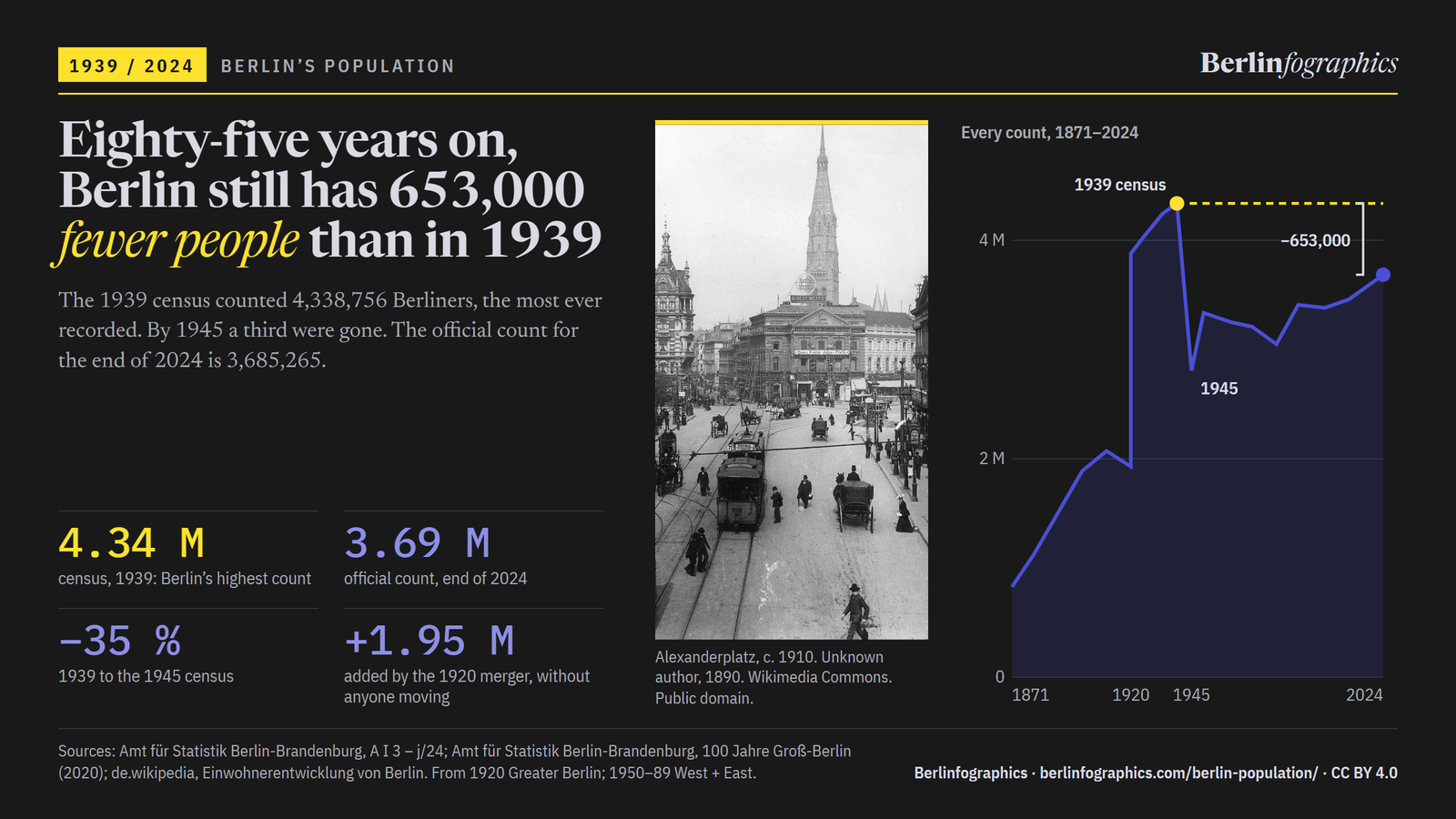
The census of 17 May 1939 counted 4,338,756 Berliners — more than at any count before or since. Six years later a third of them were gone. The official count for 31 December 2024 is 3,685,265: the city has still not made up what the war took.
Scroll through the census years
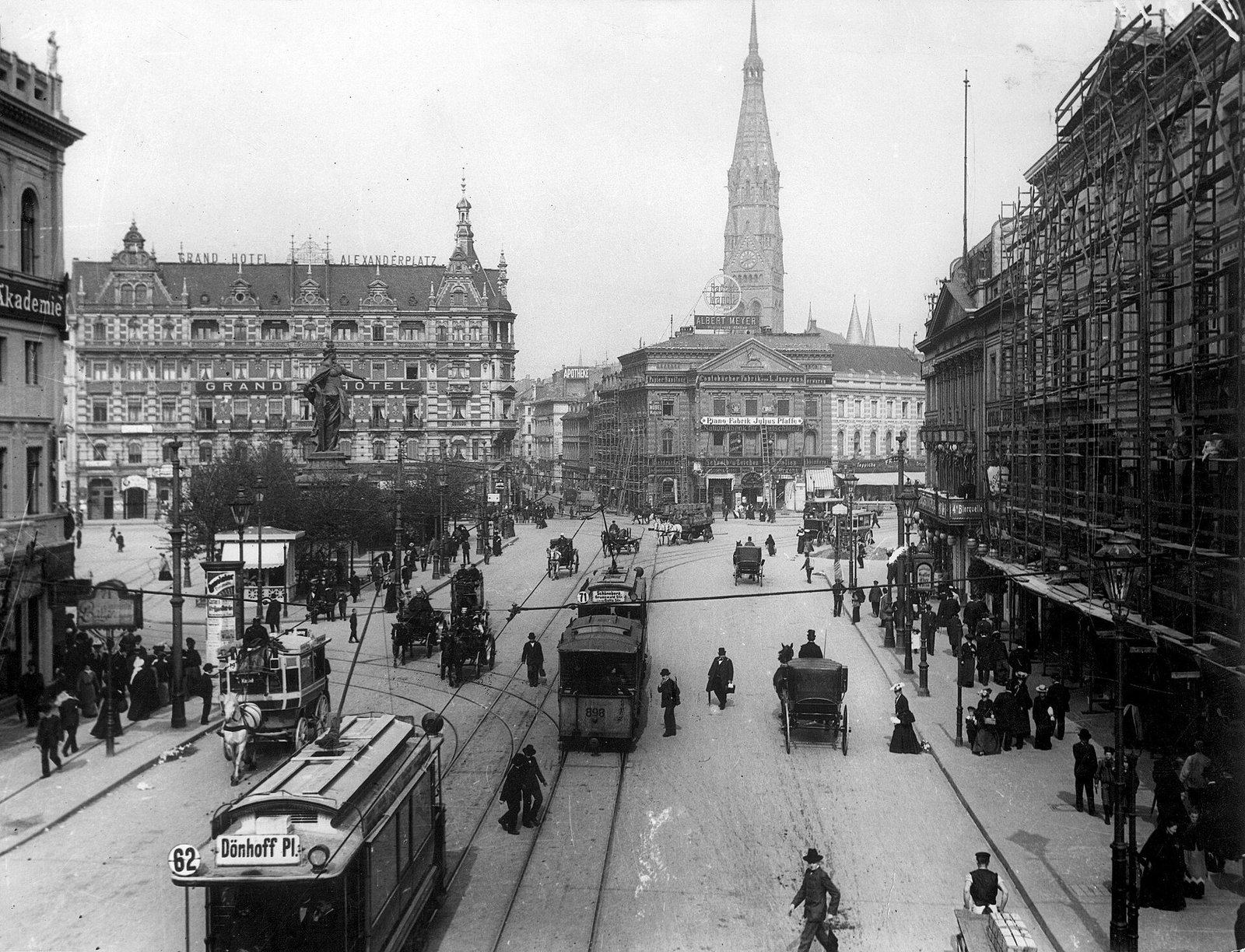
Alexanderplatz, about 1910: electric trams, carriages and pedestrians in front of the Grand Hotel.Unknown author, 1890. Wikimedia Commons. Public domain.
011871–1910
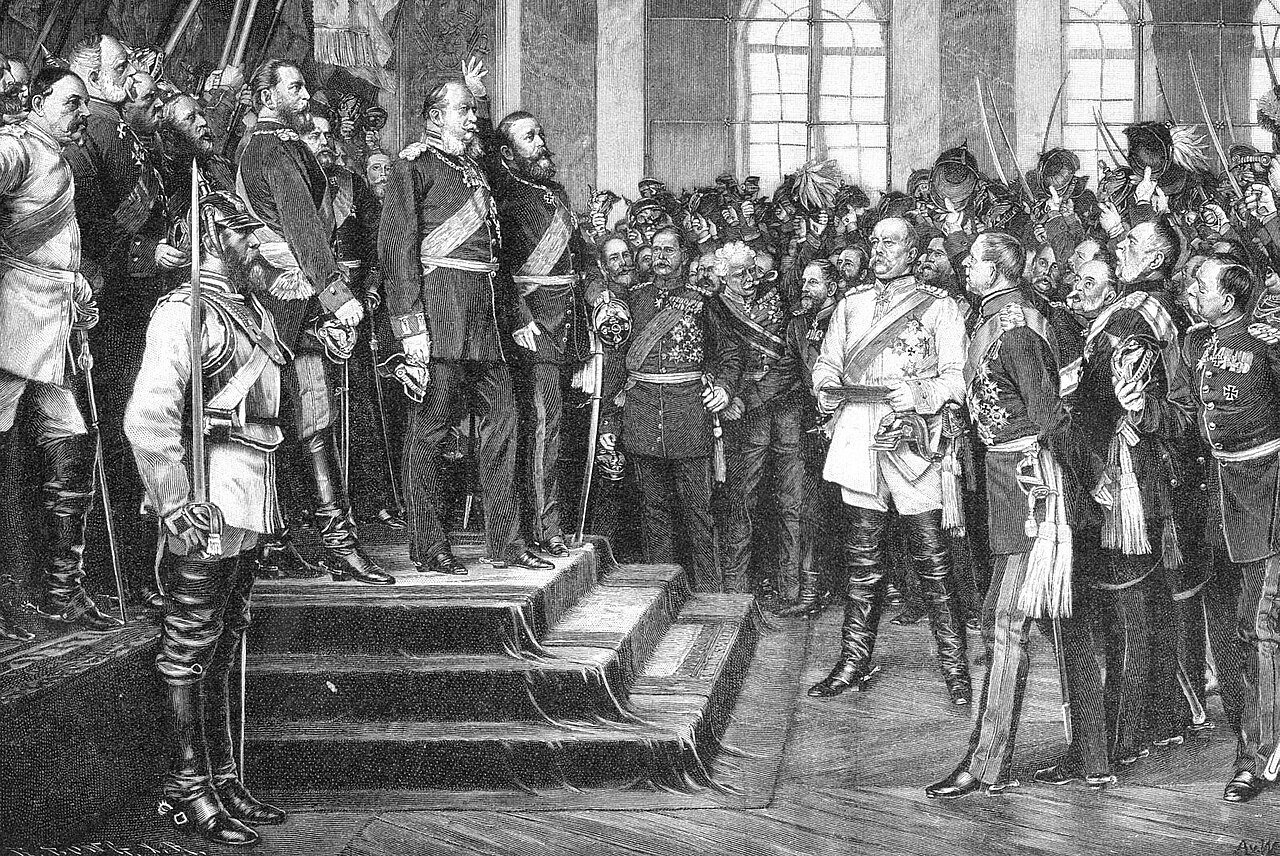
When Berlin became the capital of the new German Empire, the census of 1 December 1871 counted 826,341 people. By 1900 there were 1,888,848, and the census of 1 December 1910 passed two million: 2,071,257.
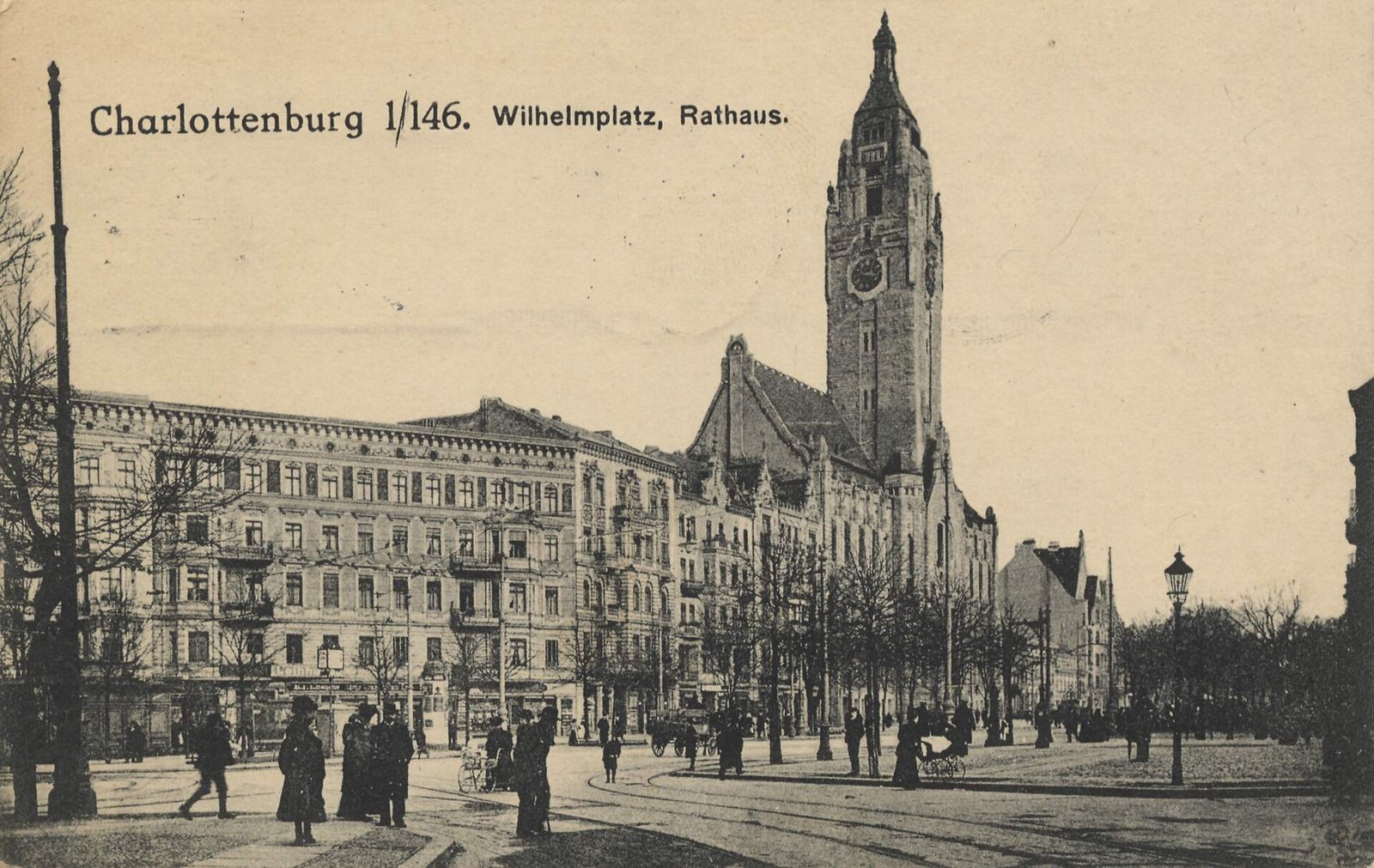
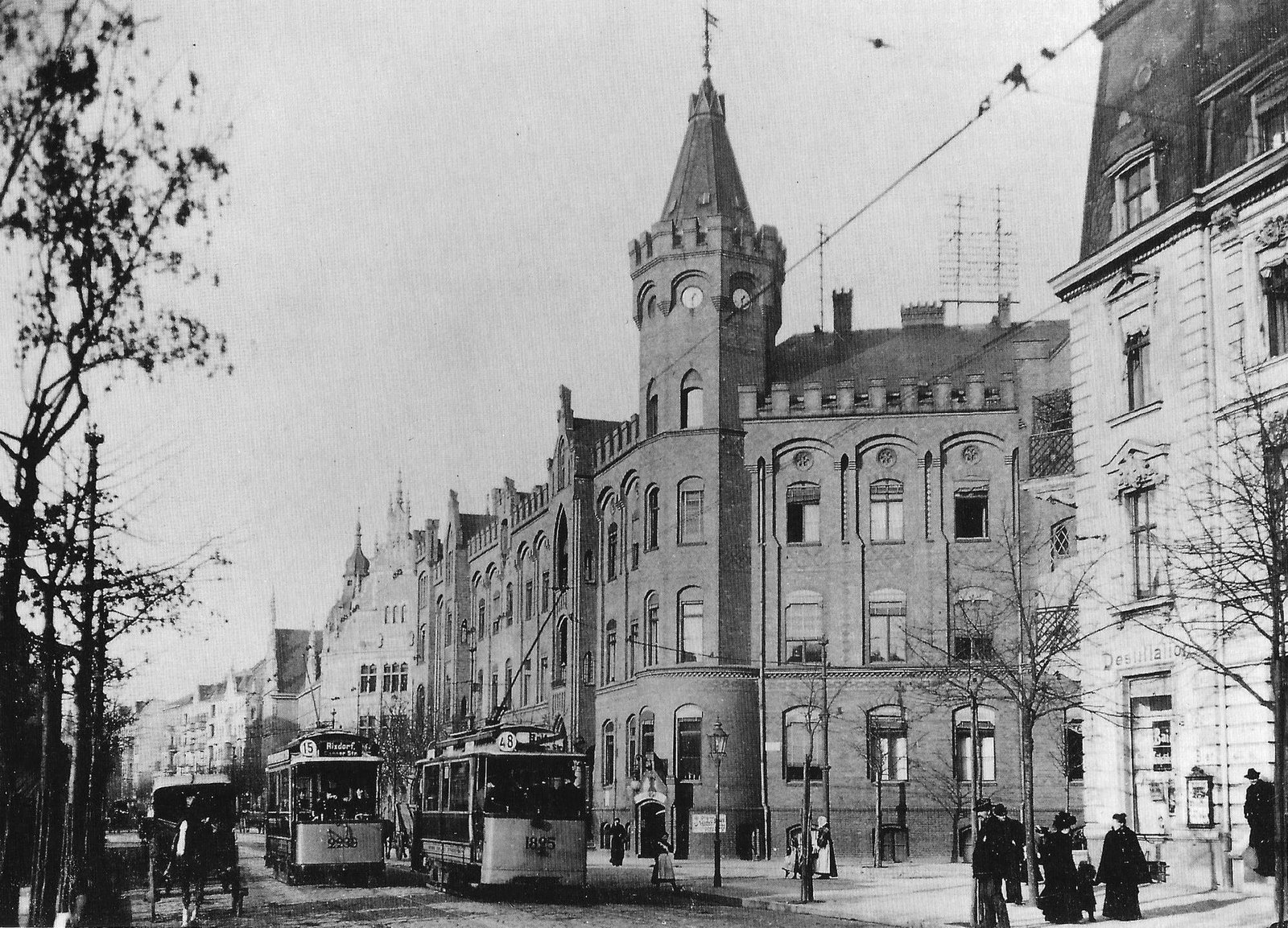
These are counts for the city of the day — the old municipality, before its suburbs were joined to it. Charlottenburg and Rixdorf — later Neukölln — were still towns of their own.


02Every count, one line
1871
Capital of unified Germany. The census of 1 December 1871 counted 826,341 people.
Sources: de.wikipedia, Einwohnerentwicklung von Berlin · Statistisches Jahrbuch für das Deutsche Reich / für den Preußischen Staat
1910
The census of 1 December 1910: 2,071,257 — 2.5 times the 1871 count, inside the old city boundary.
Sources: de.wikipedia, Einwohnerentwicklung von Berlin · Statistisches Jahrbuch für das Deutsche Reich / für den Preußischen Staat
1920
The Greater Berlin Act, in force from 1 October 1920, joined Berlin with 7 towns, 59 rural communities and 27 estate districts. From 1,928,432 at the end of 1919 to 3,879,409 at the end of 1920 — without anyone moving.
Sources: Amt für Statistik Berlin-Brandenburg, 100 Jahre Groß-Berlin (2020) · de.wikipedia, Einwohnerentwicklung von Berlin
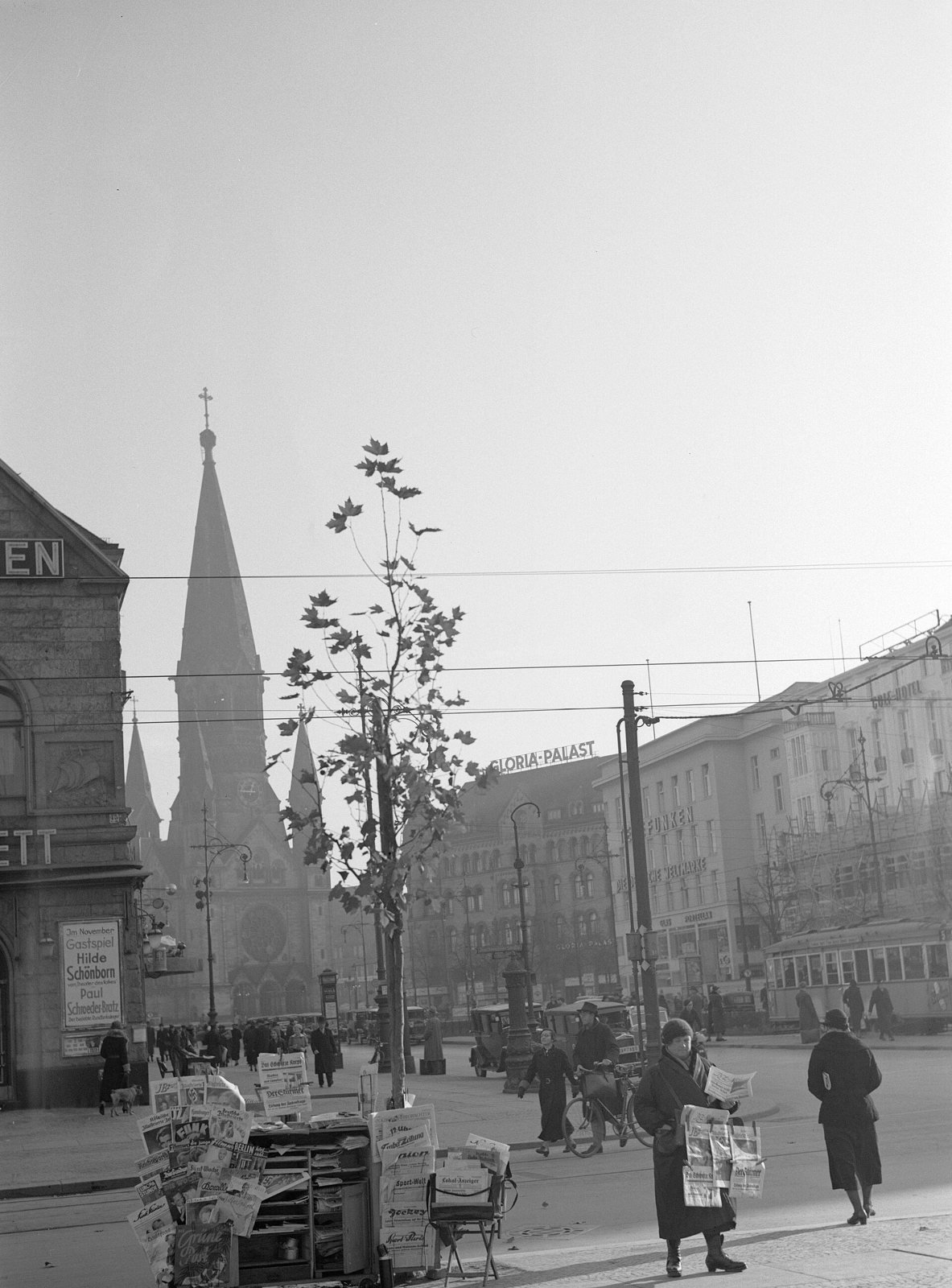
1939
The census of 17 May 1939 counted 4,338,756. The wartime register later showed 4,478,102 for 31 December 1942, but the statistics office says that figure was inflated by people who left without deregistering.
Sources: de.wikipedia, Einwohnerentwicklung von Berlin · Statistisches Jahrbuch für das Deutsche Reich / für den Preußischen Staat · Amt für Statistik Berlin-Brandenburg, 100 Jahre Groß-Berlin (2020) · de.wikipedia, Einwohnerentwicklung von Berlin
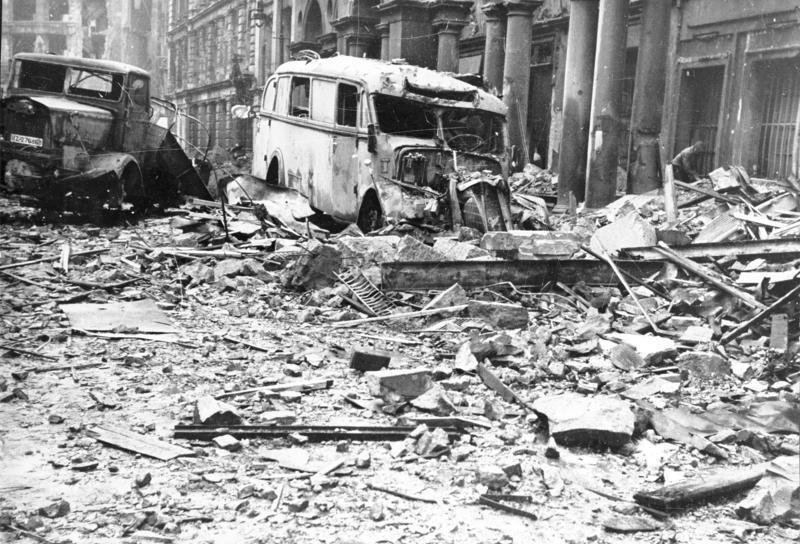
1945
The census of 12 August 1945 counted 2,807,405 — 1,531,351 fewer than in 1939, a fall of 35 %.
Sources: de.wikipedia, Einwohnerentwicklung von Berlin · Statistisches Jahrbuch für das Deutsche Reich / für den Preußischen Staat
1989
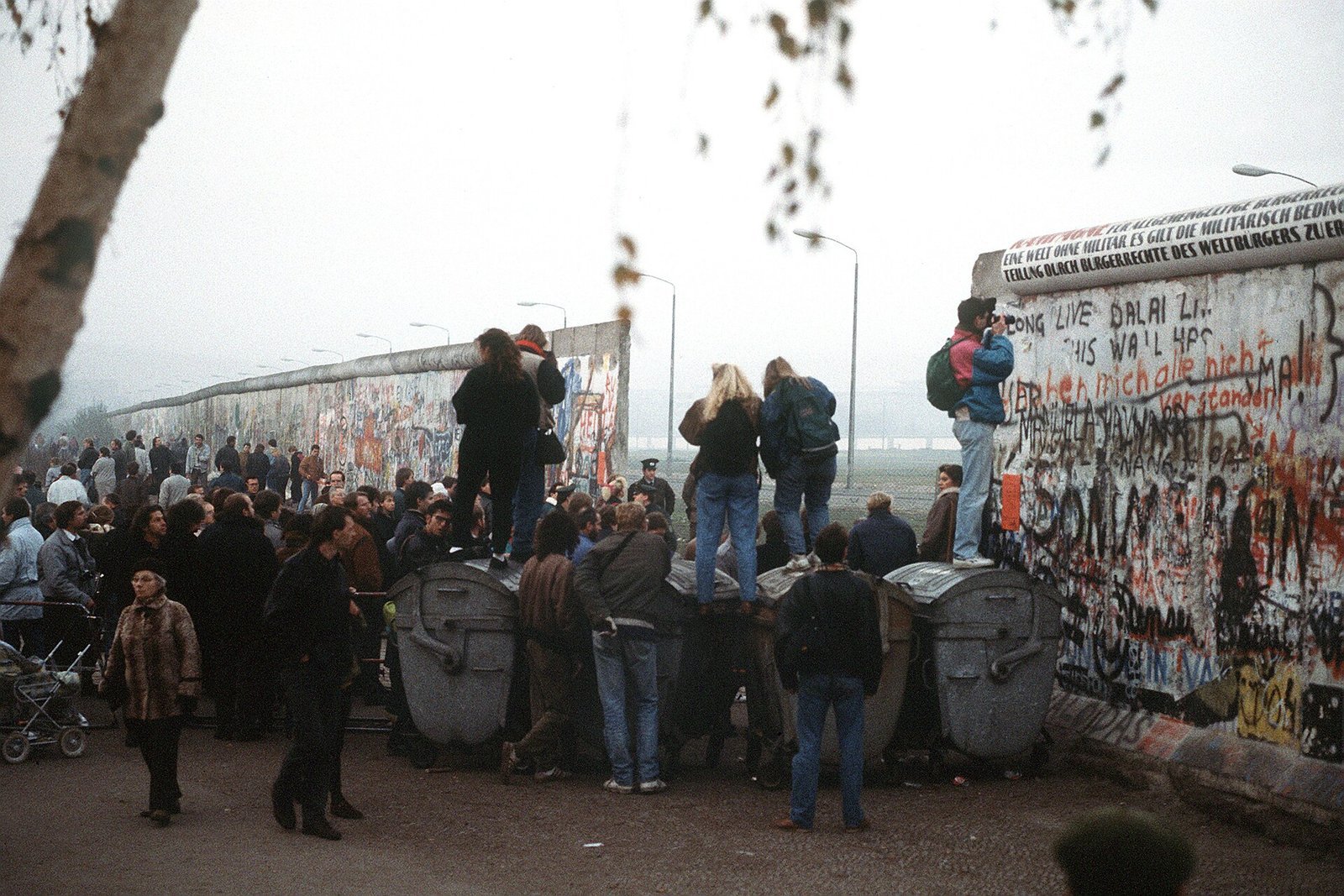
Counted together, West and East Berlin stayed between 3.05 M (1980) and 3.41 M (1989). The Wall went up in 1961 and fell in 1989.
Sources: de.wikipedia, Einwohnerentwicklung von Berlin
2024
The official count for 31 December 2024, on the basis of Census 2022, is 3,685,265. That is 653,491 fewer than the census of 1939.
Sources: de.wikipedia, Einwohnerentwicklung von Berlin · Amt für Statistik Berlin-Brandenburg, A I 3 – j/24 · Amt für Statistik Berlin-Brandenburg, release 095-2025
03Greater Berlin · 1 October 1920
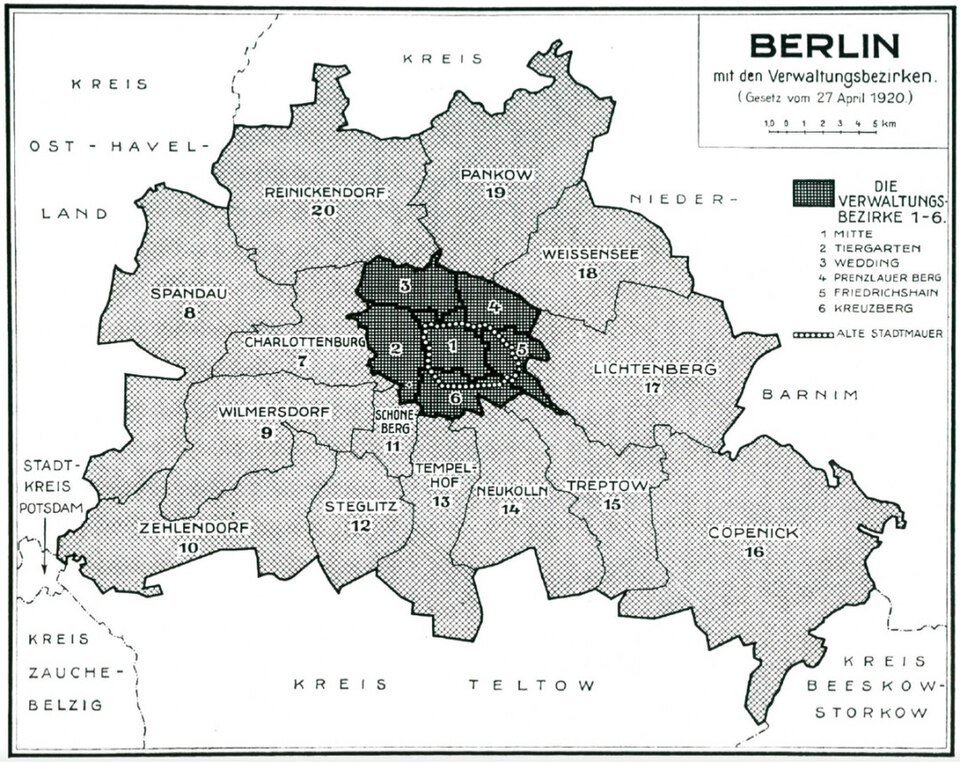
The Greater Berlin Act was passed on 27 April 1920 and came into force on 1 October 1920. It joined the old city to 7 towns, 59 rural communities and 27 estate districts — Charlottenburg and Neukölln among them.
At the end of 1919 Berlin had 1,928,432 inhabitants. A year later it had 3,879,409: +1.95 M, a city twice the size, made by redrawing a line on the map. Every count from here on is for Greater Berlin.
Berlin’s population, end of 1919 and end of 1920
What was joined: one city and 93 more communities


041939–1945
The census of 17 May 1939 counted 4,338,756. The census of 12 August 1945 counted 2,807,405 — 35 % fewer.
The statistics give its causes: combat casualties, evacuation, deportations and displacement.
Berliners counted in 1939 and 1945 · one square ≈ 10,000 people

051950–1989
From 1950 to 1989 the counts here add West and East Berlin together. The highest was 3,409,737 in 1989; the lowest 3,048,759 in 1980.
At the end of 1961, the year the Wall went up, the two halves held 3,252,691. At the end of 1989, the year it fell, 3,409,737 — still 929,019 below the 1939 census.


0631 December 2024
The official count for 31 December 2024, on the basis of Census 2022, is 3,685,265. Against the census of 17 May 1939, that leaves Berlin 653,491 people short — about 653,000.
153 years on one clock face
Each spoke is one count, running clockwise from 1871 at the top to 2024. The yellow ring is the census of 1939: only one spoke touches it. Spokes before 1920 count the old city; after, Greater Berlin.
A war emptied a third of Berlin in six years. Eighty-five years later, the city has still not filled the gap.
Press & citation
Free to publish under CC BY 4.0 — in print, online, on Wikipedia and in teaching, commercially or not — with credit to Berlinfographics and a link to this page.
Ready-to-use image
The infographic as one image: headline, key figures, chart, sources and credit, 2,400 × 1,350 px PNG. Please use it unedited.
Download landscape (PNG)
Square format
A 1:1 version for social media and narrow columns, 1,800 × 1,800 px.
Download square (PNG)
Portrait 4:5
For Instagram and LinkedIn feeds, 1,620 × 2,025 px.
Download portrait (PNG)Credit line
Berlinfographics (berlinfographics.com), CC BY 4.0
Citation
Berlinfographics (2026). “Berlin’s population, 1871–2024”. Berlin Experiences. https://berlinfographics.com/berlin-population/
Wikipedia
{{cite web |title=Berlin’s population, 1871–2024 |url=https://berlinfographics.com/berlin-population/ |website=Berlinfographics |publisher=Berlin Experiences |date=2026-11-05 |access-date=2026-11-05}}
Our infographics, charts and texts are licensed CC BY 4.0: free to republish, including commercially, with credit to Berlinfographics and a link. Photographs keep their own licences, named in each caption. How to credit
Topics: The Second World War · Cold War Berlin · Nazi Berlin · Persecution & the Holocaust · Weimar Berlin · Prussia & the Kaiserreich · Architecture & the built city · Culture, science & society · Reunified Berlin · Unusual facts
Contact: info@berlinfographics.com · Press: press@berlinfographics.com · Imprint · Privacy