Berlinfographicsby Berlin Experiences

Steel plates in the grass of the Berlin Wall Memorial on Bernauer Straße trace the line of an escape tunnel of 1964.Photo: Tony Webster, 2014. Wikimedia Commons. CC BY 2.0.

Under the Wall

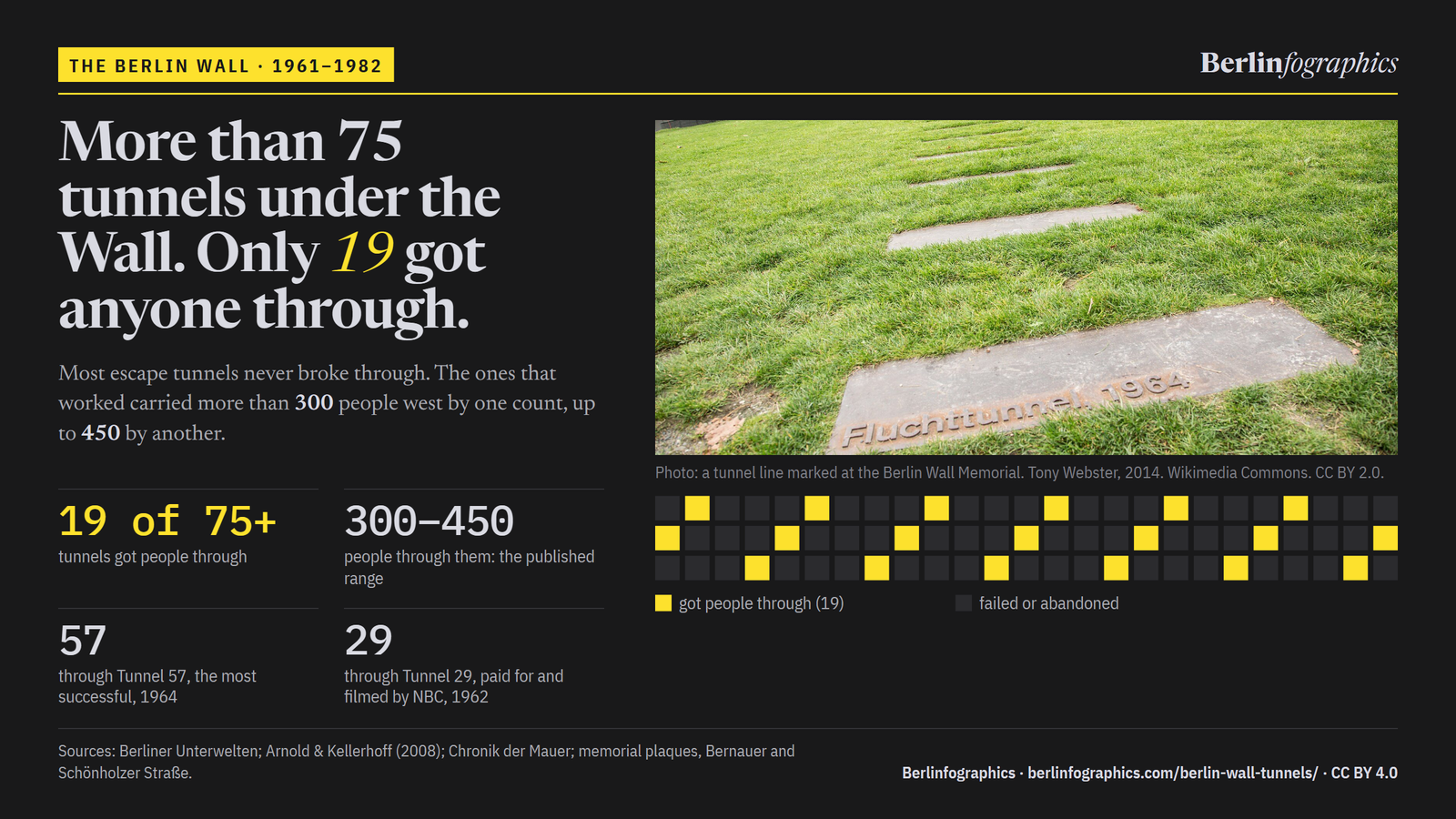
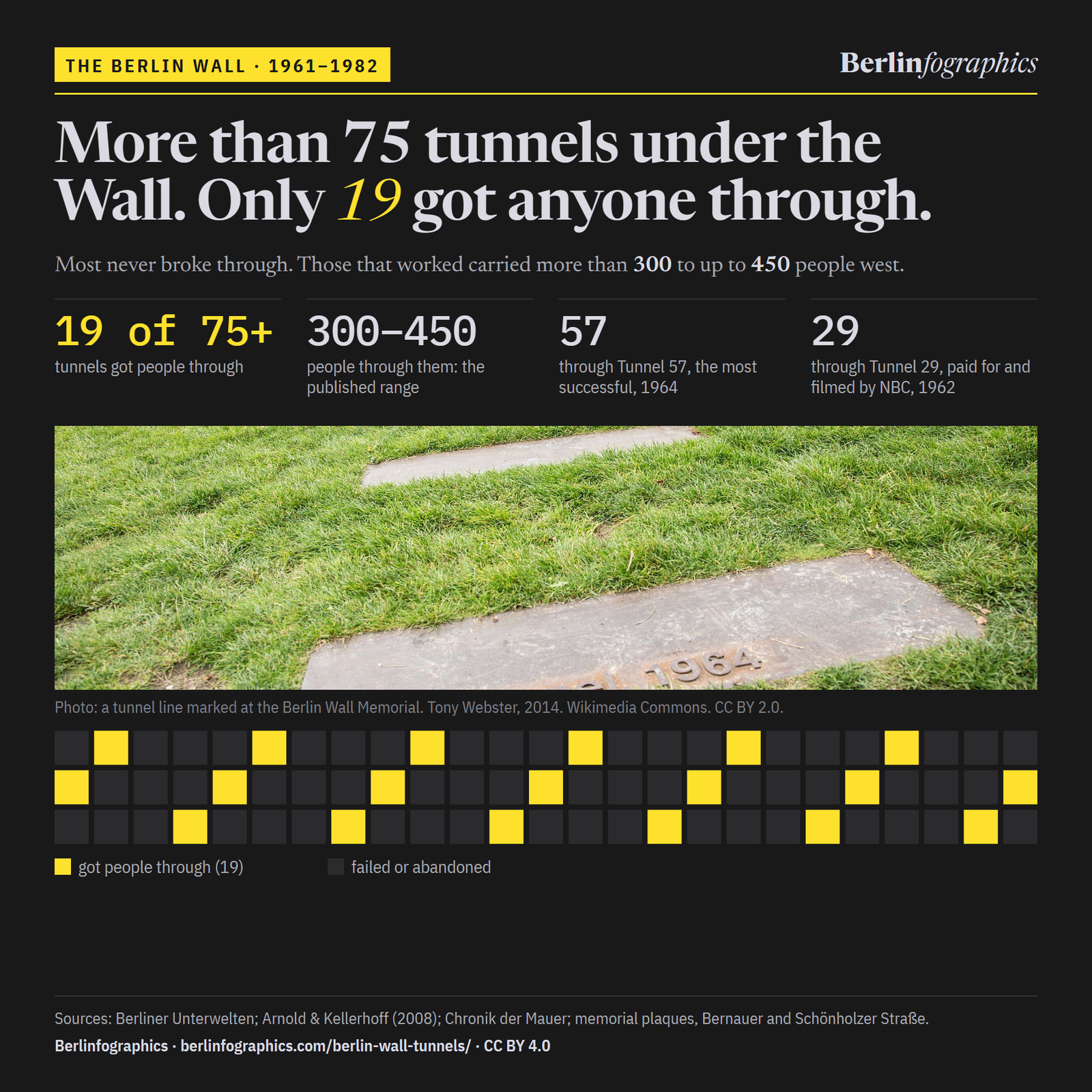
Berliners began more than 75 tunnels under the Wall. Only 19 got anyone through.

Most never broke through. The ones that worked carried more than 300 people west by one count, up to 450 by another: students, families, and a group of pensioners who dug their own.

>75
escape tunnels begun, from October 1961 to 1982
19
of them got anyone through
300–450
people through them: the range of the published counts
57
through the most successful, Tunnel 57, in early October 1964
01Bernauer Straße and beyond, from 1961

On one street, the Wall was undermined seven times in 350 metres

The first escape tunnel was dug in October 1961, two months after the border closed. On Bernauer Straße the boundary ran along the house fronts, and a cellar on the western side was only a street’s width from the East.

At least 12 tunnels were begun around Bernauer Straße, Berliner Unterwelten counts. Only three succeeded. The rest failed before they were finished, most often because someone talked.

Two of the three that worked were, in Berliner Unterwelten’s words, the two most successful projects of all: Tunnel 29 and Tunnel 57.

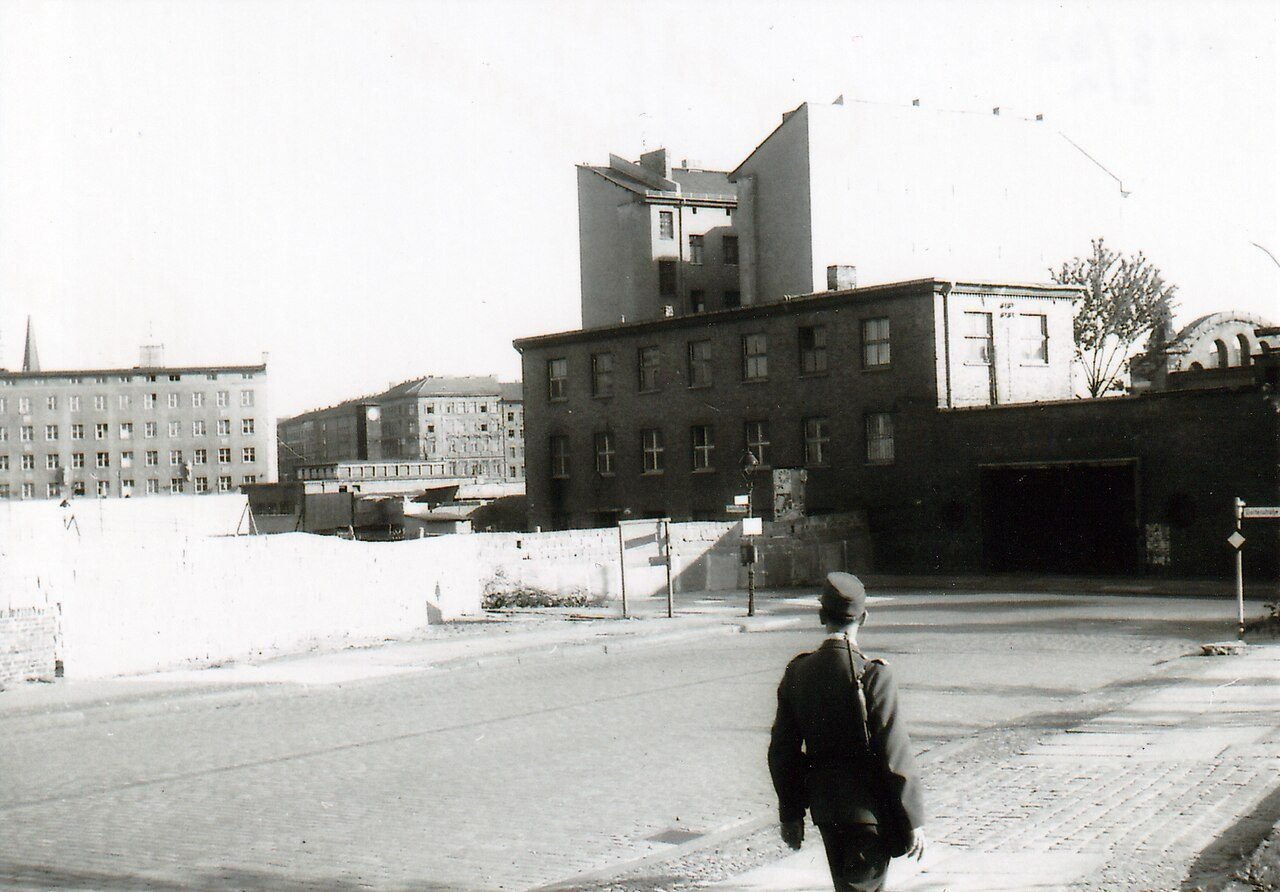
Black-and-white street scene: a low wall across an empty street, factory buildings behind, a uniformed man walking in the foreground.
Bernauer Straße at Gartenstraße on 8 June 1962, the summer Tunnel 29 was being dug under the same street. A West Berlin policeman walks beside the Wall.Photo: Sigurd Hilkenbach, 1962. Sammlung Hilkenbach. Wikimedia Commons. CC BY-SA 3.0.
Black-and-white photograph of bricked-up house fronts, vehicle barriers and a watchtower along a street.
Bernauer Straße at Ackerstraße, 1966. Here the border ran along the house fronts of the eastern side, which were bricked up as part of the Wall.Photo: ELAB, Archiv der Versöhnungsgemeinde, 1966. Wikimedia Commons. CC BY-SA 4.0.

Under the border: one scale for length and depth

Six escape tunnels under the Berlin border drawn to one scale, length and depth alike, added one by one as the story is read.

Length and depth are drawn on one scale. A dashed tunnel is one whose depth is not recorded; it is drawn at the surface, not at a guessed depth.

A suburban pavement beside a road; a double line of darker paving stones runs along it.
A double row of paving stones marks where the Wall ran through Glienicke, 2018. The Seniors’ Tunnel and the January 1962 tunnel were dug from houses on the Glienicke side of the border road.Photo: Günter Haase (Boonekamp), 2018. Wikimedia Commons. CC BY-SA 4.0.

24 January 1962

A family digs out, east to west

In Glienicke, just outside Berlin, two brothers dug from their flat by the border in 6 days. The tunnel was 27 metres long, and 28 people crawled through it to West Berlin.

A suburban pavement beside a road; a double line of darker paving stones runs along it.
Glienicke’s border line today. The Seniors’ Tunnel ran from a henhouse here to Frohnau, in West Berlin.Photo: Günter Haase (Boonekamp), 2018. Wikimedia Commons. CC BY-SA 4.0.

5 May 1962

The pensioners who were left behind dug their own

The old people who knew of the January escape had been left behind as a hindrance. Four houses away, Max Th., aged 81, began his own tunnel in his henhouse. 12 people walked through it almost upright: 32 metres long, up to 1.75 metres high.

A wide outdoor information panel titled ‘Der verratene Fluchttunnel in der Sebastianstraße, 28. Juni 1962’, with photographs and text.
Berliner Unterwelten’s information panel on the betrayed tunnel at Sebastianstraße 82, Kreuzberg, as renewed on 28 June 2022.Photo: OTFW, Berlin, 2022. Wikimedia Commons. CC BY-SA 3.0.

28 June 1962

A tunnel that broke through into a trap

Escape helpers dug about 30 metres from Sebastianstraße in Kreuzberg. An informer, IM “Pankow”, had reported it on 4 June 1962. When they broke through, the Stasi was waiting, and Siegfried Noffke was fatally shot.

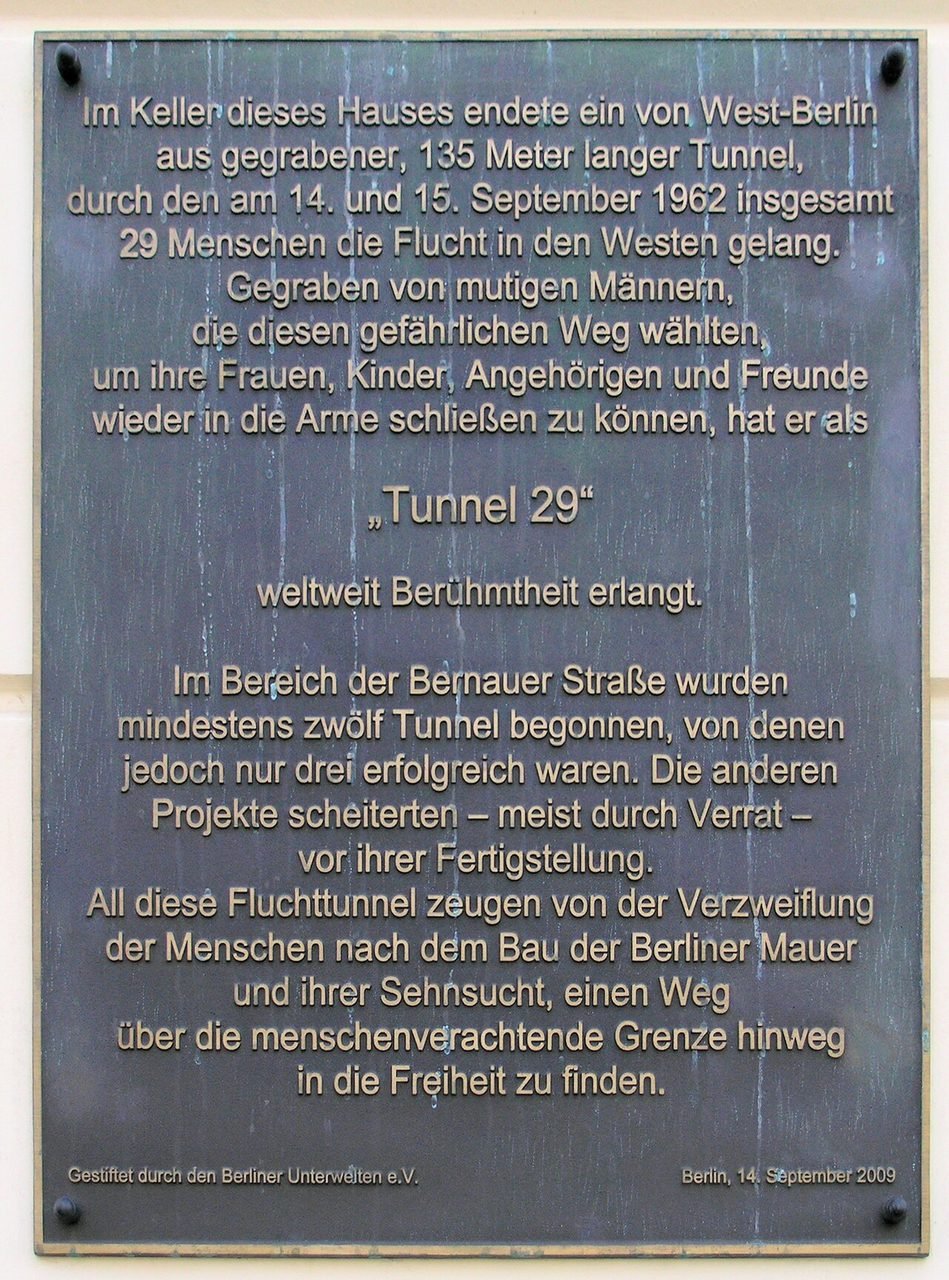
A bronze plaque with the words ‘Tunnel 29’ in large type in the middle of its text.
The plaque at Schönholzer Straße 7, where Tunnel 29 came up in a cellar on the East Berlin side.Photo: OTFW, Berlin, 2010. Wikimedia Commons. CC BY-SA 3.0.

14–15 September 1962

Tunnel 29: 135 metres, paid for by American television

Students dug from a factory cellar at Bernauer Straße 78 to the cellar of Schönholzer Straße 7, about 6 metres down. Over two nights 29 people came through, and NBC’s cameras filmed them.

A line of steel plates crossing a lawn towards apartment blocks; the nearest reads ‘Fluchttunnel, Tunnel 57, 1964’.
The line of Tunnel 57 marked in steel plates at the Berlin Wall Memorial, 2011.Photo: N-Lange.de, 2011. Wikimedia Commons. CC BY-SA 3.0.

3–5 October 1964

Tunnel 57: the most successful of all

From a closed bakery at Bernauer Straße 97: 145 metres long, 10–11 metres down. 57 people escaped. A border guard, Egon Schultz, was killed in the courtyard by a comrade’s bullet.

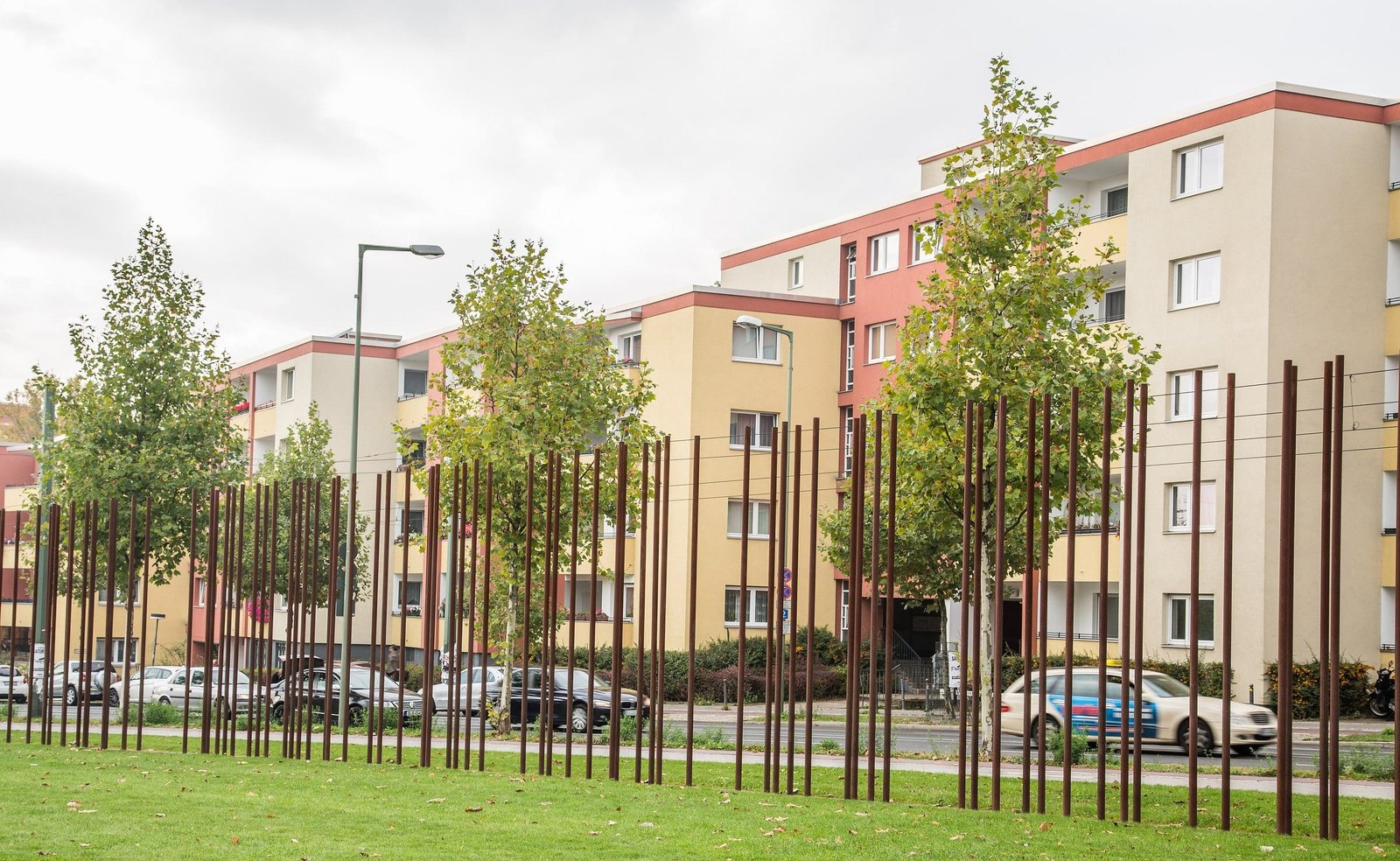
Tall rusted steel rods in a row across a lawn, with trees and buildings behind.
The line of the Wall at Bernauer Straße today, marked by steel rods.Photo: Tony Webster, 2014. Wikimedia Commons. CC BY 2.0.

After October 1964

The GDR digs back

The GDR then dug its own tunnel at Bernauer Straße, 6–8 metres down across the line, fitted with listening equipment. The Tunnel 57 plaque says that ended tunnelling on that stretch.

02Neukölln, Kreuzberg, Wedding, 1962

Most tunnels never broke through, often because of betrayal

Every tunnel needed helpers, couriers and people waiting in the East to be told when to come. Each of them was a chance for the Stasi. Most projects failed before they were finished, often through betrayal, says Berliner Unterwelten, which has researched the tunnels for decades.

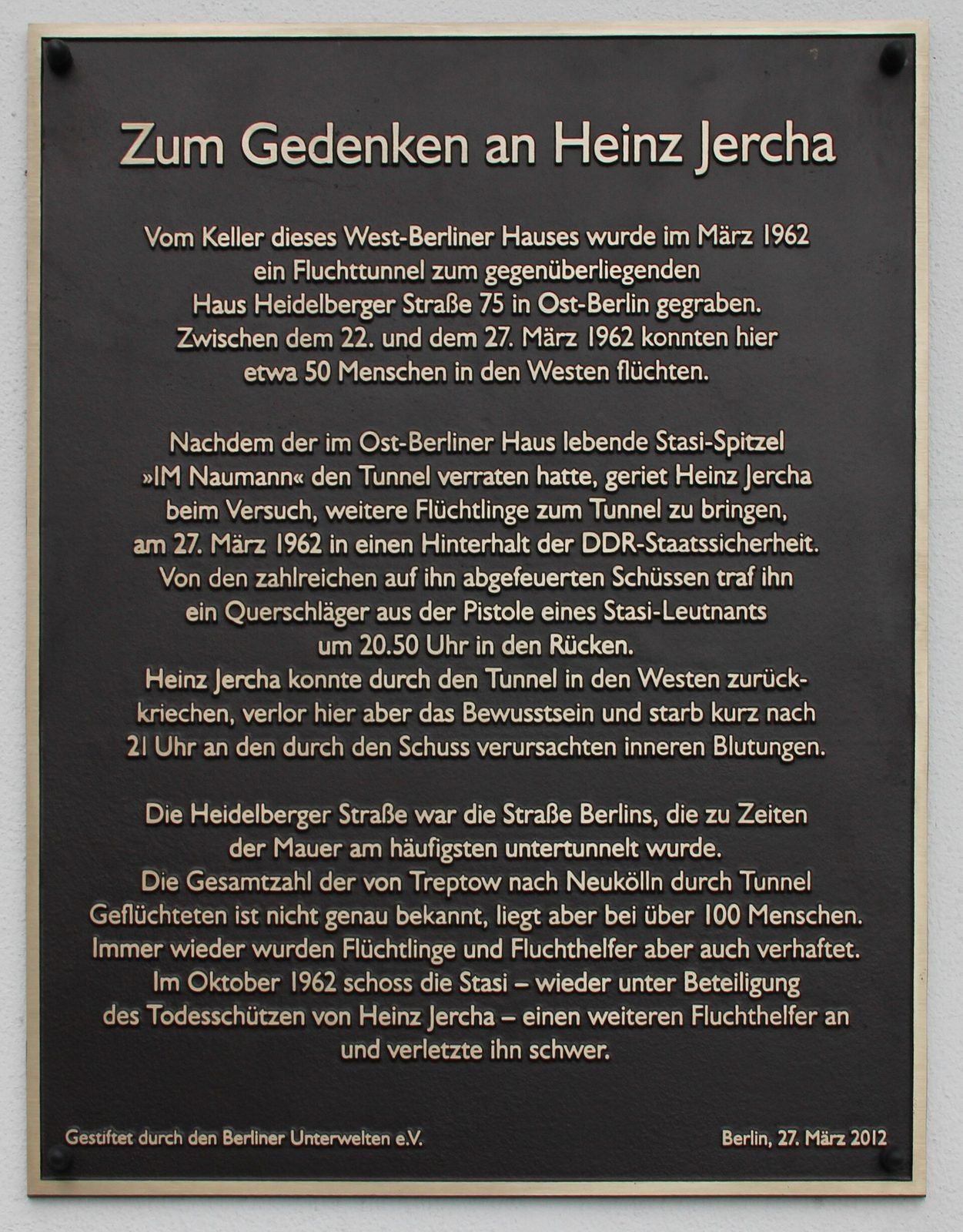
In March 1962 a tunnel ran from a West Berlin cellar to Heidelberger Straße 75 in the East. Between 22 and 27 March 1962 about 50 people got out through it. Then an informer in the eastern house, IM “Naumann”, gave it away. Heinz Jercha, an escape helper, was ambushed while bringing more refugees and died of a gunshot wound that night. Three months later the Sebastianstraße tunnel was betrayed in the same way, and Siegfried Noffke was killed. Dieter Hötger was wounded and imprisoned.

A wide outdoor information panel titled ‘Der verratene Fluchttunnel in der Sebastianstraße, 28. Juni 1962’, with photographs and text.
Berliner Unterwelten’s information panel on the betrayed tunnel at Sebastianstraße 82, Kreuzberg, as renewed on 28 June 2022.Photo: OTFW, Berlin, 2022. Wikimedia Commons. CC BY-SA 3.0.
A dark bronze plaque headed ‘Zum Gedenken an Heinz Jercha’ with several paragraphs of text.
The plaque to Heinz Jercha at Heidelberger Straße 35, Neukölln, set by Berliner Unterwelten in 2012. It records the tunnel to Heidelberger Straße 75 and the ambush of 27 March 1962.Photo: OTFW, Berlin, 2012. Wikimedia Commons. CC BY-SA 3.0.

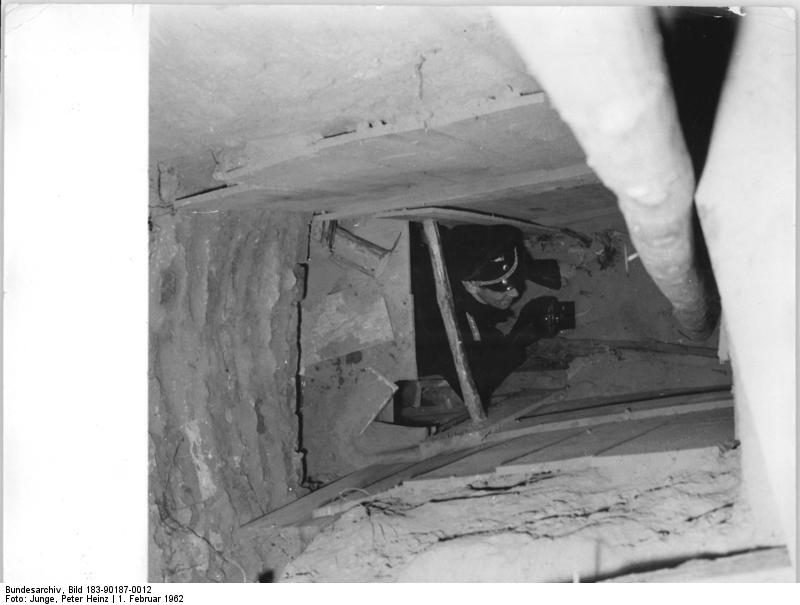
The East German state made propaganda of the tunnels it found. On 1 February 1962 its transport minister showed journalists a tunnel through the arches of the S-Bahn station Wollankstraße, which the official caption called an “agent sluice” dug by “West Berlin bandits”.

Black-and-white view down into a cramped tunnel shored with timber.
GDR press photoInside a tunnel under the S-Bahn station Wollankstraße, photographed for the East German press on 1 February 1962. The press agency’s caption called it an “agent sluice” dug by “West Berlin bandits”.Photo: Bundesarchiv, Bild 183-90187-0012 / Junge, Peter Heinz / CC-BY-SA 3.0
Black-and-white photograph of a ragged hole broken through a whitewashed brick wall.
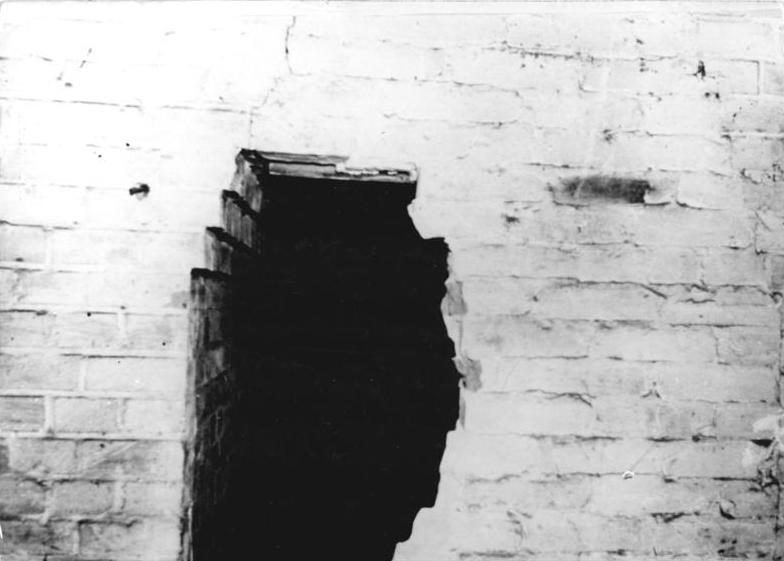
GDR press photoA hole broken through the brick of the S-Bahn arches at Wollankstraße, shown to journalists by the East German transport minister, 1 February 1962.Photo: Bundesarchiv, Bild 183-90175-0003 / CC-BY-SA 3.0

03The whole record, 1961–1982

For every tunnel that worked, about three failed

Berliner Unterwelten knows of more than 75 escape tunnels, the first dug in October 1961 and the last failing in 1982. Only 19 brought anyone through.

How many people they carried is not settled. Dietmar Arnold and Sven Felix Kellerhoff’s history of the tunnels gave more than 300. Berliner Unterwelten now gives up to 450. Three tunnels in this story alone, Tunnel 29, Tunnel 57 and the Seniors’ Tunnel, carried 98 of them.

Tunnels begun

19 of 75+
got people through: 19failed or abandonedOne square per tunnel; order is not by date

People who got through

04Bernauer Straße, 1962 and 1964

American television paid for Tunnel 29, and filmed it

The diggers of Tunnel 29 needed money for tools and timber. In June 1962 NBC agreed to pay 50,000 Deutschmarks for the film rights. Its cameras were in the tunnel when 29 people came through on 14–15 September 1962. The documentary went out on 10 December 1962. The tunnel itself was abandoned after two trips because of leaks; the Stasi found it only when it collapsed.

Its length is 135 metres, according to the plaque at Schönholzer Straße 7. Some accounts give longer figures.

Tall rusted steel rods in a row across a lawn, with trees and buildings behind.
Steel rods mark the line of the Wall at the Berlin Wall Memorial, Bernauer Straße, 2014. The tunnel markers lie in the grass on the old death strip.Photo: Tony Webster, 2014. Wikimedia Commons. CC BY 2.0.
A bronze plaque with the words ‘Tunnel 29’ in large type in the middle of its text.
The plaque at Schönholzer Straße 7, where Tunnel 29 came up in a cellar on the East Berlin side.Photo: OTFW, Berlin, 2010. Wikimedia Commons. CC BY-SA 3.0.
A line of steel plates crossing a lawn towards apartment blocks; the nearest reads ‘Fluchttunnel, Tunnel 57, 1964’.
The line of Tunnel 57 marked in steel plates at the Berlin Wall Memorial, 2011.Photo: N-Lange.de, 2011. Wikimedia Commons. CC BY-SA 3.0.

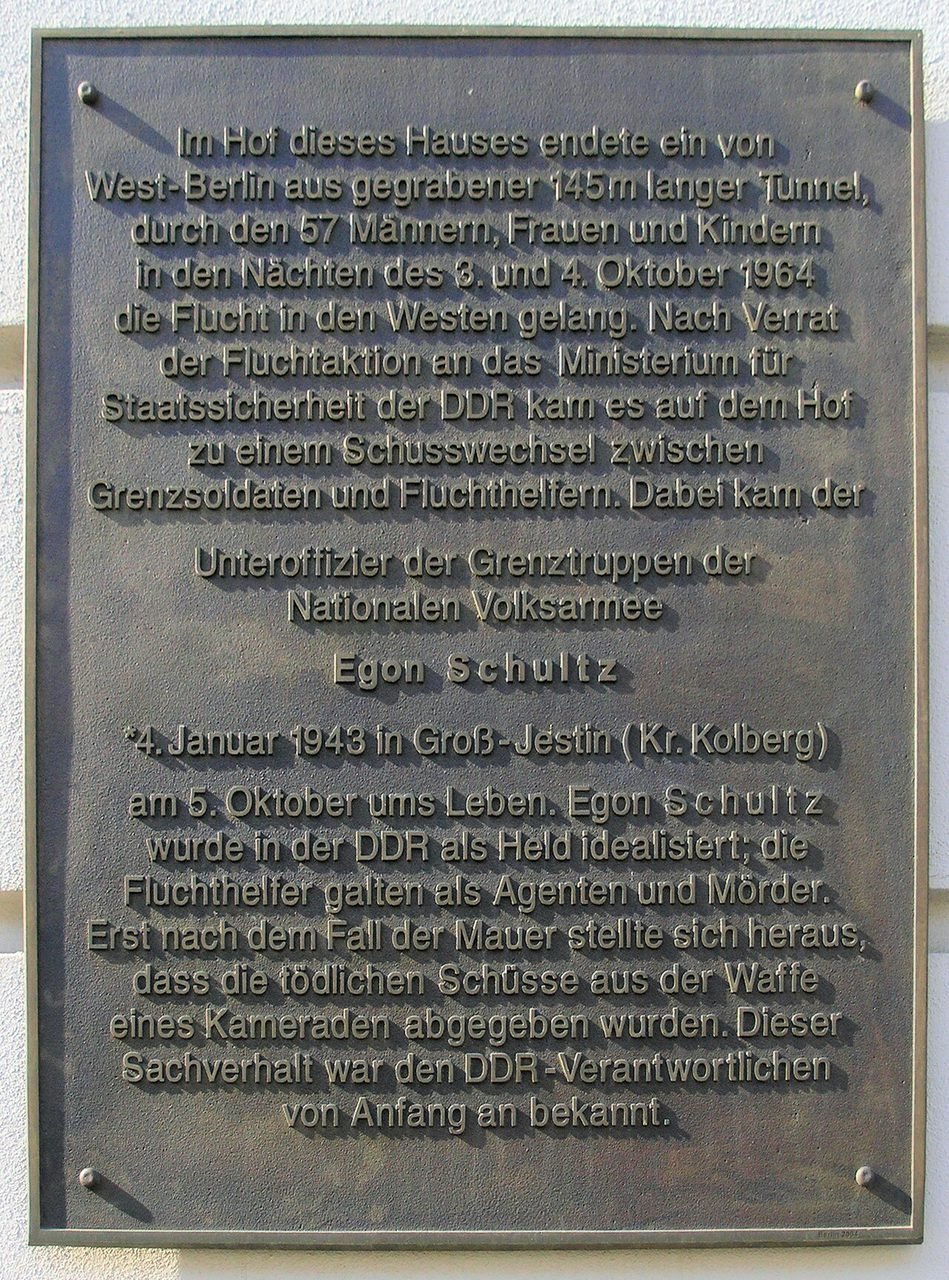
Tunnel 57 is the second tunnel its diggers drove from the old bakery at Bernauer Straße 97. Through the first, in January 1964, 3 women escaped, and the Stasi destroyed it with a grenade the next day. Through the second, 57 people escaped. On the last night Sergeant Egon Schultz of the GDR border troops was hit in the courtyard and died on 5 October 1964. The GDR made him a martyr of “West Berlin agents”. In fact the fatal shot came from a comrade’s Kalashnikov, and the state kept that secret. His story is told in a separate Berlinfographics story.

A bronze plaque with raised lettering naming Egon Schultz.
The plaque at Strelitzer Straße 55. It says the fatal shots came from a comrade’s weapon, which came out only after the Wall fell, and that the GDR knew it from the start.Photo: OTFW, Berlin, 2010. Wikimedia Commons. CC BY-SA 3.0.

05Berlin today

Lines of steel in the grass

At the Berlin Wall Memorial, the lines of the tunnels under the death strip are marked with steel plates set into the lawn, each lettered with its year. Berliner Unterwelten’s tour offers a look into the only original escape tunnel to survive, dug in 1970/71.

Steel plates in a line across a sunlit lawn; the nearest is lettered ‘Fluchttunnel, 1971’.
Steel plates mark the line of a tunnel of 1971 at Bernauer Straße, 2011.Photo: Dietmar Rabich, 2011. Wikimedia Commons. CC BY-SA 4.0.

More than 75 tunnels were begun under the Wall. 19 got through. The rest never broke through.

Press & citation

Use this Berlinfographic

Free to publish under CC BY 4.0 — in print, online, on Wikipedia and in teaching, commercially or not — with credit to Berlinfographics and a link to this page.

Under the Wall: the escape tunnels of Berlin, 1961–1982: ready-to-use landscape image

Ready-to-use image

The infographic as one image: headline, key figures, chart, sources and credit, 2,400 × 1,350 px PNG. Please use it unedited.

Download landscape (PNG)
Under the Wall: the escape tunnels of Berlin, 1961–1982: square version

Square format

A 1:1 version for social media and narrow columns, 1,800 × 1,800 px.

Download square (PNG)
Under the Wall: the escape tunnels of Berlin, 1961–1982: portrait version

Portrait 4:5

For Instagram and LinkedIn feeds, 1,620 × 2,025 px.

Download portrait (PNG)

Credit line

Berlinfographics (berlinfographics.com), CC BY 4.0

Citation

Berlinfographics (2026). “Under the Wall: the escape tunnels of Berlin, 1961–1982”. Berlin Experiences. https://berlinfographics.com/berlin-wall-tunnels/

Wikipedia

{{cite web |title=Under the Wall: the escape tunnels of Berlin, 1961–1982 |url=https://berlinfographics.com/berlin-wall-tunnels/ |website=Berlinfographics |publisher=Berlin Experiences |date=2026-11-09 |access-date=2026-11-09}}