Berlinfographicsby Berlin Experiences

The Bösebrücke at Bornholmer Straße on 10 November 1989: East Berliners coming home from the West.Photo: Gerd Danigel, 1989. Wikimedia Commons. CC BY 3.0.

Bornholmer Straße

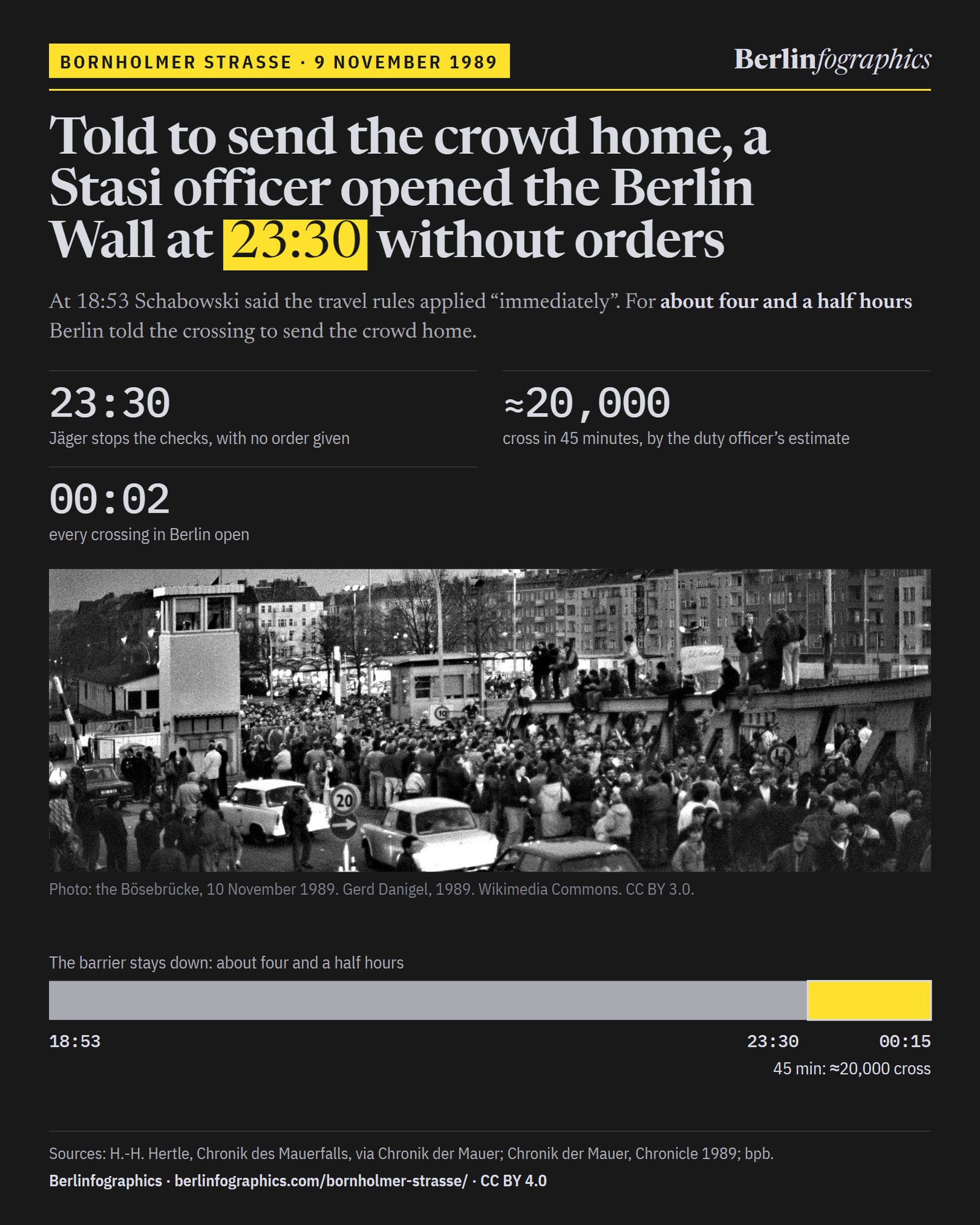
Told to send the crowd home, a Stasi officer opened the Berlin Wall at 23:30 without orders

At 18:53 a Politburo spokesman read out travel rules meant for the next day and said they applied “immediately, without delay”. At Bornholmer Straße nobody had told the passport officers anything. For about four and a half hours Berlin told them to send the crowd home.

18:53
“Sofort, unverzüglich”: immediately, without delay
~4½h
of orders to send the crowd home
≈20,000
crossed at Bornholmer Straße in 45 minutes, by the duty officer’s estimate
00:02
every crossing between East and West Berlin open

01Mohrenstraße, East Berlin

The answer was not on the paper

The new travel rules were meant to be announced the next morning. The draft’s last line said the press release was to be published on 10 November 1989. At 12:00 Politburo members had approved it in a smoking break. Günter Schabowski, the Party’s new spokesman, was not there. At 16:00 Egon Krenz read the draft to the Central Committee and added that the government spokesman should put it out “gleich”, right away. That one word lifted the embargo. At 17:30 Krenz handed Schabowski the papers.

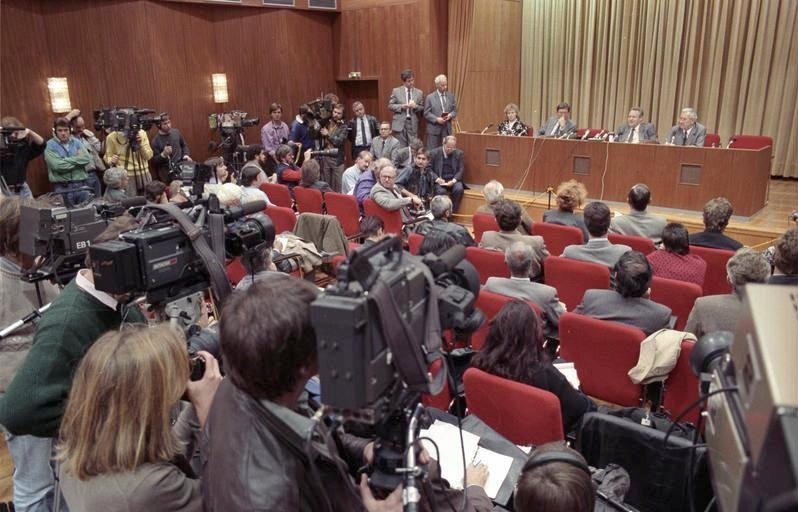
Schabowski’s press conference began at 18:00, live on East German television. Near the end he read the rules out. Asked when they took effect, he leafed through his papers and said: “Sofort … unverzüglich”. He had been handed the text, he told the room, “kurz, bevor ich rüberkam, diese Information in die Hand gedrückt bekam”: just before he came over.

A press room with four officials at a long table on a stage, facing rows of reporters and television cameras.
The press conference in the International Press Centre, Mohrenstraße, 9 November 1989. Schabowski is second from right on the podium.Photo: Bundesarchiv, Bild 183-1989-1109-030 / Thomas Lehmann / CC BY-SA 3.0 de

The last 8 min 14 s, from the broadcast

18:52:4019:00:54

Riccardo Ehrman, ANSA“Glauben Sie nicht, daß es war ein großer Fehler, diesen Reisegesetzentwurf …?”Don’t you think the travel bill was a big mistake?

Günter Schabowski“… eine Regelung zu treffen, die es jedem Bürger der DDR möglich macht, über Grenzübergangspunkte der DDR auszureisen.”… a regulation that makes it possible for every citizen of the GDR to leave through the GDR’s crossing points.

Krzysztof Janowski, Voice of America“Ab wann tritt das in Kraft?”From when does that take effect?

Peter Brinkmann, Bild“Ab sofort? Ab …?”Immediately? From …?

Günter Schabowski(reads very fast from the page)

Ralph T. Niemeyer, DAPA“Wann tritt das in Kraft?”When does that take effect?

Günter Schabowski“Das tritt, nach meiner Kenntnis ist das sofort, … unverzüglich.”That takes effect, as far as I know, immediately, … without delay.

Peter Brinkmann, Bild“Gilt das auch für Berlin-West?”Does that also apply to West Berlin?

Günter Schabowski“Die ständige Ausreise kann über alle Grenzübergangsstellen der DDR zur BRD bzw. zu Berlin-West erfolgen.”Permanent exit can take place through all GDR crossing points to the FRG or to West Berlin.

Günter Schabowski“Ich werde darauf aufmerksam gemacht, daß es 19.00 Uhr ist.”I am being told that it is seven o’clock.

Several reporters called out when it would take effect: Krzysztof Janowski of Voice of America, Peter Brinkmann of Bild and, last, Ralph T. Niemeyer of DAPA. Riccardo Ehrman of ANSA, who had opened the topic, and Brinkmann have both said it was their question. Twenty years later Ehrman said that ADN’s director-general Günter Pötschke had briefed him before the press conference to ask about the travel law. Lines abridged from Hans-Hermann Hertle’s transcript; only the first and last moments carry a time. Hertle’s transcript records a quiet call of “unverzüglich” from beside him before he repeats it.
The night of 9 November, on one clock

The night of 9 to 10 November 1989 on one time axis, in four rows: the Party, the news, the barrier at Bornholmer Straße and the rest of the city. Each mark is an event at its documented time; filled marks are fixed by a broadcast, transcript or report, hollow ones are the officers’ later recollections.

From the papers changing hands to the morning after: scroll on.

● Fixed by a broadcast, transcript or report ○ Recalled later by the officers. Hollow marks are approximate.

Egon Krenz, smiling, in a dark suit and striped tie, gesturing as he speaks.
Egon Krenz, SED general secretary, 18 October 1989.Photo: Bundesarchiv, Bild 183-1989-1018-037 / Mittelstädt, Rainer / CC BY-SA 3.0 de

12:00 – 17:30

A text meant for tomorrow

Politburo members approved the rules at 12:00; Schabowski was not there. At 16:00 Krenz told the Central Committee the spokesman should publish them “gleich”, right away, though the draft said 10 November 1989. At 17:30 he handed Schabowski the papers.

A press room with four officials at a long table on a stage, facing rows of reporters and television cameras.
The press conference, 9 November 1989. Schabowski is second from right on the podium.Photo: Bundesarchiv, Bild 183-1989-1109-030 / Thomas Lehmann / CC BY-SA 3.0 de

18:53

“Sofort, unverzüglich”

Near the end of the live press conference, asked when the rules take effect, Schabowski checks his papers: “as far as I know … immediately, without delay.” The conference ends at 19:00:54.

19:05 – 20:15

The news says the border is open

At 19:05 the Associated Press sends a flash: “DDR öffnet Grenzen”, GDR opens borders. dpa follows at 19:41. At 20:00 West Germany’s Tagesschau opens on the same headline. Until 20:15 it is the lead story on West German television and radio, and thousands in East and West set off for the crossings.

An older man in glasses, a brown jacket and a yellow jumper, seated and smiling.
Harald Jäger, the passport-control officer in charge at Bornholmer Straße that night, at a talk in 2014.Photo: Eric The Fish from UK, 2014. Wikimedia Commons. CC BY 2.0.

c. 19:30

Ten or twenty, then a hundred

Jäger reaches the barrier to find 50 to 100 people asking to cross. Many are neighbours of the border-troop officer on duty: the flats of Prenzlauer Berg run right up to the crossing. Lieutenant-Colonel Harald Jäger, in charge of the Stasi passport unit that night, rings his superior. The answer: “Wait and see. Let them stand there and send them back.”

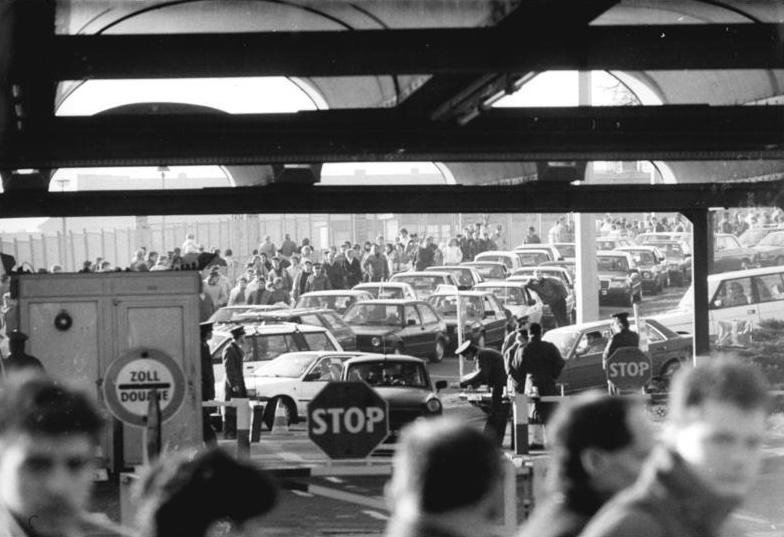
Under a steel canopy, a toll booth and STOP signs; behind them cars queue in rows, and people stand in the foreground.
The crossing at Bornholmer Straße in November 1989, after the opening: the queue of cars under the control canopy.Photo: Bundesarchiv, Bild 183-1989-1118-017 / Roeske, Robert / CC BY-SA 3.0 de

20:15 – c. 20:30

The police counted 80. The officers saw hundreds

At 20:15 the East Berlin Volkspolizei’s situation report counts 80 people at three crossings together. By the officers’ own later account, at c. 20:30 there were hundreds, if not thousands, at this barrier alone. A Volkspolizei patrol car’s loudspeaker tells them: “It is not possible to let you leave here today.” A young man answers by reading out the official news report.

c. 21:00 – 21:30

Let out, and locked out

About c. 21:00, with cars queued back more than a kilometre, Jäger sounds a silent alarm and asks Berlin to let people go. At about 21:20 the answer comes: let the most provocative out, with a stamp half over the ID photo, “and they don’t come back in.” The first to be let through run cheering across the bridge, not knowing their papers have been voided. By 21:30, between 500 and 1,000 people are at the crossing.

22:28 – 22:42

Television says the gates stand wide open. They are shut

At 22:28 East German television makes a last attempt to slow things down: travel has to be applied for. At 22:42 the West German Tagesthemen opens: “the gates in the Wall stand wide open.” At Bornholmer Straße the barrier is still down. By about 23:00 thousands are pressing on it, chanting “Tor auf!”: open the gate.

A crowd around a Trabant on the bridge, young people holding up a hand-painted banner.
On the Bösebrücke, 10 November 1989: schoolchildren from Wedding, on the West Berlin side, line the bridge to welcome visitors from the East.Photo: Bundesarchiv, Bild 183-1989-1118-028 / Lochmann, Hans Peter / CC BY-SA 3.0 de

c. 23:30

“Wir fluten jetzt!”

The wire fence in front of the checkpoint gives way. Jäger rings his superior, not to ask but to tell him: “It can’t be held any more. We have to open the crossing. I’m stopping the checks and letting the people out.” His fellow deputy, Edwin Görlitz, tells Major Manfred Sens of the border troops: “Wir fluten jetzt!”, we’re flooding it now. Sens lifts the barrier on the bridge. Thousands run through the controls and over the bridge to West Berlin, papers or no papers.

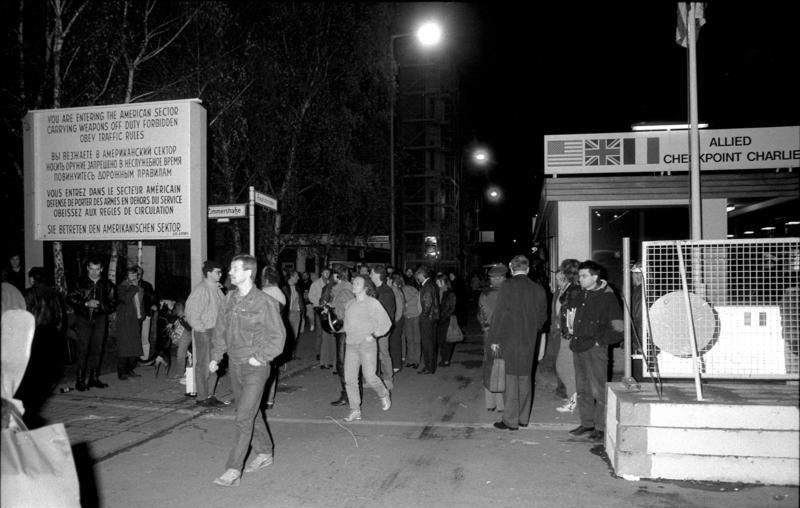
Night at Checkpoint Charlie: people walk past the sign announcing the American sector and the Allied hut.
Checkpoint Charlie in the night of 9 to 10 November 1989.Photo: Bundesarchiv, Bild 183-1989-1110-018 / Klaus Oberst / CC BY-SA 3.0 de

00:02 – c. 00:15

Two minutes after midnight, every crossing is open

At 00:02 every crossing between East and West Berlin is open. By 00:15, by the duty officer’s estimate the next day, ≈20,000 people have crossed at Bornholmer Straße. At 00:20 the army puts the Berlin border regiments, around 12,000 soldiers, on increased combat readiness. No orders follow, and their commanders stand it down.

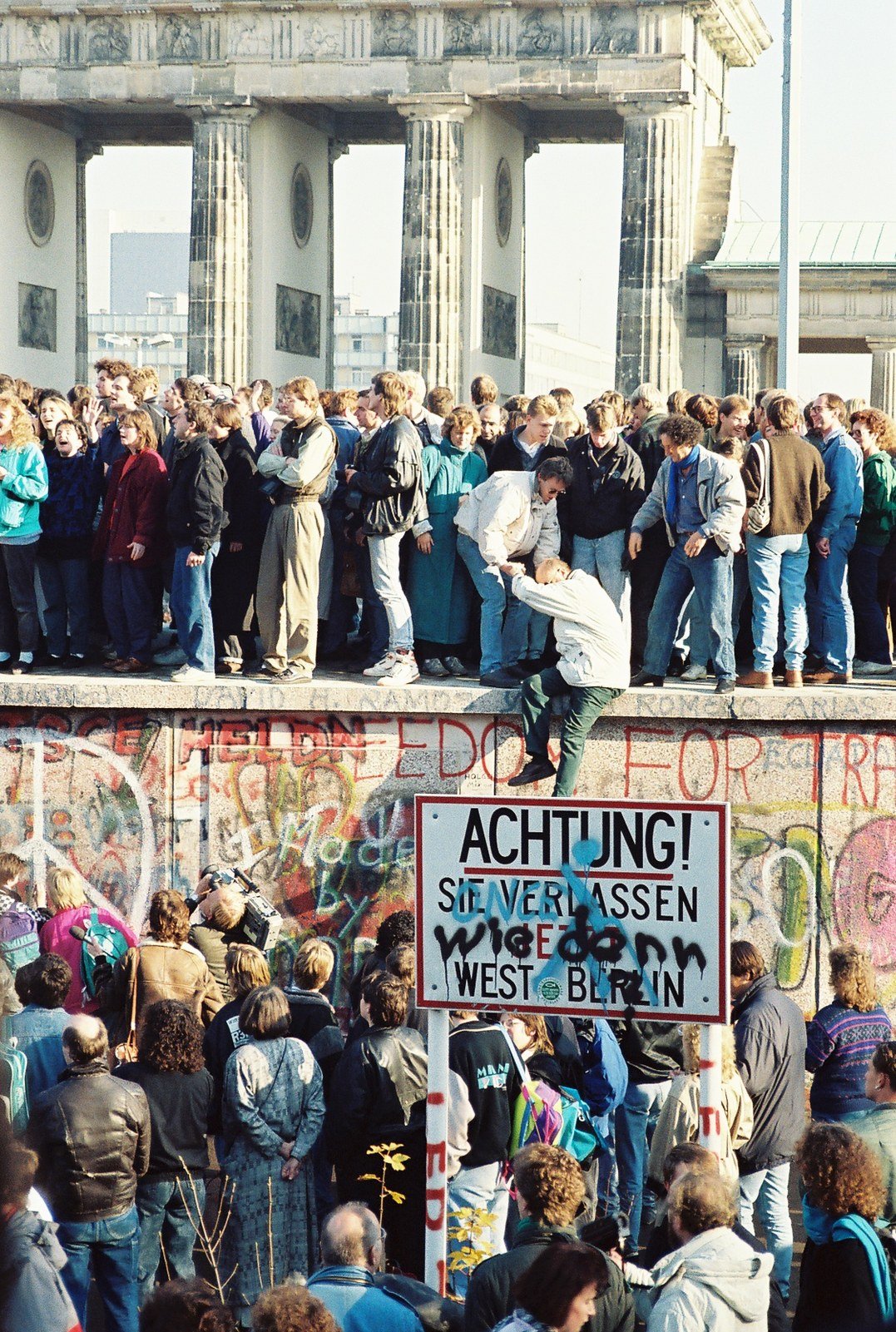
People stand along the top of the graffiti-covered Wall in front of the columns of the Brandenburg Gate; a sign below reads Achtung! Sie verlassen West-Berlin.
People on the Wall in front of the Brandenburg Gate, November 1989.Photo: Sue Ream, photographer (San Francisco, California), 1989. Wikimedia Commons. CC BY 3.0.

01:00–02:00

On the Wall at the Brandenburg Gate

Between 01:00 and 02:00 thousands of East and West Berliners climb the Wall at the Brandenburg Gate, which was not a crossing, and walk through it. At 02:00 Radio DDR announces that until 08:00, an identity card is enough to cross.

02The passport-control hall

Berlin kept telling him to wait

The crossing’s passport control belonged to the Stasi and answered directly to the ministry’s Main Department VI. Jäger rang his superior there, Colonel Rudi Ziegenhorn, again and again. This is what he was told, as he recalled it in 1995.

after the broadcast
“Wait and see. Let them stand there and send them back.”
Ziegenhorn
later
“Keep putting them off, and report back to me.”
Ziegenhorn
soon after 21:00
“Is Jäger able to judge the situation, or is he just afraid?”
Lt-Gen Gerhard Neiber, deputy Stasi minister, patched into the call
c. 21:20
“The most provocative ones — let them out. Stamp the ID half over the photo, and they don’t come back in.”
Ziegenhorn, ringing back
c. 23:30
“It can’t be held any more. I’m stopping the checks and letting the people out.”
Jäger — no longer asking
An older man in glasses, a brown jacket and a yellow jumper, seated and smiling.
Harald Jäger, the passport-control officer in charge at Bornholmer Straße that night, at a talk in 2014.Photo: Eric The Fish from UK, 2014. Wikimedia Commons. CC BY 2.0.

At c. 21:00: the people holding the crossing

Stasi passport officers: 14Border soldiers: 5Customs: 16 to 18

After the silent alarm: Stasi passport officers

About 50 to 60 in allOne square, one person

On the other side of the barrier, between 500 and 1,000 people at 21:30, and thousands by about 23:00. Firing on them was out of the question, Major Sens later said: “If the crowd starts running and we shoot, we’ll be hanging from the flagpole out front.”

03Bornholmer Straße, after the barrier went up

About four and a half hours shut, then 45 minutes for 20,000 people

From “immediately” at 18:53 to the checks being stopped at about 23:30, the barrier at Bornholmer Straße stayed down for about four and a half hours. Then, by the duty officer’s estimate the next day, ≈20,000 people crossed between 23:30 and 00:15: more than 400 a minute. “We were completely overrun.”

The 45 minutes, one column each

A hundred peopleSpread evenly: the source gives one total, not a count per minute

Most of them went back. By the Stasi’s own overview at 04:00, about 68,000 East Germans had gone over to West Berlin that night, and about 45,000 had already come home.

04Every crossing in the city

Two minutes after midnight, every crossing was open

At 00:02 every crossing between East and West Berlin was open. At 00:20 the army put the Berlin border regiments, around 12,000 soldiers, on alert; no orders followed, and their commanders stood them down.

The Interior Ministry announced that, as a temporary measure, the border could be crossed on showing an identity card until 08:00; Radio DDR I broadcast it from 02:00. The attempt to restart passport controls at 08:00 failed against the crowds.

A packed crowd fills the street in front of the crossing, with a GDR sign and cars behind.
The crossing at Invalidenstraße, seen from West Berlin, 10 November 1989: by the East German news agency’s caption, thousands passed through.Photo: Bundesarchiv, Bild 183-1989-1110-041 / Hirschberger, Ralph / CC BY-SA 3.0 de
Sonnenallee
»Alles aufmachen!«
Open everything!
Invalidenstraße
»Zieht euch zurück, lasst sie laufen!«
Pull back, let them go!
Checkpoint Charlie
»Lasst uns rein! – Lasst uns raus!«
Let us in! – Let us out!

The words Hans-Hermann Hertle uses as the titles of his chapters on these crossings in Sofort, unverzüglich. Die Chronik des Mauerfalls (2019).

A steel arch bridge with tram tracks and overhead wires under a grey sky.
The Bösebrücke in 2013, carrying the tram over the railway at Bornholmer Straße.Photo: Miriam Guterland, 2013. Wikimedia Commons. CC BY 3.0.

05The Bösebrücke

The bridge, and the claim to be first

Bornholmer Straße is usually named as the first crossing to open (Chronik der Mauer; Landesdenkmalamt). Some later reports point to the Waltersdorfer Chaussee crossing on the southern edge of the city. The official demolition of the Wall began on 13 June 1990.

The Wall did not open because the state decided to open it. It opened because a Stasi officer stopped waiting for the state to decide.

Press & citation

Use this Berlinfographic

Free to publish under CC BY 4.0 — in print, online, on Wikipedia and in teaching, commercially or not — with credit to Berlinfographics and a link to this page.

Bornholmer Straße, 9 November 1989: ready-to-use landscape image

Ready-to-use image

The infographic as one image: headline, key figures, chart, sources and credit, 2,400 × 1,350 px PNG. Please use it unedited.

Download landscape (PNG)
Bornholmer Straße, 9 November 1989: square version

Square format

A 1:1 version for social media and narrow columns, 1,800 × 1,800 px.

Download square (PNG)
Bornholmer Straße, 9 November 1989: portrait version

Portrait 4:5

For Instagram and LinkedIn feeds, 1,620 × 2,025 px.

Download portrait (PNG)

Credit line

Berlinfographics (berlinfographics.com), CC BY 4.0

Citation

Berlinfographics (2026). “Bornholmer Straße, 9 November 1989”. Berlin Experiences. https://berlinfographics.com/bornholmer-strasse/

Wikipedia

{{cite web |title=Bornholmer Straße, 9 November 1989 |url=https://berlinfographics.com/bornholmer-strasse/ |website=Berlinfographics |publisher=Berlin Experiences |date=2026-11-09 |access-date=2026-11-09}}