Café cultureUnter den Linden · Kurfürstendamm · 1825–2026
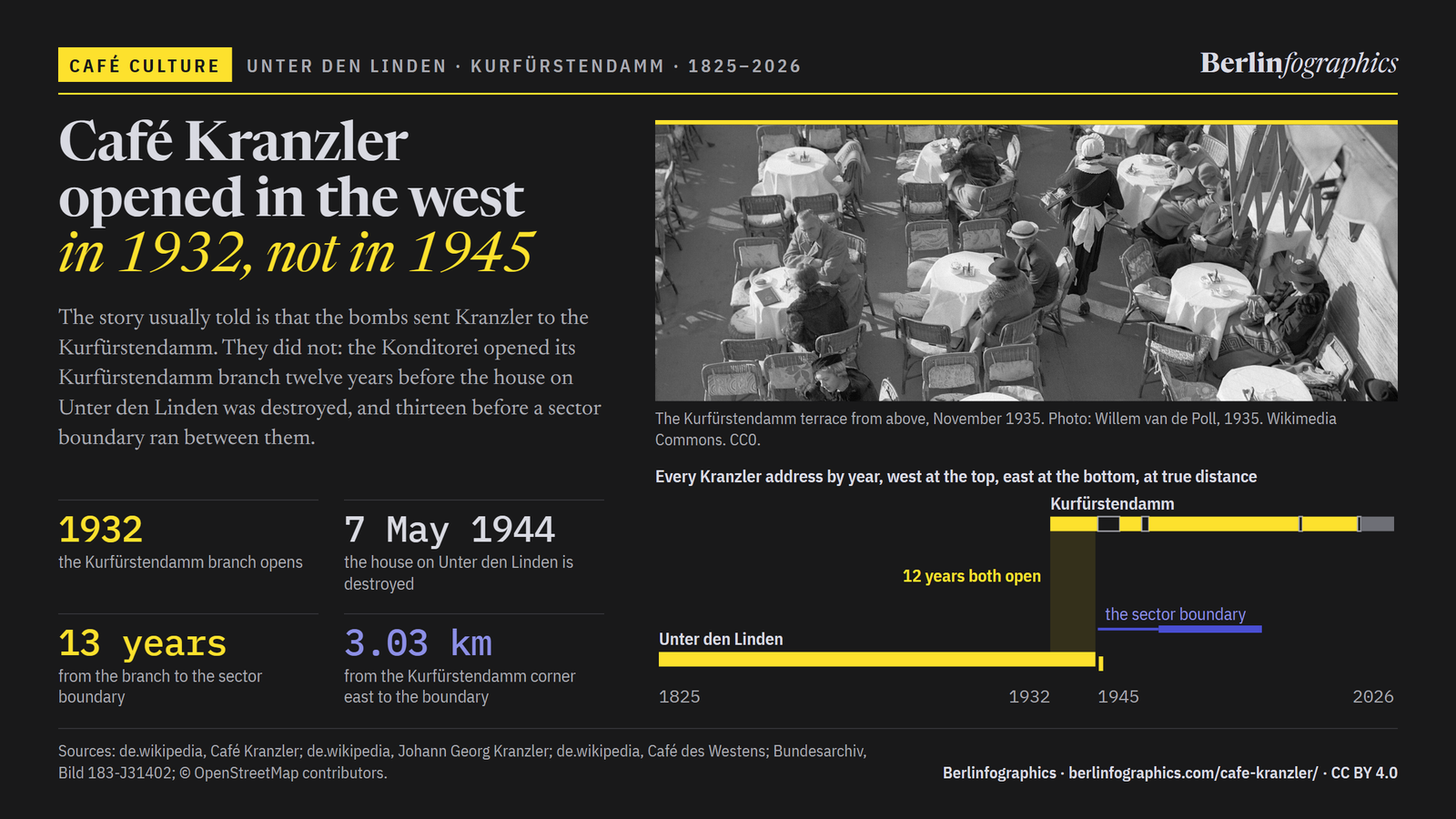
The story usually told is that the bombs sent Kranzler to the Kurfürstendamm. They did not. The Konditorei opened a branch there in 1932, twelve years before its house on Unter den Linden was destroyed, and thirteen before a sector boundary was drawn between the two addresses.
Scroll through every address
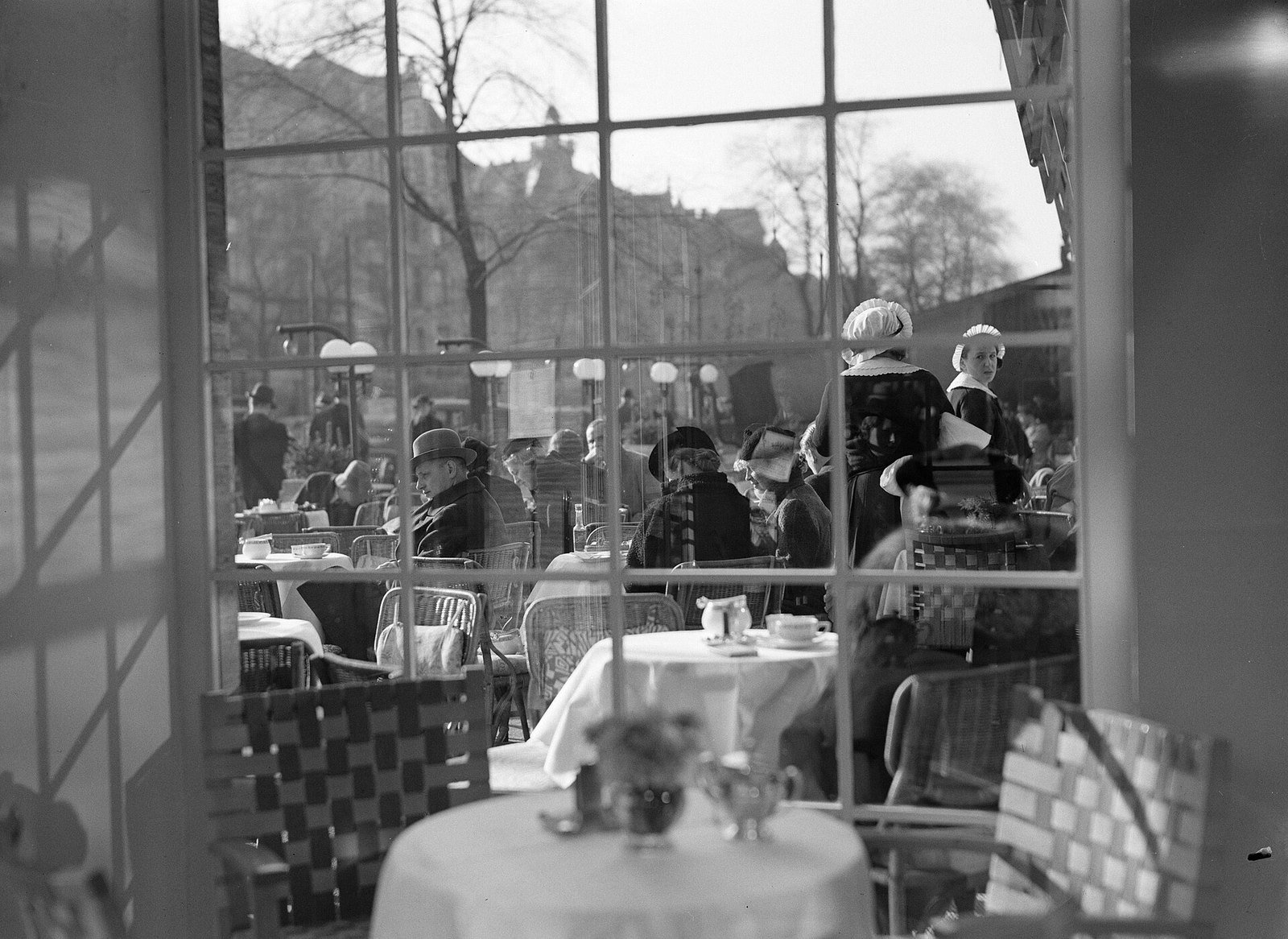
The terrace of Café Kranzler on the Kurfürstendamm, seen from above in November 1935. The Konditorei on Unter den Linden was still trading at the same time.Willem van de Poll, 1935. Wikimedia Commons. CC0.
01The received story
The story usually told is that the bombs sent Kranzler to the Kurfürstendamm. The record says otherwise. In 1932, Restaurant und Konditorei Kranzler opened at Kurfürstendamm 18/19, in the rooms of the former Café des Westens.
The house on Unter den Linden did not close. It traded on until it was destroyed in an Allied air raid on 7 May 1944, and then the firm moved east, not west: a hundred and thirty metres along the boulevard, to the Charlottenstraße corner.
A sector boundary arrived between the two addresses only in 1945: 3.03 km east of the Kurfürstendamm corner, 867 m west of the Linden house.


02Every address, at its true distance
Across: the year. Down: where each address stood, west at the top and east at the bottom, at true distance. The Kurfürstendamm corner and the house on Unter den Linden are about four kilometres apart.
1816–1834
Johann Georg Kranzler, born at Tautendorf, Lower Austria, came to Berlin in 1816 as personal cook to Chancellor Karl August von Hardenberg. He opened his own Konditorei in 1825; in 1833 he put tables out on the pavement, the Rampe, and in 1834 August Stüler raised and rebuilt the house; Café Kranzler took the whole ground and first floors.
Source: de.wikipedia, Johann Georg Kranzler · de.wikipedia, Café Kranzler
1866–1926
Kranzler died on 24 December 1866 and his sons Martin and Alfred carried on. In 1911 the heirs leased the house and the Konditorei to the Berliner Hotelbetriebs-AG, which bought it outright in 1923; in 1926 the brewery group Aschinger took the majority.
Source: de.wikipedia, Johann Georg Kranzler · de.wikipedia, Café Kranzler
1932
Restaurant und Konditorei Kranzler opened at Kurfürstendamm 18/19, in the rooms of the former Café des Westens. The house on Unter den Linden kept trading. From here on there are two Kranzlers, and both are open.
Source: de.wikipedia, Café Kranzler · de.wikipedia, Café des Westens
7 May 1944
The house Unter den Linden 25 was destroyed in an Allied air raid on 7 May 1944. For twelve years both addresses had traded at once. The firm moved a hundred and thirty metres east to the Charlottenstraße corner, taking the rescued gold mosaic frieze with it, and was trading there before 9 April 1945. How long that last address in Mitte traded is not recorded.
Source: de.wikipedia, Café Kranzler · Bundesarchiv, Bild 183-J31402 · Stremlow, 1949
1945
The Kurfürstendamm building was destroyed in 1945. That year a sector boundary was drawn 3.03 km east of the Kurfürstendamm corner and 867 m west of the Linden house. The branch had already been open for thirteen years before there was a line to be on the west side of.
Source: de.wikipedia, Café Kranzler · © OpenStreetMap contributors
1951–1958
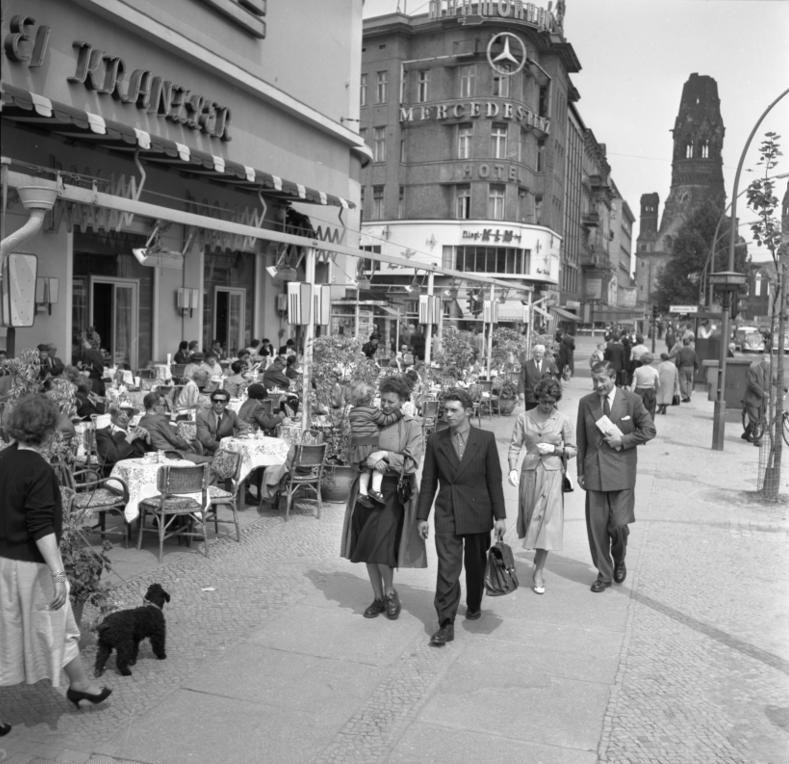
Trading resumed in 1951 in a flat building by Paul Schwebes. In 1957–1958 it was pulled down for Hanns Dustmann’s two-storey block with the rotunda on the roof, and Café Kranzler reopened on 17 December 1958.
Source: de.wikipedia, Café Kranzler · Berlinische Monatsschrift 12/1998
1961–1989
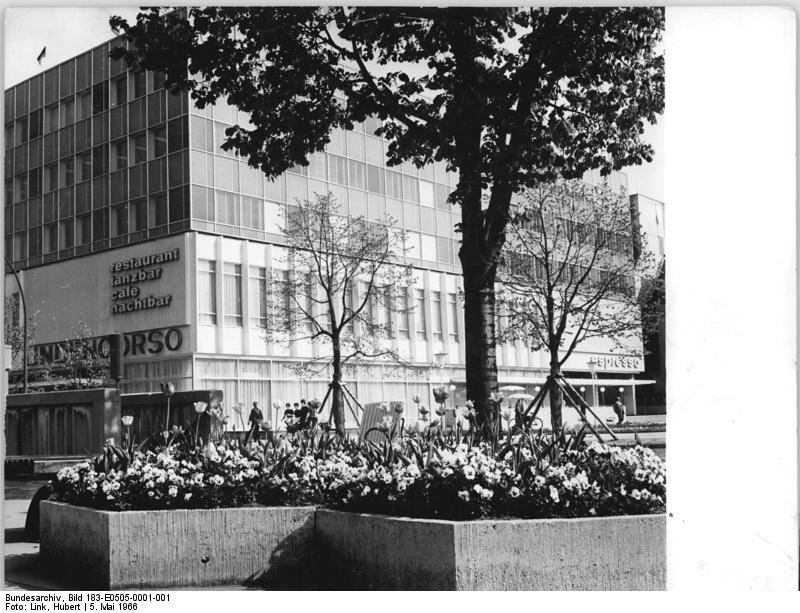
After the war the crossing lay in the Soviet sector and the surviving business lay in the west. From 1961 to 1989 the boundary was the Wall. On 5 May 1966 the East German state opened the Lindencorso on the Café Bauer corner, opposite where Kranzler stood, with a restaurant, a café, a dance bar and a night bar in it — and no Kranzler.
Source: de.wikipedia, Café Bauer · Bundesarchiv, Bild 183-E0505-0001-001 · © OpenStreetMap contributors
2000–2026
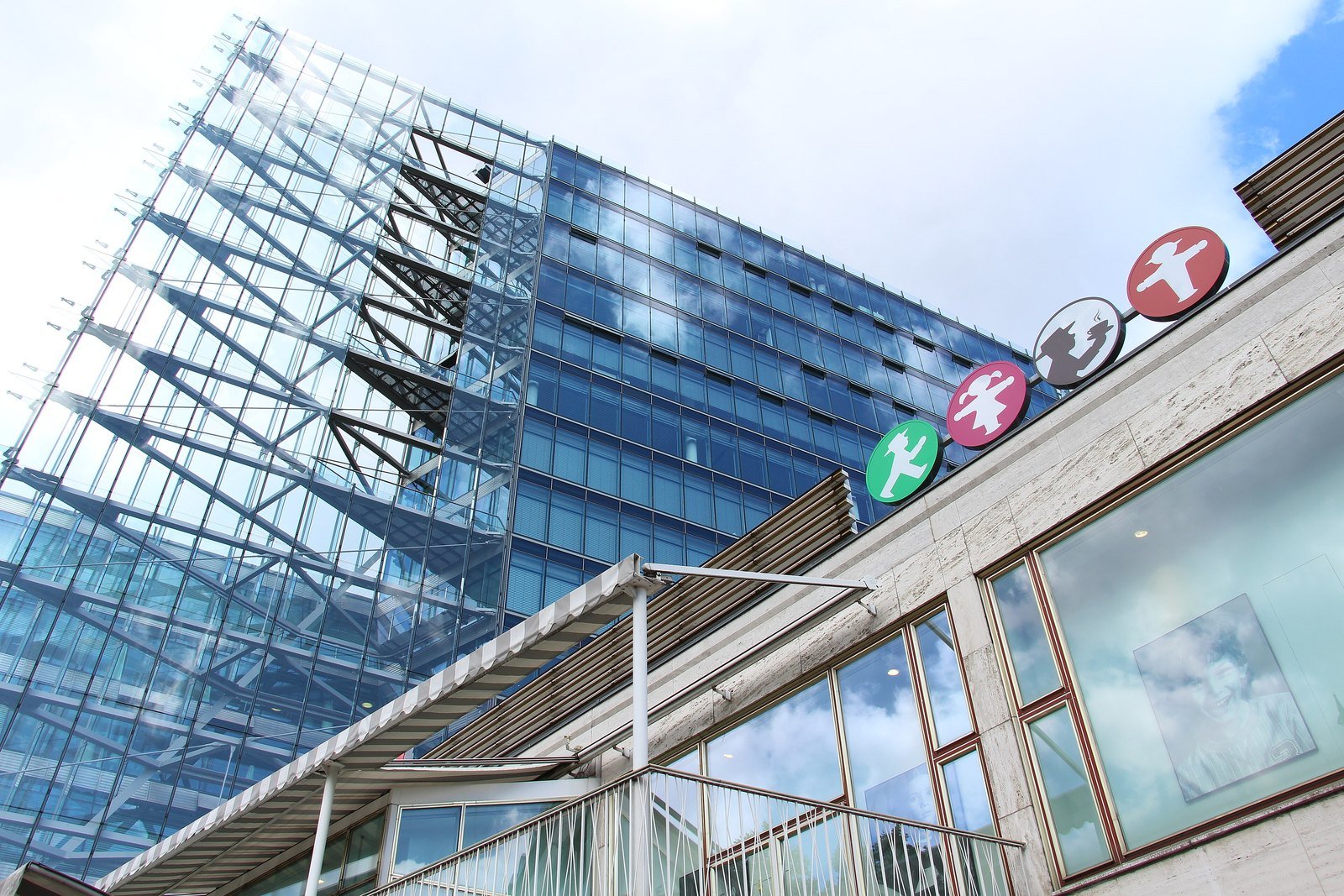
The historic café closed in 2000; that December Helmut Jahn's Neues Kranzler Eck opened — café by day, bar by night. Café Kranzler closed again on 31 December 2015. In 2016 the rotunda reopened as a branch of the roastery The Barn. A full remodelling is planned, with interim use as KranzlerX.
Source: de.wikipedia, Café Kranzler · Berliner Morgenpost, 2015 · Tagesspiegel, 2016 · B.Z., 2024
1825–2026
119 years in one house on Unter den Linden; 94 years and three buildings on the Kurfürstendamm, where a fourth remodelling is announced for 2026 and is not counted.
Source: de.wikipedia, Café Kranzler · Berlin Denkmaldatenbank 09040517 · B.Z., 2024

03The first address
A Konditorei is a confectioner's: a shop that makes cakes and ices and sells them to eat where they are made. Johann Georg Kranzler came to Berlin in 1816 as personal cook to Chancellor Karl August von Hardenberg and opened his own shop in 1825.
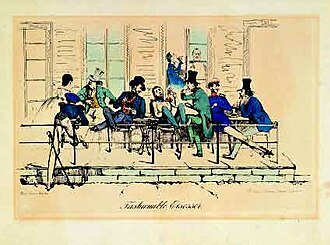
In 1833 he put tables out on the pavement, and opened Berlin's first Raucherzimmer. Berlin had not seen that before: the building police tried to have the terrace removed and failed, because the king protected it. Berliners called it the Rampe, and for the next hundred years it was why people came.

December 1866: three death dates


The first address is disputed
Unter den Linden 25: the Café Kranzler entry; Der Tagesspiegel · Friedrichstraße / Behrenstraße: the Kranzler biography. The two corners are about 168 metres apart, mostly a difference in latitude, not longitude — and both sources agree on the year. Map: © OpenStreetMap contributors, ODbL.
In 1836 a woman living outside the excise wall was charged with procuring, for having brought Kranzler a number of young women and girls of school age. Two of them said he had forced them. No charge was brought against Kranzler: the girls withdrew their statements, and under §1060 of the Prussian General Law rape was prosecuted only on complaint. He had paid settlements to the families, of markedly different sizes. The police and court files no longer exist; the case is known only from the poor-relief administration's records, reconstructed by Jonas Geist and Klaus Kürvers in 1980.
Source: de.wikipedia, Johann Georg Kranzler · Geist and Kürvers, 1980
04Unter den Linden × Friedrichstraße
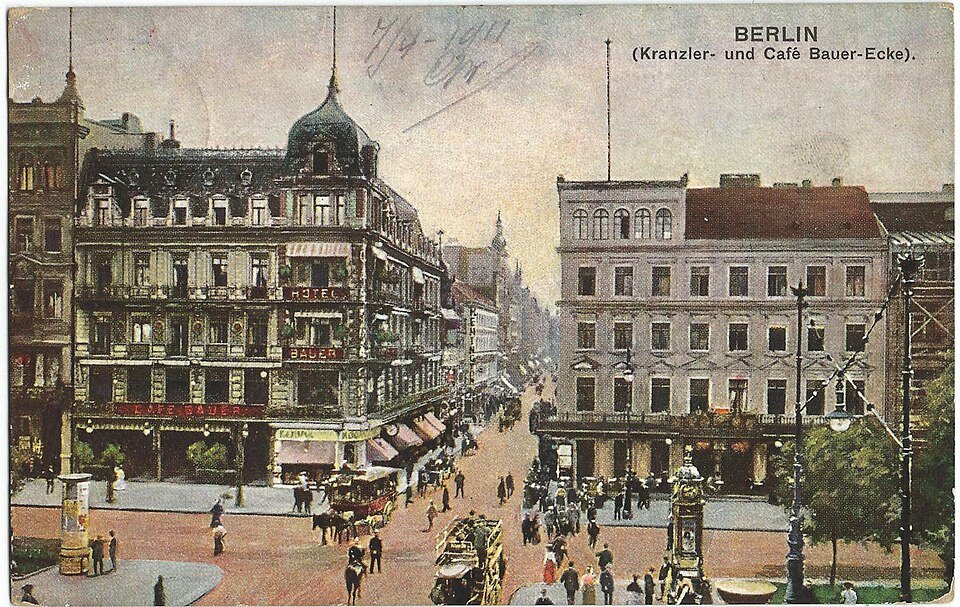
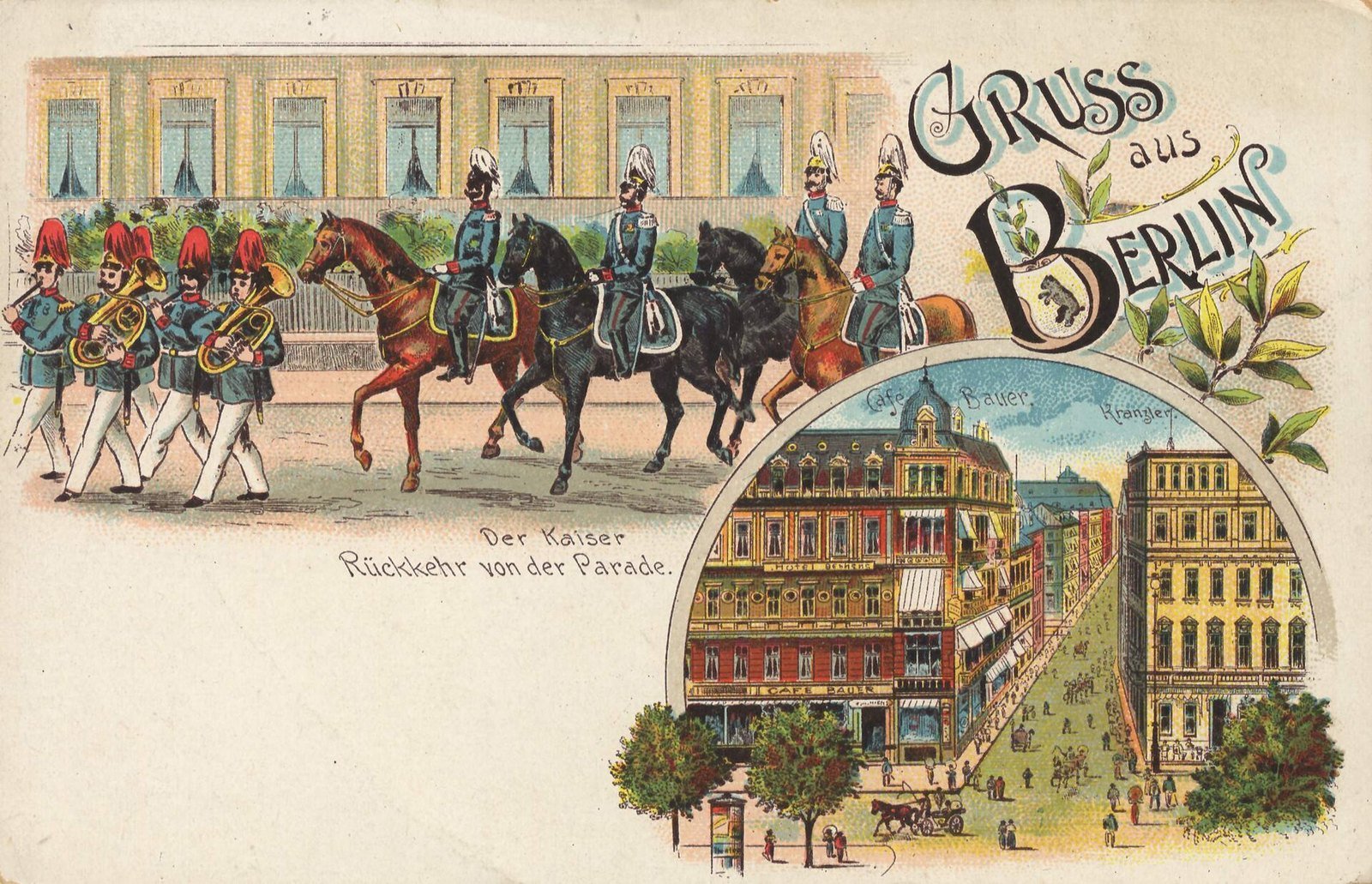
For the next hundred years it was why people came: Kranzler’s corner of Unter den Linden and Friedrichstraße, opposite the Café Bauer, was a fixed point of the boulevard, and it was photographed, printed and posted again and again.


On the balcony
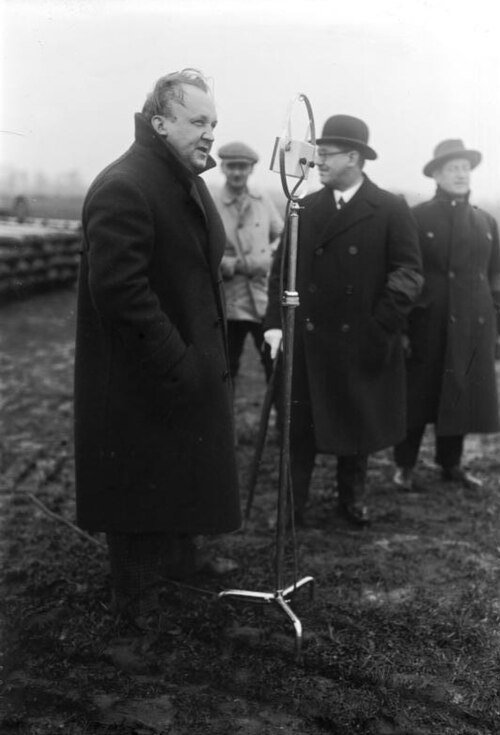
Until 1933, Alfred Braun, chief announcer of the Funk-Stunde Berlin, broadcast the New Year each year from the balcony of the house.
05Four kilometres
The boundary that divided the city after the war ran between the two addresses. Kranzler’s Kurfürstendamm corner lay 3.03 km west of it; the house on Unter den Linden had stood 867 m east of it. For twelve years before there was any line at all, both were simply Kranzler.
Distances are measured west to east between the street corners. Map: © OpenStreetMap contributors, ODbL.

06The forwarding address
The house on Unter den Linden burned on 7 May 1944, and the firm moved a hundred and thirty metres east, to the Charlottenstraße corner, taking the rescued gold mosaic frieze with it. A sign in the rubble gave the new address; the Bundesarchiv photograph of it was taken before 9 April 1945.
How long that last address in Mitte traded is not recorded, and this story does not guess.
After the war the crossing lay in the Soviet sector and the surviving business lay in the west. In 1966 the East German state rebuilt the crossing as the Lindencorso, with a restaurant, a café, a dance bar and a night bar in it — and no Kranzler. There has not been a Café Kranzler on Unter den Linden since the Charlottenstraße rooms closed.

07What was already there
The Kurfürstendamm branch did not start from nothing. It opened in the 1893–95 house by Christoph Osten, façade Max Welsch — the former Café des Westens rooms. The Kleines Café there, from 1893, was the first coffeehouse on the Kurfürstendamm; the Café des Westens, called Café Größenwahn, followed from 1898 to 1915.
Between the café and the Konditorei the rooms were not empty: the Kabarett Größenwahn used them from 1920 to 1922. Kranzler arrived in 1932, seventeen years after the café there closed.
Kurfürstendamm 18/19, 1890–1960


08Three buildings, one corner
Paul Schwebes’s flat building of 1951 lasted until 1957. Hanns Dustmann’s two-storey block replaced it, with a round pavilion on the flat roof, and opened on 17 December 1958.
The café closed in 2000, and that December Helmut Jahn's Neues Kranzler Eck opened — café by day, bar by night, in the rotunda alone. The two floors Dustmann designed for the café are offices and shops now. The building is listed, so the outside has barely changed; almost everything behind it has.
The listed building, part by part
Source: Berlin Denkmaldatenbank, Gesamtanlage 09040517


In song and on canvas
In 1984 Udo Lindenberg sang it into his song Russen:
„…und wollen im Café Kranzler die Sahnetörtchen sehn“ “…and want to see the cream cakes in the Café Kranzler” — translation by Berlinfographics
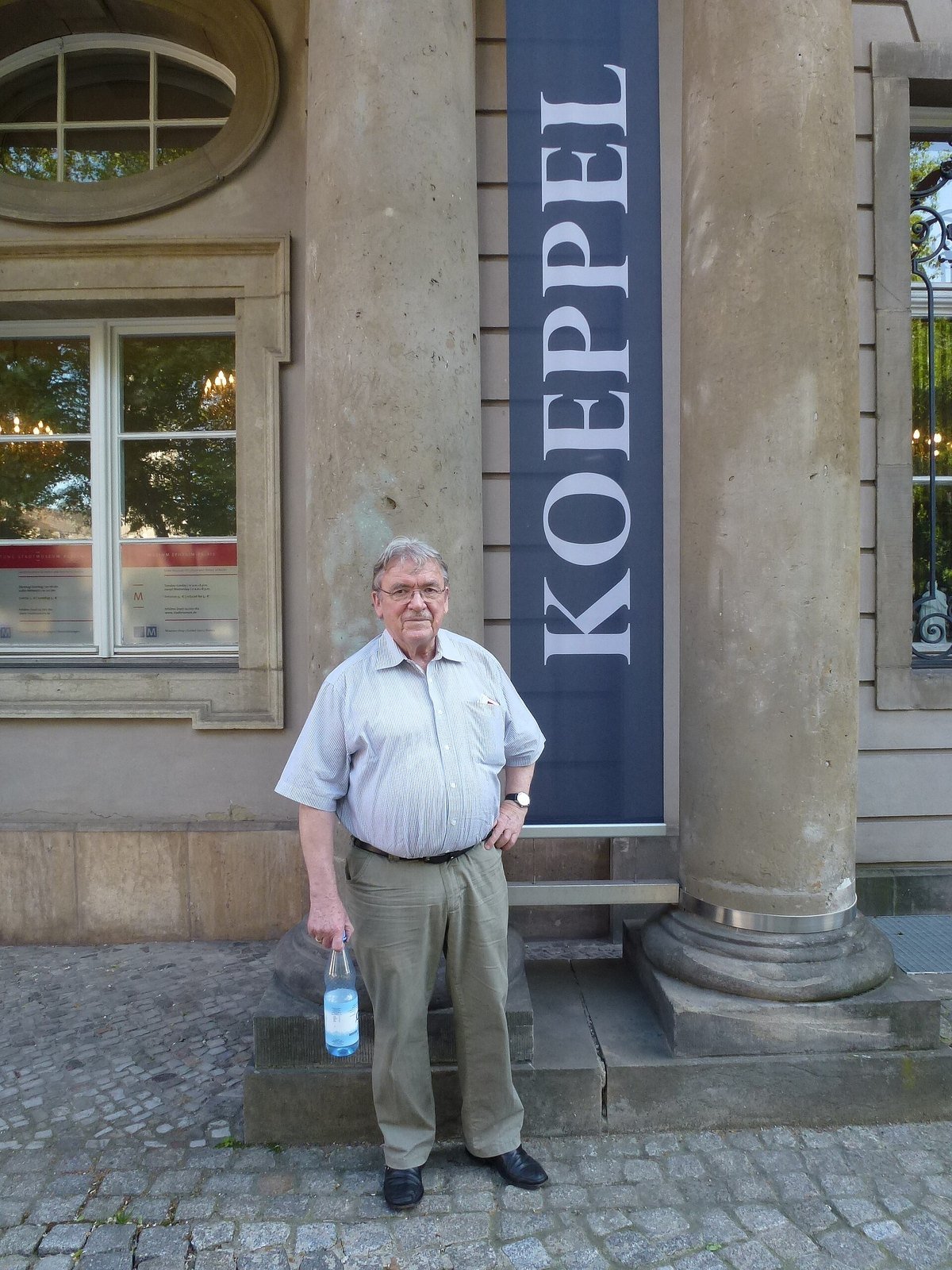
In 1987/88 Matthias Koeppel painted the Kranzler-Eck into his triptych Jahrhundertfeiern for Berlin's 750th anniversary.


09Who has held the name
Since then the name has belonged to a hotel company, to a brewery group, and after that to whoever held the lease on the corner. The last café to trade under it closed at the end of 2015; a year later the rotunda reopened, run by a Berlin coffee roastery, with the Kranzler name still on the metal band around the roof.
From the 1950s to the late 1980s a Kranzler also traded in Frankfurt am Main, in the Allianz building at the Hauptwache, with the Steigenberger company. The sources differ on the first change of hands: the founder’s article says leased 1911, taken over 1923; the café article says sold 1911; this story follows the more detailed account. Source: de.wikipedia, Café Kranzler
What has survived: not a café, a corner and a word.

Press & citation
Free to publish under CC BY 4.0 — in print, online, on Wikipedia and in teaching, commercially or not — with credit to Berlinfographics and a link to this page.
Ready-to-use image
The infographic as one image: headline, key figures, chart, sources and credit, 2,400 × 1,350 px PNG. Please use it unedited.
Download landscape (PNG)
Square format
A 1:1 version for social media and narrow columns, 1,800 × 1,800 px.
Download square (PNG)
Portrait 4:5
For Instagram and LinkedIn feeds, 1,620 × 2,025 px.
Download portrait (PNG)Credit line
Berlinfographics (berlinfographics.com), CC BY 4.0
Citation
Berlinfographics (2026). “Café Kranzler, from Unter den Linden to the Kurfürstendamm”. Berlin Experiences. https://berlinfographics.com/cafe-kranzler/
Wikipedia
{{cite web |title=Café Kranzler, from Unter den Linden to the Kurfürstendamm |url=https://berlinfographics.com/cafe-kranzler/ |website=Berlinfographics |publisher=Berlin Experiences |date=2026-11-07 |access-date=2026-11-07}}
Our infographics, charts and texts are licensed CC BY 4.0: free to republish, including commercially, with credit to Berlinfographics and a link. Photographs keep their own licences, named in each caption. How to credit
Topics: The Second World War · Cold War Berlin · Nazi Berlin · Persecution & the Holocaust · Weimar Berlin · Prussia & the Kaiserreich · Architecture & the built city · Culture, science & society · Reunified Berlin · Unusual facts
Contact: info@berlinfographics.com · Press: press@berlinfographics.com · Imprint · Privacy