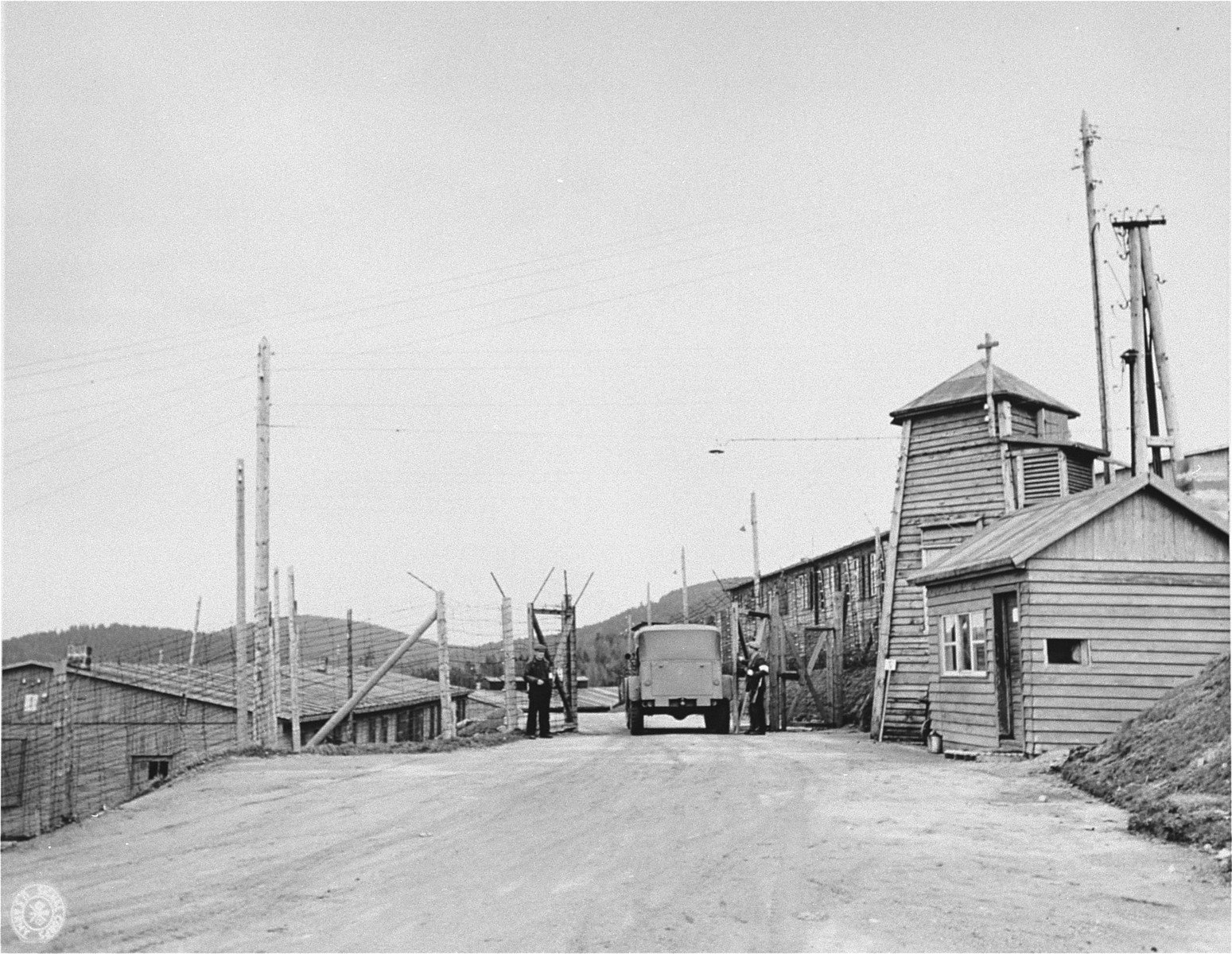
Mauthausen, May 1945: survivors cheer soldiers of the US 11th Armored Division. The banner of the Spanish Republican prisoners reads “The Spanish anti-fascists salute the liberating forces”. The archive records that the scene was photographed a day after the actual liberation and, by the account of the survivor and historian P. Serge Choumoff, recreated at General Eisenhower’s request.Photo: Cpl. Donald R. Ornitz, US Army Signal Corps, 6 May 1945 (NARA 111-SC-206395). Wikimedia Commons. Public domain.
The liberation of the camps
The Red Army reached Majdanek on 23 July 1944. The last camp, Stutthof, was reached on 9 May 1945, 290 days later. In between, the Red Army stood on the Vistula for 173 days, and nearly everything else fell in the last weeks of the war, as the two fronts closed on Berlin.
01From the first camp to the last
Soviet troops entered Majdanek, on the edge of Lublin, in July 1944. Then the front stopped. For 173 days the Red Army stood on the Vistula, and the next camp anyone reached was in the far west: Natzweiler-Struthof in Alsace, found empty by an American patrol 125 days after Majdanek. The Red Army’s own next was Auschwitz, 188 days after Majdanek.
11 of the 15 camps followed in 28 days of April and May 1945, as the armies closed on Berlin from the east and the west. At almost every one, the SS had already marched the prisoners out.
The last camp, Stutthof, in the Vistula delta, was reached on 9 May 1945: the day after the German surrender took effect.
15 main camps, July 1944
23–24 July 1944
Fewer than 500 found (USHMM) · around 1,000 Soviet invalids and hundreds of Poles (memorial). On 22 July the SS marched out about 1,000 — 800 from the camp, over 200 from the Lipowa camp.
1st Belarusian Front (memorial)
25 November 1944 (memorial) · 23 November (USHMM)
From 23 July to 12 January 1945 the Red Army stood on the Vistula: 173 days.
Found empty — the first camp discovered in the West (memorial; USHMM dates the arrival 23 November).
A patrol of the US 7th Infantry Regiment, 3rd Infantry Division (memorial)
27 January 1945
About 7,000 found in Auschwitz I, Birkenau and Monowitz; about 500 more in seven sub-camps.
60th Army, 1st Ukrainian Front (museum) · marches began 17 January
13 February 1945
Found abandoned. In early February the SS had moved at least 44,000, mostly by rail; the last transport left on 13 February.
Soviet forces
11 April 1945
4 April: Ohrdruf, a Buchenwald sub-camp: the first camp reached by US troops.
Mittelbau-Dora. Only a few prisoners found; some 250 taken to hospital.
Buchenwald. 21,000 found alive, among them some 900 children. Cleared from 7 April: 28,000 marched out.
3rd Armored Division and 104th Infantry Division
US Third Army; 4th and 6th Armored Divisions (memorial) · marches began 7 April
15 April 1945
At least 53,000 found (memorial) · around 55,000 (USHMM). Handed over without a fight after several days of ceasefire talks.
British troops (memorial); 63rd Anti-Tank Regiment and 11th Armoured Division (USHMM)
22 April 1945
About 3,000 sick prisoners, nurses and doctors found. The camp had been cleared on the night of 20–21 April: more than 30,000 marched off (memorial) · 33,000 (USHMM).
Units of the Soviet and Polish armies (memorial)
23 April 1945
Just over 1,500 found.
358th and 359th Infantry Regiments, 90th Infantry Division · marches began 15 April
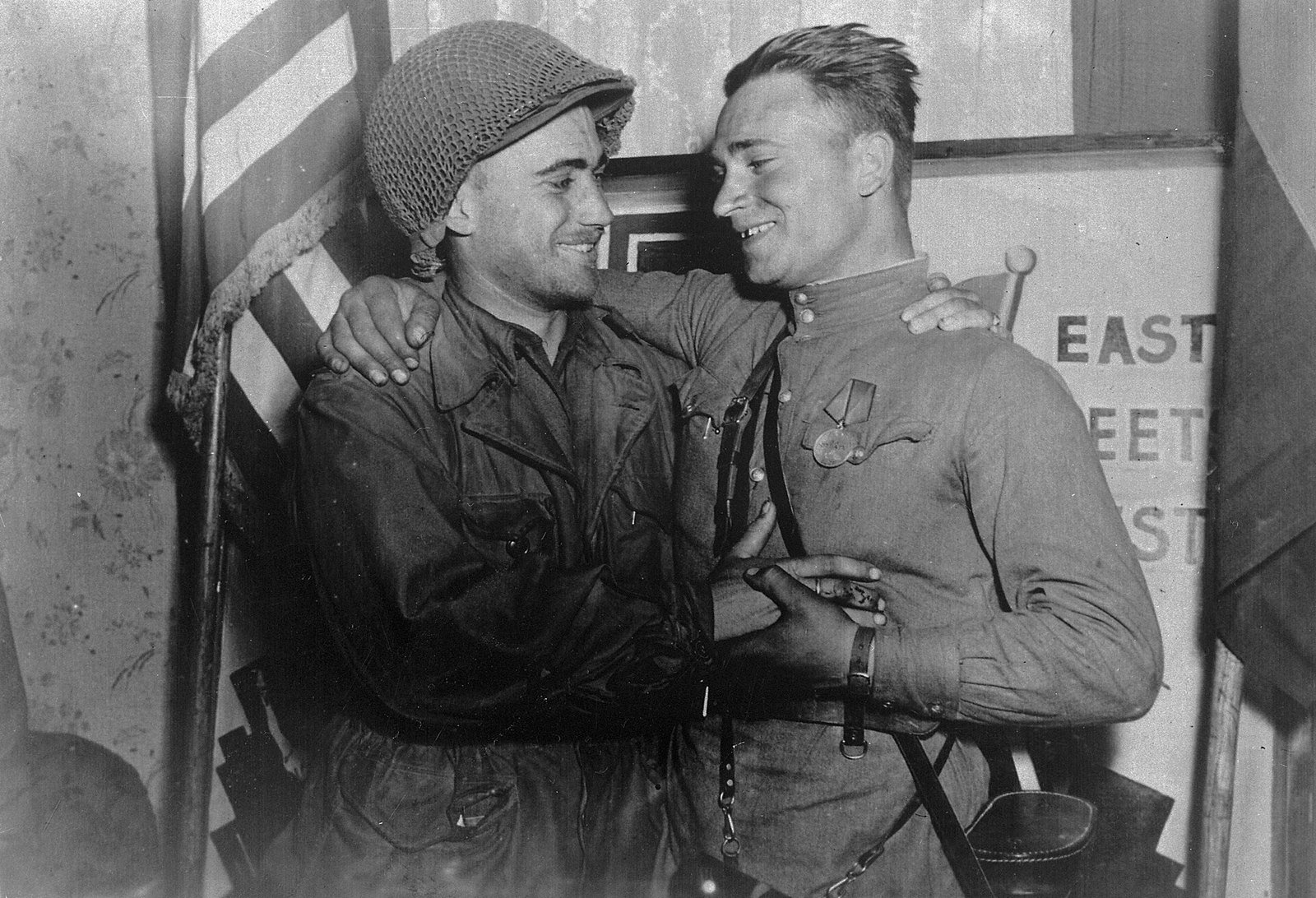
25 April 1945 · Torgau
Soviet and US forces meet on the Elbe at Torgau. 4 days earlier: Berlin encircled. The camps the SS still held now lay in what remained of the Reich, north and south of the meeting point.
29 April 1945
Over 30,000 found in the main camp (memorial) · about 32,000 (USHMM); 67,665 registered across the camp system three days earlier. From 26 April, 7,000 marched out of the main camp.
45th Division of the 7th US Army, with the 42nd Division and 20th Armored Division (memorial) · marches began 26 April
30 April 1945
Around 2,000 sick prisoners found — the memorial also gives 3,000. More than 20,000 had been marched off in late April; some 7,500 taken out earlier by the Red Cross.
Red Army (memorial; USHMM: vanguard 30 April, main units 1 May)
4 May 1945
Found empty. The prisoners had been taken to Lübeck Bay — see the marches below.
British forces · marches began 19 April
5 May 1945 (memorial: reconnaissance; full liberation 6 May)
Around 40,000 found in the two camps when the main units arrived on 6 May; a reconnaissance patrol had reached them the day before.
A reconnaissance patrol of the 11th Armored Division, then units of the 3rd US Army (memorial)
8 May 1945 (memorial) · 9 May (USHMM)
More than 30,000 in the ghetto, nearly 17,000 of them there before 20 April; the Red Cross had held it since 2 May. USHMM dates the Soviet entry 9 May.
First units of the Red Army passing towards Prague (memorial; USHMM 9 May)
9 May 1945
About 150 found (memorial) · about 100 (USHMM). The day after the surrender took effect.
48th Army, 3rd Belorussian Front (memorial) · marches began 25 January
The German surrender had taken effect the evening before, on 8 May 1945.
02April and May 1945
From the first April days the camps fell one after another, reached from the east and the west as the fronts converged. Each camp is set on the day the liberating units arrived, as its memorial gives it; where the United States Holocaust Memorial Museum gives another day, that is noted.
Blue: reached by the Red Army. Yellow: reached by the Western Allies. Mauthausen and Gusen: 5 May 1945 (memorial: reconnaissance; full liberation 6 May). Theresienstadt: 8 May 1945 (memorial) · 9 May (USHMM).
03Who was still there
What the soldiers found depended on what the SS had left. Natzweiler-Struthof, Gross-Rosen and Neuengamme were found empty or abandoned. Elsewhere the counts below are of people found alive in the camp named, not in its sub-camps. Where the memorial and the USHMM give different numbers, both are drawn.

Found alive in the camp when the liberating units arrived
Two numbers where two institutions disagree: Majdanek — Fewer than 500 found (USHMM) · around 1,000 Soviet invalids and hundreds of Poles (memorial); Bergen-Belsen — At least 53,000 found (memorial) · around 55,000 (USHMM); Dachau — Over 30,000 found in the main camp (memorial) · about 32,000 (USHMM); 67,665 registered across the camp system three days earlier; Ravensbrück — Around 2,000 sick prisoners found — the memorial also gives 3,000. Theresienstadt was a ghetto, not a concentration camp. Mittelbau-Dora: only a few prisoners found; the figure is those taken to hospital.
04The death marches
As the fronts closed in, the SS emptied camp after camp and drove the prisoners on foot, by rail and by sea towards camps still inside the shrinking Reich. Yad Vashem counts 700,000 camp prisoners in 1945, at least 250,000 sent on death marches in March and April 1945, and 200,000 to 250,000 died on the marches; 25% to a third of them Jewish.
| Camp | Marches began | Marched out | Died | Freed where |
|---|---|---|---|---|
| Auschwitz | 17 January | about 56,000 (museum) / nearly 60,000 (USHMM) | at least 9,000, more probably 15,000 (museum) | into the Reich’s camps |
| Stutthof | 25 January | nearly 33,000 (memorial) / nearly 50,000 in the whole system (USHMM) | about 17,000 (memorial) / over 25,000, one in two (USHMM) | the main camp’s last prisoners by sea, 25–27 April: of about 5,000, nearly half died (memorial) |
| Gross-Rosen | early February | at least 44,000, mostly by rail (USHMM) | — | — |
| Buchenwald | 7 April | 28,000 from the main camp (memorial, USHMM) | about one in three (memorial) / 15,000–25,000 (Yad Vashem) | — |
| Flossenbürg | 15 April | 9,300, joined by 7,000 from Buchenwald (USHMM) | perhaps 7,000 (USHMM) | the last columns on 8 May (memorial) |
| Neuengamme | 19 April (USHMM) / 21 April (memorial) | 9,000 / 10,000 to Lübeck Bay | Cap Arcona, 3 May: 6,600 or over 7,000 died — the memorial’s two pages give both; about 450 survived (memorial) / about 600 (USHMM) | — |
| Sachsenhausen | night of 20–21 April | more than 30,000 (memorial) / 33,000 (USHMM) | “thousands” (memorial) | early May, between Parchim, Schwerin and Ludwigslust (memorial) |
| Dachau | 26 April | 7,000 from the main camp (memorial, USHMM); at least 25,000 from the camp system from 23 April | “several thousand” (memorial) | early May, near Waakirchen (memorial) |
| Ravensbrück | late April | more than 20,000 (memorial) | — | — |
| Mauthausen | from 14 April | the tent camp to Gunskirchen; more than 20,000 held there (memorial) | about 6,000 at Gunskirchen (memorial) | Gunskirchen, 5 May, US 71st Infantry Division |
05Bergen-Belsen · April 1945
Belsen was a major camp handed over: after several days of ceasefire talks, British troops entered on 15 April 1945. The memorial gives at least 53,000 found, the USHMM around 55,000 found; the report written in the first days by Lieutenant Colonel Taylor gives approximately 40,000. Liberation did not end the dying: around 14,000 died by June 1945 (the memorial), more than 13,000 within three months (the USHMM).

06Who reached which camp
The unit that arrived first, and what it found, as each memorial records it. Where the USHMM gives a different date or count, both are shown.
| Date | Camp | Unit | Found |
|---|---|---|---|
| 23–24 Jul 1944 | Majdanek | 1st Belarusian Front (memorial) | fewer than 500 (USHMM) / about 1,000 and hundreds more (memorial) |
| 27 Jan | Auschwitz | 60th Army, 1st Ukrainian Front (museum) | about 7,000 |
| 13 Feb | Gross-Rosen | Soviet forces | abandoned |
| 22 Apr | Sachsenhausen | units of the Soviet and Polish armies (memorial) | about 3,000 |
| 30 Apr | Ravensbrück | Red Army (memorial; USHMM: vanguard 30 April, main units 1 May) | about 2,000 / 3,000 |
| 8 May | Theresienstadt | first units of the Red Army passing towards Prague (memorial; USHMM 9 May) | more than 30,000 |
| 9 May | Stutthof | 48th Army, 3rd Belorussian Front (memorial) | about 150 / about 100 |
| Date | Camp | Unit | Found |
|---|---|---|---|
| 25 Nov 1944 (USHMM: 23 Nov) | Natzweiler-Struthof | a patrol of the US 7th Infantry Regiment, 3rd Infantry Division (memorial) | empty |
| 4 Apr | Ohrdruf (Buchenwald sub-camp) | 4th Armored Division and 89th Infantry Division, US Third Army | the dead; prisoners marched out |
| 11 Apr | Mittelbau-Dora | 3rd Armored Division and 104th Infantry Division | a few prisoners |
| 11 Apr | Buchenwald | US Third Army; 4th and 6th Armored Divisions (memorial) | 21,000 |
| 15 Apr | Bergen-Belsen | British troops (memorial); 63rd Anti-Tank Regiment and 11th Armoured Division (USHMM) | at least 53,000 |
| 23 Apr | Flossenbürg | 358th and 359th Infantry Regiments, 90th Infantry Division | just over 1,500 |
| 29 Apr | Dachau | 45th Division of the 7th US Army, with the 42nd Division and 20th Armored Division (memorial) | over 30,000 |
| 4 May | Neuengamme | British forces | empty |
| 5–6 May | Mauthausen and Gusen | a reconnaissance patrol of the 11th Armored Division, then units of the 3rd US Army (memorial) | around 40,000 |
The first camp was reached in July 1944. The last was reached on 9 May 1945, the day after the war in Europe ended.
Press & citation
Free to publish under CC BY 4.0 — in print, online, on Wikipedia and in teaching, commercially or not — with credit to Berlinfographics and a link to this page.
Ready-to-use image
The infographic as one image: headline, key figures, chart, sources and credit, 2,400 × 1,350 px PNG. Please use it unedited.
Download landscape (PNG)
Square format
A 1:1 version for social media and narrow columns, 1,800 × 1,800 px.
Download square (PNG)
Portrait 4:5
For Instagram and LinkedIn feeds, 1,620 × 2,025 px.
Download portrait (PNG)Credit line
Berlinfographics (berlinfographics.com), CC BY 4.0
Citation
Berlinfographics (2026). “The end of the camps: liberation dates, 1944–45”. Berlin Experiences. https://berlinfographics.com/camp-liberation-dates/
Wikipedia
{{cite web |title=The end of the camps: liberation dates, 1944–45 |url=https://berlinfographics.com/camp-liberation-dates/ |website=Berlinfographics |publisher=Berlin Experiences |date=2026-11-05 |access-date=2026-11-05}}
Our infographics, charts and texts are licensed CC BY 4.0: free to republish, including commercially, with credit to Berlinfographics and a link. Photographs keep their own licences, named in each caption. How to credit
Topics: The Second World War · Cold War Berlin · Nazi Berlin · Persecution & the Holocaust · Weimar Berlin · Prussia & the Kaiserreich · Architecture & the built city · Culture, science & society · Reunified Berlin · Unusual facts
Contact: info@berlinfographics.com · Press: press@berlinfographics.com · Imprint · Privacy