Berlinfographicsby Berlin Experiences

Refugees from East Berlin wait to be processed at the Marienfelde refugee camp in West Berlin, July 1961.Photo: Central Intelligence Agency, 1961. Wikimedia Commons. Public domain.

The East German exodus

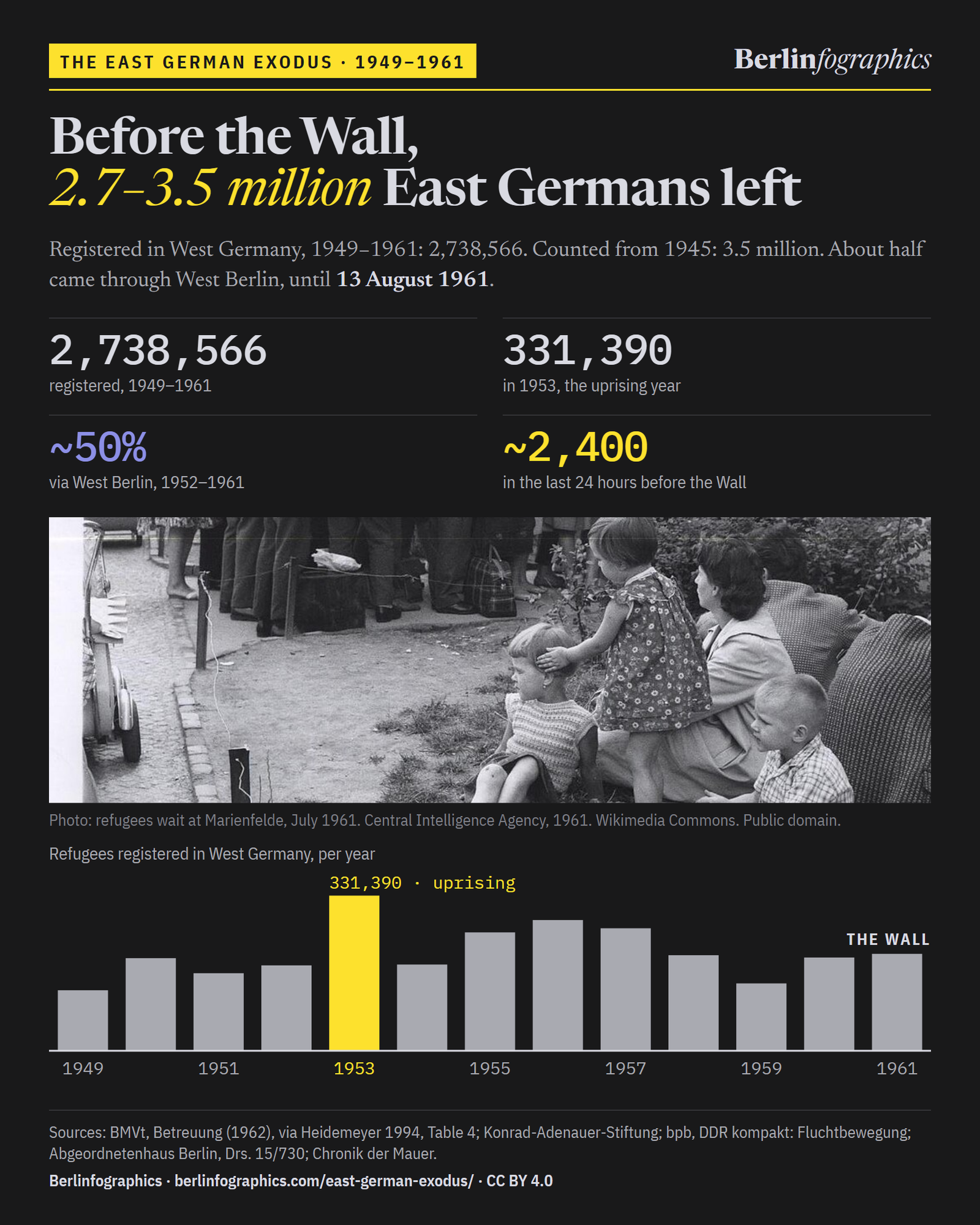
Before the Wall went up, 2.7 to 3.5 million East Germans had left

West Germany registered 2,738,566 of them between 1949 and 1961. About half went through West Berlin. In the last 24 hours before the border closed, about 2,400 more registered at Marienfelde.

2,738,566
registered as refugees in West Germany, 1949–1961
331,390
in 1953, the year of the uprising
~50%
came through West Berlin, 1952–1961
2,400
in the last 24 hours before the Wall
01East Germany, 7 October 1949

A new state that began losing its people from its first year

The German Democratic Republic was founded on 7 October 1949. In that same year West Germany’s emergency-reception procedure, the “Notaufnahme”, took in 129,245 applications from people who had come over from the East.

The register counts applications in West Germany's emergency-reception procedure (Notaufnahme), published by the federal ministry for expellees and refugees. After its first year it never counted fewer than 143,917 in a year, the figure for 1959.

Thirteen years of the register add up to 2,738,566 people, and the best-known total is larger still.

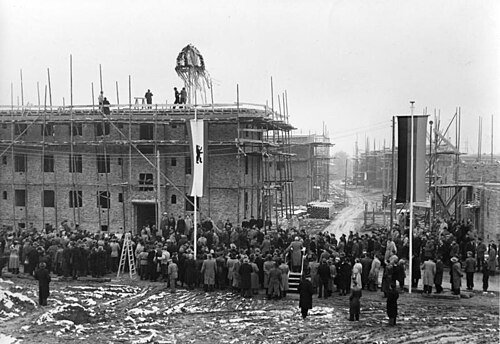
A crowd stands in snow and mud in front of a half-built block of flats in scaffolding, with a garland raised on the roof and a Berlin bear flag hanging from a pole.
Topping-out at the emergency-reception camp in Marienfelde, 1952. The archive caption says it was being built for two thousand political refugees from the Soviet zone.Photo: Bundesarchiv, B 145 Bild-P004759 / CC BY-SA 3.0 de

The register, 1949–1961

scroll to fill it, year by year
Refugees registered in West Germany's emergency-reception procedure each year from 1949 to 1961, drawn as stacks of blocks of ten thousand people, filling year by year as the story is read, with the 1953 peak and the Wall in 1961 marked.

1949

Year one: more than ten thousand a month

In the year the GDR was founded, 129,245 East Germans were registered as refugees in the West.

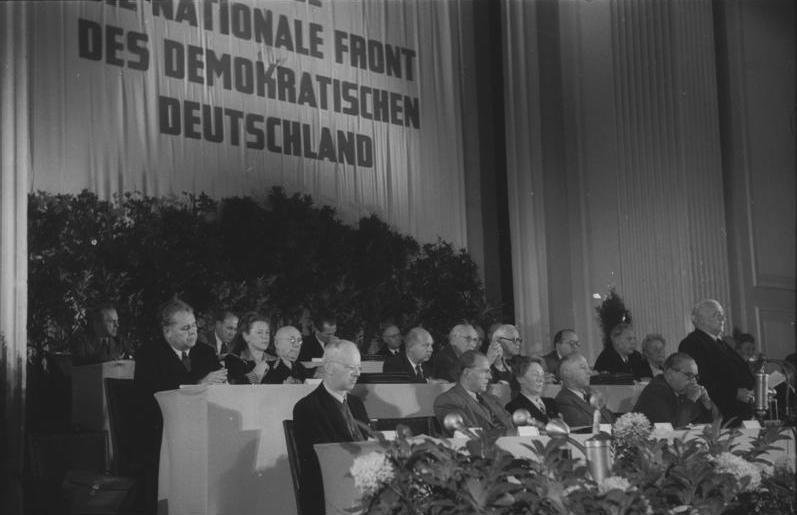
Men and a few women sit in rows at a long podium decked with flowers, under a huge banner reading “Nationale Front des demokratischen Deutschland”; a man speaks at a lectern on the right.
Berlin, 7 October 1949: the session of the Deutscher Volksrat at which the German Democratic Republic was founded. Photo: Bundesarchiv, Bild 183-S88618 / Heilig / CC BY-SA 3.0 de

1950–1952

Then a steady flow, year after year

197,788 in 1950, 165,648 in 1951, 182,393 in 1952.

1953

1953: the uprising year, and the biggest of all

331,390 people: about 908 every day of the year. The uprising of 17 June 1953 was crushed, and many who took part fled.

A Soviet T-34 tank with the number 83 and soldiers on its turret rolls across a street strewn with stones; a crowd of young men with bicycles watches from the pavement.
East Berlin, 17 June 1953: a Soviet tank in the street during the uprising. Photo: Bundesarchiv, B 145 Bild-F005191-0040 / CC BY-SA 3.0 de

1954–1957

A second wave: the next three busiest years

252,870 in 1955, 279,189 in 1956 and 261,622 in 1957: after 1953, the three busiest years in the register.

1958–1960

A dip, and then the climb begins again

The count fell to 143,917 in 1959, the lowest since 1949, and rose again to 199,188 in 1960.

13 August 1961

The series ends with the Wall

In 1961, the year the Wall went up on 13 August 1961, the register counted 207,026. In all: 2,738,566.

Men work on top of a wall of concrete slabs beside cranes and a lorry, while others watch from the wall; bare trees in a winter haze behind.
East German construction workers building the Wall, 20 November 1961. Photo: U.S. National Archives, 1961. Wikimedia Commons. Public domain.

021953

In 1953 about one in eight of thirteen years’ refugees came in a single year

The register counted 331,390 people in 1953, 12.1% of the thirteen-year total and 1.82 times as many as in 1952. That year more than 305,000 refugees passed through West Berlin.

West Berlin’s new central reception camp at Marienfelde opened in April 1953, and refugees were flown on to West Germany from Tempelhof.

A long line of people with bags walks under the wing of a four-engined propeller aircraft towards its steps.
Tempelhof airport, West Berlin, 1953: refugees from the Soviet zone are flown out to West Germany.Photo: Bundesarchiv, B 145 Bild-P004762 / CC BY-SA 3.0 de
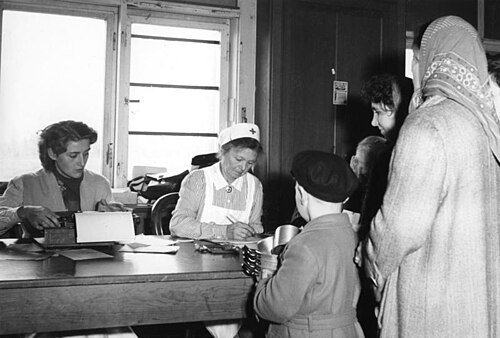
At a desk by a window, a woman and a Red Cross nurse take down details from a mother, a headscarfed older woman and children.
Refugees from the Soviet zone at the camp in Zehlendorf, West Berlin, 1953.Photo: Bundesarchiv, B 145 Bild-P048311 / CC BY-SA 3.0 de

03West Berlin, 1952–1961

About half of them got out through one city: West Berlin

From 1952 until the Wall, about half of all refugees took the route through West Berlin.

Marienfelde is where they registered and saw a doctor. Up to 1990, the camp processed about 1.35 million people.

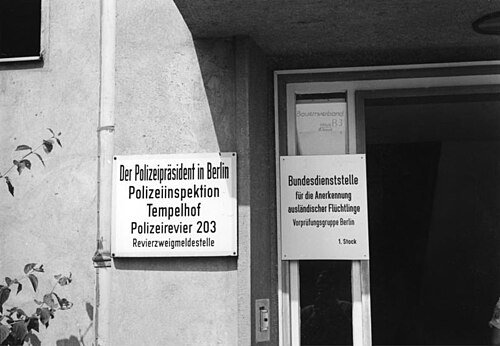
A doorway with two signs: one for the Berlin police inspectorate Tempelhof, one for a federal office for the recognition of refugees.
The entrance to the registration office at the Marienfelde camp, July 1958, with the signs of the West Berlin police and a federal refugee office.Photo: Bundesarchiv, B 145 Bild-F005836-0011 / Müller, Simon / CC BY-SA 3.0 de

The register, 1952–1961: each block ten thousand people

about half: through West Berlinthe rest: by other routes

People sit on benches beside suitcases in a courtyard between three- and four-storey blocks, under a clock on a post.
The Marienfelde camp in July 1958: new arrivals with their suitcases among the blocks of flats.Photo: Bundesarchiv, B 145 Bild-F005835-0004 / Müller, Simon / CC BY-SA 3.0 de
A doctor listens with a stethoscope to the chest of a boy stripped to the waist, while another boy waits beside him.
A medical examination at Marienfelde, August 1961.Photo: Bundesarchiv, B 145 Bild-P060493 / CC BY-SA 3.0 de
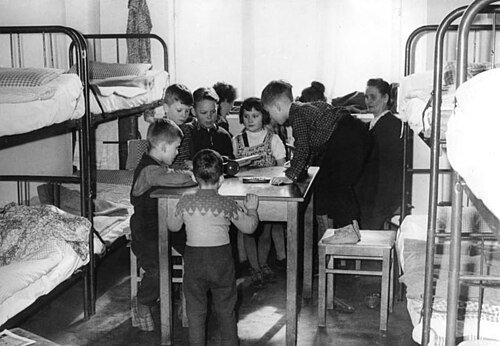
Children crowd round a small table between metal bunk beds, watched by a woman.
Children of farmers who had fled, in a dormitory at the Marienfelde reception camp, 1961.Photo: Bundesarchiv, B 145 Bild-P059016 / CC BY-SA 3.0 de

04West Berlin, August 1961

On the last day before the Wall, about 2,400 people came in 24 hours

In the first days of August 1961 Marienfelde was registering 1,100–1,926 people a day (2–10 Aug 1961).

From 12 to 13 August 1961, the last 24 hours before the border was sealed, about 2,400 refugees registered there: 2.6 times the average day of 1953.

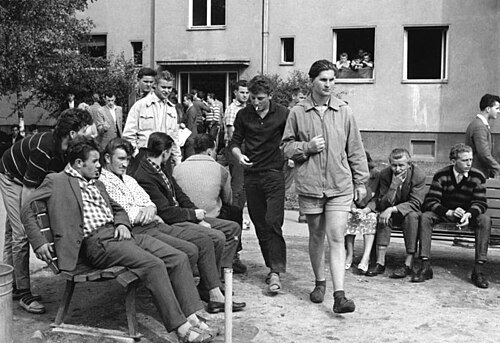
Young men sit on benches and walk across the yard in front of a camp building, its windows open.
West Berlin, 13 July 1961: a month before the Wall, the archive caption speaks of a “new stream of refugees”.Photo: Bundesarchiv, B 145 Bild-P060301 / CC BY-SA 3.0 de

People a day, against the busiest year of the register

~2,400
people in the last 24 hours, one dot each

Registered at Marienfelde, 12–13 Aug 1961. Each dot: one person.

Seen from above, a dense crowd fills a path between trees and a tent, many people looking up at the camera.
Marienfelde on 14 August 1961, the day after the sector border was sealed: crowds fill the camp’s paths.Photo: Bundesarchiv, B 145 Bild-P060458 / CC BY-SA 3.0 de
Lyndon B. Johnson stands in an open car beside a young girl, surrounded by police officers, officials and a waving crowd.
20 August 1961, a week after the Wall went up: with a young refugee from East Germany beside him, US Vice President Lyndon B. Johnson greets the crowds at the Marienfelde camp.Photo: Central Intelligence Agency, 1961. Wikimedia Commons. Public domain.

05How many left

3.5 million counted from 1945; about 2.7 million from the GDR’s founding

There is no single number. The 3.5 million usually quoted (Konrad-Adenauer-Stiftung) counts from 1945, the years of the Soviet zone included. The federal agency for civic education gives about 2.7 million for 1949–1961. The register counts applications, 2,738,566; West German migration statistics recorded 3.58 million arrivals from the GDR in 1950–1961, a gross count that includes expellees and people who moved more than once.

Four counts, each with its own years and its own scope

These counts cover different years and different people. They cannot be subtracted from one another or averaged into one figure, which is why the headline gives a range: 2.7 to 3.5 million.

06Marienfelder Allee, today

The camp that took in 1.35 million people is now a memorial

Marienfelde stayed open after the Wall and kept processing people from the GDR until 1990. Part of it is now the Erinnerungsstätte Notaufnahmelager Marienfelde, the memorial to the emergency-reception camp.

A grey bronze plaque: on the left a mass of small rounded figures in relief, on the right a German inscription.
The memorial plaque on the former camp, Marienfelder Allee, photographed in 2008.Photo: Axel Mauruszat, 2008. Wikimedia Commons. CC BY 2.0 de.

For twelve years the way out of East Germany ran through Berlin. On 13 August 1961 the Wall closed it.

Press & citation

Use this Berlinfographic

Free to publish under CC BY 4.0 — in print, online, on Wikipedia and in teaching, commercially or not — with credit to Berlinfographics and a link to this page.

The East German exodus before the Wall, 1949–1961: ready-to-use landscape image

Ready-to-use image

The infographic as one image: headline, key figures, chart, sources and credit, 2,400 × 1,350 px PNG. Please use it unedited.

Download landscape (PNG)
The East German exodus before the Wall, 1949–1961: square version

Square format

A 1:1 version for social media and narrow columns, 1,800 × 1,800 px.

Download square (PNG)
The East German exodus before the Wall, 1949–1961: portrait version

Portrait 4:5

For Instagram and LinkedIn feeds, 1,620 × 2,025 px.

Download portrait (PNG)

Credit line

Berlinfographics (berlinfographics.com), CC BY 4.0

Citation

Berlinfographics (2026). “The East German exodus before the Wall, 1949–1961”. Berlin Experiences. https://berlinfographics.com/east-german-exodus/

Wikipedia

{{cite web |title=The East German exodus before the Wall, 1949–1961 |url=https://berlinfographics.com/east-german-exodus/ |website=Berlinfographics |publisher=Berlin Experiences |date=2026-11-05 |access-date=2026-11-05}}