Strelitzer Straße at night, 2015, looking south towards the Fernsehturm. Tunnel 57 came up in a courtyard on this street.Photo: Ansgar Koreng, 2015. Wikimedia Commons. CC BY 3.0 DE.
Tunnel 57
A border-troop sergeant, aged 21, he died in the courtyard where Tunnel 57 came up. The GDR named more than 100 schools, collectives and institutions after him, and kept what it knew top secret.
01Bernauer Straße to Strelitzer Straße, 1963–64
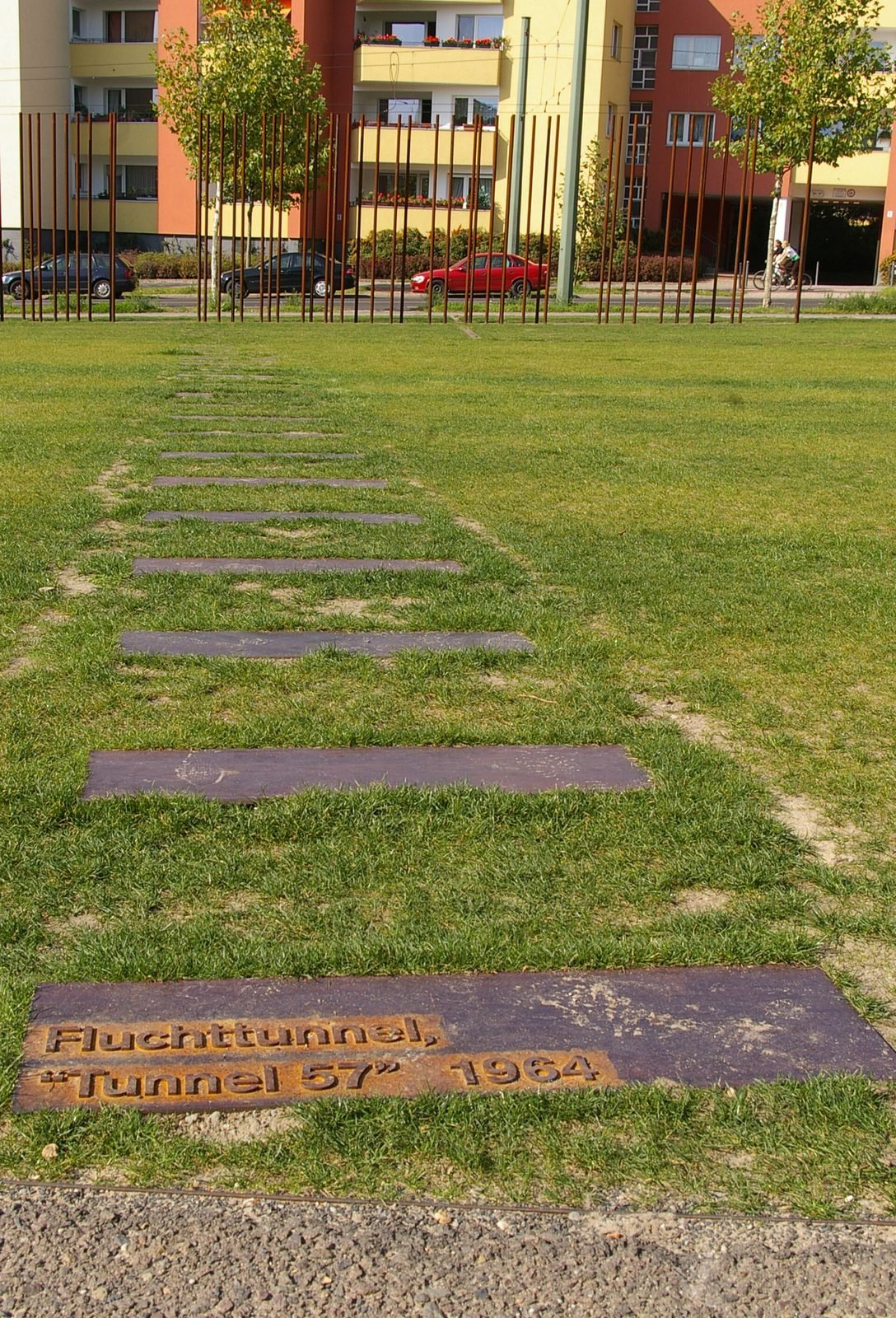
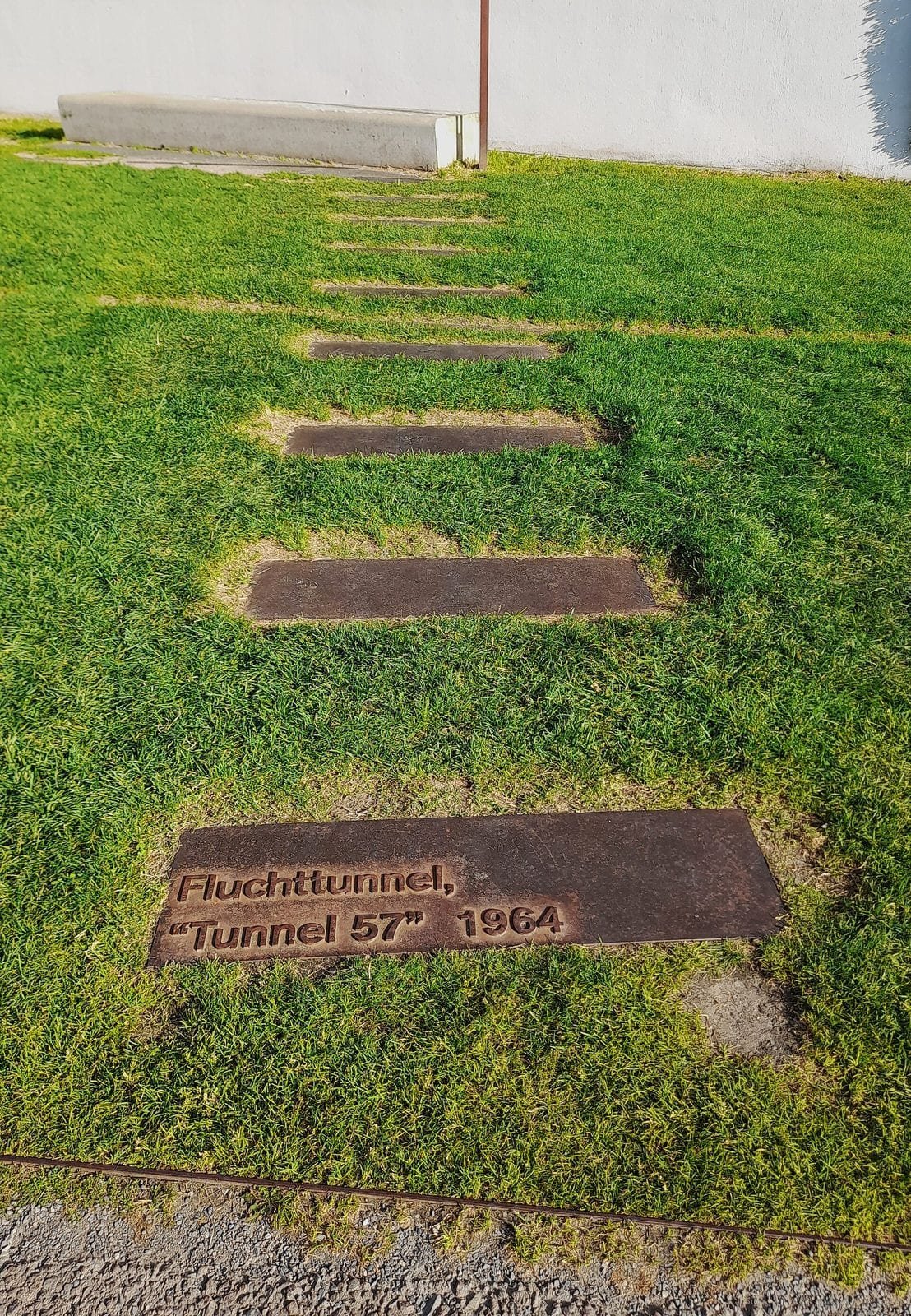
Wolfgang Fuchs and his friends dug two tunnels from the cellar of a closed bakery at Bernauer Straße 97, in West Berlin, half a year of work each, in 1963 and 1964. Their first tunnel carried 3 women out on the night of 7/8 January 1964. The Stasi found it the next day and wrecked it with a grenade.
The second, dug about 5 metres beside the first, came up in an outhouse in the courtyard of Strelitzer Straße 55, in East Berlin. In the nights between 3 and 5 October 1964, 57 men, women and children came through it. The plaque at Bernauer Straße calls it the most successful escape tunnel in Berlin.

Tunnel 57 to scale: length and depth on one ruler
The depth is 10 m on the Bernauer Straße plaque and 11 m in the Chronik der Mauer, so the tunnel is drawn as a band across that range; the band is not the tunnel’s height, which is not recorded. Where the Wall stood above it is not recorded either and is not drawn. The GDR’s listening tunnel ran across the line afterwards; only its depth is recorded, so it is shown on the depth ruler.

02Strelitzer Straße 55, 5 October 1964
Egon Schultz was born in Pomerania on 4 January 1943 and grew up near Rostock, where he became a teacher. Called up in 1963, he was a sergeant and group leader in Border Regiment 34 in Berlin-Mitte. On the night of 4 October 1964 he was in reserve at the Arkonaplatz command post.
A little after midnight he was sent to Strelitzer Straße 55 to detain “suspicious persons”. Nobody told the soldiers it was an escape. What happened in the courtyard in the next minutes, and what the state said about it until the Wall fell, is the rest of this story.

Two records, one scale of years
One linear scale of years. A dated event is a thin mark at its day; an event known only to the month or the year is drawn as wide as that month or year.
5 October 1964, about 0:15–0:30
Two men the escape helpers had taken for refugees were from the Stasi, and came back with border soldiers. Christian Zobel, a helper, fired first; his bullet lodged in Schultz’s lung. The fatal shots came from a border soldier’s Kalashnikov, fired on a Stasi officer’s order.
6 October 1964
Erich Mielke carried the Stasi’s report to Ulbricht, Honecker and Stoph in person. It said Schultz was “von Westberliner Banditen ermordet”, murdered by West Berlin bandits. The same report noted that a soldier had fired nine rounds into the courtyard “without making out the target”.
From October 1964
East Berlin’s investigators established that the fatal shots came from a comrade’s weapon. The results were placed under the highest secrecy. Those responsible in the GDR, says the plaque at the house today, knew it from the start.
1964–1977
At the funeral Honecker blamed the West. A plaque went up at Strelitzer Straße 55 on 4 January 1965, and in 1966 the street became Egon-Schultz-Straße. Schools, collectives and a youth hotel took his name: more than 100 in the end.
November 1965
A defector’s account reached the Berliner Morgenpost: “Vopo Schultz von seinen Kameraden erschossen”, shot by his comrades. The same month, West Berlin prosecutors closed their case against the escape helpers. In the East, the official story did not change.
1991–1999
The street got its old name back on 1 December 1991. In 1992 prosecutors found that the soldier who fired the fatal shots had acted in self-defence, on orders. In May 1994 a private murder charge named the helper Reinhard Furrer, and Schultz’s mother joined it. After Furrer died in 1995 it turned to the other helpers, and was dropped in 1999.
2004
Escape helpers and a friend of Schultz put up a new plaque at Strelitzer Straße 55. It calls him a victim of the Wall, and says the fatal shots came from a comrade’s weapon.
03Stasi reports 847a/64 and 847b/64
The Stasi’s evaluation office wrote the night up twice. A first version, dated 5 October 1964, was crossed out on every page, and the dispatch book shows it was never sent. The second, dated 6 October 1964, went to three of the most powerful men in the state. Both are now in the Stasi-Unterlagen-Archiv, and both mention the submachine-gun fire.
Tod eines Angehörigen der NVA (1. Fassung)
„neun Schüsse aus MPi abgegeben“
“nine shots fired from a submachine gun”
Distribution: MfS file copy only. No external recipient recorded.
Tod eines Angehörigen der NVA (2. Fassung)
„… von Westberliner Banditen ermordet.“
“… murdered by West Berlin bandits.”
„… ohne jedoch das Ziel auszumachen, neun Schuss aus der MPi in das Hofgelände abgegeben.“
“… without making out the target, fired nine rounds from the submachine gun into the courtyard.”
To: Ulbricht · Honecker · Stoph
Die tödlichen Schüsse auf Schultz wurden allerdings von einem anderen Grenzsoldaten abgegeben.“The fatal shots at Schultz were, however, fired by another border soldier.” The Stasi-Unterlagen-Archiv’s footnote to both versions.
04East Berlin, 1965–1991
The plaque of 1965 at Strelitzer Straße 55 was the first. The street itself was Egon-Schultz-Straße from 1966 until 1 December 1991. The school in Rostock where he had taught took his name on the day of his funeral, and by the end more than 100 collectives, schools and institutions were named after him.


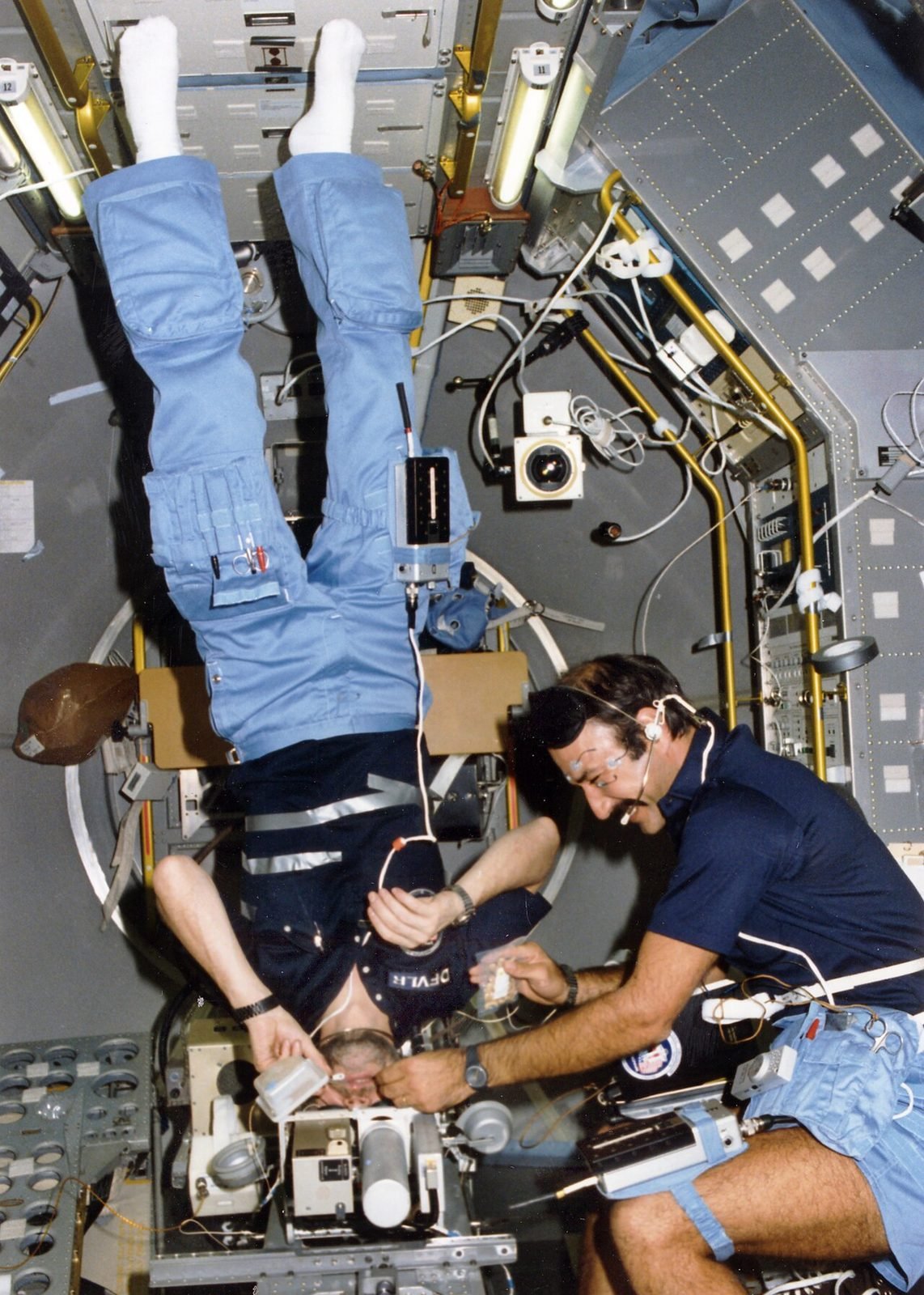
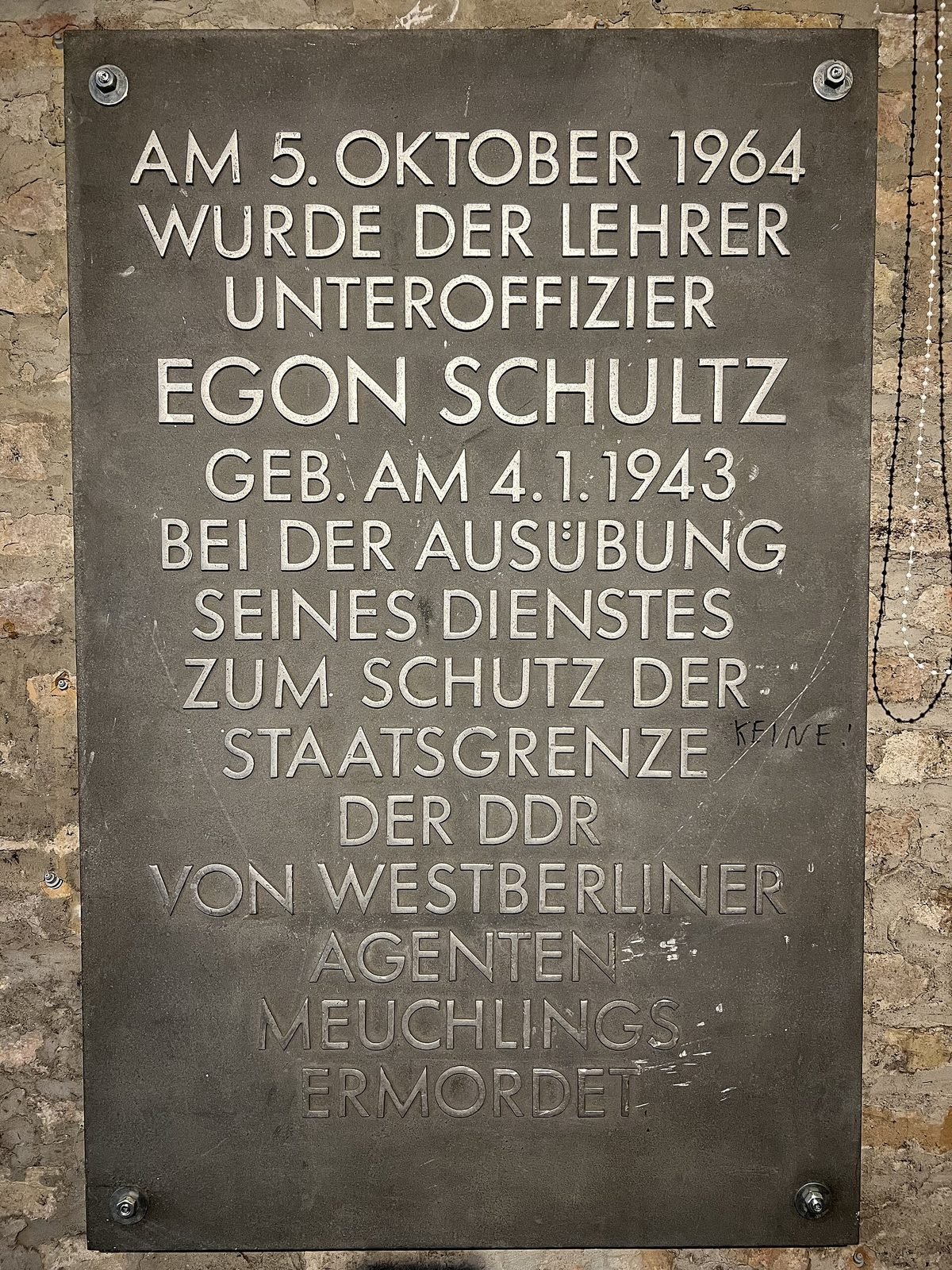
Their wording was the state’s. One GDR-era plaque still says he was “treacherously murdered by West Berlin agents”. The “agents” it meant were escape helpers from West Berlin. One of them, Reinhard Furrer, flew in space on the D1 mission in October 1985.
Two plaques for one death. One says murdered by West Berlin agents. The other says a comrade’s weapon, and that the GDR knew from the start.
Press & citation
Free to publish under CC BY 4.0 — in print, online, on Wikipedia and in teaching, commercially or not — with credit to Berlinfographics and a link to this page.
Ready-to-use image
The infographic as one image: headline, key figures, chart, sources and credit, 2,400 × 1,350 px PNG. Please use it unedited.
Download landscape (PNG)
Square format
A 1:1 version for social media and narrow columns, 1,800 × 1,800 px.
Download square (PNG)
Portrait 4:5
For Instagram and LinkedIn feeds, 1,620 × 2,025 px.
Download portrait (PNG)Credit line
Berlinfographics (berlinfographics.com), CC BY 4.0
Citation
Berlinfographics (2026). “Egon Schultz and Tunnel 57”. Berlin Experiences. https://berlinfographics.com/egon-schultz-tunnel-57/
Wikipedia
{{cite web |title=Egon Schultz and Tunnel 57 |url=https://berlinfographics.com/egon-schultz-tunnel-57/ |website=Berlinfographics |publisher=Berlin Experiences |date=2026-11-09 |access-date=2026-11-09}}
Our infographics, charts and texts are licensed CC BY 4.0: free to republish, including commercially, with credit to Berlinfographics and a link. Photographs keep their own licences, named in each caption. How to credit
Topics: The Second World War · Cold War Berlin · Nazi Berlin · Persecution & the Holocaust · Weimar Berlin · Prussia & the Kaiserreich · Architecture & the built city · Culture, science & society · Reunified Berlin · Unusual facts
Contact: info@berlinfographics.com · Press: press@berlinfographics.com · Imprint · Privacy