Berlinfographicsby Berlin Experiences

Prussian BerlinWerderscher Markt · Mitte

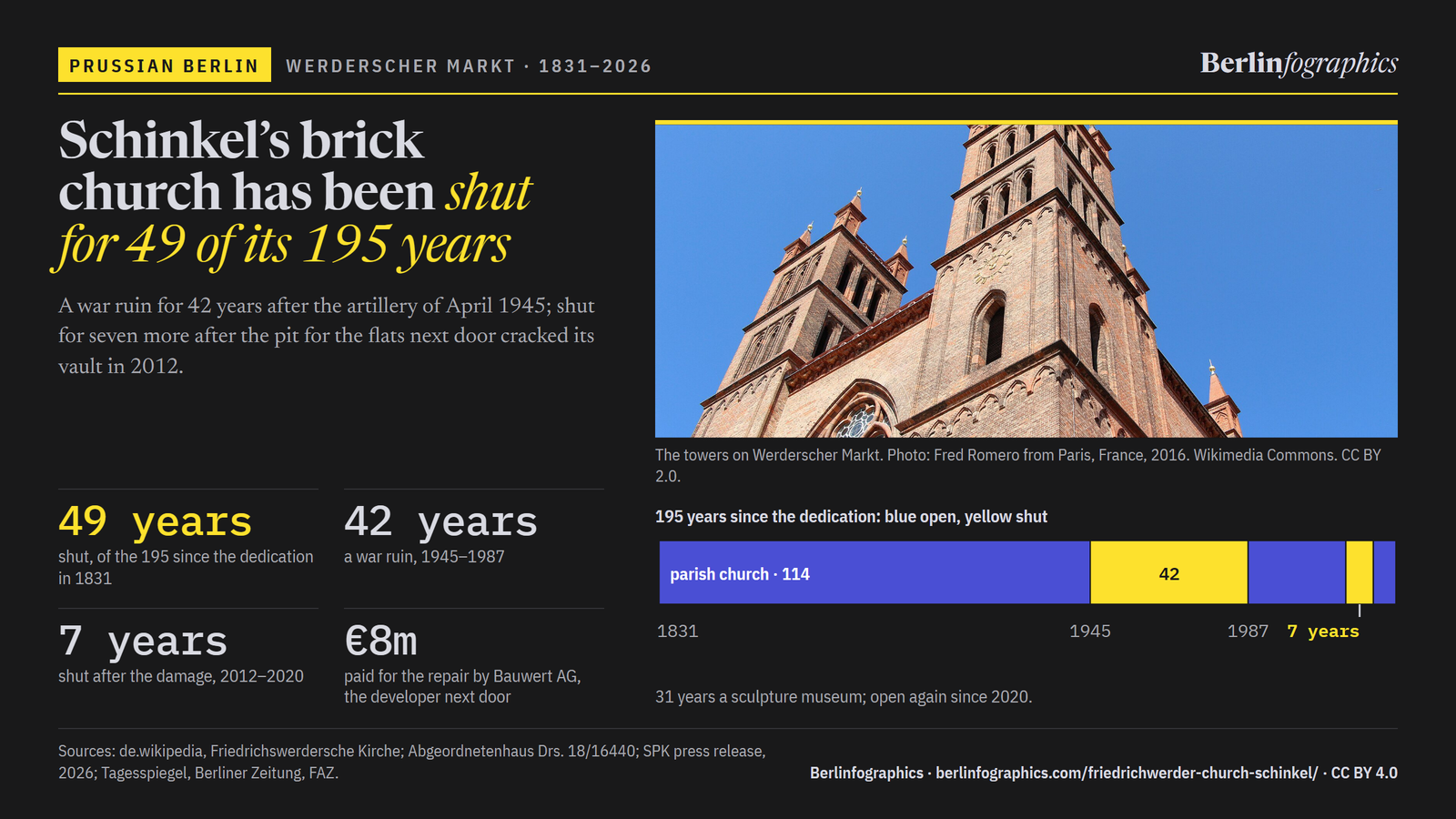
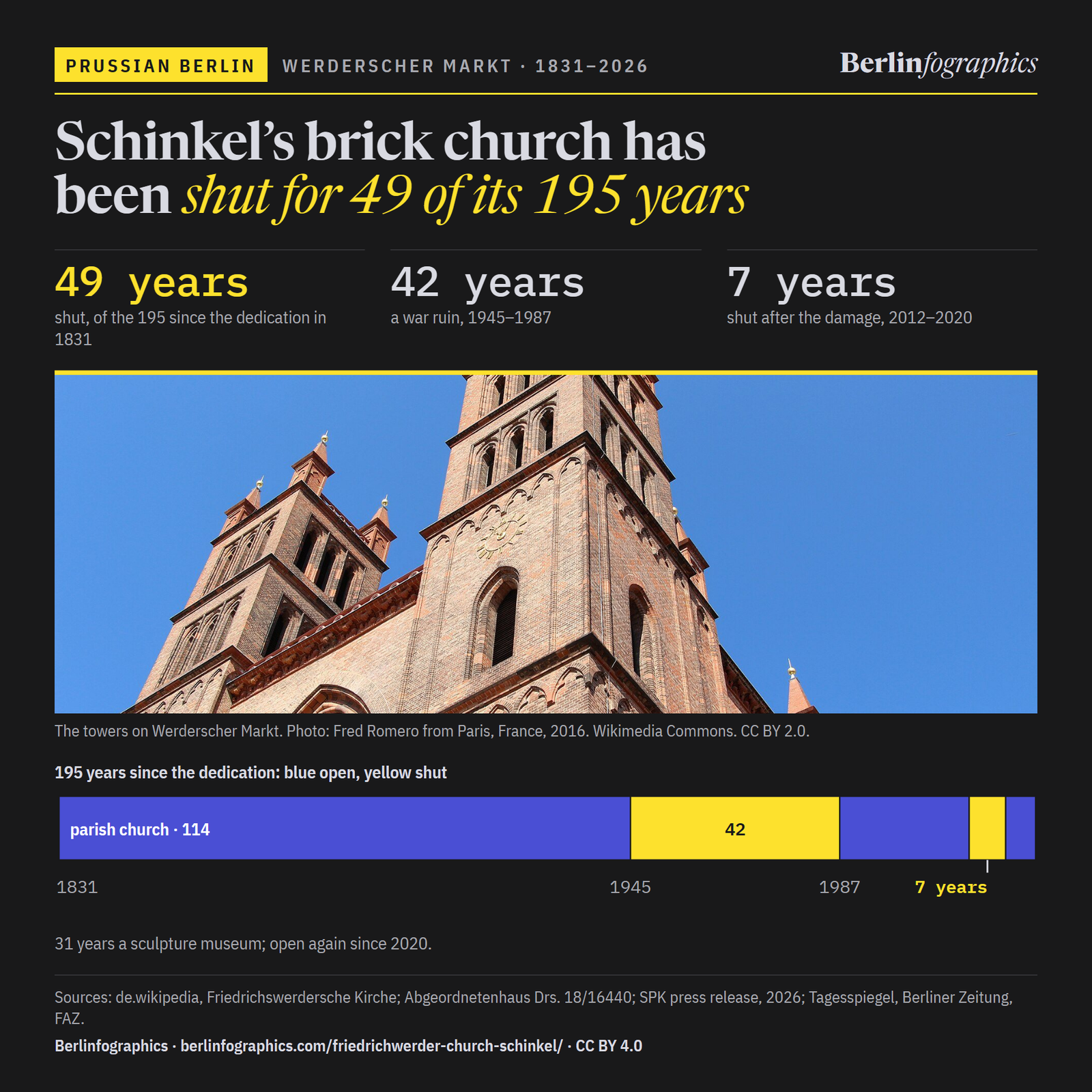
Schinkel’s brick church has been shut for 49 of its 195 years

A king chose it from a sheet of four designs. Since its dedication in 1831 the Friedrichswerdersche Kirche has been a parish church, a war ruin for 42 years, a sculpture museum, and a cracked building site shut for seven more. What stands on Werderscher Markt today is a composite of all of them.

Scroll through two centuries

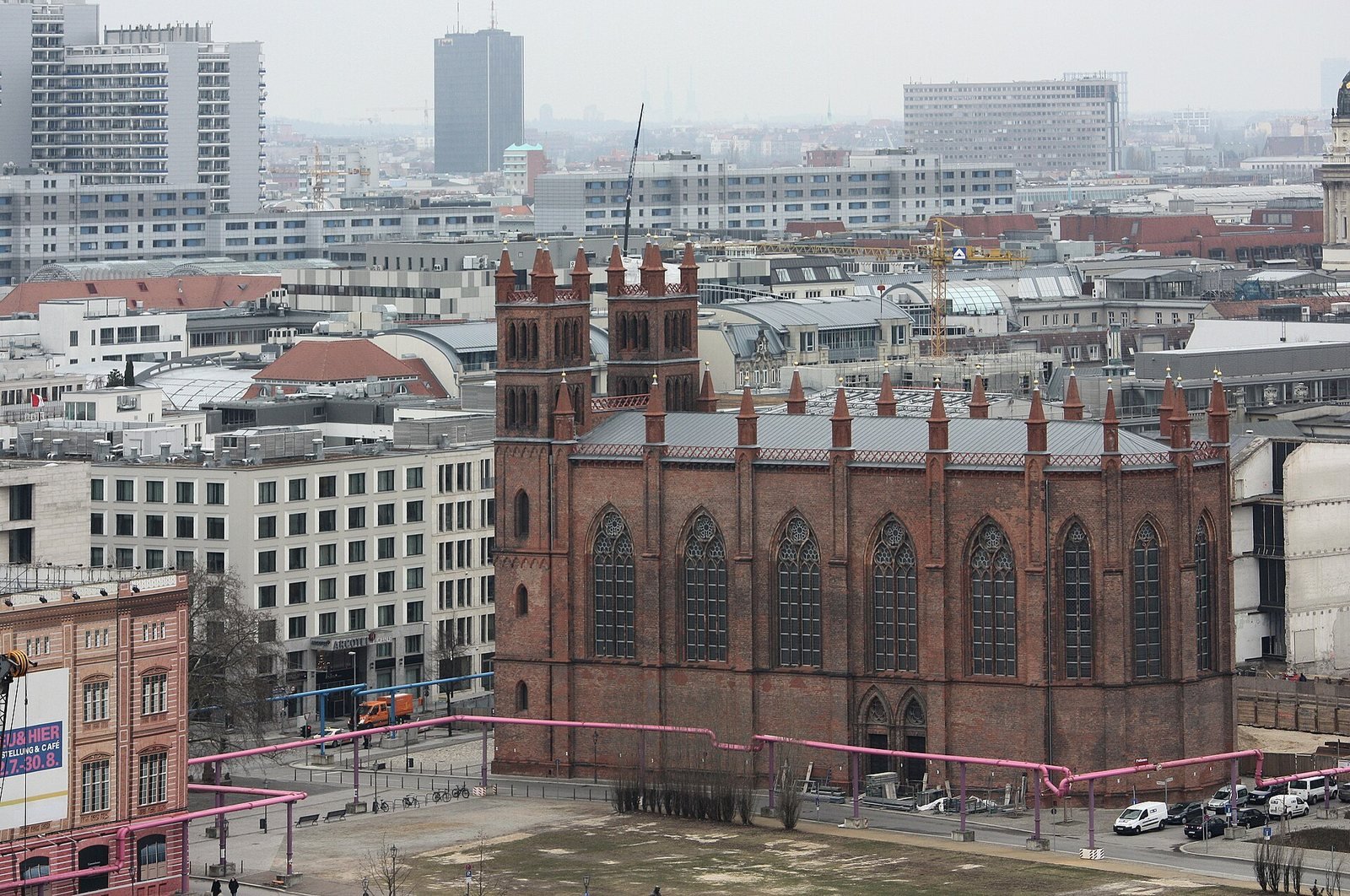
The two towers of the Friedrichswerdersche Kirche on Werderscher Markt, 2016, while the church was shut for the second time.Fred Romero from Paris, France, 2016. Wikimedia Commons. CC BY 2.0.

01The choice

A king picked the church off a single sheet of four designs

In March 1824 King Friedrich Wilhelm III asked to see what his architect had. Karl Friedrich Schinkel showed him four schemes for the same site on one sheet: a temple, a church of domes, and two in the Gothic manner. The King chose the one with two towers.

The Gothic was not the King’s idea. In 1822 he left Berlin for a long stay abroad, and his son, Crown Prince Friedrich Wilhelm, a romantic with firm opinions about medieval building, used the gap to push Schinkel off classical ground, lending him books of English antiquities and asking for a church in the „Mittelalterstil“, the medieval style. The twin towers, the rose window and the double portal first appear in sketches from the middle of 1823.

„In dieser etwas engeren Gegend der Stadt, die durch die Unregelmäßigkeit ihrer Straßenanlagen sich dem Altertümlichen nähert, dürfte eine Kirche im Mittelalterstil wohl an ihrem Platze sein.“

A church in the medieval style might suit this rather tighter quarter of the city, which its irregular streets already make look old.

Karl Friedrich Schinkel, to the King, 2 March 1824

Schinkel’s sheet for the KingFour schemes

On one sheet, March 1824

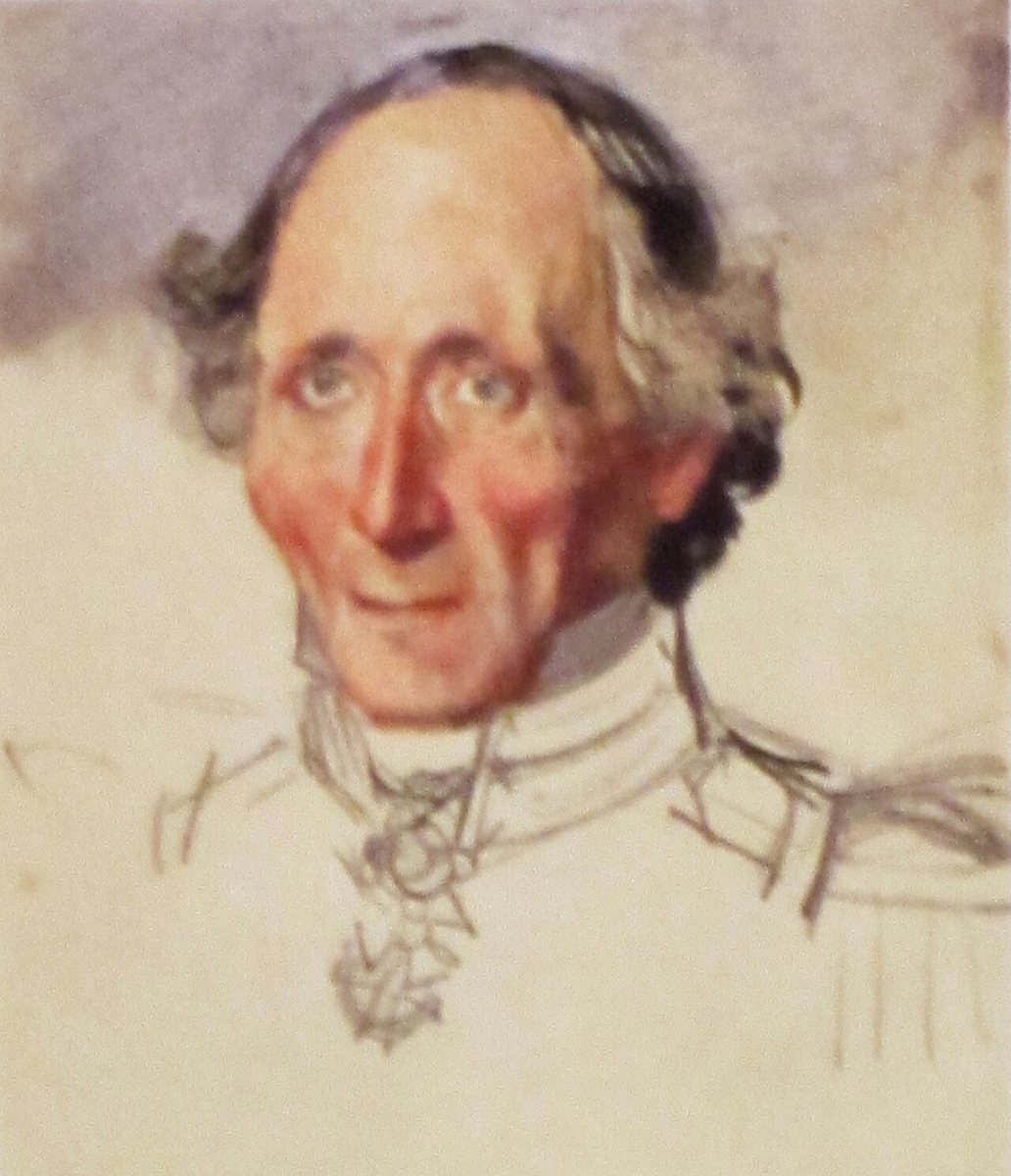
A portrait of an older man in a dark military coat with orders, seen half-length.
Friedrich Wilhelm III, by Franz Krüger, c. 1830.Franz Krüger, c. 1830. Via Wikimedia Commons (Public domain).
A lithographed portrait of a young man with side-whiskers in a dark coat, seated in a landscape, with an engraved title beneath.
The crown prince, lithograph by Alexander Clarot, 1830.Alexander Clarot, 1830. Wikimedia Commons. Public domain.
A close portrait of a man with tousled brown hair and a white neckcloth, turned three-quarters, against a dark ground.
Schinkel, by Carl Joseph Begas, 1826.Carl Joseph Begas, 1826. Wikimedia Commons. Public domain.
An engraved view of a long two-storey baroque hall with a central pediment, a row of small trees in front, and a caption beneath.
What stood on the site before: a converted riding house shared by the German (A) and the French (B) congregations of Friedrichswerder, on Johann David Schleuen’s plan of Berlin, 1760.Johann David Schleuen, 1760. Wikimedia Commons. Public domain.

Before Schinkel

The site on Friedrichswerder already had a church: a converted riding house, shared by a German and a French congregation. Schinkel’s brick replaced it, and the French share in the new church was bought out only in 1872.

02Open and shut

Shut for 49 of its 195 years: by war, and then by the neighbours

Count the church’s life from its dedication to today and it has been closed for a quarter of it, in two spells: 42 years as a ruin after the Second World War, and seven years after the building next door cracked it.

195years since the dedication10 July 1831
to September 2026
The church's years since its dedication as one long band: blue for the years it was open, yellow for the years it was shut. Below, the shut years and the open years added up.
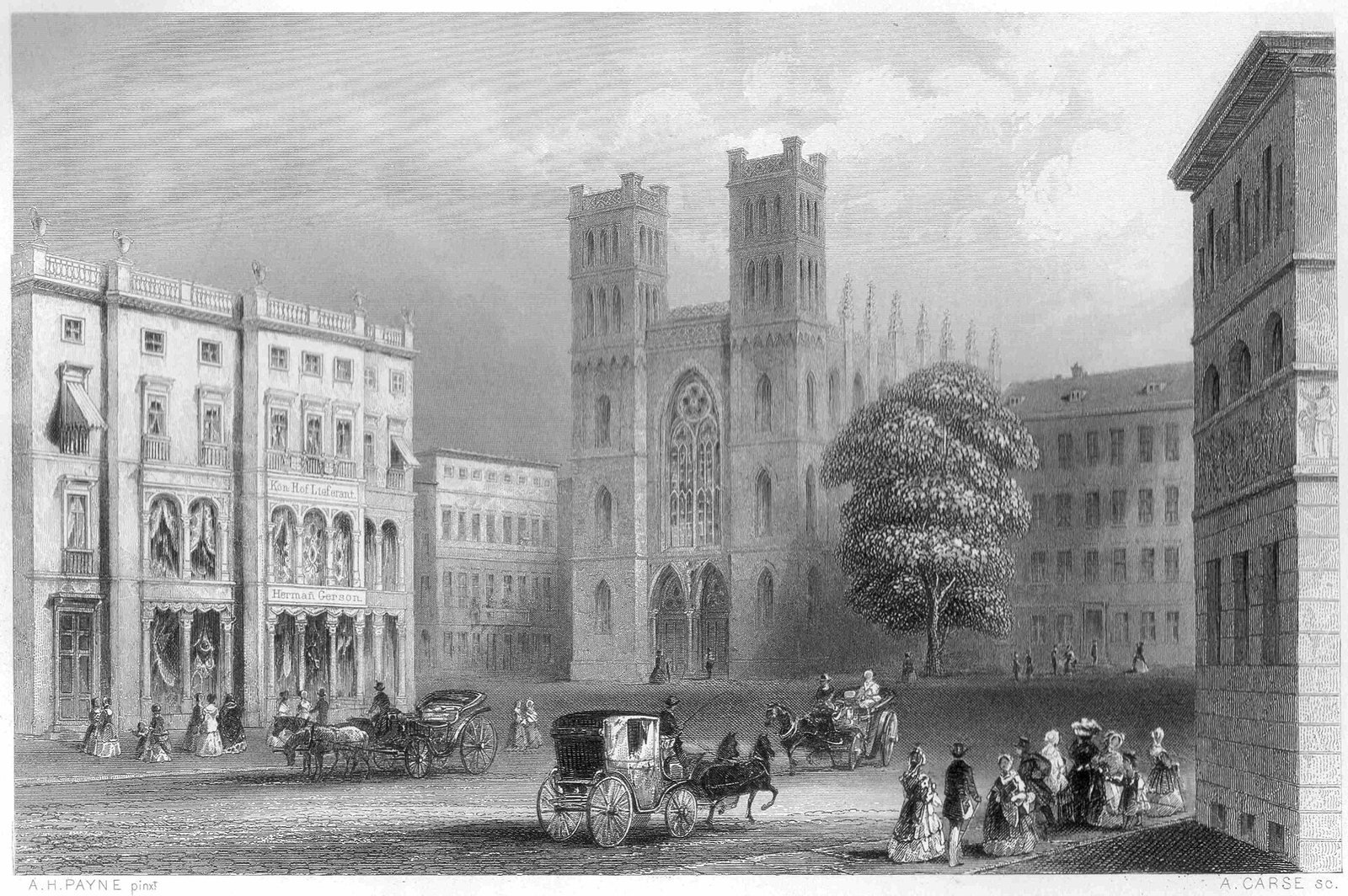
An engraving of a twin-towered Gothic church on a square, with grand houses on either side and carriages and people in front.
The parish church in an engraving by Albert Henry Payne, 1850.Albert Henry Payne, 1850. Wikimedia Commons. Public domain.

10 July 1831

Dedicated on 10 July 1831

The fabric was finished in the middle of 1830; the church was dedicated the following July, on Werderscher Markt in the old town of Friedrichswerder.

Source: de.wikipedia, Friedrichswerdersche Kirche

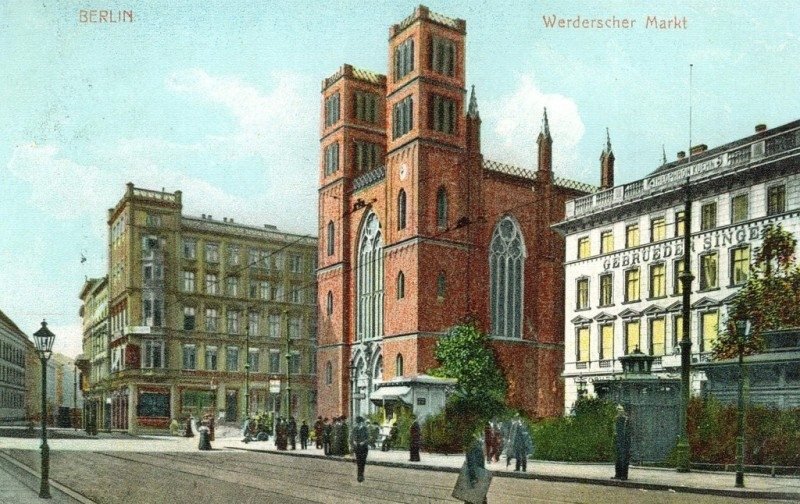
A tinted postcard of a busy square with tram lines, a red twin-towered church in the middle and tall commercial buildings either side.
Werderscher Markt on a postcard, about 1910.Unknown author, 1910. Wikimedia Commons. Public domain.

1831–1945

A parish church for 114 years

For a hundred and fourteen years it was a working church. Stüler altered its towers from 1843; in 1872 the French congregation’s share was bought out.

Source: de.wikipedia, Friedrichswerdersche Kirche · visitBerlin

A black-and-white photograph of the church's twin-towered front, scarred and with boarded windows, on an empty street.
The war-damaged tower front, 1951.Bundesarchiv, Bild 183-19000-0599 / CC BY-SA 3.0 de

29 April 1945

Artillery, then 42 years as a ruin

Bombs and a night of artillery on 29 April 1945 took the tower front and almost everything inside. The shell stood open to the weather for a good four decades while Berlin argued about what to do with it.

Source: de.wikipedia, Friedrichswerdersche Kirche

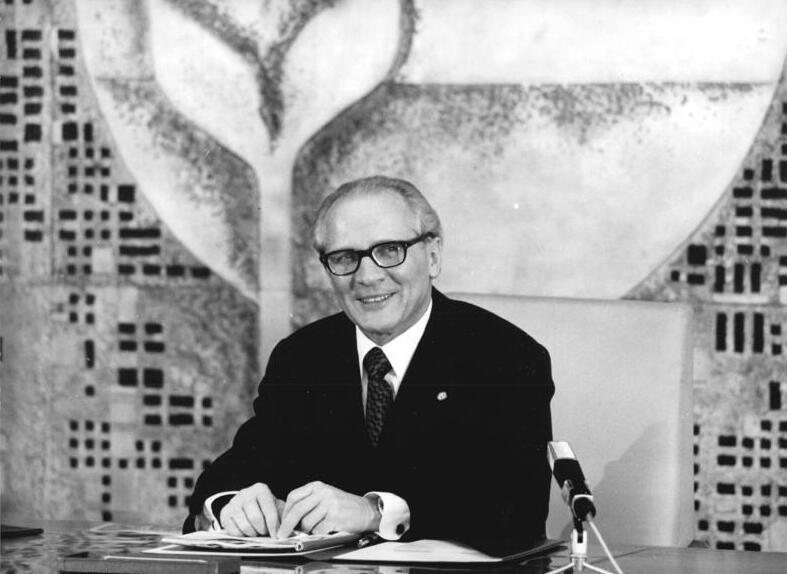
A black-and-white photograph of a smiling man with glasses in a dark suit, seated at a desk in front of a large abstract wall mural.
Erich Honecker, photographed 1976.Bundesarchiv, Bild 183-R1029-031 / Koard, Peter / CC BY-SA 3.0 de

1982–1987

Rebuilt on Honecker’s orders

On Erich Honecker’s direct instruction, East Berlin rebuilt the ruin from 1982 to 1987, to reopen it as a museum of Berlin sculpture.

Source: de.wikipedia, Friedrichswerdersche Kirche

A black-and-white photograph of a wide empty square, the twin-towered church at the left and a long modern office block at the right.
The museum church and the foreign ministry, 1990.Gerd Danigel, 1990. Wikimedia Commons. CC BY 3.0.

1987–2012

A museum for 25 years

From 1987 the nave held the sculpture of the Berlin school, with a Schinkel exhibition on the gallery. It shut after 25 years.

Source: de.wikipedia, Friedrichswerdersche Kirche · Staatliche Museen zu Berlin

The twin-towered brick church under a blue sky, with construction hoardings, a crane and a site container in front of it.
The Kronprinzengärten site beside the church, 2016.Fridolin freudenfett, 2016. Wikimedia Commons. CC BY-SA 4.0.

autumn 2012

Shut again by the building next door

The pit for the Kronprinzengärten flats was dug about five metres from the west wall. Cracks ran through the vault; by autumn 2012 the museum shut, for seven years.

Source: de.wikipedia, Friedrichswerdersche Kirche · Abgeordnetenhaus Drs. 18/16440 · Tagesspiegel, Berliner Zeitung, FAZ

A white marble sculpture of two young women embracing, in the middle of a tall Gothic nave with coloured windows at the end.
Schadow’s Prinzessinnengruppe in the nave, 2023.Gerda Arendt, 2023. Wikimedia Commons. CC0.

18 January 2020

Open again

The building reopened on 18 January 2020; the sculpture came back on 27 October 2020. The church is open in 2026.

Source: de.wikipedia, Friedrichswerdersche Kirche · SPK press release, 2026 · Staatliche Museen zu Berlin

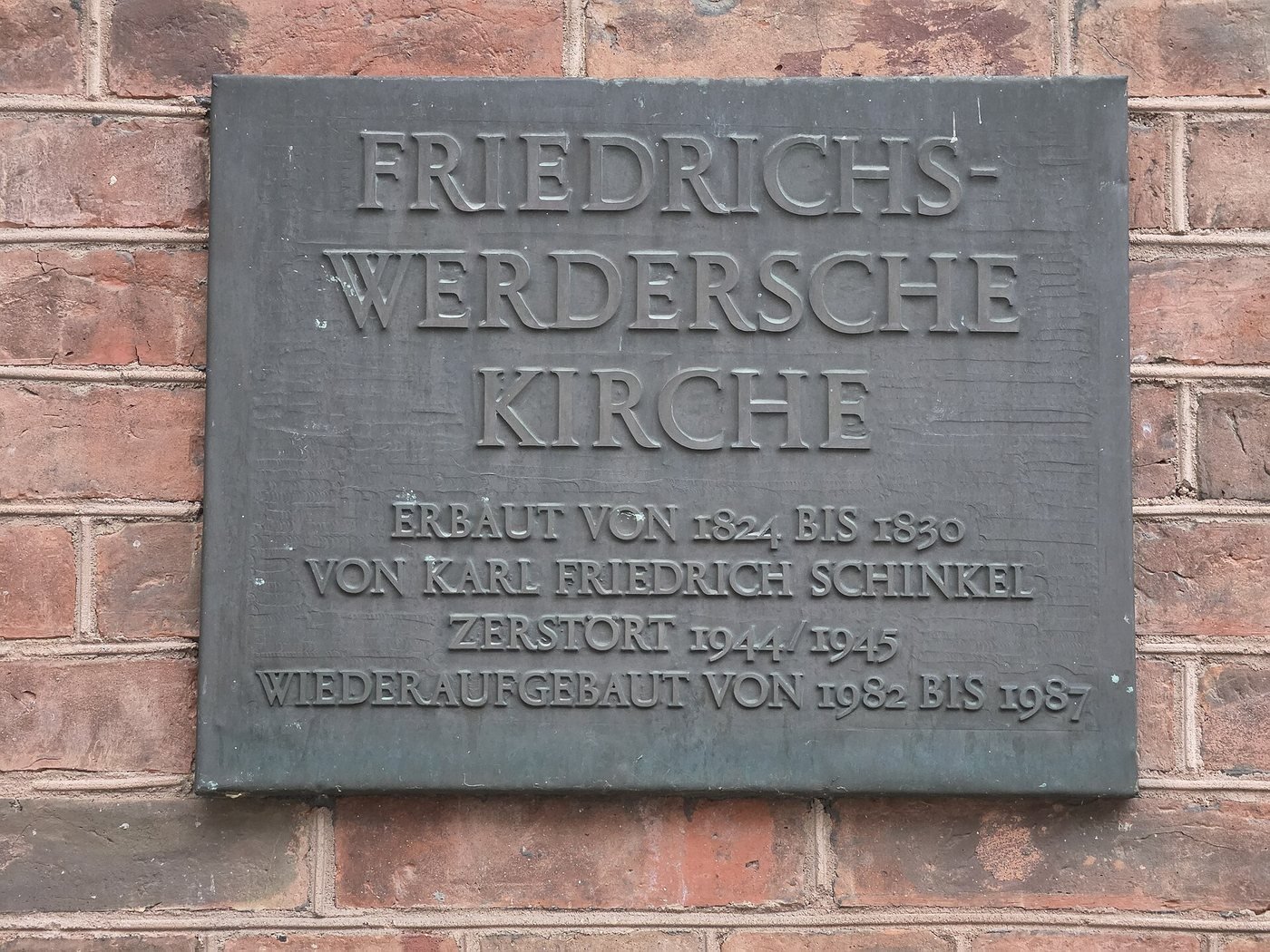
A bronze plaque on a red brick wall reading Friedrichswerdersche Kirche, with lines on when it was built, destroyed and rebuilt.
The plaque on the church wall, 2026.NutzerAusBerlin, 2026. Wikimedia Commons. CC0.

1831–2026

49 of 195 years behind closed doors

Add the two spells together: 42 years as a ruin and 7 after the crack make 49 years shut, against 31 as a museum.

Source: de.wikipedia, Friedrichswerdersche Kirche · Abgeordnetenhaus Drs. 18/16440 · Berlinfographics fact-check

A wide view down a Gothic hall from an upper gallery, with carved wooden balustrades, slender piers and sculptures along the floor.
The nave from a gallery, 2022. The galleries were meant to be cast iron; the money ran out, and they were built in softwood faced with oak.Flocci Nivis, 2022. Wikimedia Commons. CC BY 4.0.

03Five ages in one building

Nothing on this church is of one age

The brick body is Schinkel’s and has never come down. Almost everything else has been taken off, cut, destroyed, remade or cracked since. Here are the south front and the west flank, coloured in age by age.

5ages, one buildingSouth front · west flank
after Schinkel’s plates
An elevation of the church's south front and west flank. As you read, the parts of each age are coloured in: Schinkel's brick, the nave pinnacles, Stüler's tower tops, the glass and the archangel remade after the war, the five surviving choir windows, and the recent crack.
The brick church seen from a street corner: the tall tower front with a great pointed window, and the flank with buttresses running away.
Schinkel’s brick, 2022.Gerd Eichmann, 2022. Wikimedia Commons. CC BY 4.0.

Schinkel

Schinkel's, still standing

The brick body, the buttresses, the two portals, the window tracery and the cornice. None of it has come down. The cornice alone carries 141 moulded acanthus leaves.

Source: de.wikipedia, Friedrichswerdersche Kirche

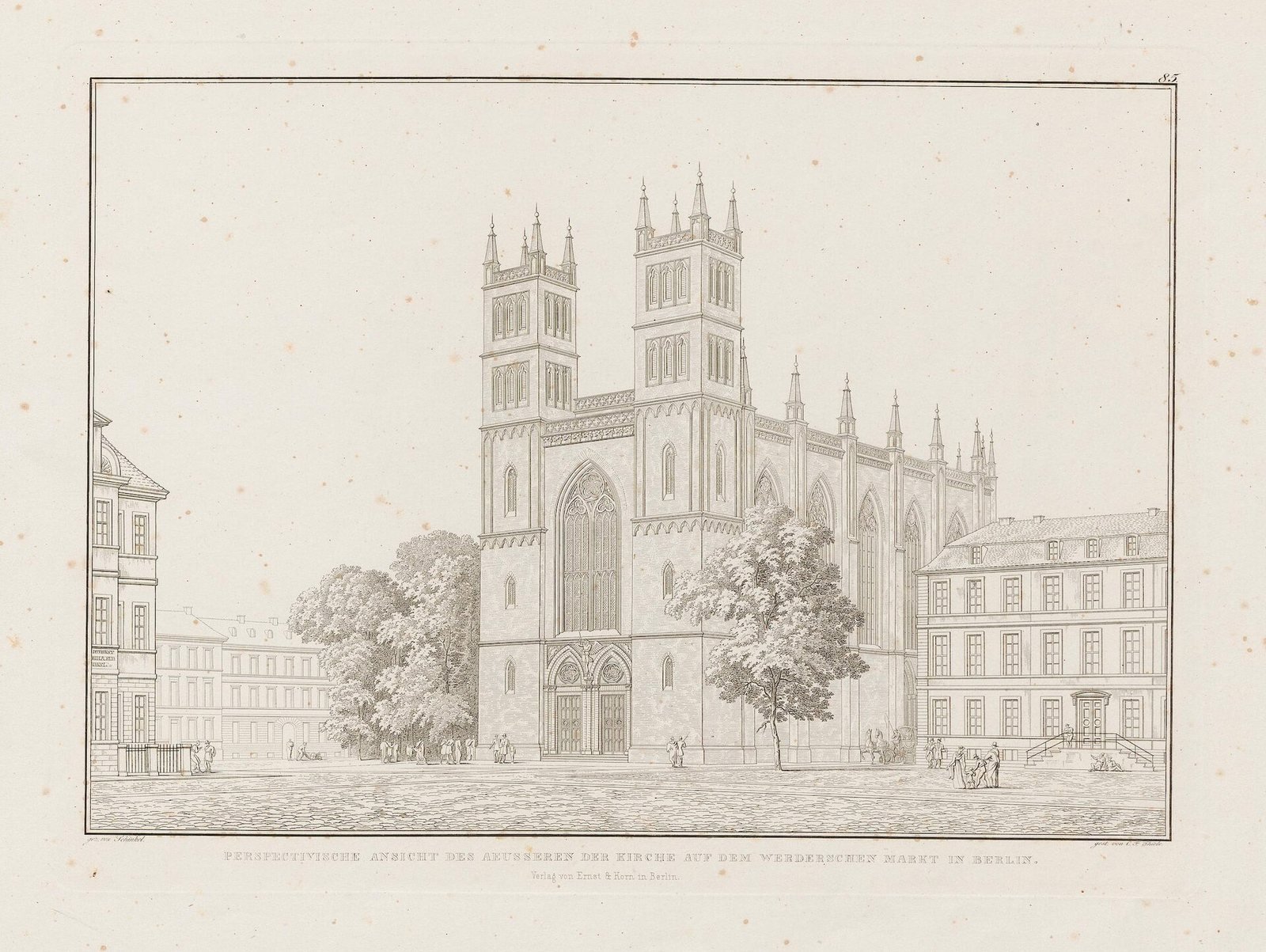
A fine engraving of the twin-towered brick church seen from the south-west, its long flank lined with tall windows and small spires.
Schinkel’s published view of the church, with every pinnacle.Karl Friedrich Schinkel, engraved by C. F. Thiele. Sammlung architektonischer Entwürfe, plate 85. Wikimedia Commons. Public domain.

1824 · February 1828

The pinnacles Schinkel had to fight for

He drew 24: 8 on the towers and 16 along the nave. The budget took the nave’s away in 1824. He won them back in February 1828, on condition they were hacked out of ordinary bricks on the scaffold. They weathered within a generation.

Source: de.wikipedia, Friedrichswerdersche Kirche

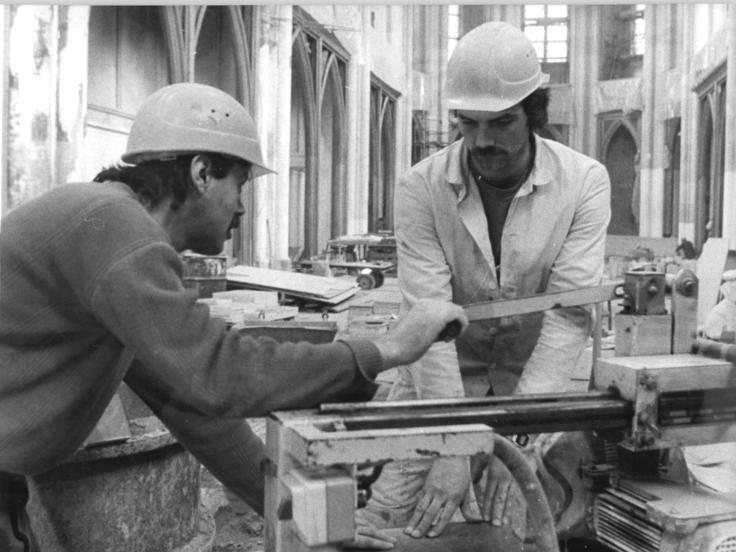
Two workmen in hard hats cutting a stone slab on a bench, with Gothic arches and scaffolding behind them.
Restorers inside the church, March 1987.Bundesarchiv, Bild 183-1987-0305-019 / Ritter, Steffen / CC BY-SA 3.0 de

East Berlin, the 1980s

The fifth pinnacle on the west side

East Berlin’s restorers were copying the shape that had replaced Schinkel’s, until in the base of this one they found two of his original moulded stones intact. The work stopped; new bricks were made to the shape in their hands.

Source: de.wikipedia, Friedrichswerdersche Kirche

A drawn portrait of a bearded middle-aged man in a dark coat, head and shoulders.
Stüler, drawn by Adolph von Menzel, 1861.Adolph von Menzel, 1861. Wikimedia Commons. Public domain.

from 1843

Stüler took the tower tops down

The 8 pinnacles on the towers were taken down to their bases for a Gothicising rebuild that ran out of money, and finished instead with cast-zinc crocketed tops.

Source: de.wikipedia, Friedrichswerdersche Kirche · visitBerlin

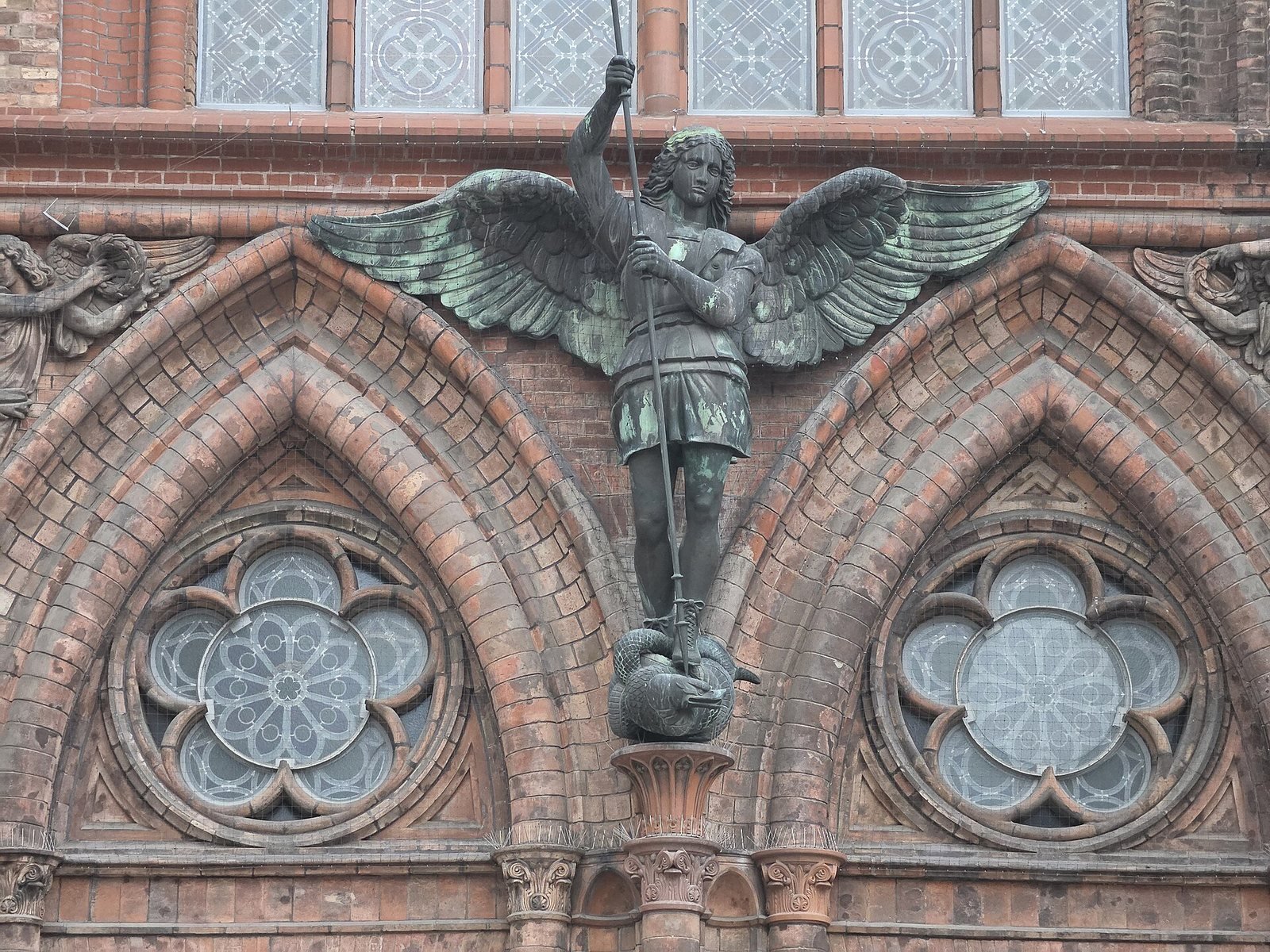
A dark bronze figure of a winged angel with a spear, standing on a globe between two round traceried windows set in red brick.
The Archangel Michael, 2026.NutzerAusBerlin, 2026. Wikimedia Commons. CC0.

1945 · 1982–1987

Destroyed in the war, made new

The glass of all 10 nave windows and of the great south window was remade from coloured cartoons of 1829. The archangel over the portals, 7 pieces of terracotta, was copied in copper in 1904 and recast in bronze in 1986.

Source: de.wikipedia, Friedrichswerdersche Kirche

A tall Gothic interior seen from a gallery: wooden galleries on both sides, statues on a patterned floor, and coloured windows at the far end.
The nave and the choir windows, 2022.Flocci Nivis, 2022. Wikimedia Commons. CC BY 4.0.

restored 1986

Five windows hid from the war

The 5 original choir windows were taken out and stored before the bombing, restored in 1986 and put back. They are the only old glass in the building.

Source: de.wikipedia, Friedrichswerdersche Kirche

A view from above of the long brick church with its row of tall windows, surrounded by new office buildings and a cleared lot.
The shut church from above, 2013.Dguendel, 2013. Wikimedia Commons. CC BY 3.0.

autumn 2012

The crack of 2012

Opened along the west side when the pit next door was dug. It ran the length of the building, and closed it for seven years.

Source: de.wikipedia, Friedrichswerdersche Kirche · Abgeordnetenhaus Drs. 18/16440

What is of which age

Schinkel's, still standingThe brick body, the buttresses, the two portals, the window tracery and the cornice with its 141 acanthus leaves. None of it has come down.
Schinkel's, never built as drawnThe sixteen pinnacles along the nave. Cut from the budget in 1824; won back in 1828 only on condition they were hacked out of ordinary bricks on the scaffold instead of moulded. They weathered within a generation.
Altered by Stüler, from 1843The eight pinnacles on the towers, taken down to their bases for a Gothicising rebuild that ran out of money, and finished instead with cast-zinc crocketed tops.
Destroyed 1945, made new 1982–87The glass of all ten nave windows and of the great south window, remade from the coloured cartoons of 1829; and the archangel over the portals, recast in bronze in 1986.
Survived the war in storageThe five original choir windows. Taken out and stored before the bombing, restored in 1986, put back. They are the only old glass in the building.
The crack of 2012Opened along the west side when the pit next door was dug.

The fabric, counted

2towers
5storeys to each tower
5bays in the nave
10nave windows — five to each long side
5choir windows
1great tracery window
2portals
20cast-iron medallions on the doors
24pinnacles — 8 on the towers, 16 on the nave
141acanthus leaves on the main cornice
7pieces to the terracotta archangel
A black architectural ground plan of a long church: a thick entrance block at the left, a vaulted nave with buttresses, and a polygonal end at the right.
Schinkel’s published ground plan: the towers and portals at the south, five vaulted bays, the buttresses, and the five-sided choir at the north end.Karl Friedrich Schinkel, Sammlung architektonischer Entwürfe. Wikimedia Commons. Public domain.
An early black-and-white rooftop photograph: a long Gothic church with pinnacles in the middle ground, a great domed palace behind it.
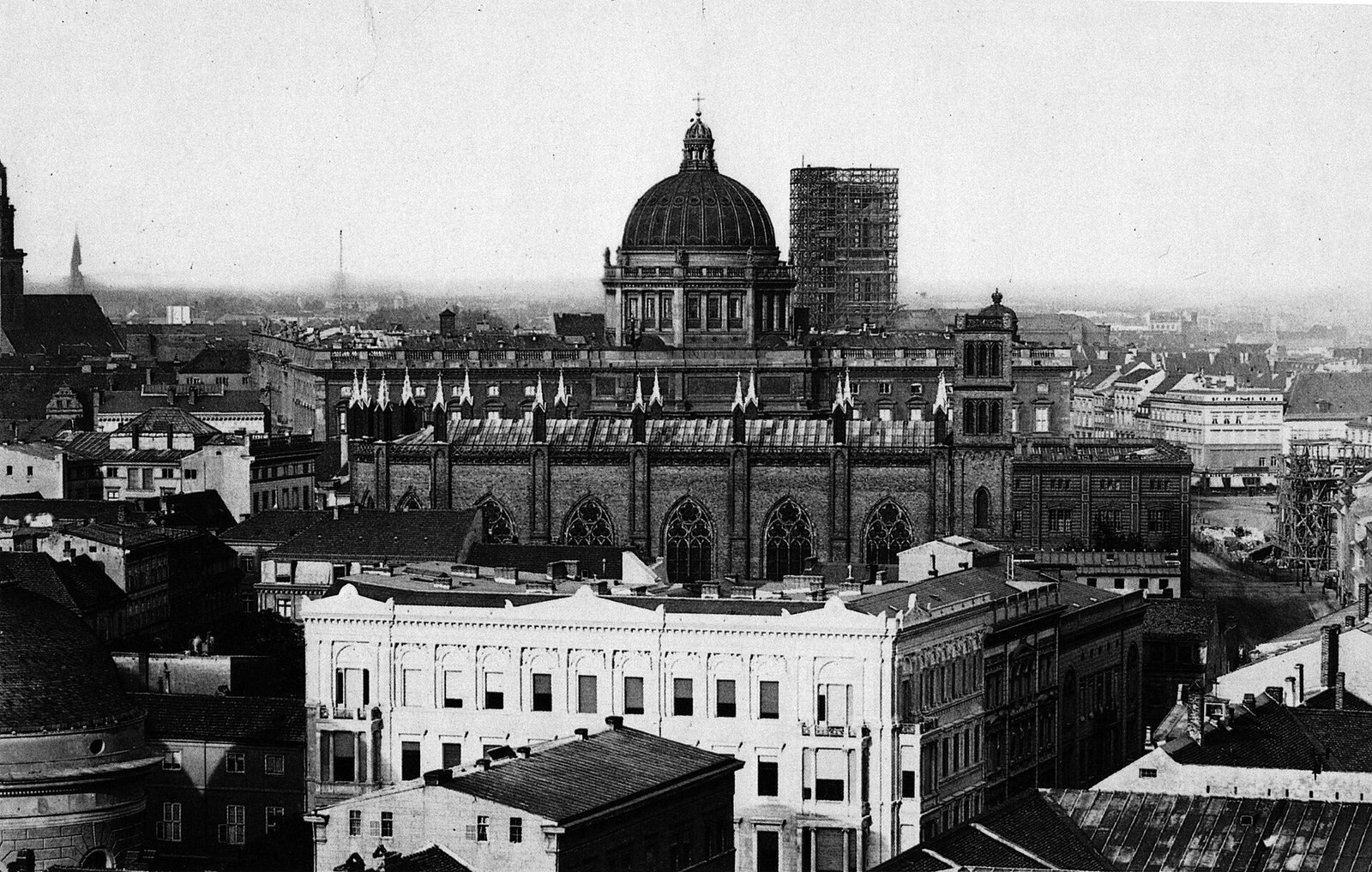
The church’s flank, a pinnacle over every buttress, in front of the dome of the Berliner Schloss; photographed by Friedrich Albert Schwartz, 1866.Friedrich Albert Schwartz, 1866. Wikimedia Commons. Public domain.

04Brick left bare

Schinkel left the brick bare, and Berlin’s bricklayers had forgotten how

He said so in advance: the walls would stand in careful masonry without plaster, „wie die Kirchen des Mittelalters unserer Gegenden“, like the churches of the middle ages in our own parts. It tied the church to the brick Gothic of the Baltic towns, and it cost him.

Bricklayers in 1824 Berlin had forgotten how to lay a face they could not cover up. The hand-struck bricks varied by a millimetre or two in height, so every course had to be run to the line. Up to the first string course they gave up and ran a raised joint to make the wall look even. Inside, the walls and piers are stucco painted to look like brick and sandstone, and the net of ribs across the vault is painted on.

„Schinkels gothisches Schmerzenskind“

“Schinkel's Gothic problem-child”: what the literature of the day called the finished church.

Paid for the moulded clay, in Reichstaler

141 acanthus leaves on the main cornice, one mark each

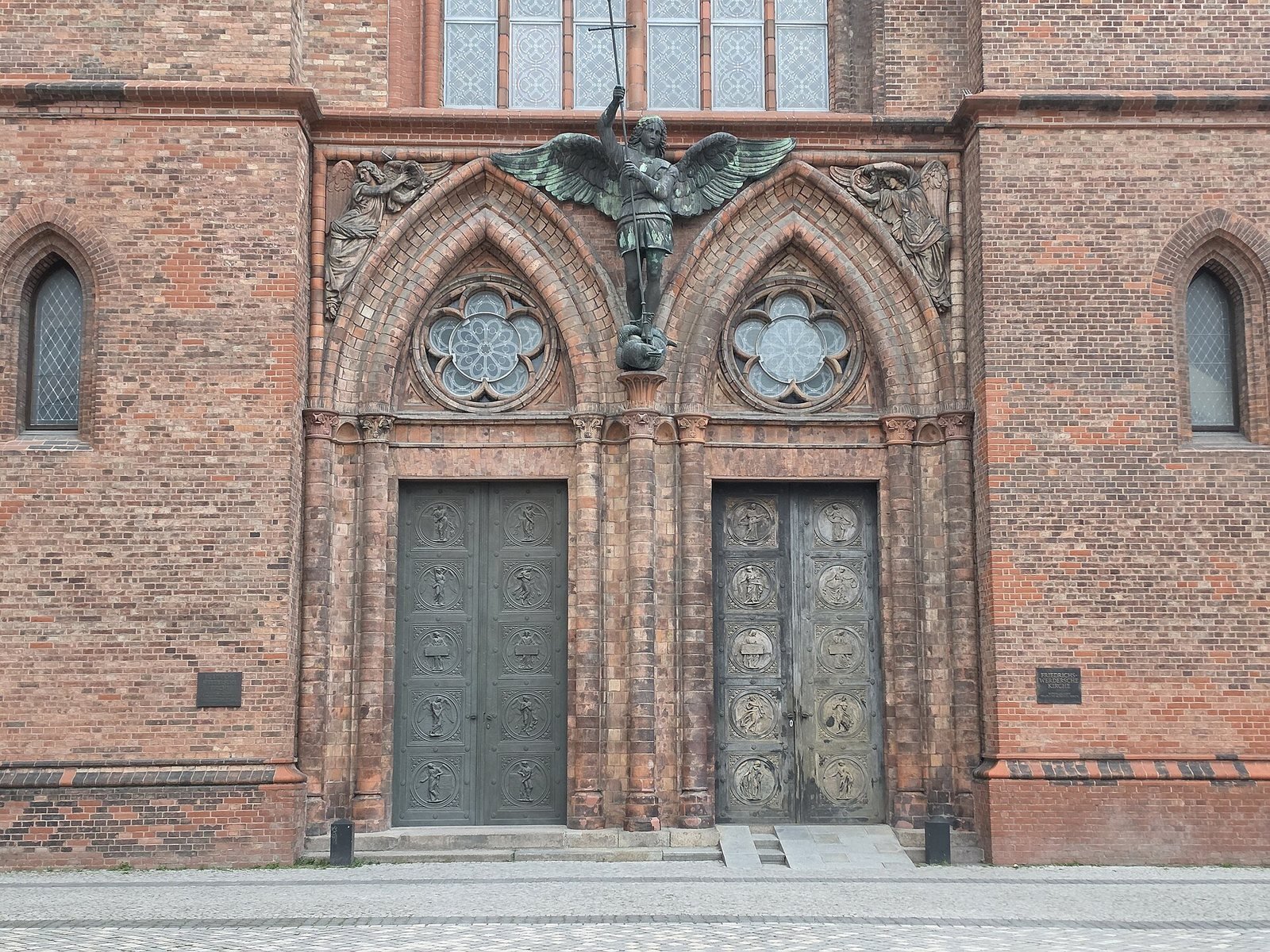
Two tall pointed brick doorways side by side with dark metal doors studded with round medallions, under a bronze angel.
The two portals under one deep niche, 2026, with their iron door leaves and the moulded clay of the Feilner works around them.NutzerAusBerlin, 2026. Wikimedia Commons. CC0.
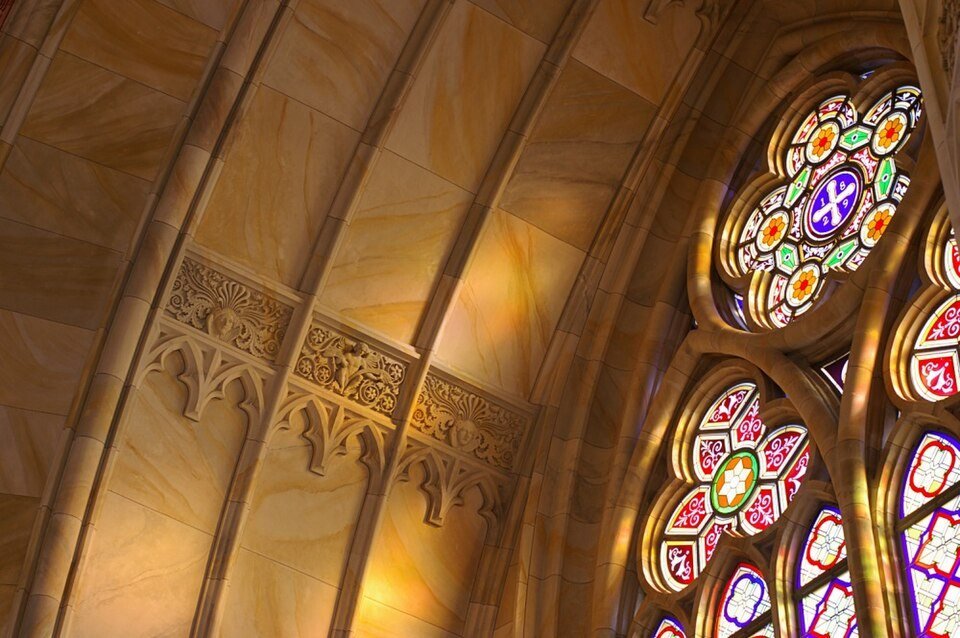
A close view inside the church of a curving vault and a carved frieze lit warm yellow, beside a round stained-glass window.
Inside, 2006: the walls and piers are stucco, painted to look like brick and sandstone.Steffen Zahn from Berlin, Germany, 2006. Wikimedia Commons. CC BY 2.0.
05Five metres

Five metres from the wall, a pit for a car park

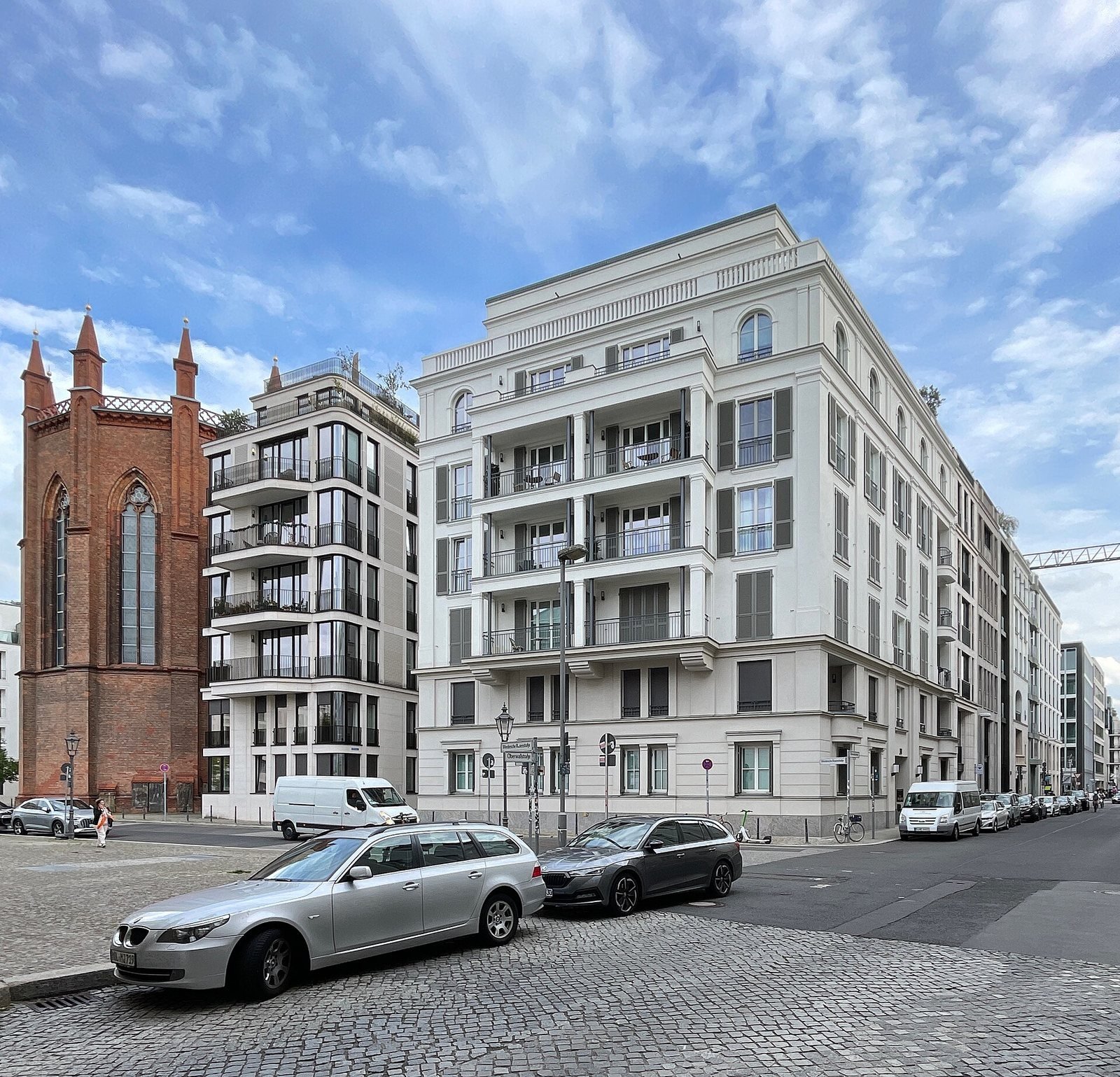
The Kronprinzengärten, luxury flats on the west side, were built with a car park two storeys deep. Its pit went down about five metres from the church’s west wall; another development, by Frankonia Eurobau, was going up on the other side.

The record is plain about what followed. The foundation settled on the western side, cracks opened in the vault and in the floor, plaster came off the ceiling and stones fell out of the vaulting. By autumn 2012 a crack ran through the whole interior and the museum shut. The repair took from 2013 to 2019.

The pit and the west wall, in section

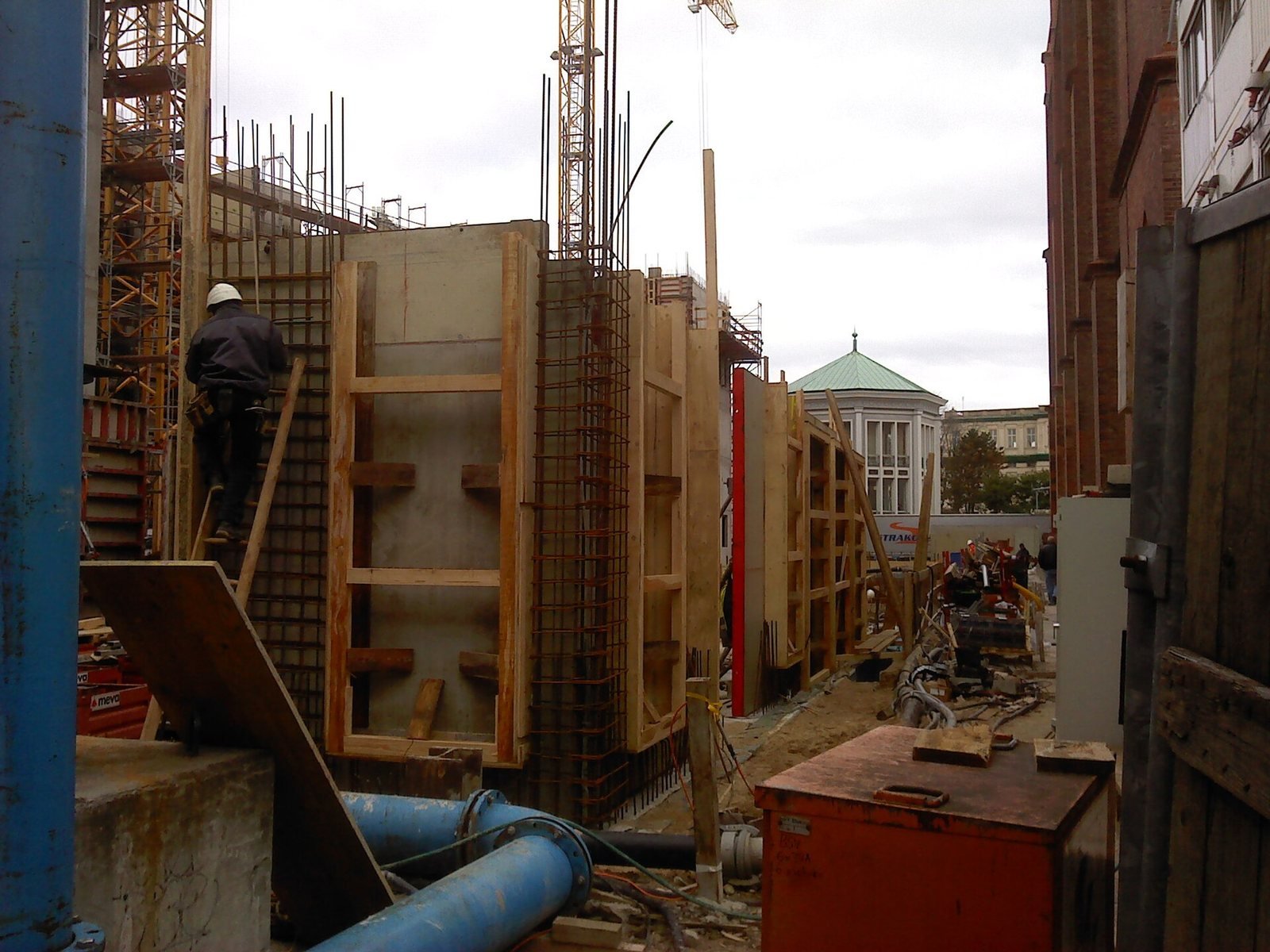
A building site: concrete formwork, steel reinforcement and pipes in a narrow lane, with a worker on a ladder; at the right edge, a red brick wall with buttresses.
The new building going up in the Falkoniergasse, 2015. The brick wall with buttresses at the right is the church’s flank.Monika Angela Arnold, (=44Pinguine/44penguins), 2015. Wikimedia Commons. CC BY-SA 3.0.
A street corner: a tall pale apartment block with balconies, and at the left edge the red brick Gothic church with its pointed windows.
The finished Kronprinzengärten flats beside the church, 2026.Carl Ha, 2026. Wikimedia Commons. CC BY-SA 4.0.
Werderscher Markt · 1831–2026

The church on Werderscher Markt is not one building but five: Schinkel’s brick, Stüler’s zinc, East Berlin’s glass, five windows that hid from the war, and a crack from the building next door.

A tall Gothic interior seen from a gallery: wooden galleries on both sides, statues on a patterned floor, and coloured windows at the far end.
The nave looking north to the choir, 2022. The coloured windows at the far end are the only old glass in the building.Flocci Nivis, 2022. Wikimedia Commons. CC BY 4.0.

Press & citation

Use this Berlinfographic

Free to publish under CC BY 4.0 — in print, online, on Wikipedia and in teaching, commercially or not — with credit to Berlinfographics and a link to this page.

Schinkel’s Friedrichswerdersche Kirche: ready-to-use landscape image

Ready-to-use image

The infographic as one image: headline, key figures, chart, sources and credit, 2,400 × 1,350 px PNG. Please use it unedited.

Download landscape (PNG)
Schinkel’s Friedrichswerdersche Kirche: square version

Square format

A 1:1 version for social media and narrow columns, 1,800 × 1,800 px.

Download square (PNG)
Schinkel’s Friedrichswerdersche Kirche: portrait version

Portrait 4:5

For Instagram and LinkedIn feeds, 1,620 × 2,025 px.

Download portrait (PNG)

Credit line

Berlinfographics (berlinfographics.com), CC BY 4.0

Citation

Berlinfographics (2026). “Schinkel’s Friedrichswerdersche Kirche”. Berlin Experiences. https://berlinfographics.com/friedrichwerder-church-schinkel/

Wikipedia

{{cite web |title=Schinkel’s Friedrichswerdersche Kirche |url=https://berlinfographics.com/friedrichwerder-church-schinkel/ |website=Berlinfographics |publisher=Berlin Experiences |date=2026-11-06 |access-date=2026-11-06}}