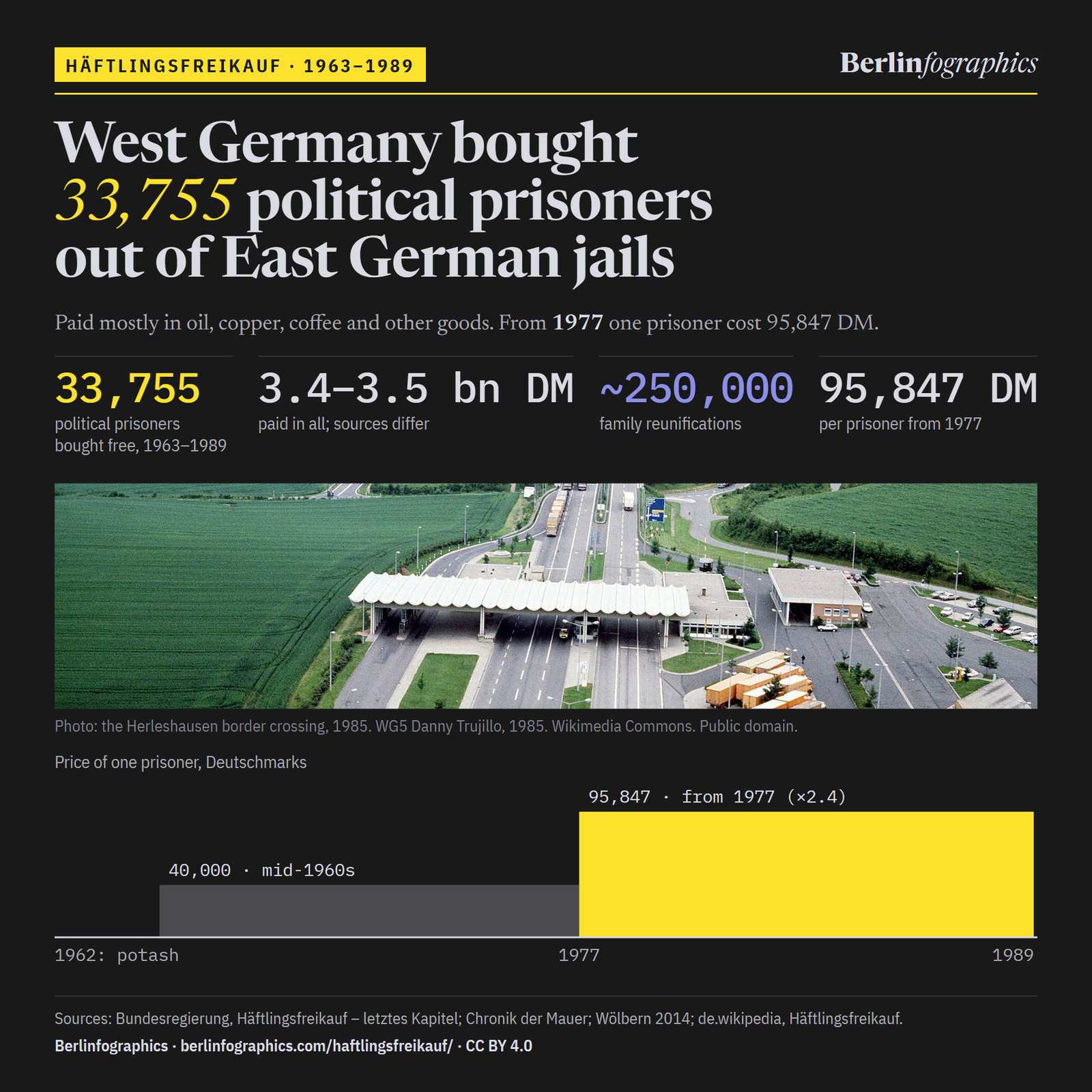
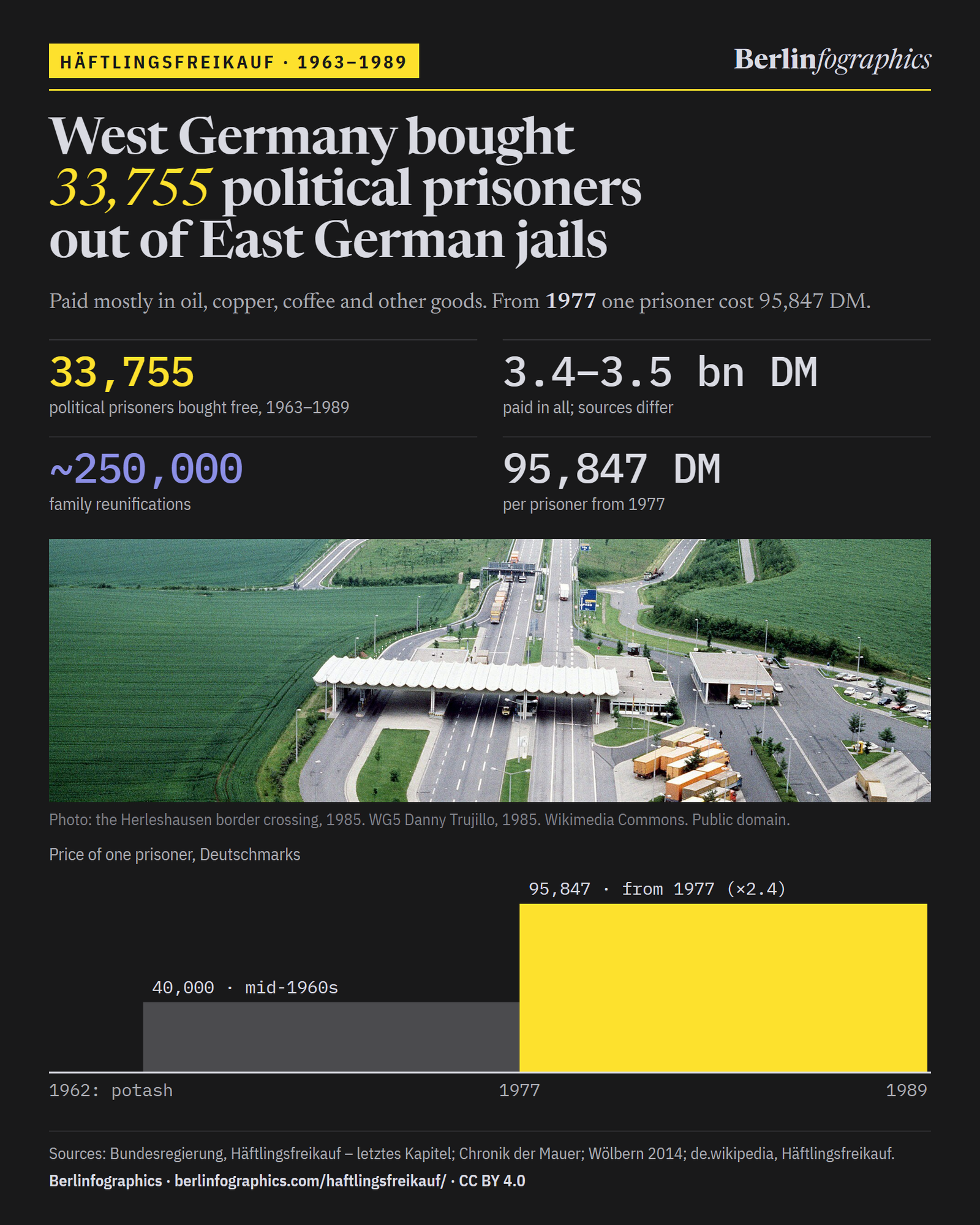
The West German border crossing at Herleshausen, on the autobahn to Wartha in the GDR, from the air, June 1985.Photo: WG5 Danny Trujillo, 1985. Wikimedia Commons. Public domain.
Häftlingsfreikauf
From 1963 to 1989 Bonn paid 3.4–3.5 billion DM, mostly in oil, copper, coffee and other goods, for them and for about 250,000 family reunifications. By 1977 one prisoner cost 95,847 DM.
01Christmas 1962
The first prisoners were let go for 3 railway wagons of potash fertiliser, arranged through church channels (Kurt Scharf, Reymar von Wedel) with two lawyers: Jürgen Stange in West Berlin and Wolfgang Vogel in East Berlin. The first deal with the West German government followed in 1963.
How many went free that Christmas depends on the source. The standard account, after Schroeder (1998), counts 20 prisoners and as many children. The federal government’s own history speaks of “the first 15 prisoners”.

Price per prisoner, 1962–1990
Scroll on: the price, step by step.
December 1962
The first releases were paid for in kind: 3 wagons of potash fertiliser.
1963
In 1963 the federal minister for all-German affairs, Rainer Barzel, took up the channel. From then on the government paid.
From the mid-1960s
Prisoners were priced in bulk, at an average of 40,000 DM each.
1977
The flat rate became 95,847 DM: 2.4 times the old average.
1985
2,669 prisoners were bought free in 1985, more than in any other year.
1963–1989
By the autumn of 1989, when the GDR began to fall, the Federal Republic had bought the freedom of 33,755 political prisoners.
24 September 1990
The last goods owed for prisoners reached the GDR on 24 September 1990, a few days before reunification.
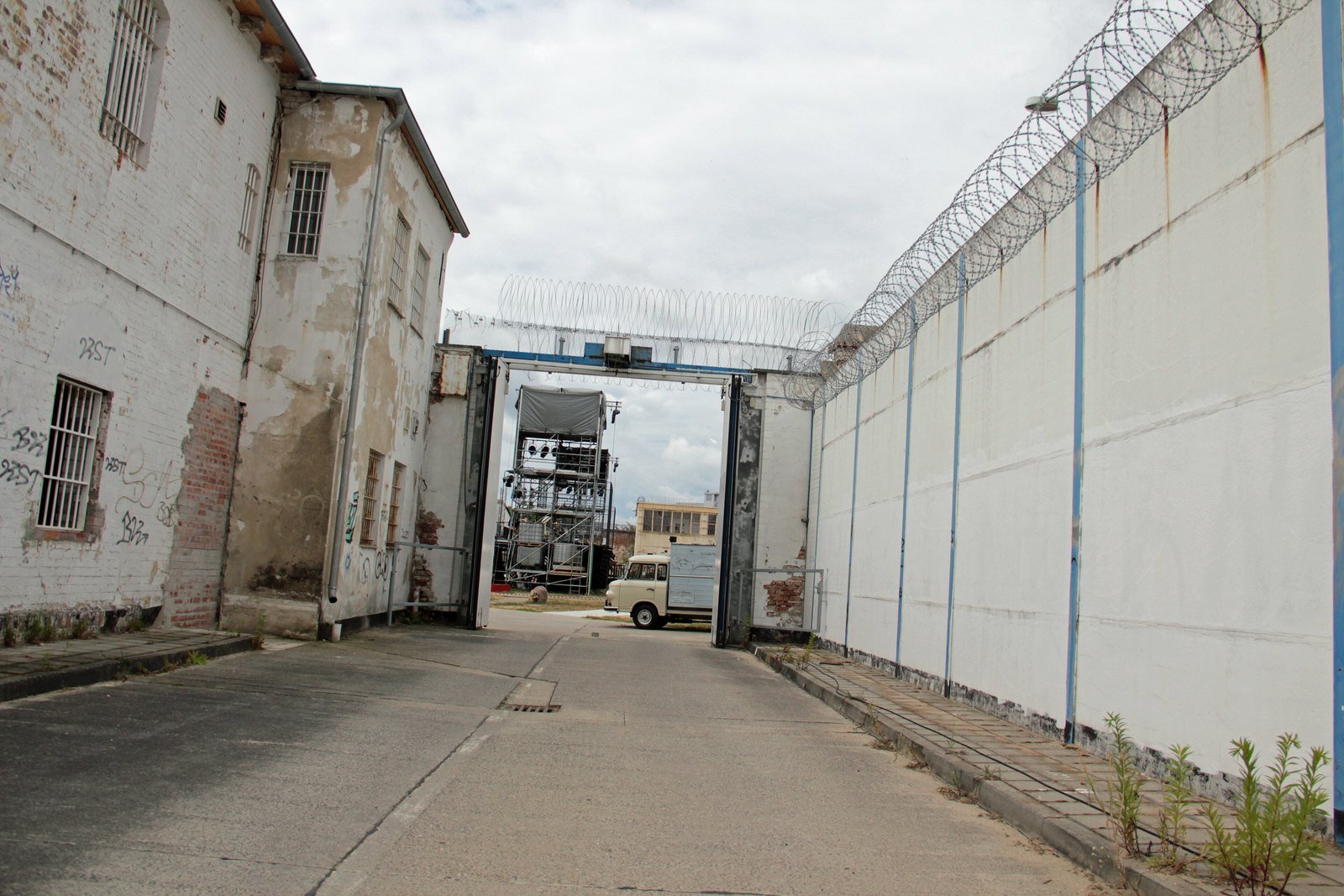
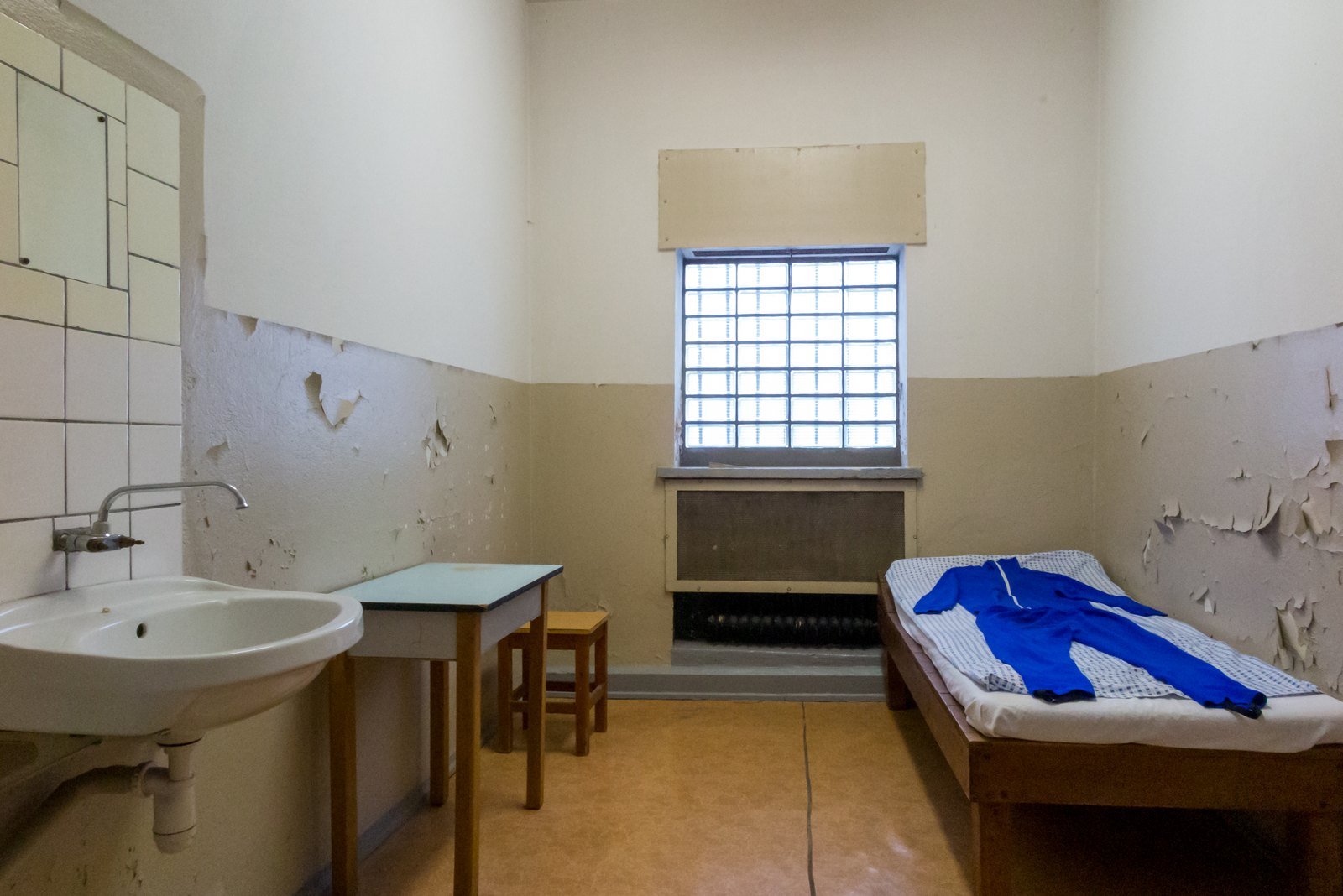
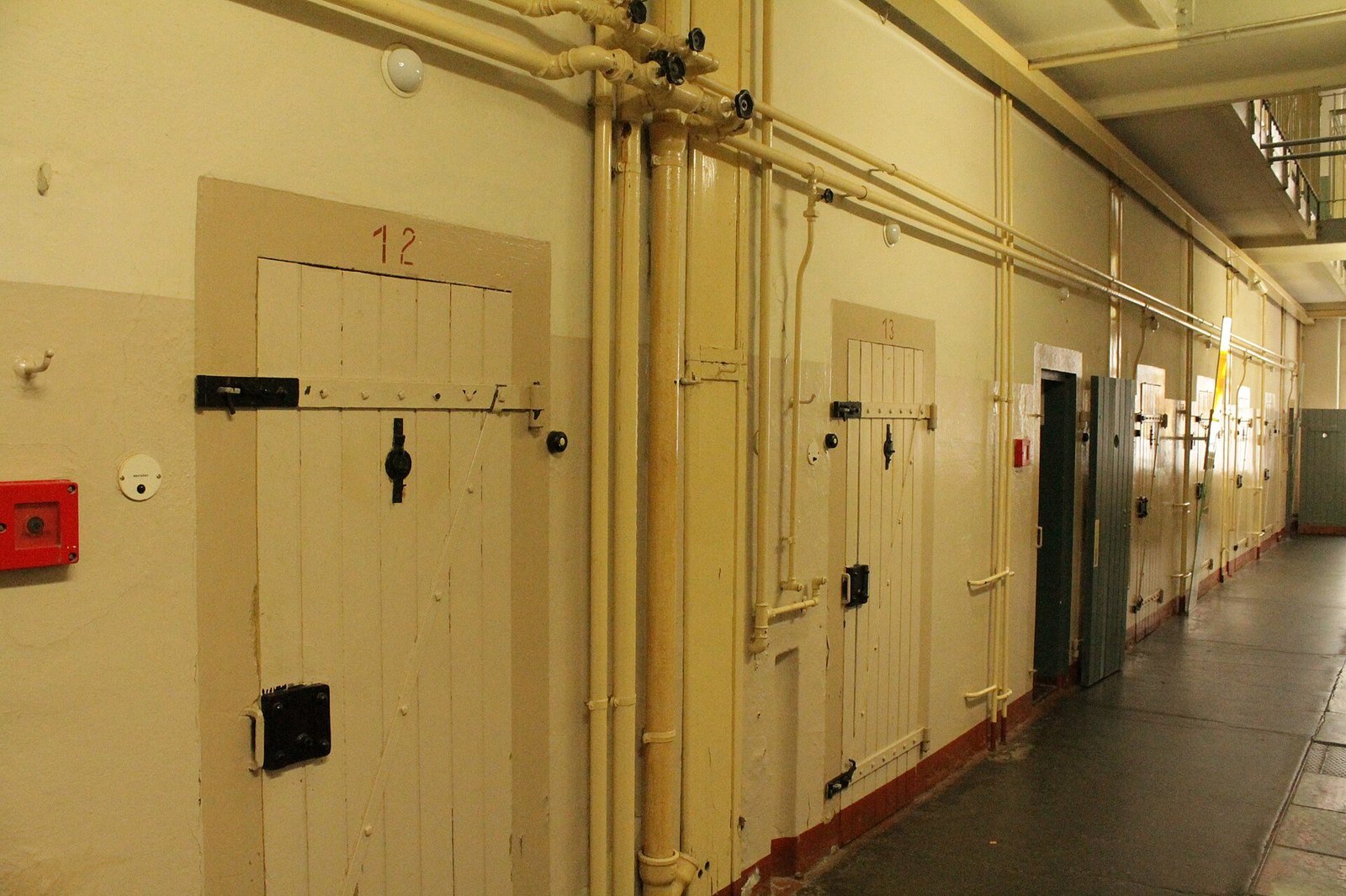
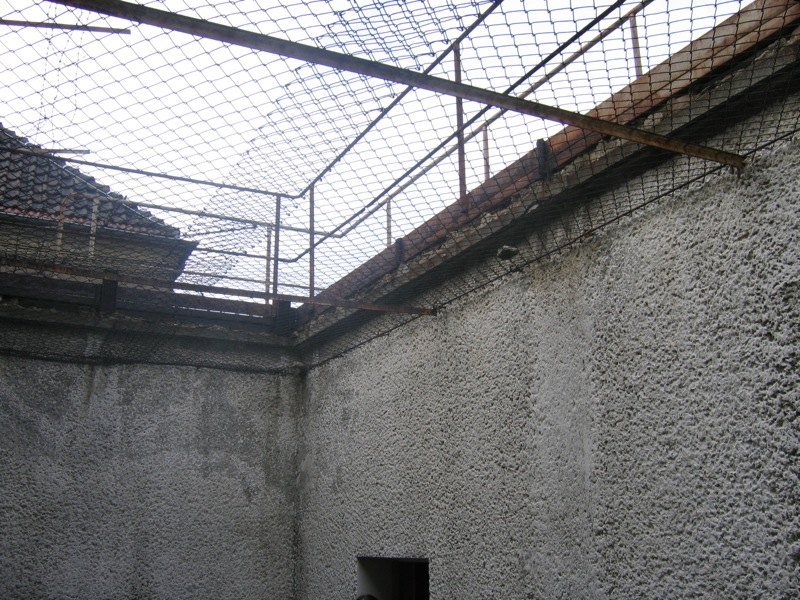
02The GDR’s prisons
Every prisoner the West bought was someone the GDR had jailed for political reasons, and each was worth hard currency. Critics, Amnesty International among them, argued that this gave the state an incentive to arrest people it could later sell. The historian Jan Philipp Wölbern found strong indications that it did.
Supporters answered that every release ended a real prisoner’s suffering. The trade survived every change of government in Bonn from 1962 to 1989.


03Karl-Marx-Stadt to Herleshausen
Prisoners chosen for release were gathered at the Kaßberg prison in Chemnitz, then called Karl-Marx-Stadt. From there West German buses took them across the border at Herleshausen/Wartha.
So as not to be noticed, the buses carried GDR number plates on East German roads and West German plates in the Federal Republic. The driver only had to press a button on the dashboard to turn the plates over.
„Der Busfahrer brauchte nur einen Knopf am Armaturenbrett zu drücken, um die Nummernschilder umzudrehen.“Bundesregierung, “Häftlingsfreikauf – letztes Kapitel”

The way out, in four stops (not to scale)
The bus moves as you scroll. Its plates turn over at the border.
04The same channel
The prisoners were the smaller part. About 2,000 children were allowed to join their parents in the West, and roughly 250,000 family reunifications were arranged the same way: 7.4 for each of the 33,755 prisoners.
Who came out, 1963–1989: each square 500 people
33,755 political prisonersabout 2,000 childrenabout 250,000 family reunifications
05The bill
Bonn did not hand over cash for most of it. The money bought goods (oil, copper, coffee, butter, rubber) that were delivered to the GDR through the Diakonisches Werk of the Protestant Church. In East Berlin the business had a code name: “Kirchengeschäft B”.
The total covers the prisoners, about 2,000 children and the family reunifications together. No source splits it between them, and no two sources give quite the same figure.
Four sources, four readings of the total
That is why this story gives the total as a range, 3.4–3.5 billion DM, and never as one number. The exact sum of 3.44 billion DM is Geißel’s (1991); the others are rounded by the Bundesregierung, the Chronik der Mauer and the historian Wölbern.
06East Berlin, 1962–1989
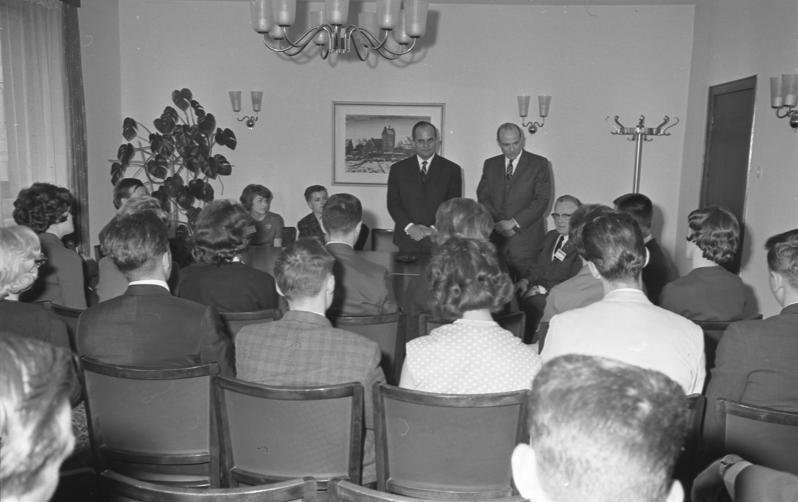
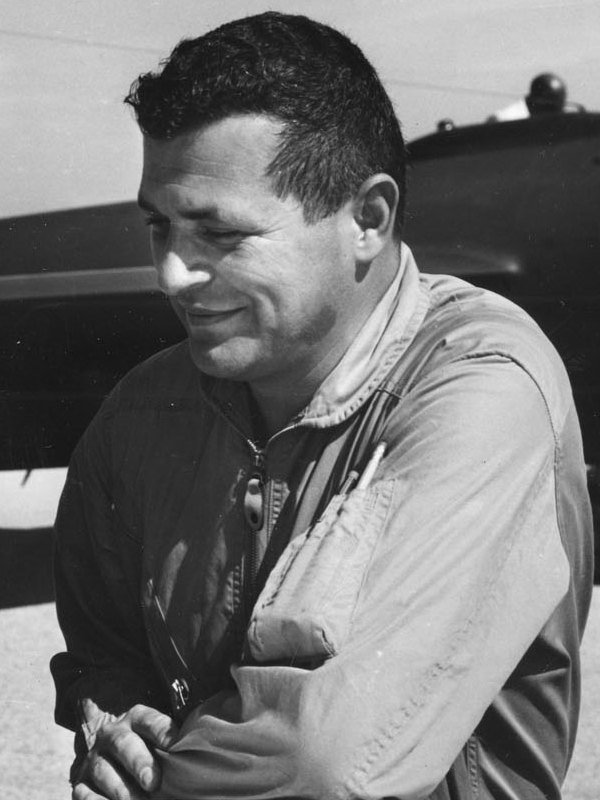
Wolfgang Vogel (1925–2008) brokered the trade from the first release at Christmas 1962 to the end. He also arranged the prisoner exchanges on Glienicke Bridge: Powers in 1962, 23 for 4 in 1985, Sharansky in 1986.
Vogel had once been registered as an informer of the Stasi, and he had a direct line to its leadership through his handler, Heinz Volpert. Bonn, for its part, paid him a yearly lump sum of about 320,000 DM.
In 1996 a Berlin court convicted him of perjury, extortion and forgery and gave him a suspended sentence. In 1998 the Federal Court of Justice acquitted him of extortion.

Vogel’s years at the table, 1962–1989


0723 January 1990 – 24 September 1990
By January 1990 there were no political prisoners left in East German jails, but the last bill was still open: goods worth 65 million DM. The Diakonisches Werk confirmed the delivery on 23 January 1990; the goods arrived on 24 September 1990, 244 days later.
The vans in the last delivery, one block each.
For 27 years, freedom in divided Germany had a price, and the Federal Republic paid it 33,755 times.
Press & citation
Free to publish under CC BY 4.0 — in print, online, on Wikipedia and in teaching, commercially or not — with credit to Berlinfographics and a link to this page.
Ready-to-use image
The infographic as one image: headline, key figures, chart, sources and credit, 2,400 × 1,350 px PNG. Please use it unedited.
Download landscape (PNG)
Square format
A 1:1 version for social media and narrow columns, 1,800 × 1,800 px.
Download square (PNG)
Portrait 4:5
For Instagram and LinkedIn feeds, 1,620 × 2,025 px.
Download portrait (PNG)Credit line
Berlinfographics (berlinfographics.com), CC BY 4.0
Citation
Berlinfographics (2026). “Häftlingsfreikauf: West Germany buys East Germany's political prisoners, 1962–1990”. Berlin Experiences. https://berlinfographics.com/haftlingsfreikauf/
Wikipedia
{{cite web |title=Häftlingsfreikauf: West Germany buys East Germany's political prisoners, 1962–1990 |url=https://berlinfographics.com/haftlingsfreikauf/ |website=Berlinfographics |publisher=Berlin Experiences |date=2026-11-05 |access-date=2026-11-05}}
Our infographics, charts and texts are licensed CC BY 4.0: free to republish, including commercially, with credit to Berlinfographics and a link. Photographs keep their own licences, named in each caption. How to credit
Topics: The Second World War · Cold War Berlin · Nazi Berlin · Persecution & the Holocaust · Weimar Berlin · Prussia & the Kaiserreich · Architecture & the built city · Culture, science & society · Reunified Berlin · Unusual facts
Contact: info@berlinfographics.com · Press: press@berlinfographics.com · Imprint · Privacy