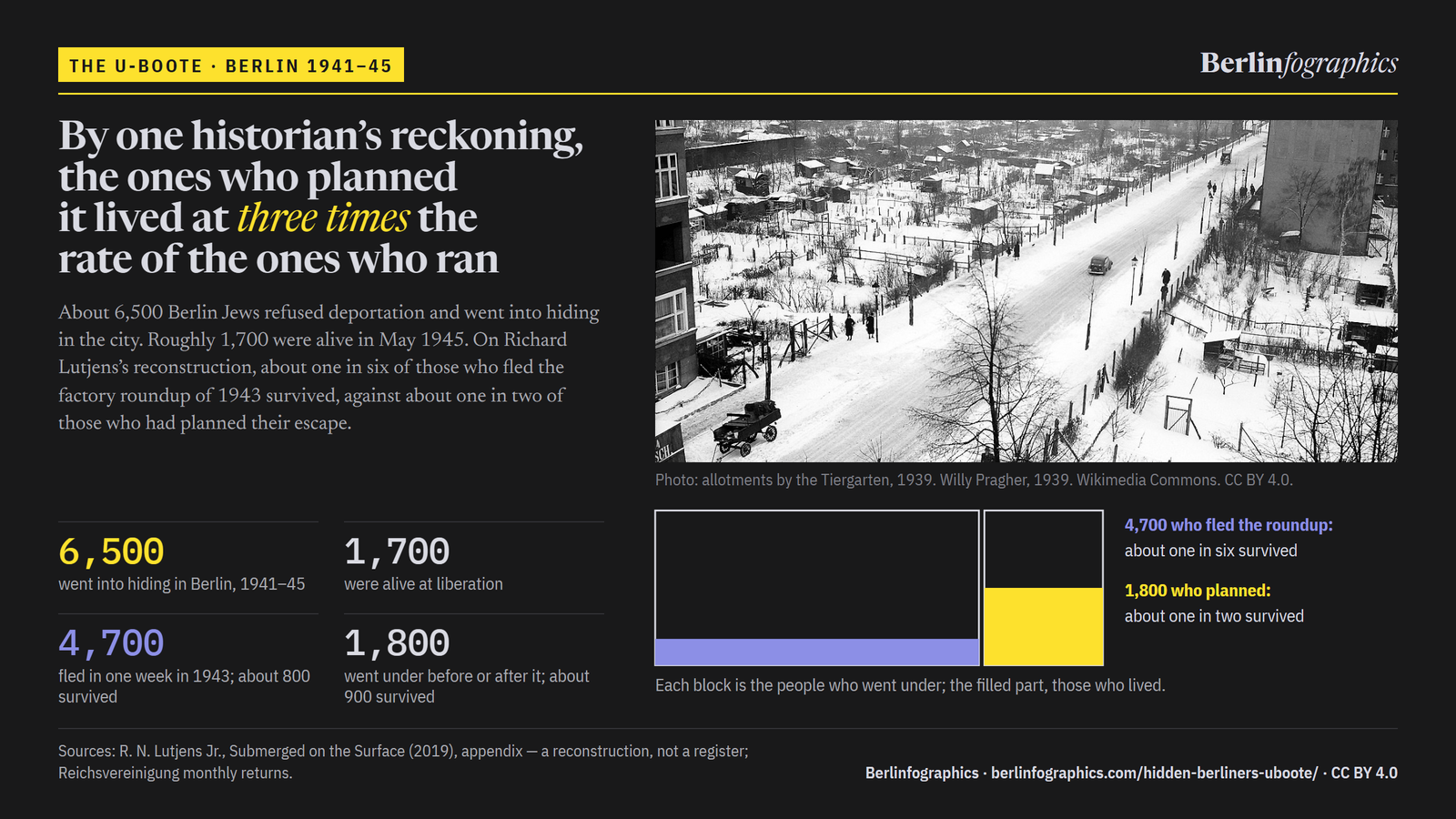
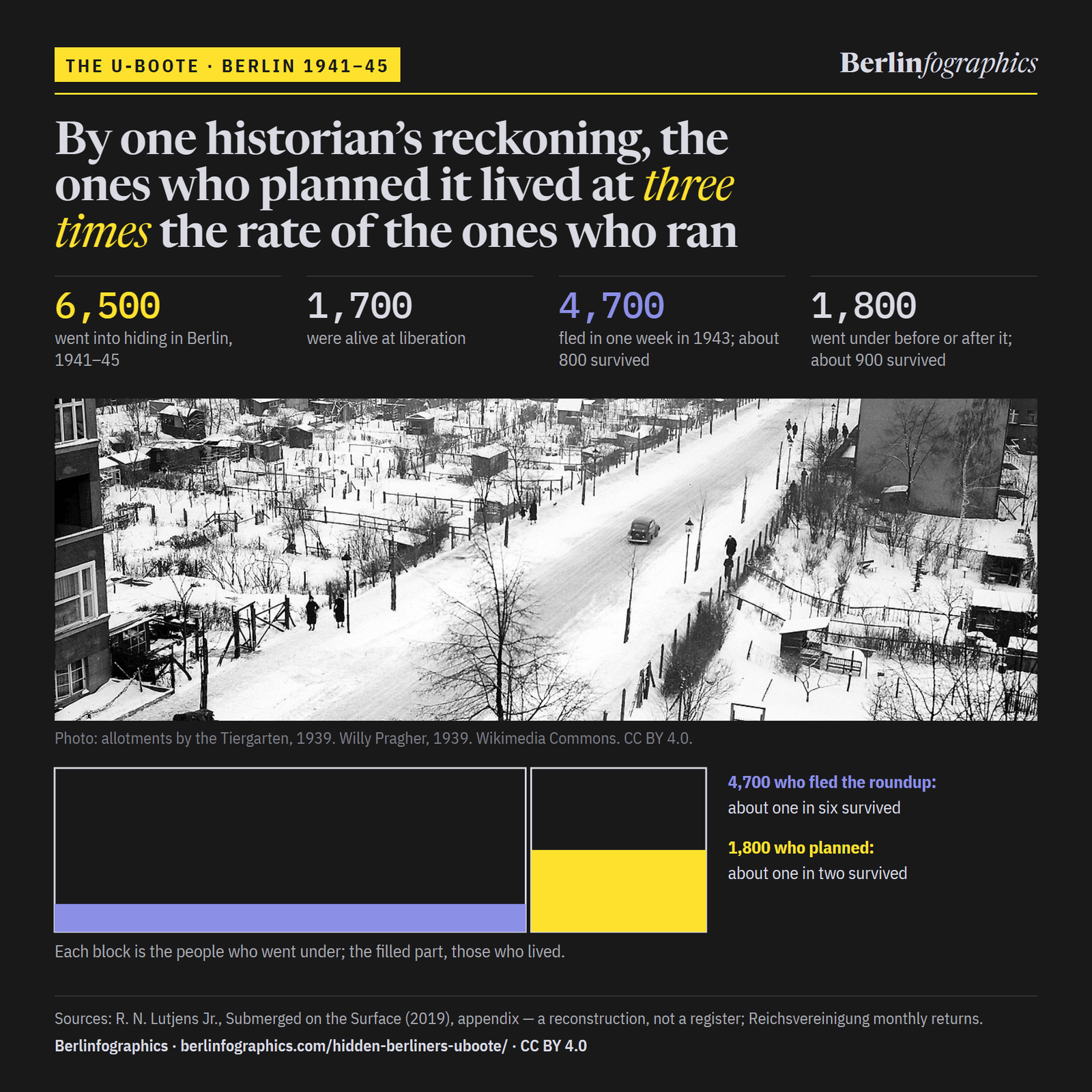
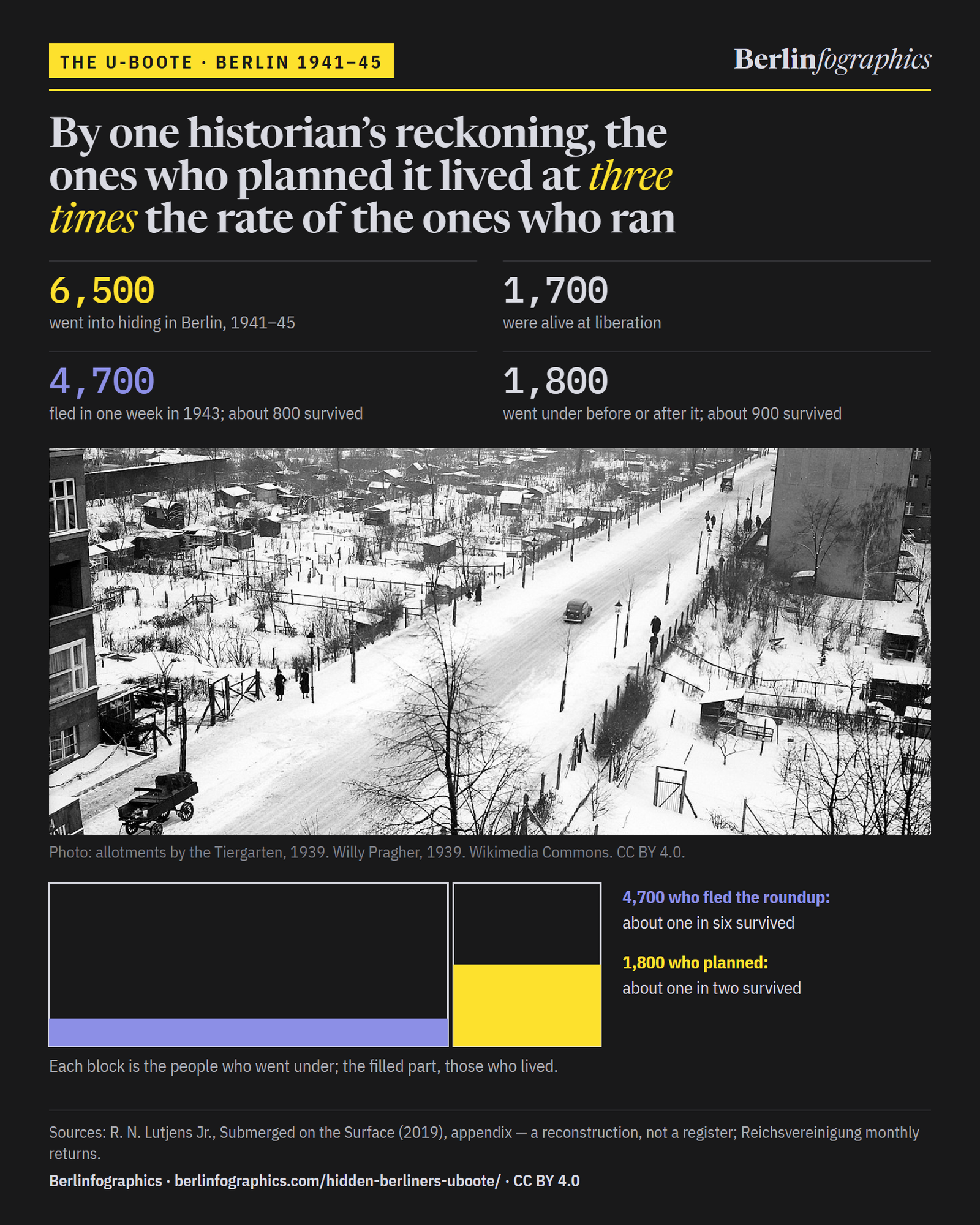
Allotment gardens beside the Tiergarten, seen from an upper-floor window in the snow of 1939. Berlin had tens of thousands of these plots, each with a shed; Hans Rosenthal spent two years in one of them.Photo: Willy Pragher, 1939. Wikimedia Commons. CC BY 4.0.
The U-Boote · Berlin 1941–45
About 6,500 Berlin Jews refused their deportation and disappeared into the city — into cellars, allotment sheds, spare rooms and forged names. They were called U-Boote, “submarines”. Roughly 1,700 were still alive in May 1945.
011933 – May 1945
Berlin had about 160,000 Jews in 1933, the year the Nazis came to power. The squares that follow are that community, drawn to area, at the dates its own officials counted it, and then the people who tried to vanish rather than board a train.
The numbers for those who hid are not a register. They are the historian Richard Lutjens’s reconstruction from arrest and deportation records, and other historians count differently; where they disagree, every count is shown.
Berlin’s Jewish community, drawn to area
1933
Berlin’s Jewish community in 1933, the year the Nazis came to power: about 160,000 people.
18 October 1941
The first transport left from Grunewald station on 18 October 1941. The community’s monthly return for October counted 65,479: 7,393 fewer than in September.
December 1942
Fourteen months of transports later, the return for December 1942 counted 32,999.
April 1943
April 1943 — the last monthly return: 17,810. The returns stop there; the Reichsvereinigung was dissolved in June 1943.
1941–45
Of those, 4,700 fled during the Fabrikaktion week, the Fabrikaktion, “factory operation”, when the Gestapo emptied the factories of their Jewish forced labourers. The other 1,800 went under before or after it.
May 1945 · Lutjens’s reconstruction
By Lutjens’s estimate about 800 of the 4,700 who ran in that week survived: about one in six. Of the 1,800 who had a room arranged and papers waiting, about 900: about one in two.
On Lutjens’s reconstruction, more people survived from the small column than from the large one.
1946 – 2019
8 May 1945
At liberation about 8,300 Jews were alive in Berlin. 56.6% never deported — a mixed marriage, or counted as “Mischlinge”, the regime’s term for people of partly Jewish descent; 22.9% came back from the camps; 20.5% had been hidden. The last group is the 1,700.
0227 February – 6 March 1943
Between 27 February 1943 and 6 March 1943 the Gestapo seized the Jews still working in Berlin’s factories. About 4,700 fled instead: roughly two in five of the Jewish workers still in the factories. That one week accounts for nearly three-quarters of everyone who went under in Berlin.
There was no time to arrange anything. Within days the deportations went on: the 36th “Osttransport”, eastern transport, left for Auschwitz on 12 March 1943; the fourth “großer Alterstransport”, large transport of the elderly, left for Theresienstadt on 17 March 1943.
In the transports that followed the operation, 8,658 people were deported from Berlin. About 1,100 of them had tried to hide and been caught.

Berlin’s Jews, as the community counted them each month, January 1941 – April 1943
The Reichsvereinigung der Juden in Deutschland filed a return for Berlin every month; they run from January 1941 to April 1943. Between February 1943 and March 1943, the month of the factory roundup, the count fell by 8,766. Nobody counted again until liberation.
When the survivors went under
Of the survivors whose date of going under is known (425 dated testimonies), two-thirds went under between October 1942 and March 1943. Each band spans its months; its area is its share. Later flights were small: in a roundup in January 1944 of those no longer protected by a mixed marriage, 205 fled; between September 1943 and February 1945 the records list 273 people as “flüchtig”, absconded.
03The helpers
The historian Beate Kosmala of the German Resistance Memorial Center put the number of Berliners who helped at around 30,000. It is not a register: it is the room, the meal, the papers, the errand and the silence, multiplied out. In all of Germany only about 3,000 helpers are known by name. Most were aged 40–50; close to two-thirds of those named were women.
Helping could cost everything.
Agnes Wendland, a pastor's wife in Prenzlauer Berg, hid Ralph and Rita Neumann and was arrested when Rita was taken.
Ida Jauch, who took Hans Rosenthal into her garden shed, died in 1944 and did not see him survive.


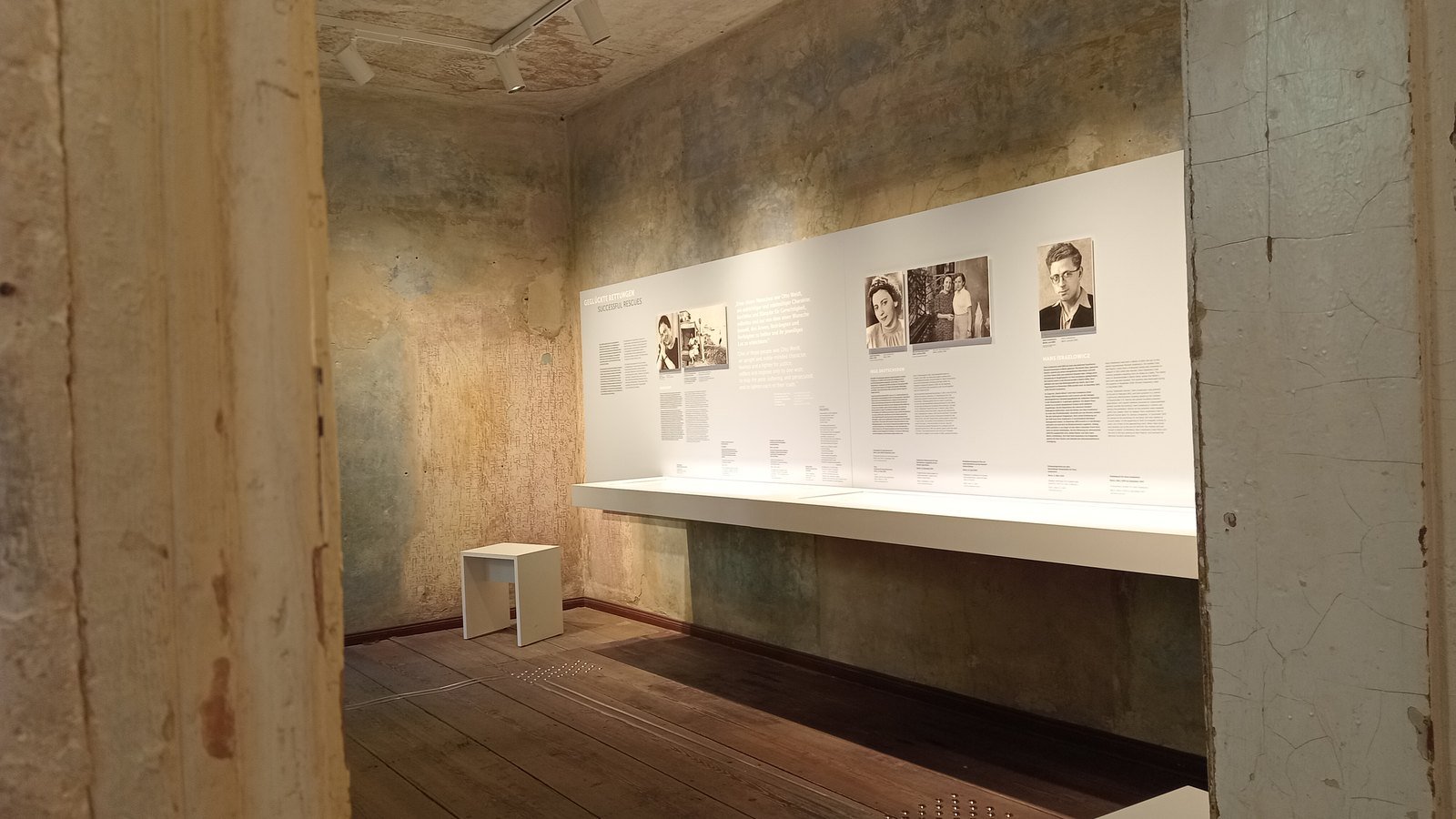
Otto Weidt ran a workshop for brooms and brushes in Mitte, with blind and deaf Jewish workers, and hid some of them when the deportations reached them. One of his workers, Inge Deutschkron, is among the eight lives below. The family hidden in the room behind the cupboard, Chaim, Machla, Max and Ruth Horn, was discovered in October 1943 and deported to Auschwitz.


04Eight people
Their stories are documented by the memorials and archives that hold them. Seven of the eight came through in hiding. The eighth was caught, and she stands for the larger number.
Eight people in hiding, June 1942 – May 1945
September 1942 – September 1943
Graphic artist; forged papers. Parents Fanja and Boris deported and murdered June 1942. Forged passes in a rented shop in Moabit; left Berlin on a forged Wehrpass, a military pass, and a faked leave certificate.
Helped by Ludwig Lichtwitz, Werner Scharff
Reached Switzerland by bicycle, early October 1943.
June 1942 – April 1945
Student; refused her deportation. At Kaulsdorf from the end of April 1943. Dictated her account onto 77 tapes for her son Hermann Simon shortly before her death.
Helped by Gerrit Burgers
Survived in Berlin.
January 1943 – May 1945
Worked at Otto Weidt's Blindenwerkstatt. Went under with her mother Ella on the Gumz family's initiative. Weidt obtained a non-Jewish woman's employment book and had works papers forged in the name Richter.
Helped by Otto Weidt, the Gumz family, Ella Deutschkron
Survived, as "Inge Richter", in Potsdam.
February 1943 – March 1945
Forced labour at Osram; under with his sister Rita. Mother Gertrud seized in their former Levetzowstraße flat, died in custody June 1943.
Helped by the farmer Fleischer (Melchow), Agnes Wendland, Dr. Aub, Elisabeth Abegg, Harald Poelchau
Arrested in a police check; he and Rita escaped from the Iranische Straße hospital during an air raid, late March 1945.
February 1943 – April 1945
Musician, born Breslau 1922. Organist at the Wedding crematorium while hidden. Parents Margarete and Manfred deported to Auschwitz and murdered. Founded the Berliner Barock-Orchester in 1953 and led it to 1997.
Helped by Ursula Meißner, Harald Poelchau, Ellen Brockmann, Gottfried von Einem, Edwin Fischer, Leo Borchard, Ruth Andreas-Friedrich, Anne-Lise Harich
Survived in Berlin; escaped the collection camp 23 November 1943.
January 1943 – April 1945
With Walter, and Reha, born into hiding. Reha born 19 January 1943, delivered with the help of the Jewish doctor Benno Heller. Maria Nickel, a stranger, gave them her postal identity card and her husband's driving licence, and later registered Reha as her own daughter so the sick child could be treated. Yad Vashem honoured Maria Nickel as Righteous Among the Nations.
Helped by Maria Nickel, Willi Nickel, Benno Heller
All three survived.
March 1943 – April 1945
Hidden in a garden shed in Berlin-Lichtenberg. In the Gartenkolonie "Dreieinigkeit". Ida Jauch died in 1944; Maria Schönebeck fed him afterwards, and Emma Harndt brought newspapers and the war news. Liberated when the Red Army took Lichtenberg, 25 April 1945. The 4 m² shed is his own memoir's figure.
Helped by Ida Jauch, Maria Schönebeck, Emma Harndt
Survived; liberated in the garden colony.
January 1943 – May 1945
Née Bendheim; went under alone. Went under after her mother Auguste and brother Ralph were seized; her mother's last message, passed by a neighbour: “Versuche, dein Leben zu machen” — “try to make your life”. Fifteen months hidden, through some sixteen places. Auguste and Ralph were murdered at Auschwitz.
Arrested — Deported to Theresienstadt; survived.
Margot Friedländer is not one of the 1,700. She was caught. Of every four people who went into hiding in Berlin, three did not survive.

Margot Friedländer is not one of the 1,700. She was caught. Of every four people who went into hiding in Berlin, three did not survive.
Margot Friedländer (née Bendheim; went under alone): hidden for 15 months. Arrested, April 1944. Deported to Theresienstadt; survived.
05May 1945
Lutjens’s profile of the survivors who had hidden rests on 1,074 individuals (63 % of survivors). Set beside the community’s own census of 1939, it shows who could survive a life underground, and who could not.
56.6% were never deported, protected by a mixed marriage or counted as “Mischlinge”; 22.9% came back from the camps; 20.5% had been hidden.
Almost exactly the community’s own proportions. Historians read this not as women and men hiding alike, but as more men going under and more men being caught.
The average survivor was 37 (women) or 39 (men). The people who could not run were the people who did not survive.

The people in this story were not hidden by a resistance movement. They were hidden by a landlady, a chaplain, three women with an allotment, a stranger on a street who handed over her own identity card. Almost none of them were ever counted, and most of their names are gone.
What can be counted is the arithmetic at the top of this page: about six and a half thousand people in Berlin decided not to go when they were called, and about seventeen hundred of them were still alive when it ended.
Press & citation
Free to publish under CC BY 4.0 — in print, online, on Wikipedia and in teaching, commercially or not — with credit to Berlinfographics and a link to this page.
Ready-to-use image
The infographic as one image: headline, key figures, chart, sources and credit, 2,400 × 1,350 px PNG. Please use it unedited.
Download landscape (PNG)
Square format
A 1:1 version for social media and narrow columns, 1,800 × 1,800 px.
Download square (PNG)
Portrait 4:5
For Instagram and LinkedIn feeds, 1,620 × 2,025 px.
Download portrait (PNG)Credit line
Berlinfographics (berlinfographics.com), CC BY 4.0
Citation
Berlinfographics (2026). “Hidden Berliners: the Jews who went under, 1941–45”. Berlin Experiences. https://berlinfographics.com/hidden-berliners-uboote/
Wikipedia
{{cite web |title=Hidden Berliners: the Jews who went under, 1941–45 |url=https://berlinfographics.com/hidden-berliners-uboote/ |website=Berlinfographics |publisher=Berlin Experiences |date=2026-11-05 |access-date=2026-11-05}}
Our infographics, charts and texts are licensed CC BY 4.0: free to republish, including commercially, with credit to Berlinfographics and a link. Photographs keep their own licences, named in each caption. How to credit
Topics: The Second World War · Cold War Berlin · Nazi Berlin · Persecution & the Holocaust · Weimar Berlin · Prussia & the Kaiserreich · Architecture & the built city · Culture, science & society · Reunified Berlin · Unusual facts
Contact: info@berlinfographics.com · Press: press@berlinfographics.com · Imprint · Privacy