Berlinfographicsby Berlin Experiences

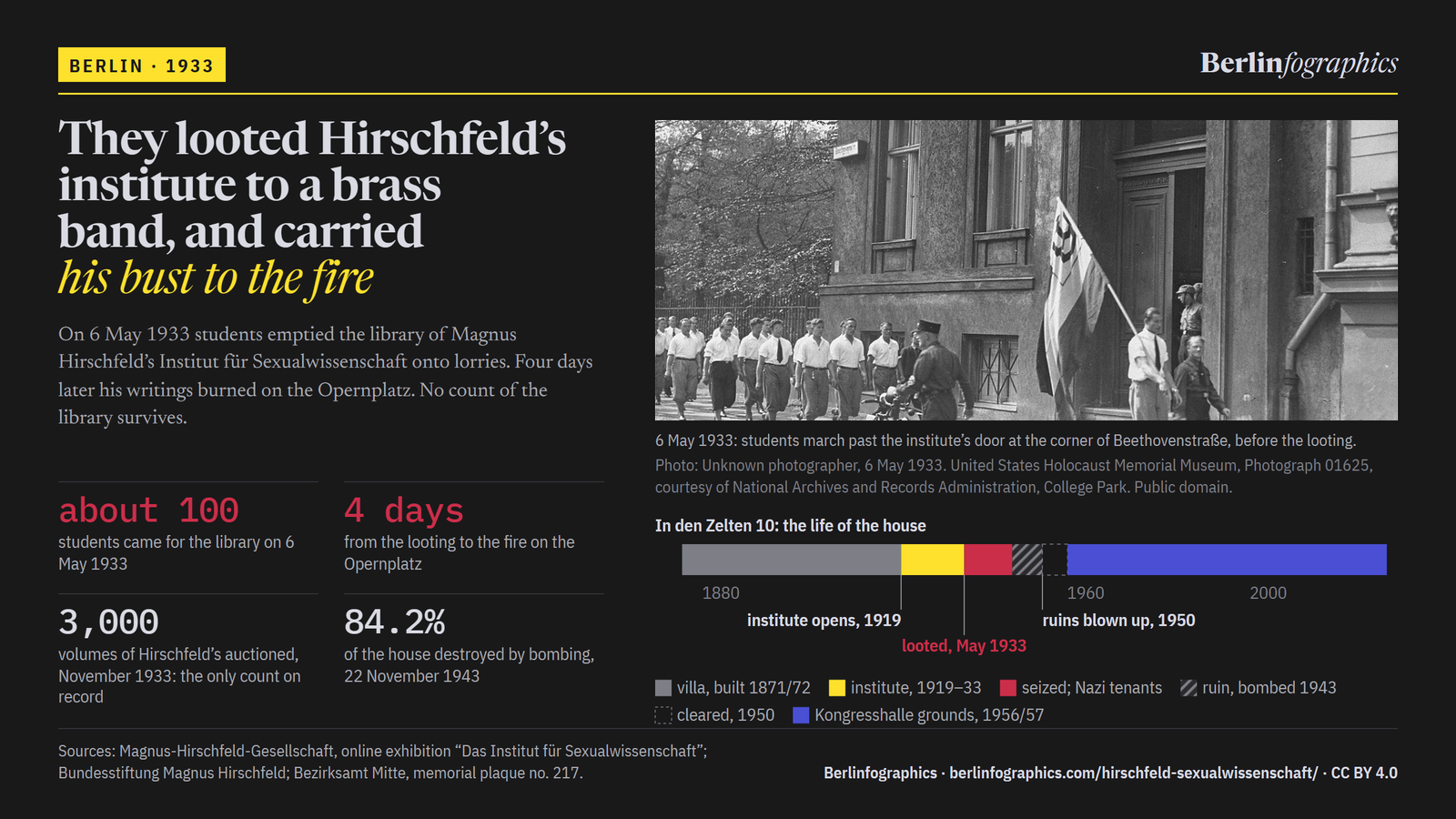
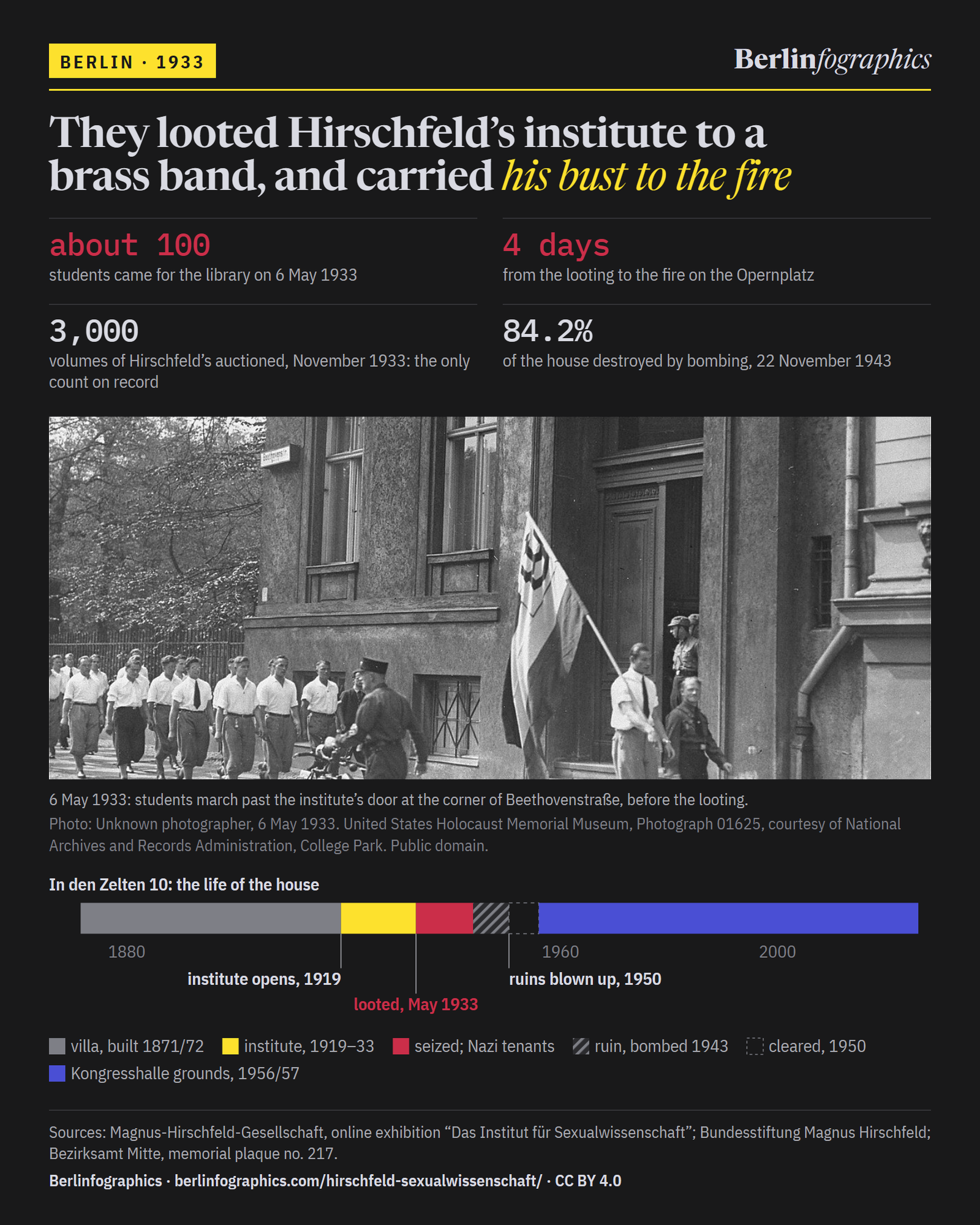
6 May 1933: students march past the institute’s door at the corner of Beethovenstraße, before the looting.Unknown photographer, 6 May 1933. United States Holocaust Memorial Museum, Photograph 01625, courtesy of National Archives and Records Administration, College Park. Public domain.

Institut für Sexualwissenschaft

They looted Hirschfeld’s institute to a brass band, and carried his bust to the fire on a stick

On 6 May 1933 students sealed off Magnus Hirschfeld’s Institut für Sexualwissenschaft in Berlin and emptied its library onto lorries. Four days later his writings burned on the Opernplatz. Hirschfeld, already abroad, saw the film of it in a cinema in France.

about 100
sports students came for the library on the morning of 6 May 1933, with lorries and a brass band
4 days
from the looting to the fire on the Opernplatz
3,000
volumes of Hirschfeld’s, sold at a tax-office auction in November 1933: the only count on record
84.2%
of the house destroyed in the air raid of 22 November 1943

01In den Zelten 10, Tiergarten

A violinist’s villa became a clinic, a library and a museum of sex

Magnus Hirschfeld was a Berlin doctor who had founded the Wissenschaftlich-humanitäres Komitee in 1897 to campaign against Paragraph 175, the law that made sex between men a crime. On 6 July 1919 he opened the Institut für Sexualwissenschaft in a house he had bought for 400,000 Mark: the Villa Joachim at In den Zelten 10, on the edge of the Tiergarten, built in 1871/72 for the violinist Joseph Joachim.

It gave advice and treatment, ran research and lectures, and housed a library, an archive and a public museum. In 1929 the campaign came closest: a Reichstag committee voted to repeal Paragraph 175, but the motion never reached a vote in parliament before the Nazis came to power.

“Die Institutsbibliothek war die größte sexualwissenschaftliche Bücherei der Welt.”“The institute’s library was the largest library of sexual science in the world.” Ludwig Levy-Lenz, a doctor at the institute, looking back.

A black-and-white portrait of a heavy-set man with a thick white moustache and round glasses, in a dark suit.
Magnus Hirschfeld in 1928, nine years after he opened the institute.Photo: Magnus Hirschfeld, 1928. Photographer unknown. Public domain.
A coloured chalk drawing of a young man with dark hair, head turned in three-quarter profile.
The violinist Joseph Joachim, drawn by Adolph Menzel in 1854. The villa at In den Zelten 10 was built for him in 1871/72.Adolph von Menzel, 1854. Wikimedia Commons. Public domain.

02The life of a house

Not quite fourteen years as an institute, ten as a Nazi address

The bar below is the house’s life on one scale of years. For 1933 the scale opens out to a single year, so that the looting, the fire, the closure and the auction sit on their own dates. Where a source gives only a month, the mark spans the month.

In den Zelten 10: the life of a house

A time line of the house at In den Zelten 10 on one linear scale of years: a violinist's villa from 1871/72, Hirschfeld's institute from 1919, seized in 1933 and let to Nazi organisations, bombed in 1943, blown up in 1950, and built over for the Kongresshalle grounds. For 1933 the scale zooms to a single year, with the looting, the burning, the closure and the auction marked on their dates, and a second lane showing where Hirschfeld was.
villainstituteseized, Nazi useruinKongresshalle grounds
A coloured chalk drawing of a young man with dark hair, head turned in three-quarter profile.
The violinist Joseph Joachim, drawn by Adolph Menzel in 1854. The villa at In den Zelten 10 was built for him in 1871/72. Adolph von Menzel, 1854. Wikimedia Commons. Public domain.

1871/72

A violinist’s villa

The house at In den Zelten 10, on the corner of Beethovenstraße, was built in 1871/72 for the violinist Joseph Joachim.

A black-and-white portrait of a heavy-set man with a thick white moustache and round glasses, in a dark suit.
Magnus Hirschfeld in 1928, nine years after he opened the institute. Magnus Hirschfeld, 1928. Photographer unknown. Public domain.

6 July 1919

Hirschfeld buys it for 400,000 Mark

The institute opens on 6 July 1919. In 1921 it buys No. 9a next door and turns its restaurant into a lecture hall.

mid-1932

The founder is already abroad

After a lecture tour round the world, Hirschfeld stays in Switzerland from mid-1932. Karl Giese, who ran the archive, follows him into exile in 1932.

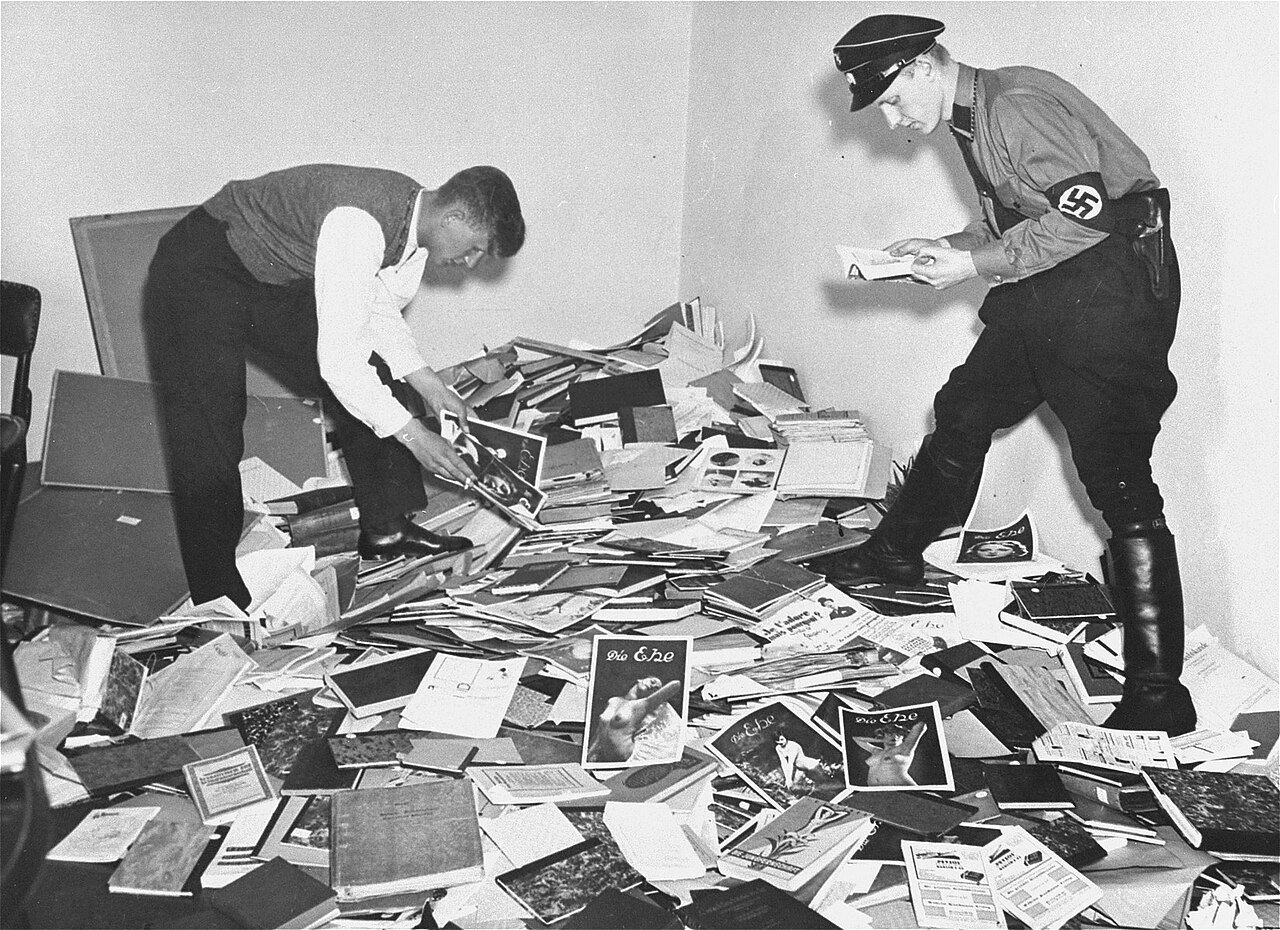
A black-and-white photograph: two young men stand at a table piled with books and journals, one in a black uniform reading a page, the other in a white shirt.
6 May 1933: two young men, one in Nazi uniform, go through publications taken from the institute’s library, among them issues of the journal Die Ehe. Unknown photographer, 6 May 1933. United States Holocaust Memorial Museum, Photograph 01628. Public domain.

6 May 1933

Lorries, a brass band and a trumpet signal

In the morning about 100 sports students of the Deutsche Studentenschaft seal off the house and, at a trumpet signal, loot the library. In the afternoon an SA troop takes what is left of the archive.

A black-and-white night photograph of a large bonfire of books in a square, a crowd standing around it.
The Opernplatz, 10 May 1933. Hirschfeld’s writings went into this fire. Unknown author, 1933. United States Holocaust Memorial Museum. Wikimedia Commons. Public domain.

10 May 1933

His bust on a stick

In the torchlight procession to the Opernplatz a student carries a bust of Hirschfeld spiked on a stick. His writings go into the fire with those of the other banned authors.

May 1933

He watches it in a cinema

At about the time of the looting Hirschfeld leaves Ascona for France. There, in a cinema, he sees film of his writings being burned in Berlin.

14 June 1933

Closed, confiscated, sold off

The Berlin police president closes the institute, and the property is confiscated without compensation; eight staff are still at work, unpaid. In November a 3,000-volume library of Hirschfeld’s is auctioned by the tax office.

1933–1943

A Nazi address

The tenants include the Institut zum Studium der Judenfrage. From 1938 the house serves a State Academy of Public Health that teaches racial hygiene.

A black-and-white photograph of roofless, gutted buildings with empty window openings behind bare trees.
In den Zelten in 1945: the bombed-out restaurants on the street where the institute stood. Bundesarchiv, Bild 183-M1015-321 / Donath, Otto / CC-BY-SA 3.0

22 November 1943

Bombed, then blown up

An air raid destroys 84.2% of the house. In 1950 the ruins are blown up and cleared.

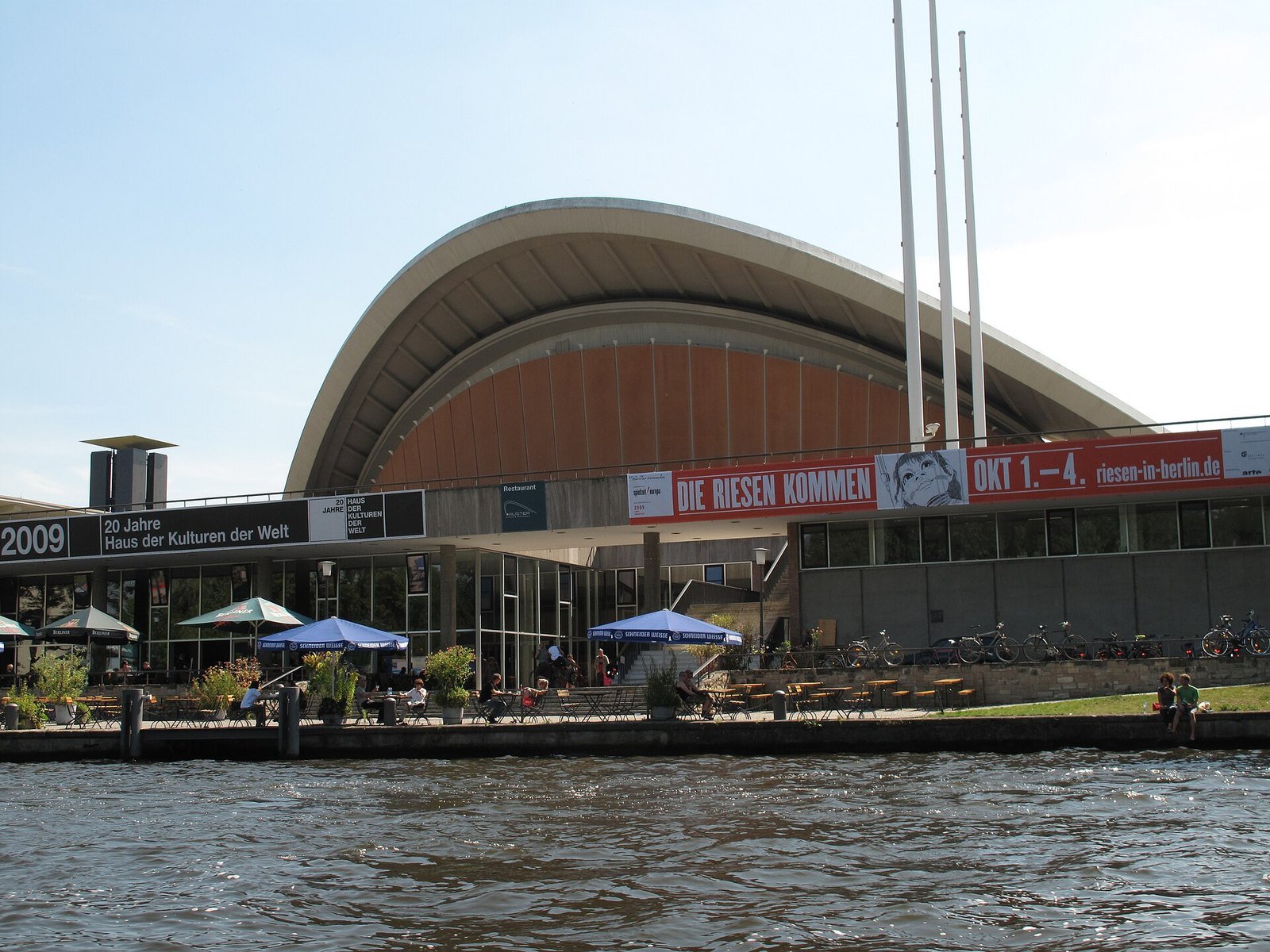
A colour photograph of a building with a huge sweeping curved concrete roof above a glass front, seen across the river, with cafe umbrellas along the bank.
The Kongresshalle, now the Haus der Kulturen der Welt, on the Spree. Part of the institute’s ground went under its grounds in 1956/57. Schlaier, 2008. Wikimedia Commons. Public domain.

1955–2008

57,000 DM, and a riverbank

In 1955 Berlin pays 57,000 DM for the plots; in 1956/57 part of the ground goes under the Kongresshalle grounds. Since May 2008 the Spree bank beside it has carried Hirschfeld’s name.

03The library

Nobody knows how many books they took

“Genauere Angaben gibt es nicht. Der Umfang der Bibliothek bleibt Legende.”

“There are no more precise figures. The size of the library remains a legend.” Magnus-Hirschfeld-Gesellschaft, the society that researches the institute’s history.

No catalogue of the library survives, and no inventory of what was taken on 6 May. Round figures for books, photographs and patient files circulate, but no record supports them. These are the counts the record does hold:

about 100
students came for the library, with lorries, on the morning of the looting
hundreds
of lantern slides in the picture archive, “all that was un-German destroyed”, reported the Centre Party newspaper Germania, the next day
3,000
volumes in a library of Hirschfeld’s sold at a tax-office auction in November 1933, reported by the Wiener Neue Journal
A black-and-white photograph: two young men stand at a table piled with books and journals, one in a black uniform reading a page, the other in a white shirt.
6 May 1933: two young men, one in Nazi uniform, go through publications taken from the institute’s library, among them issues of the journal Die Ehe.Photo: Unknown photographer, 6 May 1933. United States Holocaust Memorial Museum, Photograph 01628. Public domain.

The looters were not only burning. The newspaper Germania reported the next day that the seized books and files would be examined by experts, so that works of value to medical science would not be destroyed.

What became of the rest is still not known. The society’s own conclusion: despite a few scraps of information, nothing concrete is known of where the institute’s holdings went.

04In exile

He never came back

Hirschfeld was not in Berlin for any of it. From mid-1932 he stayed in Switzerland; around the time of the looting he left Ascona for France. He was driven out and later stripped of his citizenship. He died in Nice on 14 May 1935, his 67th birthday.

Where Hirschfeld was, and what happened in Berlin, 1932–35

where Hirschfeld livedthe move to France: “in May 1933”, no day recordedNazi action against the institute

One scale of time throughout; months are placed only as precisely as the sources give them. Sources: MHG, Paris, MHG, Die letzten Tage, MHG, Chronologie 1933.

A black-and-white night photograph of a large bonfire of books in a square, a crowd standing around it.
The Opernplatz, 10 May 1933. Hirschfeld’s writings went into this fire.Photo: Unknown author, 1933. United States Holocaust Memorial Museum. Wikimedia Commons. Public domain.

A year to the day after the fire, on 10 May 1934, Hirschfeld was one of the speakers who opened the “Library of the Books Burned in Germany” in Paris. In November 1934 he moved to Nice.

His grave there carries his motto, PER SCIENTIAM AD JUSTITIAM: through science to justice.

The Opernplatz fire and the writers it named →

05The site today

Between the Chancellery and the House of World Cultures

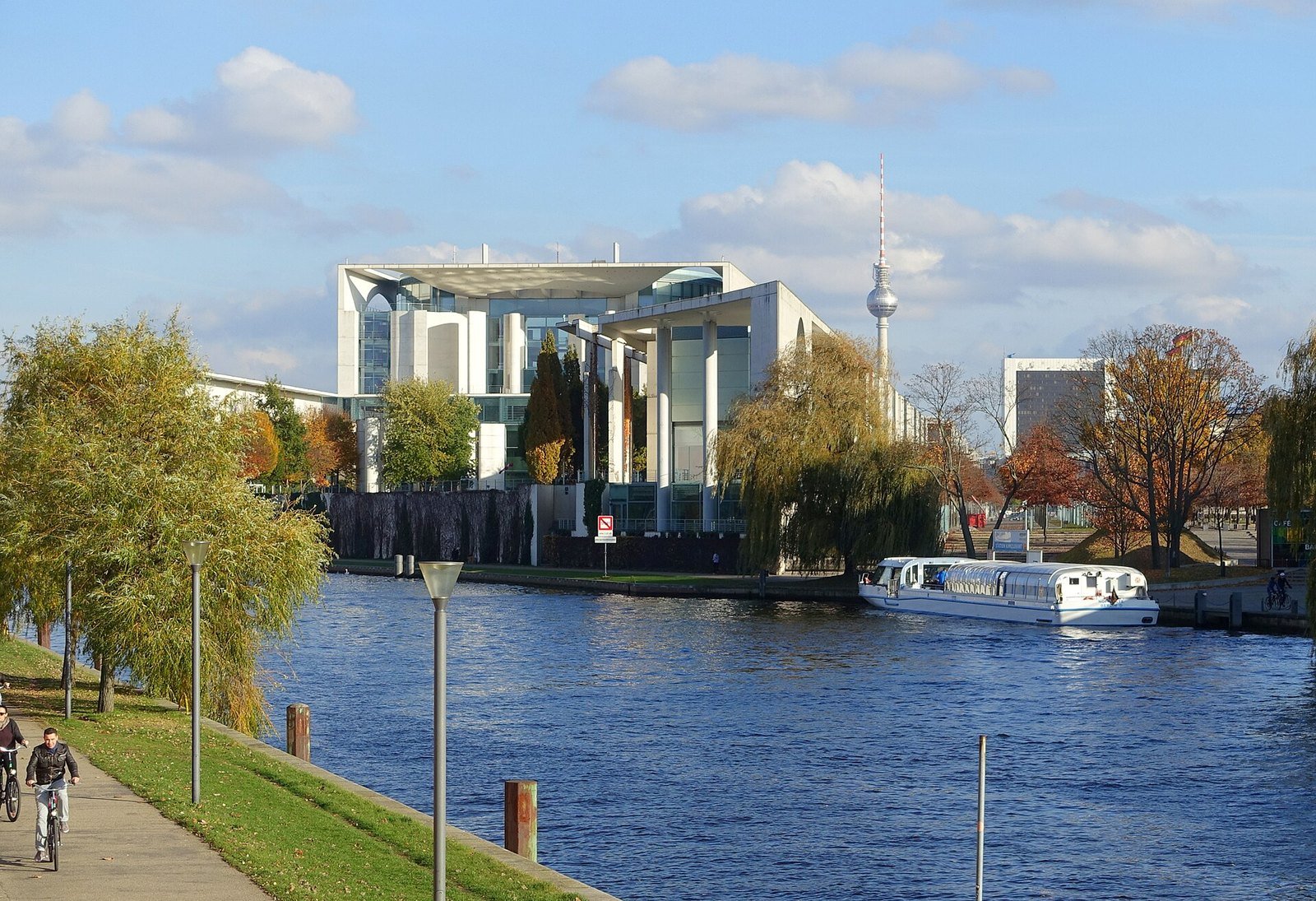
The institute stood on the ground between today’s Federal Chancellery and the Haus der Kulturen der Welt, the former Kongresshalle. A memorial stele stands on the Spree embankment, and since May 2008 that stretch of riverbank has been the Magnus-Hirschfeld-Ufer.

A colour photograph of a large white modern government building beside a river, with a riverside path, cyclists and autumn trees; the Berlin TV tower behind.
The Federal Chancellery across the Spree. The institute stood on the ground between the Chancellery and the Haus der Kulturen der Welt.Photo: Daderot, 2014. Wikimedia Commons. CC0.
A rust-brown steel stele with a curling white inscription plate stands beside a riverside path among plants.
The memorial stele for the institute on the Spree embankment near its site.Photo: Babewyn, 2016. Wikimedia Commons. CC BY-SA 4.0.

What happened to the men Hirschfeld’s committee had campaigned for is told in the story of Paragraph 175 and the Nollendorfplatz memorial.

Paragraph 175: the law that outlived Hitler →

Outside the door they gave Hitler a triple “Sieg Heil”. Nobody counted the books. The size of the library remains a legend.

Press & citation

Use this Berlinfographic

Free to publish under CC BY 4.0 — in print, online, on Wikipedia and in teaching, commercially or not — with credit to Berlinfographics and a link to this page.

The looting of Magnus Hirschfeld’s Institut für Sexualwissenschaft, 1933: ready-to-use landscape image

Ready-to-use image

The infographic as one image: headline, key figures, chart, sources and credit, 2,400 × 1,350 px PNG. Please use it unedited.

Download landscape (PNG)
The looting of Magnus Hirschfeld’s Institut für Sexualwissenschaft, 1933: square version

Square format

A 1:1 version for social media and narrow columns, 1,800 × 1,800 px.

Download square (PNG)
The looting of Magnus Hirschfeld’s Institut für Sexualwissenschaft, 1933: portrait version

Portrait 4:5

For Instagram and LinkedIn feeds, 1,620 × 2,025 px.

Download portrait (PNG)

Credit line

Berlinfographics (berlinfographics.com), CC BY 4.0

Citation

Berlinfographics (2026). “The looting of Magnus Hirschfeld’s Institut für Sexualwissenschaft, 1933”. Berlin Experiences. https://berlinfographics.com/hirschfeld-sexualwissenschaft/

Wikipedia

{{cite web |title=The looting of Magnus Hirschfeld’s Institut für Sexualwissenschaft, 1933 |url=https://berlinfographics.com/hirschfeld-sexualwissenschaft/ |website=Berlinfographics |publisher=Berlin Experiences |date=2026-11-09 |access-date=2026-11-09}}