
Berlinfographicsby Berlin Experiences

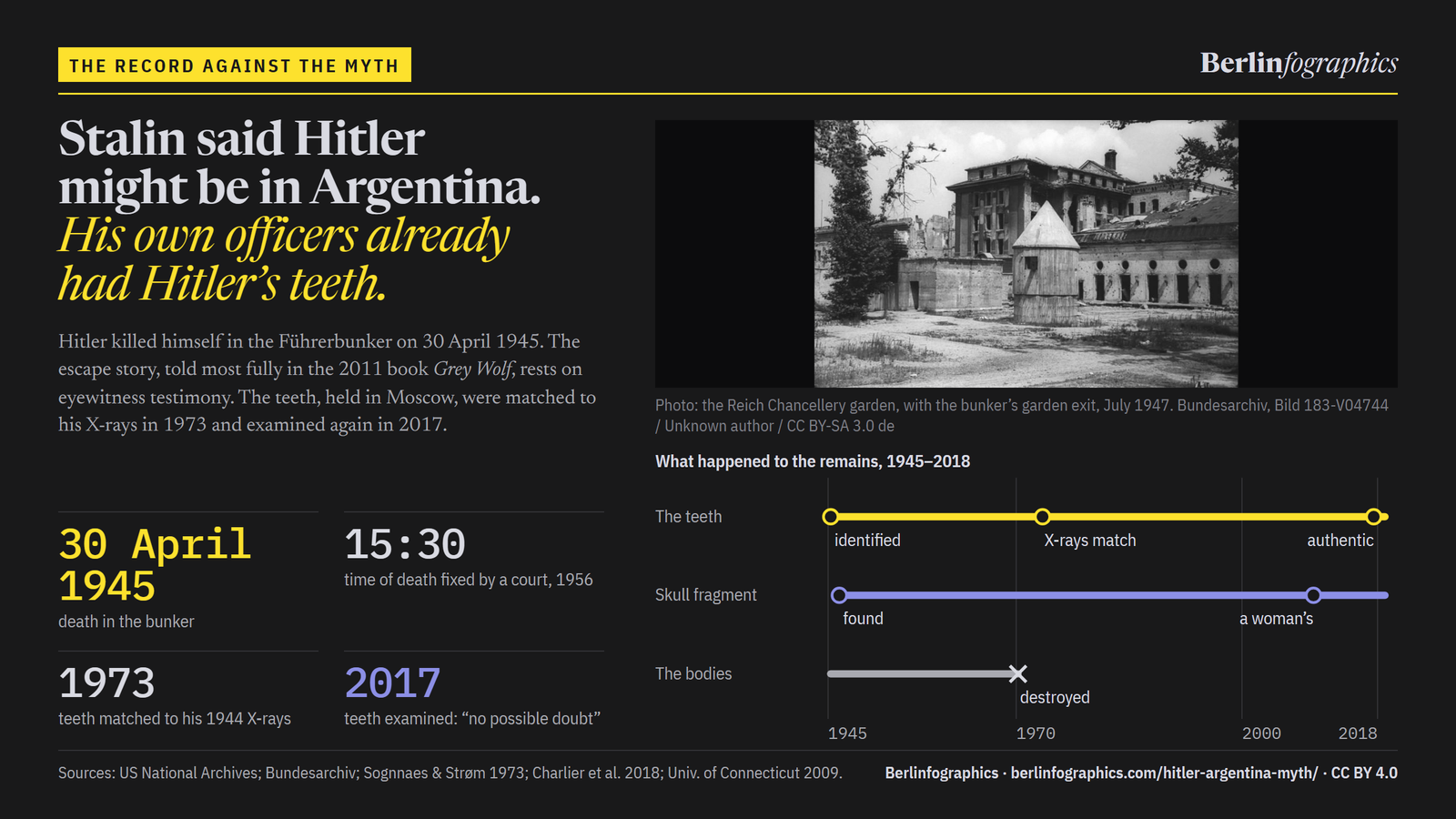
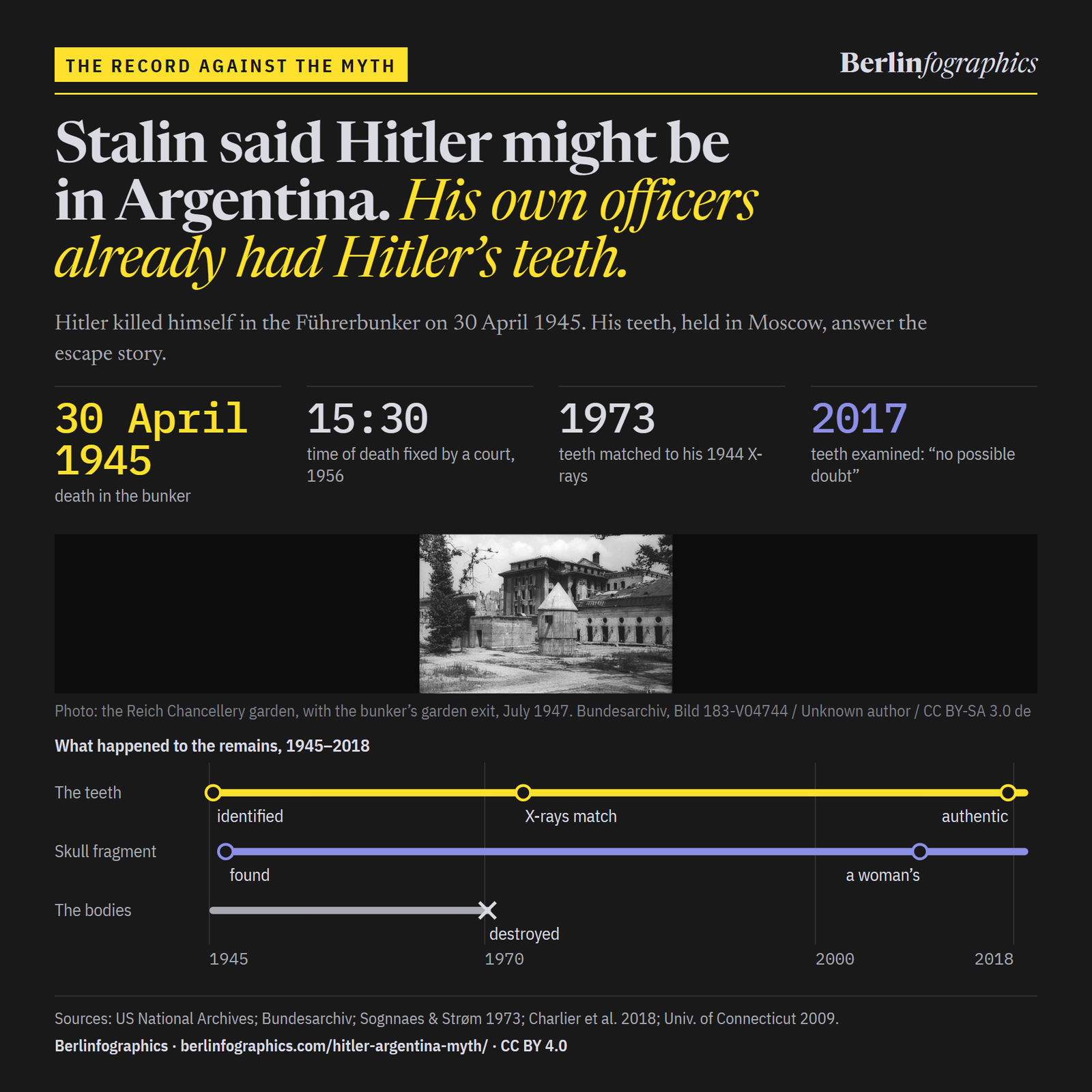
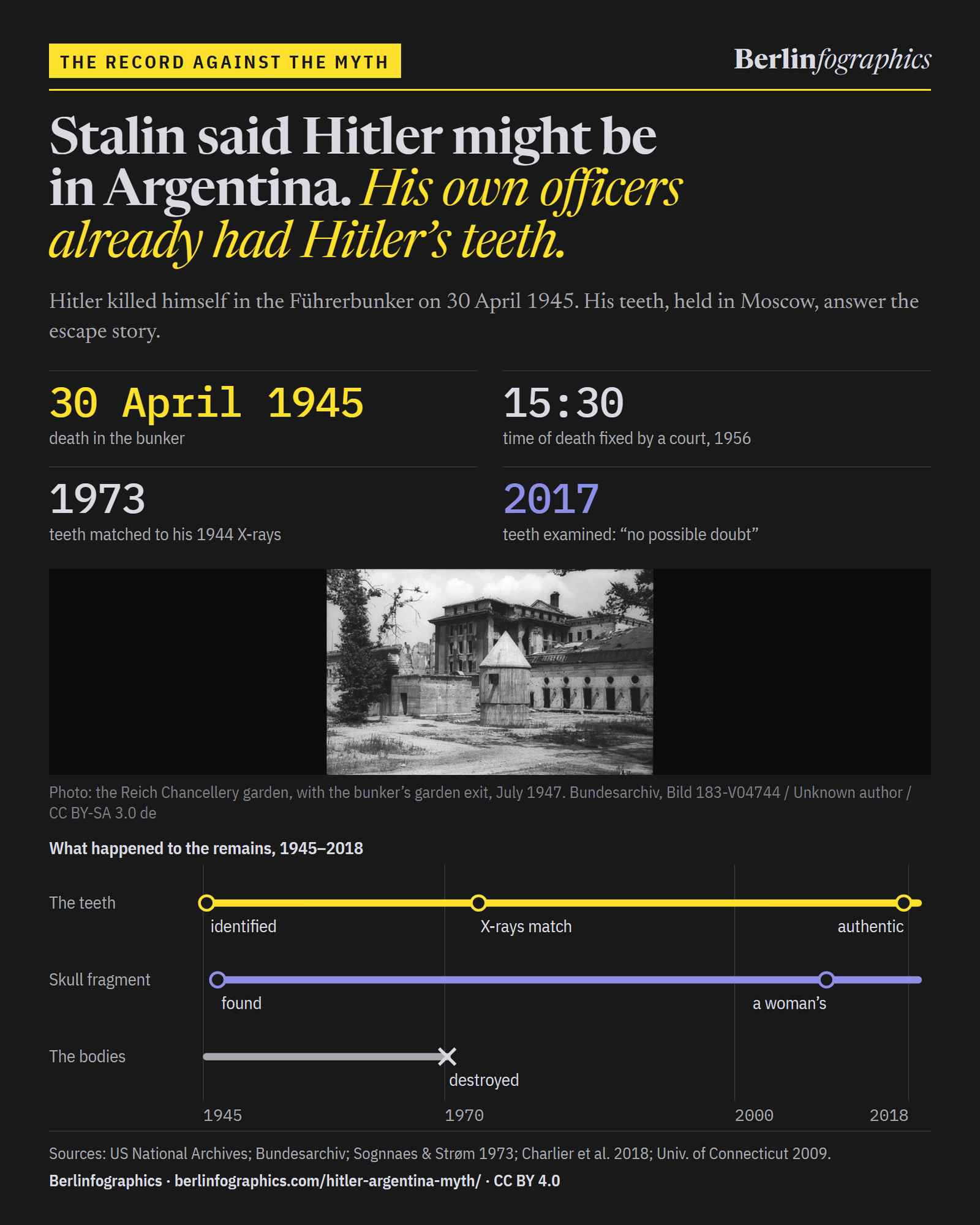
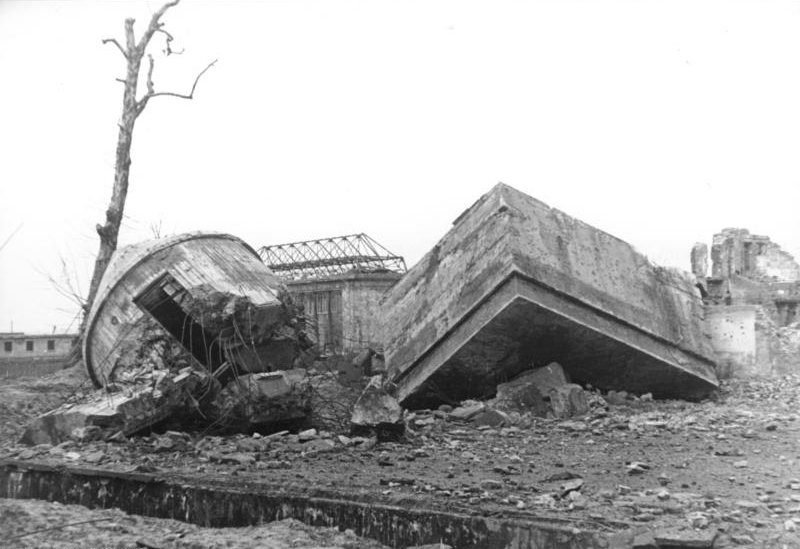
The garden of the ruined Reich Chancellery in July 1947, with the blockhouse of the bunker’s garden exit and a concrete tower in front. The bodies were carried out into this garden and burned.Bundesarchiv, Bild 183-V04744 / Unknown author / CC BY-SA 3.0 de

The record against the myth

Stalin said Hitler might be in Argentina. His own officers already had Hitler’s teeth.

Adolf Hitler killed himself in the Führerbunker on 30 April 1945. The story that he escaped began that summer and has never stopped; its fullest version is the book Grey Wolf, published in 2011. Here are its claims, set out as claims, and the evidence that answers them, each with its source.

30 April 1945
Hitler and Eva Braun kill themselves in the bunker
15:30
the time of death a West German court fixed in 1956, on the testimony of Linge and Günsche
11 May 1945
by this day the staff of Hitler’s dentist had identified his teeth for Soviet investigators
2017
French scientists examine the teeth in Moscow: “no possible doubt”

01The claim

The escape story, in its own words

In October 2011 Simon Dunstan and Gerrard Williams published Grey Wolf: The Escape of Adolf Hitler. Its case is that Hitler and Eva Braun did not die in Berlin but fled to Argentina. The book rests largely on eyewitness testimony. The British historian Guy Walters called it “2,000 per cent rubbish”.

Its claims are set out below exactly as claims, in italic and behind a broken outline, along the route the book describes. The route on the map is the book’s, not a documented journey.

The route Grey Wolf claims

A map of the Atlantic from Europe to South America. A dashed line, the route the book Grey Wolf claims, runs from Berlin to Reus in Spain, to the Canary Islands, across the ocean to the coast of Argentina and inland to Bariloche. Two solid dots at Mar del Plata mark where two real German U-boats surrendered in 1945.
the book’s claimed routedocumented: U-boats surrenderedLand: Natural Earth (public domain)
A black-and-white photograph of a ruined monumental building with a blown-up concrete shelter in front.
The destroyed Reich Chancellery, 1947.Bundesarchiv, Bild 183-M1204-318 / Otto Donath / CC BY-SA 3.0 de

Berlin

Doubles in the bunker

A body double took Hitler's place in the bunker, and an actress stood in for Eva Braun.

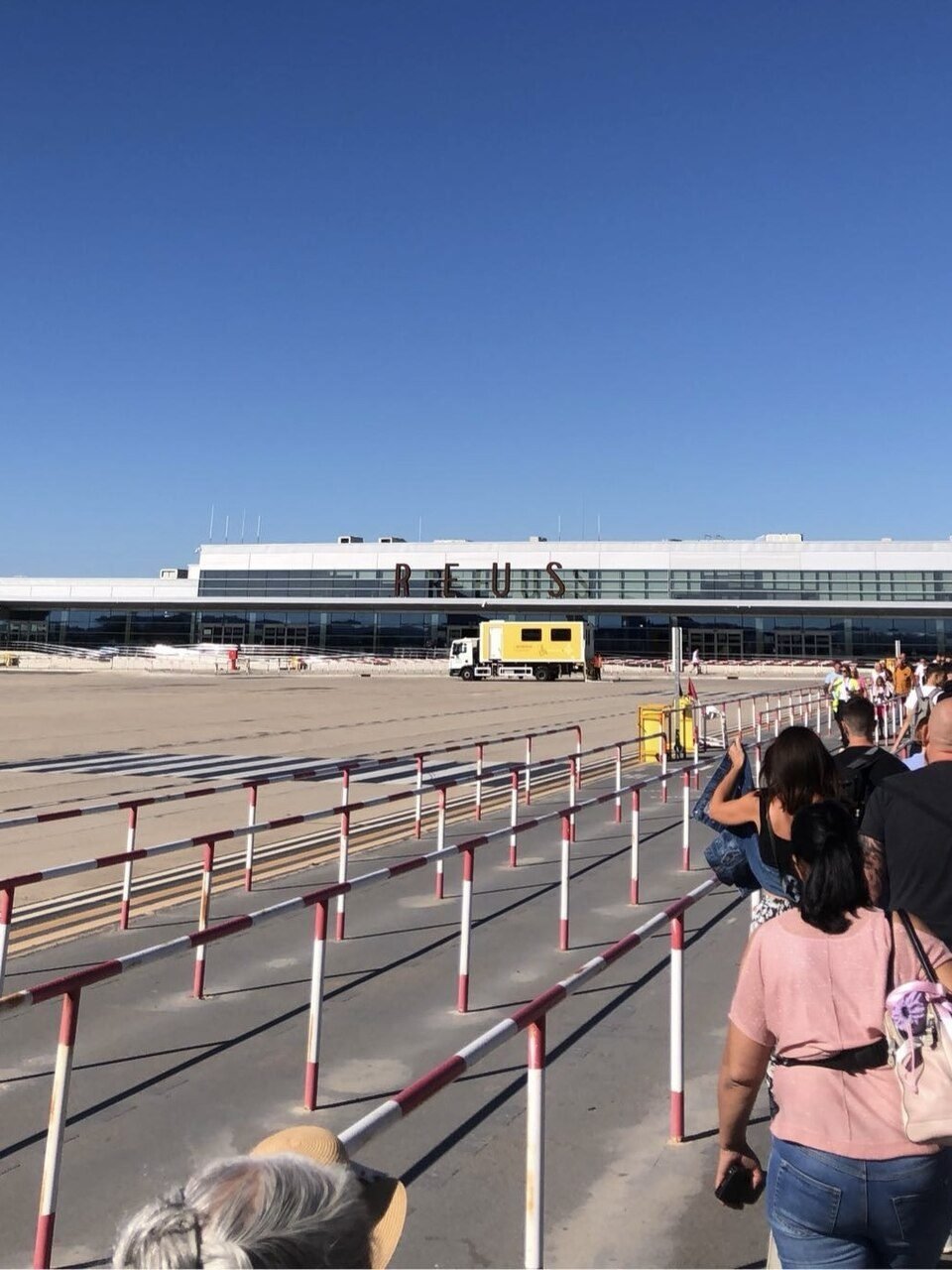
Passengers walking across an airport apron towards a low terminal building with the word REUS on it.
Reus airport, Catalonia, in 2022. Grey Wolf has Hitler’s party landing here on 29 April 1945.HB200, 2022. Wikimedia Commons. CC0.

Spain

A flight to Reus

Hitler's party was flown out of Germany to Reus, in Spain, on 29 April 1945.

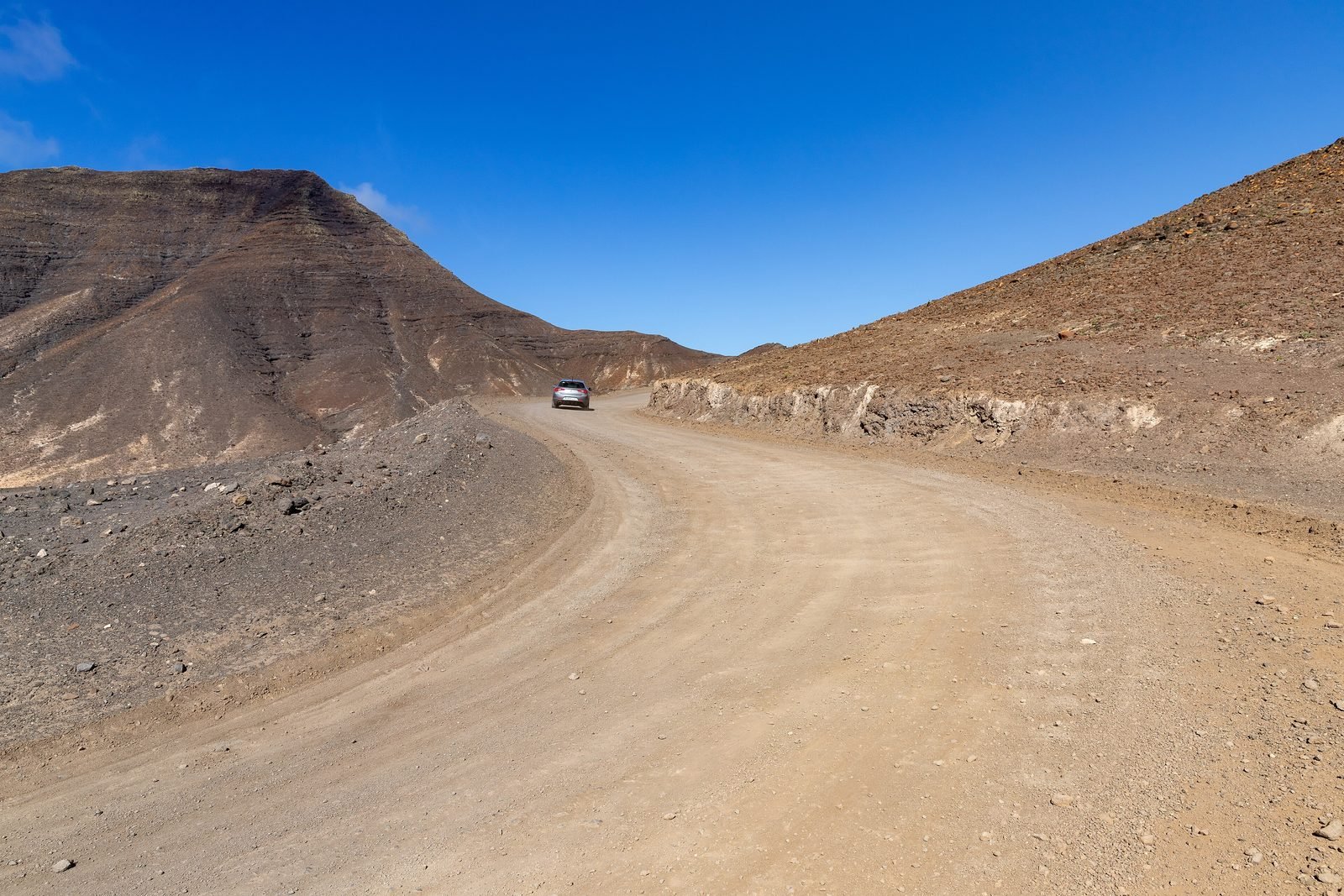
A dirt road winding between bare brown mountains under a blue sky.
The road to Cofete on Fuerteventura, in the Canary Islands, 2020.dronepicr, 2020. Wikimedia Commons. CC BY 2.0.

The Canary Islands

Through the Canary Islands

From Spain the escape ran on through the Canary Islands.

The Atlantic

Across by U-boat

U-boats carried the party across the Atlantic to Argentina.

The publisher says the book’s notes identify the “escape route, vehicles, aircraft, U-boats, and hideouts”.

A wide panorama of a deep-blue lake with snow-capped mountains on the far shore.
Lake Nahuel Huapi and San Carlos de Bariloche, in Patagonia, 2011.Elemaki, 2011. Wikimedia Commons. CC BY 3.0.

Patagonia

A house near Bariloche

Hitler and Braun lived near San Carlos de Bariloche, in Patagonia, and had two daughters.

Argentina

A death in exile

Hitler died in Argentina on 13 February 1962, aged 73.

Like the rest of the book’s case, this rests on eyewitness testimony.

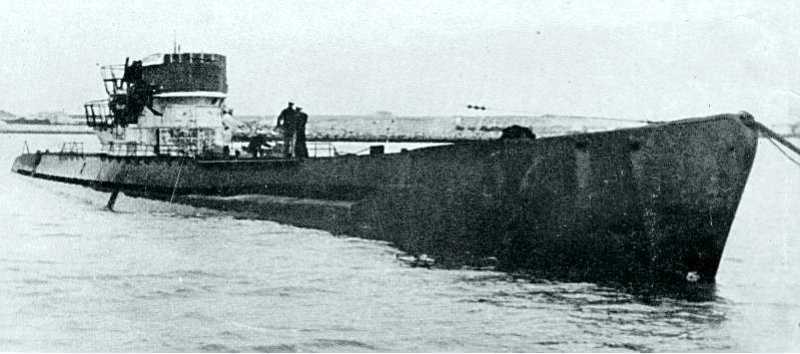
A black-and-white photograph of a surfaced submarine with men standing on its deck and conning tower.
An Argentine Navy boarding party inspects U-530 at Mar del Plata, July 1945.Unknown photographer, July 1945 (La Capital, Mar del Plata, 1980). Wikimedia Commons. Public domain.
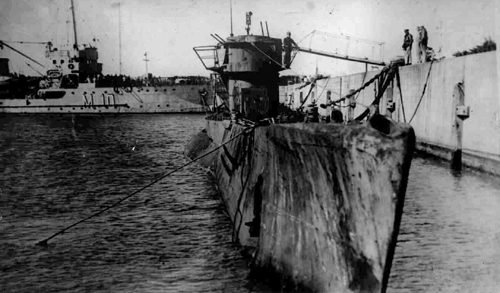
A black-and-white photograph of a submarine tied up alongside a quay, a warship behind it.
U-977 moored at Mar del Plata after its surrender in August 1945.Daniel Mesa, 1945. Wikimedia Commons. Public domain.

July 1945 – August 1945 · Mar del Plata

What did reach Argentina

The record

Two German U-boats did arrive, months after the war in Europe ended. U-530 surrendered at Mar del Plata on 10 July 1945, and U-977 on 17 August 1945. Their crews were interrogated by the US Navy. The Argentine Ministry of the Navy denied that U-530 had landed any prominent Nazi.

02The record

One room, two witnesses, two clocks

The record of Hitler’s last two days comes from the people who were in the bunker with him, questioned separately by British, American and Soviet investigators, and from the documents that left Berlin.

A typewritten page in German on yellowed paper, listing names of ministers, in a bound volume.
A page of Hitler’s political testament, signed in the bunker in the early hours of 29 April 1945. This copy, carried out of Berlin by a courier, is in the US National Archives.US National Archives, RG 242 (NAID 6883511). Wikimedia Commons. Public domain.

In the early hours of 29 April 1945 Hitler signed his political testament, at about 4 am. Martin Bormann, Joseph Goebbels, Hans Krebs and Wilhelm Burgdorf witnessed it. Three couriers were sent to carry copies out of the city; one copy is now in the US National Archives in Washington.

On the afternoon of 30 April 1945 Hitler and Eva Braun withdrew into his study. At about 2:30 pm his adjutant Otto Günsche telephoned Hitler’s chauffeur and ordered ten jerrycans of petrol brought to the bunker’s garden exit.

Two clocks

A clock face showing the two times the two witnesses gave for Hitler's death: Günsche's wristwatch and Linge's clock, twenty minutes apart, with the gap between them shaded.

Two men fixed the time of death, and they did not agree to the minute. Günsche put it at 15:30 by his wristwatch; the valet Heinz Linge at about 15:50 by the grandfather clock in the antechamber. Goebbels thought he may have heard a shot; the others did not. The bodies were carried up into the garden and burned. On 1 May 1945 Joseph and Magda Goebbels killed their six children and themselves in the bunker; the next day Berlin’s defenders surrendered.

Linge and Günsche came home from Soviet captivity in 1955. Under oath, both described finding Hitler dead in his study.

On 25 October 1956 both men gave evidence under oath to the court in Berchtesgaden, which declared Hitler dead so that the state could take over his fortune. It fixed the time of death at 15:30.

03The evidence in custody

Three sets of remains came out of one garden

Soviet troops searched the Chancellery garden in the first days of May 1945. What they took away became three separate pieces of evidence: the jaw and teeth, the bodies, and — found a year later — a fragment of skull. The Soviet state hid all three, destroyed one, and still holds the other two. Meanwhile the escape story was being told, first of all by Stalin.

The remains, and what was said

A timeline from 1945 to 2018 with four lanes: what was said about Hitler's fate, the teeth, the skull fragment and the bodies. The bodies lane ends in 1970, when they were destroyed; the teeth and skull fragment lanes run on to today.
finding or recordclaim✕ destroyed
Tilted slabs of broken concrete and a dead tree in a field of rubble.
The blown-up Führerbunker in the garden of the ruined Reich Chancellery, 1947.Bundesarchiv, Bild 183-M1204-319 / Otto Donath / CC BY-SA 3.0 de

9 May 1945 – 11 May 1945

The teeth are identified

On 9 May 1945 the Soviets showed Käthe Heusermann, the assistant of Hitler’s dentist, and Fritz Echtmann, the technician who had made his dental bridges, the jaw and teeth recovered from the garden. Both identified them, and by 11 May 1945 they had confirmed it for the chief pathologist. Heusermann was then held by the Soviets for about a decade, until 1955.

A black-and-white photograph of Stalin in a white marshal’s uniform, seated.
Joseph Stalin at the Potsdam Conference, 1 August 1945. At Potsdam he told the Americans that Hitler had probably escaped.US Army Signal Corps, 1945. Library of Congress, via Wikimedia Commons. Public domain.

17 July 1945 · Potsdam

Stalin tells the Americans Hitler escaped

Two months after his own investigators had the teeth identified, Stalin told the Americans at Potsdam that he believed Hitler had escaped, and that he was possibly “either in Spain or Argentina”. Weeks earlier, on 9 June 1945, Marshal Zhukov had told the press in Berlin: “We have found no corpse that could be Hitler's.”

1 November 1945

A British investigation: no valid evidence of escape

Hugh Trevor-Roper, a British intelligence officer, questioned seven witnesses to the bunker’s last days and reported that Hitler and Eva Braun had died there by suicide. Stories of survival, he wrote, “rest on no valid evidence whatsoever”.

A black-and-white photograph looking up at a tall stepped facade of narrow vertical windows.
The State Archive of the Russian Federation, Moscow, 2013. The skull fragment found in 1946 is held in the Russian state archives.Sergey Norin from Moscow, Russia, 2013. Wikimedia Commons. CC BY 2.0.

February 1946 · 1946

A skull fragment, a year later

The bodies recovered in 1945 were reburied at a Soviet counter-intelligence base in Magdeburg in February 1946. In 1946 a second Soviet investigation dug in the garden again and found part of a skull, with a hole where a bullet had reportedly exited. It was sent to Moscow, and it is held today in Russia’s State Archive.

25 October 1956

A court declares Hitler dead

In Berchtesgaden, a West German court heard Linge and Günsche under oath and fixed the time of death at 15:30 on 30 April 1945.

1968 · April 1970

A Soviet book, and the bodies destroyed

In 1968 a Soviet journalist, Lev Bezymenski, published the Soviet autopsy, which said Hitler died of cyanide poisoning. In April 1970 the KGB, on Yuri Andropov's authority, had the Magdeburg remains dug up and burned, and the ashes thrown into the Biederitz. That evidence no longer exists.

1973

The X-rays of 1944 match

In 1944 Hitler’s head had been X-rayed after the assassination attempt; the five plates were attached to the 1945 American interrogation reports of Hitler's dentist and physicians. In 1973 the dentists Reidar Sognnaes and Ferdinand Strøm compared them with the Soviet autopsy record of the jaw: “definite odontologic proof that Hitler did in fact die”.

2009

The skull fragment is a woman’s

In 2009 Nick Bellantoni, an archaeologist, examined the skull fragment, and a laboratory at the University of Connecticut tested it. It came from a woman aged about 20 to 40. The laboratory’s director said the result proved nothing about Hitler’s fate, only that the fragment was someone else’s. The finding says nothing about the teeth.

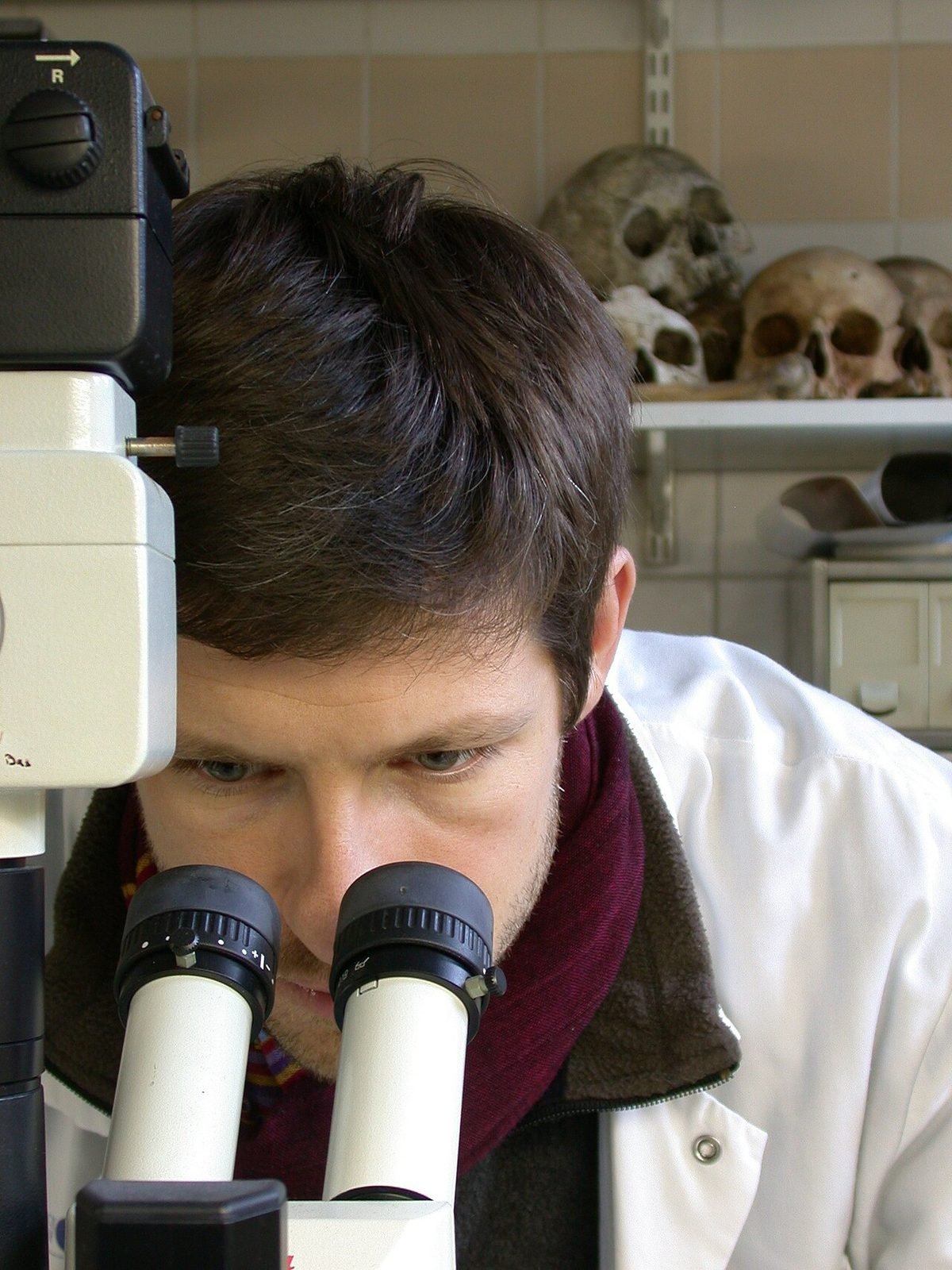
A young man in a white coat looking into a binocular microscope, skulls on a shelf behind him.
The French forensic pathologist Philippe Charlier at a microscope, 2011.Tiberi77, 2011. Wikimedia Commons. CC BY 3.0.
A large ochre neoclassical building with a clock on its central bay, behind a wide road.
The Lubyanka in Moscow, headquarters of the FSB, 2010. The jaw and teeth are held in the FSB’s archive.A.Savin, 2010. Wikimedia Commons. CC BY-SA 3.0.

March and July 2017

The teeth, examined in Moscow

Philippe Charlier and a French team were let into the FSB’s archive in March and July 2017, six years after Grey Wolf appeared. “The teeth are authentic, there is no possible doubt.” They found no traces of powder on the teeth, so no shot to the mouth, and bluish deposits on the false teeth could indicate a chemical reaction between cyanide and the metal of the dentures. The skull fragment in the state archive showed a hole on the left side, in all probability made by a bullet; they were not allowed to take samples from it. Asked whether Hitler died by bullet or cyanide, Charlier said: “It's in all probability both.”

04What the claim needs

The escape story leans on three men. All three died in Berlin

An escape from the bunker needs accomplices who got out too. Grey Wolf gives roles in it to two men from Hitler’s circle, and for decades rumour had a third, the Gestapo chief, on the run. Each has a documented end in Berlin.

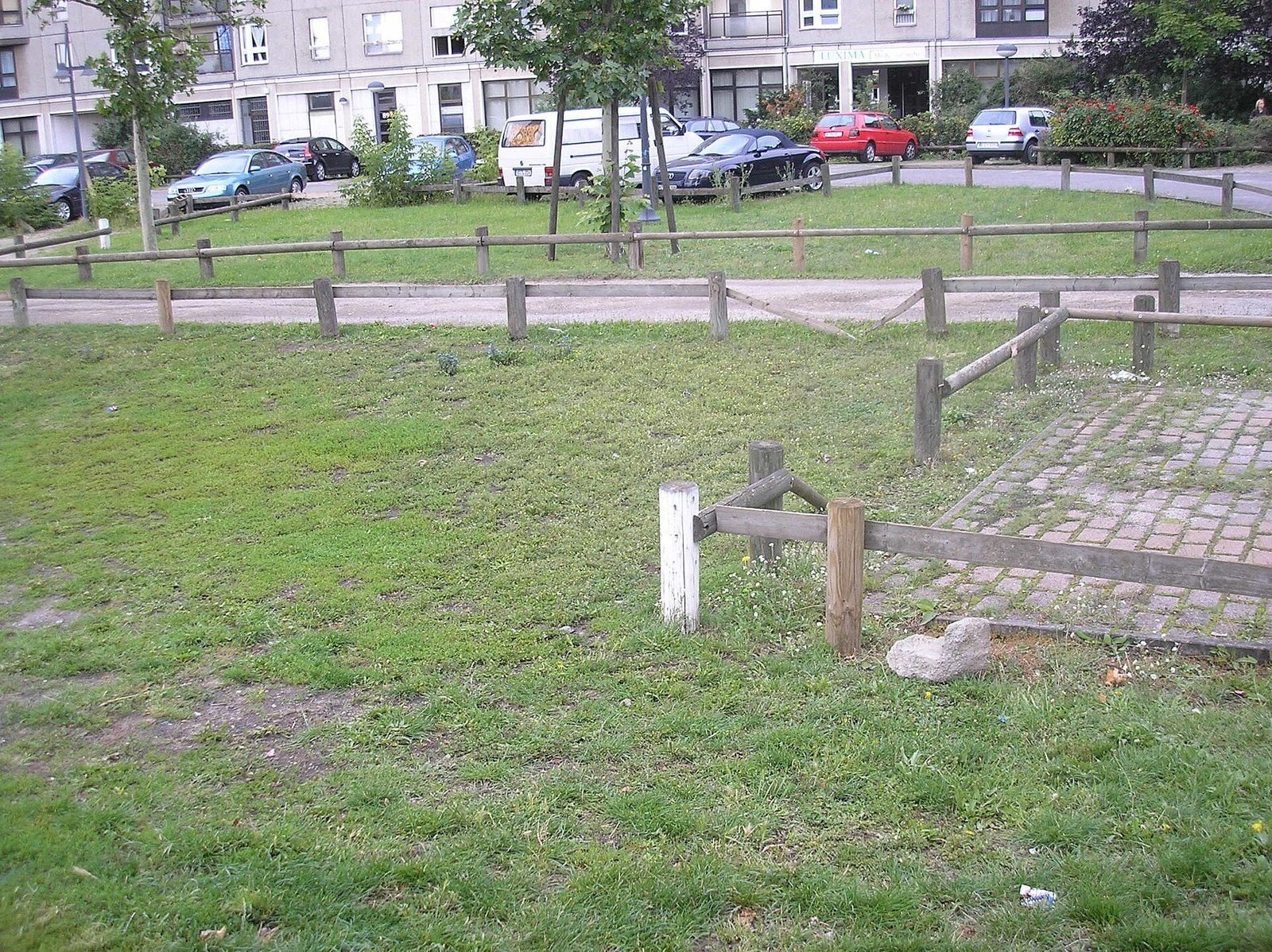
A scruffy lawn crossed by low wooden fences, with parked cars and grey apartment blocks behind.

Hermann Fegelein

Grey Wolf says Fegelein scouted an escape landing strip in Berlin, and that no court-martial ever took place.

Himmler’s liaison officer at Hitler’s headquarters was shot on Hitler’s orders on the night of 28 April 1945, in the last days of the bunker.

The site of the Führerbunker in Mitte, 2007: a lawn, a wooden fence and a car park. Deror avi, 2007. Wikimedia Commons. Attribution.

A glass-and-steel railway station reflected in a harbour basin, a tour boat passing.

Martin Bormann

Grey Wolf says Bormann organised the escape and lived on in Argentina under false names.

Construction workers found his skeleton in December 1972, beside the Lehrter Bahnhof, where Berlin Hauptbahnhof stands today. Dental records identified him, and a DNA test confirmed it in 1998.

Berlin Hauptbahnhof in 2016. It stands where the Lehrter Bahnhof stood, beside which Bormann’s skeleton was dug up in December 1972. Ansgar Koreng, 2016. Wikimedia Commons. CC BY 3.0 de.

Weathered stone gravestones set against a red brick wall.

Heinrich Müller

The Gestapo chief got out of Berlin in 1945 and was never found.

In 2013 the historian Johannes Tuchel found a burial commando’s report: Müller’s body was identified in August 1945, his military ID still in his pocket, and buried in a mass grave in the Jewish cemetery on Große Hamburger Straße, Mitte.

Gravestones set into the wall of the old Jewish cemetery on Große Hamburger Straße, Mitte, 2017. Z thomas, 2017. Wikimedia Commons. CC BY 3.0.

The escape story has a book and a route on a map. The record has a room, two witnesses, a court ruling, and a set of teeth that two independent examinations, 1973 and 2017, found to be his.

Adolf Hitler died in the Führerbunker on 30 April 1945.

Press & citation

Use this Berlinfographic

Free to publish under CC BY 4.0 — in print, online, on Wikipedia and in teaching, commercially or not — with credit to Berlinfographics and a link to this page.

Hitler did not escape to Argentina: the evidence: ready-to-use landscape image

Ready-to-use image

The infographic as one image: headline, key figures, chart, sources and credit, 2,400 × 1,350 px PNG. Please use it unedited.

Download landscape (PNG)
Hitler did not escape to Argentina: the evidence: square version

Square format

A 1:1 version for social media and narrow columns, 1,800 × 1,800 px.

Download square (PNG)
Hitler did not escape to Argentina: the evidence: portrait version

Portrait 4:5

For Instagram and LinkedIn feeds, 1,620 × 2,025 px.

Download portrait (PNG)

Credit line

Berlinfographics (berlinfographics.com), CC BY 4.0

Citation

Berlinfographics (2026). “Hitler did not escape to Argentina: the evidence”. Berlin Experiences. https://berlinfographics.com/hitler-argentina-myth/

Wikipedia

{{cite web |title=Hitler did not escape to Argentina: the evidence |url=https://berlinfographics.com/hitler-argentina-myth/ |website=Berlinfographics |publisher=Berlin Experiences |date=2026-11-09 |access-date=2026-11-09}}