Berlinfographicsby Berlin ExperiencesThe Cold War · Moscow and East Berlin · 1983–1992
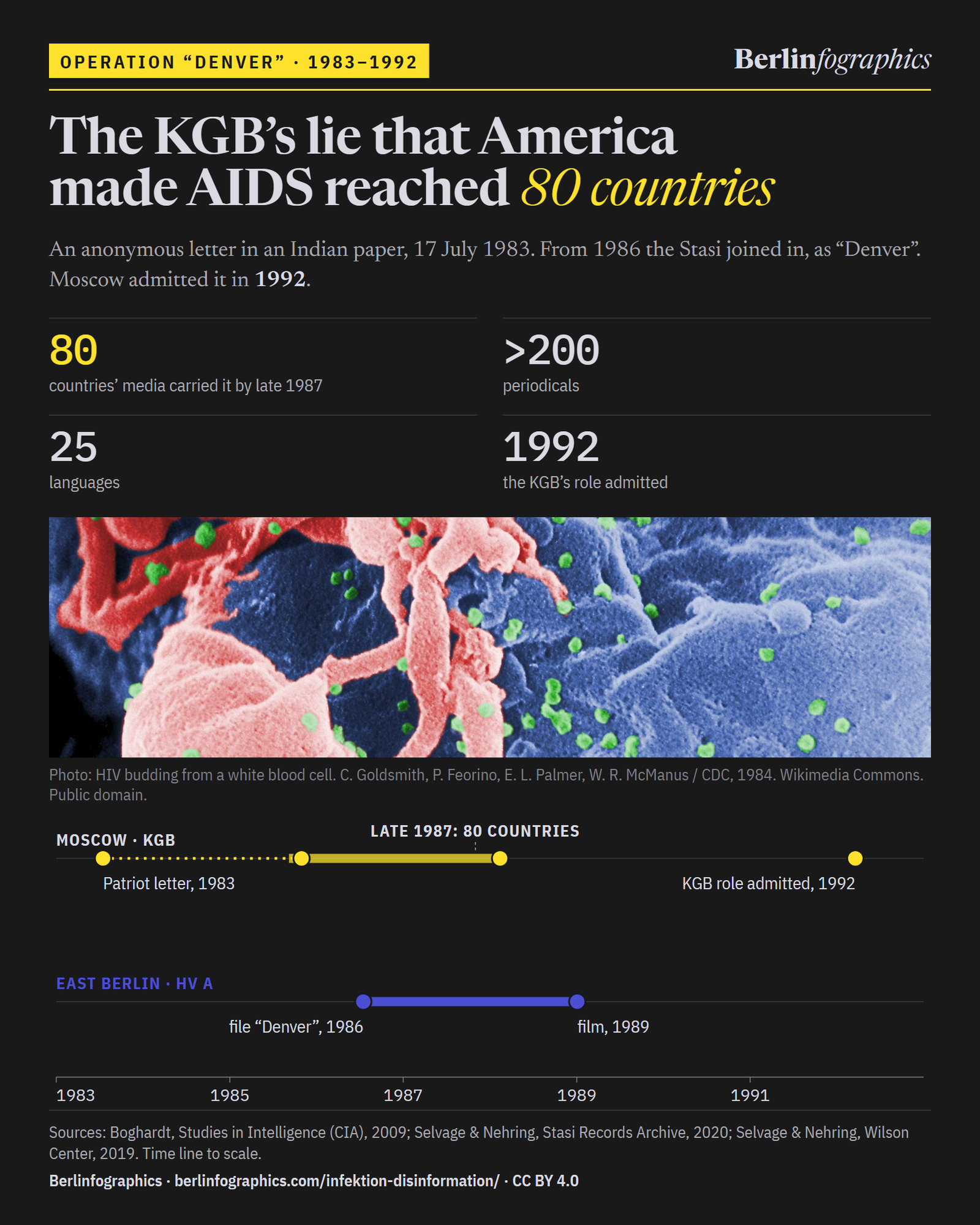
HIV particles (green, coloured by the CDC) budding from a human white blood cell, photographed through a scanning electron microscope at the CDC in 1984.Photo: C. Goldsmith, P. Feorino, E. L. Palmer, W. R. McManus / CDC, 1984. Wikimedia Commons. Public domain.
Operation “Denver”
The KGB’s lie that America made AIDS reached the media of 80 countries
It began in July 1983 with an anonymous letter in an Indian newspaper. By 1986 East Berlin’s foreign intelligence service had joined in. Moscow did not admit to the lie until 1992.
80
countries’ media carried it by late 1987
>200
periodicals
25
languages
3years
from the letter to the Stasi’s file, to the day (17 Jul 1983 → 17 Jul 1986)
01New Delhi, July 1983
It began as a letter from “a well-known American scientist”
On 17 July 1983 the Patriot, a left-wing paper in New Delhi, printed an anonymous letter. It claimed that the mysterious new disease had been made in the Pentagon’s experiments at Fort Detrick, Maryland, and could spread to India. The KGB had helped to set the paper up in 1967, so that it could circulate Soviet-inspired stories.
The disease had first been reported, in five young men in Los Angeles, on 5 June 1981. Its cause, a virus, was not isolated until May 1983. The letter filled that gap with a villain.
It is the first known publication to name Fort Detrick as the place where AIDS was made.
Patriot · New Delhi17 July 1983
KGB-inspired
“AIDS may invade India: Mystery disease caused by US experiments”
Signed by an anonymous “well-known American scientist and anthropologist”
The headline as Boghardt and the Stasi Records Archive’s historians quote it, set in type. No freely licensed copy of the page exists.
The life of a lie, 1981–1995
Moscow · KGBEast Berlin · HV AWashington · science
Dates to scale. A band marks an event known only by its year.
02Late 1987
Washington said the letter did not exist. Moscow printed it.
US officials searched the Patriot only back to January 1984, and in early November 1986 a State Department spokesman said no such letter had ever appeared. On 19 November 1986Literaturnaya Gazeta reproduced its front page in triumph.
By late 1987, by the count of US officials that Boghardt cites, the story had appeared in the media of 80 countries, in over 200 periodicals and 25 languages. Each square below is one.
80countries whose media carried the claim
the 25 African countries whose press carried Segal’s claims after Harareother countries
>200periodicals
25languages
One square for each country, periodical or language, on the same scale in every row. The 25 African countries are Boghardt’s count of those whose press carried Segal’s claims after Harare; no source lists the countries by name.
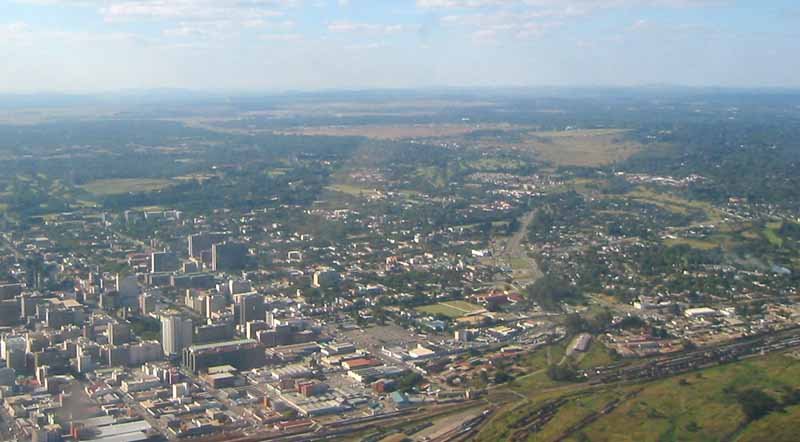
Central Harare from the air in 2005. The city hosted the Eighth Non-Aligned Summit, where the Segals’ brochure was handed out, in September 1986.Photo: Radozw, 2005. Wikimedia Commons. CC BY-SA 3.0.
President Reagan, with Secretary of State George Shultz on the right, at the first plenary meeting of the Washington summit with Mikhail Gorbachev’s delegation, 8 December 1987.Photo: White House Photographic Office, 8 December 1987. Ronald Reagan Presidential Library via Wikimedia Commons. Public domain.
03The Stasi Records Archive, Berlin
What the files prove, and what is still argued
The KGB’s part is no longer in doubt: its own cable survives in the Bulgarian archives, and Russia’s foreign intelligence chief admitted it in 1992. East Berlin’s part is harder to weigh. About 90 per cent of the HV A’s files were destroyed or went missing in 1989–90, the “Denver” file among them.
What survives is in other people’s papers: Bulgarian minutes of meetings with the HV A, the East German party’s files, the Segals’ own estate. Historians read them differently.
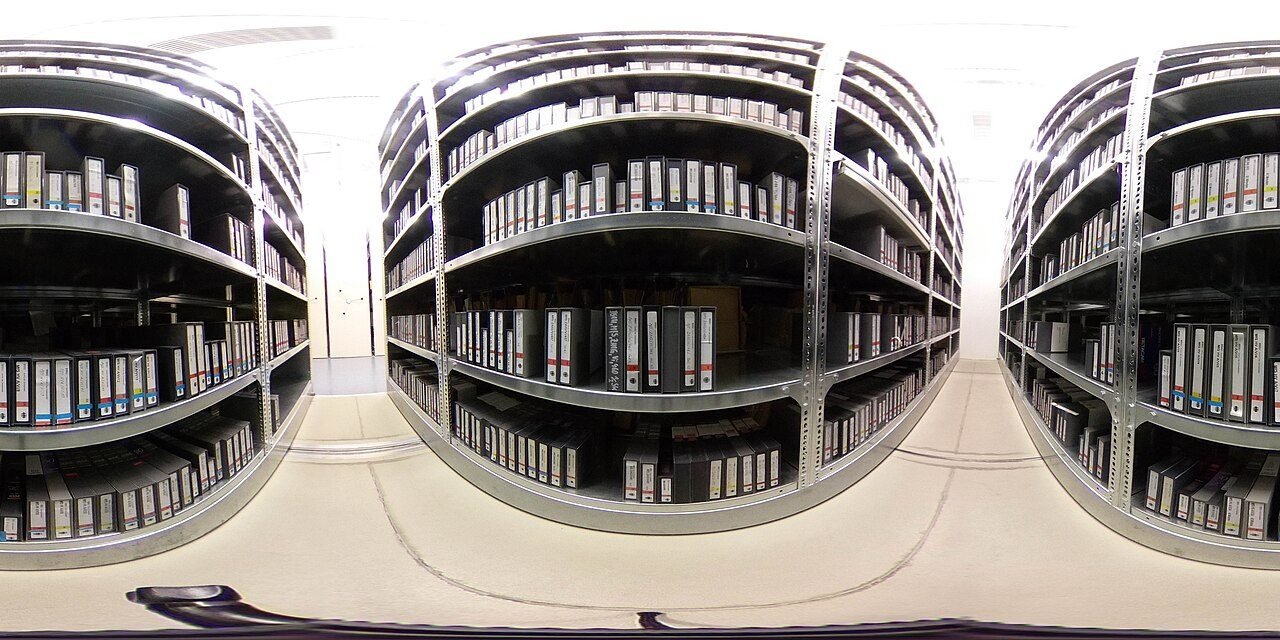
A 360° photograph of a depot of the Stasi Records Archive in Lichtenberg, 2018. Most of the HV A’s own files, the “Denver” file among them, were destroyed in 1989–90.Photo: Maximilian Schönherr / Wikimedia Commons / CC BY-SA 4.0
In the files
The KGB launched the campaign
KGB cable Nr. 2955 of 7 September 1985 asked Bulgarian state security to spread the Fort Detrick claim. Primakov confirmed the KGB’s role in 1992.
Selvage & Nehring, Stasi Records Archive, 2020 · Selvage & Nehring, Wilson Center, 2019
In the files
The HV A’s operation was called “Denver”
HV A Department X registered it on 17 July 1986. HV A officers told their Bulgarian colleagues it was a major part of the department’s work.
Selvage & Nehring, Stasi Records Archive, 2020 · Selvage & Nehring, Wilson Center, 2019
In the files
The HV A paid towards a West German film
DM 40,000 of DM 120,000, by the HV A’s own account to Sofia: “AIDS – die Afrikalegende”, first shown on 3 January 1989.
Selvage & Nehring, Stasi Records Archive, 2020
One witness
HV A and KGB officers handed out the Harare brochure
The count of four HV A and 20 KGB officers comes from a former HV A officer’s letters to Boghardt and the State Department’s 1986–87 report. The Stasi files hold no direct proof either way.
Boghardt, Studies in Intelligence (CIA), 2009
Not in the files
The name “INFEKTION”
It came from the same former officer, by way of Boghardt in 2009. The historians at the Stasi Records Archive found it “nowhere in the files of the Bulgarian or East German State Security” on AIDS; the HV A used it for a different joint action.
Selvage & Nehring, Wilson Center, 2019 · Selvage & Nehring, Stasi Records Archive, 2020
Contested
Did the HV A give Segal his theory?
Boghardt (CIA, 2009)HV A/X supplied much of the material for the Segals’ study, and staged visits to prop Segal up (from former HV A officers).
Selvage & Nehring (Stasi Records Archive, 2020)A KGB–HV A conspiracy is documented, but Segal may have reached his thesis on his own; the first trace of HV A contact in the Stasi files dates from July 1986.
Geissler & Sprinkle (2013)The campaign was no Stasi success; the tale of a Stasi masterstroke is itself “disinformation squared”, spread afterwards by former officers.
Boghardt, Studies in Intelligence (CIA), 2009 · Selvage & Nehring, Stasi Records Archive, 2020 · Geissler & Sprinkle, Politics and the Life Sciences, 2013
04Lichtenberg today
The headquarters is now a museum and an archive
The Stasi’s compound in Lichtenberg now houses the Stasi Museum and the Stasi Records Archive. Working from what survived in Berlin and Sofia, Douglas Selvage of the archive and Christopher Nehring found the name “Denver” in the HV A’s surviving card index.
The former headquarters of the Ministry for State Security on Normannenstraße, Berlin-Lichtenberg, in 2005.Photo: Andreas Praefcke, 2005. Wikimedia Commons. CC BY 3.0.
Moscow owned up in 1992. By then East Berlin had destroyed most of its own file on the lie.
Press & citation
Use this Berlinfographic
Free to publish under CC BY 4.0 — in print, online, on Wikipedia and in teaching, commercially or not — with credit to Berlinfographics and a link to this page.
Ready-to-use image
The infographic as one image: headline, key figures, chart, sources and credit, 2,400 × 1,350 px PNG. Please use it unedited.
Berlinfographics (berlinfographics.com), CC BY 4.0
Citation
Berlinfographics (2026). “Operation “Denver”: the KGB’s AIDS lie, 1983–1992”. Berlin Experiences. https://berlinfographics.com/infektion-disinformation/
Wikipedia
{{cite web |title=Operation “Denver”: the KGB’s AIDS lie, 1983–1992 |url=https://berlinfographics.com/infektion-disinformation/ |website=Berlinfographics |publisher=Berlin Experiences |date=2026-11-09 |access-date=2026-11-09}}
Every figure comes from the sources listed above; tap any underlined figure in the story to see its source.
Photographs in the story and in the ready-to-use images are not ours and keep the licences named in their captions and credits — keep those credits when you republish. The CC BY 4.0 licence covers our infographics, charts, texts and design.
Our infographics, charts and texts are licensed CC BY 4.0: free to republish, including commercially, with credit to Berlinfographics and a link. Photographs keep their own licences, named in each caption. How to credit