Berlinfographicsby Berlin Experiences

Haus 1 of the former Ministry for State Security in Berlin-Lichtenberg, now the Stasi Museum, in 2015. Wolf was a deputy minister of this ministry from 1955.Photo: Angela Monika Arnold (=44Pinguine), 2015. Wikimedia Commons. CC BY 2.5.

The man without a face

East Germany’s spymaster was “the man without a face”, until Swedish agents photographed him in 1978

Markus Wolf ran the Stasi’s foreign intelligence service for about 34 years. From this ministry in East Berlin he ran spies the West could catch, while his own face stayed unknown.

34years
at the head of the HV A, 1952–1986
4,778
HV A staff at the end, from twelve at the start
17
agents arrested after one officer defected
17years
after the Wall opened, to the day, he died
01East Berlin, the HV A

The West knew his name, his rank and his agents. It did not know his face.

From 1952 to 1986 Markus Wolf led the Hauptverwaltung A, the Stasi’s foreign intelligence service, and rose to colonel-general. His people sat in the West German chancellor’s office and in NATO’s headquarters. In the West he was “the man without a face”.

That ended in Stockholm in the summer 1978, when the Swedish security service photographed a well-dressed stranger in large sunglasses. A few months later a defector helped put a name to him.

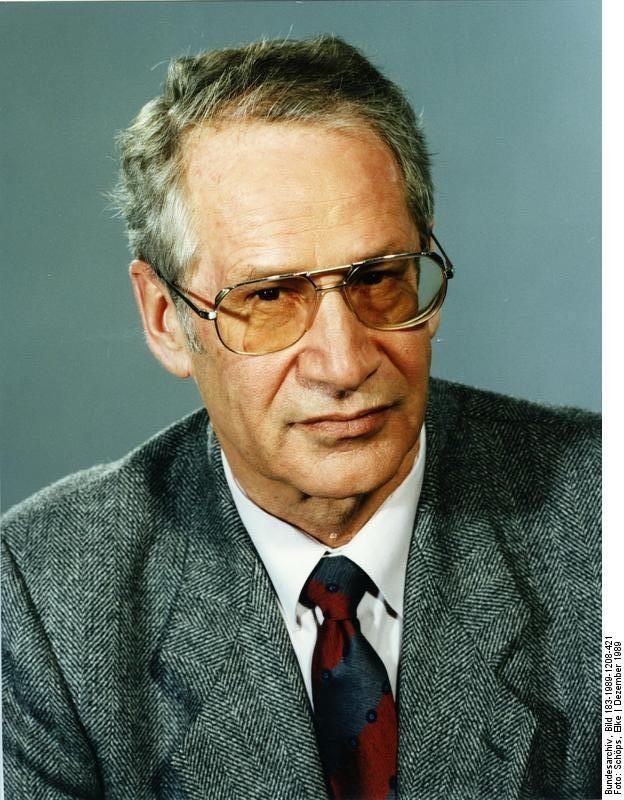
Black-and-white portrait of a grey-haired man in a dark jacket and tie.
Markus Wolf in December 1989, three years after he left the HV A.Photo: Bundesarchiv, Bild 183-1989-1208-421 / Schöps, Elke / CC BY-SA 3.0 de

One life, and the service he built

Wolf at the head of the HV Athe rest of his lifeHV A full-time staff
A time line from 1920 to 2010, drawn to scale. The top band shows the phases of Markus Wolf's life; beneath it, columns show the HV A's staff in each year the Bundesarchiv gives a count, on one linear scale. Each step of the story lights up its part.

Years drawn to scale. Columns: HV A staff in each year the Bundesarchiv gives a count, on one linear scale; the pale cap on 1989 adds the officers on special assignment and full-time informers.

Black-and-white portrait of a grey-haired man in a dark jacket and tie.
Markus Wolf in December 1989, three years after he left the HV A.Photo: Bundesarchiv, Bild 183-1989-1208-421 / Schöps, Elke / CC BY-SA 3.0 de

19 January 1923

Born in Hechingen, a writer’s son

His father, Friedrich Wolf, was a doctor and writer of Jewish birth. His brother Konrad, later a film director, was born two years after him.

1933 – 1945

A Soviet boyhood

The family fled the Nazis in 1933, through France and Switzerland to Moscow. He went to the German Karl Liebknecht School and became a Soviet citizen in 1936. In 1942/43 he attended a Comintern school.

A courtroom: two rows of men in a dock behind a wooden rail, guarded by military police in white helmets.
The defendants’ dock at the International Military Tribunal, Nuremberg, 1945–46. Wolf reported on the trial for the Berliner Rundfunk.Photo: Ray D'Addario, US Army Signal Corps, 1945–46. Wikimedia Commons. Public domain.

May 1945

Back in Berlin, behind a microphone

He came back a Soviet citizen and worked for the Berliner Rundfunk, reporting on the Nuremberg trial. From 1949 to 1951 he was a counsellor at the GDR’s mission in Moscow.

A grey eight-storey office block with long rows of windows, behind a concrete lattice wall and a guard hut.
The former headquarters of the Ministry for State Security on Normannenstraße, Berlin-Lichtenberg, in 2005. The HV A was one of its main departments.Photo: Andreas Praefcke, 2005. Wikimedia Commons. CC BY 3.0.

1951 – 1952

A spy service with a dull name

The service began in 1951 as an “Institute for Economic Research”, with twelve staff. Wolf took it over in 1952, at twenty-nine. From 1955 he was also a deputy minister of state security.

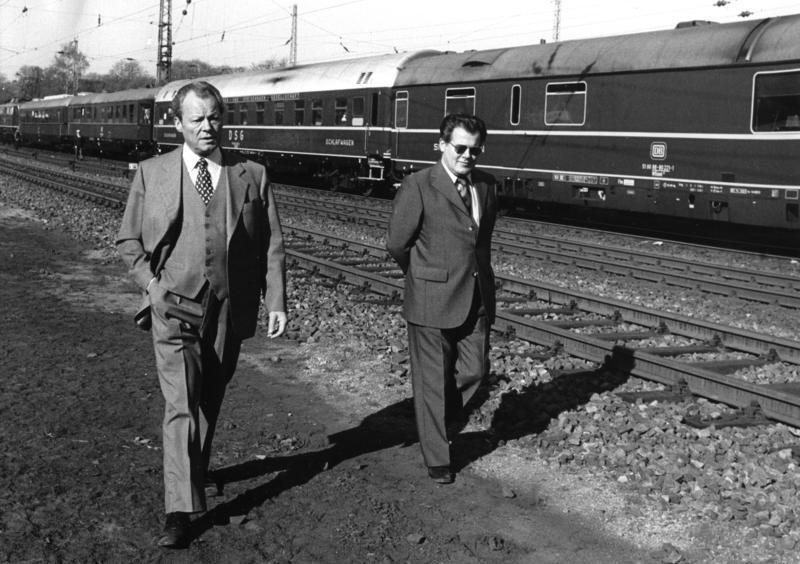
Black-and-white photograph of Willy Brandt in a crowd, with a man in glasses beside him.
Willy Brandt on the campaign trail in Lower Saxony, 8 April 1974, with his aide Günter Guillaume to his right. Guillaume was arrested as an HV A spy sixteen days later.Photo: Bundesarchiv, B 145 Bild-F042453-0011 / Wegmann, Ludwig / CC BY-SA 3.0 de

1974

A spy at the chancellor’s side

His “greatest success”, in the words of the Neue Deutsche Biographie, was Günter Guillaume, Willy Brandt’s personal aide. Brandt resigned after Guillaume and his wife were exposed in 1974. By 1972 the HV A had 1,066 full-time staff.

A harbour seen from above: quays with tugboats, a wide road along the water, ferries and a sailing ship moored across the bay.
Stockholm in August 1978, the summer the Swedish security service photographed Wolf there.Photo: Holger Ellgaard, 1978. Wikimedia Commons. CC BY-SA 3.0.

Summer 1978 – 18 Jan 1979

A face in Stockholm

Swedish agents photographed a stranger in sunglasses in Stockholm. On 18 January 1979 Werner Stiller, an HV A officer, fled West. Thanks to him, the man in the pictures could be identified as Wolf.

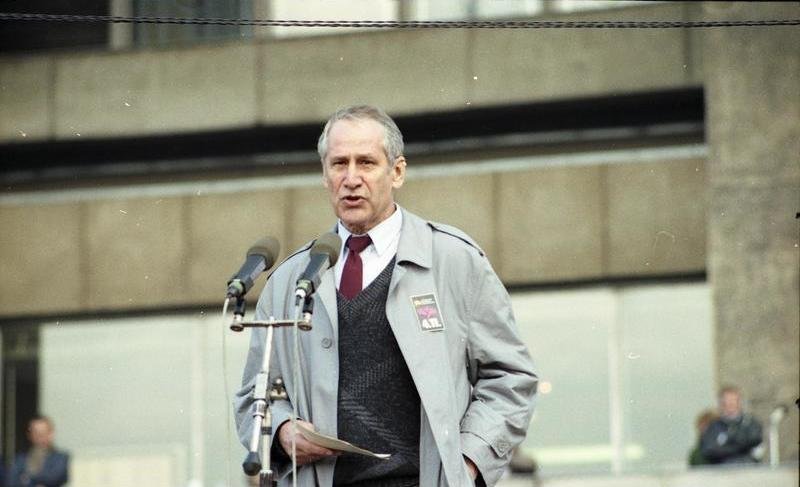
A grey-haired man in a light raincoat speaks into two microphones in front of a concrete building.
Wolf speaks at the rally on Alexanderplatz, East Berlin, 4 November 1989.Photo: Bundesarchiv, Bild 183-1989-1104-431 / Grimm, Peer / CC BY-SA 3.0 de

1986 – 1989

Retired, then a would-be reformer

He left the HV A in 1986; the month is disputed. On 4 November 1989 he spoke at the great rally on Alexanderplatz, trying to recast himself as a reformer. By then the HV A had 3,299 full-time staff.

Low glass-and-steel pavilions lit from inside at dusk.
The Federal Constitutional Court in Karlsruhe. Its decision of 15 May 1995 ended the treason prosecutions of HV A officers who had spied from the GDR.Photo: Baden de, 2015. Wikimedia Commons. CC BY 3.0.

1990 – 1997

Flight, return, three verdicts

He fled to the Soviet Union in 1990 and came back in September 1991. Convicted of treason in 1993, cleared in 1995, he was convicted on other charges in 1997.

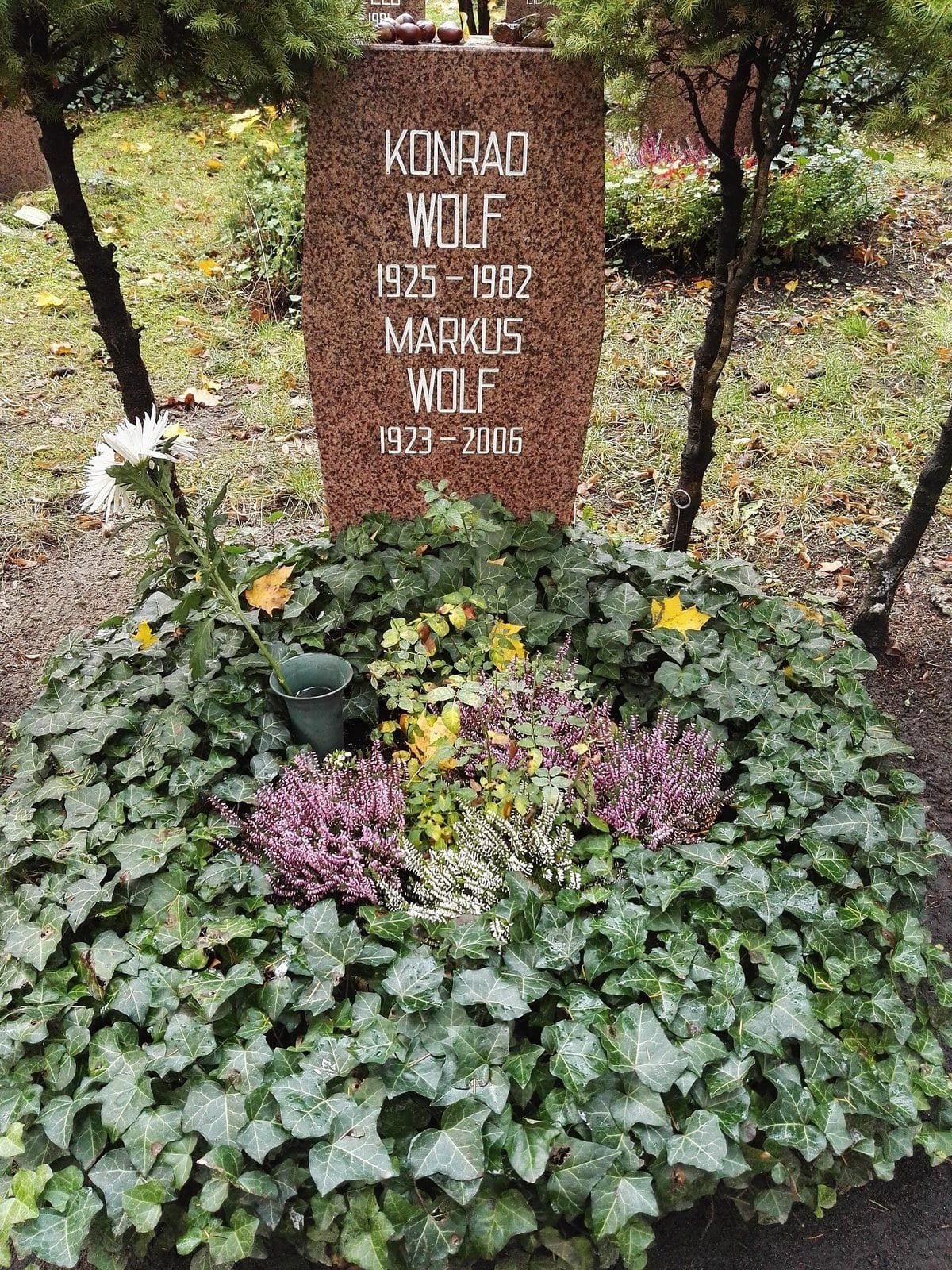
A red granite headstone inscribed Konrad Wolf 1925–1982 and Markus Wolf 1923–2006, above a bed of ivy and heather.
The brothers’ grave in the Zentralfriedhof Friedrichsfelde, Berlin, in 2016.Photo: Z thomas, 2016. Wikimedia Commons. CC BY-SA 3.0.

9 November 2006

He died on the anniversary of the Wall’s fall

He died in Berlin aged 83, 17 years to the day after the Wall opened. He lies beside his brother in Friedrichsfelde.

02Friedrichstraße, January 1979

One officer walked out, and the HV A had to pull its agents home

Werner Stiller, an officer in the HV A’s science and technology sector, had been working for West German intelligence for months. On the night of 18 January 1979 he took papers from a safe in the Stasi headquarters and crossed to the West at Friedrichstraße, carrying some 20,000 sheets on microfilm. Among his services, a historian of the case writes, was that “the man without a face” could now be identified on a photograph.

In 1979 Der Spiegel put a picture from Wolf’s Stockholm visit on its cover. After the defection and the cover, the HV A’s leadership pulled two of its sources at NATO, Ursel Lorenzen and Dieter Will, out of the West in March 1979.

“That is complete nonsense.” Wolf, in 2003, called the story of the single photograph a legend: for years he had appeared in uniform at school ceremonies in the GDR, photographed by relatives visiting from the West.Interview with Annemieke Hendriks, Duitsland Instituut
Black-and-white photograph of a crowd waiting outside a station building, with an archive caption strip beneath.
Outside Friedrichstraße station in 1964. Werner Stiller fled to the West through this crossing on the night of 18 January 1979.Photo: Bundesarchiv, Bild 183-C1030-0046-001 / Spremberg, Hans-Joachim / CC BY-SA 3.0 de

17agents arrested in the West

15+at least, withdrawn by the Stasi before they could be caught

100+investigations opened by the Federal Prosecutor

One square for each person or case, on the same scale in every row. Counts from Nicole Glocke’s study of the Stiller case (Zeitschrift des Forschungsverbundes SED-Staat, 2002); the second and third are minimums.

03Düsseldorf and Karlsruhe, 1993–1997

Convicted, cleared, convicted again

After unification the Federal Republic put the GDR’s spymaster on trial for treason. Then Karlsruhe ruled that East Germans who had spied from East German soil could not be punished for it, and the case collapsed. What stuck was something else: deprivation of liberty, coercion and bodily harm.

A pale classical palace with a columned portico behind a lawn and trees.
The Bundesgerichtshof in Karlsruhe, which quashed Wolf’s treason conviction in 1995.Photo: Andreas Praefcke, 2012. Wikimedia Commons. CC BY 3.0.
Convicted

1993: treason and bribery

The Higher Regional Court in Düsseldorf sentenced him to six years in prison.

NDB 28 (2024) · MfS-Lexikon: Wolf

Quashed

1995: the verdict falls

On 15 May 1995 the Federal Constitutional Court ruled that HV A officers who had lived and worked in the GDR could not be prosecuted for spying. The Federal Court of Justice then quashed Wolf’s conviction.

NDB 28 (2024) · BVerfGE 92, 277

Convicted

1997: deprivation of liberty, coercion, bodily harm

Düsseldorf convicted him again, finally: two years, suspended, and a fine of DM 50,000.

NDB 28 (2024) · MfS-Lexikon: Wolf

He died on 9 November 2006, 17 years to the day after the Wall opened.

A red granite headstone inscribed Konrad Wolf 1925–1982 and Markus Wolf 1923–2006, above a bed of ivy and heather.
The brothers’ grave in the Zentralfriedhof Friedrichsfelde, Berlin, in 2016.Photo: Z thomas, 2016. Wikimedia Commons. CC BY-SA 3.0.

Press & citation

Use this Berlinfographic

Free to publish under CC BY 4.0 — in print, online, on Wikipedia and in teaching, commercially or not — with credit to Berlinfographics and a link to this page.

Markus Wolf, the man without a face, 1923–2006: ready-to-use landscape image

Ready-to-use image

The infographic as one image: headline, key figures, chart, sources and credit, 2,400 × 1,350 px PNG. Please use it unedited.

Download landscape (PNG)
Markus Wolf, the man without a face, 1923–2006: square version

Square format

A 1:1 version for social media and narrow columns, 1,800 × 1,800 px.

Download square (PNG)
Markus Wolf, the man without a face, 1923–2006: portrait version

Portrait 4:5

For Instagram and LinkedIn feeds, 1,620 × 2,025 px.

Download portrait (PNG)

Credit line

Berlinfographics (berlinfographics.com), CC BY 4.0

Citation

Berlinfographics (2026). “Markus Wolf, the man without a face, 1923–2006”. Berlin Experiences. https://berlinfographics.com/markus-wolf-life/

Wikipedia

{{cite web |title=Markus Wolf, the man without a face, 1923–2006 |url=https://berlinfographics.com/markus-wolf-life/ |website=Berlinfographics |publisher=Berlin Experiences |date=2026-11-09 |access-date=2026-11-09}}