Berlinfographicsby Berlin Experiences

Bismarckstraße in front of the Deutsche Oper, 2 June 1967: police pull a demonstrator out of the crowd onto the roadway.Photo: Ludwig Binder / Stiftung Haus der Geschichte, 1967. Wikimedia Commons. CC BY-SA 2.0.

2 June 1967

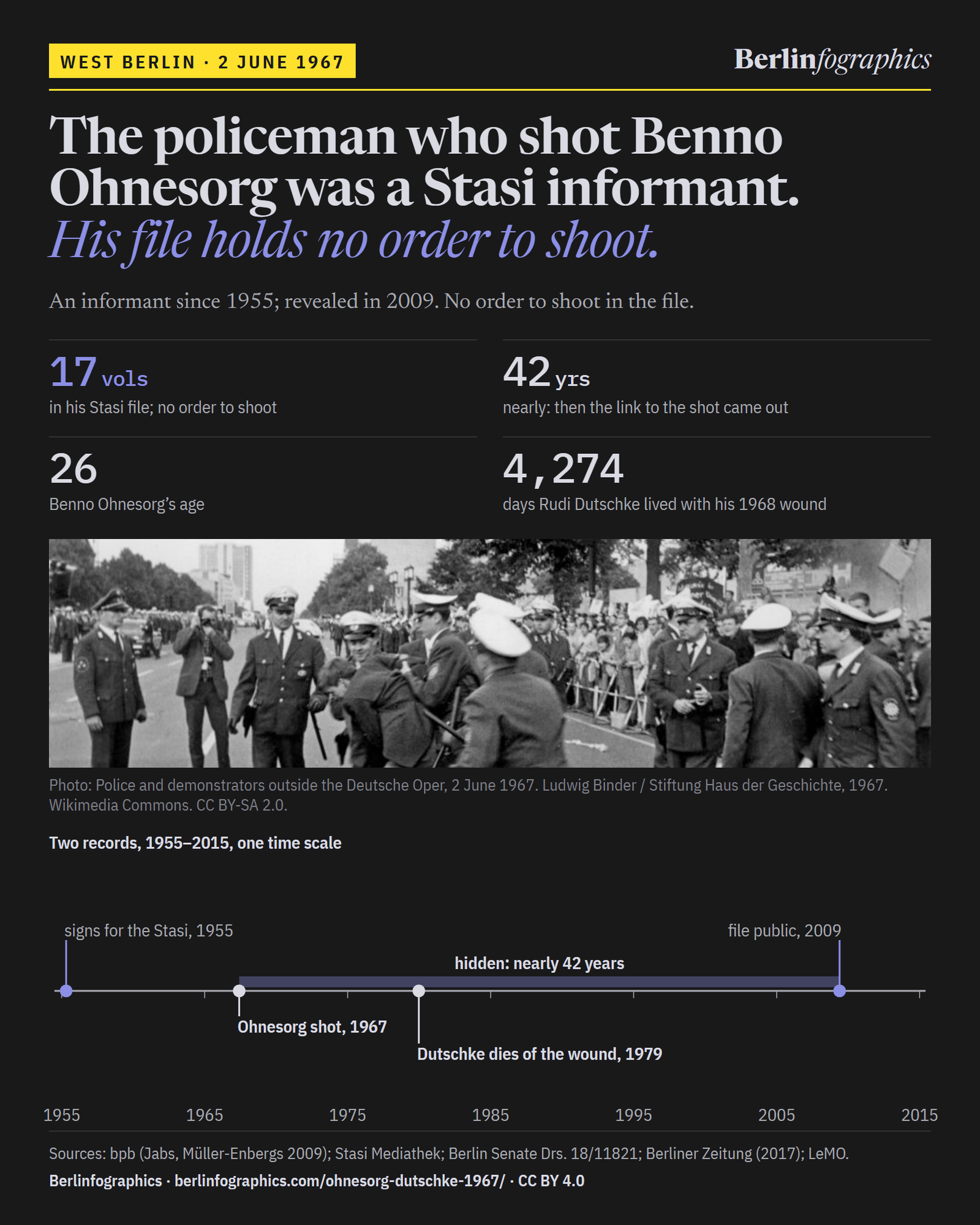
The policeman who shot Benno Ohnesorg was a Stasi informant. His seventeen-volume file holds no order to shoot.

On 2 June 1967 a West Berlin police officer fired one shot in a courtyard behind the Deutsche Oper, and the student protest became West Germany’s 1968. Nearly 42 years later the files showed the officer had reported to East Berlin since 1955. They record what the Stasi did after the shot, and nothing that ordered it.

26years old
Benno Ohnesorg, student at the Freie Universität
17volumes
in Kurras’s Stasi file; none holds an order to shoot
42years, nearly
before the link to the shot became public, in 2009
4,274days
Rudi Dutschke lived with his 1968 head wound
01West Berlin, 1–2 June 1967

The Shah came to West Berlin, and so did the protest

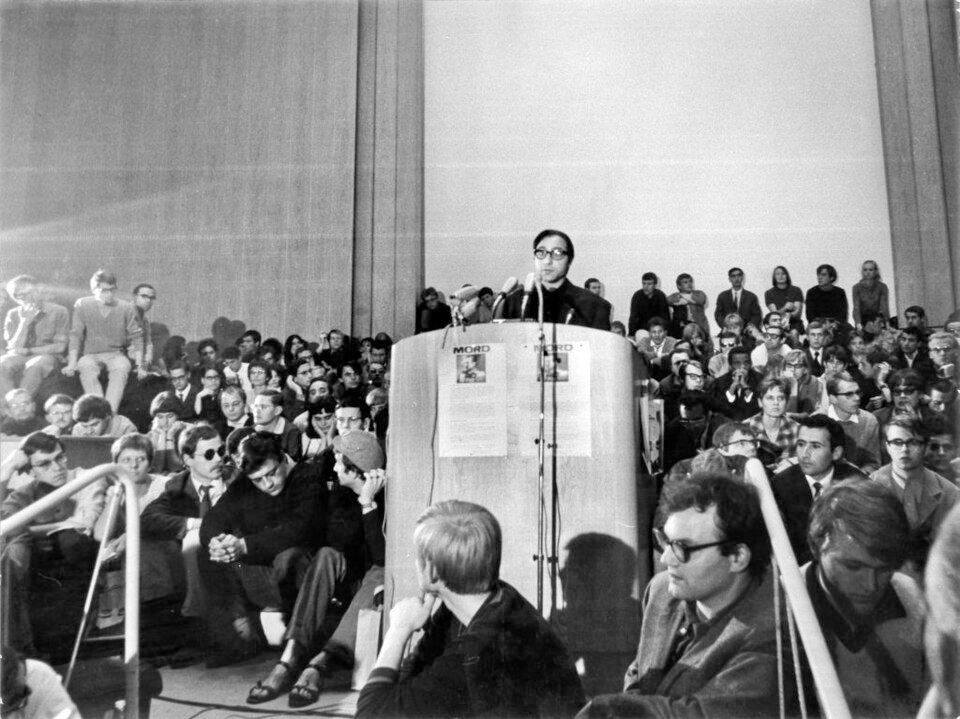
Mohammad Reza Pahlavi, the Shah of Iran, reached West Berlin on 2 June 1967 on a state visit to the Federal Republic. Demonstrators met him with banners against the torture of Persian prisoners and for the release of those held in Iran. On the evening before, Bahman Nirumand spoke at a lectern hung with leaflets headed “Mord” and the Shah’s picture.

Benno Ohnesorg was 26. He studied Romance languages and German at the Freie Universität. His wife Christa was expecting their son, Lukas, who was born in November 1967. That evening he joined the demonstration in front of the opera house on Bismarckstraße, where the Shah was to see a performance.

Black-and-white photograph of a man speaking at a lectern in a crowded hall, listeners sitting on the floor in front.
The eve of the visit, 1 June 1967: Bahman Nirumand at the lectern, which carries leaflets headed “Mord” with the Shah’s picture.Photo: Ludwig Binder / Stiftung Haus der Geschichte, 1967. Wikimedia Commons. CC BY-SA 2.0.

2 June 1967, on one clock

The day of 2 June 1967 on one clock: each event at the time recorded, the shot drawn as the window in which it fell because its minute is not recorded, the ambulance's detour drawn fading because its length is approximate, and the time of death.

One linear clock: the whole day first, then the evening, 19:00–23:30.

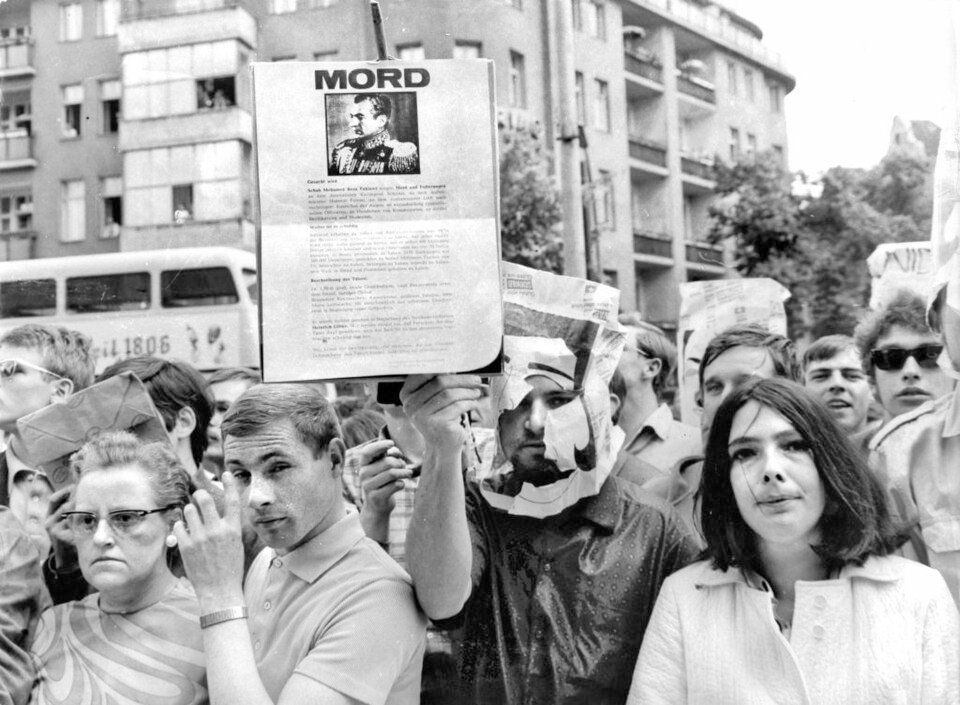
Black-and-white photograph of a crowd of young demonstrators, some with paper masks of the Shah pushed up on their heads, one holding a placard headed MORD.
Rathaus Schöneberg, 2 June 1967: demonstrators wearing Shah masks; one holds up a placard presenting the Shah as a wanted man.Photo: Ludwig Binder / Stiftung Haus der Geschichte, 1967. Wikimedia Commons. CC BY-SA 2.0.

12:18 · Rathaus Schöneberg

Wooden slats at the town hall

Pro-Shah men chosen by the imperial delegation beat demonstrators with wooden slats. The police step in after three or four minutes, then against the demonstrators.

Black-and-white photograph of demonstrators with banners standing behind metal barriers, a row of police officers in front of them.
Opposite the Deutsche Oper, 2 June 1967: demonstrators behind the street barriers, police in front. One banner calls for the autonomy of Tehran University and the release of prisoners.Photo: Ludwig Binder / Stiftung Haus der Geschichte, 1967. Wikimedia Commons. CC BY-SA 2.0.

19:20–19:55 · Deutsche Oper

Up to 3,000 people at the opera

Pro-Shah men arrive by bus, “disguised as press”. Police estimate up to 3,000 people opposite the opera. At 19:55 the Shah and Farah Diba go in.

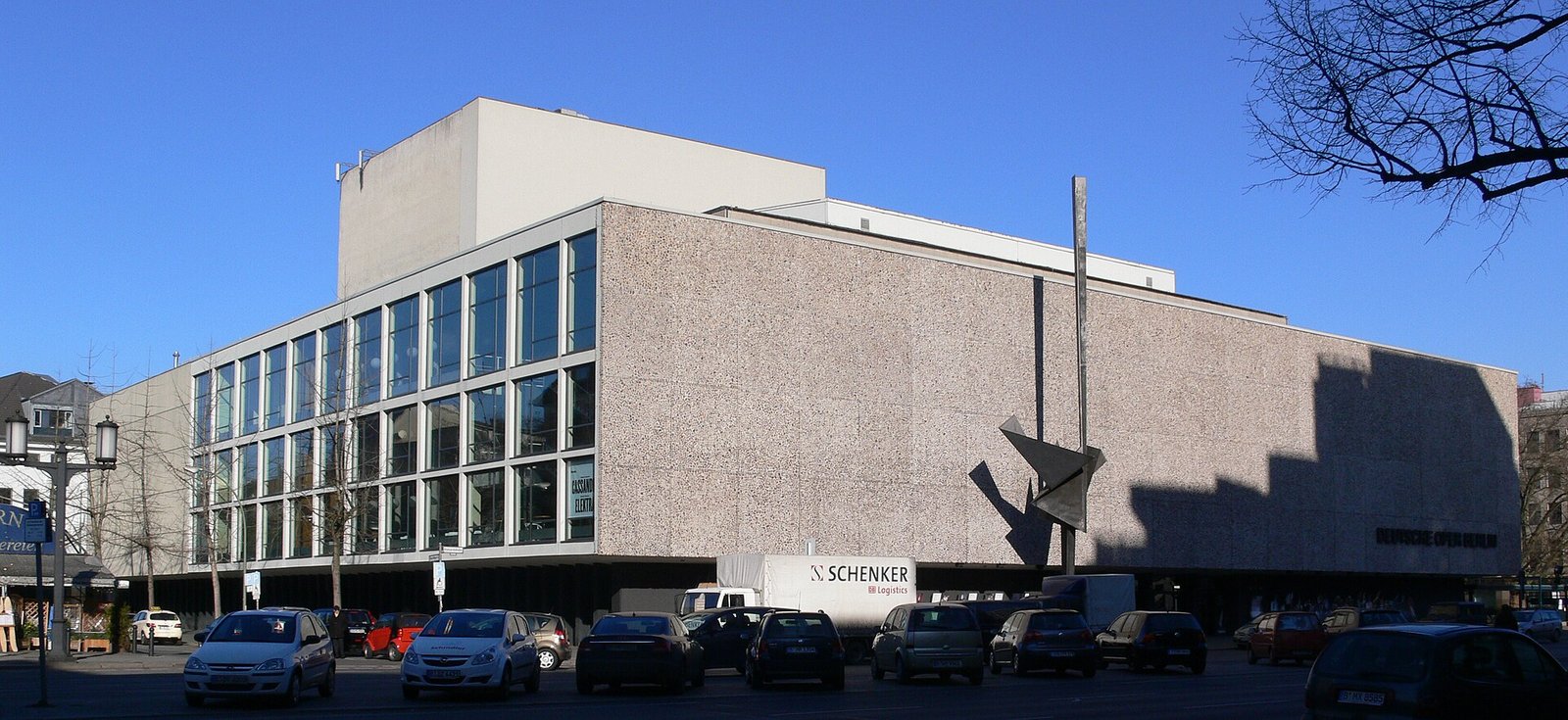
The long, windowless upper facade of the Deutsche Oper Berlin above a glazed ground floor, cars parked in front.
The Deutsche Oper on Bismarckstraße, 2009.Photo: Andreas Praefcke, 2009. Wikimedia Commons. CC BY 3.0.

20:07 · Bismarckstraße

Inside, Die Zauberflöte. Outside, batons

As the opera begins at 20:07, the police draw batons and drive into the crowd. The police president later called it a “liver sausage” tactic: stab into the middle.

The side of a modern opera house with tall glass windows, seen from a residential street with parked cars and a tree.
The Deutsche Oper seen from Krumme Straße, 2009. The courtyard of Krumme Straße 66/67 lies along this street.Photo: Andreas Praefcke, 2009. Wikimedia Commons. CC BY 3.0.

After 20:20 · Krumme Straße 66/67

One shot in a courtyard

Police strike Benno Ohnesorg from behind and he falls. Kurras, about 1.5 metres away with his pistol drawn, fires once. The bullet hits the back of his head. The minute is not recorded.

20:50 · the ambulance

A detour to Moabit

An ambulance arrives at 20:50. It takes nearly 45 minutes, by a detour, to reach the Städtisches Krankenhaus Moabit.

Black-and-white photograph: people standing around a hand-painted banner lying on the ground; a man crouches in front of it.
Krumme Straße, 3 June 1967: people stop at a banner laid on the ground outside the house, with five roses. It asks how many more “potential Kurrases” still carry service weapons.Photo: Ludwig Binder / Stiftung Haus der Geschichte, 1967. Wikimedia Commons. CC BY-SA 2.0.

22:55 · Krankenhaus Moabit

Declared dead

Benno Ohnesorg is declared dead at 22:55. The death certificate gives “skull injury from blunt force”. The autopsy the next day finds the gunshot wound.

02The Stasi file of Karl-Heinz Kurras

The officer had reported to East Berlin for twelve years

Karl-Heinz Kurras signed his commitment to the Stasi on 26 April 1955 and chose the code name “Otto Bohl”. He applied to join East Germany’s ruling SED on 15 December 1962; his membership book was issued on 28 July 1964. In September 1966 he became a Kriminalobermeister, in the political police. On 2 June 1967 he was 39.

The Stasi paid him 550 DM in 1955 and 4,500 DM in 1966. At a meeting on 17 May 1967, sixteen days before the shot, he received 1,000 DM.

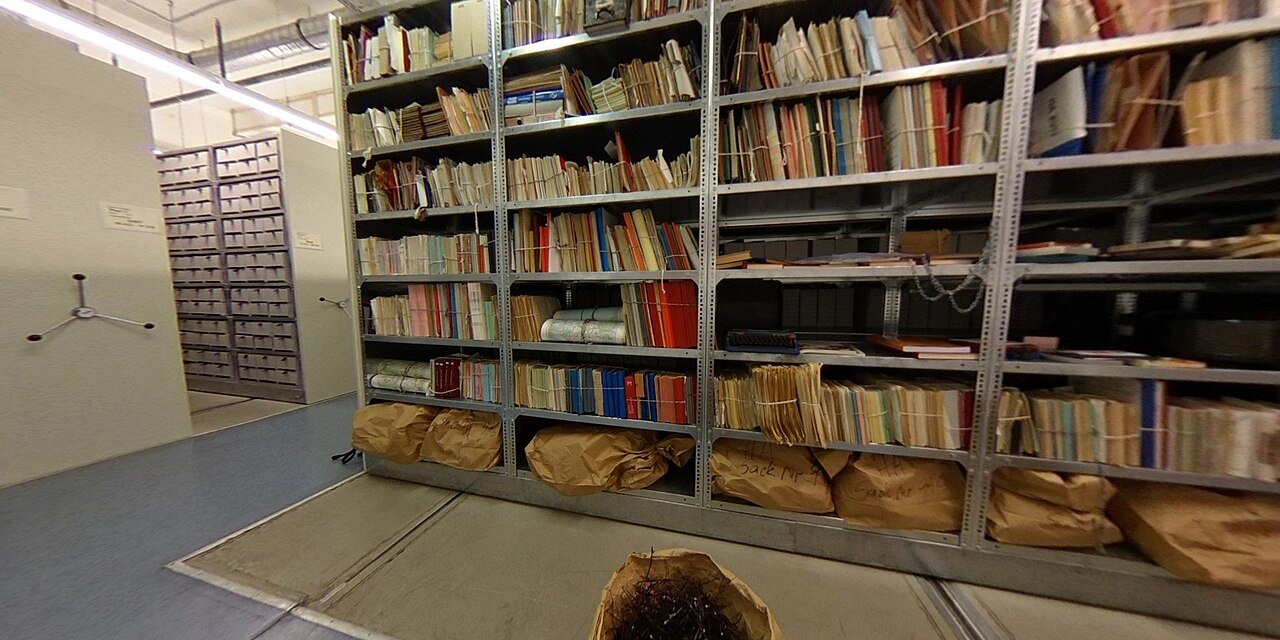
Rows of archive shelving with grey file boxes.
The Stasi Records Archive in Berlin-Lichtenberg, 2018.Photo: Maximilian Schönherr, 2018. Wikimedia Commons. CC BY-SA 4.0.

One spine for each volume of Kurras's Stasi file; the radio message of 8 June 1967 is in the last volume.

What the Stasi paid him in a year, Deutschmarks

The Stasi's payments to Kurras in 1955 and in 1966, as bars on one linear scale in Deutschmarks.

In the file

  • 26 April 1955Kurras signs a written commitment to the Stasi and chooses the code name “Otto Bohl”.
  • 28 July 1964His SED membership book is issued.
  • 8 June 1967The Stasi radios: “Material sofort vernichten. Vorerst Arbeit einstellen.” Destroy material immediately. Stop work for now. And: “Betrachten Ereignis als sehr bedauerlichen Unglücksfall.”
  • June 1967Kurras answers that everything has been destroyed, and asks for money for a lawyer: “Brauche Geld für Anwalt.”
  • November 1967The MfS bars him from entering the GDR, noting: “K. ist der Mörder des westdeutschen Studenten Benno Ohnesorg.”
  • 1976Kurras tells his former handler he fired in self-defence.
  • May 1986A deputy minister orders that the file stay concealed.

Not in the file

  • Volumes 1–17An order, a request or a plan to shoot. Seventeen volumes, and no proof of one.
  • 17 June 1967A further long encrypted message reached the Stasi. It has been removed from the file.

“Ein Beleg dafür findet sich in der 17-bändigen Akte nicht.”No proof that the Stasi ordered it is to be found in the seventeen-volume file. Helmut Müller-Enbergs and Cornelia Jabs, who found the file, 2009. They added: “Ein Auftragsmord scheint auch wenig wahrscheinlich.” — a contract killing seems unlikely.

From 2009 the Generalstaatsanwaltschaft Berlin investigated whether the Stasi had a part in the shot. It closed the case on 11 November 2011, finding too little evidence to charge.

03Berlin and Hanover, June–November 1967

About 15,000 people followed his coffin to the border

On 8 June, after a memorial service at the Freie Universität, about 15,000 people went with the coffin to the Dreilinden crossing, where the transit road leaves West Berlin for the West. Benno Ohnesorg was buried in Hanover on 9 June; a congress, “Hochschule und Demokratie”, followed there with about 5,000 people.

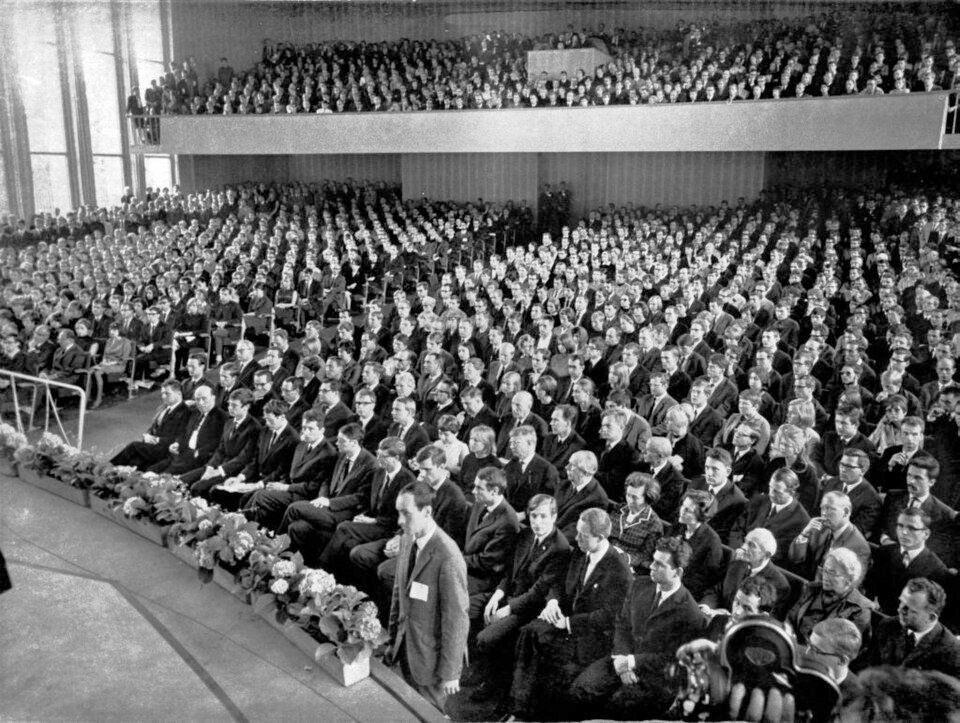
Black-and-white photograph of a large auditorium packed with seated mourners, on the floor and in the balcony.
The memorial service for Benno Ohnesorg at the Freie Universität, 8 June 1967: the auditorium is full to the gallery.Photo: Ludwig Binder / Stiftung Haus der Geschichte, 1967. Wikimedia Commons. CC BY-SA 2.0.
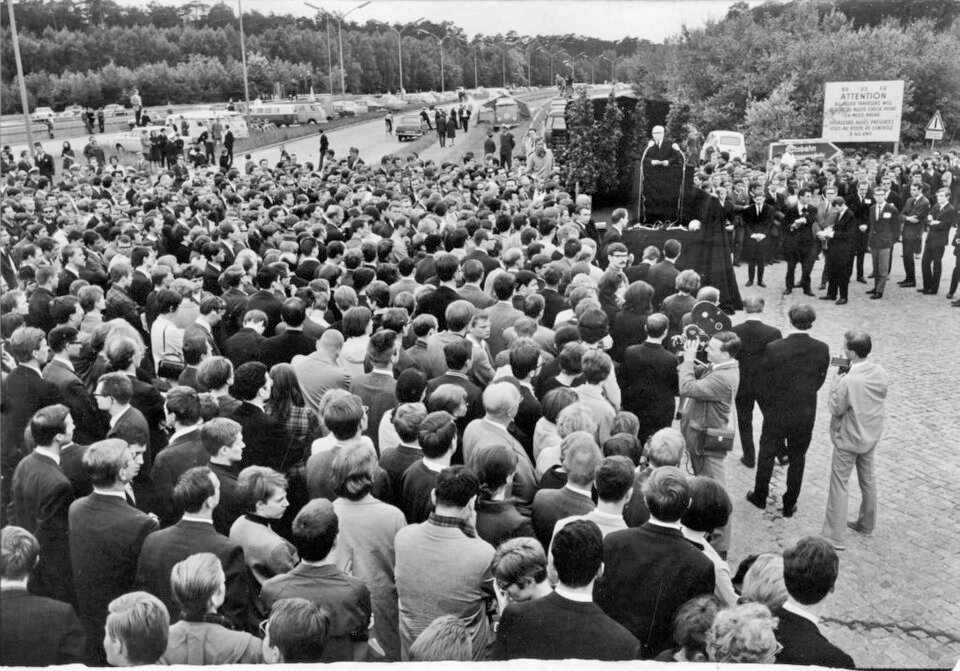
Black-and-white photograph of a dense crowd on an empty motorway, a speaker on a raised platform, a road sign pointing to the checkpoint.
8 June 1967, the closed Autobahn at the Zehlendorf interchange, on the road to the Dreilinden crossing: the crowd that followed the coffin listens to Professor Helmut Gollwitzer.Photo: Ludwig Binder / Stiftung Haus der Geschichte, 1967. Wikimedia Commons. CC BY-SA 2.0.

A parliamentary inquiry that summer found serious police and political failures; the police president, the interior senator and the Governing Mayor resigned one after another.

Kurras was acquitted on 21 November 1967, and again in 1970: both acquittals rested on “putative Notwehr”, self-defence he believed in. Six days after the first verdict, another trial over 2 June opened in Moabit.

Black-and-white photograph of spectators in a courtroom gallery, a young dark-haired man in the foreground left.
Moabit, 27 November 1967: Rudi Dutschke (front left) in the public gallery at the opening of the trial of Fritz Teufel, accused over 2 June. Wolfgang Neuss sits far right.Photo: Ludwig Binder / Stiftung Haus der Geschichte, 1967. Wikimedia Commons. CC BY-SA 2.0.

04Kurfürstendamm, 11 April 1968

Ten months later, three shots at Rudi Dutschke

On 11 April 1968, 314 days after Ohnesorg died, Josef Bachmann, a painter and decorator, shot Rudi Dutschke on the Kurfürstendamm. He fired three times; a single shot left him with a life-threatening head wound. Bachmann had taken press headlines calling for a “hunt” on Dutschke literally.

Dutschke, born in Schönefeld, Brandenburg in 1940, had left the GDR for West Berlin in 1961. He was 28.

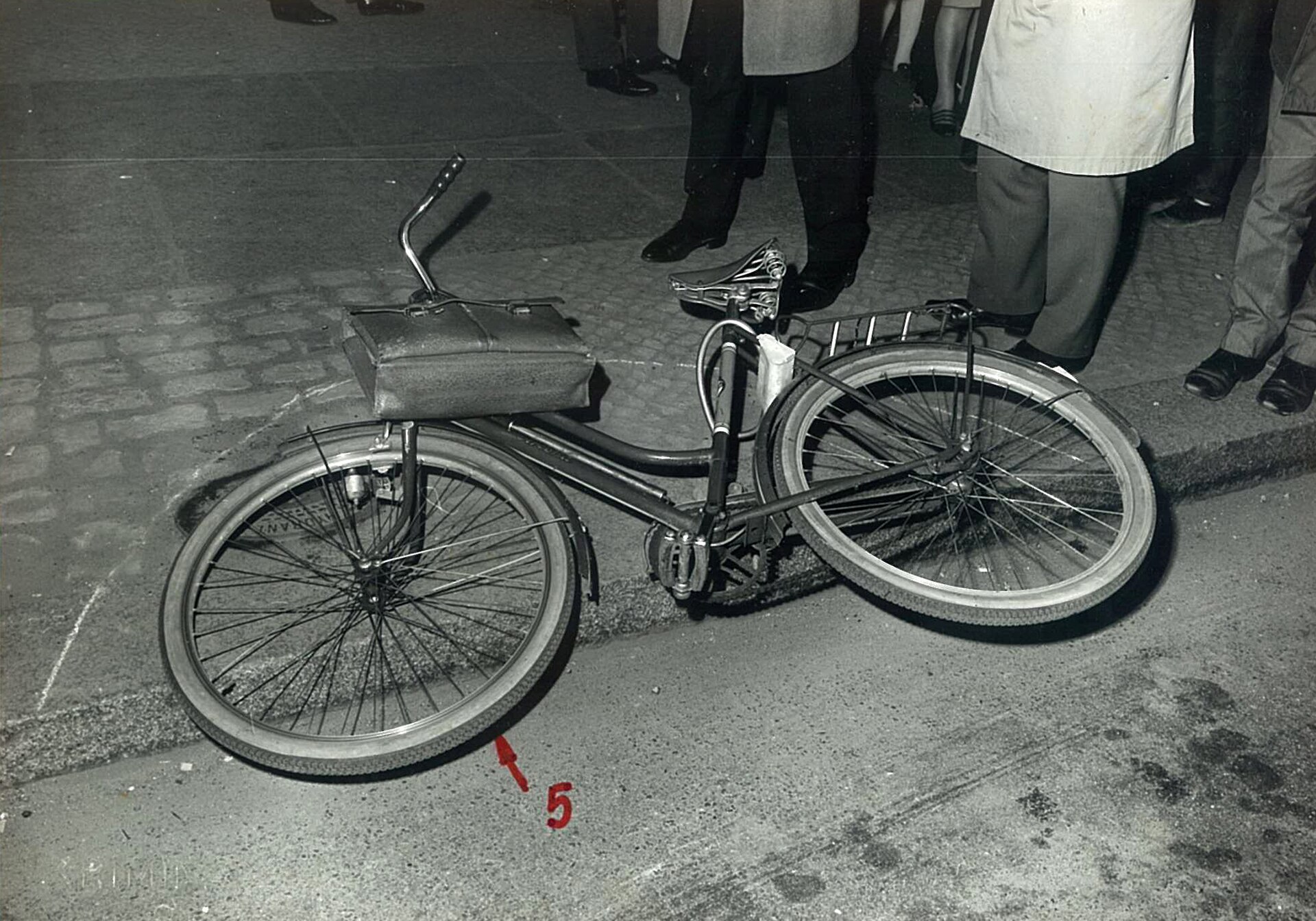
Black-and-white police photograph of a bicycle lying on its side at the kerb with a briefcase on the carrier; legs of bystanders behind.
Kurfürstendamm, 11 April 1968: Rudi Dutschke’s bicycle and briefcase where he was shot. Police evidence photograph; the red marker is on the original.Photo: Polizei Berlin, 1968. Wikimedia Commons. CC BY-SA 4.0.
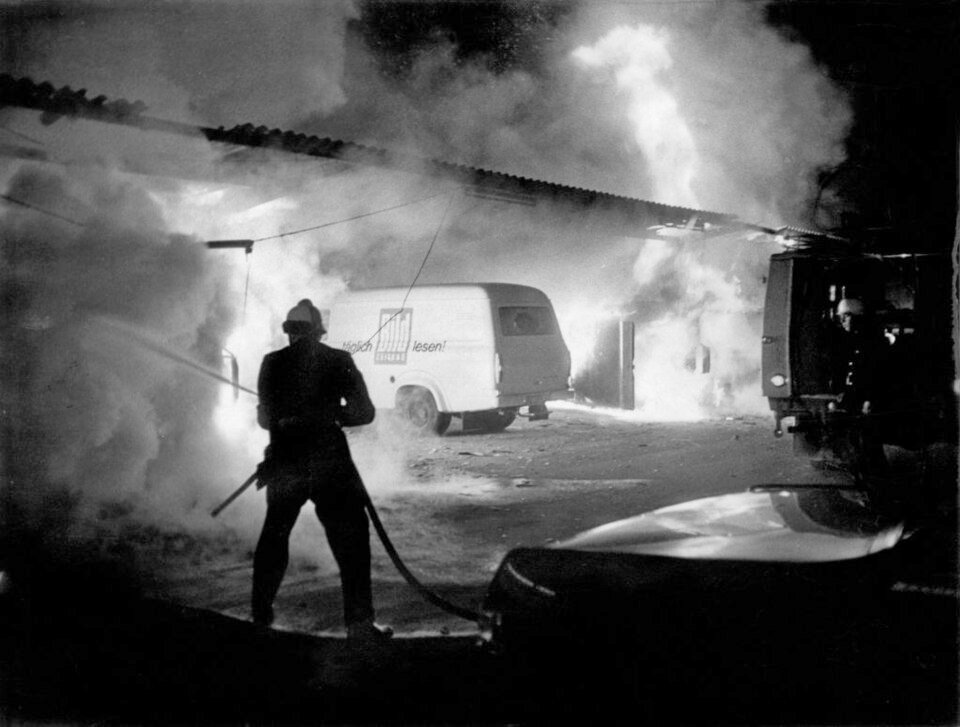
Black-and-white night photograph of a fireman with a hose silhouetted against burning delivery vans under a canopy.
Near the Axel Springer building, the night of the attack: firemen fight burning Bild delivery vans. The archive dates the photograph to 11 April 1968.Photo: Ludwig Binder / Stiftung Haus der Geschichte, 1968. Wikimedia Commons. CC BY-SA 2.0.

That night and over Easter, the protest turned on the Springer house: its branches had windows smashed; delivery vans were blocked or set on fire. There were demonstrations in 27 cities; about 21,000 police were deployed; two people died in Munich.

Bachmann was convicted of attempted murder in 1969 and sentenced to seven years. He took his own life in his cell in February 1970. Dutschke recovered slowly, studied at Cambridge until he was expelled from Britain, and taught at Aarhus from 1971. On 24 December 1979 he drowned in his bath after an epileptic seizure, a late effect of the 1968 attack. He was 39, and had lived 4,274 days with the wound.

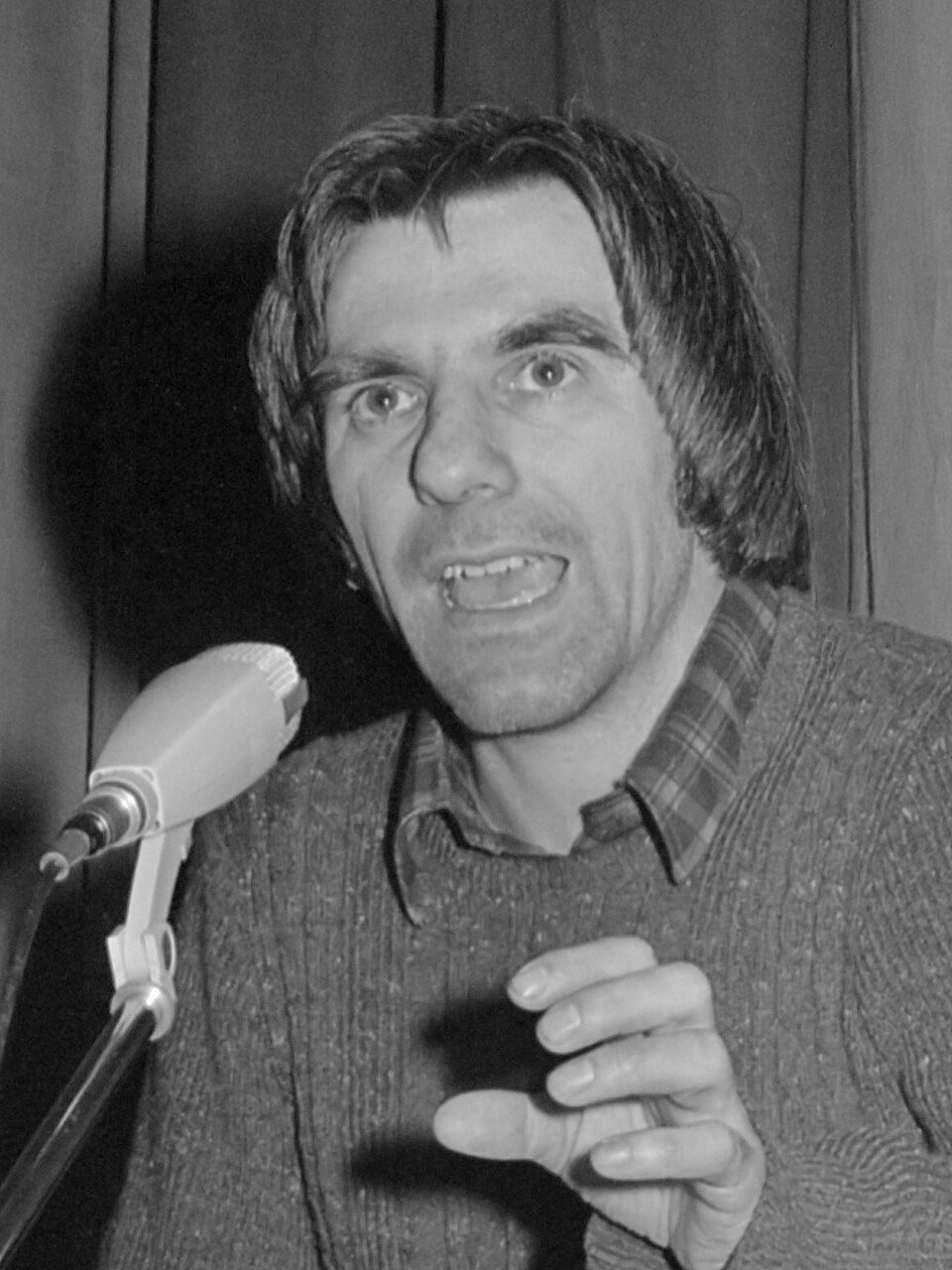
Black-and-white photograph of a man with dark, unruly hair speaking into a microphone and gesturing with one hand.
Rudi Dutschke lecturing in Tilburg, the Netherlands, 12 February 1976.Photo: Hans Peters for Anefo, 1976. Nationaal Archief / Wikimedia Commons. CC0.
A grave planted with green shrubs, a rough boulder headstone behind.
Rudi Dutschke’s grave in the St.-Annen-Kirchhof, Berlin-Dahlem, 2016.Photo: OTFW, Berlin, 2016. Wikimedia Commons. CC BY-SA 3.0.

05Berlin, 2009–2014

Nearly 42 years later, the file came out

On 27 May 2009 Helmut Müller-Enbergs and Cornelia Jabs, researchers at the Stasi records agency, published what they had found: the man who shot Benno Ohnesorg had been a Stasi informant and an SED member when he fired. The link had stayed hidden for nearly 42 years.

In January 2012 Der Spiegel published a reconstruction from the prosecutors’ files: a photograph puts Kurras at the scene, against the testimony of the operation commander, Helmut Starke; an eight-second SFB film shows a silhouette with a pistol. Digital analysis of film and photographs showed he stood close to Ohnesorg, not far back as he had claimed. There will be no new trial: many of those involved are dead or unfit to testify. Kurras died on 16 December 2014.

Two records, 1955–2015, one scale

A vertical time line from 1955 to 2015 on one linear scale. On the left, Kurras and his Stasi file; on the right, Benno Ohnesorg and Rudi Dutschke. Each mark sits at its recorded date; dates known only to the month or the year are drawn as brackets.

What the record now holds: Kurras was an informant when he fired; the Stasi treated the shot as an accident, told him to destroy his material and cut him off; prosecutors found no case that it ordered the shot. Why Kurras ran to the group and fired is still unclear.

“Die Konturen legen nahe, dass es sich um Kurras handelt.”“The outlines suggest that it is Kurras.” A Berlin prosecutor’s note on the film, quoted by Der Spiegel, 2012.

06Charlottenburg, Kreuzberg, Hanover

A relief by the opera, a grave in Hanover, and a street corner in Kreuzberg

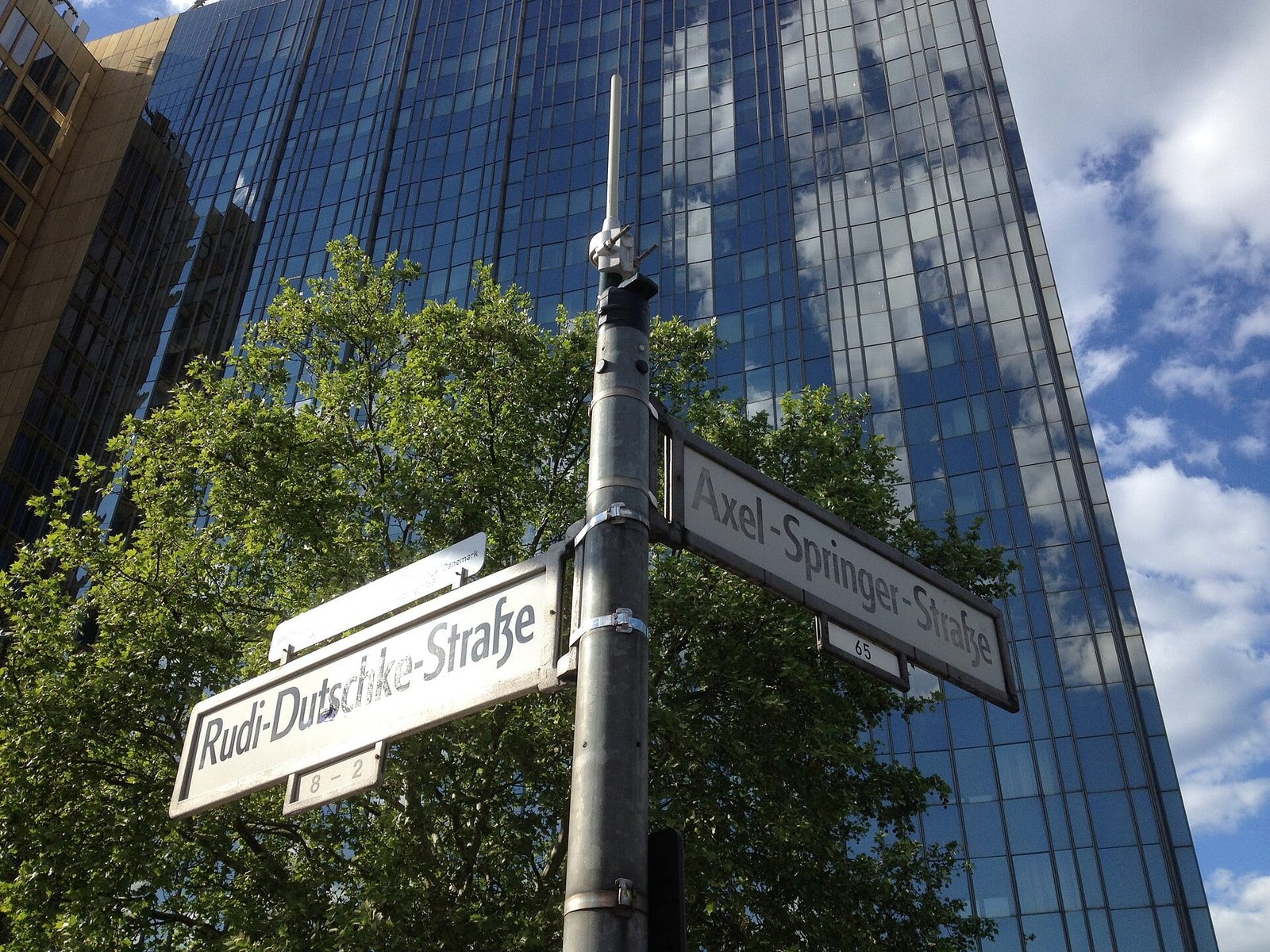
Beside the Deutsche Oper stands Alfred Hrdlicka’s relief “Der Tod des Demonstranten”, The Death of the Demonstrator, with a plaque to Benno Ohnesorg. He is buried with Christa in Hanover. In Kreuzberg, Rudi-Dutschke-Straße now meets Axel-Springer-Straße.

A tall bronze relief panel standing on a pavement in front of the glass entrance of the opera house.
Alfred Hrdlicka’s relief “Der Tod des Demonstranten” beside the Deutsche Oper, Bismarckstraße, with the memorial plaque to Benno Ohnesorg, 2016.Photo: Fridolin freudenfett, 2016. Wikimedia Commons. CC BY-SA 4.0.
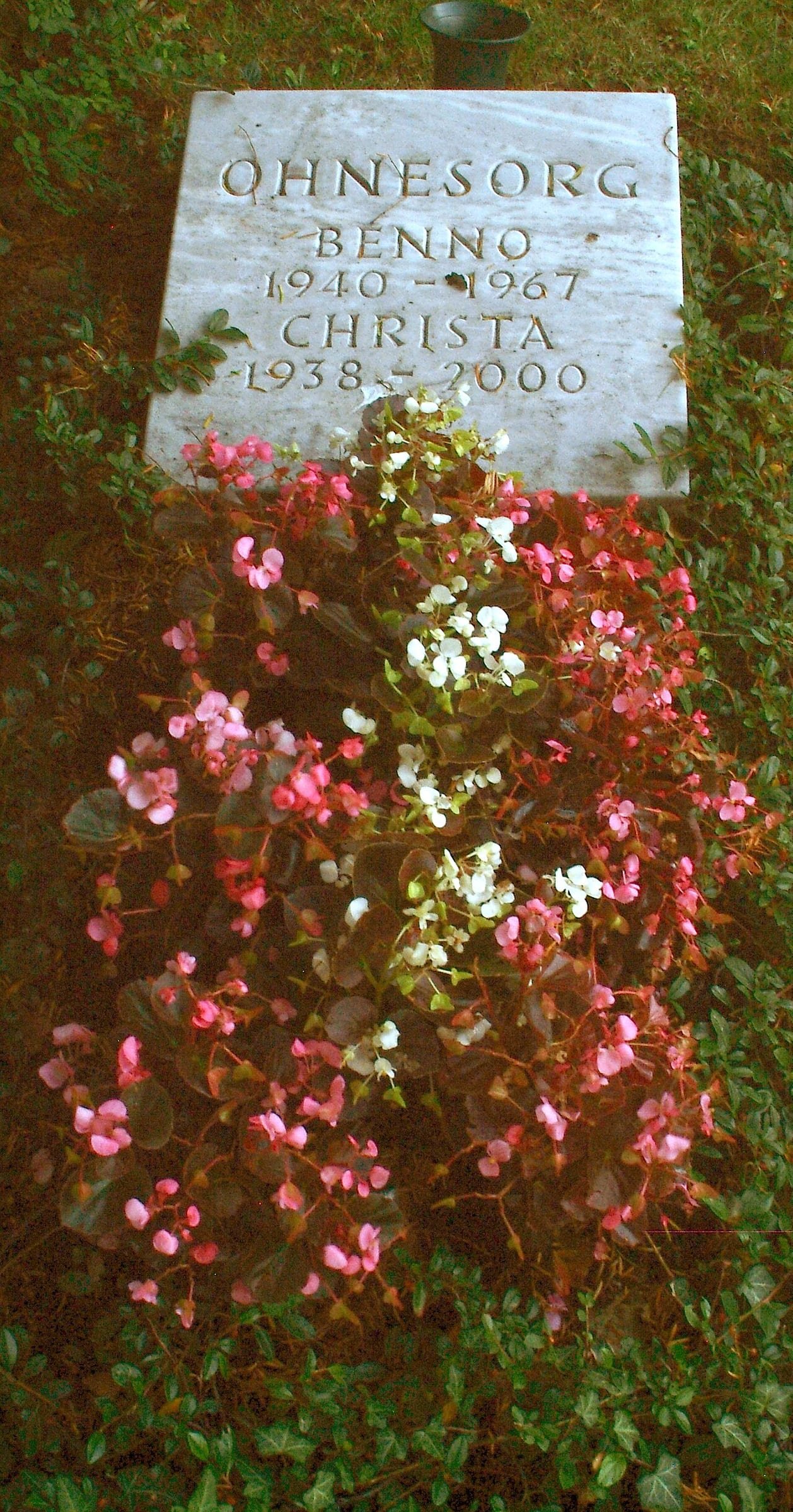
A small stone engraved OHNESORG, BENNO and CHRISTA above a bed of red and pink flowers.
The grave of Benno and Christa Ohnesorg in the Bothfeld cemetery, Hanover, 2011.Photo: Bernd Schwabe in Hannover, 2011. Wikimedia Commons. CC BY 3.0.
Two street signs on a pole, Rudi-Dutschke-Straße and Axel-Springer-Straße, in front of a glass office tower.
Where Rudi-Dutschke-Straße meets Axel-Springer-Straße, Berlin-Kreuzberg, 2014.Photo: JohanahoJ, 2014. Wikimedia Commons. CC BY-SA 3.0.

The shot that made 1968 was fired by a Stasi informant. Why he fired, the record still does not say.

Press & citation

Use this Berlinfographic

Free to publish under CC BY 4.0 — in print, online, on Wikipedia and in teaching, commercially or not — with credit to Berlinfographics and a link to this page.

Benno Ohnesorg, Karl-Heinz Kurras and Rudi Dutschke, 1967–68: ready-to-use landscape image

Ready-to-use image

The infographic as one image: headline, key figures, chart, sources and credit, 2,400 × 1,350 px PNG. Please use it unedited.

Download landscape (PNG)
Benno Ohnesorg, Karl-Heinz Kurras and Rudi Dutschke, 1967–68: square version

Square format

A 1:1 version for social media and narrow columns, 1,800 × 1,800 px.

Download square (PNG)
Benno Ohnesorg, Karl-Heinz Kurras and Rudi Dutschke, 1967–68: portrait version

Portrait 4:5

For Instagram and LinkedIn feeds, 1,620 × 2,025 px.

Download portrait (PNG)

Credit line

Berlinfographics (berlinfographics.com), CC BY 4.0

Citation

Berlinfographics (2026). “Benno Ohnesorg, Karl-Heinz Kurras and Rudi Dutschke, 1967–68”. Berlin Experiences. https://berlinfographics.com/ohnesorg-dutschke-1967/

Wikipedia

{{cite web |title=Benno Ohnesorg, Karl-Heinz Kurras and Rudi Dutschke, 1967–68 |url=https://berlinfographics.com/ohnesorg-dutschke-1967/ |website=Berlinfographics |publisher=Berlin Experiences |date=2026-11-09 |access-date=2026-11-09}}