Berlinfographicsby Berlin Experiences

1776–1810Queen Luise of Prussia

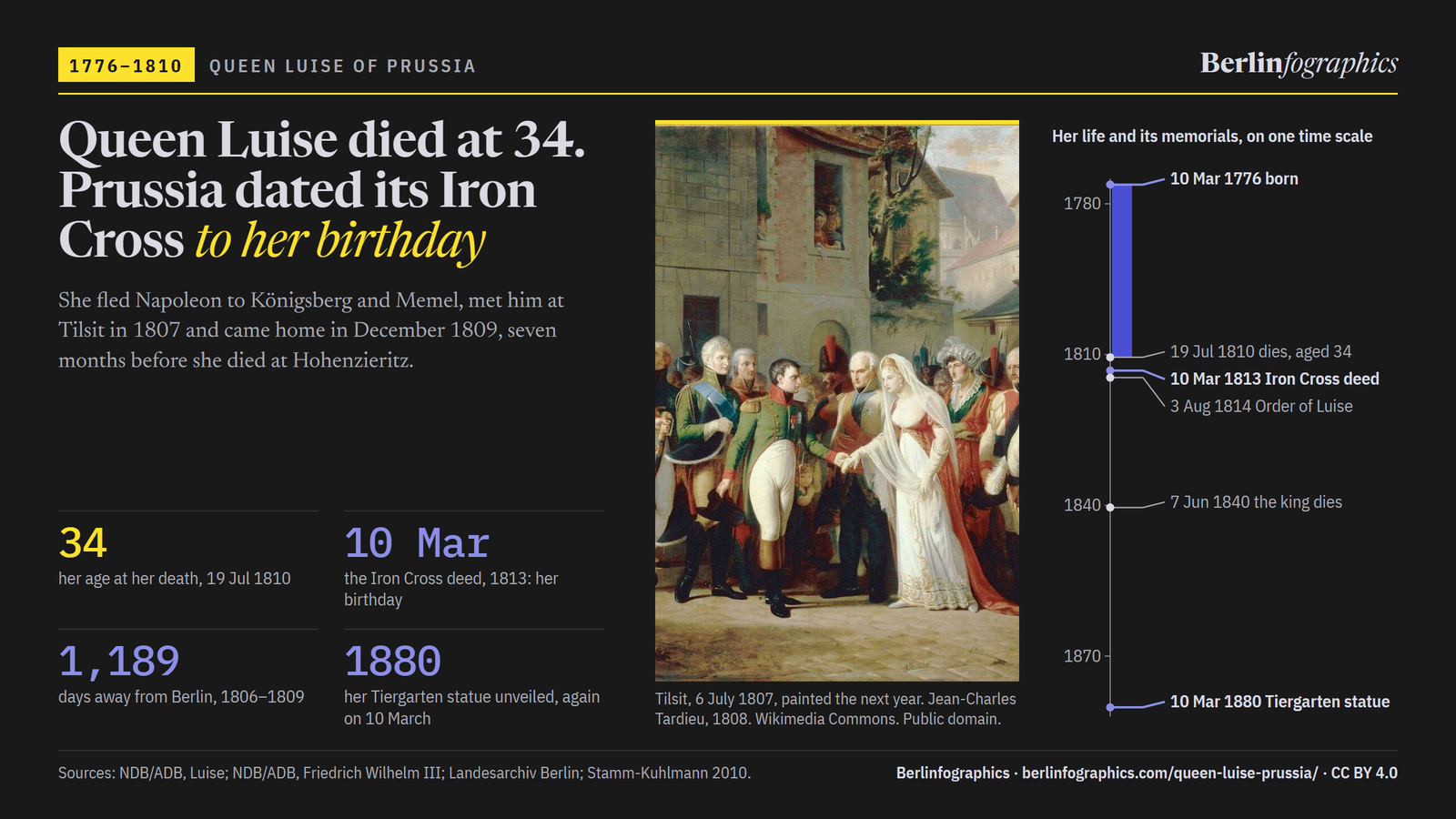
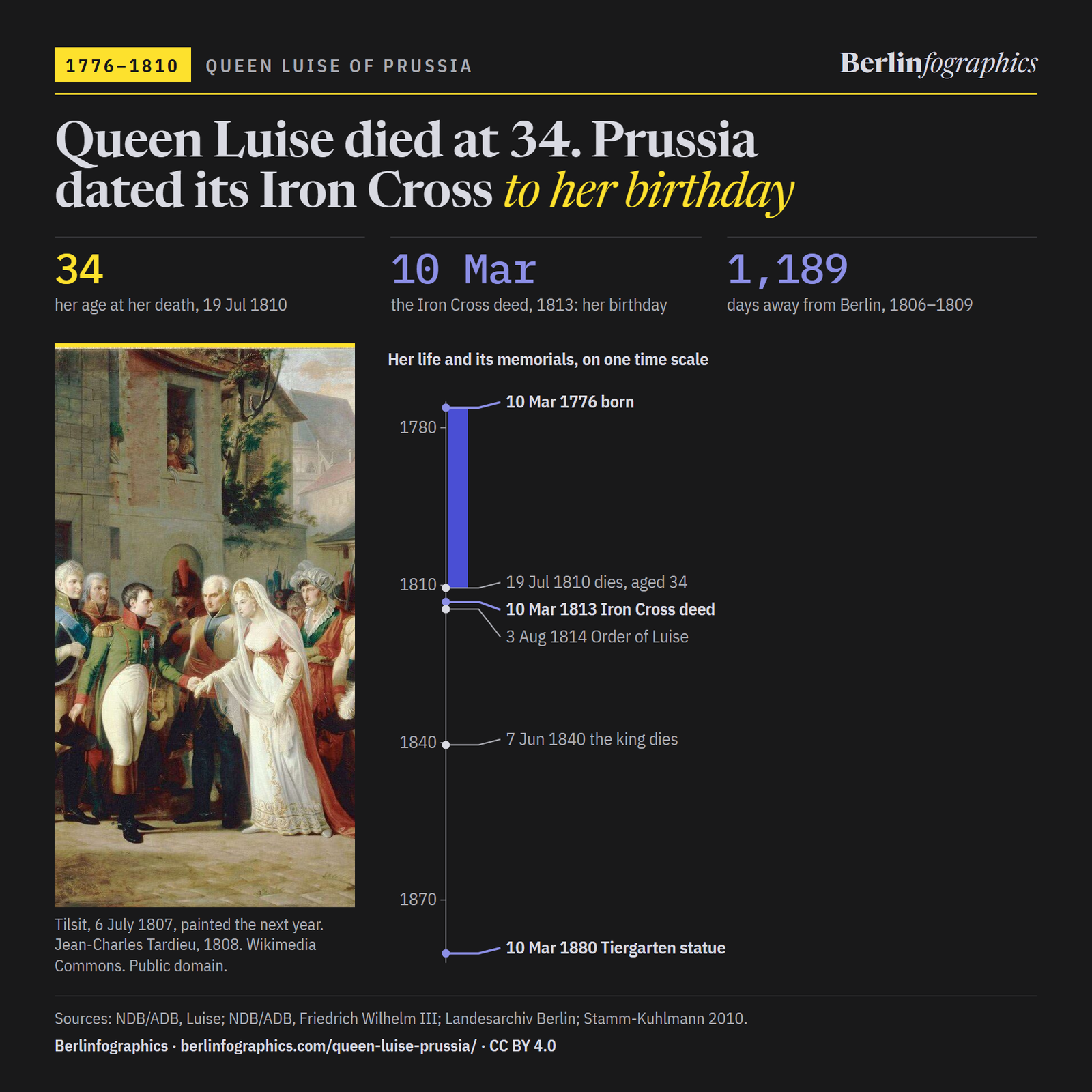
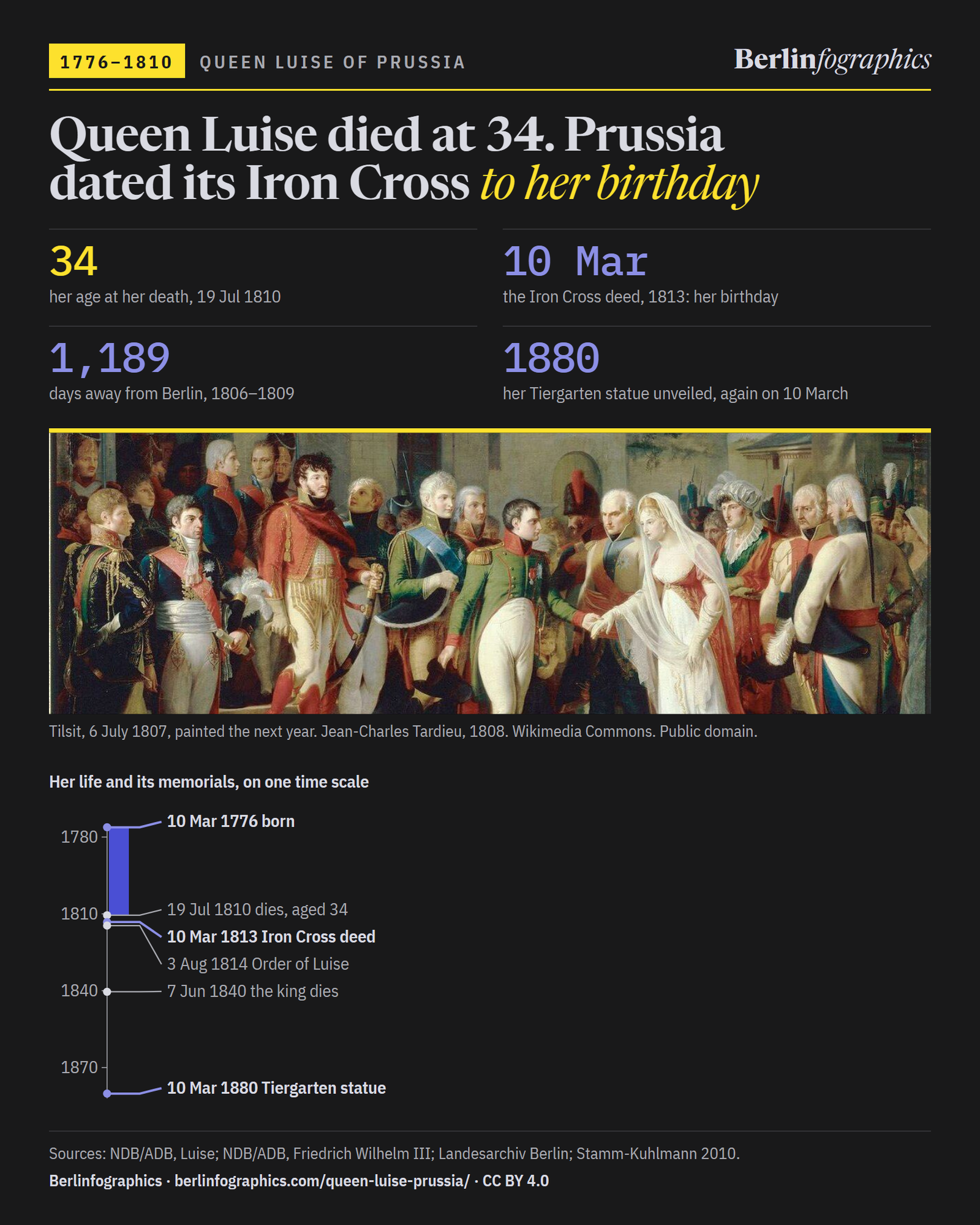
Queen Luise died at 34. Three years later, Prussia dated its new medal for bravery to her birthday

The deed founding the Iron Cross is dated 10 March 1813, the day she would have turned 37. She had fled Berlin before Napoleon, faced him at Tilsit and come home with seven months left to live. Berlin kept her day: her statue in the Tiergarten was unveiled on 10 March 1880.

Scroll through her last four years

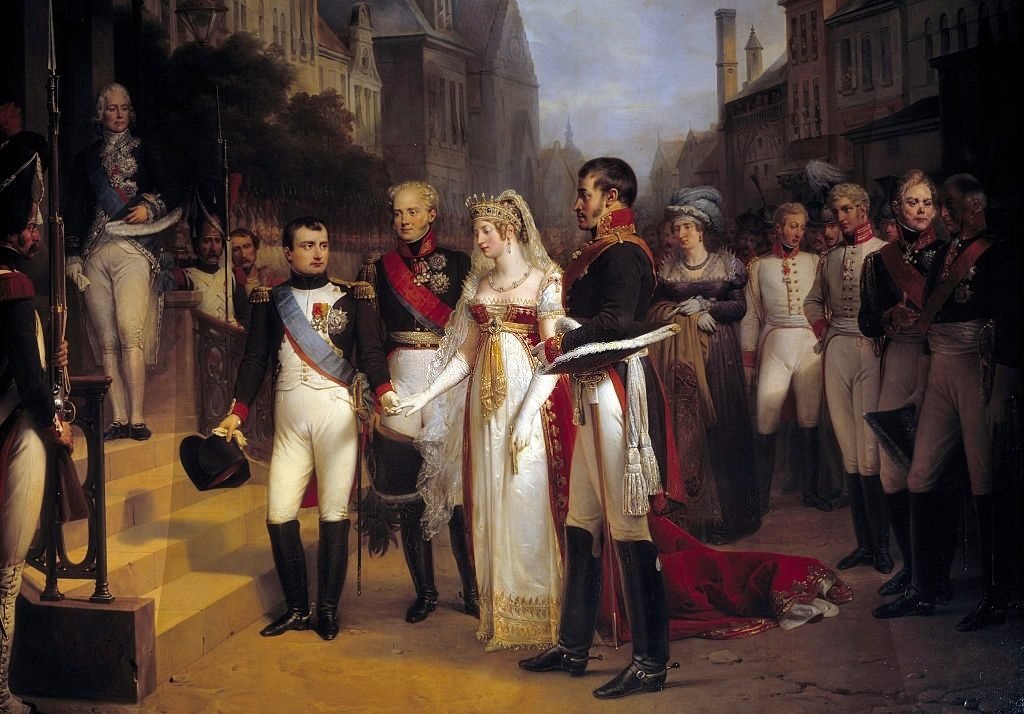
Jean-Charles Tardieu, Napoleon receives the Queen of Prussia at Tilsit, 6 July 1807, painted in 1808, the year after.Jean-Charles Tardieu, 1808. Wikimedia Commons. Public domain.

01Berlin, 22 December 1793

A princess from Mecklenburg-Strelitz, married in Berlin at 17

Luise was born in Hanover on 10 March 1776, a princess of Mecklenburg-Strelitz. She entered Berlin on 22 December 1793 and married Crown Prince Friedrich Wilhelm two days later, on Christmas Eve. When his father died on 16 November 1797, she became Queen of Prussia.

She had nine children, five sons and four daughters. Two of the sons became kings of Prussia, Friedrich Wilhelm IV and Wilhelm I, and Wilhelm was later the first German Emperor.

17
her age at the wedding, 24 December 1793
9
children, among them two future kings
34
her age at her death, 19 July 1810
A white sculpture of two young women standing side by side, one with her arm over the other's shoulder.
Johann Gottfried Schadow’s Prinzessinnengruppe: Luise, left, with her sister Friederike. Schadow modelled it in 1795 and finished it in marble in 1797; this version stood in the Friedrichswerdersche Kirche when photographed in 2023.Rainer Halama, 2023 (sculpture: Johann Gottfried Schadow). Wikimedia Commons. CC0 1.0.

02Four years, on one line

Three years away from Berlin, then six months at home

Each row is a place; each bar a stay, drawn at its true dates. Where the source gives a move only to the month, that month is drawn pale, never pinned to a day. From 21 September 1806 to 23 December 1809 she was away from Berlin for 1,189 days, apart from a brief stop in her flight in October 1806.

1806–1810six places
one row each
where she was, dated to the daydated to the dayknown only to the monthmonth onlyBerlinBerlin
Where Queen Luise was from September 1806 to July 1810, one row per place, on a single time line. Where a source gives a move only to the month, that month is drawn pale. A marker moves to the date of each card.
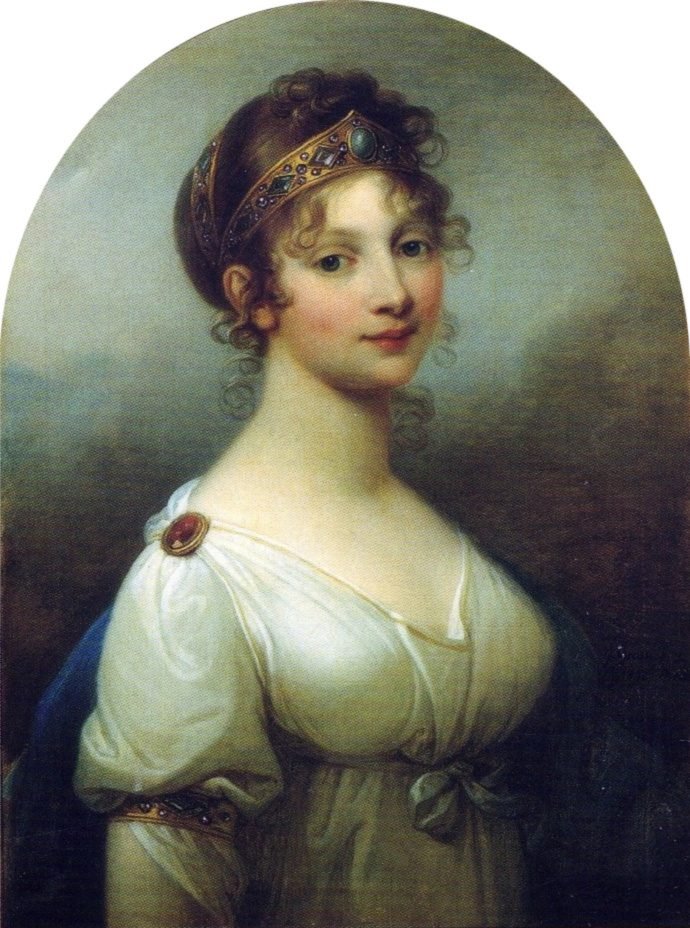
Portrait of Queen Luise in a white gown with a jewelled band in her hair and a blue drape.
Josef Grassi, 1802. Wikimedia Commons. Public domain.

21 September 1806

She rides out with the king to the army

On 21 September 1806 she left Charlottenburg with Friedrich Wilhelm III for the army’s headquarters. Prussia was going to war with Napoleon.

Sources: NDB/ADB, Luise

Napoleon on horseback before ranks of French Guard grenadiers on a smoky battlefield.
Horace Vernet, 1836. Via Wikimedia Commons (Public domain).

14 October 1806

One day, two lost battles

On 14 October 1806, the day Napoleon beat the Prussians at Jena and Auerstedt, she left Weimar. She fled east, passing through Berlin only briefly.

Sources: Fondation Napoléon, Berlin 1806 · NDB/ADB, Luise

Napoleon on a white horse rides through the Brandenburg Gate, received by Berlin dignitaries.
Charles Meynier, 1810. Via Wikimedia Commons (Public domain).

27 October 1806

Napoleon rides into her city

On 27 October 1806 Napoleon entered Berlin through the Brandenburg Gate. The queen was already on the road to the east.

Sources: Fondation Napoléon, Berlin 1806

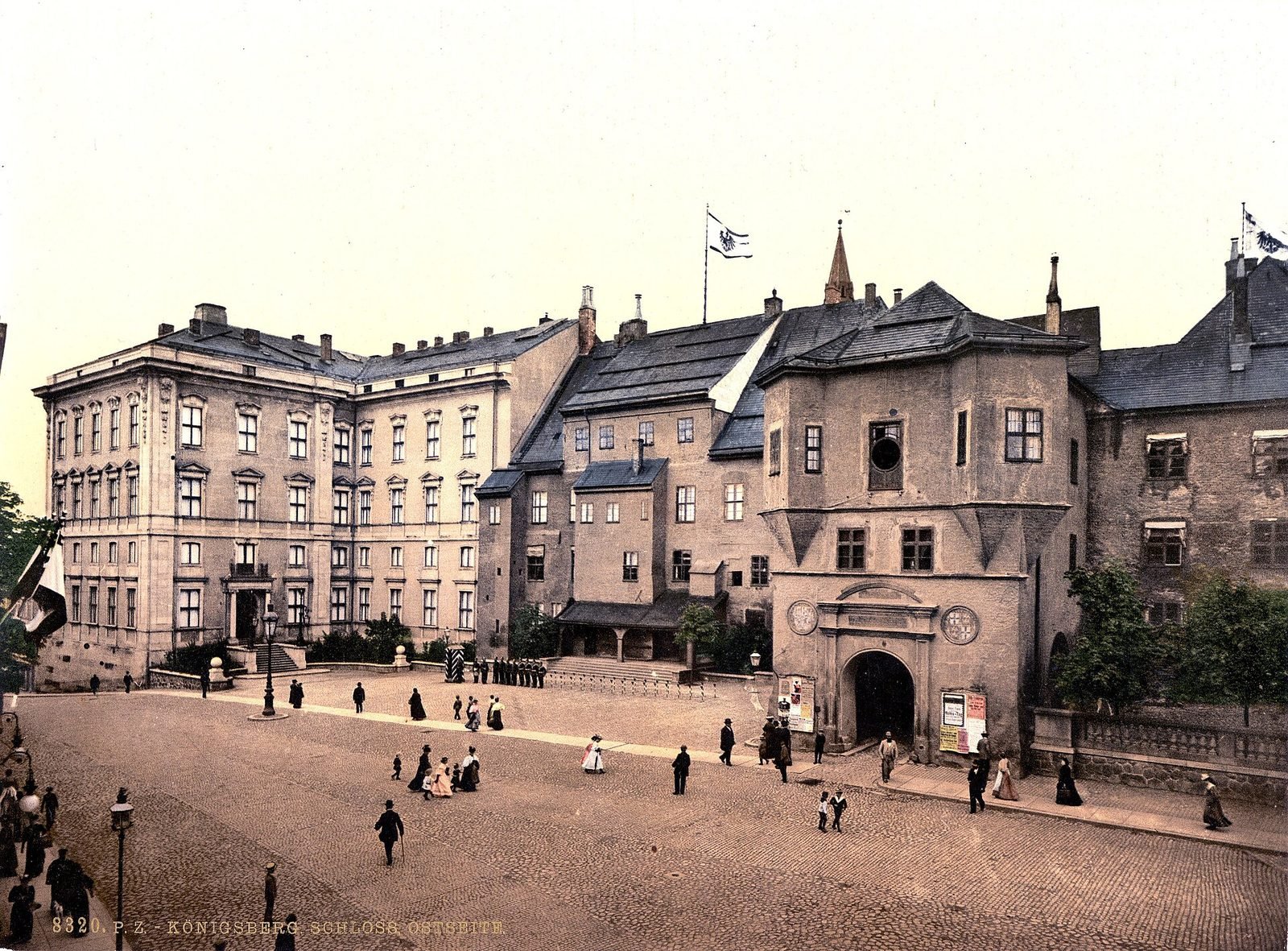
A wide square before the castle wings, with people walking, in a colour photochrom view.
Unknown author, between 1890 and 1900. Wikimedia Commons. Public domain.

9 December 1806

To the far edge of the kingdom

She reached Königsberg on 9 December 1806, exhausted and ill. In January 1807 she fled on to Memel across the Curonian Spit, through storm and snow.

Sources: NDB/ADB, Luise

Before a house, Napoleon takes the hand of Queen Luise in a white gown, among officers and courtiers.
Jean-Charles Tardieu, 1808. Wikimedia Commons. Public domain.

6 July 1807

She meets Napoleon at Tilsit

From Memel she was sent to Tilsit, where Napoleon was making peace with the tsar. She arrived on 6 July 1807 and dined with Napoleon, hoping to soften the terms.

Sources: NDB/ADB, Luise · Fondation Napoléon, Tilsit

In a street before a house, Napoleon greets Queen Luise in a white gown; the tsar and the Prussian king stand by among officers.
Nicolas Gosse (1787–1878), 1836–37. Wikimedia Commons. Public domain.
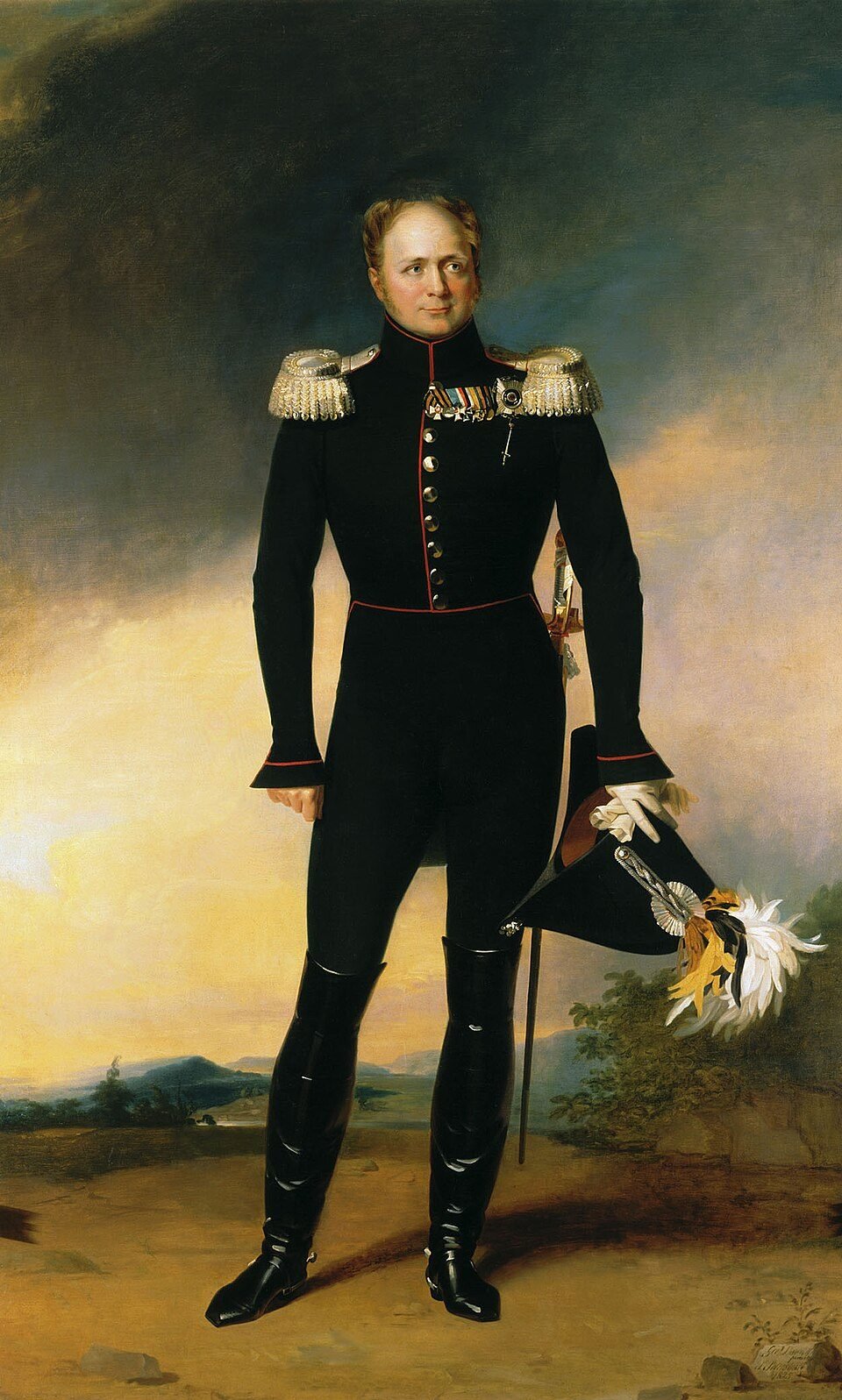
Full-length portrait of Tsar Alexander I in a dark green uniform with epaulettes.
George Dawe, 1826. Wikimedia Commons. Public domain.

9 July 1807

The peace she could not soften

Prussia’s treaty was signed on 9 July 1807. It lost its lands west of the Elbe and most of its Polish gains. Her plea had not changed the terms.

Sources: Fondation Napoléon, Tilsit · Britannica, Tilsit · NDB/ADB, Luise

Full-length portrait of Tsar Alexander I in a dark green uniform with epaulettes.
George Dawe, 1826. Wikimedia Commons. Public domain.

December 1808

A winter journey to the tsar

The court moved back to Königsberg in January 1808. In December 1808, at Tsar Alexander’s invitation, she travelled to St Petersburg; by February 1809 she was back in Königsberg.

Sources: NDB/ADB, Luise

Half-length portrait of the king in a dark uniform with orders.
Franz Krüger, c. 1830. Via Wikimedia Commons (Public domain).

23 December 1809

Back in Berlin, after more than three years

She left Königsberg on 11 December 1809 and entered Berlin with the king on 23 December 1809. She had been away for 1,189 days.

Sources: NDB/ADB, Luise · Stamm-Kuhlmann 2010

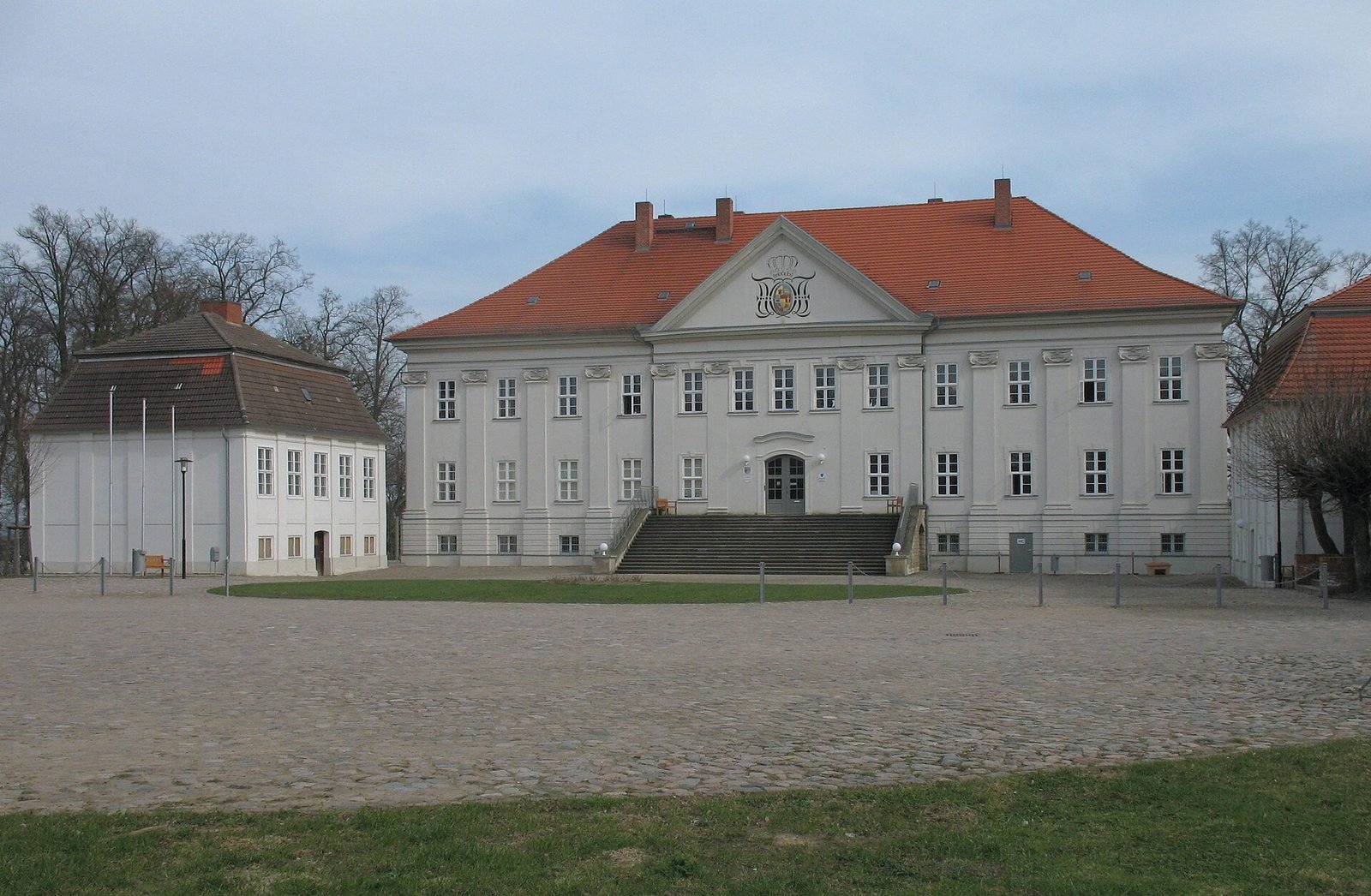
A long two-storey country palace with a central pediment, seen across a lawn.
Doris Antony, Berlin, 2010. Wikimedia Commons. CC BY-SA 3.0.

19 July 1810

She dies at 34, visiting her father

On 25 June 1810 she left to visit her father in Mecklenburg-Strelitz. At Hohenzieritz she fell ill with pneumonia and died on 19 July 1810. The king reached her deathbed in time.

Sources: NDB/ADB, Luise · Stamm-Kuhlmann 2010

A small classical temple with four columns and a pediment, set among dark trees and clipped conifers.
Unknown author, 1895. Wikimedia Commons. Public domain.

23 December 1810

Laid to rest a year to the day after coming home

Her body lay first in the Berlin Dom. On 23 December 1810, a year to the day after her return, she was laid in a new mausoleum in the Charlottenburg palace garden, planned by Heinrich Gentz after the king’s own sketches.

Sources: NDB/ADB, Luise · SPSG, Mausoleum · Museumsportal Berlin

03Tilsit, in pictures

Her most famous evening was painted the next year, and again some 30 years and 89 years later

No one painted the meeting at Tilsit on the day. Jean-Charles Tardieu’s picture was made in 1808, the year after. Nicolas Gosse painted it again in 1836–37 for the history galleries at Versailles, and in 1896 Woldemar Friedrich drew it for a picture-book of her life “for young and old”. Each is a reconstruction, not a record.

Before a house, Napoleon takes the hand of Queen Luise in a white gown, among officers and courtiers.
Tardieu, painted in 1808: the year after the evening it shows.Jean-Charles Tardieu, 1808. Wikimedia Commons. Public domain.
In a street before a house, Napoleon greets Queen Luise in a white gown; the tsar and the Prussian king stand by among officers.
Nicolas Gosse painted the same scene in 1836–37 for the history galleries at Versailles. Tsar Alexander and King Friedrich Wilhelm III stand by.Nicolas Gosse (1787–1878), 1836–37. Wikimedia Commons. Public domain.
An illustration of Queen Luise standing before Napoleon in a room, with officers in the background.
Woldemar Friedrich drew it in 1896 for a picture-book of the queen’s life “for young and old”.Woldemar Friedrich (1846-1910), 1896. Wikimedia Commons. Public domain.

Years between the evening at Tilsit and each picture of it, on one linear scale; pale where a picture is dated to a span of years

04After 1810

Prussia kept her birthday

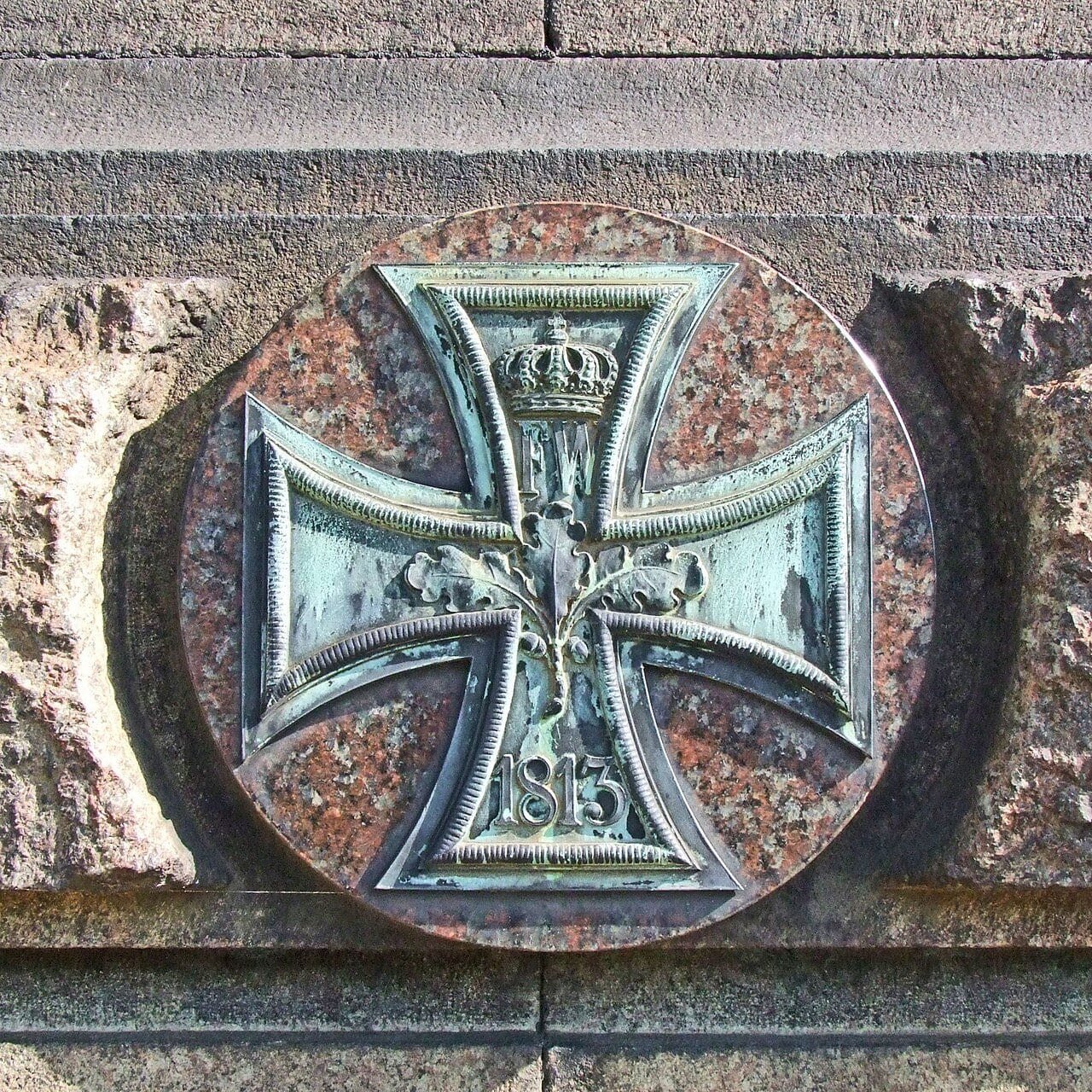
In March 1813 Prussia rose against Napoleon again. The king’s deed founding the Iron Cross, issued at Breslau, is dated 10 March 1813, Luise’s birthday. On 3 August 1814, his own birthday, he founded the Order of Luise for women’s “proofs of patriotism and charity” in the war years of 1813 and 1814. And on 10 March 1880, 70 years after her death, her marble statue by Erdmann Encke was unveiled in the Tiergarten.

Her life and its memorials, 1776–1880, on one linear scale of years; 10 March in yellow

A bronze cross with flared arms, a crown at the top, oak leaves in the centre and the year 1813, set in a round red granite plaque.
The Iron Cross of 1813, with the crown, oak leaves and the year, as a bronze relief on a memorial; photographed in 2016.Alta Falisa, 2016. Wikimedia Commons. CC BY-SA 4.0.
Two white marble tombs with recumbent figures in a hall with dark columns.
Inside the mausoleum, about 1895: the marble figure of the queen by Rauch, and beside it that of King Friedrich Wilhelm III.Unknown author, 1895. Wikimedia Commons. Public domain.
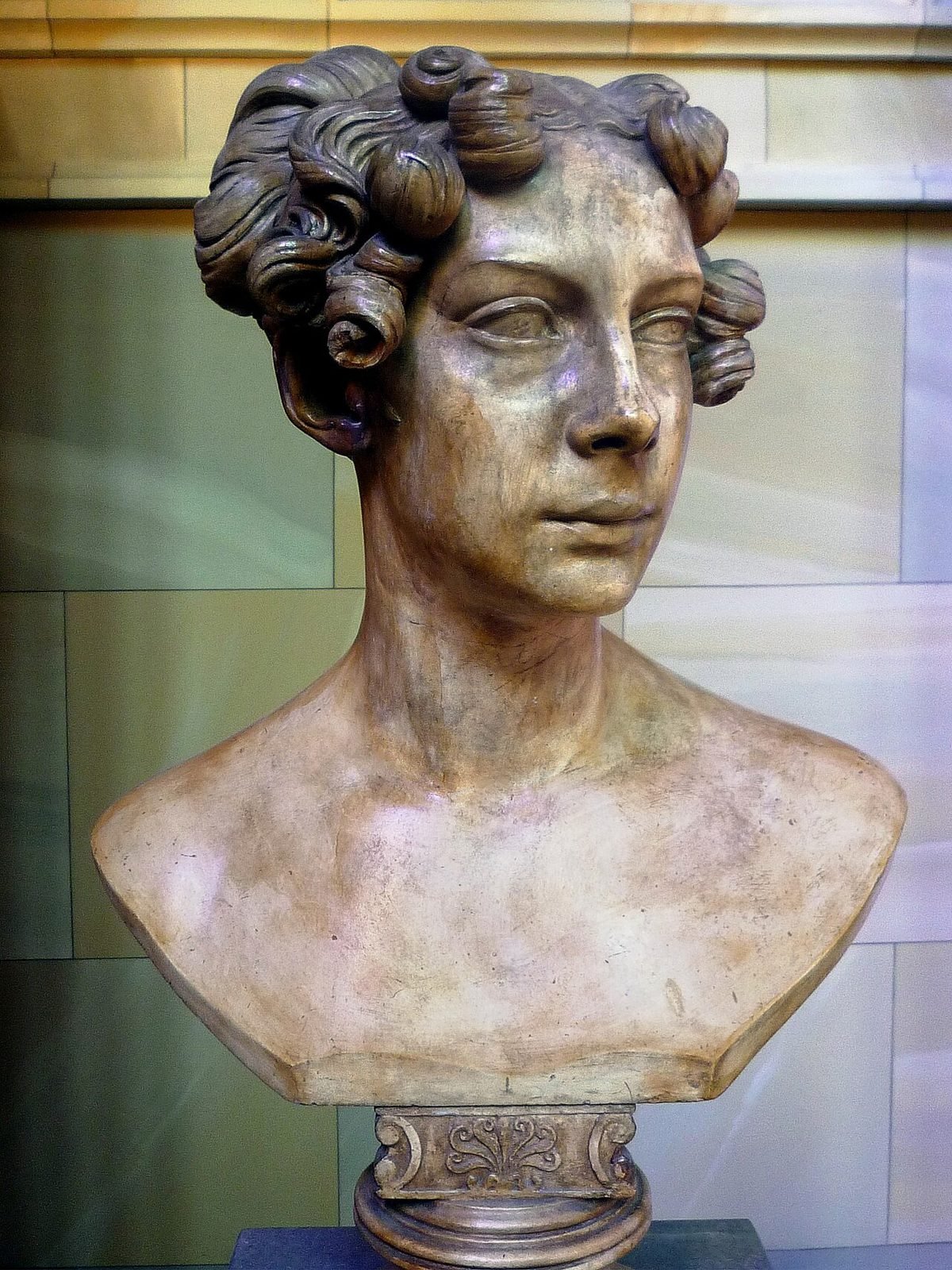
A bust of Queen Luise with curled hair, on a pedestal against a pale wall.
Christian Daniel Rauch, the sculptor of her tomb, made this bust of the queen in 1824.Manfred Brückels, 2010. Wikimedia Commons. CC BY-SA 3.0.
A white marble statue of the queen on a tall carved pedestal, among autumn trees behind an iron fence.
Erdmann Encke’s statue of the queen in the Tiergarten, unveiled on her birthday in 1880; photographed in 2014.Daderot, 2014. Wikimedia Commons. Public domain.

Rauch had the commission for her tomb in 1810; his marble figure of the sleeping queen was set up in the mausoleum in 1814. The parish church of Charlottenburg was named the Luisenkirche in 1826. Friedrich Wilhelm III died on 7 June 1840 and was buried in the same mausoleum, which stands in the palace garden today.

More Prussia on Berlinfographics, including the reform years that began at Tilsit:

A drawing of a Gothic memorial hall with pointed arches, a sarcophagus beneath a canopy of palm-like vaults.
Karl Friedrich Schinkel’s study for a monument to the queen, 1810. The mausoleum that was built was planned by Heinrich Gentz.Karl Friedrich Schinkel, 1810. Wikimedia Commons. Public domain.
Prussia · 1776–1810

She lived 34 years. Prussia kept her birthday for 70 more.

Press & citation

Use this Berlinfographic

Free to publish under CC BY 4.0 — in print, online, on Wikipedia and in teaching, commercially or not — with credit to Berlinfographics and a link to this page.

Queen Luise of Prussia, 1776–1810: ready-to-use landscape image

Ready-to-use image

The infographic as one image: headline, key figures, chart, sources and credit, 2,400 × 1,350 px PNG. Please use it unedited.

Download landscape (PNG)
Queen Luise of Prussia, 1776–1810: square version

Square format

A 1:1 version for social media and narrow columns, 1,800 × 1,800 px.

Download square (PNG)
Queen Luise of Prussia, 1776–1810: portrait version

Portrait 4:5

For Instagram and LinkedIn feeds, 1,620 × 2,025 px.

Download portrait (PNG)

Credit line

Berlinfographics (berlinfographics.com), CC BY 4.0

Citation

Berlinfographics (2026). “Queen Luise of Prussia, 1776–1810”. Berlin Experiences. https://berlinfographics.com/queen-luise-prussia/

Wikipedia

{{cite web |title=Queen Luise of Prussia, 1776–1810 |url=https://berlinfographics.com/queen-luise-prussia/ |website=Berlinfographics |publisher=Berlin Experiences |date=2026-11-09 |access-date=2026-11-09}}