Berlinfographicsby Berlin Experiences

Yevgeny Khaldei’s photograph on the roof of the Reichstag, 2 May 1945, in Adam Cuerden’s restoration of the Commons scan. Khaldei retouched the picture before it was first printed.Yevgeny Khaldei, 1945, restored by Adam Cuerden (public domain) · Wikimedia Commons

The Reichstag · 30 April – 13 May 1945

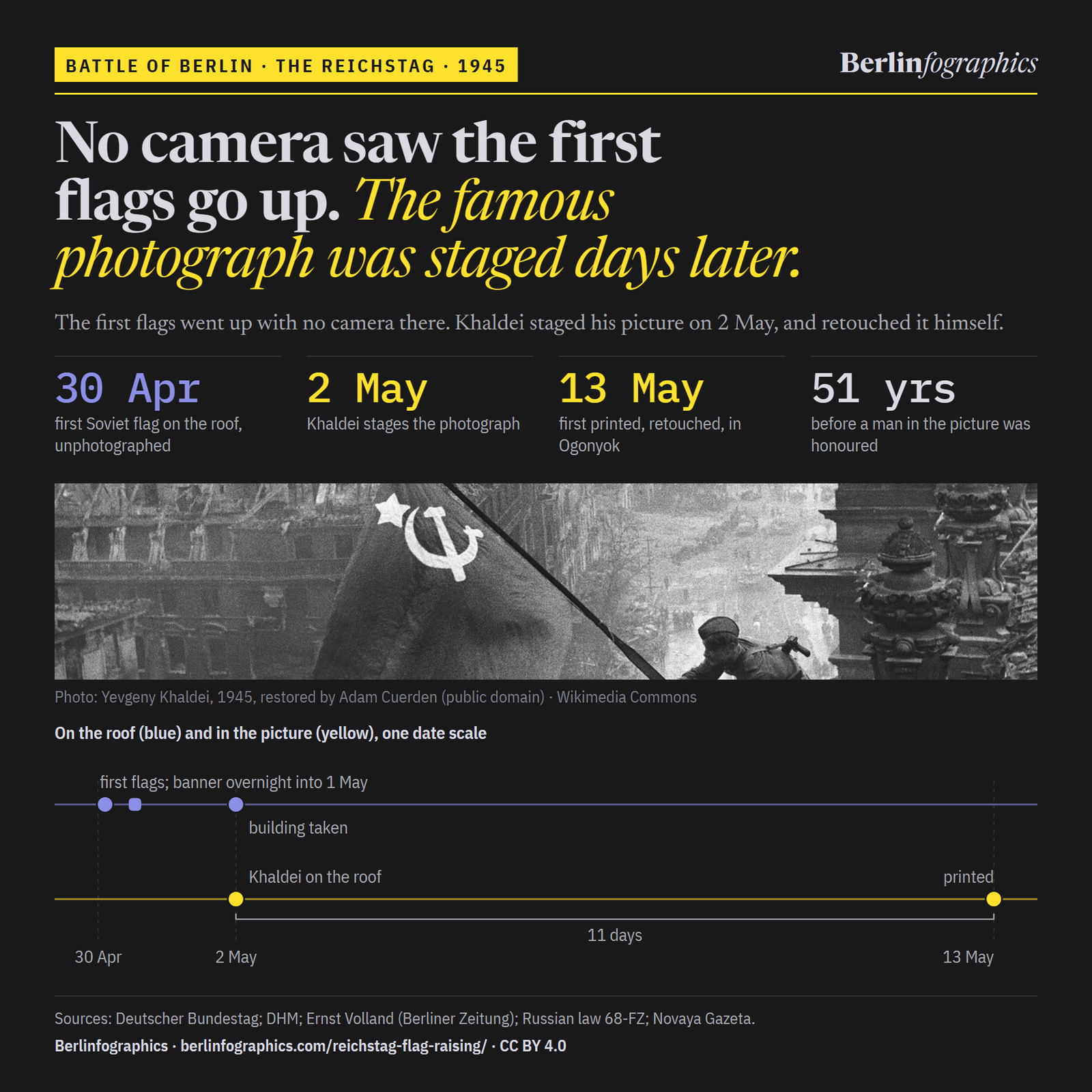
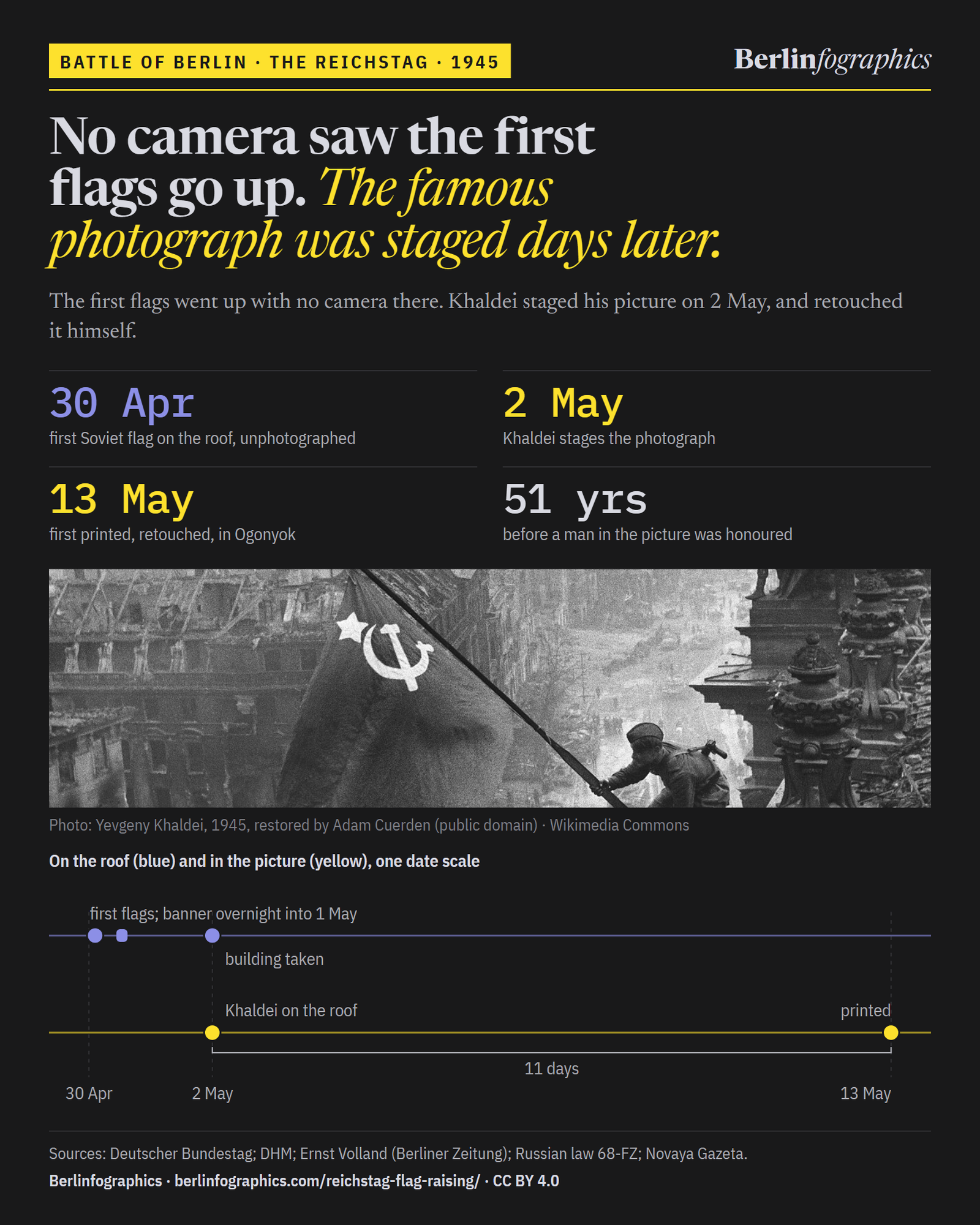
No camera saw the first flags go up. The famous photograph was staged days later.

Red Army soldiers fixed the first flags to the Reichstag on the last day of April, in the middle of the battle and with no photographer there. Yevgeny Khaldei climbed to the roof on 2 May 1945 with a flag he had brought himself, set the scene up, and then retouched the picture with his own hands.

30 Apr
the first Soviet flag on the roof, in the dark, unphotographed
2 May
Khaldei stages his photograph, after Berlin’s surrender
13 May
first printed, retouched, in the magazine Ogonyok
51 yrs
before a man in the picture was honoured for it

01The Reichstag

The Reichstag was fought over for three days, floor by floor

For Soviet propaganda the Reichstag was the target, the symbol of Hitler’s Germany. The assault on it began on 30 April 1945. For a time German troops held the lower rooms and Soviet troops the upper ones. The building was not finally taken until 2 May 1945, the day Berlin surrendered.

Soviet units carried red flags to mark what they had captured, and several groups set out for the Reichstag with one, so that at least one would get there. The roof was the prize.

Erst am 30. April 1945 gelang es Einheiten der Roten Armee, auf dem Dach die sowjetische Fahne zu hissen.“Only on 30 April did Red Army units succeed in hoisting the Soviet flag on the roof.” — Deutscher Bundestag

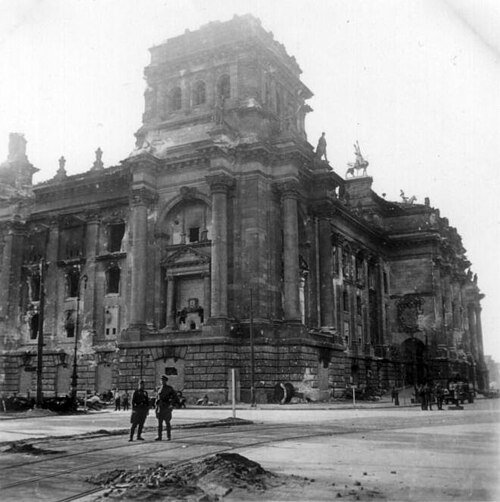
The ruined Reichstag with its dome reduced to a bare iron frame, rubble and a burnt-out vehicle in the foreground.
The Reichstag on 3 June 1945, a month after the fighting (IWM BU 8573).Sgt Hewitt, No. 5 Army Film & Photographic Unit, 1945. Imperial War Museum BU 8573, via Wikimedia Commons. Public domain.

02The event and the image

The flags went up unphotographed. The camera came days later.

Upper line: what happened on the roof. Lower line: the photograph. Which soldiers were first, and at what time, is disputed: the sources give different hours, and this story shows them side by side.

The roof and the picture, 30 April – 13 May

Two timelines across the first two weeks of May. The upper one marks what happened on the Reichstag roof: the battle for the building, the first flags on the afternoon and night of the last day of April, and the building’s capture. The lower one marks the photograph: Khaldei on the roof, and its first printing in the magazine Ogonyok. Two later markers show when the men were honoured.
On the roofThe photograph
Two Soviet soldiers stand before the scarred west front of the Reichstag.
A Soviet officer and soldier in front of the Reichstag, early May 1945.Bundesarchiv, Bild 204-009 / Gorovits, Henryk / CC BY-SA 3.0 de

30 Apr 1945

The assault on the Reichstag begins

Soviet infantry fight their way into the building on 30 April 1945. Inside, the two sides hold different floors.

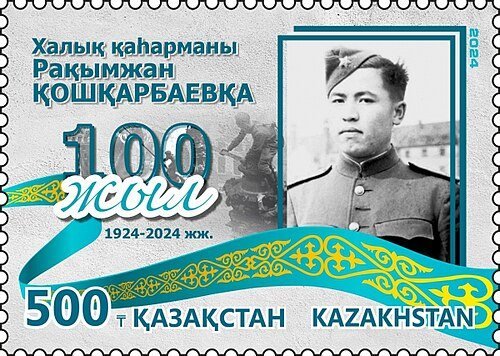
A postage stamp with a portrait photograph of a young soldier in a side cap and the inscription “100 жыл”, 1924–2024.
Rakhimzhan Koshkarbaev on a Kazakh stamp of 2024, issued for the centenary of his birth.T. Baskhozhayev / QazPost, 2024. Wikimedia Commons. Public domain.

30 April, afternoon

A flag on the front steps

The division’s war log records a flag planted at 14:25 by Lieutenant Rakhimzhan Koshkarbaev and the scout Grigory Bulatov. The two men themselves later put it at 18:30. There was no camera.

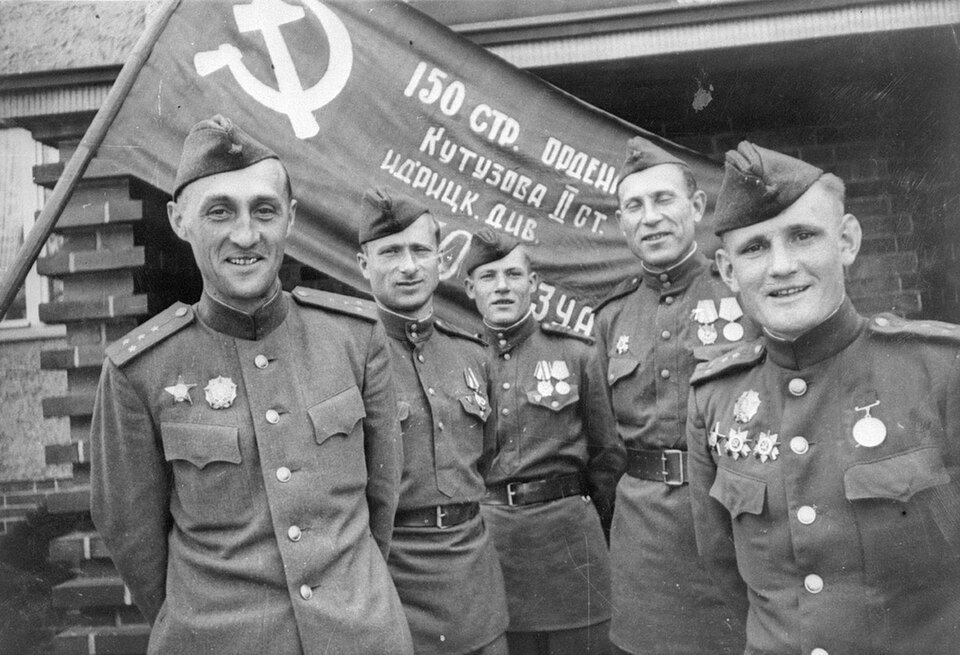
Five smiling Soviet soldiers with medals stand in front of a red banner lettered with the name of the 150th Rifle Division.
Mikhail Yegorov and Meliton Kantaria with other soldiers at the banner of the 150th Rifle Division, Berlin, 20 May 1945 (photograph by Khaldei; the archive does not say who is who).Yevgeny Khaldei, 1945. Wikimedia Commons. Public domain.

Night of 30 April – 1 May

The banner on the roof

Alexei Berest, Mikhail Yegorov and Meliton Kantaria of the 150th Rifle Division fix its red assault flag high on the building. Accounts give 22:40 Berlin time; others about 3 a.m. Russian law dates it 1 May 1945. It was dark, and no photographer was there.

German officers in long coats stand in a group, guarded, after their surrender.
General Helmuth Weidling with members of his staff after their surrender, 2 May 1945.Gleb Samsonov (Izvestia), 1945. Mil.ru, via Wikimedia Commons. CC BY 4.0.

2 May 1945

The building falls; Berlin surrenders

On 2 May 1945 the building is finally taken, and General Weidling and his staff surrender Berlin.

The same rooftop scene from a slightly different moment: the flag hangs lower and the soldier holds the pole lower down, the street below clearer.
One of Khaldei’s frames on the roof.Yevgeny Khaldei, 1945. Wikimedia Commons. Public domain.

2 May 1945, after the surrender

Khaldei climbs to the roof

The TASS photographer goes up with three soldiers and a flag of his own. The fighting is over. He has them raise it again, and shoots.

A Soviet soldier on a parapet of the Reichstag fixes a large flag with hammer, sickle and star on a pole, a second soldier steadying him, above a ruined city under smoke.
The photograph as it became known.Yevgeny Khaldei, 1945, restored by Adam Cuerden (public domain) · Wikimedia Commons

13 May 1945

The picture is printed, retouched

It first appears in the magazine Ogonyok, issue 19, 11 days after it was taken. By then Khaldei has darkened the sky with smoke and retouched a soldier’s wrist.

1946 and 1996

The medals

Yegorov and Kantaria, the men of the banner, become Heroes of the Soviet Union in 1946. Abdulkhakim Ismailov, one of the men in the photograph, is recognised only half a century later: a Hero of Russia in 1996.

03The photograph

Khaldei brought the flag, added the smoke and removed a watch

The Bundestag’s own account of the building says the picture was “staged by Khaldei only days later and retouched by him several times”. None of this makes the moment false: the soldiers were real and so was the ruined city. But the picture the world knows was made, and then made again in the darkroom.

The photograph, as it became known

Photo: Yevgeny Khaldei, 1945, restored by Adam Cuerden (public domain) · Wikimedia Commons

2 May 1945

He brought his own flag

“Ich nahm die Fahne, die ich bei mir hatte.” — “I took the flag I had with me.” It was a handmade flag sewn by a tailor, not the banner of the night before.

In the darkroom

Two clouds of smoke

Before publication Khaldei dramatised the sky with two rising clouds of smoke, montaged into the background.

In the darkroom

Look at his wrists

The soldier steadying the flag-bearer wore something on each wrist. For fear the soldier would be branded a thief, Khaldei retouched one of them away before publication. The second “watch” was possibly a wrist compass.

The men in the picture

Not the men of the banner

The soldiers in the photograph are not the ones credited with the flag. Khaldei named the flag-bearer as Aleksei Kovalyov; the man steadying him was identified in the 1990s as Abdulkhakim Ismailov. The third is named differently in different accounts.

2 May 1945

Shot more than once

Another frame from the same roll: the same men, the flag hanging differently. Khaldei set the scene up and took it several times.

04Who was honoured

One of the men in the photograph waited 51 years to be honoured for it

Moscow chose its flag-raisers from the banner of the 150th Division, not from the picture. The two men of the afternoon flag got no star at all.

Years from the flag to the honour

Bars run from the flags of 1945 to the award. Koshkarbaev and Bulatov were put forward for Hero of the Soviet Union and given the Order of the Red Banner instead, for reasons never explained.

A postage stamp with a portrait photograph of a young soldier in a side cap and the inscription “100 жыл”, 1924–2024.

30 April, afternoon

Rakhimzhan Koshkarbaev and Grigory Bulatov

The division’s war log records their flag on the front of the building at 14:25. He was never made a Hero of the Soviet Union; Kazakhstan put him on a stamp for his centenary.

Rakhimzhan Koshkarbaev on a Kazakh stamp of 2024, issued for the centenary of his birth. T. Baskhozhayev / QazPost, 2024. Wikimedia Commons. Public domain.
Five smiling Soviet soldiers with medals stand in front of a red banner lettered with the name of the 150th Rifle Division.

Night of 30 April – 1 May

Berest, Yegorov and Kantaria

Their assault flag became the official Victory Banner. It was flown to Moscow on 20 June for the Victory Parade, and Russia later gave it a law of its own.

Mikhail Yegorov and Meliton Kantaria with other soldiers at the banner of the 150th Rifle Division, Berlin, 20 May 1945 (photograph by Khaldei; the archive does not say who is who). Yevgeny Khaldei, 1945. Wikimedia Commons. Public domain.
The same rooftop scene from a slightly different moment: the flag hangs lower and the soldier holds the pole lower down, the street below clearer.

2 May 1945

Kovalyov, Ismailov and a third man

The men Khaldei photographed. Ismailov, from Dagestan, was recognised only half a century later and died in 2010, aged 93.

Another of Khaldei’s frames from the roof, 2 May 1945: the same soldiers and the same flag, which hangs differently. The scene was set up and shot more than once. Yevgeny Khaldei, 1945. Wikimedia Commons. Public domain.

05Inside the building

The soldiers who never made the photograph wrote their names on the walls instead

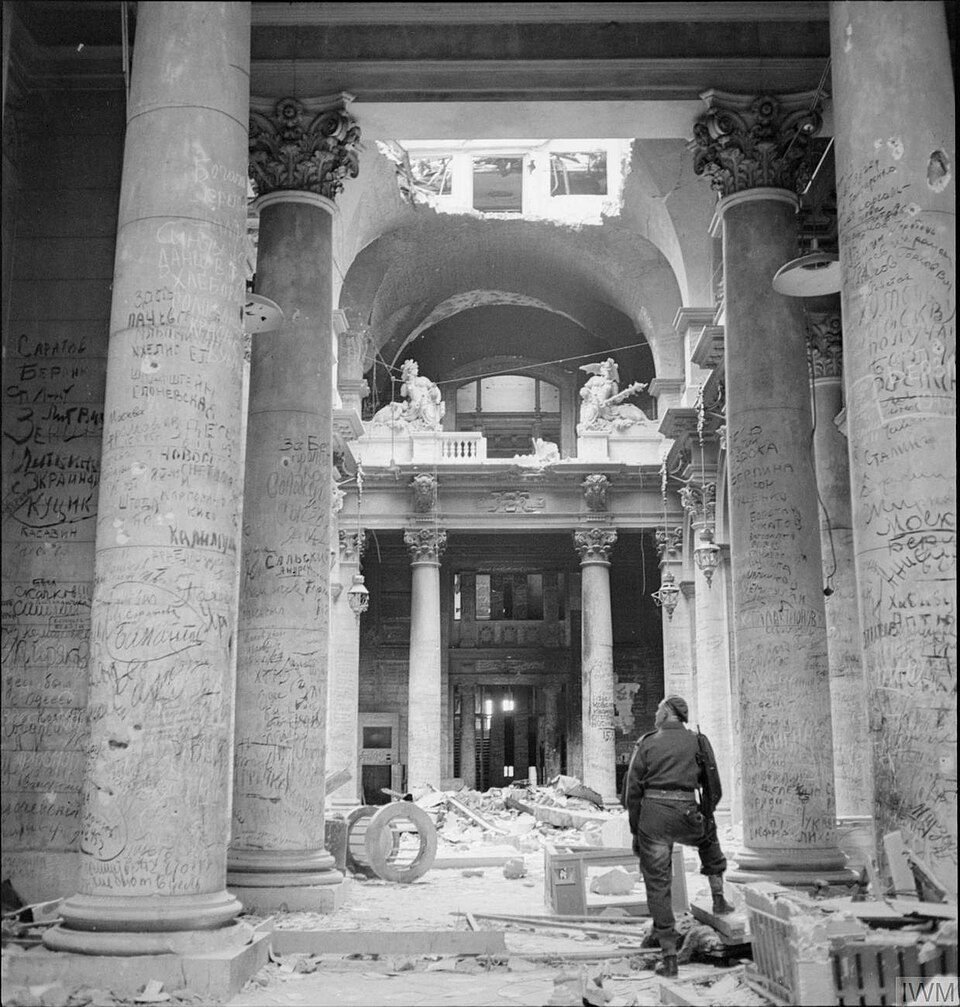
In the days after the battle, Soviet soldiers streamed to the Reichstag. They wrote their names and home towns on its walls in coloured chalk or charcoal, as high as they could reach, standing on each other’s shoulders. Most wrote “Hier war …”: “… was here”, then a name, a date, a unit or the road they had come by.

When Norman Foster began stripping the interior in 1995, he found them behind the plasterboard Paul Baumgarten had put up in the 1960s. They were cleaned and conserved under the Berlin monuments office, with the Bundestag and the Russian embassy, and Foster framed them in the new plaster like paintings. Among those the Bundestag records:

  • „Für Leningrad haben sie voll bezahlt! Stetschischin“
  • „Ruhm den Pontonbauern, die die Spree und ihre Kanäle bezwungen haben. Wir waren im Reichstag 6.5.45 Iwanow und Tschikhlin“
  • a heart with Cupid’s arrow for „Anatoli und Galina“

“For Leningrad they have paid in full”; “Glory to the pontoon builders who conquered the Spree and its canals”. Veterans have come back more than half a century later and found their own handwriting. The building has been the seat of the Bundestag, under Foster’s glass dome, since 1999.

Massive columns in a ruined hall, covered from the floor to above head height in handwritten Cyrillic; a soldier in a beret looks up at them.
Inside the ruined Reichstag in the summer of 1945: a British soldier looks at the columns covered in the names of Soviet soldiers.Hewitt (Sergeant), No 5 Army Film Photographic Unit Post-Work: User:W.wolny, 1945. Wikimedia Commons. Public domain.
A wall of rough old stone set into smooth modern plaster, covered with large handwritten Cyrillic words in charcoal.
Soviet graffiti kept in the rebuilt Reichstag, 2007. “Рязань — Берлин”, Ryazan to Berlin, is legible in the middle.Photo: Andreas Praefcke, 2007. Wikimedia Commons. Public domain.
The Reichstag’s west portico with the inscription Dem Deutschen Volke and the glass dome behind it.
Foster’s glass dome over the west portico, 2008.Gabriele Giuseppini, 2008. Wikimedia Commons. CC BY 3.0.

06The photographer

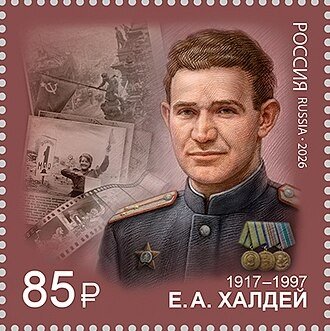
Khaldei had lost his father and three siblings to the Germans

Yevgeny Khaldei was born in 1917 in Yuzovka, today Donetsk, into a Jewish family. His mother was killed in a pogrom when he was about a year old. He became a photographer for the news agency TASS in 1936 and followed the Red Army with his camera through the war.

In 1941/42 the Germans murdered his father and three of his siblings. When he climbed onto the roof of the Reichstag, he was photographing the defeat of the people who had killed them. He died in Moscow in 1997.

A postage stamp: portrait of a man in uniform with medals, a film strip and the flag photograph behind him; lettering “Е. А. Халдей, 1917–1997”.
Yevgeny Khaldei on a Russian stamp of 2026, with his Reichstag photograph behind him.Russian Post, ITC Marka (designer M. Podobed), 2026. Wikimedia Commons. Public domain.
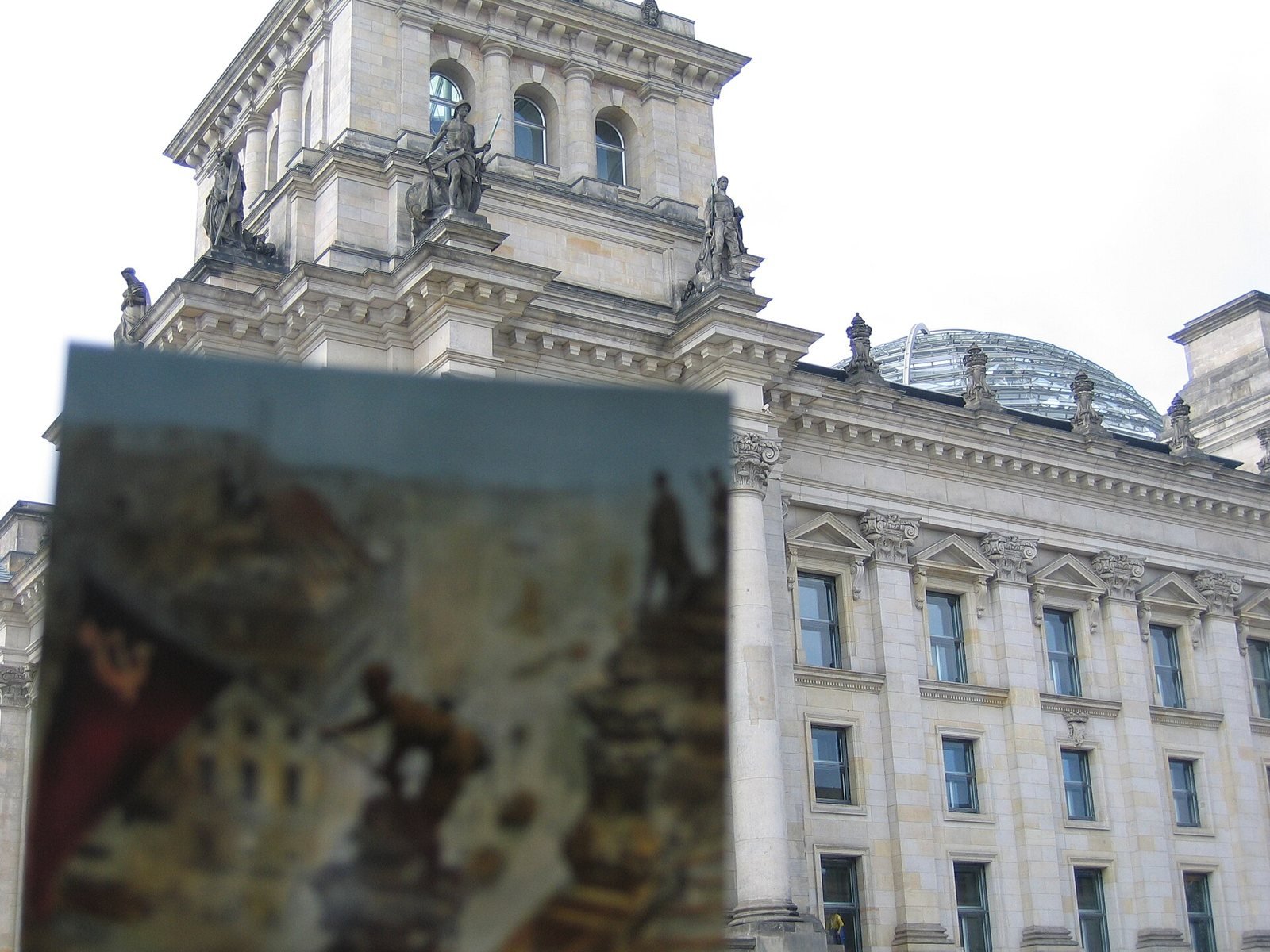
The restored stone corner tower of the Reichstag with statues on its parapet; in the foreground, out of focus, a postcard of the flag photograph.
The corner of the Reichstag where Khaldei took his picture, 2007, with a postcard of the photograph held up in front of it.Martin Jacobsen, 2007. Wikimedia Commons. CC BY-SA 3.0.

The corner of the building is still there, statues and all; only the city behind it has changed. The soldiers were real, the ruins were real, and the picture was made: all three are true.

The flags that went up first left no picture. The one the world remembers was set up afterwards with a flag the photographer brought.

The history is in the walls, in the soldiers’ own hand.

Press & citation

Use this Berlinfographic

Free to publish under CC BY 4.0 — in print, online, on Wikipedia and in teaching, commercially or not — with credit to Berlinfographics and a link to this page.

The flags on the Reichstag, 1945: ready-to-use landscape image

Ready-to-use image

The infographic as one image: headline, key figures, chart, sources and credit, 2,400 × 1,350 px PNG. Please use it unedited.

Download landscape (PNG)
The flags on the Reichstag, 1945: square version

Square format

A 1:1 version for social media and narrow columns, 1,800 × 1,800 px.

Download square (PNG)
The flags on the Reichstag, 1945: portrait version

Portrait 4:5

For Instagram and LinkedIn feeds, 1,620 × 2,025 px.

Download portrait (PNG)

Credit line

Berlinfographics (berlinfographics.com), CC BY 4.0

Citation

Berlinfographics (2026). “The flags on the Reichstag, 1945”. Berlin Experiences. https://berlinfographics.com/reichstag-flag-raising/

Wikipedia

{{cite web |title=The flags on the Reichstag, 1945 |url=https://berlinfographics.com/reichstag-flag-raising/ |website=Berlinfographics |publisher=Berlin Experiences |date=2026-11-09 |access-date=2026-11-09}}