Berlinfographicsby Berlin Experiences
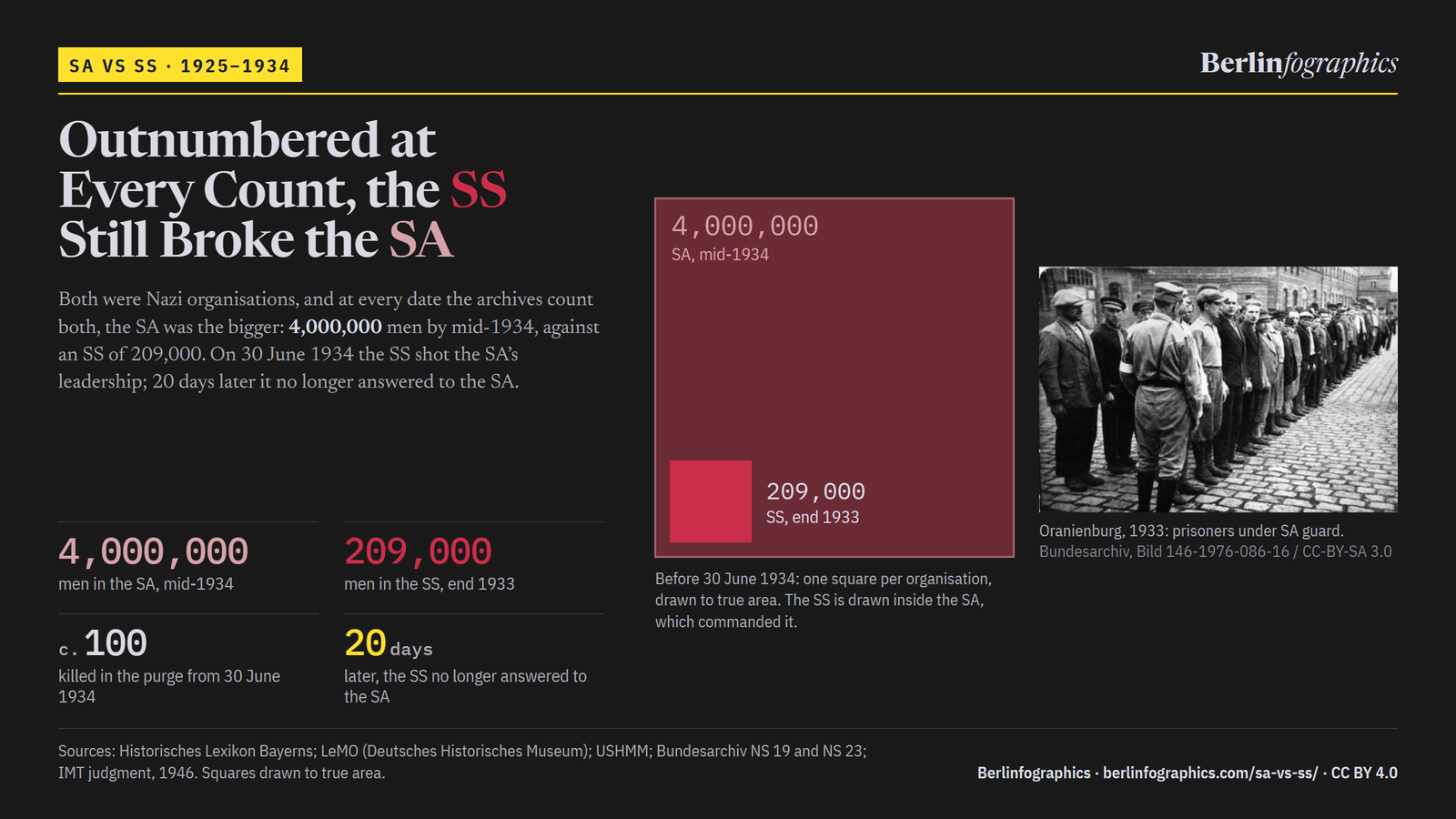
A long line of men in caps and jackets stands on a cobbled yard in front of brick buildings; in the foreground a uniformed guard with an armband and cross-strap faces them.SA · 1933
Rows of men with shaven heads eat soup at long wooden tables in a bare hall with high windows.SS · 1933
Oranienburg concentration camp, north of Berlin, 1933: prisoners lined up under SA guard.Bundesarchiv, Bild 146-1976-086-16 / CC-BY-SA 3.0Dachau in 1933, the year it opened. After the purge Himmler put the camps under one SS inspectorate, run by the officer who had shot Röhm.Bundesarchiv, Bild 152-01-14 / Friedrich Franz Bauer / CC BY-SA 3.0 de

SA vs SS

Outnumbered at Every Count, the SS Still Broke the SA

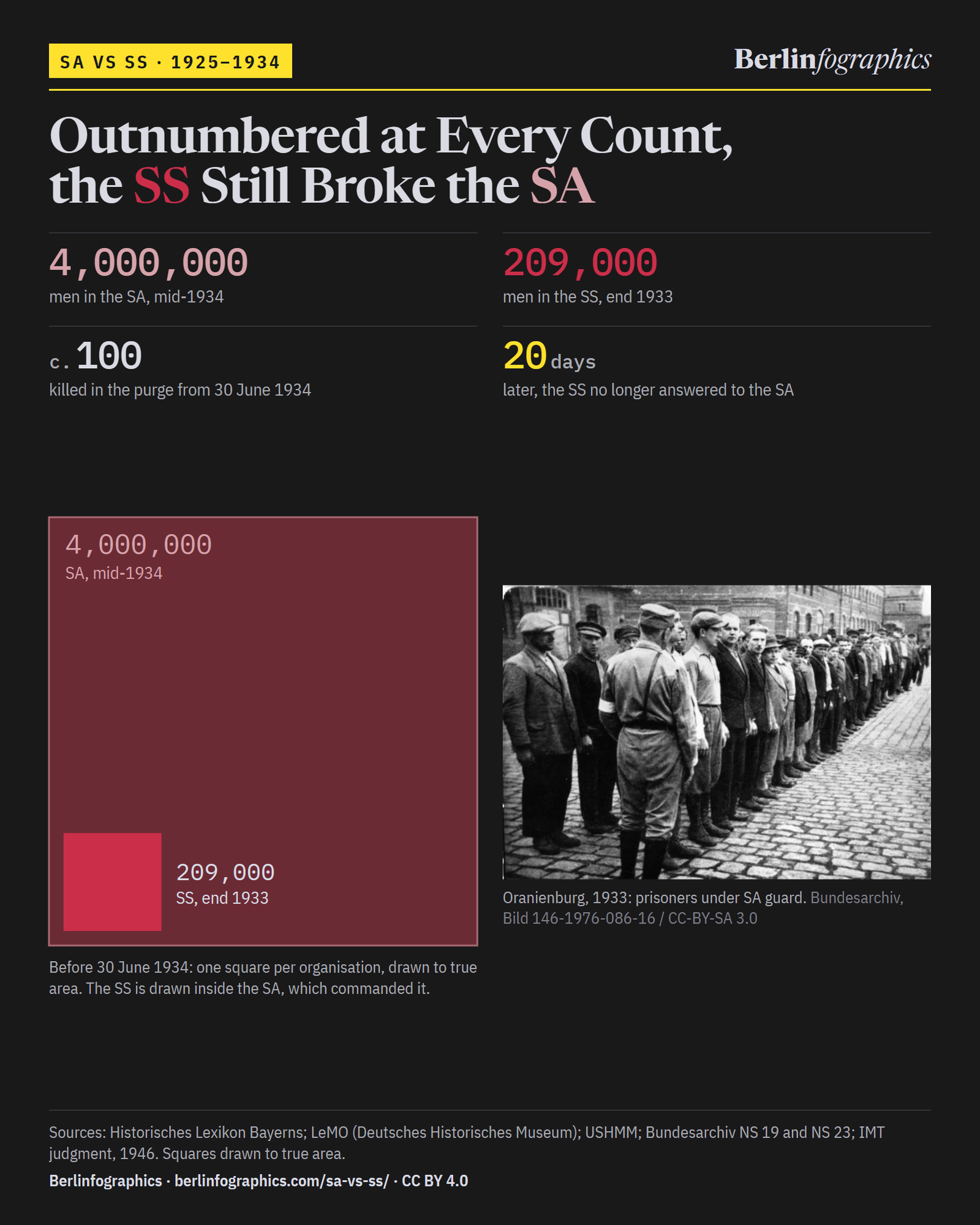
At every date the archives count both, the Sturmabteilung was the larger organisation — four million men to the SS's two hundred thousand. On 30 June 1934 the SS killed the SA's leadership, and twenty days later stepped out from under its command. Size and power came apart.

4,000,000
men in the SA by mid-1934, on the figure three institutions give
209,000
men in the SS at the end of 1933, half a year before the purge
c.100
killed from 30 June 1934, on the best estimate
20days
from the purge until the SS no longer answered to the SA

01Munich, 1921–1931

The SS began as eight men, and for nearly eight years it was a unit inside the SA

The Sturmabteilung, the Nazi party’s street army, was formed in Munich in August 1921 with about 300 men. The Schutzstaffel followed in April 1925: a guard founded to protect Hitler in person and to guard meetings. It has eight men.

In November 1926 the SS was placed under the SA’s supreme commander. For nearly eight years it is a unit inside the SA.

When Heinrich Himmler took over the SS in January 1929, it had 280 men by one count and 980 by another.

Ernst Röhm returns from Bolivia, where he had been a military instructor, to take command of the SA. Under him the SA grew to 445,279 men by August 1932.

Head-and-shoulders portrait of a heavy-set man with a scarred face and short moustache, in an army uniform with an Iron Cross.
SAErnst Röhm, Stabschef of the SA, 1931–34. A professional soldier — this is him in 1924, before the SA was his. He came back from instructing the Bolivian army to take command of it.Shot in his cell at Stadelheim, 1 July 1934.US National Archives and Records Administration (NARA), 1924. Wikimedia Commons. Public domain.
Portrait of a young man with round glasses, a small moustache and close-cropped hair, in a dark uniform.
SSHeinrich Himmler, Reichsführer-SS from January 1929. Photographed in the year he took the job. The organisation he took over had a few hundred men in it and answered to the SA.Took his own life with a hidden poison capsule in a British camp at Lüneburg, 23 May 1945.Bundesarchiv, Bild 146II-783 / Heinrich Hoffmann / CC BY-SA 3.0 de

SA and SS: every square at one scale

One man is the same area in every panel

Two squares, one for each organisation, drawn at one true area scale so that one man is the same area in every panel: the SA from August 1932 to January 1940 and the SS across the same dates. While the SS answered to the SA its square sits inside the SA's; after 20 July 1934 it stands beside it.
SASSa second SS branch100,000 men

August 1932

445,279 to 25,853

The last summer before power. Both counts come from the same register, in the same month.

January 1933

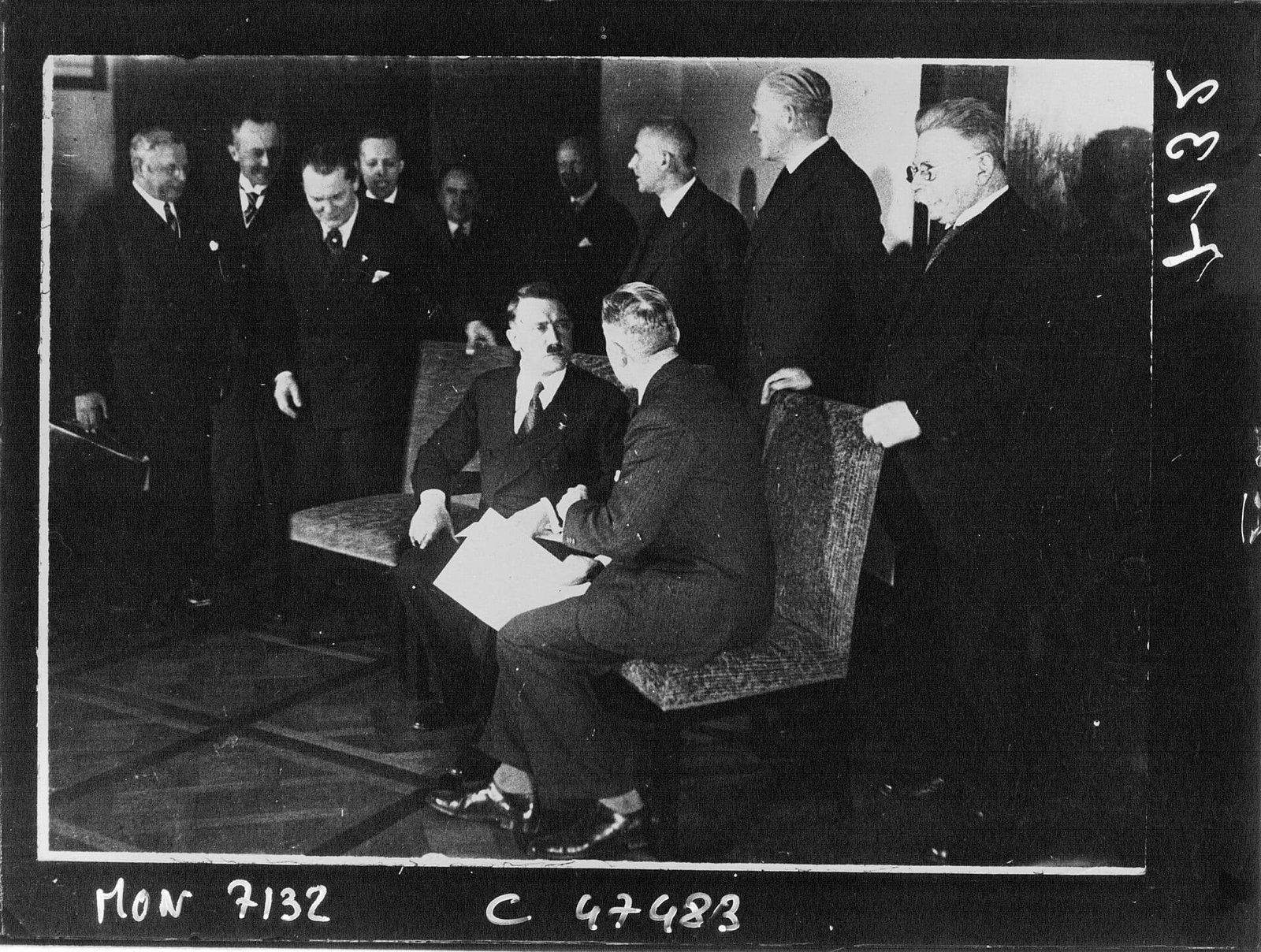
A press photograph of Hitler seated on a sofa talking to a man beside him, a group of men in dark suits standing around them.
Hitler, seated, with members of his new government, January 1933, the month he was made Chancellor.Robert Sennecke / Internationaler Illustrations Verlag, 1933. Wikimedia Commons. Public domain.

at least 400,000 to 52,000

Hitler is made Chancellor. The SA figure is a floor, not a total — the source says only that it was well over four hundred thousand.

Before 30 June 1934

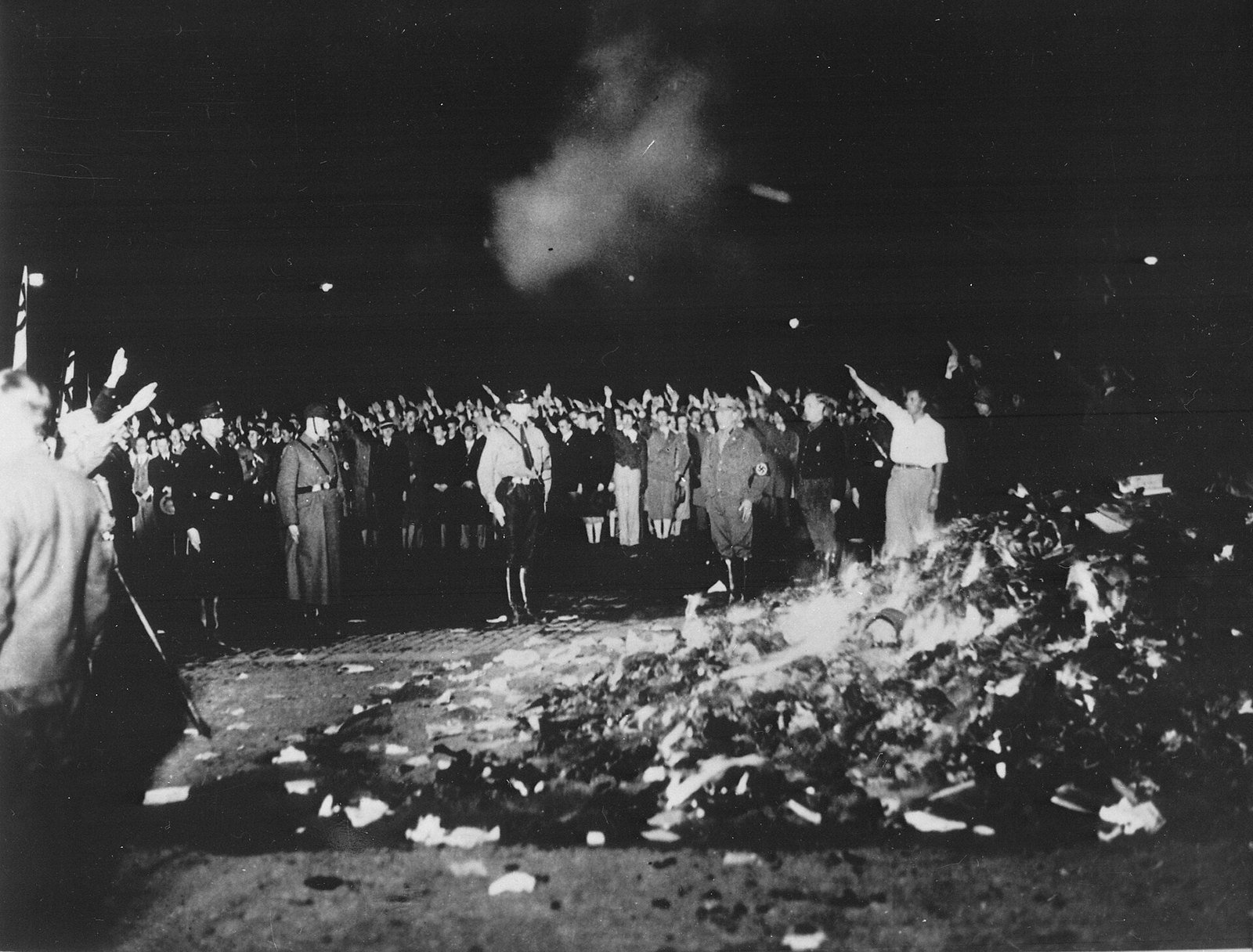
At night, a crowd with raised arms behind a burning heap of books on a square; men in SA uniform with swastika armbands stand in front.
SA men and students give the Nazi salute over the fire at the book burning on the Opernplatz, Berlin, 10 May 1933.Bundesarchiv, Bild 102-14597 / Pahl, Georg / CC BY-SA 3.0 de

4,000,000 to 209,000

The SA at its greatest extent. Three institutions give four million men by the middle of the year; the Bundesarchiv's own finding aid records 2.9 million that August.

20 July 1934

The SS steps out from under the SA

Hitler raises the SS to an independent organisation of the party, ending nearly eight years under SA command. The Bundesarchiv records the reason given: its services “especially in connection with the events of 30 June 1934”.

1935

1,600,000 to 166,863

A year after the purge the SA has lost more than half its men. The SS has lost some too — and has begun to divide into branches.

SS: 164,863 Allgemeine-SS and 2,000 Totenkopfverbände.

1939–40

900,000 to 340,000

Seventeen SA men for every SS man in 1932; now fewer than three — and the SS has an armed branch of its own.

SS: 240,000 Allgemeine-SS, 1939 and 100,000 Waffen-SS, 1940.

0230 June – 2 July 1934

The SS shot the SA’s leadership. 20 days later it no longer answered to the SA
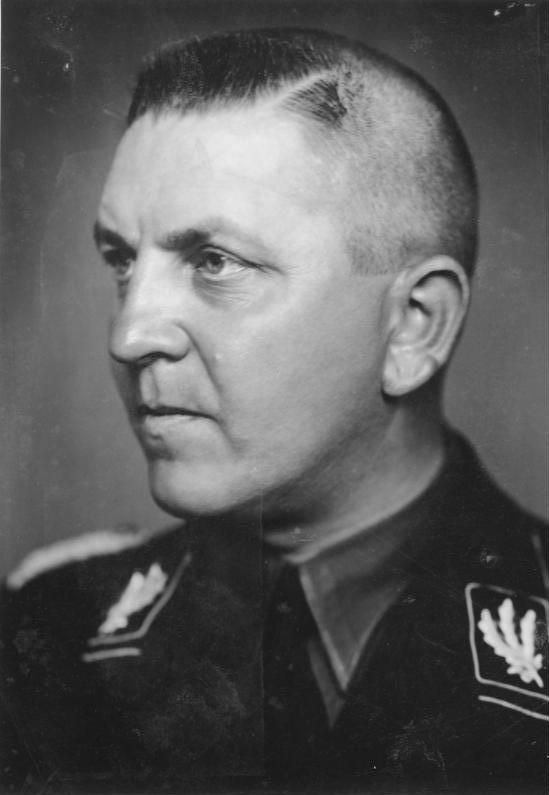
The SA leadership was shot by the SS, the SD and the Gestapo over three days. The law that made them lawful was signed on the fourth, and it is one sentence long.

On 4 July 1934, Theodor Eicke, the Dachau commandant who had shot Röhm, was given the new post of Inspector of Concentration Camps. On 20 July 1934, Hitler raised the SS to an independent organisation of the party, ending its nearly eight years under SA command. The Bundesarchiv records the reason given: its services “especially in connection with the events of 30 June 1934”.

30 June 1934 to 20 July 1934, one square a day

30 Jun 1934 – 2 JulThe killings, carried out by the SS, the SD and the Gestapo.
3 Jul 1934A one-article law declares the killings lawful, four days after they began.
4 Jul 1934Eicke made Inspector of Concentration Camps.
20 Jul 1934The SS made an independent organisation of the party.

One dot is one person in all three rows. Fifty of the dead were senior SA leaders. The three figures are not three estimates of one number — they count three different things, and the gap between the first two is the part of the killing the record cannot name.

A printed page in Gothic type: the title of the law, its single article, the date, and the names of Hitler, Frick and Gürtner.
Einziger ArtikelGesetz über Maßnahmen der Staatsnotwehr, 3 July 1934, as printed: RGBl. 1934 I, S. 529. Signed by Hitler as Chancellor, Frick for the Interior and Gürtner for Justice.Reichsgesetzblatt I 1934, S. 529. Wikimedia Commons. Public domain.

Gesetz über Maßnahmen der Staatsnotwehr · 3 July 1934

“The measures carried out on 30 June, 1 and 2 July 1934 to put down attacks of high treason and treason against the country are lawful as emergency defence of the state.”

„Die zur Niederschlagung hoch- und landesverräterischer Angriffe am 30. Juni, 1. und 2. Juli 1934 vollzogenen Maßnahmen sind als Staatsnotwehr rechtens.“

Einziger Artikel, the law’s only article. Signed by Hitler as Chancellor, Frick for the Interior and Gürtner for Justice. RGBl. 1934 I, S. 529.

Among the dead

  • Ernst RöhmStabschef of the SA
    Arrested at Bad Wiessee on 30 June, taken to Stadelheim prison in Munich and shot there on 1 July.
  • Kurt von SchleicherChancellor of Germany, 1932–33
    Shot at his home with his wife Elisabeth.
  • Gregor StrasserReichsorganisationsleiter of the NSDAP
    Arrested in Berlin by the Gestapo on 30 June and shot by SS men.
  • Gustav Ritter von KahrBavarian state commissioner in 1923, who had refused Hitler his putsch
    Taken from his Munich flat by an SS detachment on 30 June to Dachau, and shot there.
  • Ferdinand von BredowMajor-general, Schleicher's long-standing collaborator
    Murdered.
  • Edgar JungAdviser and speechwriter to Vice-Chancellor von Papen
    Shot near Oranienburg on 30 June or 1 July.
  • Herbert von BoseVon Papen's closest collaborator
    Murdered at the Vice-Chancellery.
  • Karl ErnstHead of the Berlin SA
    Taken to the Lichterfelde cadet school and murdered.

Also shot at Stadelheim on 30 June: the SA leaders August Schneidhuber, Wilhelm Schmid, Edmund Heines, Hans Peter von Heydebreck, Hans Hayn and Hans Joachim von Spreti-Weilbach.

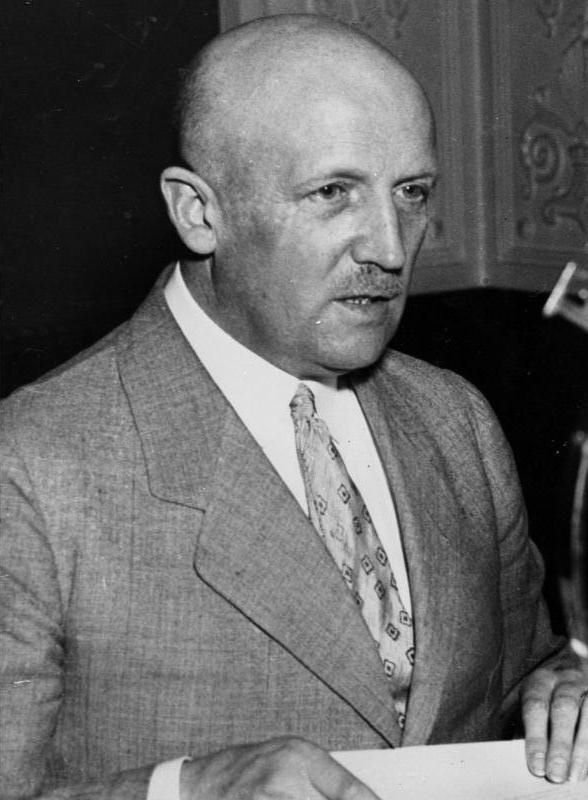
Portrait of a bald man in a dark suit and tie, looking to one side.
Kurt von Schleicher, Chancellor of Germany, December 1932 – January 1933. Hitler's immediate predecessor as Chancellor, and no part of the SA at all.Shot at home with his wife Elisabeth, 30 June 1934.Bundesarchiv, Bild 183-B0527-0001-020 / Unknown / CC BY-SA 3.0 de
Studio portrait of a broad-faced man with short dark hair, in a jacket and tie.
Gregor Strasser, Reichsorganisationsleiter of the NSDAP. Built the party's organisation from 1925, then set himself against Hitler over an anti-capitalist programme. His attempt to split the party by joining a government failed.Arrested in Berlin and shot by SS men, 30 June 1934.Robert Sennecke / Internationaler Illustrations Verlag, 1932. Wikimedia Commons. Public domain.
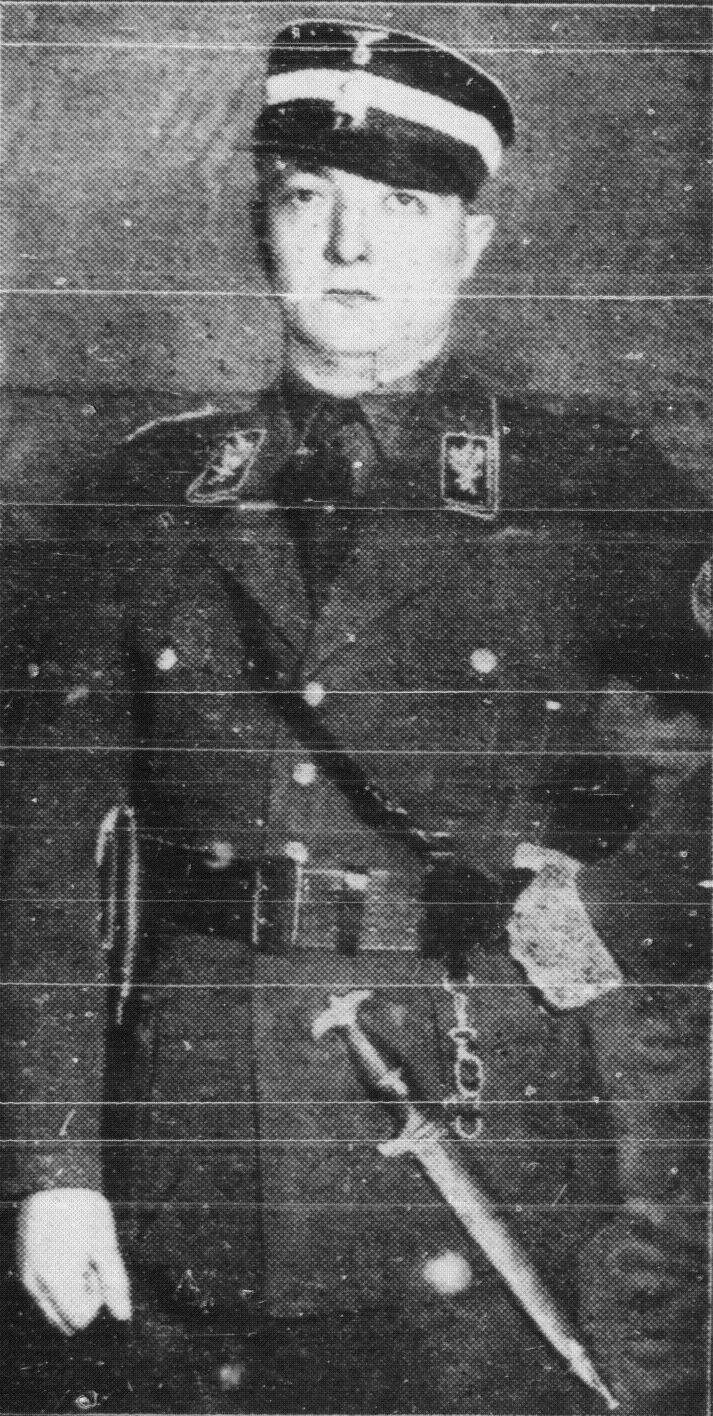
A grainy full-length portrait of a man in a peaked cap and uniform with collar badges and a dagger at his belt.
SAKarl Ernst, head of the Berlin SA, in SA uniform, around the turn of 1933–34.Taken to the Lichterfelde cadet school and murdered.Daniel Gerth (1891–1934), 1933. Wikimedia Commons. Public domain.
A man in shirt and tie sits on a beach with a smiling girl beside him and a boy leaning against his knees.
Herbert von Bose, von Papen's closest collaborator, with two of his children, summer 1933.Murdered at the Vice-Chancellery.Walter Bochow (1889–1946), 1933. Wikimedia Commons. Public domain.
A steel plaque engraved in German with his name, his dates and a text saying he was murdered by the SS in the night of 30 June to 1 July 1934.
BerlinFerdinand von Bredow, major-general, Schleicher's long-standing collaborator: the memorial plaque at Spichernstraße 15, Berlin-Wilmersdorf, where he lived from 1930 to 1934.OTFW, Berlin, 2009. Wikimedia Commons. CC BY-SA 3.0.
Portrait of a middle-aged man in a peaked cap and military uniform with decorations at the collar.
SSTheodor Eicke, Commandant of Dachau, then Inspector of Concentration Camps. Wrote the Dachau punishment regime the other camps copied, and shot Röhm himself. Twelve years later the tribunal would describe exactly this work.Died on the eastern front in 1943, an SS general by then.Bundesarchiv, Bild 183-W0402-503 / Unknown / CC BY-SA 3.0 de

031921–1944

On every date the archives count both, the SA is the larger. After January 1940, no one counts the SA

The SA line is the whole organisation. The SS line is the Allgemeine-SS until 1939; from 1940 the marks are the Waffen-SS, whose figures the sources give separately. Each mark is a count an institution states; nothing between them is filled in, so no line joins them.

The last SA count is 900,000 in January 1940. The Waffen-SS alone passed 900,000 in autumn 1944, with nothing on the SA side to set against it. For the SA in 1934 two figures stand: three institutions give four million by the middle of the year; the Bundesarchiv's own finding aid for the SA leadership records 2.9 million in August. Both are drawn.

SA countSS counta floor or a rangea second institution disagreeing, tied by a dashed lineWaffen-SS, counted separately from 1940

041933–1944

The SA kept its men and lost everything else. The SS took the police and the camps

On 17 June 1936 Himmler became Chief of the German Police: the party organisation and the state police are now one command. In 1939 came the Reich Security Main Office, and in 1942 the office from which the camps were run. The SA was left with pre-military training, and still took a leading part in the November pogrom of 1938.

After the purge Himmler put the camps under one SS inspectorate, run by the officer who had shot Röhm.

Rows of men with shaven heads eat soup at long wooden tables in a bare hall with high windows.
SS · 1933Dachau in 1933, the year it opened. After the purge Himmler put the camps under one SS inspectorate, run by the officer who had shot Röhm.Bundesarchiv, Bild 152-01-14 / Friedrich Franz Bauer / CC BY-SA 3.0 de
Looking down on rows of wooden pews in a synagogue; the floor between and in front of them is covered in rubble, plaster and broken wood.
Berlin · 1938A Berlin synagogue wrecked in the November pogrom of 1938. The archive names the building only with a query: “Fasanenstraße (?)”.Bundesarchiv, Bild 147-1118 / Unknown / CC BY-SA 3.0 de
SA · SturmabteilungSS · Schutzstaffel

05Nuremberg, 1 October 1946

At Nuremberg the tribunal spared the SA because of the purge, and declared the SS criminal

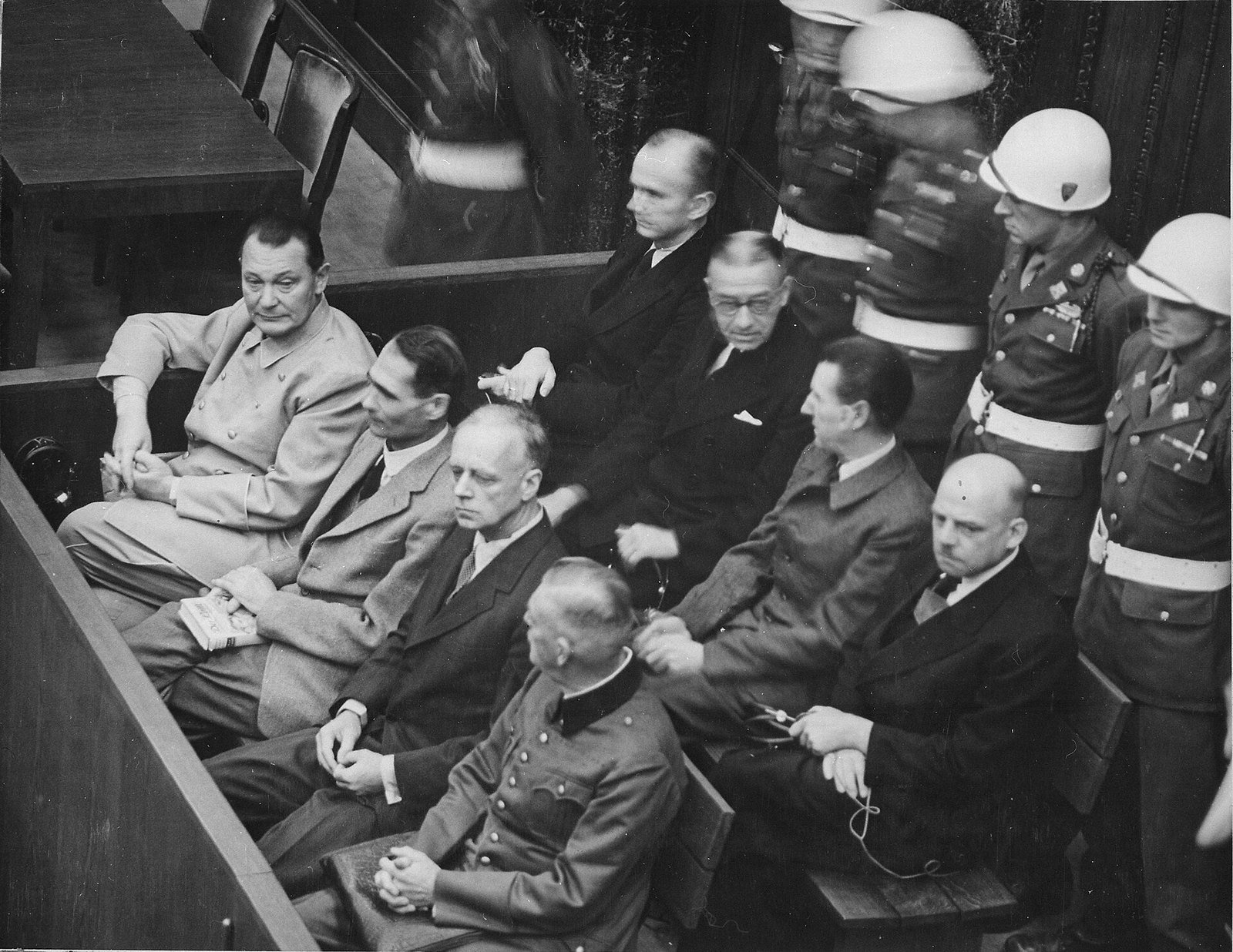
The tribunal considered both organisations, and reached opposite conclusions about them. The reason it gave for sparing the SA was the purge.

Two rows of men in suits and uniforms sit in a wooden dock, with white-helmeted American military police standing behind them.
Nuremberg · 1946The dock at the International Military Tribunal, Nuremberg, 1945–46. Beside the individual defendants, the tribunal ruled on the SA and the SS as organisations.Ray D'Addario, US Army Signal Corps, 1945–46. Wikimedia Commons. Public domain.

SA

The SA is not declared criminal

“After the purge, the SA was reduced to the status of a group of unimportant Nazi hangers-on. Although in specific instances some units of the SA were used for the commission of war crimes and crimes against humanity, it cannot be said that its members generally participated in or even knew of the criminal acts. For these reasons the Tribunal does not declare the SA to be a criminal organisation within the meaning of Article 9 of the Charter.”

SS

The SS is declared criminal

“The SS was utilised for purposes which were criminal under the Charter involving the persecution and extermination of the Jews, brutalities and killings in concentration camps, excesses in the administration of occupied territories, the administration of the slave labour programme and the mistreatment and murder of prisoners of war.”

Twelve years earlier the SS had been a unit inside the SA, and the smaller of the two by a factor of nineteen. On no count of both did it outnumber the SA. It did not need to.

Press & citation

Use this Berlinfographic

Free to publish under CC BY 4.0 — in print, online, on Wikipedia and in teaching, commercially or not — with credit to Berlinfographics and a link to this page.

SA vs SS: the smaller organisation took the power, 1921–1946: ready-to-use landscape image

Ready-to-use image

The infographic as one image: headline, key figures, chart, sources and credit, 2,400 × 1,350 px PNG. Please use it unedited.

Download landscape (PNG)
SA vs SS: the smaller organisation took the power, 1921–1946: square version

Square format

A 1:1 version for social media and narrow columns, 1,800 × 1,800 px.

Download square (PNG)
SA vs SS: the smaller organisation took the power, 1921–1946: portrait version

Portrait 4:5

For Instagram and LinkedIn feeds, 1,620 × 2,025 px.

Download portrait (PNG)

Credit line

Berlinfographics (berlinfographics.com), CC BY 4.0

Citation

Berlinfographics (2026). “SA vs SS: the smaller organisation took the power, 1921–1946”. Berlin Experiences. https://berlinfographics.com/sa-vs-ss/

Wikipedia

{{cite web |title=SA vs SS: the smaller organisation took the power, 1921–1946 |url=https://berlinfographics.com/sa-vs-ss/ |website=Berlinfographics |publisher=Berlin Experiences |date=2026-11-05 |access-date=2026-11-05}}