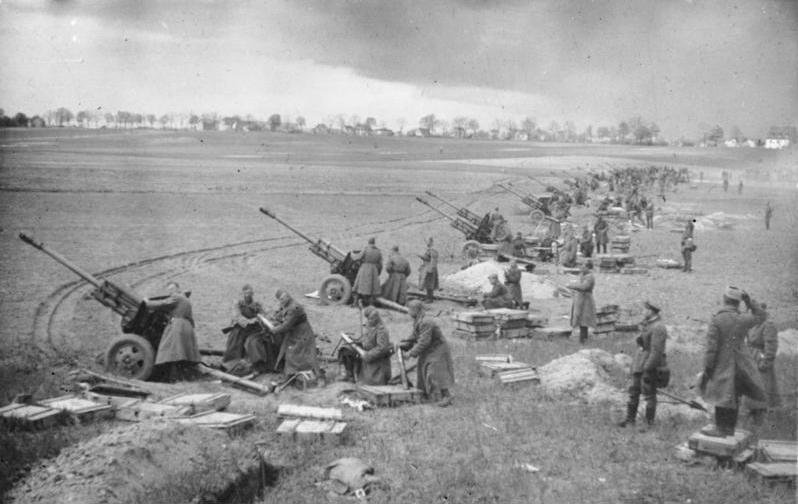
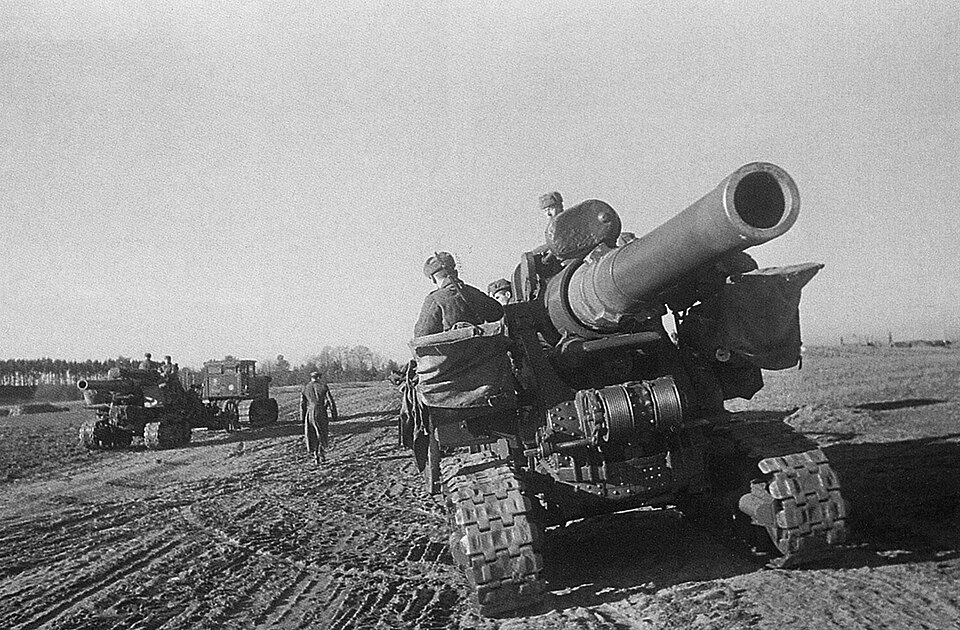
Soviet 203 mm B-4 howitzers on the road to Berlin, April 1945.Photo: Aleksandr Ustinov, 1945. Mos.ru, via Wikimedia Commons. CC BY 4.0.
The gun line
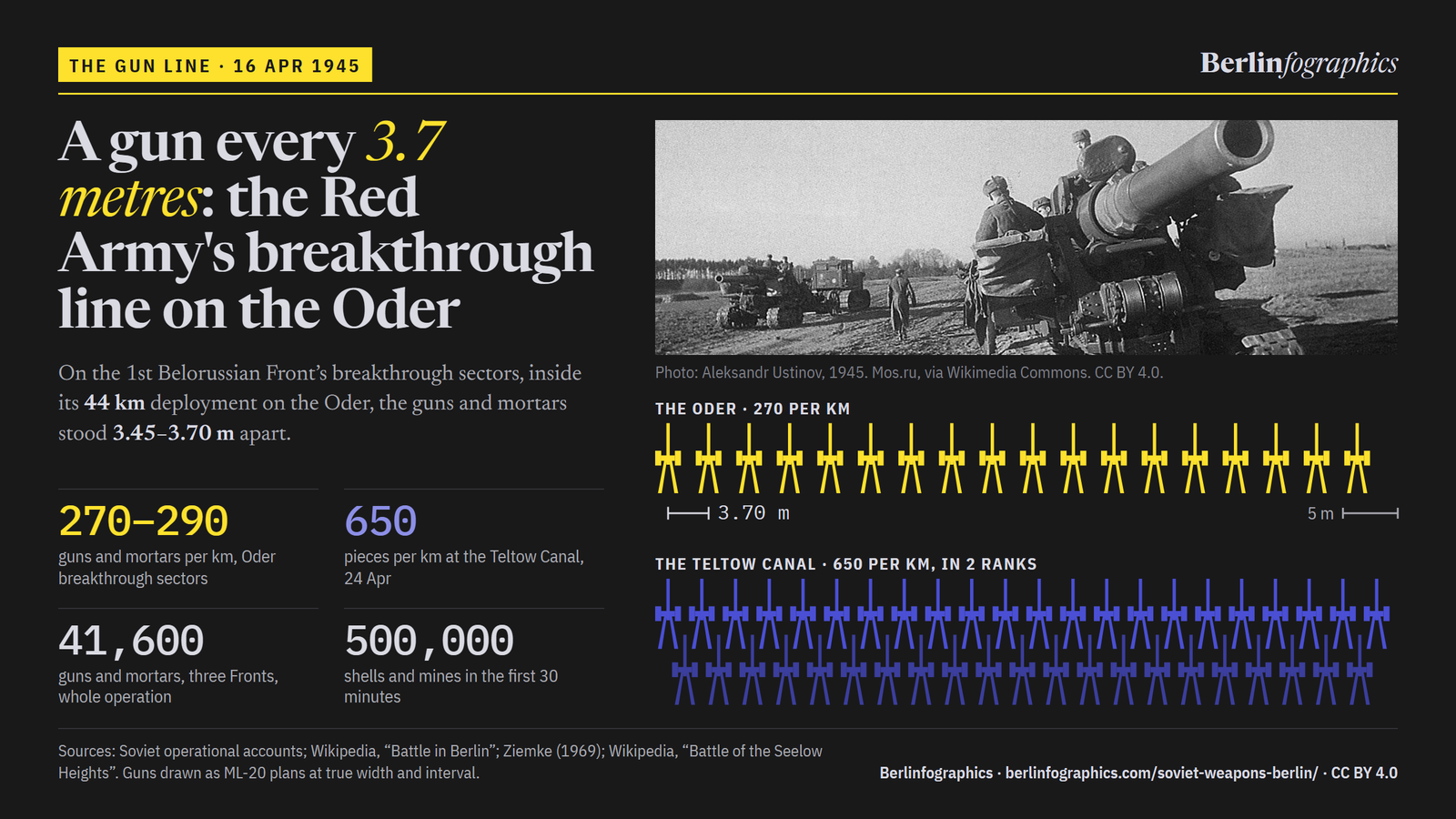
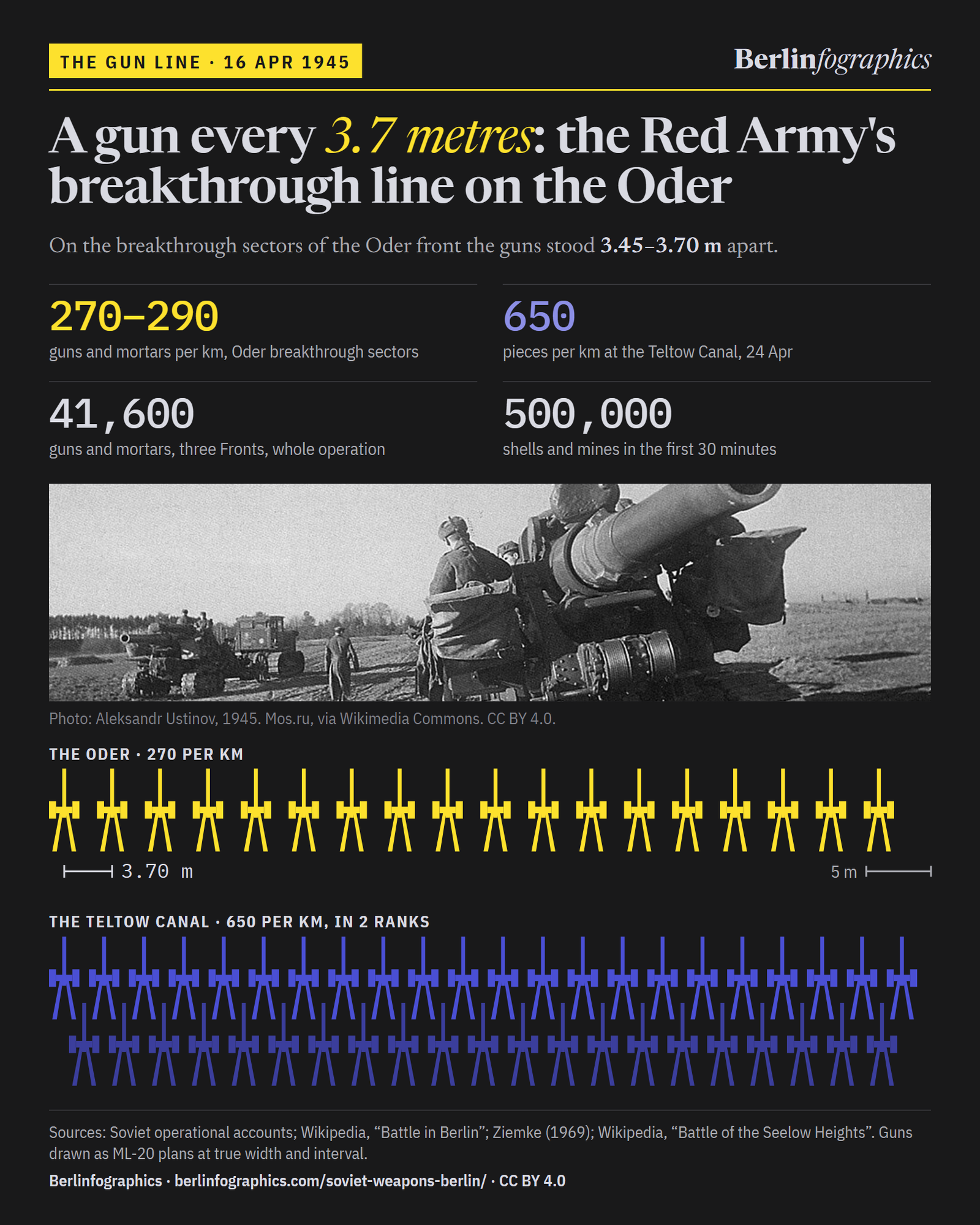
On 16 April 1945 the 1st Belorussian Front’s breakthrough sectors on the Oder held 270 to 290 guns and mortars to every kilometre. Across three Fronts the Berlin operation brought 41,600 guns and mortars, 6,250 tanks and self-propelled guns, and 7,500 aircraft.
01The Oder, before dawn
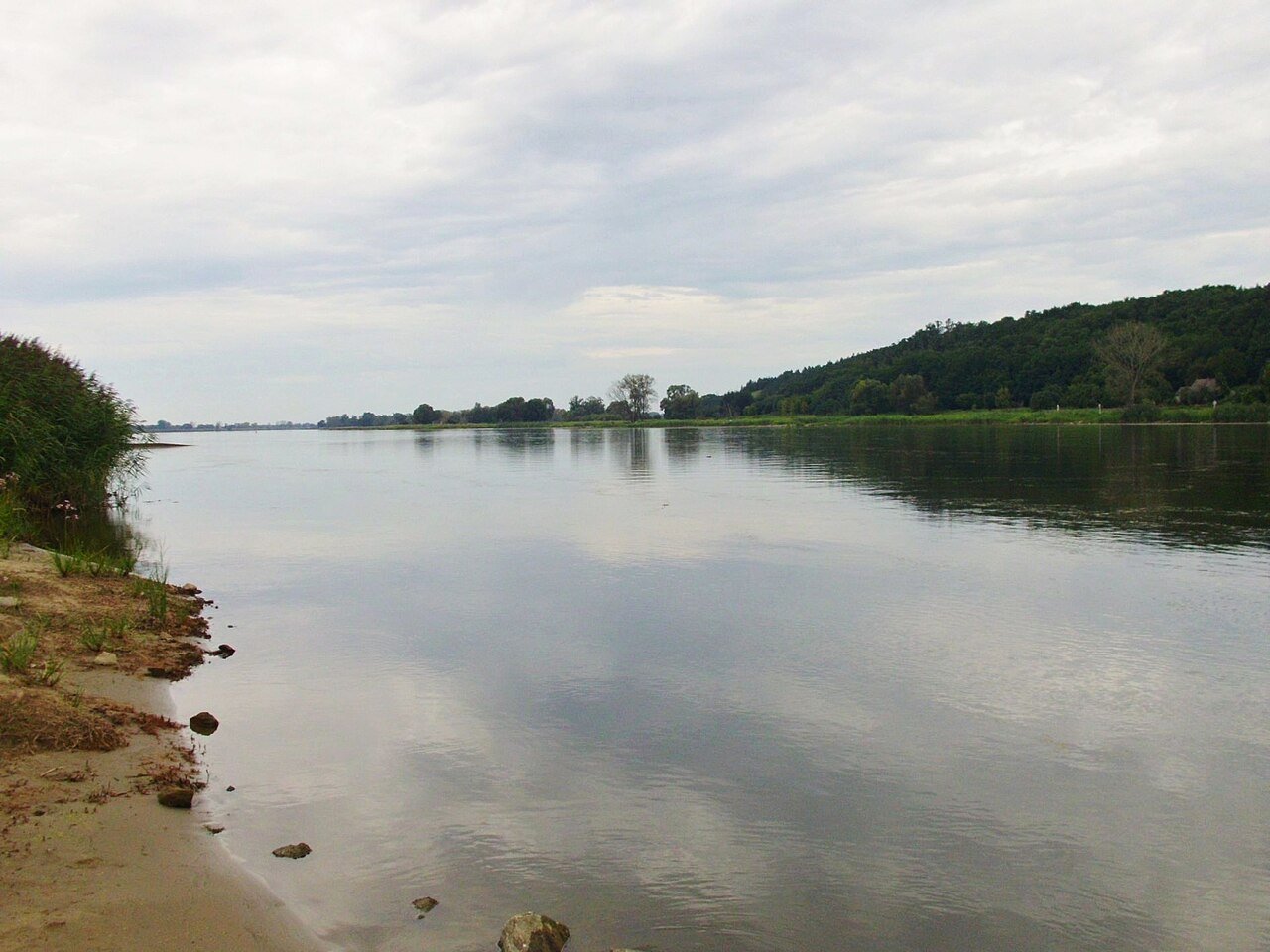
Between Güstebiese and Podelzig the 1st Belorussian Front deployed along 44 km of the Oder. On the breakthrough sectors inside that stretch, the Soviet operational account counts 270 to 290 guns and mortars, excluding the 45 mm and 57 mm anti-tank guns, to the kilometre. Divide a kilometre by those numbers and the guns stand 3.45–3.70 m apart, centre to centre.
That density was not held along the whole river line. It was reached where the Front meant to break through; one Russian account puts the breakthrough zone at 27 km.
A 152 mm gun-howitzer is 2.35 metres wide. At 290 to the kilometre, the gap between two of them is 1.10 m.

One hundred metres of front
One hundred metres of the Oder front, drawn to scale. Scroll to place the guns.One hundred metres of front, to scale
The ground
The strip is a hundred metres of frontage, drawn to scale. Every gun that follows is drawn the same way: the plan of a 152 mm ML-20, 2.35 m across its wheels, set at its real interval.
16 April · the Oder
At 270 guns and mortars per kilometre, a hundred metres holds 27. The carriage takes 2.35 m of each 3.70 m interval; 1.35 m is left between the wheels of one gun and the next.
16 April · the Oder · Zhukov
The account’s upper figure for Zhukov’s 1st Belorussian Front is 290. Then a hundred metres holds 29 guns, 3.45 m apart, and a gun crew could reach out and touch the next gun’s wheel. The count is of guns and mortars, excluding the 45 mm and 57 mm anti-tank guns.
The whole deployment
Pull back to the full 44 km from Güstebiese to Podelzig and the strip above becomes a sliver. The densities were reached on the breakthrough sectors within this line, not all along it: one account gives a breakthrough zone of 27 km.
16 April · the Neisse
To the south, the 1st Ukrainian Front crossed the Neisse behind 2 hours and 35 minutes of artillery and air preparation, with 270 artillery barrels to the kilometre on its breakthrough sector.
24 April · the Teltow Canal
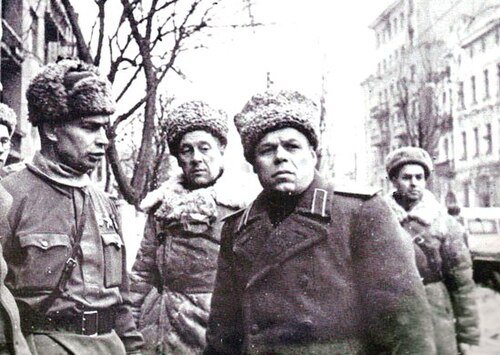
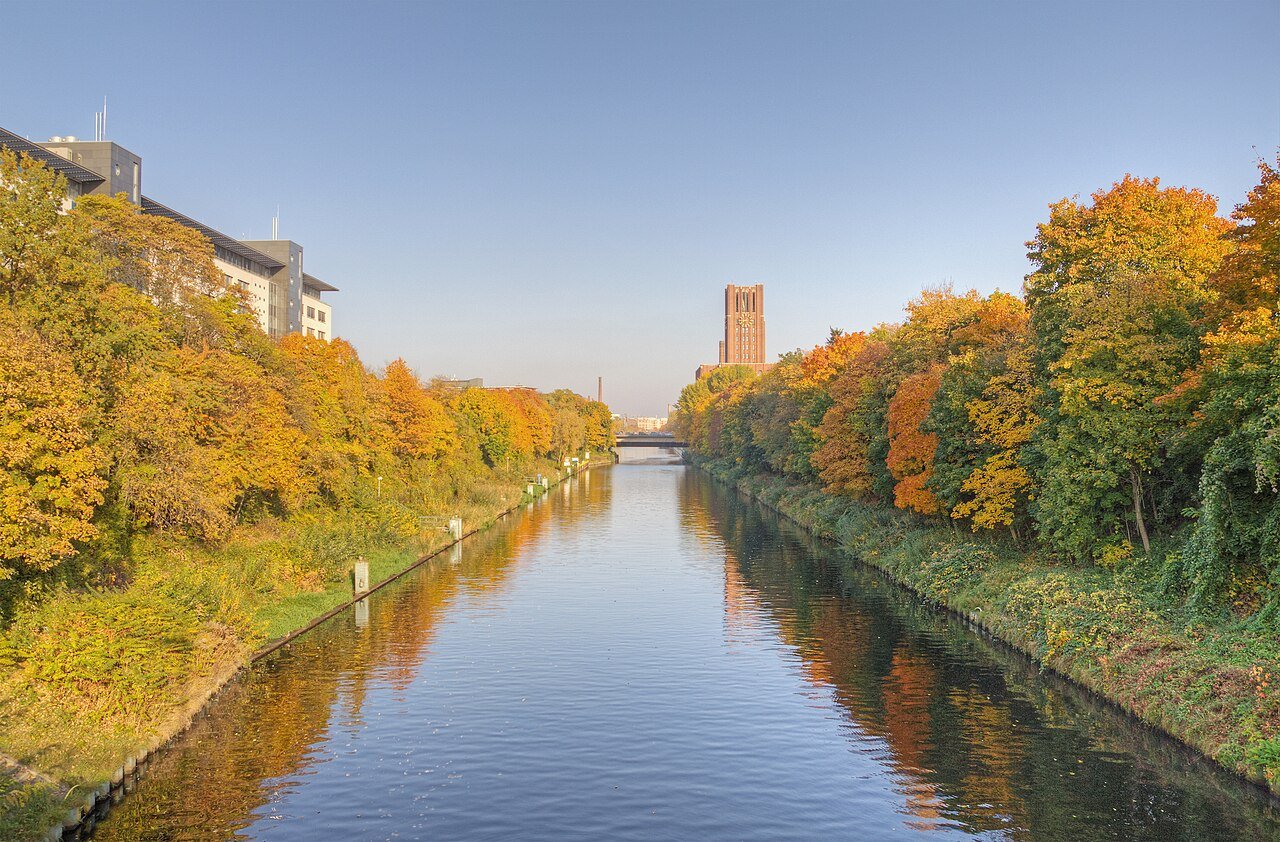
On the southern edge of Berlin, Rybalko’s 3rd Guards Tank Army, 1st Ukrainian Front massed 3,000 guns, heavy mortars and Katyusha rocket launchers together at 650 to the kilometre. That is a piece every 1.54 m, less than the 2.35 m width of an ML-20 carriage, so they had to stand in ranks, one behind another.
03The guns
The two drawings share one metre. The 203 mm B-4 on its tracks measured 11.15 by 2.7 m; the ML-20 that stands for every gun in the line above is 2.35 m wide.

203 mm howitzer M1931 (B-4)
Built to break fortifications from eighteen kilometres. In Berlin its crews ran it up to the buildings and fired over open sights, which its manuals did not cover.

152 mm gun-howitzer ML-20
The heavy field gun of the Berlin operation and the shape drawn in the gun line above. Laid flat against a building it took reinforced concrete down a floor at a time.

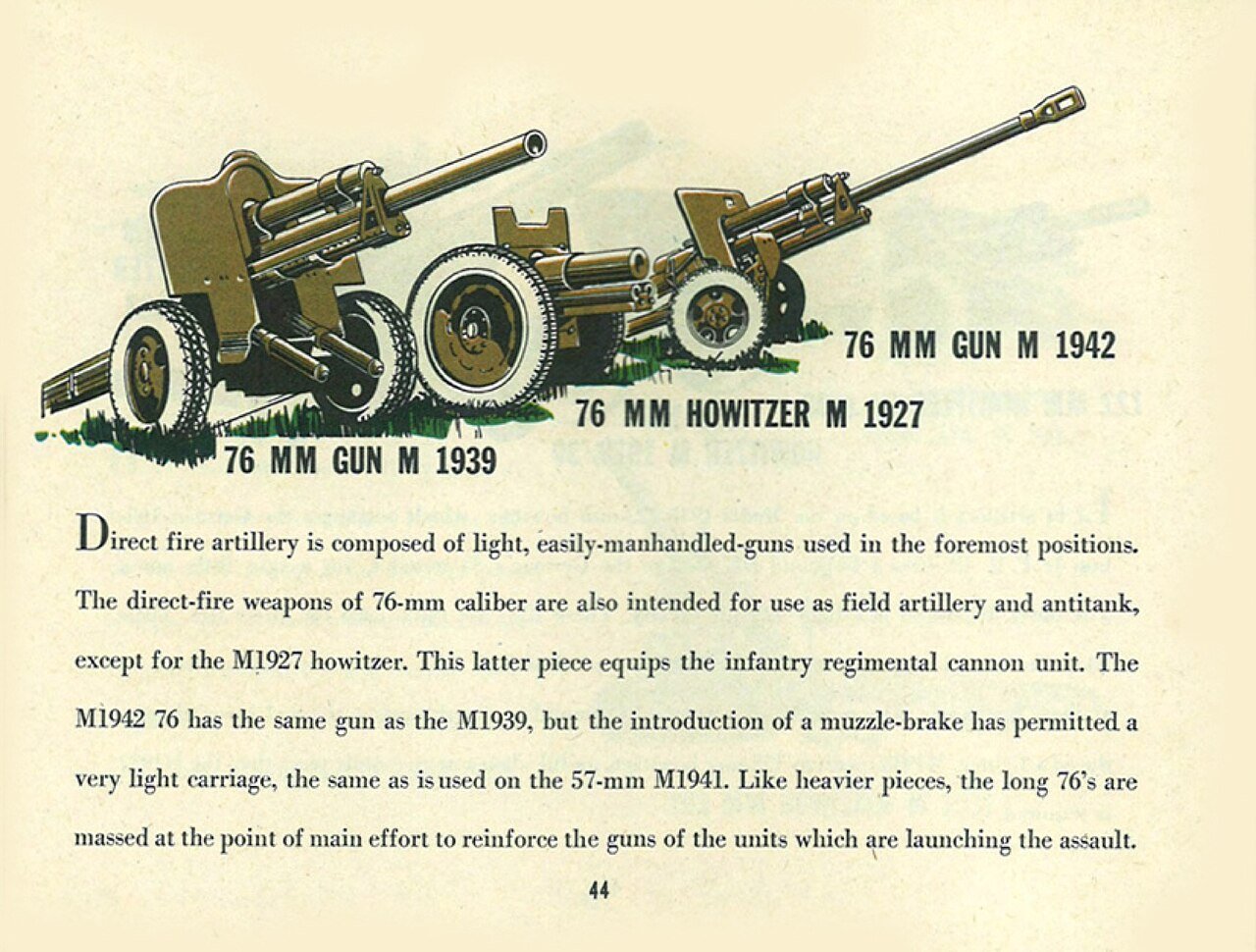
76 mm field guns
The ordinary artillery of a rifle division. The M1927, the regimental piece among them, was light enough to be manhandled over rubble and into a courtyard, which in a city mattered more than range.
04Into the streets
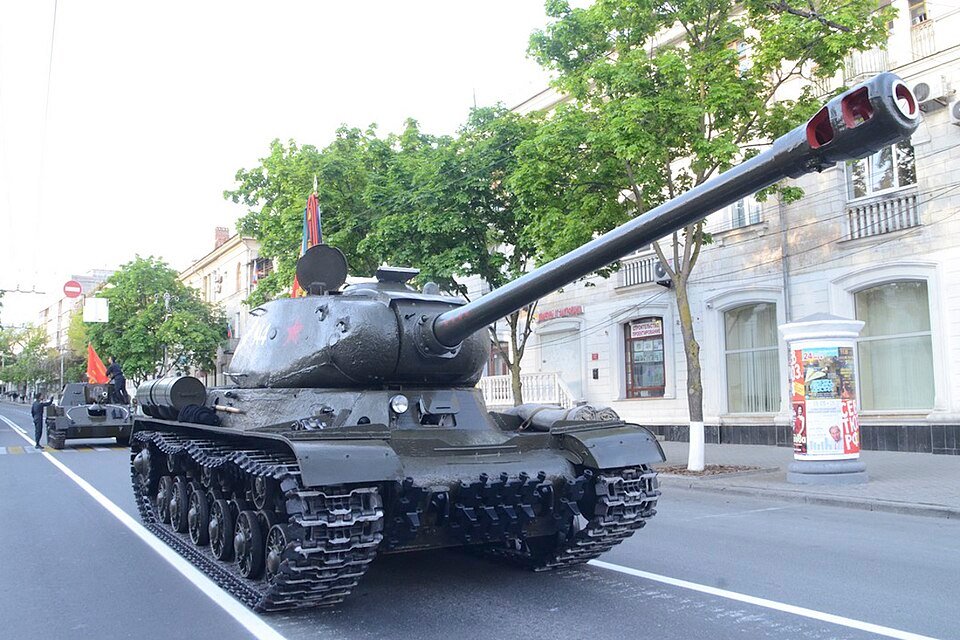
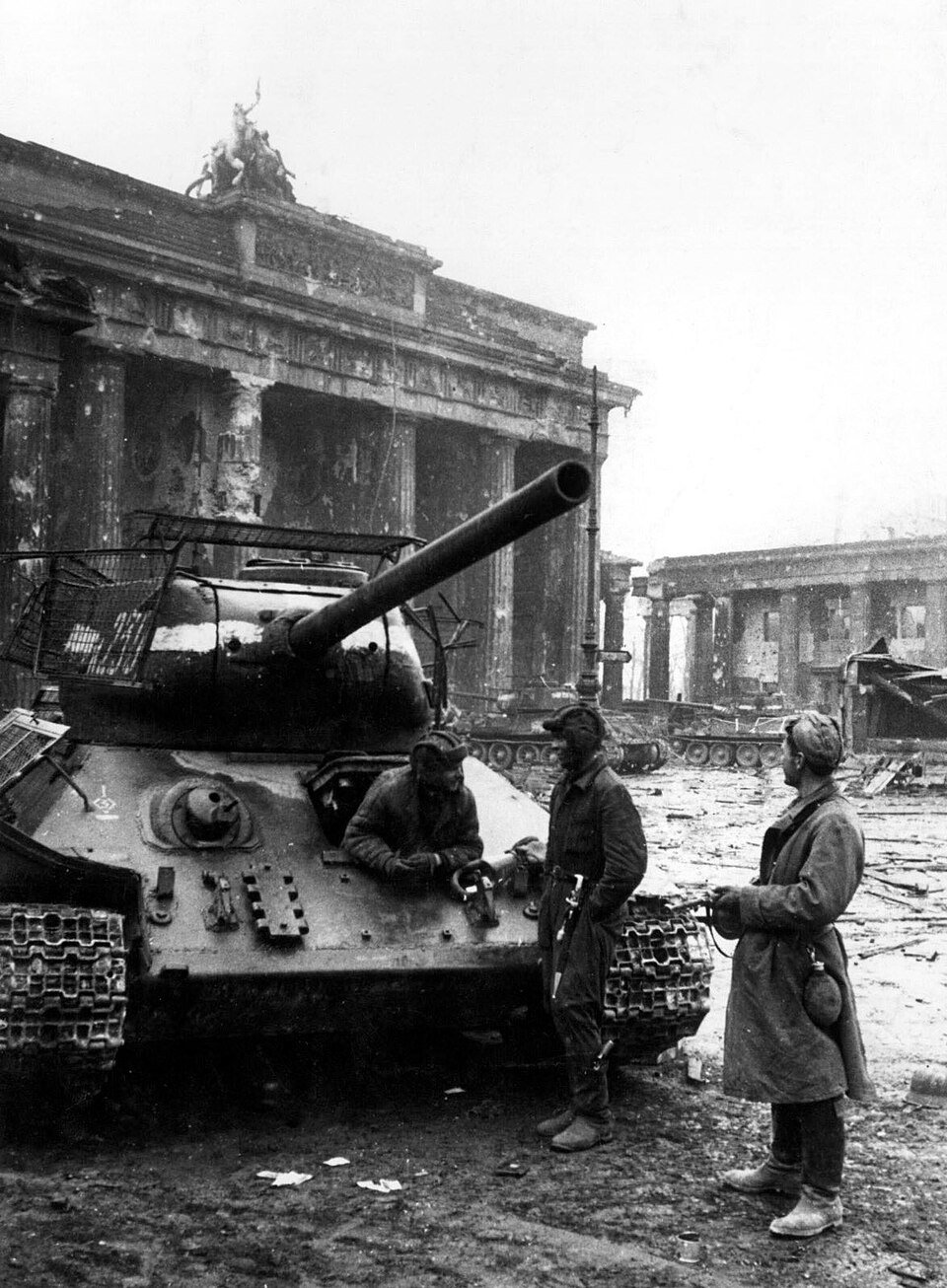
Weapons built to break a defended line in open country were driven into streets. The IS-2’s 122 mm D-25T was meant for breaking a defence open; in Berlin it fought at the range of a street.


IS-2 heavy tank
The largest gun on any tank in the Berlin assault, and only two or three rounds a minute from it. Meant for breaking a defence open, not for the close work it got.

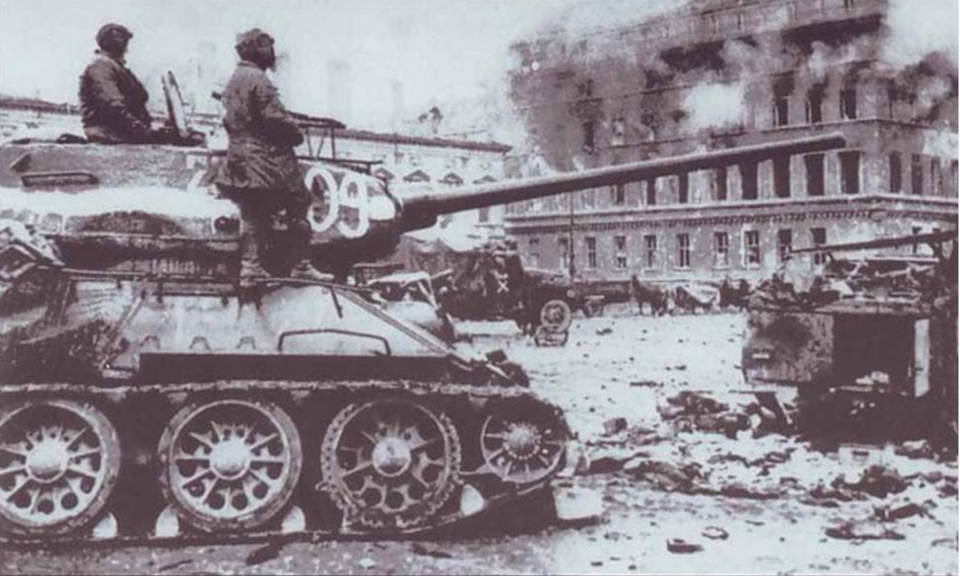
T-34/85 medium tank
The tank the assault was made of. In the streets it was within Panzerfaust range of an upper window for most of every advance, and many were lost that way.

PPSh-41 submachine gun
The one weapon on this sheet that the city suited. The drum let a man clear a stairwell or hold a window without stopping to reload, which is what street fighting asked for.

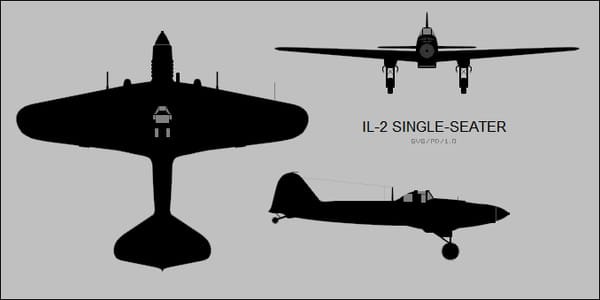
Il-2 Sturmovik
Designed to work over open country at a few hundred feet. Over Berlin the smoke was thick enough that telling Soviet troops from German ones from the air became the problem.

Mosin-Nagant 91/30
The rifle every infantry division carried. Its sniper variant, with a 3.5× scope, was the weapon best suited to a city of upper floors and rooftops.


05The Reichstag
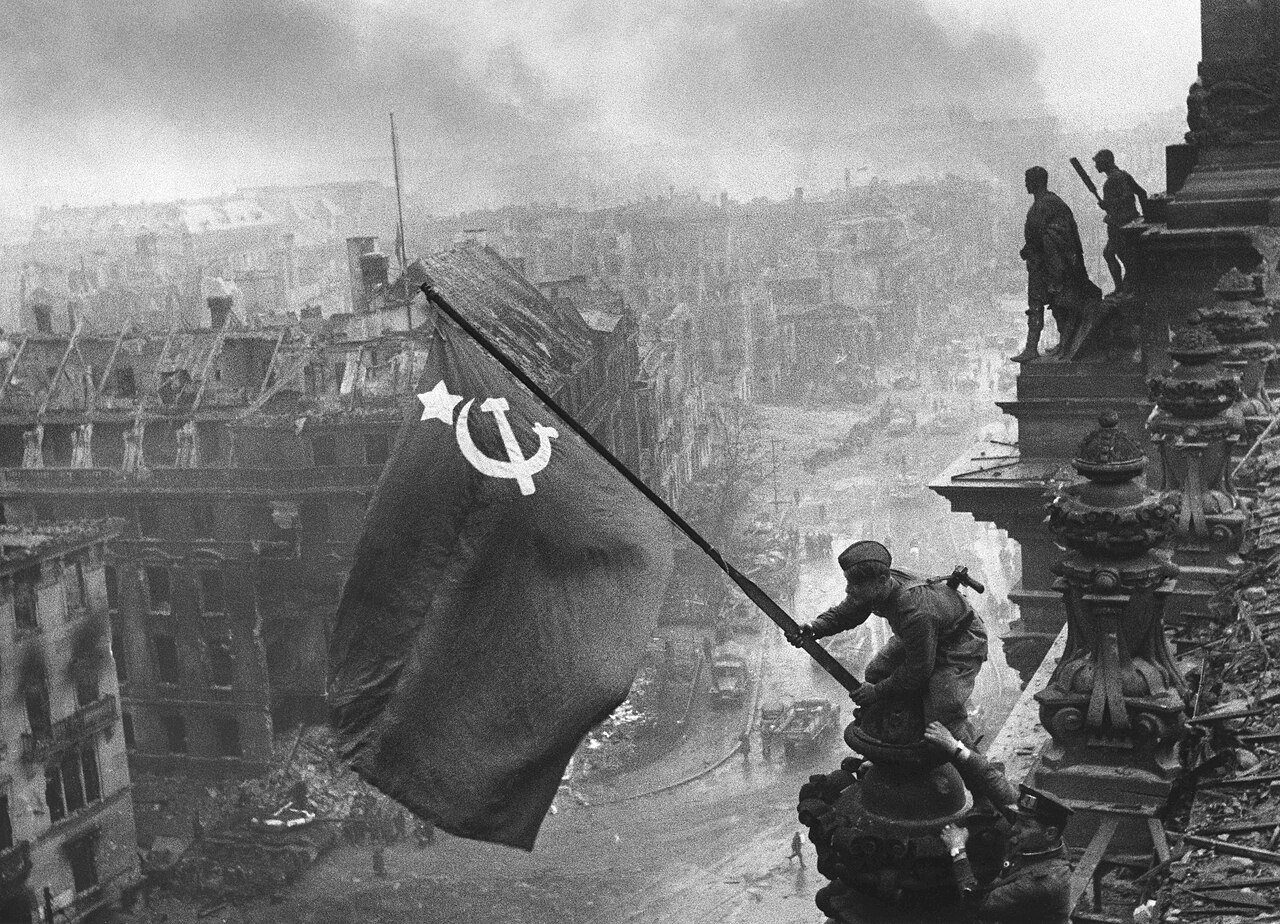
On 30 April 1945, at 13:00, 89 pieces opened fire together on the Reichstag: 152 mm and 203 mm howitzers, tank guns, self-propelled guns and Katyusha launchers. Other accounts give “some ninety”, and one puts the hour at noon.

06What it cost
The figures below cover the whole operation, from the Oder to the end of the fighting, not the city alone.

Soviet and Polish casualties in the Berlin operation, Krivosheev: 81,116 killed, dead of wounds or missing, and 280,251 wounded or sick.
German civilian dead, as given by Antill (2005) and Clodfelter (2002) for the whole operation. Counts restricted to the fighting inside the city are very much lower, and nobody has reconciled them.
Rubble for every Berliner, at one metre scale
About 30 m³ of rubble for each inhabitant: a cube 3.11 m on a side, beside a person 1.70 m tall. In all, 55 to 75 million m³; the upper figure is the Landesdenkmalamt Berlin’s.
On the Oder the guns stood 3.45 to 3.70 metres apart. 16 days later, the Berlin garrison surrendered.
Press & citation
Free to publish under CC BY 4.0 — in print, online, on Wikipedia and in teaching, commercially or not — with credit to Berlinfographics and a link to this page.
Ready-to-use image
The infographic as one image: headline, key figures, chart, sources and credit, 2,400 × 1,350 px PNG. Please use it unedited.
Download landscape (PNG)
Square format
A 1:1 version for social media and narrow columns, 1,800 × 1,800 px.
Download square (PNG)
Portrait 4:5
For Instagram and LinkedIn feeds, 1,620 × 2,025 px.
Download portrait (PNG)Credit line
Berlinfographics (berlinfographics.com), CC BY 4.0
Citation
Berlinfographics (2026). “The gun line: Soviet artillery in the Berlin operation, 1945”. Berlin Experiences. https://berlinfographics.com/soviet-weapons-berlin/
Wikipedia
{{cite web |title=The gun line: Soviet artillery in the Berlin operation, 1945 |url=https://berlinfographics.com/soviet-weapons-berlin/ |website=Berlinfographics |publisher=Berlin Experiences |date=2026-11-05 |access-date=2026-11-05}}
Our infographics, charts and texts are licensed CC BY 4.0: free to republish, including commercially, with credit to Berlinfographics and a link. Photographs keep their own licences, named in each caption. How to credit
Topics: The Second World War · Cold War Berlin · Nazi Berlin · Persecution & the Holocaust · Weimar Berlin · Prussia & the Kaiserreich · Architecture & the built city · Culture, science & society · Reunified Berlin · Unusual facts
Contact: info@berlinfographics.com · Press: press@berlinfographics.com · Imprint · Privacy