The dock at Nuremberg. Front row from left: Hermann Göring, Rudolf Hess, Joachim von Ribbentrop, Wilhelm Keitel. Behind: Karl Dönitz, Erich Raeder, Baldur von Schirach, Fritz Sauckel. Four of the eight would serve their sentences in Spandau.Photo: Ray D'Addario, US Army Signal Corps, 1945–46. Wikimedia Commons. Public domain.
Spandau
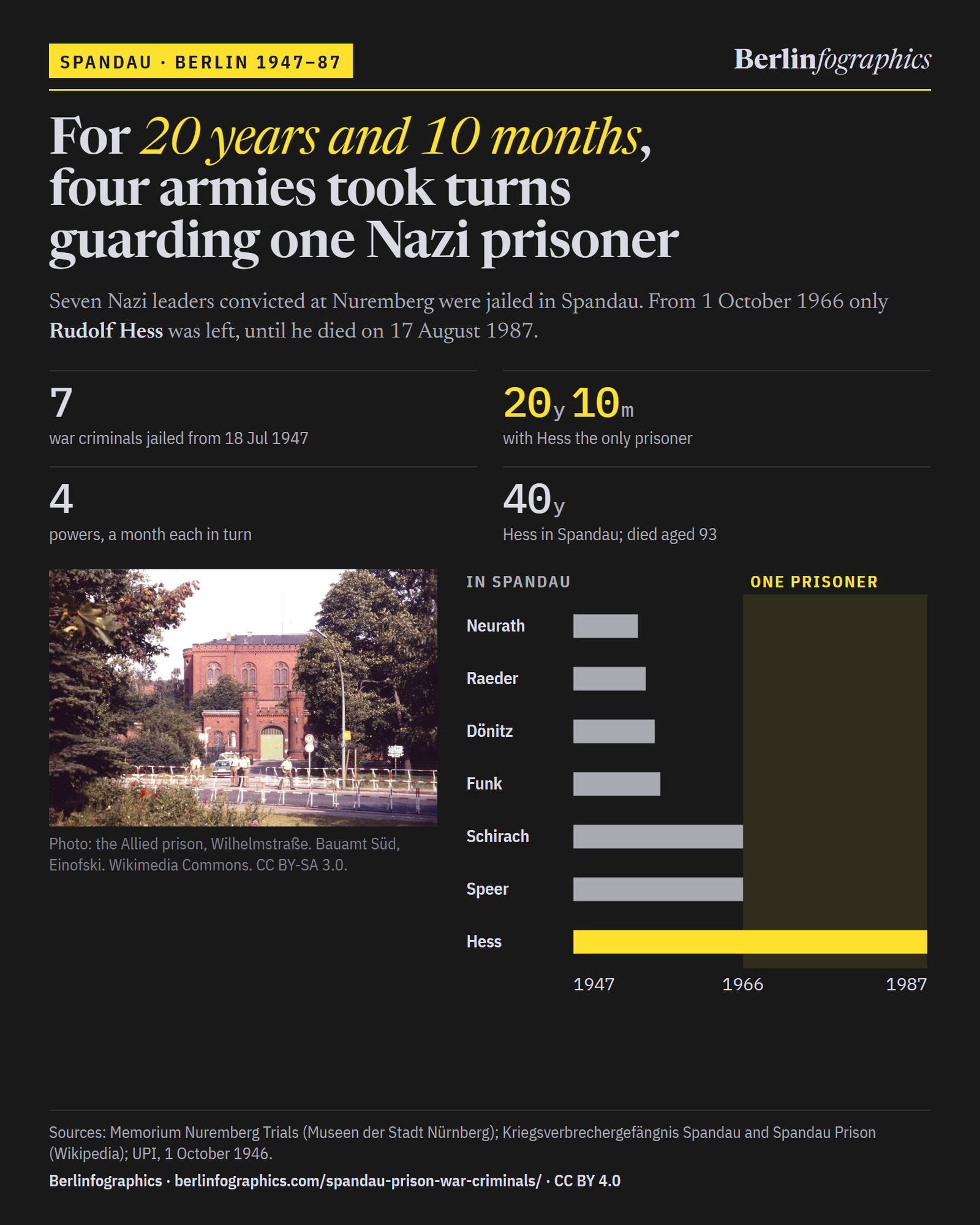
Seven of Hitler’s ministers and commanders, convicted at Nuremberg, served their sentences in the Allied prison at Spandau. From 1 October 1966 only Rudolf Hess was left. The United States, Britain, France and the Soviet Union went on guarding him, a month each in turn, until he died on 17 August 1987.
01Nuremberg
On 1 October 1946 the International Military Tribunal at Nuremberg passed its sentences on the surviving leaders of Nazi Germany. Many were sentenced to death. Seven were given prison terms: three for life, the others for ten to twenty years.
They stayed in the Nuremberg jail for nine more months. On 18 July 1947 they were taken to Berlin, to the old military prison on Wilhelmstraße in Spandau, in the British sector: from then on the Allied prison for war criminals, run jointly by all four occupying powers.

The seven, and the crimes the tribunal found them guilty of
| Prisoner | Found guilty of, in the tribunal’s judgment | 1 | 2 | 3 | 4 | Sentence |
|---|---|---|---|---|---|---|
Konstantin von Neurath Foreign Minister; Reich Protector of Bohemia and Moravia | As Reich Protector, crushed Czech political and cultural life | 15 years | ||||
Erich Raeder Grand Admiral, head of the navy | Planned and waged aggressive war at sea | Life | ||||
Karl Dönitz Grand Admiral, U-boat chief; Hitler’s successor as head of state | Directed unrestricted submarine warfare | 10 years | ||||
Walther Funk Economics Minister and Reichsbank president | Took SS gold, including gold taken from concentration-camp victims, into the Reichsbank | Life | ||||
Baldur von Schirach Hitler Youth leader; Gauleiter of Vienna | Pressed for and oversaw the deportation of Vienna’s Jews | 20 years | ||||
Albert Speer Hitler’s architect; Armaments Minister | Ran war production on forced and slave labour | 20 years | ||||
Rudolf Hess Deputy Führer | Conspiracy and crimes against peace | Life |
02Wilhelmstraße, Spandau
Four of the seven were out within ten years, three of them early because they were ill. Then the count stuck at three for nearly a decade, and then at one.
Inside: seven prisoners
18 July 1947
Each man was known from then on by a number, given in the order he first took his cell: Hess was number 7.
6 Nov 1954 – 26 Sep 1955
Konstantin von Neurath, sentenced to 15 years, was let out on 6 November 1954; Erich Raeder, sentenced to life, on 26 September 1955. Both were released on grounds of ill health.
1 Oct 1956 – 16 May 1957
Karl Dönitz walked out at the end of his full term, on 1 October 1956. Walther Funk, sentenced to life, was released ill on 16 May 1957.
1 October 1966
Twenty years after their sentence, Albert Speer and Baldur von Schirach were released together at midnight. One prisoner remained.
1966 onwards
Rudolf Hess, sentenced to life, was now the only inmate. The Soviet Union blocked repeated attempts to free him, and the four powers kept the prison running, guard shifts and all.
17 August 1987
Hess died in the prison on 17 August 1987, aged 93, after 7,625 days as its only prisoner.
03A month at a time
Long after the occupying powers’ joint rule of Berlin had broken down, the prison was one of the last places where all four still worked side by side. Each power took the guard for a month, three times a year, in a fixed order: Britain, Jan, May, Sep; France, Feb, Jun, Oct; Soviet Union, Mar, Jul, Nov; United States, Apr, Aug, Dec.
The detachment on duty was about 60 soldiers. On the first of each month one army marched out of the gate and the next marched in, for one prisoner.
Hess died in August: a month of the United States.


04Inside the walls
Behind the gate and the towers, the prison garden was where the prisoners worked and walked. Speer paced its paths for years, counting the distance as an imaginary walk around the world.


Albert Speer wrote thousands of pages in secret. A sympathetic Dutch orderly carried them out of the prison. After his release they became his memoirs and the published Spandau diaries, in which he presented himself as the Nazi who repented, and claimed he had not known of the murder of the Jews. Letters that came to light later show that claim was false.
Hess refused to ask for release, year after year. Neurath, Raeder and Funk were let out on grounds of ill health; for Hess, the Soviet Union blocked every attempt.


05Prisoner number seven
Hitler’s deputy had been a captive since 10 May 1941, when he flew alone to Scotland and was taken prisoner by the British. At Nuremberg he was convicted of conspiracy and crimes against peace and sentenced to life.
He became the only prisoner on 1 October 1966, and stayed the only prisoner for 20 years and 10 months.
He died in the prison on 17 August 1987, aged 93. The Allied investigation found that he had hanged himself with an electrical cord. His family disputed the finding and insisted he had been killed. Peter Padfield’s study of the record found the verdict of suicide consistent with the evidence.
06After the last prisoner
Within months of Hess’s death it was demolished, in 1987, so that it could never become a place of neo-Nazi pilgrimage. The rubble was ground up and dumped in the North Sea.


A shopping centre for the British garrison and a car park were built on the site.
Four armies spent 20 years and 10 months guarding a single Nazi prisoner. When he died, they erased the building.
Press & citation
Free to publish under CC BY 4.0 — in print, online, on Wikipedia and in teaching, commercially or not — with credit to Berlinfographics and a link to this page.
Ready-to-use image
The infographic as one image: headline, key figures, chart, sources and credit, 2,400 × 1,350 px PNG. Please use it unedited.
Download landscape (PNG)
Square format
A 1:1 version for social media and narrow columns, 1,800 × 1,800 px.
Download square (PNG)
Portrait 4:5
For Instagram and LinkedIn feeds, 1,620 × 2,025 px.
Download portrait (PNG)Credit line
Berlinfographics (berlinfographics.com), CC BY 4.0
Citation
Berlinfographics (2026). “Spandau: the Allied prison and its seven Nazi war criminals, 1947–1987”. Berlin Experiences. https://berlinfographics.com/spandau-prison-war-criminals/
Wikipedia
{{cite web |title=Spandau: the Allied prison and its seven Nazi war criminals, 1947–1987 |url=https://berlinfographics.com/spandau-prison-war-criminals/ |website=Berlinfographics |publisher=Berlin Experiences |date=2026-11-05 |access-date=2026-11-05}}
Our infographics, charts and texts are licensed CC BY 4.0: free to republish, including commercially, with credit to Berlinfographics and a link. Photographs keep their own licences, named in each caption. How to credit
Topics: The Second World War · Cold War Berlin · Nazi Berlin · Persecution & the Holocaust · Weimar Berlin · Prussia & the Kaiserreich · Architecture & the built city · Culture, science & society · Reunified Berlin · Unusual facts
Contact: info@berlinfographics.com · Press: press@berlinfographics.com · Imprint · Privacy