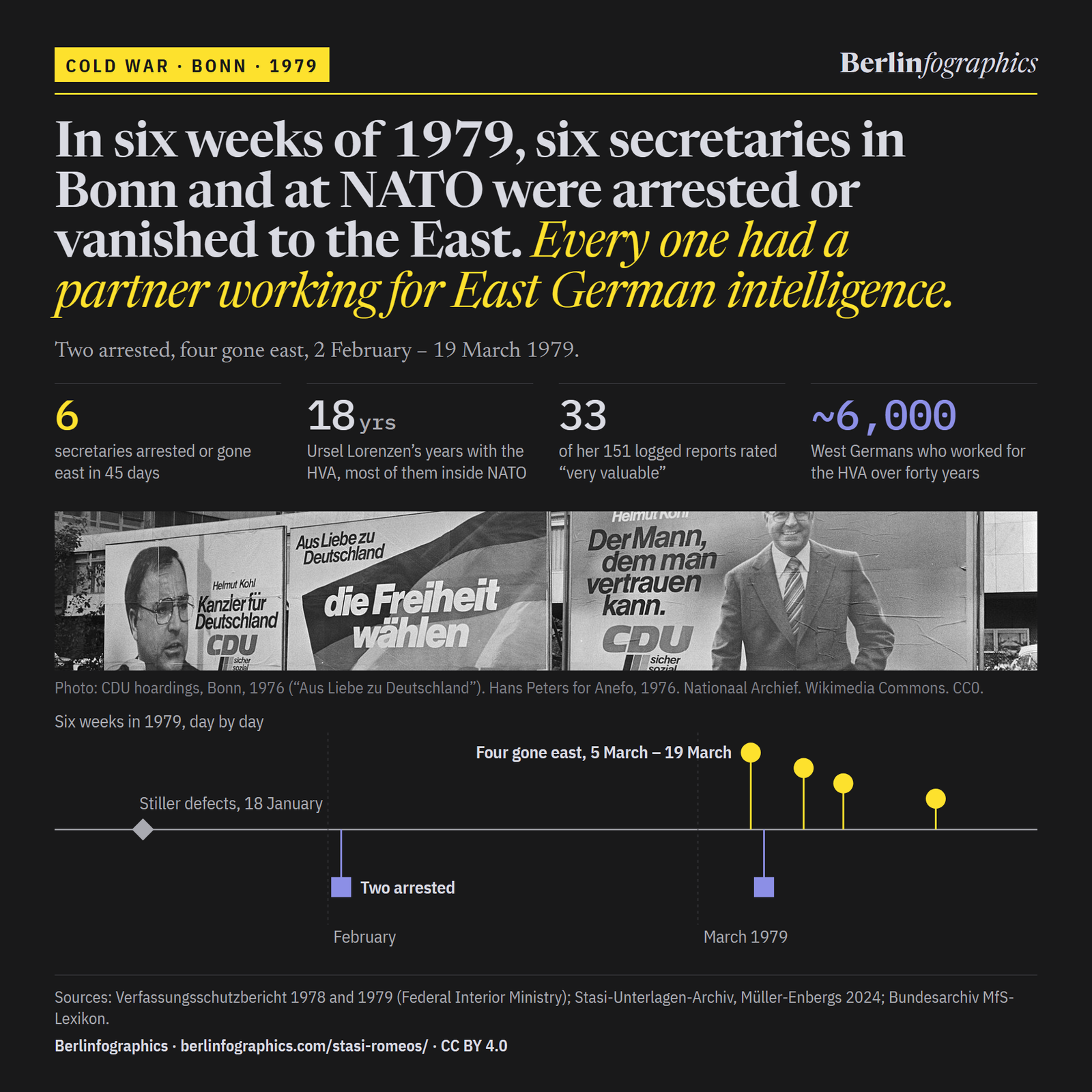
Election hoardings in Bonn before the federal election of 3 October 1976. The CDU poster in the middle reads “Aus Liebe zu Deutschland”: for love of Germany.Hans Peters for Anefo, 1976. Nationaal Archief. Wikimedia Commons. CC0.
The Romeo spies · 1961–1991
Bonn’s counter-intelligence had a name for them: the “secretary cases”. The press called the men Romeos. For three decades East Germany’s foreign intelligence service sent agents west under borrowed names to court women who typed the secrets of the West German state.
01The method
The HVA, the Stasi’s foreign intelligence service, was run by Markus Wolf from 1952 to 1986. Among its methods was one the West German authorities had pieced together by the late 1970s. In its report for 1978 the Federal Office for the Protection of the Constitution set it out plainly: the Stasi infiltrated agents under false identities with orders “to entangle single women, especially secretaries”.
Such agents, the same service reported later, had been through about 2–3 years of intelligence training before they were sent. Some lived in the West for a decade or more before their case broke.
‘Romeo’ is the press’s word. The Verfassungsschutz wrote of ‘secretaries’ and their ‘friends’ or ‘husbands’; the BfV’s president spoke of the ‘so-called secretary cases’.

The pattern, as the Verfassungsschutz described it in 1978
An agent is smuggled into the West under a false identity, often the papers of a real person who had emigrated.
In a café, as a neighbour helping with a car repair, as a colleague at work.
How far it goes depends on the case: a friendship, an engagement, a wedding — once even a staged wedding in the GDR.
If she is not yet a secretary with access, the ‘friend’ or ‘husband’ steers her into secretarial or language courses.
The agents often pose as members of a friendly Western intelligence service, so that handing over papers does not feel like treason.
If that cover can no longer be kept up, the agent threatens to end the relationship.
Paraphrased from the report’s own account. Blue marks the two steps that kept the women working: the false flag, and the threat to leave.
0218 January – 19 March 1979
On 18 January 1979 an HVA officer, Werner Stiller, defected to the West. Over the next weeks West German counter-intelligence arrested two secretaries; four more vanished before they could be arrested, and resurfaced in East Berlin. Every one of the six had a boyfriend or husband whom investigators identified as an East German agent.
six weeks in 1979, day by day
18 January – 19 March 1979
18 January 1979
An HVA officer in its science and technology department, he went to his office in Haus 15 of the Lichtenberg headquarters after hours, took papers from the safe of his department head’s secretary and crossed to West Berlin that night through the agents’ passage at Friedrichstraße station.
He brought with him what he knew of the HVA’s agents in the West.
2 February · arrested
She was secretary in the political department of West Germany’s permanent delegation to NATO, Brussels. Her partner: “Christian Willer”, an infiltrated agent of an East German service living under the identity of a man in Canada.
She admitted passing him papers on NATO meetings. Before him, from 1967 to 1974, she had been with another infiltrated MfS agent, “Heisinger”.
5–6 March · gone east
She was chief secretary to the director for Council affairs in NATO’s International Staff, Brussels. Her partner: Dieter Will, a hotel manager in Brussels, who was also her HVA instructor.
She fled exactly four weeks after Garbe’s arrest. Bonn read it as a reaction to that arrest; the HVA’s own records show the order to pull her out followed Stiller’s defection.
6 March · arrested
She was secretary to the head of organisation at CDU headquarters, Bonn. Her partner: her husband, “Jürgen Höfs”, identified as an infiltrated East German agent, Siegfried Gäbler.
Both were arrested in Bonn. She denied the charge.
9 March · gone east
She was personal secretary to Werner Marx, the CDU/CSU’s foreign-affairs spokesman in the Bundestag. Her partner: her husband, Wolfgang Goliath, an infiltrated MfS agent who had arrived in 1961 claiming to come from Perth, Scotland.
They had married in 1967. The GDR news agency announced that both had gone east.
12 March · gone east
She was personal secretary to Kurt Biedenkopf, deputy chairman of the CDU. Her partner: “Heinrich Hoffmann”, later “Konrad Kipping”, an infiltrated MfS agent.
Investigators concluded he had recruited her in 1968–70, before she took the secretarial exam and a language course in London.
19 March · gone east
She was secretary to Manfred Lahnstein, state secretary in the Federal Finance Ministry; earlier in the Chancellery’s economics department. Her partner: “Robert Kresse”, a chemical worker who had arrived in 1973 claiming to come from Birmingham.
Two days after he went missing, she phoned her mother from East Berlin.
six weeks
Two arrested, four gone east, from the offices of the CDU’s leaders, the Finance Ministry and NATO. The Verfassungsschutz wrote that all the cases were alike in their essentials.
031961 – 1990
The six of 1979 were not the beginning or the end. Each bar below runs from the first documented contact between a woman and her East German partner to the day she fled or was arrested, on one scale. Where the record gives only a year, the start is drawn faint across that year.
How long it lasted, on one scale, 1960–1992
Mar 1961 – Mar 1979
Recruited, probably in March 1961, she joined NATO in January 1967; her partner Dieter Will was also her HVA instructor. Through her desk the HVA received NATO papers classified ‘Atomal’, among them the alliance’s new strategy, MC 14/3, soon after its adoption in January 1968.
The HVA logged 151 reports from her from 1969; it rated 33 of them “very valuable”.
Jul 1968 – Aug 1985
She met “Franz Becker”, a student in Bonn, in July 1968. Per the BfV, he had been smuggled in from the GDR in March 1966 under false papers.
From 1981 she photographed papers with cameras he gave her, the first built into a lipstick; from 1980 she was paid DM 500 a month. She was arrested in August 1985.
1968 – 1990
Recruited by the HVA in 1968, by published accounts, she joined the BND in 1973. She rose to Regierungsdirektorin, a senior analyst’s rank, in the BND’s headquarters at Pullach. Markus Wolf met her in person, a privilege he kept for chosen sources.
Arrested on 30 September 1990, she was sentenced on 19 December 1991 to six years and nine months.
1961 – 1990
Each of these cases ended from outside: with an arrest, with a defection, or with an order from East Berlin to pull out. Inge Goliath had been married to her agent for eleven years when they left together.
041967 – 1990
For years, the Verfassungsschutz wrote in its 1978 report, counter-intelligence had been unmasking secretaries as agents of communist services. It listed the best known. Each dot below is a case this story names, placed at the year it was exposed.
Secretary cases named in this story, by year exposed, 1967–1990
Named in the 1978 report: Leonore Sütterlin (1967, secretary, Foreign Office); Irene Schultz (1970, front-office secretary to the Federal Science Minister); Gerda Schröter (1973, foreign-language secretary, West German embassy, Warsaw); Helge Berger (1976, chief secretary, economics department, Foreign Office); Dagmar Kahlig-Scheffler (1977, secretary, Federal Chancellery — married in a wedding the MfS staged in the GDR). Yellow: fled to the East; blue: arrested. The list is not complete; it is the cases the official record names.

05After 1990
Agents caught in the West were tried in the West: the man who called himself Jürgen Höfs was arrested in Bonn in March 1979. After 1990 the question was what to do with the people who had run them from the East. In 1995 the Federal Constitutional Court ruled that prosecuting GDR citizens who had spied from GDR territory, and still lived there at reunification, was disproportionate. West Germans who had spied for the HVA had no such protection.
Gabriele Gast was a West German. She was tried in Munich for espionage and sentenced to six years and nine months; she was released on 12 February 1994, having served half. She had worked for the HVA, in her own words, for “twenty-one years”.
“…in das Raster der sogenannten Sekretärinnen-Fälle.”Heribert Hellenbroich, president of the Federal Office for the Protection of the Constitution, on Margret Höke, 1985: she fitted “the pattern of the so-called secretary cases”.
The weapon, Bonn concluded, was loneliness: the Stasi “exploits single women’s need for company”.
In six weeks of 1979, six of those lives came apart at once.
Press & citation
Free to publish under CC BY 4.0 — in print, online, on Wikipedia and in teaching, commercially or not — with credit to Berlinfographics and a link to this page.
Ready-to-use image
The infographic as one image: headline, key figures, chart, sources and credit, 2,400 × 1,350 px PNG. Please use it unedited.
Download landscape (PNG)
Square format
A 1:1 version for social media and narrow columns, 1,800 × 1,800 px.
Download square (PNG)
Portrait 4:5
For Instagram and LinkedIn feeds, 1,620 × 2,025 px.
Download portrait (PNG)Credit line
Berlinfographics (berlinfographics.com), CC BY 4.0
Citation
Berlinfographics (2026). “The Romeo spies of Bonn”. Berlin Experiences. https://berlinfographics.com/stasi-romeos/
Wikipedia
{{cite web |title=The Romeo spies of Bonn |url=https://berlinfographics.com/stasi-romeos/ |website=Berlinfographics |publisher=Berlin Experiences |date=2026-11-09 |access-date=2026-11-09}}
Our infographics, charts and texts are licensed CC BY 4.0: free to republish, including commercially, with credit to Berlinfographics and a link. Photographs keep their own licences, named in each caption. How to credit
Topics: The Second World War · Cold War Berlin · Nazi Berlin · Persecution & the Holocaust · Weimar Berlin · Prussia & the Kaiserreich · Architecture & the built city · Culture, science & society · Reunified Berlin · Unusual facts
Contact: info@berlinfographics.com · Press: press@berlinfographics.com · Imprint · Privacy