Berlinfographicsby Berlin Experiences

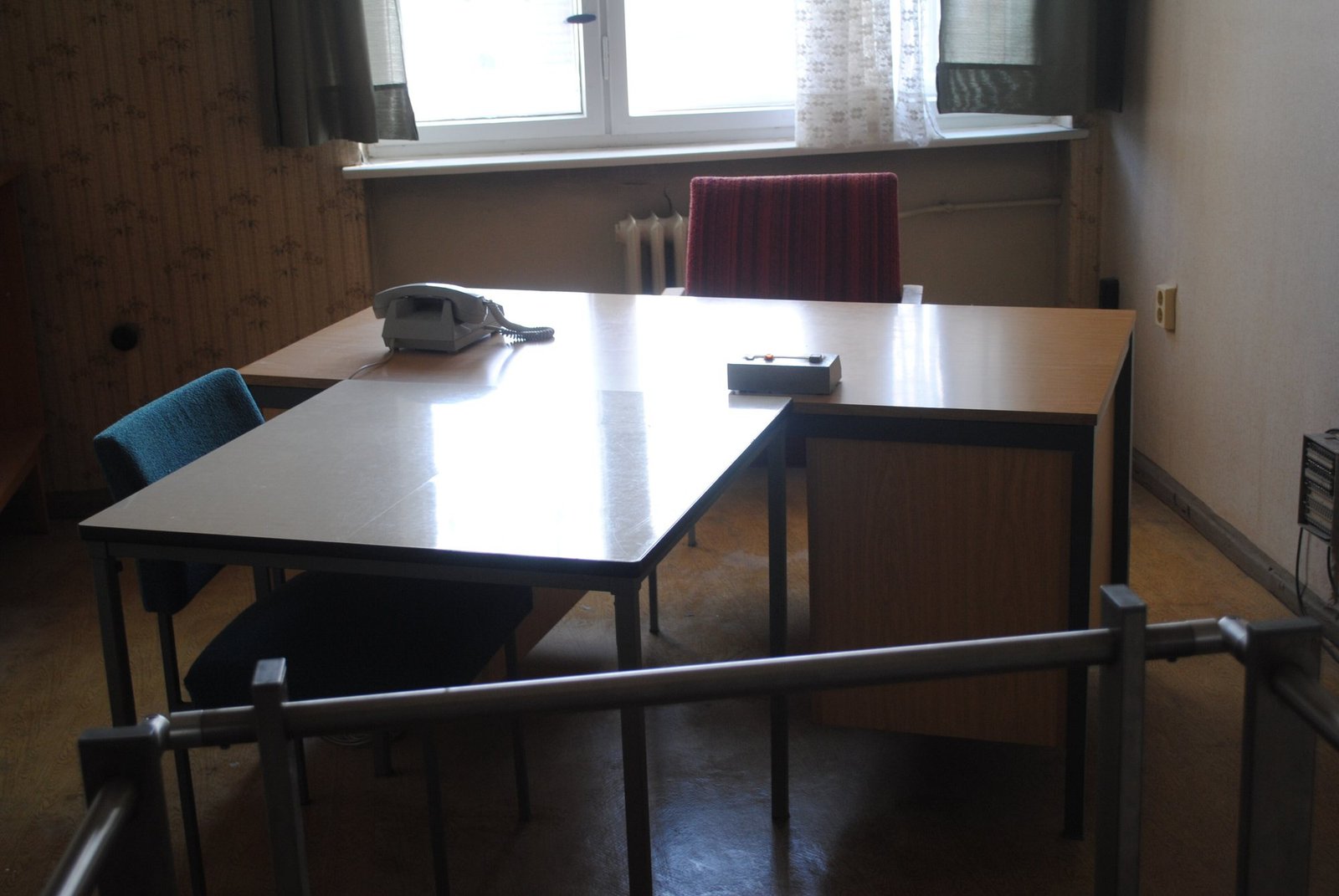
An interrogation room in the Stasi’s remand prison at Hohenschönhausen, Berlin, now a memorial.Photo: Oh-Berlin.com, 2012. Wikimedia Commons. CC BY 2.0.

The smell jars

The Stasi sealed its suspects’ smell in jars so dogs could pick them out. Nobody ever counted the jars.

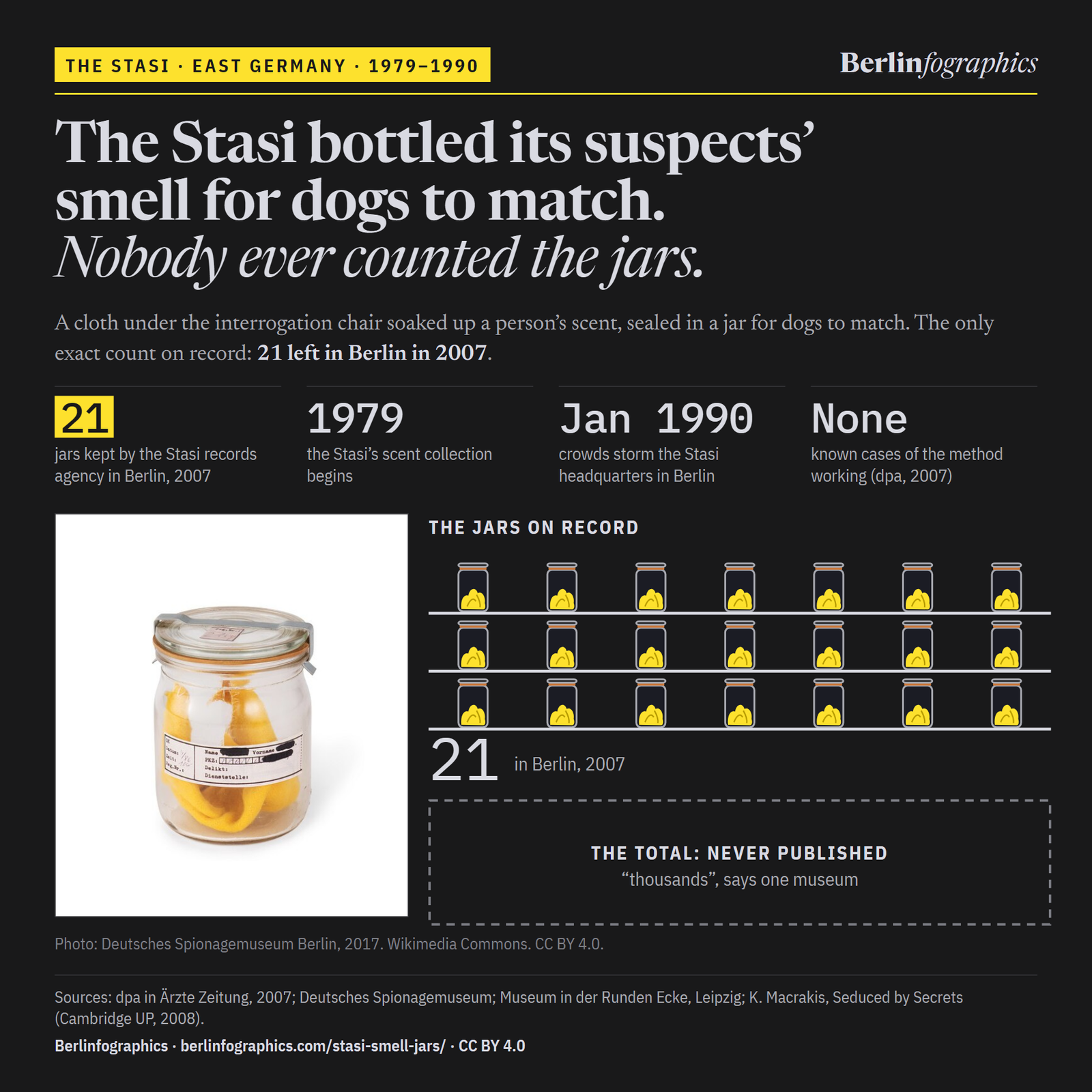
From 1979 East Germany’s secret police took people’s body odour on cloths, often from the chair they sat on while being questioned, and kept it in airtight preserving jars. The only exact number on record is the 21 jars the Stasi records agency still held in Berlin in 2007.

21
jars still held by the Stasi records agency in Berlin, 2007
1979
the Stasi’s own scent collection begins, run by Main Department XX
15 Jan 1990
the crowd storms the Stasi headquarters in Berlin
None
known cases of the method working, dpa reported in 2007
01East Germany, 1970s–1980s

A police trick became a secret archive of smells

East Germany’s People’s Police, the Volkspolizei, worked out the method in the 1970s: soak up a scent on a cloth, seal it in a glass jar, and let a trained dog compare it with a trace from a crime scene. The Stasi’s own dictionary called this Geruchsdifferenzierung, scent differentiation, and its samples Geruchskonserven, “preserved smells”.

The Stasi began its own collection in 1979, by the Deutsches Spionagemuseum’s account, run by Main Department XX, which watched culture and the media and repressed the opposition. Other accounts put the archive in the 1980s. It sampled people in advance, before any offence: mostly people the Stasi suspected of opposing the regime — sampled in advance, before any offence, so that a dog could pick them out later.

Each jar carried a typed label with the person’s name and their 12-digit personal ID number, the number every East German had been issued since 1970.

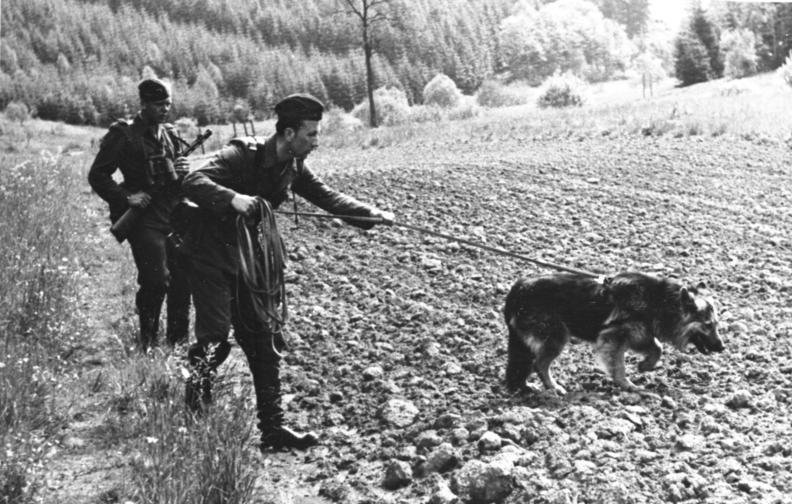
Two uniformed men in a ploughed field, one holding a long lead on a dog that sniffs the ground.
East German border police on patrol with a tracker dog, 1956. Dogs were part of East German policing long before the scent jars; this is not a scent-differentiation dog.Photo: Bundesarchiv, Bild 183-42998-0006 / Unknown / CC BY-SA 3.0 de
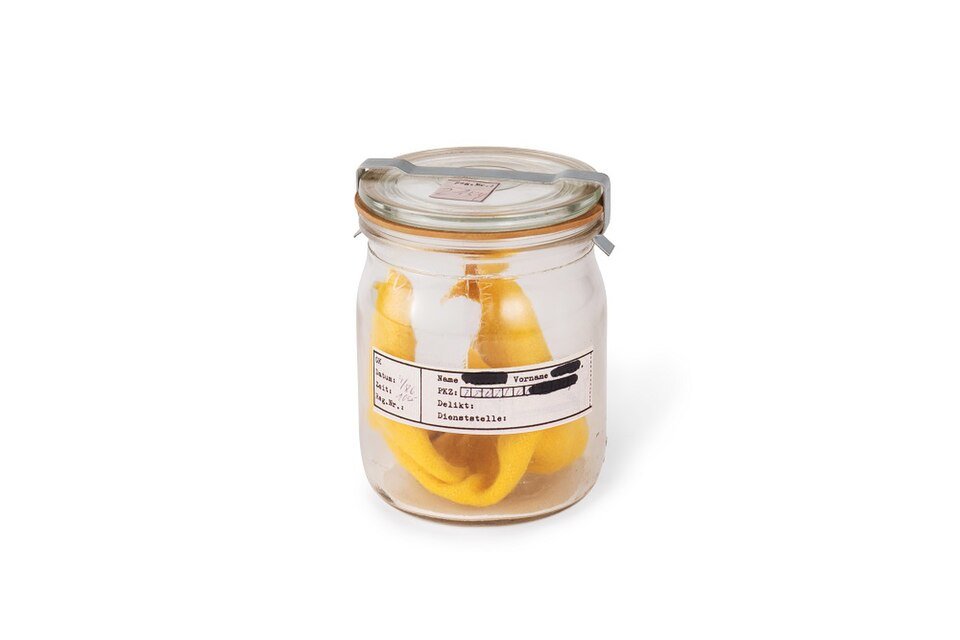
A glass preserving jar with a clamp lid holding a crumpled yellow cloth; a typed label on the glass has the name blacked out.
A Stasi scent jar: a yellow duster sealed in a preserving jar, with a typed label for the date, name, personal ID number, alleged offence and office. The museum has blacked out the name.Photo: Deutsches Spionagemuseum Berlin, 2017. Wikimedia Commons. CC BY 4.0.

A Stasi scent jar: how it was made

How a scent sample was taken, sealed in a jar, labelled, matched by a dog, and what is left of the jars.

Drawn from the jar in the Deutsches Spionagemuseum and the Stasi’s own descriptions. Not to scale.

An interrogation room with a desk, a telephone, a red upholstered chair and two green chairs behind a visitor railing.
Another interrogation room at Hohenschönhausen, with the interrogator’s desk and the chairs across it.Photo: Oh-Berlin.com, 2012. Wikimedia Commons. CC BY 2.0.

Taken · the chair

A cloth under the seat cover

Usually the person never noticed. A sterile cloth lay under the seat cover of the chair they sat on while being questioned, and soaked up their smell. A jar now in Leipzig, dated 16 April 1982, holds one such cloth.

Taken · the body, the home

Dusters, worn clothes, everyday things

Arrested dissidents were made to leave their scent on yellow dusters pressed to intimate parts of the body. In secret house searches, officers wiped cloths over worn clothes and things the person often touched.

A glass preserving jar with a clamp lid holding a crumpled yellow cloth; a typed label on the glass has the name blacked out.
A Stasi scent jar: a yellow duster sealed in a preserving jar, with a typed label for the date, name, personal ID number, alleged offence and office. The museum has blacked out the name.Photo: Deutsches Spionagemuseum Berlin, 2017. Wikimedia Commons. CC BY 4.0.

Sealed

A preserving jar and a typed label

The cloth went into an airtight glass preserving jar so the smell would not fade. The label recorded the date and time, a registry number, the name, the 12-digit personal ID number, the alleged offence and the Stasi office that took it.

Two uniformed men in a ploughed field, one holding a long lead on a dog that sniffs the ground.
East German border police on patrol with a tracker dog, 1956. Dogs were part of East German policing long before the scent jars; this is not a scent-differentiation dog.Photo: Bundesarchiv, Bild 183-42998-0006 / Unknown / CC BY-SA 3.0 de

Matched

A dog walks the line of jars

Specially trained “differentiation dogs” compared a jar with a scent trace secured at a scene, such as a leaflet or a letter, to single out a suspect. The Stasi’s own dictionary says the jars only ever narrowed down suspects; they were never evidence in court.

A tall grey-brown office block with rows of windows behind a concrete forecourt.
Haus 1 of the former Stasi headquarters in Berlin-Lichtenberg, now the Stasimuseum.Photo: Angela Monika Arnold (=44Pinguine), 2015. Wikimedia Commons. CC BY 2.5.

2007

What was left: 21 jars in Berlin

No one has published how many jars there were. A large part was destroyed, with no number or date on record. In 2007 the records agency still kept 21 in Berlin; others had gone to museums and regional branches.

02Leipzig and Berlin, 1989–90

When the crowds broke in, they found shelves of jars

The first jars came to light in Leipzig. In December 1989 dissidents opened a storage room at a local Stasi district office, the historian Kristie Macrakis writes, and saw:

“Rows and rows of glass jars with yellow dust cloths in them.”Kristie Macrakis, Seduced by Secrets, 2008

By June 1990 the same jars turned up at the smell storage facility of the local police's service dog station, empty: the cloths were gone. The labels were still there, and they showed what the jars had held, a “complete smell collection of the Leipzig opposition”.

A courtyard enclosed by brick and rendered office buildings, with a bridge linking two of them.
The “Runde Ecke” in Leipzig, the former regional headquarters of the Stasi, seen from its courtyard. It is now a museum and holds a scent jar dated 1982.Photo: Flocci Nivis, 2020. Wikimedia Commons. CC BY 4.0.

In Berlin, thousands stormed the Stasi headquarters in Normannenstraße on 15 January 1990. Among the sacks of shredded files they found jars of body-odour samples taken from people who had been questioned and arrested.

A night crowd at a gate holding a hand-lettered banner and umbrellas.
The demonstration called by the Neues Forum outside the Stasi headquarters in Lichtenberg, 15 January 1990. The banner reads “Stasi into production. No extra pay, only a performance wage.”Photo: Bundesarchiv, Bild 183-1990-0115-026 / Uhlemann, Thomas / CC BY-SA 3.0 de
A dense crowd of people of all ages under a large banner.
At the demonstration at the headquarters on Normannen- and Ruschestraße (East German press agency photo dated 16 January 1990). The banner reads “Enough of the Stasi and SED dictatorship and Nazism”.Photo: Bundesarchiv, Bild 183-1990-0116-013 / Uhlemann, Thomas / CC BY-SA 3.0 de
A tall grey-brown office block with rows of windows behind a concrete forecourt.
Haus 1 of the former Stasi headquarters in Berlin-Lichtenberg, now the Stasimuseum.Photo: Angela Monika Arnold (=44Pinguine), 2015. Wikimedia Commons. CC BY 2.5.

03The count

How many jars were there? No one has ever published a count

The International Spy Museum in Washington says Stasi offices in East Berlin stored “thousands”. That is a word, not a number. The Stasi records agency has published no total, and the historian of its methods, Kristie Macrakis, gives none.

What happened to them is just as thin on paper. A spokeswoman for the agency said the samples had lost their value as evidence and that “a large part of them were destroyed”, giving no number and no date. In 2007 the agency told dpa it still kept 21 jars in Berlin. Others had gone to museums and to its regional branches.

Macrakis warns that the jars grew into a legend after 1990: “a myth, not grounded in the facts, developed on the topic of the jam jars”.

04What the jars proved

The jars convicted no one, and dpa knew of no case where they worked

The Stasi’s own dictionary says the scent jars were not used as evidence in court; they served to narrow down suspects. A dog’s reaction could point at a suspect, for instance the author of a leaflet, but that was all. In 2007 the news agency dpa reported that no example of the method being used successfully was known.

Scent matching outlived the Stasi. The same dpa report described it as a normal, if rare, investigative method in unified Germany, and in 2007 the Federal Prosecutor took odour samples from anti-G8 activists before the summit at Heiligendamm. The modern way: the suspect holds a metal tube in the hand for a few minutes.

What a jar could and could not do. It could let a trained dog say that two smells matched. It could not stand up in a court, by the Stasi’s own rules, and no known case shows it ever caught anyone.

05From police method to museum piece

Most of what survives is in the archive; a few jars are in museums

The Deutsches Spionagemuseum says most of the surviving samples are in the central Stasi records archive, which became part of the Bundesarchiv on 17 June 2021. Jars are on show in Berlin and Leipzig.

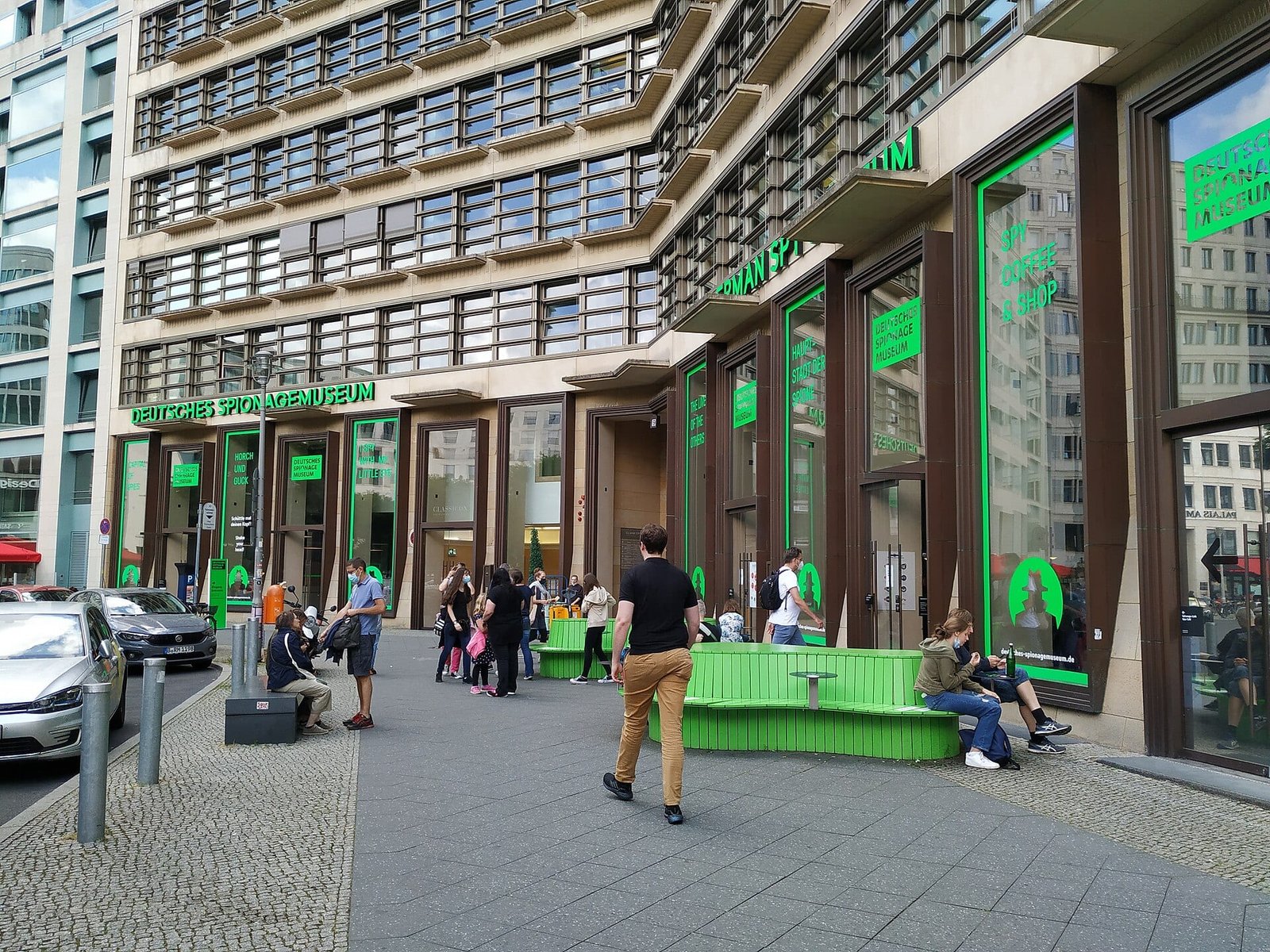
A modern street front with green signage and people on benches outside the museum.
The Deutsches Spionagemuseum at Leipziger Platz, Berlin, which owns the jar shown in this story.Photo: Lukas Beck, 2021. Wikimedia Commons. CC BY-SA 4.0.
A long institutional corridor with filing cabinets, doors and exhibition panels.
The central corridor of the Runde Ecke museum, Leipzig.Photo: Nick-D, 2011. Wikimedia Commons. CC BY-SA 3.0.
Metal letters on a granite wall: Haus der Geschichte der Bundesrepublik Deutschland.
The entrance of the Haus der Geschichte in Bonn, which received Stasi scent jars, dpa reported in 2007.Photo: Langinger, 2010. Wikimedia Commons. CC BY 3.0.

The Deutsches Spionagemuseum in Berlin shows the jar at the top of this story, with the name blacked out. The Runde Ecke in Leipzig, the former regional Stasi headquarters, holds the jar dated 16 April 1982. In 2007 dpa reported that the Haus der Geschichte in Bonn had received jars too.

The Stasi bottled the smell of the people it feared. The only exact count on record is 21 jars, left in Berlin in 2007.

Press & citation

Use this Berlinfographic

Free to publish under CC BY 4.0 — in print, online, on Wikipedia and in teaching, commercially or not — with credit to Berlinfographics and a link to this page.

The Stasi’s smell jars: ready-to-use landscape image

Ready-to-use image

The infographic as one image: headline, key figures, chart, sources and credit, 2,400 × 1,350 px PNG. Please use it unedited.

Download landscape (PNG)
The Stasi’s smell jars: square version

Square format

A 1:1 version for social media and narrow columns, 1,800 × 1,800 px.

Download square (PNG)
The Stasi’s smell jars: portrait version

Portrait 4:5

For Instagram and LinkedIn feeds, 1,620 × 2,025 px.

Download portrait (PNG)

Credit line

Berlinfographics (berlinfographics.com), CC BY 4.0

Citation

Berlinfographics (2026). “The Stasi’s smell jars”. Berlin Experiences. https://berlinfographics.com/stasi-smell-jars/

Wikipedia

{{cite web |title=The Stasi’s smell jars |url=https://berlinfographics.com/stasi-smell-jars/ |website=Berlinfographics |publisher=Berlin Experiences |date=2026-11-09 |access-date=2026-11-09}}