The Detlev-Rohwedder-Haus on Wilhelmstraße, Berlin, the Treuhandanstalt’s seat from 1991. Since April 1992 it has carried the name of the president who was murdered a year earlier. Today it houses the Federal Ministry of Finance.Jensens, 2008. Wikimedia Commons. Public domain.
The Treuhandanstalt · 1990–94
The Treuhandanstalt was founded on 1 March 1990 to hold the people’s property in trust, and closed on 31 December 1994. Its own count, tabled before a Bundestag committee of inquiry, shows where every enterprise went.
01March 1990 – December 1994
It began as a GDR body and ended as a federal one. In between it inherited 8,000 Kombinate, the GDR’s combined industrial groups, and state-owned enterprises, with about 32,000 works and sites. Its first president lasted five weeks; its second was murdered.
The Treuhandanstalt, 1990–94: its presidents
1 March 1990
On 1 March 1990 the GDR’s Ministerrat, under Hans Modrow, resolved to found an agency to hold the people’s property in trust. Selling it was not yet the plan.
17 Jun 1990 · 1 Jul 1990
On 17 June 1990 the freely elected Volkskammer passed the Treuhandgesetz: privatise “as fast and as far as possible”. Two weeks later the currency union converted wages and salaries one for one into Deutsche Marks.
15 Jul 1990 – 3 Oct 1990
Rainer Maria Gohlke took office on 15 July 1990 and resigned on 20 August 1990. Detlev Karsten Rohwedder replaced him on 29 August 1990. From 3 October 1990 the agency answered to the federal finance ministry.
No licence-clear photograph of Gohlke was found.
1 April 1991
His watchword had been: “privatise quickly, restructure decisively, close down carefully”. On 1 April 1991 an RAF sniper shot him dead at his home in Düsseldorf. His wife, Hergard, was badly injured. The killing has never been solved.
13 Apr 1991 – 31 Dec 1994
Twelve days later Birgit Breuel took over, on 13 April 1991. She ran the agency until it closed.
30 Sep 1993 – 31 Aug 1994
The Bundestag set up a committee of inquiry on 30 September 1993. Its 846-page report of 31 August 1994 could not agree. The coalition majority and the opposition filed opposing verdicts.
31 Dec 1994 · 1 Jan 1995
The Treuhandanstalt closed on 31 December 1994. The next day DM 205 billion of its debt passed to the Erblastentilgungsfonds, the federal fund set up to pay off what unification left owing.
02The count of 31 May 1994
The agency broke the Kombinate into saleable pieces, which multiplied the count. That is why it is credited with privatising anything from six thousand enterprises to fourteen thousand: the finance minister gave the inquiry 6,054 whole enterprises privatised by June 1994, and 14,079 once 7,570 enterprise parts and 455 mining rights were added. The bars below count whole enterprises, in the agency’s own monthly statistics.
The Treuhandanstalt’s enterprises, 31 May 1994
31 May 1994
By 31 May 1994 the breaking-up of the Kombinate had produced a portfolio of 13,661 enterprises. Every bar in this panel is drawn on the same scale.
Taken out of the count
462 were mining rights, 408 were reclassified as the agency’s own assets, and 299 had been merged or split again. That leaves a gross holding of 12,335.
51.7% of the holding
6,089 were sold outright and 288 to a majority buyer. About four in five of these sales were made by the regional branches, not by headquarters in Berlin.
12.9% of the holding
1,586 enterprises went back to the owners, or their heirs, from whom they had been taken under the GDR.
2.6% of the holding
264 went to towns and districts and 60 were assigned by possession orders. It was the only outcome that kept an enterprise in public ownership.
27.6% of the holding
More than one in four was put into liquidation rather than sold: 3,292 liquidations were still in progress and 107 complete. This is what the argument has been about ever since.
5.3% of the holding
Seven months before the agency closed, 649 enterprises were still in its hands. Everything else, 11,686 of 12,335, had been decided.
0328 November – 19 December 1990
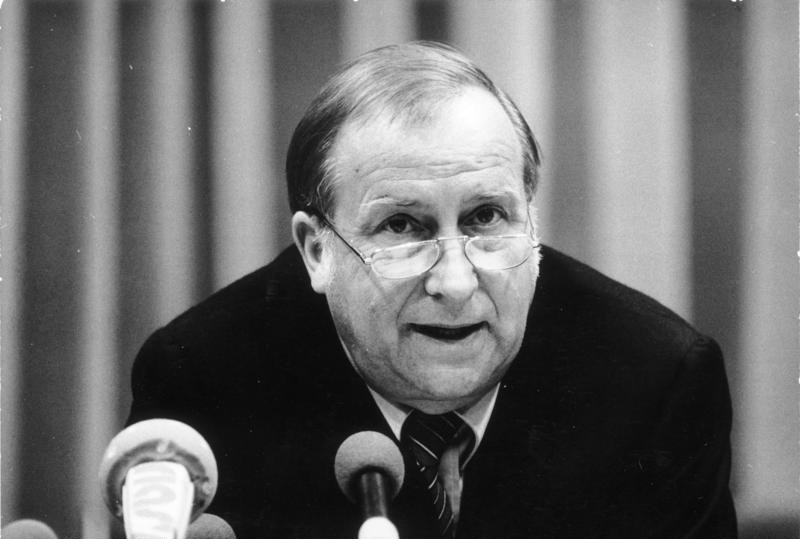
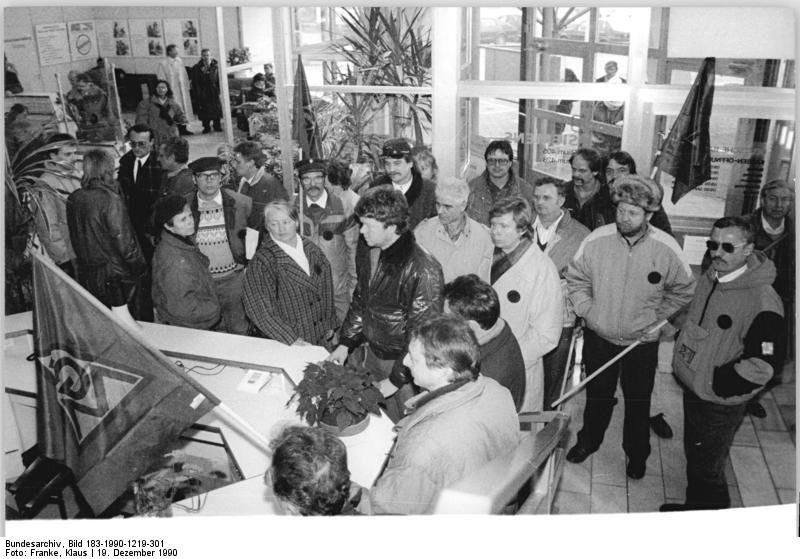
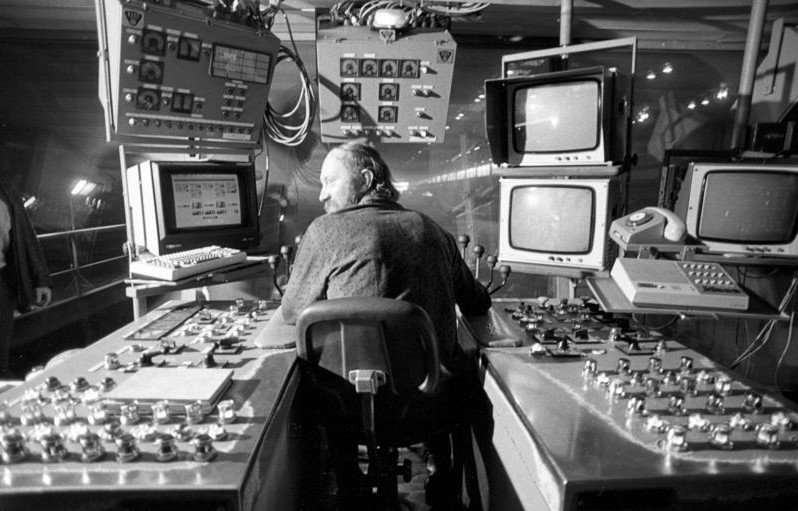
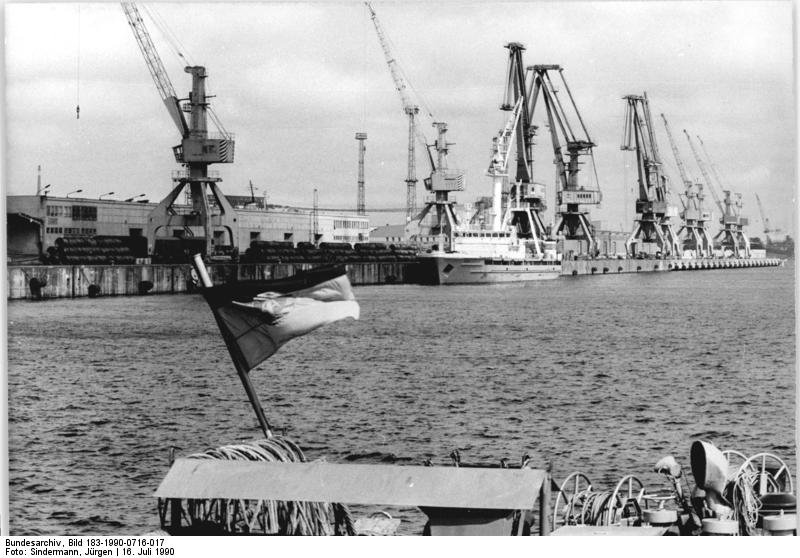
Every photograph here was taken between 28 November 1990 and 19 December 1990, by photographers of the GDR news agency ADN. The captions follow the agency’s own, dated on the day.


The Maxhütte in Unterwellenborn, Thuringia, was the GDR’s oldest integrated steelworks. In December 1990 its works council came to Berlin to ask the Treuhandanstalt for a binding answer: would the plant keep its blast furnace, steel plant and rolling mill, or only a fragment of them?
041990 – spring 1994
The agency’s own count of the people working in the enterprises it still held fell year by year. That is not a count of jobs lost. When an enterprise was sold, it left the holding with its staff.
People employed in enterprises the agency still held
1990
About 4.08 million people worked in what became Treuhand enterprises at the start of 1990. By July it was about 3.5 million: the GDR’s eastern markets had collapsed and its customers had switched to western goods.
31 Dec 1990
At the end of 1990, 3,162,867 people worked in enterprises the agency still held, by its own data management.
31 Dec 1991
A year later, 1,837,131. The big sales of 1991 took whole workforces out of the holding.
31 Dec 1992
By the end of 1992, 759,526.
30 Jun 1993
By mid-1993, 379,791: about one in eight of the number at the end of 1990.
Spring 1994
In spring 1994 a witness told the inquiry that 179,000 people still worked in enterprises the agency owned.
14 April 1994
On 14 April 1994 a witness told the inquiry where the 3.5 million of mid-1990 were: 7% still in a Treuhand enterprise, 43% in a privatised one, and 50% gone through job cuts. About half of those went straight onto the unemployment register.
Another witness, earlier that spring, put the number working in Treuhand and former Treuhand enterprises together at 1.2 million to 1.3 million. The two accounts do not agree, and the inquiry did not reconcile them. Against them stood 1,486,900 jobs that buyers had promised by the end of 1993.
In 1994 East Germany’s unemployment rate averaged 14.8% of the civilian labour force.
05Who bought
The economist Hans-Werner Sinn gave the inquiry the split, counted by the jobs attached to what was sold rather than by the number of enterprises: 85% to West Germans, 9% to foreign buyers, 6% to East Germans.

Who bought, by the jobs attached to what was sold
Other splits circulate, by share of productive assets or of large privatisations only; they measure different things. Source: Sinn’s evidence to the committee, Bundestag Drucksache 12/8404.
Management buy-outs: two counts, on one scale
The agency counted 2,591 buy-outs by managers and staff among 13,643 enterprises and parts privatised. A survey for the economics ministry found ordinary takeovers recorded as buy-outs and put the true figure about 8 per cent lower: about 1,850 to Feb 1993. 66% of all buy-outs were at firms with one to fifty employees.
06Rostock · 1991–94
When the Bagger-, Bugsier- und Bergungsreederei in Rostock was sold in 1991, the contract bound the buyer to keep 900 of its roughly 1,400 employees for at least three years. By February 1994 its works council chairman put the workforce at 15. All 900 were still counted in the agency’s published job pledges: its president confirmed to the inquiry that they included every pledge ever agreed, whether or not the firm was still trading.
One Rostock company, on one scale of people
Every bar is drawn to the same scale. The 15 make a sliver.

07The reckoning
Sales were never going to cover the cost. By early 1994 the agency’s contracts had agreed DM 49 bn in sale proceeds, much of it not yet due. Buyers had promised DM 186.6 bn of investment, and had invested DM 14.2 bn of it by the end of 1993. Its 1994 accounts closed with a deficit of DM 256.4 bn, about €131 billion at the fixed conversion rate.
The money, in billions of Deutsche Marks, all on one scale
Breuel’s figures are what she told the committee, rounded as she gave them. They are spending, not the deficit, which also nets off what came in. The deficit and the debt taken over are two different accountings and are shown separately. Sources: Drucksache 12/8404, Drucksache 13/1834, Deutsche Bundesbank, March 1997.
Both verdicts are in the same 846-page report of 31 August 1994.
the Treuhandanstalt discharged its duties under the Treuhandgesetz as the circumstances allowed; the government had supervised properly and no minister had leaned on a decision.
the agency was given power over thousands of firms and millions of livelihoods while being released from liability for its mistakes; saveable firms were shut too fast and sold too cheaply; of four million jobs in Treuhand enterprises about 1.2 million were left.
Seven months before it closed, 11,686 of its 12,335 enterprises had been sold, handed back, transferred or wound up.
The building it worked from now carries the name of the president it lost.
Press & citation
Free to publish under CC BY 4.0 — in print, online, on Wikipedia and in teaching, commercially or not — with credit to Berlinfographics and a link to this page.
Ready-to-use image
The infographic as one image: headline, key figures, chart, sources and credit, 2,400 × 1,350 px PNG. Please use it unedited.
Download landscape (PNG)
Square format
A 1:1 version for social media and narrow columns, 1,800 × 1,800 px.
Download square (PNG)
Portrait 4:5
For Instagram and LinkedIn feeds, 1,620 × 2,025 px.
Download portrait (PNG)Credit line
Berlinfographics (berlinfographics.com), CC BY 4.0
Citation
Berlinfographics (2026). “The Treuhandanstalt, 1990–94”. Berlin Experiences. https://berlinfographics.com/treuhand/
Wikipedia
{{cite web |title=The Treuhandanstalt, 1990–94 |url=https://berlinfographics.com/treuhand/ |website=Berlinfographics |publisher=Berlin Experiences |date=2026-11-09 |access-date=2026-11-09}}
Our infographics, charts and texts are licensed CC BY 4.0: free to republish, including commercially, with credit to Berlinfographics and a link. Photographs keep their own licences, named in each caption. How to credit
Topics: The Second World War · Cold War Berlin · Nazi Berlin · Persecution & the Holocaust · Weimar Berlin · Prussia & the Kaiserreich · Architecture & the built city · Culture, science & society · Reunified Berlin · Unusual facts
Contact: info@berlinfographics.com · Press: press@berlinfographics.com · Imprint · Privacy