Berlinfographicsby Berlin Experiences
Shortly after midnightFour men shot in this courtyard

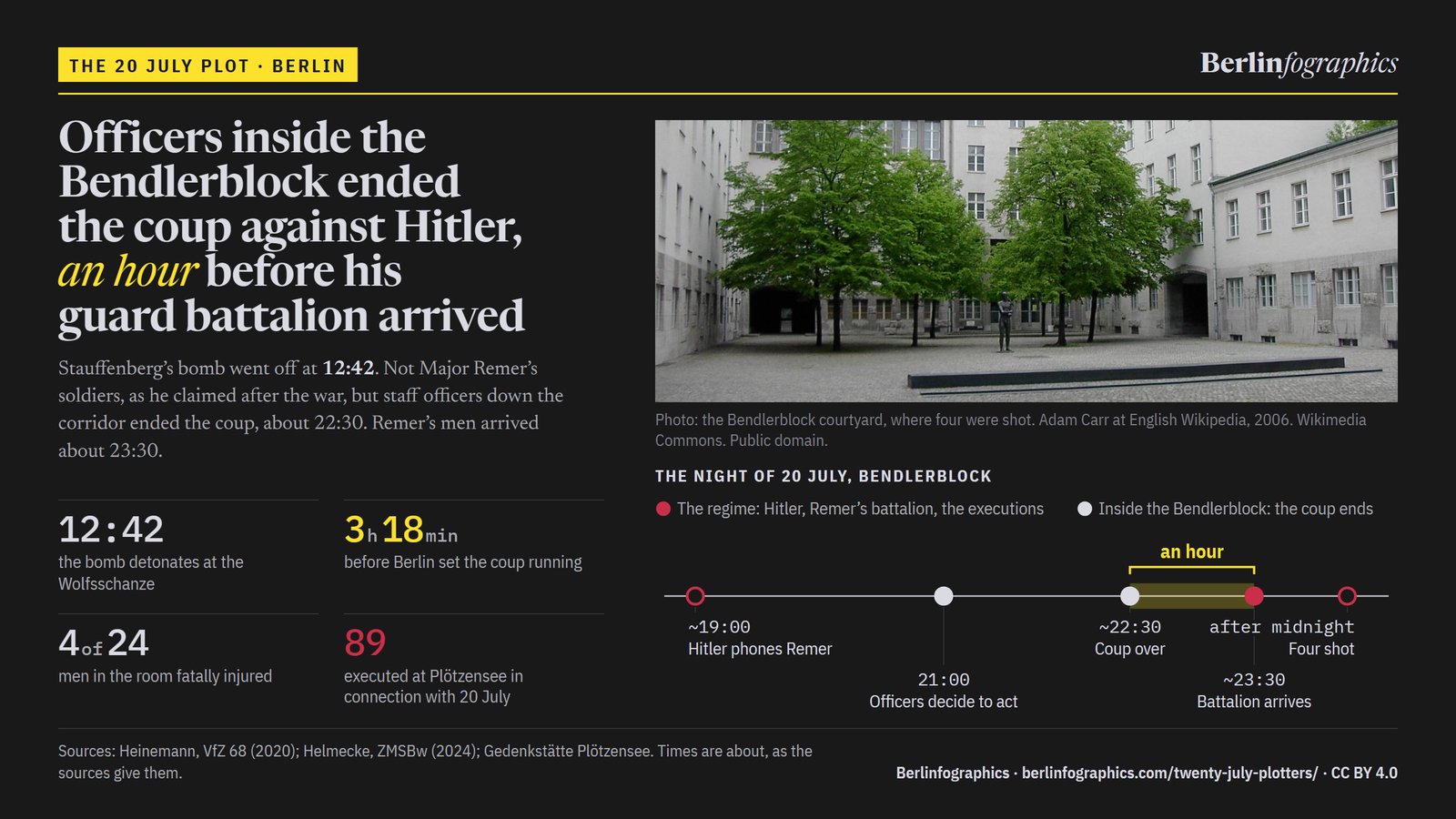
The Bendlerblock courtyard, now the Gedenkstätte Deutscher Widerstand. Stauffenberg, Haeften, Olbricht and Mertz von Quirnheim were shot here one at a time, shortly after midnight, in the headlights of a lorry.Photo: Adam Carr at English Wikipedia, 2006. Wikimedia Commons. Public domain.

The 20 July plot

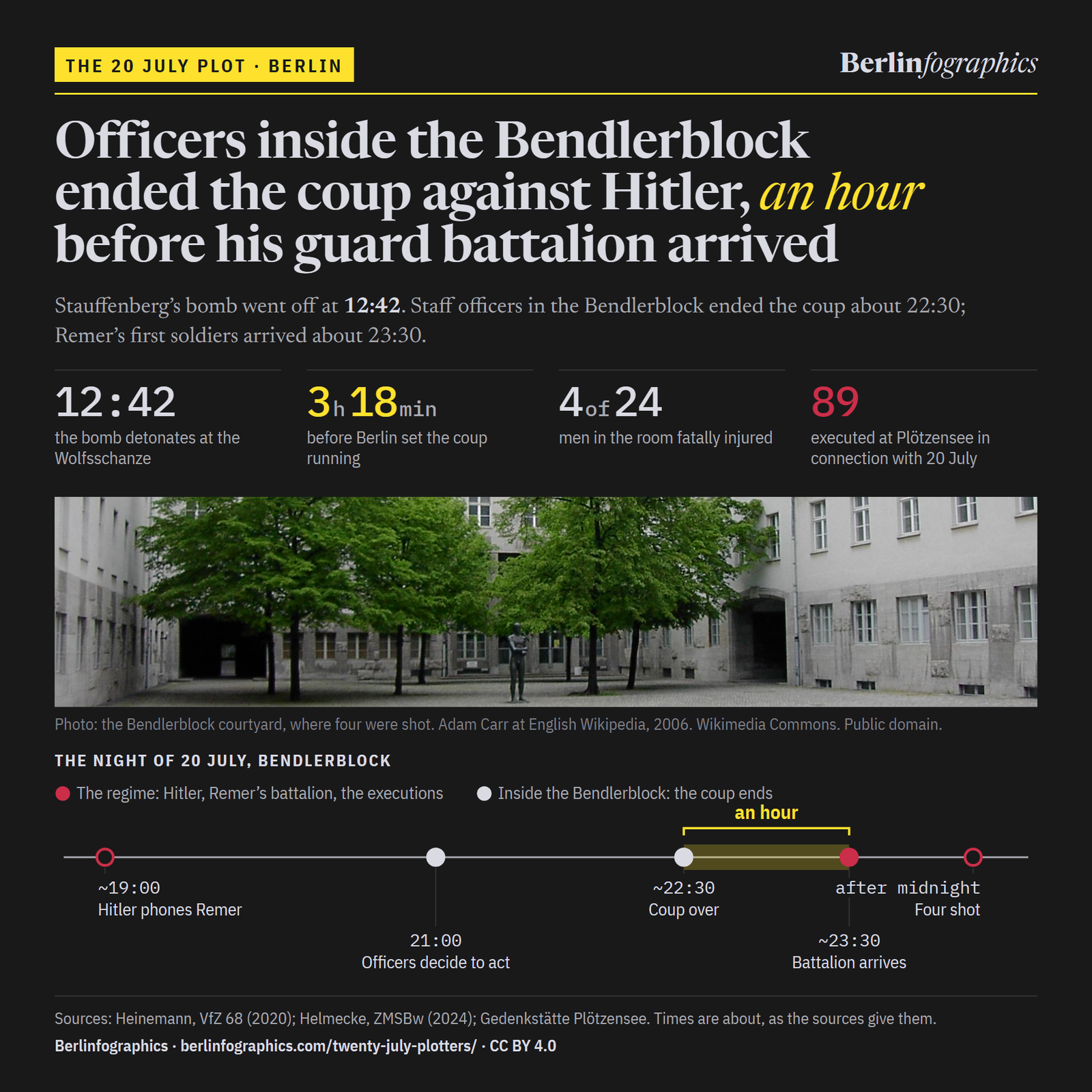
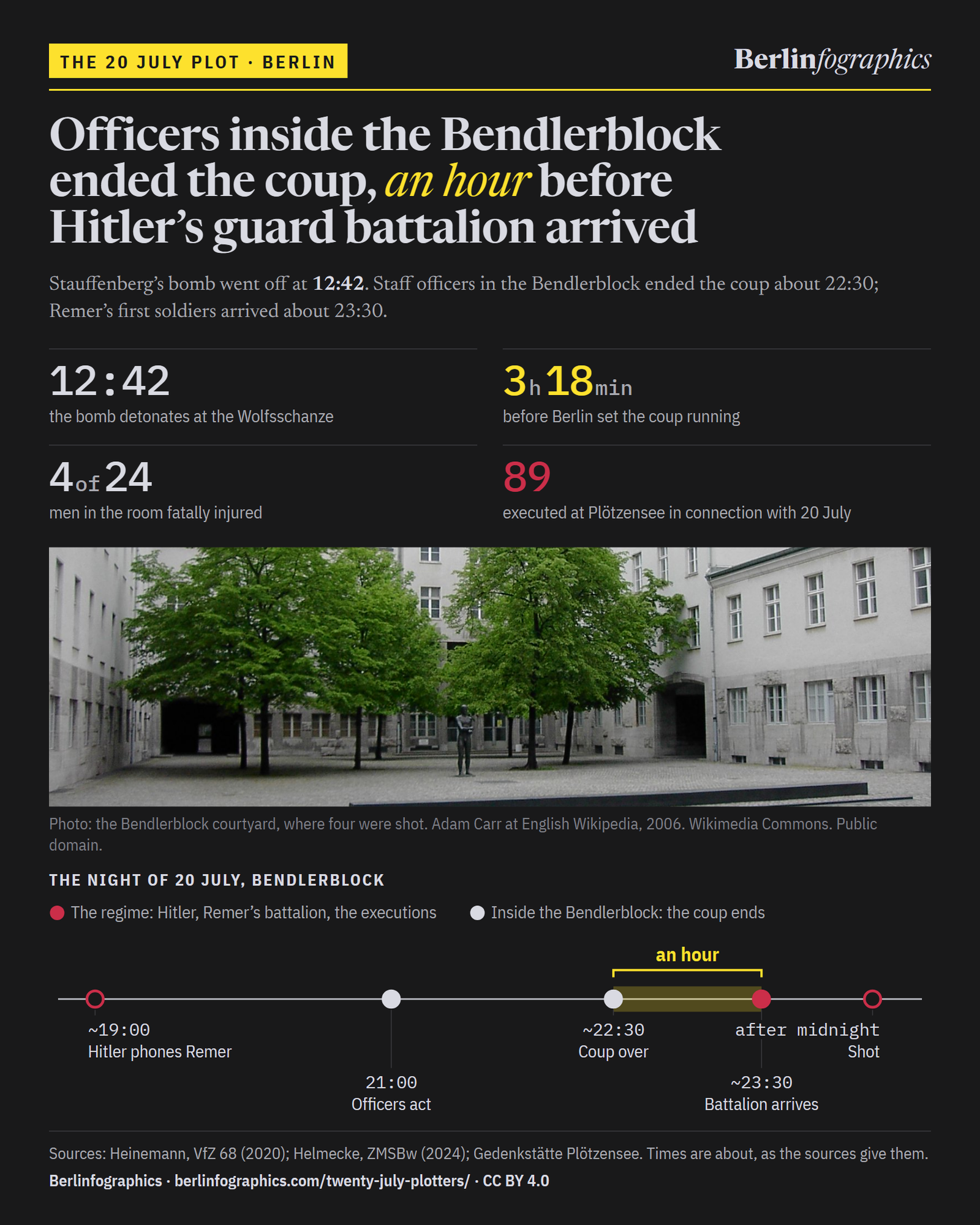
The coup against Hitler was ended by officers inside its own headquarters, an hour before his guard battalion arrived

Stauffenberg’s bomb went off at the Wolfsschanze at 12:42. In Berlin the coup was not crushed by Major Remer’s soldiers, as Remer claimed after the war. Staff officers down the corridor of the Bendlerblock ended it; the first of Remer’s men reached the courtyard about 23:30, in time to supply the firing squad.

12:42
the bomb detonates in the conference barrack
3h 18min
before Berlin set the coup running
4of 24
men in the room fatally injured; Hitler survived
89
executed at Plötzensee in connection with 20 July

01Wolfsschanze, East Prussia

Stauffenberg carried two kilograms of explosive into the Wolfsschanze. He armed one

About 12:30, just before the conference. In a side room, on the pretext of changing his shirt. He has one hand and three fingers and works with special pliers. Oberfeldwebel Vogel comes to hurry him; only one of the two kilograms is armed.

The account that the meeting was moved from a concrete bunker into a wooden hut is false: the situation conferences had been held in the barrack since the start of July. The briefcase went down beside the massive table support on the side facing Hitler; after Stauffenberg left, another man pushed it to the far side to get closer to the map.

„Durch dieses Versäumnis blieb die Explosionswirkung begrenzt.““Through this omission the force of the explosion stayed limited.” Peter Longerich, Hitler. Biographie, p. 968

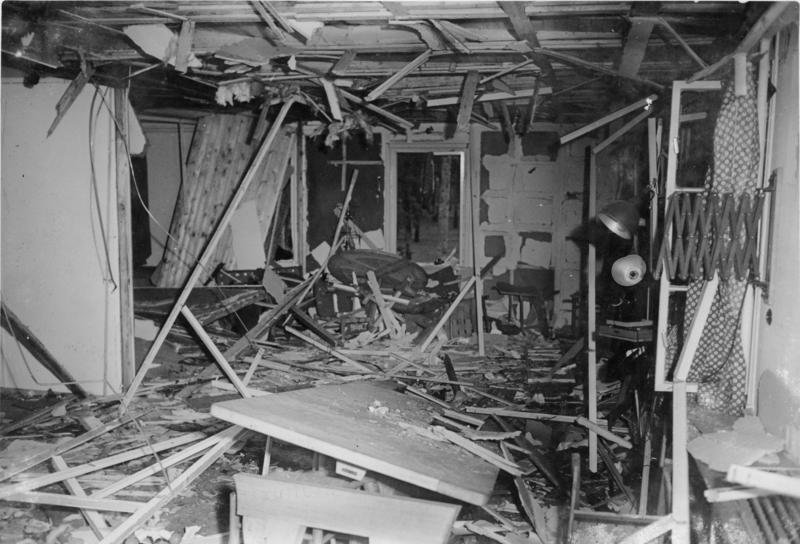
At 12:42 the charge went off. Twenty-four men are in the room. Four are fatally injured. Hitler has bruises, grazes and burst eardrums. In the lightly built barrack the blast escaped through the wooden floor and the open windows.

The charges

24 men in the room

Fatally injured: 4Survived, Hitler among them

Four men in the room were fatally injured. One of them died that day.

The inside of a wooden barrack wrecked by a blast: ceiling boards hang down, a table top lies tilted among splintered beams and fallen chairs.
The situation-conference barrack at the Wolfsschanze after the explosion, 1944. The archive’s title: “Destroyed conference barrack after 20 July 1944”.Photo: Bundesarchiv, Bild 146-1972-025-12 / Unknown author / CC BY-SA 3.0 de
A group of officers in long leather coats and caps stands in a room whose ceiling and walls have been blown apart.
Inspecting the destroyed barrack at the Wolfsschanze: the archive caption names Martin Bormann, Hermann Göring and Generaloberst Bruno Loerzer among the group.Photo: Bundesarchiv, Bild 146-1972-025-10 / Unknown author / CC BY-SA 3.0 de
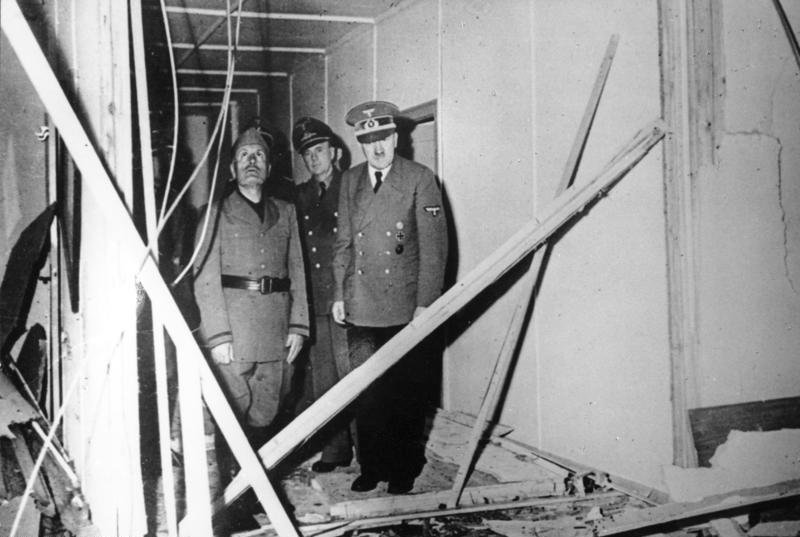
Hitler, in a cap, and Mussolini stand in a shattered corridor, broken boards slanting across the frame.
The afternoon of 20 July 1944: Hitler shows Mussolini, who was due that day, the wrecked barrack.Photo: Bundesarchiv, Bild 146-1970-097-76 / Unknown author / CC BY-SA 3.0 de

02Twenty July 1944, hour by hour

Berlin knew Hitler had survived while Stauffenberg was still in the air

Stauffenberg had to be in East Prussia to place the bomb and in Berlin to run the coup. The diagonals below are his hours in the air, out of contact with both. Scroll through the day; every time is on one clock, and there was no time difference between the two places.

Two places, one clock

20 July

The Wolfsschanze above, Berlin below. Each dot is a moment of the day.

Two parallel time tracks, Wolfsschanze above and Berlin below, from six in the morning of 20 July to after one in the morning of 21 July, with Stauffenberg's two flights drawn as diagonals between them and the day's events as dots.
The conspiratorsThe regimeTime given as “about”
Head-and-shoulders portrait of a young officer in uniform, looking at the camera.Portrait of a young officer in a peaked cap.

about 06:00 – about 10:15

Two packets of plastic explosive fly east

Stauffenberg leaves Nikolassee and meets his adjutant at Rangsdorf. Haeften carries two one-kilogram packets of British plastic explosive.

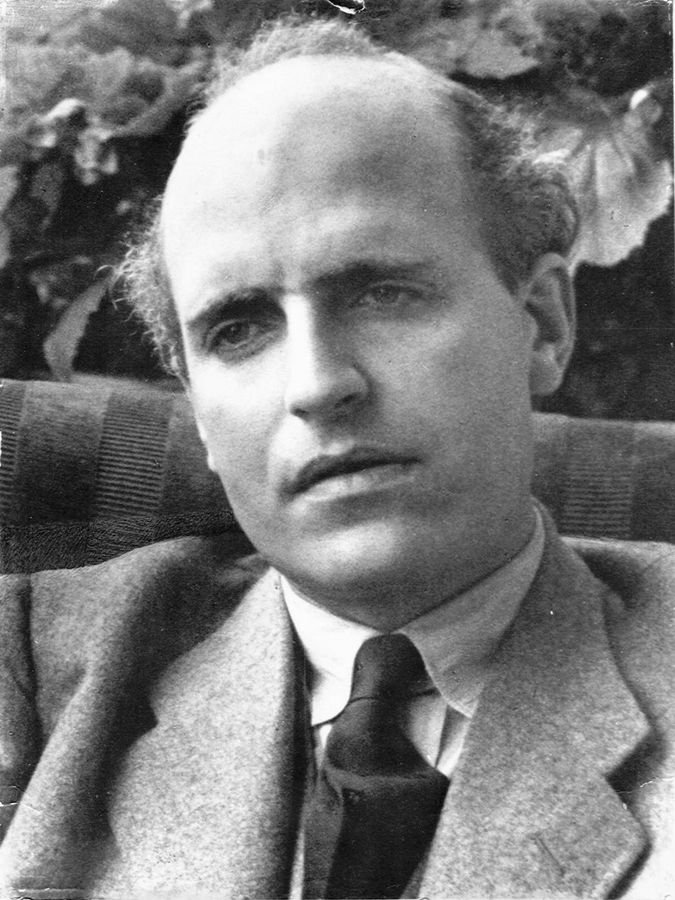
Claus von Stauffenberg, 1934 · Photo: Unknown author, 1934. Wikimedia Commons. Public domain.
Werner von Haeften · Photo: Bundesarchiv, Bild 146III-347 / Unknown author / CC BY-SA 3.0 de

The inside of a wooden barrack wrecked by a blast: ceiling boards hang down, a table top lies tilted among splintered beams and fallen chairs.

about 12:00 – 12:42

The conference is brought forward; the bomb goes off

The conference is moved from 13:00 to 12:30 — Hitler expected Mussolini that afternoon. Half an hour vanishes from Stauffenberg's margin. Stauffenberg leaves the room on a pretext. About ten minutes run from crushing the acid capsule to the striker falling.

The wrecked barrack, Wolfsschanze, 1944 · Photo: Bundesarchiv, Bild 146-1972-025-12 / Unknown author / CC BY-SA 3.0 de

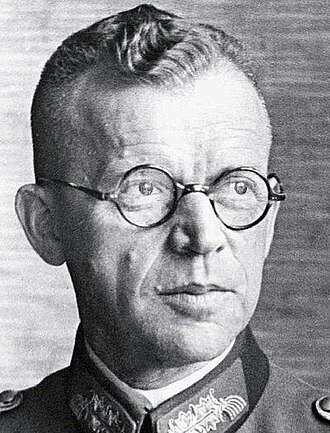
Portrait of a general with close-cropped hair and round glasses.Hitler, in a cap, and Mussolini stand in a shattered corridor, broken boards slanting across the frame.

about 13:00 onward

The news reaches Berlin first

The Lagebaracke's telephone installation is switched off and countermanded within minutes; it never covered the SS links. Fellgiebel's message to Thiele: “Es ist etwas Furchtbares passiert, der Führer lebt.” Two and a half hours in the air, believing Hitler dead. Berlin already knew he was not.

Erich Fellgiebel · Photo: Unknown author, 1944. Wikimedia Commons. Public domain.
Hitler shows Mussolini the barrack, 20 July 1944 · Photo: Bundesarchiv, Bild 146-1970-097-76 / Unknown author / CC BY-SA 3.0 de

Portrait photograph of Friedrich Olbricht.

12:42 – 16:00

Three hours and 18 minutes of waiting

Albrecht Ritter Mertz von Quirnheim signs them out himself, against Olbricht's decision to wait. The landing time is genuinely disputed: about 15:45, about 15:00, or about 16:00 depending on the source. Walküre, the coup order, went out about 16:00.

Friedrich Olbricht · Photo: Bundesarchiv, Bild 183-R66036 / Lutz Koch / CC BY-SA 3.0 de

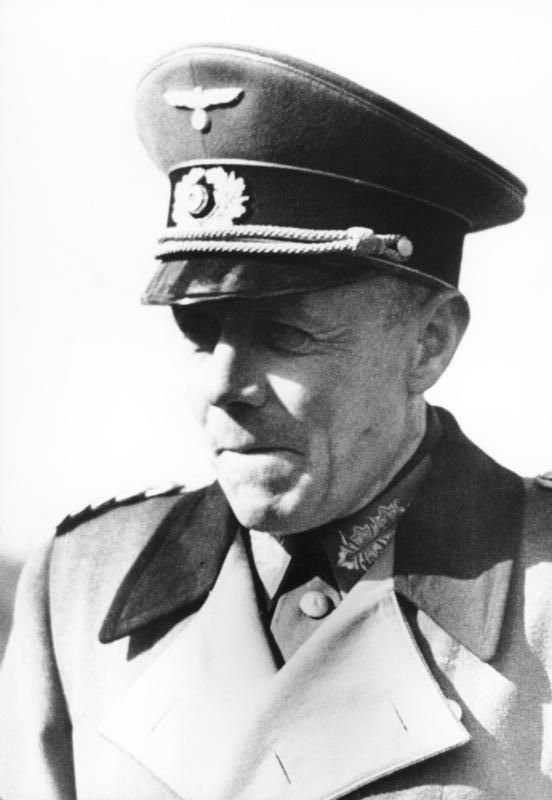
Portrait of a heavy-set general in a peaked cap, the Knight’s Cross at his collar.Portrait photograph of Ludwig Beck.

about 16:00 – about 17:00

The same wires, used better by the regime

Counter-orders go out to the Wehrkreis commands. The two sides are now using the same wires, and the regime is using them better. Stauffenberg tells Fromm he set off the bomb himself. Fromm has already spoken to Keitel and refuses; Stauffenberg, Olbricht and Mertz arrest him instead. Beck arrives about 17:00.

Friedrich Fromm · Photo: Bundesarchiv, Bild 146-1969-168-07 / Unknown author / CC BY-SA 3.0 de
Ludwig Beck · Photo: Bundesarchiv, Bild 183-C13564 / Unknown / CC BY-SA 3.0 de

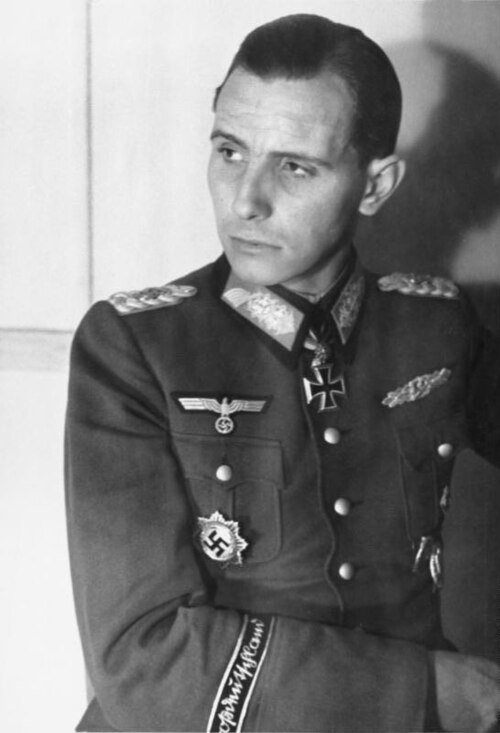
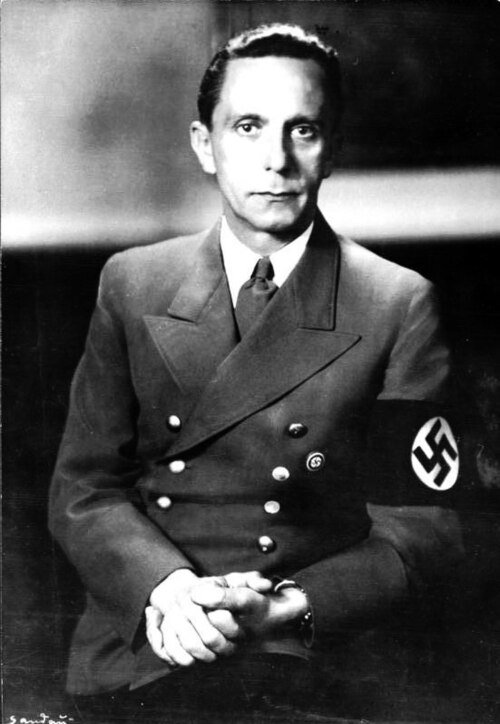
Portrait of an officer with slicked-back hair, arms folded, looking to the side.Portrait of a man in a party uniform jacket with a swastika armband, hands clasped.Portrait photograph of Erwin von Witzleben.

about 19:00 – 20:20

Hitler is on the telephone; the radio says he lives

Remer's adjutant drives through the cordon to Goebbels, who puts Remer on the line. Hitler places every Wehrmacht soldier in Berlin under his command. Witzleben arrives at the Bendlerblock about 19:30. Keitel's teleprinter message to every Wehrkreis command declares the Bendlerblock's orders invalid.

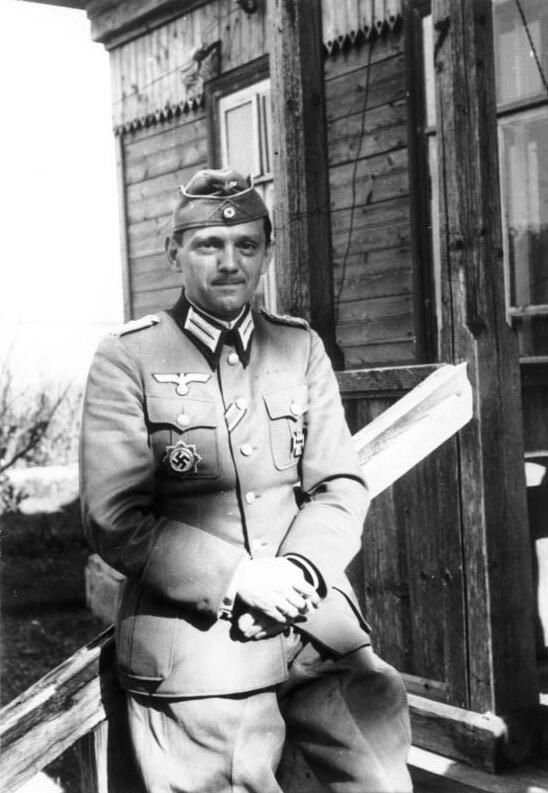
Otto Ernst Remer · Photo: Bundesarchiv, Bild 183-2004-0330-500 / Unknown / CC BY-SA 3.0 de
Joseph Goebbels · Photo: Bundesarchiv, Bild 183-1989-0821-502 / Sandau / CC BY-SA 3.0 de
Erwin von Witzleben · Photo: Bundesarchiv, Bild 146-1978-043-13 / Heinrich Hoffmann / CC BY-SA 3.0 de

From a balcony: helmeted soldiers stand around a car in a cobbled courtyard in front of a tall open gateway.

21:00 – about 22:30

The officers down the corridor end it

Franz Herber asks his superior Olbricht what is going on and gets no answer. Herber, von der Heyde and Pridun are General Army Office staff officers in the same building — not the guard battalion. About 22:30: Stauffenberg is wounded. Fromm is freed and the conspirators are overpowered. The coup is over.

Soldiers in the Bendlerblock, 1944 (no day given) · Photo: Bundesarchiv, Bild 146-1972-109-19A / Unknown author / CC BY-SA 3.0 de

Portrait of an officer with slicked-back hair, arms folded, looking to the side.

about 23:30

The guard battalion arrives an hour later

An hour after it ended, and five hours after Remer's call with Hitler. Fromm forms the firing squad from their ranks. Its barracks were a ten-minute walk away.

Otto Ernst Remer · Photo: Bundesarchiv, Bild 183-2004-0330-500 / Unknown / CC BY-SA 3.0 de

A cobbled courtyard enclosed by pale multi-storey office buildings, with lime trees, a bronze figure of a young man and a low dark stone slab in the paving.

shortly after midnight – about 01:00

Shot one at a time, in the headlights of a lorry

Stauffenberg, Haeften, Olbricht and Mertz von Quirnheim, in front of a sandheap, in the headlights of a lorry. Beck was already dead. A radio van is fetched from Königsberg, ninety kilometres away. The conspirators never got near a transmitter all day.

The Bendlerblock courtyard today · Photo: Adam Carr at English Wikipedia, 2006. Wikimedia Commons. Public domain.

03The Bendlerblock, the night of 20 July

Remer’s battalion did not put the coup down. It arrived an hour after it was over

At 21:00 staff officers of the General Army Office, in the same building as the conspirators, decided to act: Herber, von der Heyde and Pridun. By 22:30 there was shooting in the corridors, Fromm was free and the coup was over.

Hitler had given Major Otto Ernst Remer command of every soldier in Berlin by telephone about 19:00. His first men reached the Bendlerblock courtyard about 23:30. After the war Remer and his adjutant Hagen told the story the other way round, and the regime preferred it: Winfried Heinemann’s study of the night, published by the Institut für Zeitgeschichte in 2020, sets it straight.

Fromm formed the firing squad from Remer’s soldiers. Stauffenberg, Haeften, Olbricht and Mertz von Quirnheim were shot in the courtyard shortly after midnight. Beck was already dead.

From a balcony: helmeted soldiers stand around a car in a cobbled courtyard in front of a tall open gateway.
Soldiers and Waffen-SS in the Bendlerblock, 1944. The archive gives the place, not the day or the occasion.Photo: Bundesarchiv, Bild 146-1972-109-19A / Unknown author / CC BY-SA 3.0 de
Portrait of an officer with slicked-back hair, arms folded, looking to the side.
Otto Ernst Remer: Hitler put every soldier in Berlin under his command that evening.Photo: Bundesarchiv, Bild 183-2004-0330-500 / Unknown / CC BY-SA 3.0 de
Portrait of a heavy-set general in a peaked cap, the Knight’s Cross at his collar.
Friedrich Fromm: arrested by the conspirators in the afternoon, freed in the night, he formed the firing squad.Photo: Bundesarchiv, Bild 146-1969-168-07 / Unknown author / CC BY-SA 3.0 de

04August 1944 – April 1945

The arrests after 20 July are counted two ways: about 7,000, or about 700

Two counts of the arrests and executions that followed are in circulation. The higher pair began as a Gestapo claim and reached English-language accounts through Shirer; the lower is the German specialists’ correction. They are drawn here on one scale, one square per person, and not averaged.

Where the missing five thousand wentAbout 5,000 further arrests were made in August 1944 under Aktion Gitter, a separate sweep against the old Weimar parties. It is an arrest figure, not an execution figure, and it is very probably the origin of the number that circulates as the death toll of 20 July.

05Volksgerichtshof, Berlin

Freisler’s court sent more than a hundred of them to their deaths

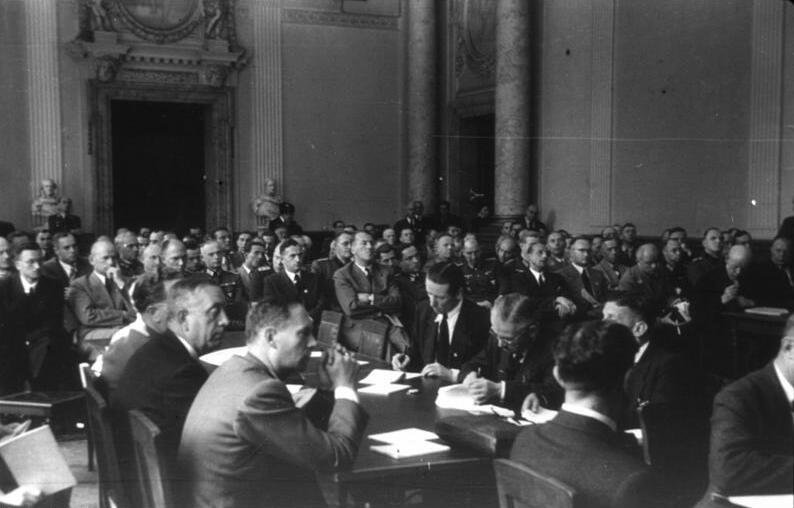
The Volksgerichtshof tried those involved in or supporting 20 July from August 1944 to April 1945.

55
trials of those involved in or supporting 20 July
200+
people charged
100+
sentenced to death
89
executed at Plötzensee
A crowded courtroom with columns and a carved doorway; rows of uniformed officers and men in suits sit behind a table of lawyers.
The Volksgerichtshof in session, 1944, in one of the trials after 20 July (archive caption).Photo: Bundesarchiv, Bild 151-02-30 / Unknown / CC BY-SA 3.0 de

Roland Freisler ran most of them himself. Defendants could not choose counsel and saw the charges only briefly beforehand. Witzleben had to hold his trousers up, his belt having been taken, and was abused from the bench for it. Those condemned on 8 August were hanged the same day, on hooks installed at the end of 1942 for the Rote Kapelle.

Three judges in robes sit at a bench in front of a large swastika banner.
The Volksgerichtshof bench, 1944: Reinecke, Freisler, Lautz.Photo: Bundesarchiv, Bild 151-39-21 / Unknown / CC BY-SA 3.0 de
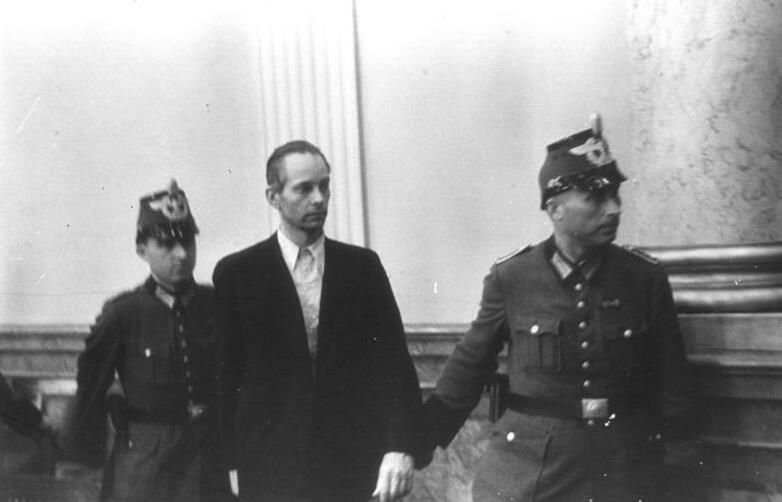
A man in a suit stands at attention in a courtroom.
Peter Yorck von Wartenburg before the Volksgerichtshof, August 1944.Photo: Bundesarchiv, Bild 151-03-26 / Unknown / CC BY-SA 3.0 de
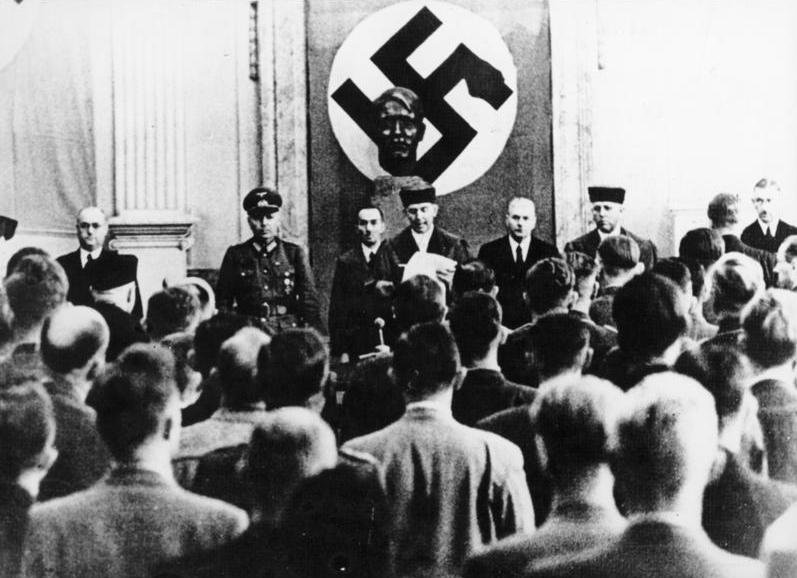
A judge in robe and cap reads from a paper at the bench, beneath a swastika banner and a bust of Hitler; the courtroom stands with its back to the camera.
Roland Freisler pronouncing judgment in one of the 20 July trials (archive caption).Photo: Bundesarchiv, Bild 183-C0718-0052-001 / Unknown / CC BY-SA 3.0 de

06The ten

Three of the ten died that night; three more were hanged 19 days later

Each name sits at the number of days between the bomb and the death. Carl Goerdeler, the intended chancellor, was kept alive longest, because the regime wanted what he knew.

Portrait photograph of Claus von Stauffenberg.

Claus von Stauffenberg

Oberst i. G. · Chief of Staff, Ersatzheer

Dead the same night

Armed the charge and carried it into the conference; flew back to Berlin believing Hitler dead.

Shot in the Bendlerblock courtyard, shortly after midnight, 20/21 July 1944.

Photo: Bundesarchiv, Bild 183-C0716-0046-003 / Unknown / CC BY-SA 3.0 de
Portrait photograph of Ludwig Beck.

Ludwig Beck

Generaloberst a. D. · Intended head of state

Dead the same night

Reached the Bendlerblock about 17:00, an hour after Walküre was triggered.

Bendlerblock, the same night — two failed shots of his own, then a Feldwebel on Fromm's order.

Photo: Bundesarchiv, Bild 183-C13564 / Unknown / CC BY-SA 3.0 de
Portrait photograph of Friedrich Olbricht.

Friedrich Olbricht

General der Infanterie · Head of the Allgemeines Heeresamt

Dead the same night

Triggered Walküre with Mertz von Quirnheim about 16:00, having waited three hours for confirmation that never came.

Shot in the Bendlerblock courtyard, shortly after midnight, 20/21 July 1944.

Photo: Bundesarchiv, Bild 183-R66036 / Lutz Koch / CC BY-SA 3.0 de
Portrait photograph of Henning von Tresckow.

Henning von Tresckow

Generalmajor · Chief of Staff, 2nd Army — Army Group Centre

1 day after the bomb

At the front. He had driven earlier attempts on Hitler, including the bomb disguised as bottles of Cointreau put aboard Hitler's aircraft in March 1943.

Suicide with a hand grenade at the front near Ostrów, 21 July 1944, staged to look like a partisan ambush.

Photo: Bundesarchiv, Bild 146-1976-130-53 / Unknown author / CC BY-SA 3.0 de
Portrait photograph of Erwin von Witzleben.

Erwin von Witzleben

Generalfeldmarschall · Intended Commander-in-Chief of the Wehrmacht

19 days after the bomb

Arrived at the Bendlerblock about 19:30, after a day away from Berlin with no reliable information, and left again within the hour.

Hanged at Plötzensee on 8 August 1944, hours after the first Volksgerichtshof trial.

Photo: Bundesarchiv, Bild 146-1978-043-13 / Heinrich Hoffmann / CC BY-SA 3.0 de
Portrait photograph of Hellmuth Stieff.

Hellmuth Stieff

Generalmajor · Head of organisation, Army High Command

19 days after the bomb

Flew to the Wolfsschanze with Stauffenberg that morning. He had supplied and stored the British plastic explosive.

Hanged at Plötzensee on 8 August 1944, tried in the first batch with Witzleben.

Photo: Bundesarchiv, Bild 101I-146-1547-17 / Menzendorf / CC BY-SA 3.0 de
A man in a suit stands at attention in a courtroom.

Peter Yorck von Wartenburg

Oberleutnant d. R. · Kreisauer Kreis — the civilian resistance circle

19 days after the bomb

In the Bendlerblock through the evening. Stauffenberg's cousin, and with Moltke the co-founder of the Kreisau circle.

Hanged at Plötzensee on 8 August 1944. His last letter to his wife Marion is in the Bundesarchiv.

Photo: Bundesarchiv, Bild 151-03-26 / Unknown / CC BY-SA 3.0 de

Wolf-Heinrich von Helldorf

SA-Obergruppenführer · Police President of Berlin

26 days after the bomb

Held the Berlin Schutzpolizei, which was to have sealed the Wilhelmstrasse and arrested the government. The order never reached him in a form he could act on.

Hanged at Plötzensee on 15 August 1944, on Hitler's personal order.

Portrait photograph of Adam von Trott zu Solz.

Adam von Trott zu Solz

Legationsrat · Foreign Office — the conspiracy's channel to the Allies

37 days after the bomb

In Berlin. A Rhodes Scholar at Oxford in the early thirties, he had carried the conspiracy's proposals to Stockholm and Switzerland; all were rebuffed.

Hanged at Plötzensee on 26 August 1944.

Photo: Familie von Trott, 1943. Wikimedia Commons. Public domain.
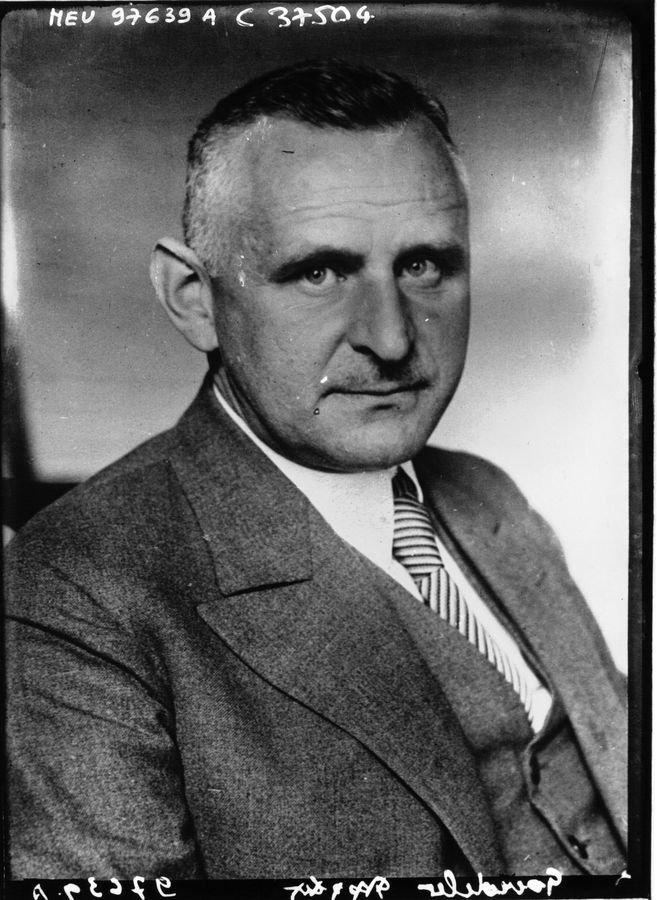
Portrait photograph of Carl Goerdeler.

Carl Goerdeler

Oberbürgermeister a. D. · Intended Chancellor

197 days after the bomb

In hiding. Mayor of Leipzig until 1937, when he resigned over the removal of the city's Mendelssohn statue.

Hanged at Plötzensee on 2 February 1945, after six months of interrogation.

Photo: Agence de presse Meurisse. Agence photographique (commanditaire), 1932. Wikimedia Commons. Public domain.
07Sippenhaft

The regime took the plotters’ children too

Sippenhaft (“kin liability”) made a family answerable with its liberty, its property or its life for what one of its members had done. 46 children of the plotters were taken to a home at Bad Sachsa. Adult relatives, Nina Schenk Gräfin von Stauffenberg among them, went to concentration camps.

In spring 1945 a group of over a hundred of these prisoners was assembled at Buchenwald, 12 of them Stauffenbergs, and marched through the Dolomites until the SS lost control of them on 30 April 1945. At Plötzensee, meanwhile, 89 people connected with the 20 July circles had been hanged.

A bare brick room with a whitewashed wall and an iron beam across the ceiling.
The execution shed at Plötzensee, now a memorial.Photo: Alter Fritz, 2010. Wikimedia Commons. CC BY-SA 3.0.
A pale stone gravestone with two carved coats of arms, inscribed with the names of Nina and, in memoriam, Claus Schenk Graf von Stauffenberg.
The grave of Nina Schenk Gräfin von Stauffenberg at Kirchlauter, Bavaria, which also bears a memorial inscription for Claus, 2011.Photo: CSvBibra, 2011. Wikimedia Commons. Public domain.
A tall stone bell tower behind a bronze group of figures on a red stone plinth.
The memorial at Buchenwald, 2013.Photo: Friedrich K., 2013. Wikimedia Commons. CC BY-SA 3.0.

Hitler’s guard battalion did not save his regime on 20 July. Officers inside the Bendlerblock ended the coup themselves, an hour before the soldiers came.

Press & citation

Use this Berlinfographic

Free to publish under CC BY 4.0 — in print, online, on Wikipedia and in teaching, commercially or not — with credit to Berlinfographics and a link to this page.

The 20 July plot, 1944: ready-to-use landscape image

Ready-to-use image

The infographic as one image: headline, key figures, chart, sources and credit, 2,400 × 1,350 px PNG. Please use it unedited.

Download landscape (PNG)
The 20 July plot, 1944: square version

Square format

A 1:1 version for social media and narrow columns, 1,800 × 1,800 px.

Download square (PNG)
The 20 July plot, 1944: portrait version

Portrait 4:5

For Instagram and LinkedIn feeds, 1,620 × 2,025 px.

Download portrait (PNG)

Credit line

Berlinfographics (berlinfographics.com), CC BY 4.0

Citation

Berlinfographics (2026). “The 20 July plot, 1944”. Berlin Experiences. https://berlinfographics.com/twenty-july-plotters/

Wikipedia

{{cite web |title=The 20 July plot, 1944 |url=https://berlinfographics.com/twenty-july-plotters/ |website=Berlinfographics |publisher=Berlin Experiences |date=2026-11-05 |access-date=2026-11-05}}