Berlinfographicsby Berlin Experiences

Berlin · 1696–2024Four universities, one city

The youngest of Berlin’s four universities is now the largest

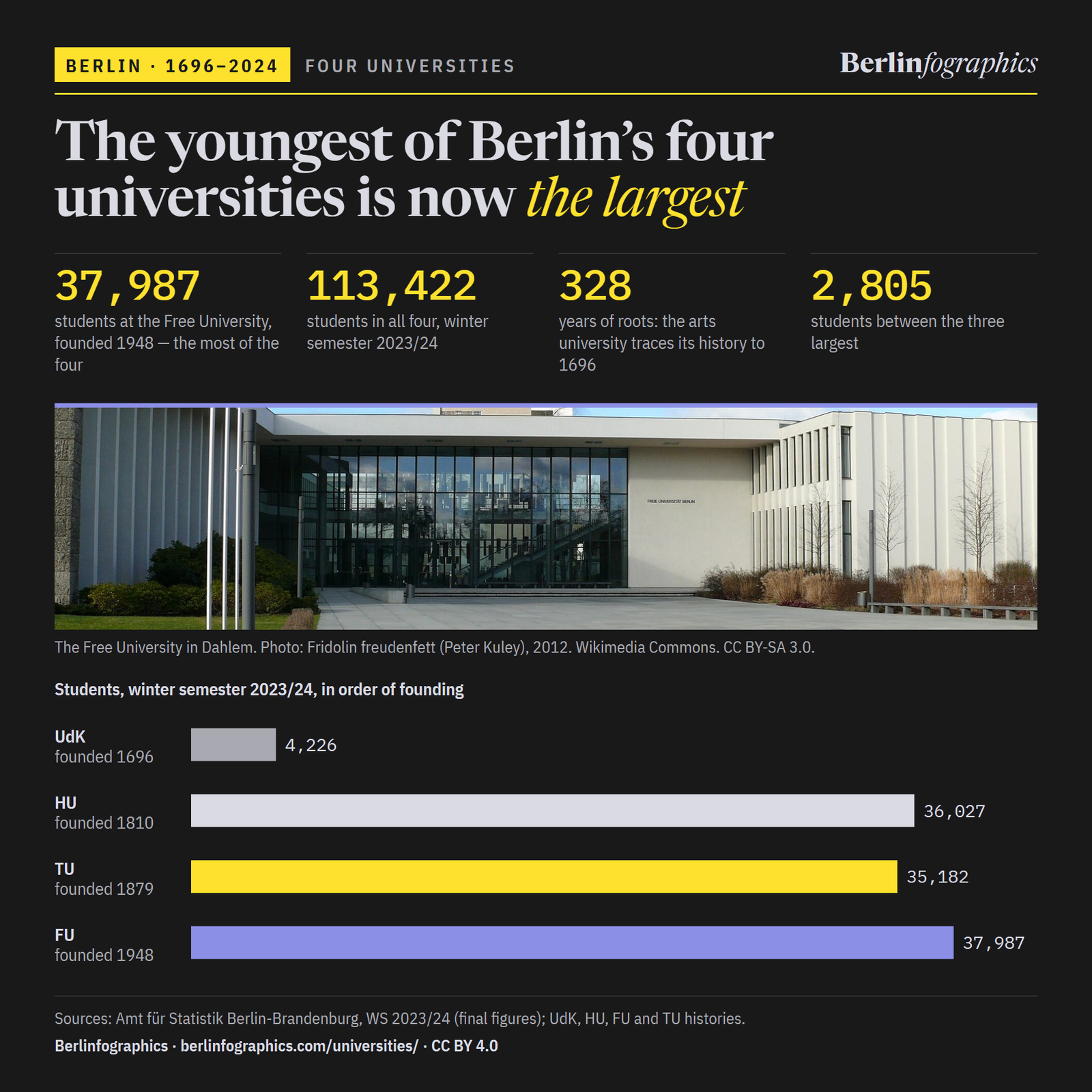
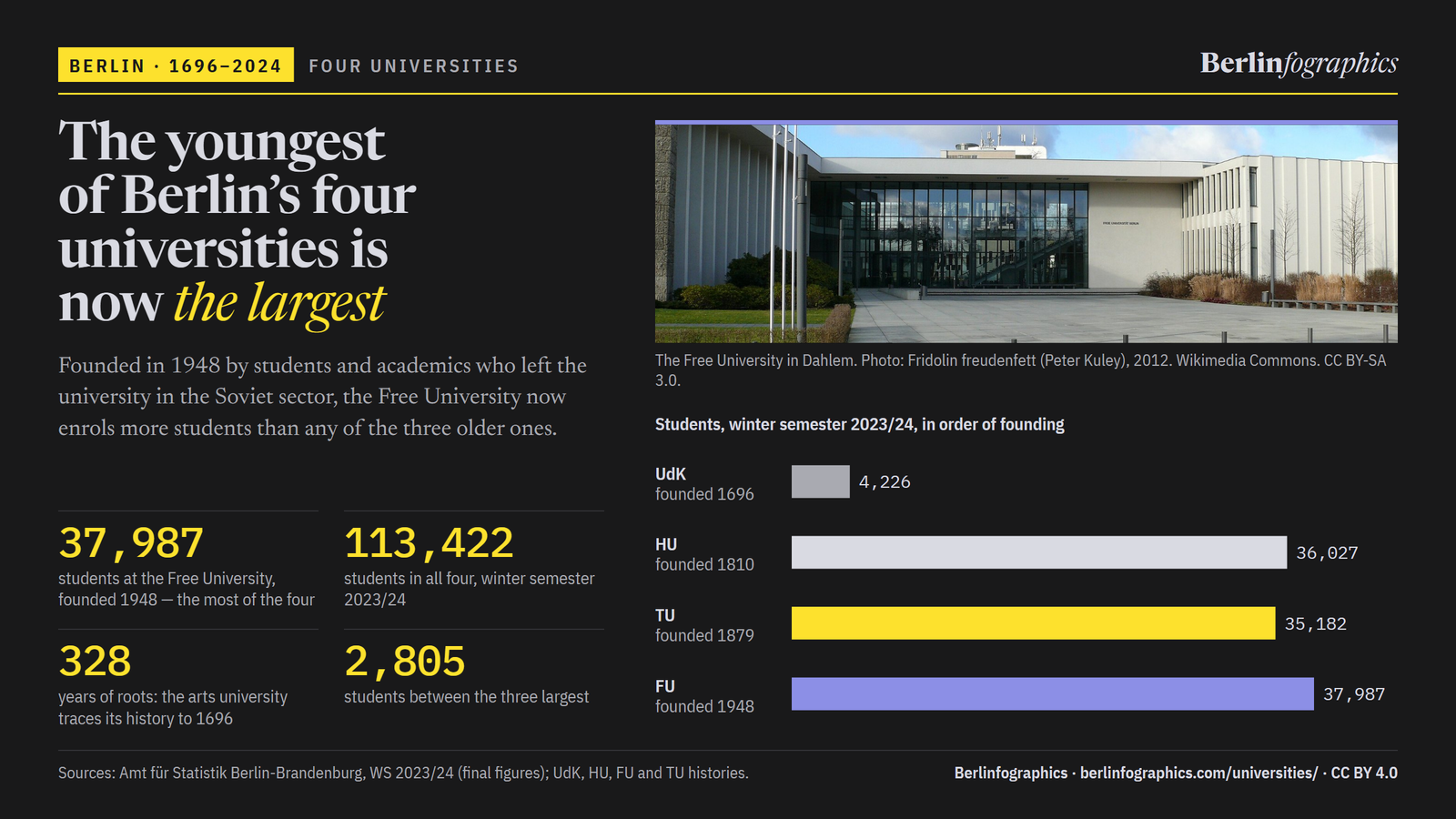
The Free University was founded in 1948 by students and academics who left the university in the Soviet sector. In winter semester 2023/24 it enrolled 37,987 students — more than the university its founders left, and more than the two whose roots reach back to 1696.

Scroll through three centuries

The university on Unter den Linden, in the former palace of Prince Heinrich, on a colour photochrom print of the 1890s or early 1900s. Photochrom, Detroit Publishing Co., c. 1890–1905. Library of Congress, LC-DIG-ppmsca-00342. Wikimedia Commons. Public domain.

01Four universities

Their roots span 328 years; their students number 113,422

From the Elector’s arts academy of 1696, through Humboldt’s university of 1810 and the technical college of 1879, to the Free University founded in West Berlin in 1948: Berlin’s four major universities were founded across 328 years. In winter semester 2023/24 they enrolled 113,422 students between them.

Age and size run almost opposite. The arts university, whose roots reach back furthest, teaches about a ninth as many students as each of the other three. The three big ones lie within 3,000 of each other — and the youngest leads.

1696

Universität der Künste

Hardenbergstraße · 4,226 students

1810

Humboldt-Universität

Unter den Linden · 36,027 students

1879

Technische Universität

Ernst-Reuter-Platz · 35,182 students

1948

Freie Universität

Dahlem · 37,987 students

021696 to 2024

1696–2024Three centuries, four lines
A timeline across three centuries with one line for each of the four universities. Dashed lines are the earlier schools a university traces its roots to; solid lines are the university itself. A cursor moves forward in time as you read.
the university itselfthe earlier schools it grew from
Baroque portrait of a man in a long curled wig, armour and an ermine-lined royal mantle, one hand on a crown.
Friedrich III, Elector of Brandenburg, who founded the academy in 1696 — painted in 1701, the year he became King Friedrich I in Prussia.Friedrich Wilhelm Weidemann, 1701. Wikimedia Commons. Public domain.

1696

An Elector founded an academy of the arts

The Universität der Künste traces its history to the academy of painting, sculpture and architecture founded by the Elector of Brandenburg in 1696. The Elector was Friedrich III. The UdK counts its age from here.

Sources: UdK Berlin, its history · Wikipedia (de): Preußische Akademie der Künste
Painting of a square red-brick building on an open square, with carriages and strollers in front and church towers behind it at left.
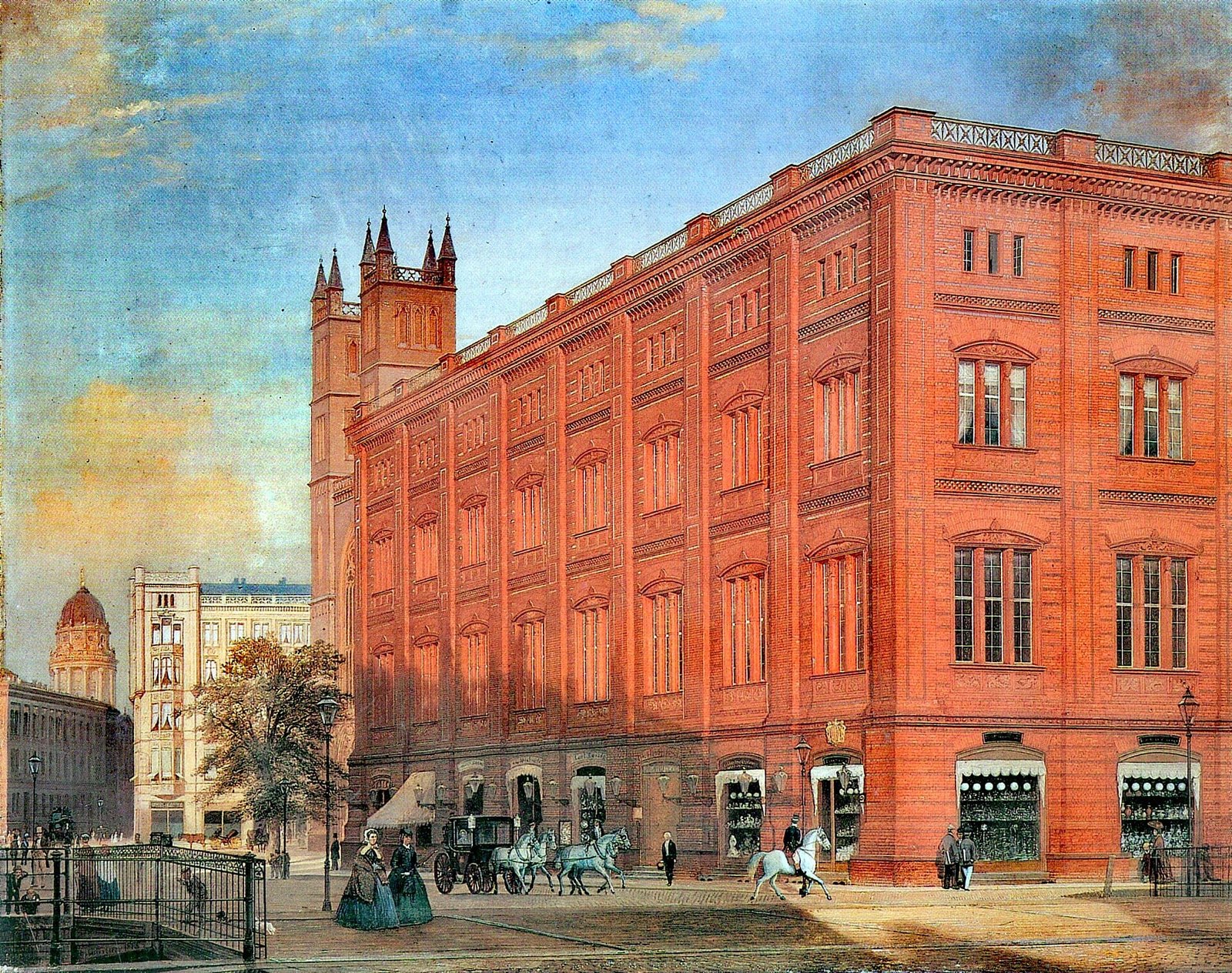
Schinkel’s building for the Bauakademie, one of the two schools that merged to form the TU, painted by Eduard Gaertner in 1868.Eduard Gaertner, 1868. Wikimedia Commons. Public domain.

1799

A school for builders: the Bauakademie

The TU’s oldest root is the Bauakademie of 1799. Schinkel later gave it the building Eduard Gaertner painted.

Sources: Bezirksamt Charlottenburg-Wilmersdorf, on the TU

Engraved half-length portrait of a man with short grey hair in a dark coat with a high collar and a star of an order.A small engraved elevation of a long three-storey palace with a central block and two wings around a forecourt.
Wilhelm von Humboldt (left); the palace of Prince Heinrich on Unter den Linden, on Schleuen’s plan of Berlin (right).Friedrich Oldermann, after Franz Krüger, 19th century. Via Wikimedia Commons (Public domain). · Johann David Schleuen, 1757. Wikimedia Commons. Public domain.

1810

Humboldt’s university opened in a royal palace

The university was founded in 1810 on Wilhelm von Humboldt's initiative, in the Prince Heinrich palace on Unter den Linden.

Sources: HU Berlin, Short History

Painting of a long ochre classical building along a quiet street, with a church spire rising at the far left.
The Gewerbeakademie under its earlier name, the Gewerbeinstitut, on Klosterstraße: Eduard Gaertner’s view of 1830.Eduard Gaertner, 1830. Wikimedia Commons. Public domain.

1821

A second root: the Gewerbeakademie

The TU’s other root is the Gewerbeakademie, which dates from 1821. Its early home on Klosterstraße, in the old centre, appears in Eduard Gaertner’s painting.

Sources: Bezirksamt Charlottenburg-Wilmersdorf, on the TU · Wikipedia (de): Gewerbeakademie Berlin

A grand stone building of the nineteenth century, its tall arched windows and pillared front running away along a tree-lined street.
The Technische Hochschule Charlottenburg, the merged school of 1879, in a view of 1895.Unknown author, 1895. Wikimedia Commons. Public domain.

1879

The two schools merged in Charlottenburg

The TU was formed on 1 April 1879 as the Königlich Technische Hochschule Charlottenburg by merging the Bauakademie (1799) and the Gewerbeakademie. It is the TU’s founding date: 1 April 1879.

Sources: Bezirksamt Charlottenburg-Wilmersdorf, on the TU

Head-and-shoulders photograph of an elderly man with white hair and glasses, in a suit and tie, smiling.
Konrad Zuse, the computer pioneer, who graduated from the Technische Hochschule in civil engineering; photographed in 1992.Wolfgang Hunscher, Dortmund, 1992. Wikimedia Commons. CC BY-SA 3.0.

1935

A computer pioneer took his degree here

Konrad Zuse, the computer pioneer, graduated from the Technische Hochschule in civil engineering in 1935.

Sources: Computer History Museum, Konrad Zuse
A long two-storey institute building with a steep roof and a corner tower, on a new unpaved street with a villa at left.
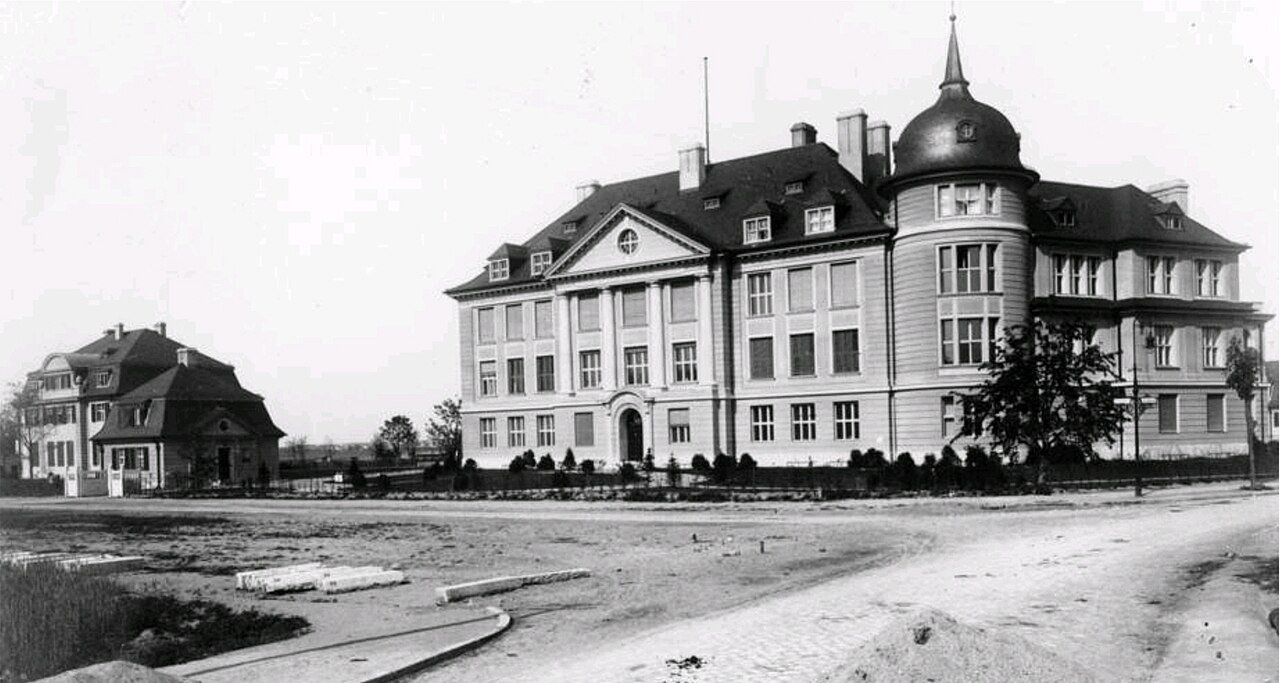
The Kaiser Wilhelm Institute for Chemistry in Dahlem, newly built, October 1912. The Free University has used Kaiser Wilhelm Society buildings in Dahlem since it was founded; this one is now its Hahn-Meitner-Bau.Unknown author, 1912. Wikimedia Commons. Public domain.

1948

The city split — and students left to found a university of their own

The Free University was founded on 4 December 1948 in the American sector by students and academics who left the university in the Soviet sector. It has used former Kaiser Wilhelm Society buildings in Dahlem since its founding.

Sources: FU Berlin, Kurzporträt 2023 · FU Berlin press release (Hahn-Meitner-Bau)

A large ornate building complex with gabled wings, towers and a domed hall, seen across a wide street where a man is sweeping.
The Hochschule für die Bildenden Künste on Hardenbergstraße, photographed by Rudolf Albert Schwartz in 1910 — today the main building of the UdK.Rudolf Albert Schwartz, 1910. Staatsbibliothek zu Berlin, via Wikimedia Commons. Public domain.

2001

The arts schools became a university

The academy’s line runs through the Hochschule für die Bildenden Künste of 1875, whose building on Hardenbergstraße is the UdK’s main house today. Formed as the Hochschule der Künste in 1975; a university since 2001.

Sources: UdK Berlin, its history

The pale baroque main building of the Humboldt-Universität with its forecourt, seen from Unter den Linden.A long low modernist building with a glass front and a flat projecting roof, behind a lawn and trees.A long multi-storey modernist slab of the 1960s behind a wide road crossing, with traffic lights, cars and a cyclist.The ornate sandstone front of the arts university under a blue sky, with trees and a street crossing in front.
Today: Unter den Linden, Dahlem, Ernst-Reuter-Platz, Hardenbergstraße.Mike Peel, 2014. Wikimedia Commons. CC BY-SA 4.0. · Fridolin freudenfett (Peter Kuley), 2012. Wikimedia Commons. CC BY-SA 3.0. · Gunnar Klack, 2017. Wikimedia Commons. CC BY-SA 4.0. · Fred Romero from Paris, France, 2016. Wikimedia Commons. CC BY 2.0.

2024

Four universities, 328 years of roots

Counted to the semester of the latest figures: the UdK’s roots are 328 years old, the HU 214, the TU 145 and the FU 76.

Sources: UdK Berlin, its history · HU Berlin, Short History · Bezirksamt Charlottenburg-Wilmersdorf, on the TU · FU Berlin, Kurzporträt 2023

03Students, winter semester 2023/24

The oldest roots have the fewest students; the youngest university has the most

113,422In order of founding
Bars for the students each university enrolled in winter semester, drawn to one scale: first in founding order, then by size, then the gap between the three largest, nine arts-university bars against the largest, and finally all four stacked into one total beside the Charité, which is counted separately.
Students: Amt für Statistik Berlin-Brandenburg, WS 2023/24, final figures, principal and secondary enrolments. One scale throughout each view.
The ornate sandstone front of the arts university under a blue sky, with trees and a street crossing in front.The pale baroque main building of the Humboldt-Universität with its forecourt, seen from Unter den Linden.A long multi-storey modernist slab of the 1960s behind a wide road crossing, with traffic lights, cars and a cyclist.A long low modernist building with a glass front and a flat projecting roof, behind a lawn and trees.
In order of founding: Hardenbergstraße, Unter den Linden, Ernst-Reuter-Platz, Dahlem.Fred Romero from Paris, France, 2016. Wikimedia Commons. CC BY 2.0. · Mike Peel, 2014. Wikimedia Commons. CC BY-SA 4.0. · Gunnar Klack, 2017. Wikimedia Commons. CC BY-SA 4.0. · Fridolin freudenfett (Peter Kuley), 2012. Wikimedia Commons. CC BY-SA 3.0.

The oldest roots, the fewest students

Taken oldest first: the UdK 4,226, the HU 36,027, the TU 35,182 and the FU 37,987. The university with the oldest roots is by far the smallest; the youngest is the largest.

Sources: Amt für Statistik Berlin-Brandenburg, WS 2023/24

A long low modernist building with a glass front and a flat projecting roof, behind a lawn and trees.
The Henry-Ford-Bau of the Free University in Dahlem, 2012.Fridolin freudenfett (Peter Kuley), 2012. Wikimedia Commons. CC BY-SA 3.0.

The youngest is the largest

The Free University, founded in 1948, enrolled 37,987 students — the most of the four, ahead of the Humboldt-Universität on Unter den Linden.

Sources: Amt für Statistik Berlin-Brandenburg, WS 2023/24 · FU Berlin, Kurzporträt 2023

The pale baroque main building of the Humboldt-Universität with its forecourt, seen from Unter den Linden.A long multi-storey modernist slab of the 1960s behind a wide road crossing, with traffic lights, cars and a cyclist.
The HU on Unter den Linden (left) and the TU by Ernst-Reuter-Platz (right).Mike Peel, 2014. Wikimedia Commons. CC BY-SA 4.0. · Gunnar Klack, 2017. Wikimedia Commons. CC BY-SA 4.0.

The three big ones lie within 3,000 of each other

Between the FU in first place and the TU in third there are only 2,805 students. The HU sits in between.

Sources: Amt für Statistik Berlin-Brandenburg, WS 2023/24

The ornate sandstone front of the arts university under a blue sky, with trees and a street crossing in front.
The Universität der Künste on Hardenbergstraße, 2016.Fred Romero from Paris, France, 2016. Wikimedia Commons. CC BY 2.0.

The arts university is about a ninth their size

The UdK enrolled 4,226 students, 11.1–12% of each of the others. Nine UdKs would make 38,034 — just more than the FU alone.

Sources: Amt für Statistik Berlin-Brandenburg, WS 2023/24

A tall hospital tower block rising above a street of older buildings, with parked cars and bare trees.
The Charité, the joint medical school of the Free University and the Humboldt-Universität, at its Campus Mitte, 2008.Werneuchen, 2008. Wikimedia Commons. Public domain.

Together: 113,422 students

The four enrolled 113,422 students between them. The Charité, the joint medical school of the FU and the HU, is counted separately: its 9,781 students are not in these figures.

Sources: Amt für Statistik Berlin-Brandenburg, WS 2023/24

04Where they are

Two stand a short walk apart in Charlottenburg; the youngest began out in Dahlem

The TU by Ernst-Reuter-Platz and the UdK on Hardenbergstraße sit about 350 metres apart. The HU stayed on Unter den Linden, in the Soviet sector after the war. The FU began in Dahlem, in the American sector, about 11 km away as the crow flies, in buildings of the Kaiser Wilhelm Society.

Map of central and south-west Berlin with rivers, parks, railways and district outlines. The four main sites are marked: the Humboldt-Universität on Unter den Linden in Mitte, the Technische Universität and the Universität der Künste a short walk apart in Charlottenburg, and the Free University in Dahlem.
Map: © OpenStreetMap contributors, ODbL. Shaded: the districts the four stand in.
The pale baroque main building of the Humboldt-Universität with its forecourt, seen from Unter den Linden.
The Humboldt-Universität’s main building on Unter den Linden, 2014.Mike Peel, 2014. Wikimedia Commons. CC BY-SA 4.0.

Humboldt-Universität

Unter den Linden, Mitte · founded 1810 · 36,027 students

A long low modernist building with a glass front and a flat projecting roof, behind a lawn and trees.
The Henry-Ford-Bau of the Free University in Dahlem, 2012.Fridolin freudenfett (Peter Kuley), 2012. Wikimedia Commons. CC BY-SA 3.0.

Freie Universität

Dahlem · founded 1948 · 37,987 students

A long multi-storey modernist slab of the 1960s behind a wide road crossing, with traffic lights, cars and a cyclist.
The TU’s main building on Straße des 17. Juni, by Ernst-Reuter-Platz, 2017.Gunnar Klack, 2017. Wikimedia Commons. CC BY-SA 4.0.

Technische Universität

Ernst-Reuter-Platz, Charlottenburg · founded 1879 · 35,182 students

The ornate sandstone front of the arts university under a blue sky, with trees and a street crossing in front.
The Universität der Künste on Hardenbergstraße, 2016.Fred Romero from Paris, France, 2016. Wikimedia Commons. CC BY 2.0.

Universität der Künste

Hardenbergstraße, Charlottenburg · founded 1696 · 4,226 students
05The buildings

The UdK still teaches in the art college’s house on Hardenbergstraße

A large ornate building complex with gabled wings, towers and a domed hall, seen across a wide street where a man is sweeping.
The Hochschule für die Bildenden Künste on Hardenbergstraße, photographed by Rudolf Albert Schwartz in 1910 — today the main building of the UdK.Rudolf Albert Schwartz, 1910. Staatsbibliothek zu Berlin, via Wikimedia Commons. Public domain.
The ornate sandstone front of the arts university under a blue sky, with trees and a street crossing in front.
The Universität der Künste on Hardenbergstraße, 2016.Fred Romero from Paris, France, 2016. Wikimedia Commons. CC BY 2.0.
Berlin · 1948 · 2024

The university a divided city produced in 1948 now enrols more students than any of the three that are older.

Press & citation

Use this Berlinfographic

Free to publish under CC BY 4.0 — in print, online, on Wikipedia and in teaching, commercially or not — with credit to Berlinfographics and a link to this page.

Berlin’s four universities, 1696–2024: ready-to-use landscape image

Ready-to-use image

The infographic as one image: headline, key figures, chart, sources and credit, 2,400 × 1,350 px PNG. Please use it unedited.

Download landscape (PNG)
Berlin’s four universities, 1696–2024: square version

Square format

A 1:1 version for social media and narrow columns, 1,800 × 1,800 px.

Download square (PNG)
Berlin’s four universities, 1696–2024: portrait version

Portrait 4:5

For Instagram and LinkedIn feeds, 1,620 × 2,025 px.

Download portrait (PNG)

Credit line

Berlinfographics (berlinfographics.com), CC BY 4.0

Citation

Berlinfographics (2026). “Berlin’s four universities, 1696–2024”. Berlin Experiences. https://berlinfographics.com/universities/

Wikipedia

{{cite web |title=Berlin’s four universities, 1696–2024 |url=https://berlinfographics.com/universities/ |website=Berlinfographics |publisher=Berlin Experiences |date=2026-11-06 |access-date=2026-11-06}}