US Army tanks at Checkpoint Charlie, Friedrichstraße, 1961, facing Soviet tanks across the sector boundary.Photo: U.S. Army / USAMHI, 1961. Wikimedia Commons. Public domain.
US troops in Germany
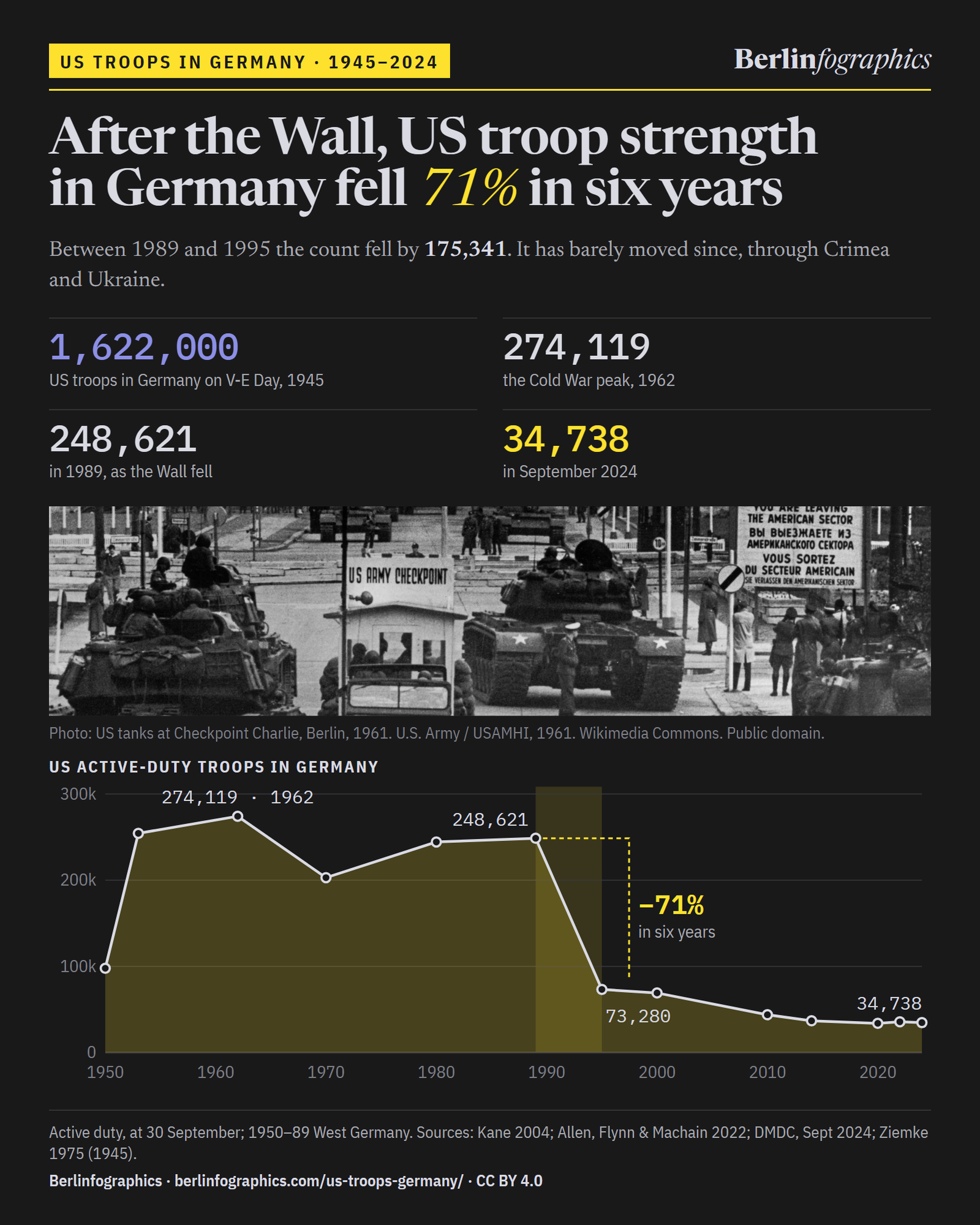
In 1989 the United States had 248,621 active-duty troops in West Germany. By 1995 there were 73,280 in a united Germany. In September 2024 there were 34,738.
01Germany, May 1945
When Germany surrendered on 8 May 1945, Eisenhower had sixty-one US divisions in Germany: 1,622,000 men, out of 3,077,000 American troops in Europe. That is about 53 in every hundred.
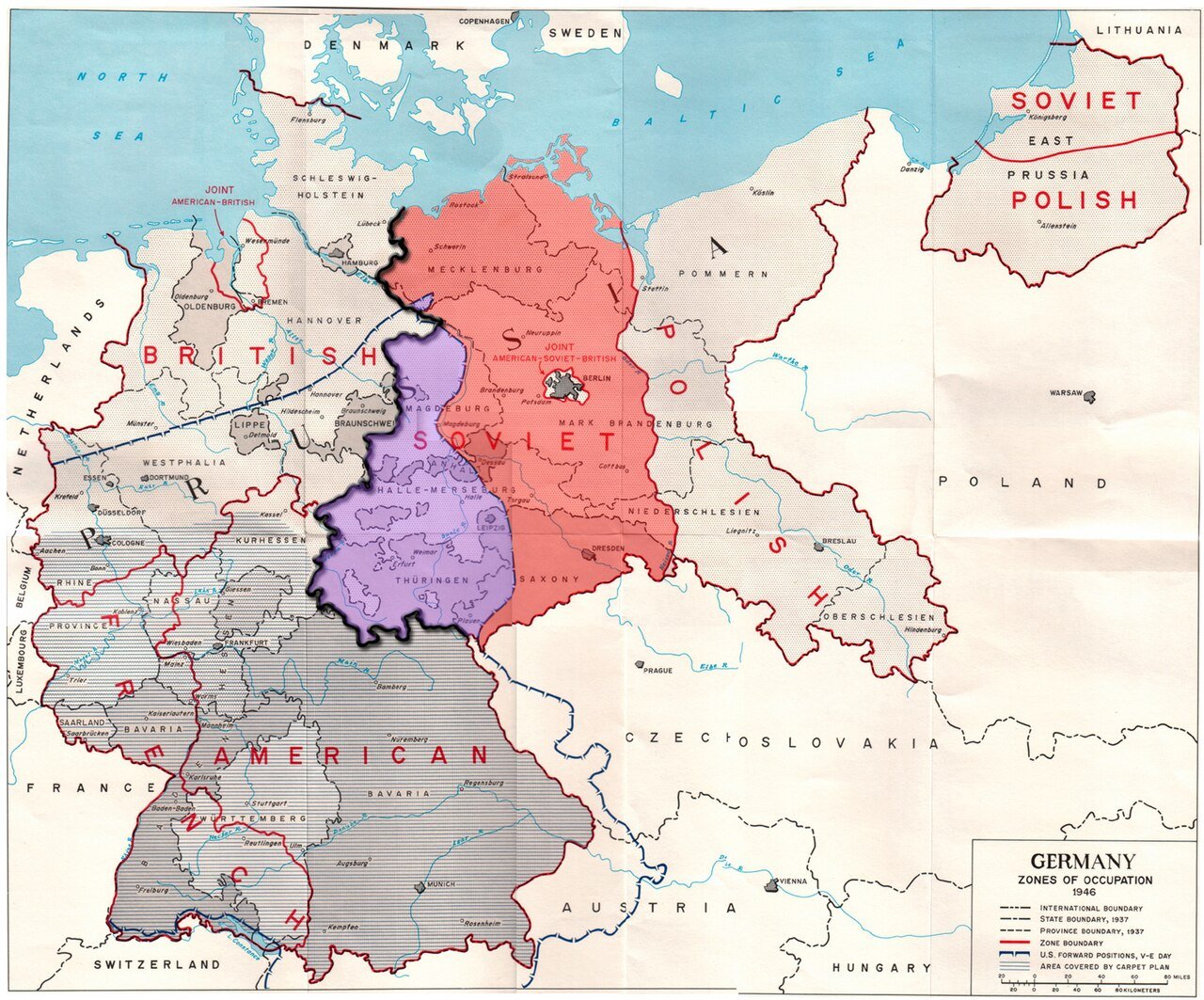
That army was demobilised fast. The zones of occupation came weeks later, and the United States took the south: Bavaria, Hesse, the north of Württemberg and Baden, and the port of Bremen.
The occupation army of 1945 was a wartime army. What followed was something new: a peacetime garrison that is still there.


02West Germany, 1950–1989
The count runs from 1950, at 30 September each year, for active-duty troops only: families and civilian employees, are not in it. Scroll on to watch it rise, hold and fall.
US active-duty troops in Germany
1950–2024scroll to draw the line
Dots mark the years counted; the dashed line is the whole series to come. 1950–89: West Germany.
1950
Five years after the war, 97,820 US troops were stationed in West Germany.
1950 – 1953
By 1953 there were 254,347. The occupation force had become part of NATO’s defence of Western Europe.
1962
The year after the Wall went up, the count reached 274,119, the highest of the Cold War in this series.
1970 – 1989
Through the 1970s and 1980s the line barely moved: 202,935 in 1970, 244,320 in 1980, 248,621 in 1989, the year the Wall fell.
1989 – 1995
By 1995 the count was 73,280: 175,341 fewer than in 1989, a fall of 71%.
1995 – 2024
69,203 in 2000, 43,903 in 2010, 33,948 in 2020, the lowest in the series. Russia’s annexation of Crimea in 2014 and its invasion of Ukraine in 2022 barely moved it: 35,781 in 2022, 34,738 in September 2024.
03West Berlin, 1961–63
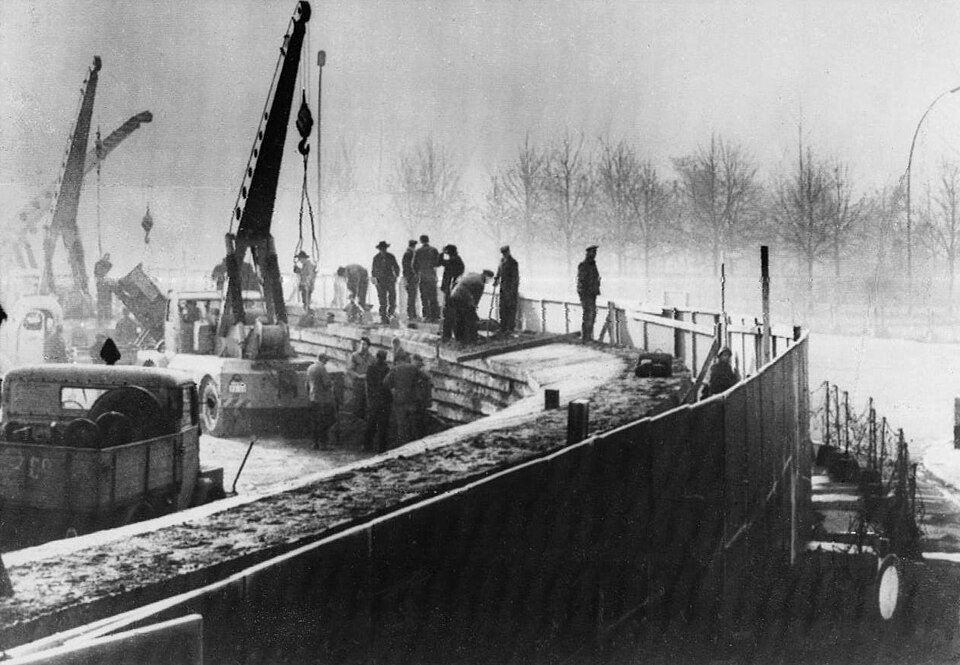
West Berlin lay deep inside East Germany. Its American garrison, the Berlin Brigade, could never have held the city alone; it was there to show that the United States would stay. In 1961, as the Wall went up, its tanks and military police stood face to face with East German police at Checkpoint Charlie, and with Soviet tanks across the line.


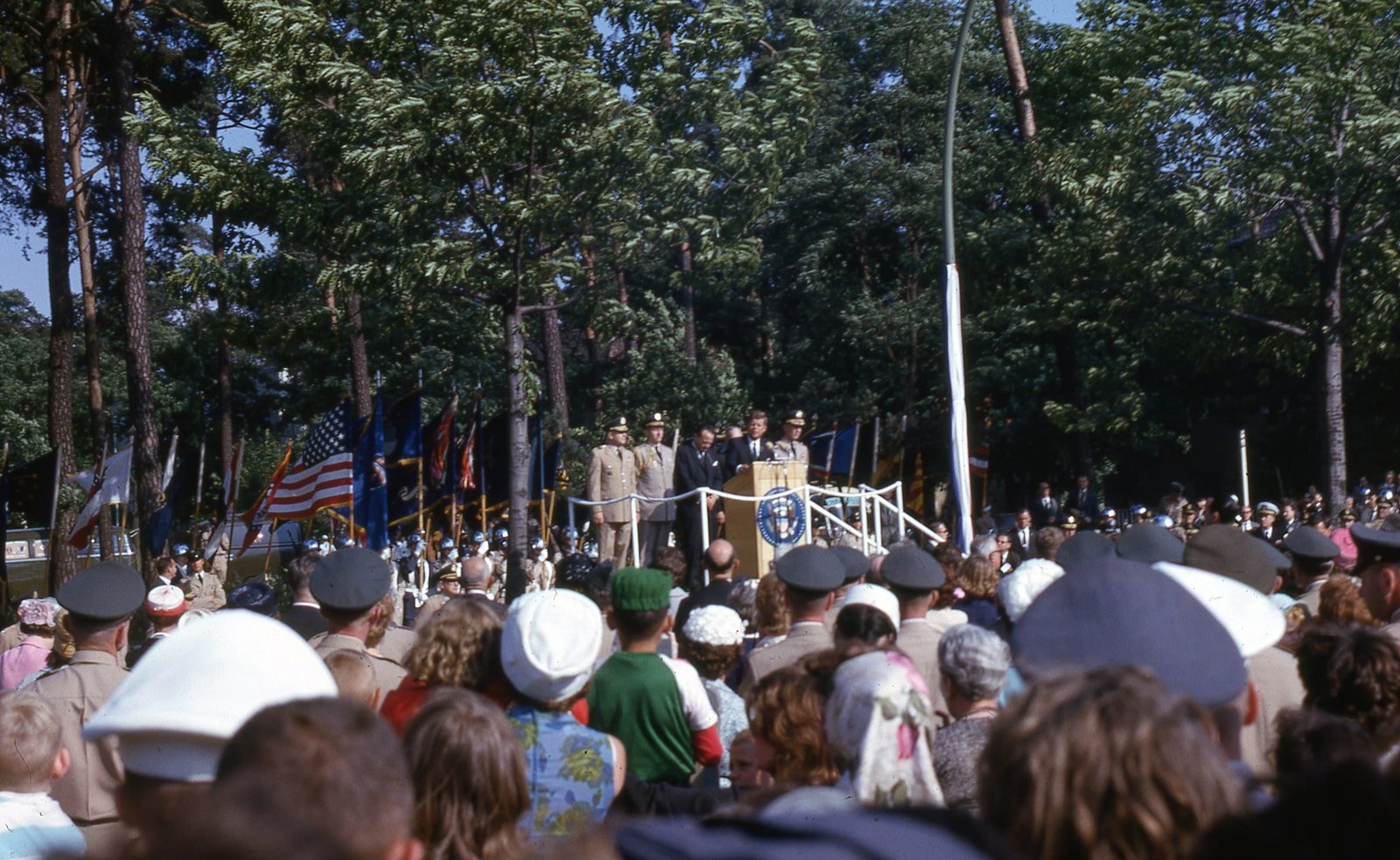
Two years later, on 26 June 1963, President Kennedy came to the city. Between the crowds and the Wall he spoke to the brigade itself.

04Hesse and Bavaria, 1950–1985
Many US units took over barracks built for the German army, like Frankfurt’s Gutleut-Kaserne, home before the war to an infantry regiment. In exercises such as Reforger, the “return of forces to Germany”, divisions based in Germany and units flown in from the United States rehearsed its defence together, driving tanks through Hessian villages.


05After the Wall, 1989–1995
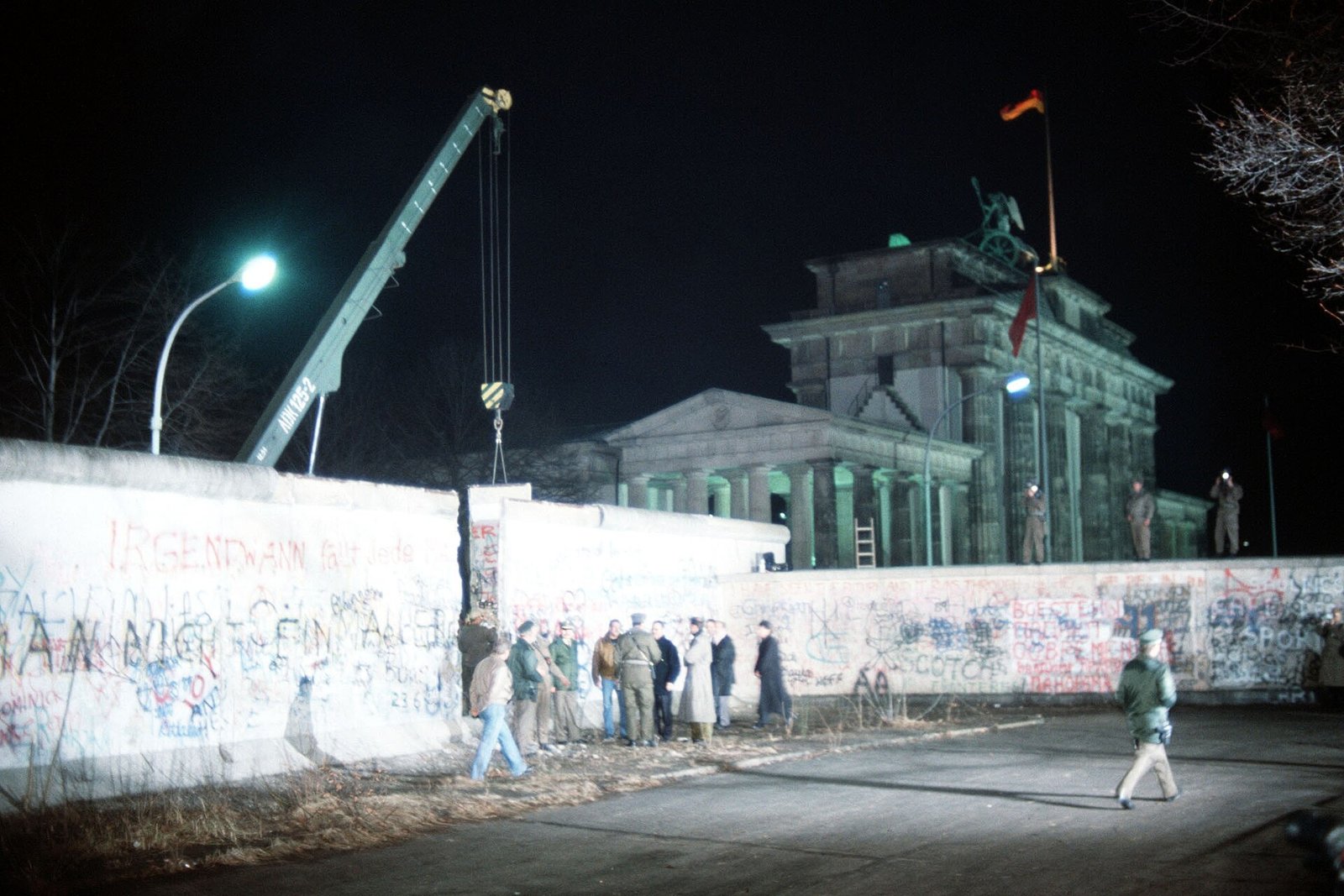
Between 1989 and 1995 the count fell from 248,621 to 73,280: 175,341 fewer troops, a fall of 71% in six years. Divisions went home and bases closed.
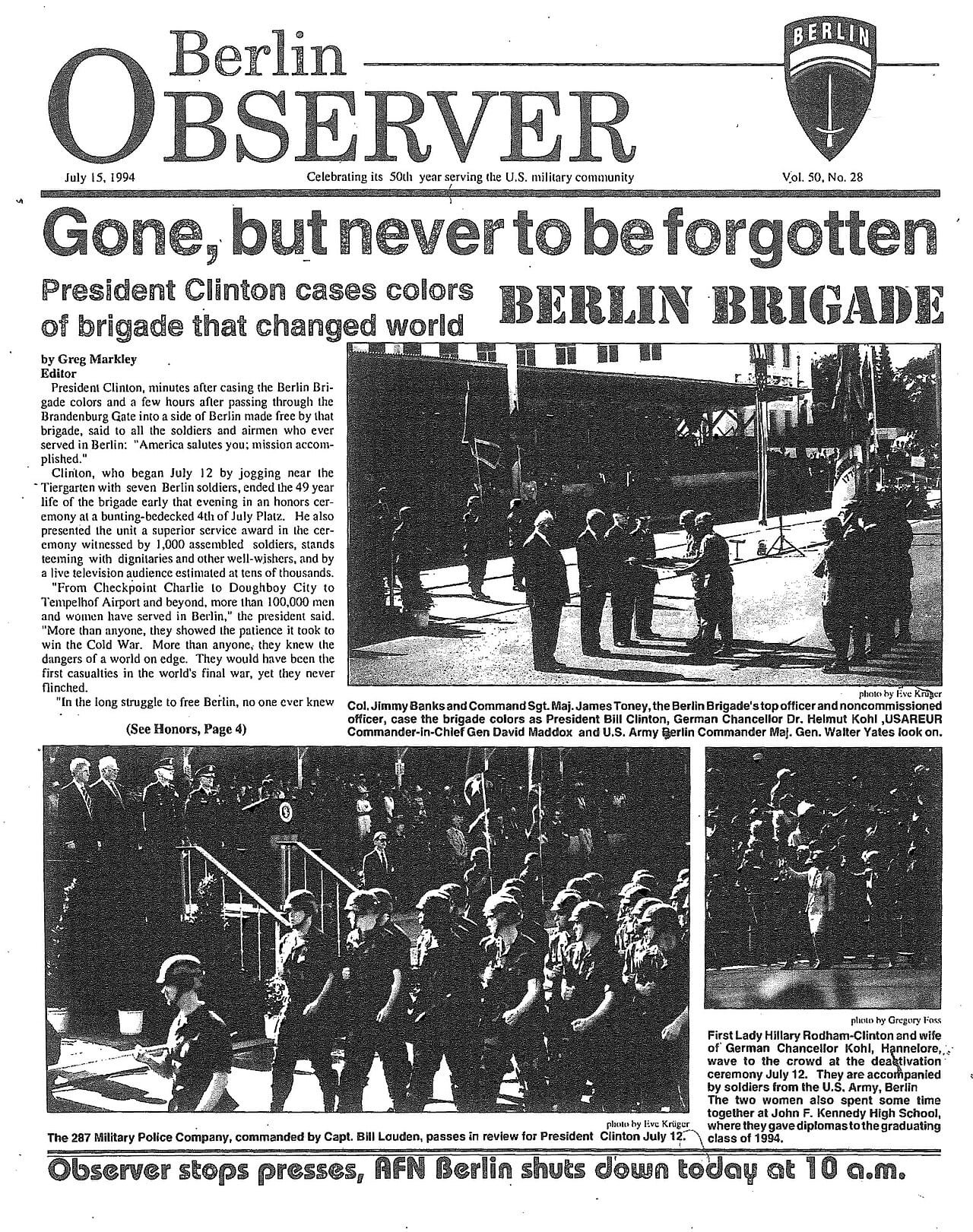
In Berlin, the brigade that had faced the Wall was stood down. On 12 July 1994 President Clinton spoke at its inactivation ceremony.
For every ten US troops in Germany in 1989


06Germany today
In September 2024 there were 34,738 US active-duty troops in Germany. The number has hardly changed in a decade: 36,846 in 2014, the year Russia annexed Crimea, and 35,781 in 2022, the year it invaded Ukraine.

They train alongside the Bundeswehr at bases in Bavaria and elsewhere, a fraction of the army that once filled the country: 47 times fewer than on V-E Day, eight times fewer than at the Cold War peak.
In 1962 the United States kept 274,119 troops in West Germany. In 2024 it kept 34,738: one for every eight.
Press & citation
Free to publish under CC BY 4.0 — in print, online, on Wikipedia and in teaching, commercially or not — with credit to Berlinfographics and a link to this page.
Ready-to-use image
The infographic as one image: headline, key figures, chart, sources and credit, 2,400 × 1,350 px PNG. Please use it unedited.
Download landscape (PNG)
Square format
A 1:1 version for social media and narrow columns, 1,800 × 1,800 px.
Download square (PNG)
Portrait 4:5
For Instagram and LinkedIn feeds, 1,620 × 2,025 px.
Download portrait (PNG)Credit line
Berlinfographics (berlinfographics.com), CC BY 4.0
Citation
Berlinfographics (2026). “US Troops in Germany, 1945–2024”. Berlin Experiences. https://berlinfographics.com/us-troops-germany/
Wikipedia
{{cite web |title=US Troops in Germany, 1945–2024 |url=https://berlinfographics.com/us-troops-germany/ |website=Berlinfographics |publisher=Berlin Experiences |date=2026-11-05 |access-date=2026-11-05}}
Our infographics, charts and texts are licensed CC BY 4.0: free to republish, including commercially, with credit to Berlinfographics and a link. Photographs keep their own licences, named in each caption. How to credit
Topics: The Second World War · Cold War Berlin · Nazi Berlin · Persecution & the Holocaust · Weimar Berlin · Prussia & the Kaiserreich · Architecture & the built city · Culture, science & society · Reunified Berlin · Unusual facts
Contact: info@berlinfographics.com · Press: press@berlinfographics.com · Imprint · Privacy