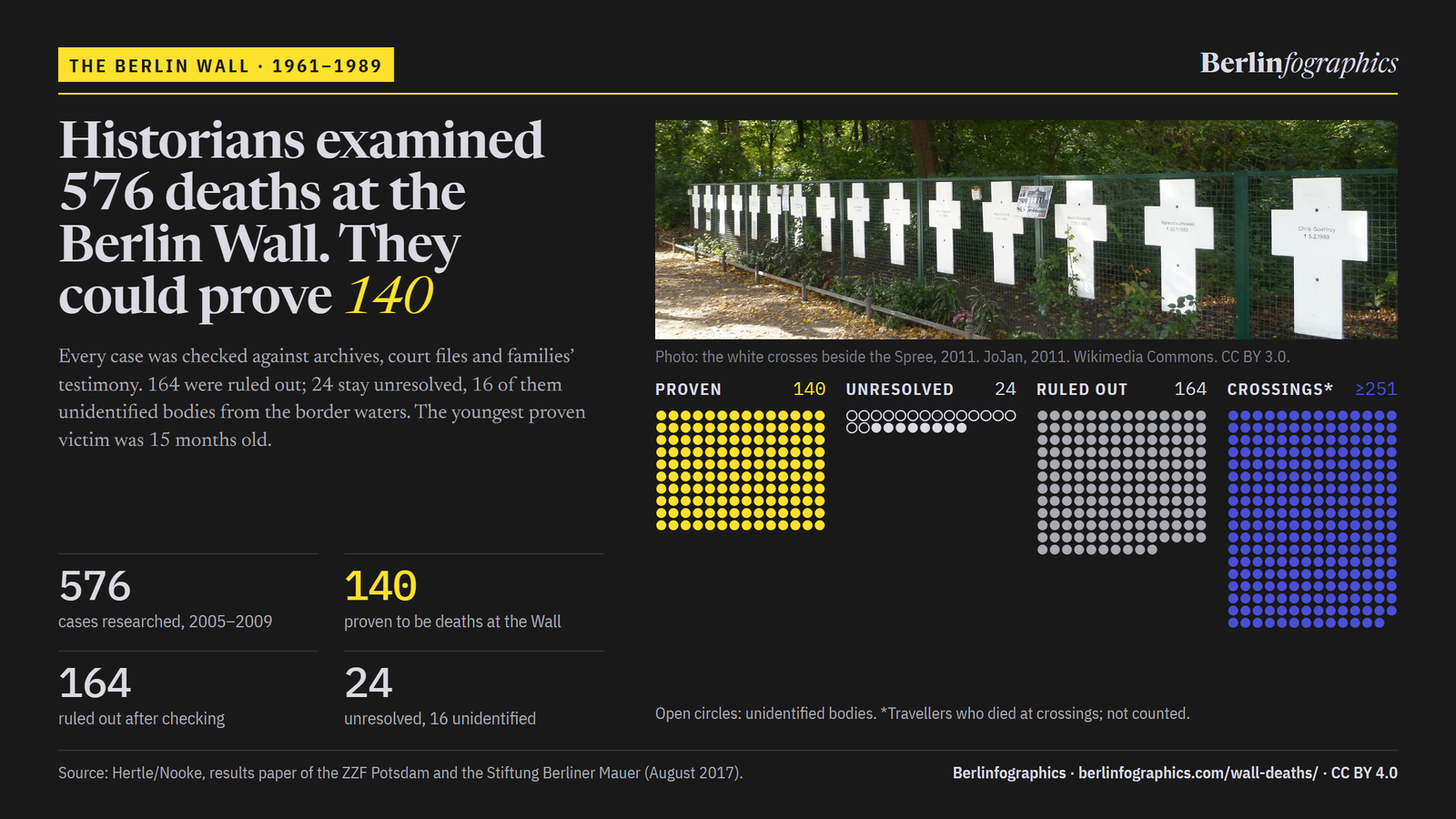
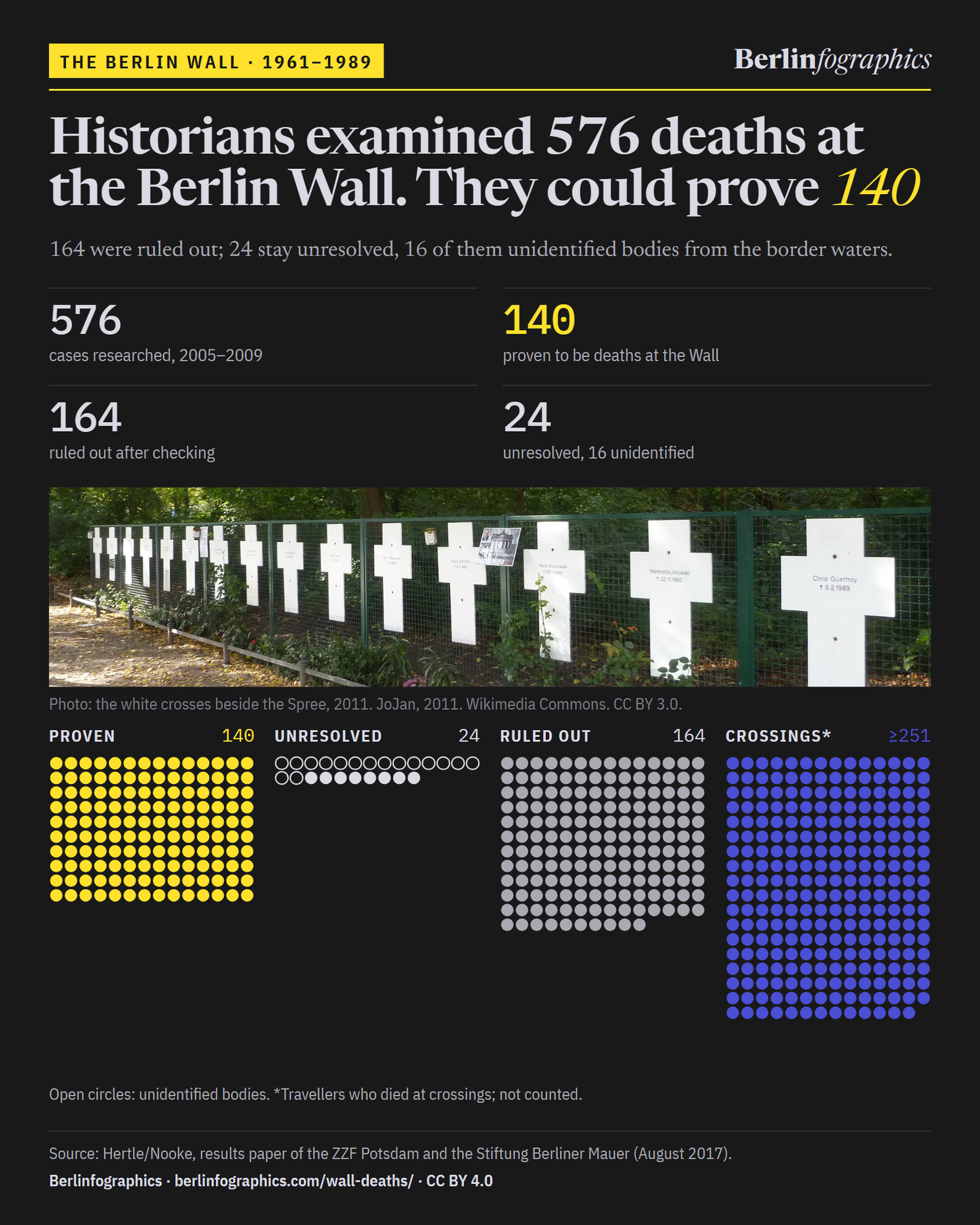
The white crosses for people killed at the Wall, beside the Spree near the Reichstag, 2011. Each carries a name and a date.Photo: JoJan, 2011. Wikimedia Commons. CC BY 3.0.
The dead of the Berlin Wall
Between 2005 and 2009 the ZZF Potsdam and the Stiftung Berliner Mauer checked every death and suspected death at the Wall against archives, court files and the testimony of families. These are seven of the 140, the places where they died, and the cases that could not be counted.
0113 August 1961 – 9 November 1989
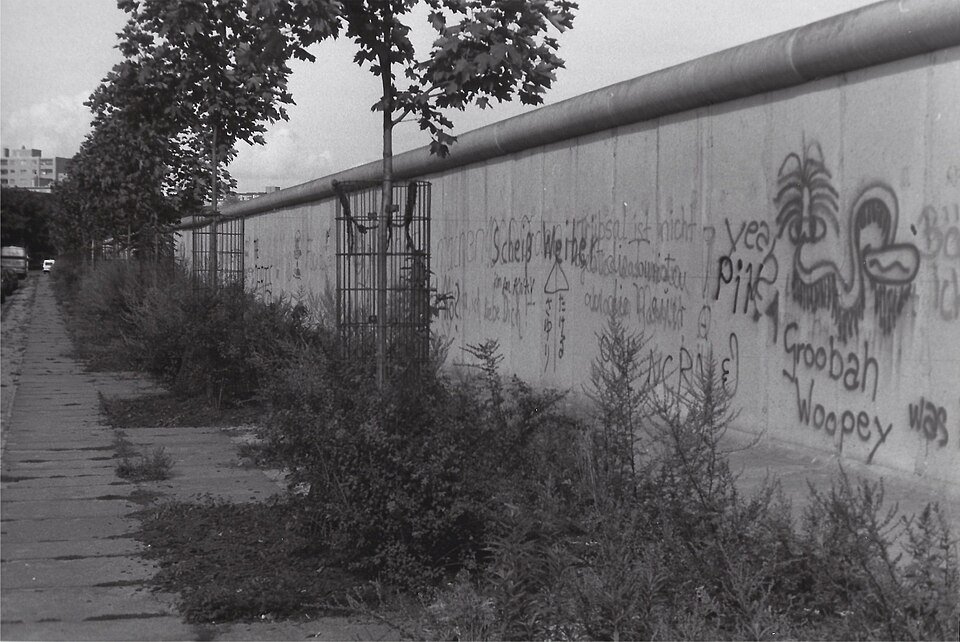
The Wall ran 155 km around West Berlin. Only 43.1 km of it went through the city, between East and West Berlin; 111.9 km separated West Berlin from the GDR’s surrounding country. People died along all of it.

The Wall around West Berlin, 1989
155 km in all: yellow through the city, pale against the GDR’s surroundings.
155 km
Of the 155 kilometres, 111.9 lay between West Berlin and the GDR’s surrounding country, and 43.1 through the city.
The first to die · 22 August 1961
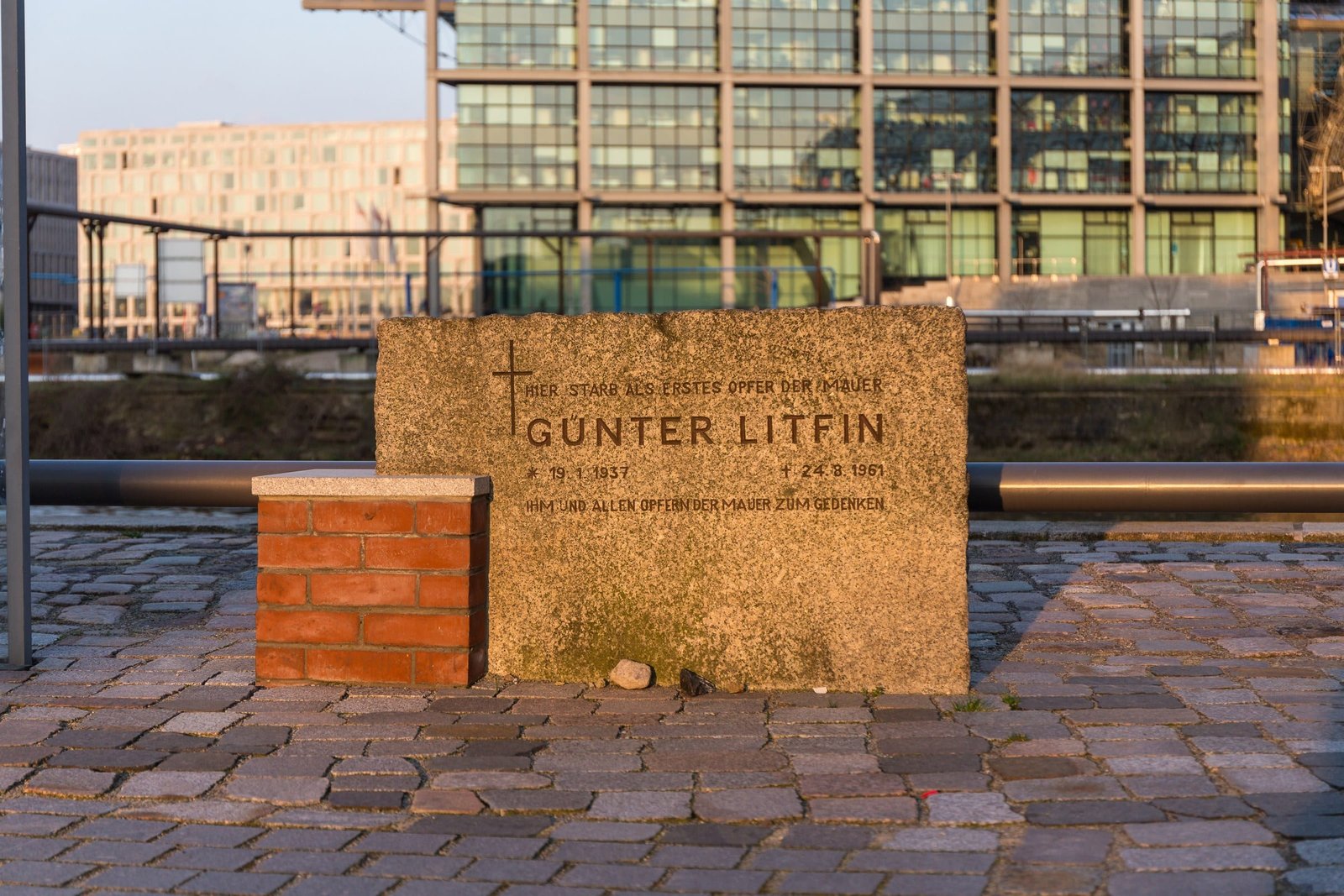
Her building at Bernauer Straße 48 stood in the East; the pavement below it was already the West. Nine days after the border was sealed, she threw her bedding from her third-floor window and jumped after it. She died on the way to hospital, a day before her 59th birthday.
The first victim of the order to shoot · 24 August 1961
A tailor from Weißensee who worked in West Berlin until the Wall took his job. Two days after Ida Siekmann’s fall he ran for the Humboldthafen. Transport Police fired as he swam, and a bullet struck the back of his head. In 1997 two of them were convicted of manslaughter and given suspended sentences.
Left to bleed to death · 17 August 1962
A bricklayer, shot in the death strip a few steps from Checkpoint Charlie and left lying there. He called for help for about fifty minutes while people on both sides watched. He died in 1962, the deadliest year of the Wall: 22 dead.
A border soldier · 5 October 1964
A GDR border soldier, killed in the courtyard of Strelitzer Straße 55 when an escape tunnel was discovered. The fatal bullet came from a comrade’s rifle. The GDR blamed West Berlin escape helpers and kept the finding secret; it was established only after 1989. He is one of 8 border soldiers among the 140.
The children of the Gröbenufer
On the Kreuzberg bank at the Gröbenufer, the Spree itself was the border water. Five children playing on the bank fell into it and died. They are among the 7 West Berliners who died in accidents at the Wall.
The youngest · 22 January 1973
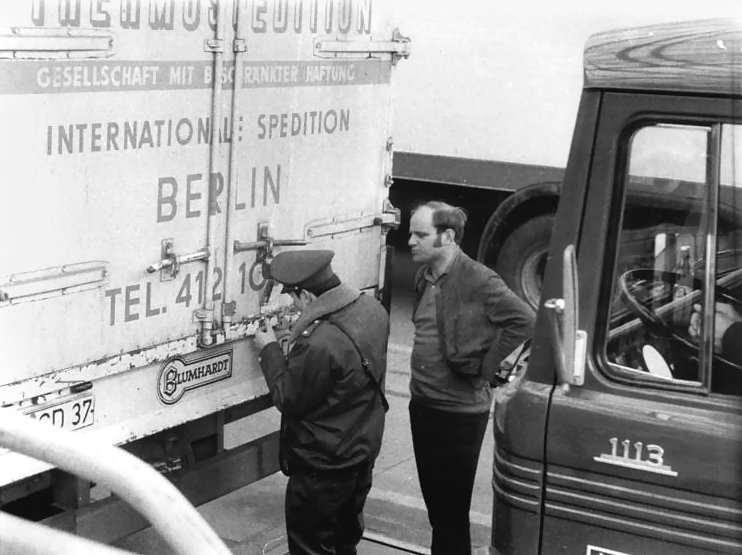
Hidden with his mother in a crate on a lorry, his father in another. At the Drewitz transit checkpoint the inspection dragged on; the baby cried, and his mother covered his mouth. He had an ear infection, and his nose was probably blocked. He was dead when the crates were opened, in the West. The memorial names the family only by initial, and so does this story.
The last · 8 March 1989
An engineer who took a job at East Berlin’s gas works to get at the gas. He and his wife built a balloon from plastic sheeting in their flat. Discovered while filling it, he cut loose alone after 2 a.m., drifted for several hours in freezing air and fell in Zehlendorf, eight months before the Wall opened.
02Every year of the Wall
The deadliest year was 1962, the first full year of the Wall, with 22 dead. The research project credits the fall in deaths after 1975 to three things: the signal fence of 1974; Grenzmauer 75, the last generation of the Wall; and the Helsinki Final Act of August 1975. In four years nobody died at all.
Deaths at the Wall, 1961–1989: each wedge is one year, its area that year’s dead
Years with no deaths: 1976, 1978, 1985, 1988. Each wedge’s area, not its length, is proportional to that year’s dead: a year with twice the dead has twice the area.


03How a death was counted
The project counted a death as a Wall death if the person was trying to escape, or if the death was linked in time and place to the border regime: shot, killed in an accident in the border installations, or a suicide after a failed escape. It researched 576 deaths and suspected cases.
576 cases researched, 2005–2009
What became of them: each dot is one case.
140 proven
Each has a biography, written from archives, court files and the testimony of families and friends. 4 of them were added after the project closed in 2009, taking the count from 136 to 140.
24 unresolved
For 16 dead found in the border waters, the records could neither prove nor rule out a link to the Wall, and nobody knows who they were. For 8 more, no records could be found at all. These 24 are not in the count, and not ruled out.
164 excluded
Among them: people who were shot at while escaping and survived their wounds, escape attempts reported in the West that never happened, cases counted twice, and suicides in Berlin’s waters with no link to an escape.
At least 251
Mostly older travellers from East and West, who died before, during or after the border controls. At Friedrichstraße station alone at least 227 died. They are not counted among the 140: the sources rarely say exactly where or how they died. The researchers say these deaths cannot be separated from the Wall either.
Who the 140 were
101 died trying to escape. 22 were West Berliners and visitors with no intent to escape: 15 shot, among them 4 escape helpers, and 7 in accidents. 9 were East Germans who were not fleeing, one of them a Soviet soldier. And 8 were GDR border soldiers killed on duty.
04The other counts
The Arbeitsgemeinschaft 13. August, the private working group behind the Checkpoint Charlie Museum, admits cases the academic project excludes, among them border-guard suicides and unidentified bodies from the border waters. Its figure has moved from year to year. The official tallies of the 1990s were lower, each on its own criteria. Neither kind of count can be reconciled with the project’s, which documents each case.
Published counts of the dead of the Berlin Wall
Not drawn, because no year is given: 86 (Staatsanwaltschaft Berlin). Not counted anywhere here: the 39 people who died at the Berlin sector border between 1948 and the building of the Wall.
140 of the Wall’s dead have a name and a biography. 16 more were pulled from the border waters and have neither.
Press & citation
Free to publish under CC BY 4.0 — in print, online, on Wikipedia and in teaching, commercially or not — with credit to Berlinfographics and a link to this page.
Ready-to-use image
The infographic as one image: headline, key figures, chart, sources and credit, 2,400 × 1,350 px PNG. Please use it unedited.
Download landscape (PNG)
Square format
A 1:1 version for social media and narrow columns, 1,800 × 1,800 px.
Download square (PNG)
Portrait 4:5
For Instagram and LinkedIn feeds, 1,620 × 2,025 px.
Download portrait (PNG)Credit line
Berlinfographics (berlinfographics.com), CC BY 4.0
Citation
Berlinfographics (2026). “Where they died: the dead of the Berlin Wall”. Berlin Experiences. https://berlinfographics.com/wall-deaths/
Wikipedia
{{cite web |title=Where they died: the dead of the Berlin Wall |url=https://berlinfographics.com/wall-deaths/ |website=Berlinfographics |publisher=Berlin Experiences |date=2026-11-05 |access-date=2026-11-05}}
Our infographics, charts and texts are licensed CC BY 4.0: free to republish, including commercially, with credit to Berlinfographics and a link. Photographs keep their own licences, named in each caption. How to credit
Topics: The Second World War · Cold War Berlin · Nazi Berlin · Persecution & the Holocaust · Weimar Berlin · Prussia & the Kaiserreich · Architecture & the built city · Culture, science & society · Reunified Berlin · Unusual facts
Contact: info@berlinfographics.com · Press: press@berlinfographics.com · Imprint · Privacy