Berlinfographicsby Berlin ExperiencesWeimar Berlin · 1922
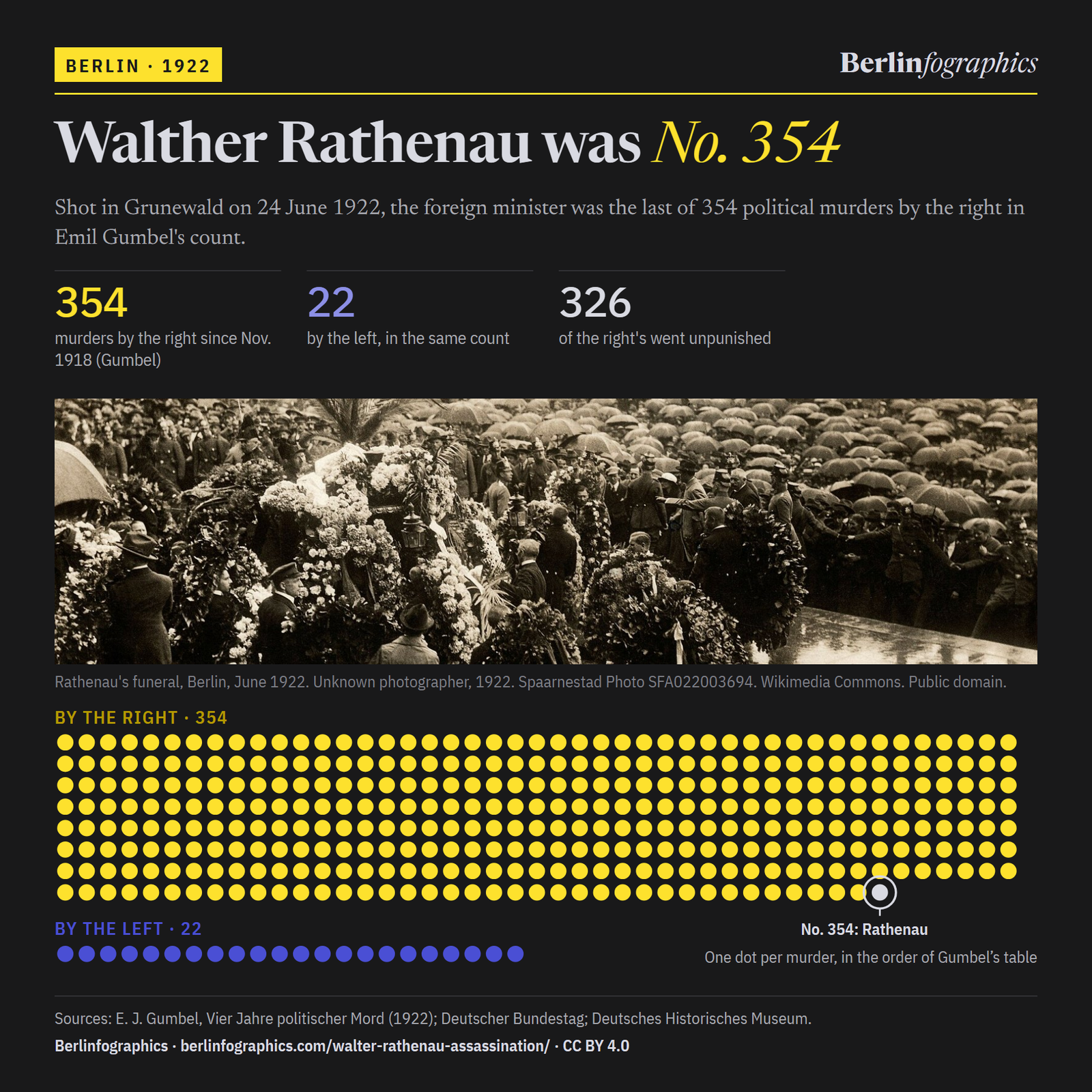
Rathenau's funeral in Berlin, June 1922: in pouring rain, his hearse disappears under a sea of flowers (Spaarnestad archive caption).Unknown photographer, 1922. Spaarnestad Photo SFA022003694. Wikimedia Commons. Public domain.
The Rathenau murder
Walther Rathenau was No. 354
On 24 June 1922 Germany's foreign minister was shot in his open car in Grunewald. That October the statistician Emil Julius Gumbel finished his count of political murders since the revolution of November 1918: 354 by the right, 22 by the left. Rathenau was the last name on the list.
354
political murders by the right since November 1918, in Gumbel's count
22
by the left, in the same count
326
of the right's 354 went unpunished; of the left's 22, 4
24days
from the murder to the Reichstag's law to protect the Republic
01Grunewald, a Saturday morning
Nine shots from a passing car
Walther Rathenau, an industrialist's son born in Berlin in 1867, had been foreign minister since 1 February 1922, 143 days. The far right hated him for his policy of meeting the Allies’ demands, and as a Jew. He had declined protection despite police warnings.
On the morning of 24 June he set off in his open car from his house, Koenigsallee 65, for the Foreign Office. In the curve at Erdener Straße another car overtook his. Nine shots were fired from close range, and a hand grenade went off in his car. The Bundestag gives the time as 11 o’clock.
Ernst Werner Techow drove the attackers’ car; Erwin Kern fired a machine pistol; Hermann Fischer was the third man. All three were members of the far-right Organisation Consul. Rathenau was carried back into his house, and died within minutes. He was 54.
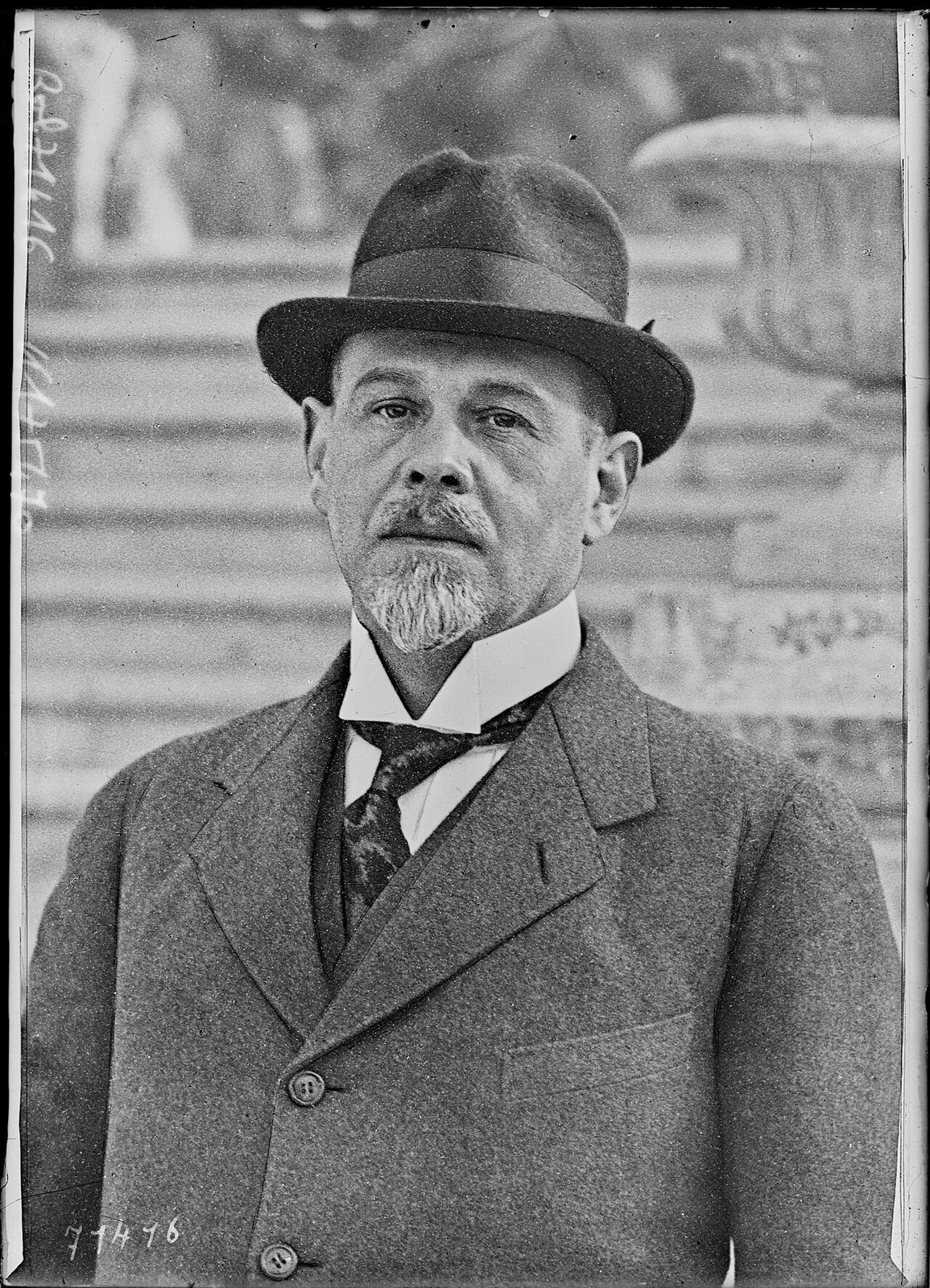
Walther Rathenau, Germany's foreign minister, in 1922.Photo: Agence Rol. Agence photographique (commanditaire), 1922. Wikimedia Commons. Public domain.
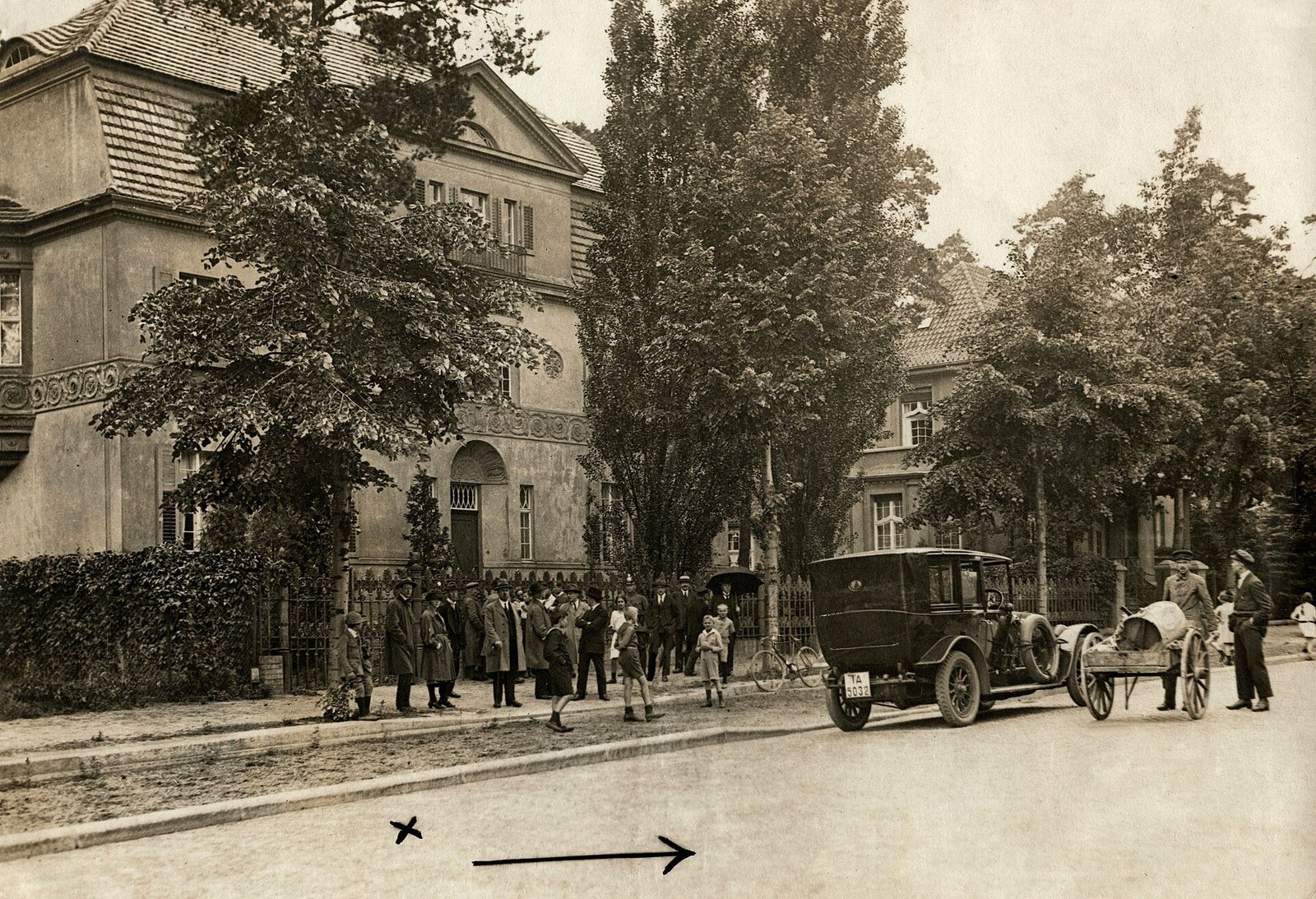
Grunewald, 24 June 1922: from the house to the curve
Onlookers outside Rathenau's house on the Koenigsallee, June 1922. The cross and arrow were drawn on the original print.Photo: Unknown photographer, 1922. Spaarnestad Photo SFA022003695. Wikimedia Commons. Public domain.
The house at Koenigsallee 65 in Grunewald, a listed monument, in 2012.Photo: Bodo Kubrak, 2012. Wikimedia Commons. CC0.
02A statistician's list
Emil Gumbel counted every political murder
The statistician Emil Julius Gumbel collected every political killing in Germany since the revolution of 9 November 1918whose victim he could name, from court files, verdicts, witness statements and newspapers. His book, Vier Jahre politischer Mord, expanded an earlier pamphlet. He dated its preface 16 October 1922.
He wrote that he had chosen the cases from the right “far more cautiously” than those from the left, and did not claim his list was complete. Below, every dot is one killing on his list, in the order of his table.
Emil Julius Gumbel, the statistician who counted the murders, in a portrait published in 1931.Photo: Unknown photographer, 1931. Wikimedia Commons. Public domain.
Political killings in Germany since November 1918
one political killing on Gumbel's list
Emil Julius Gumbel, the statistician who counted the murders, in a portrait published in 1931.Photo: Unknown photographer, 1931. Wikimedia Commons. Public domain.
9 November 1918 onwards
Every political killing since the revolution
Gumbel's list holds 376 political killings. Each dot here is one, in the order of his table.
Gumbel's two tables
354 from the right, 22 from the left
He sorted the killings by the camp of the killers. 354 were by the right, 22 by the left.
Karl Liebknecht, 1911. Gumbel's list numbers him 8. Rosa Luxemburg, undated studio portrait (1910s). Gumbel's list numbers her 9.Photos: Bain News Service, 1911. Library of Congress, Bain Collection. Wikimedia Commons. Public domain. · Unknown photographer, 1910s. Wikimedia Commons. Public domain.
15 January 1919
Numbers 8 and 9
Near the top of the list: Karl Liebknecht and Rosa Luxemburg, murdered in Berlin on 15 January 1919. Most of the right's killings came in 1919: 255 of them.
Matthias Erzberger, the former finance minister, in 1920. He was shot on 26 August 1921; Gumbel's list numbers him 353.Photo: Agence Rol, 1920. Wikimedia Commons. Public domain.
26 August 1921
Number 353
Matthias Erzberger, the former finance minister, was shot on 26 August 1921. The year 1921 has 21 dots on the list.
Walther Rathenau, Germany's foreign minister, in 1922.Photo: Agence Rol. Agence photographique (commanditaire), 1922. Wikimedia Commons. Public domain.
24 June 1922
Number 354
Walther Rathenau's is the last dot, and the only one for 1922. Gumbel finished his book two days after the verdict in the Rathenau trial.
Emil Julius Gumbel, the statistician who counted the murders, in a portrait published in 1931.Photo: Unknown photographer, 1931. Wikimedia Commons. Public domain.
Gumbel's summary table
Who was punished
Of the right's 354 killings, he counted 326 unpunished and 1 punished in full. Of the left's 22, 17 were punished in full.
Imprisonment per murder
15 years against 4 months
On average a killing from the left cost 15 years in prison, one from the right 4 months. Killings by the left led to 10 executions; killings by the right, to none.
03June to July 1922
The Republic answered in 24 days
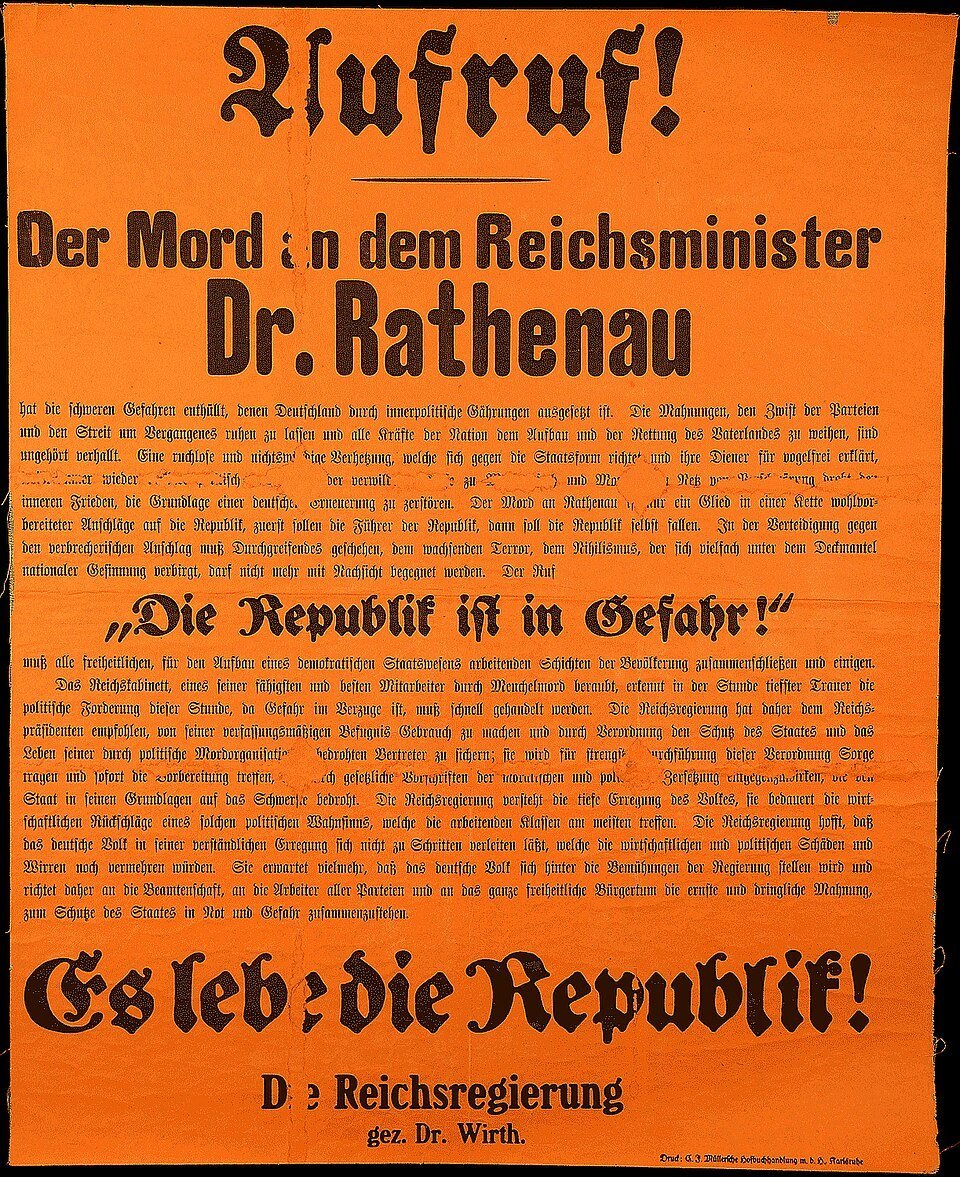
The day after the murder the government issued two emergency decrees to protect the Republic, and a government poster declared “Die Republik ist in Gefahr!”, the Republic is in danger. In the Reichstag, Chancellor Joseph Wirth turned on the nationalist right, whose press had attacked Rathenau for months:
“Da steht der Feind … dieser Feind steht rechts!” (There stands the enemy … this enemy is on the right!)Joseph Wirth in the Reichstag, June 1922
On 27 June, three days after the murder, government and parliament met for a state ceremony in the Reichstag. President Friedrich Ebert gave the oration: the deed, he said, “was aimed at the German Republic and at the idea of democracy”. There was a protest strike across Germany, and Rathenau was buried that day in the family grave at Oberschöneweide.
“Der Mord an dem Reichsminister Dr. Rathenau … Die Republik ist in Gefahr!” The government's poster of 24 June 1922, signed by Chancellor Wirth. It ends “Es lebe die Republik!”Document: Landesarchiv Baden-Württemberg, Staatsarchiv Freiburg W 110/1 Nr. 0143. Wikimedia Commons. CC BY 4.0.
The state ceremony for Rathenau in the Reichstag chamber, June 1922. The coffin lies under palms and flowers (Bundesarchiv dating: 27 June 1922).Photo: Bundesarchiv, Bild 183-Z1117-502 / Unknown author / CC BY-SA 3.0 de
On the steps of the Reichstag at Rathenau's funeral, June 1922: President Friedrich Ebert in the right foreground, with Chancellor Joseph Wirth beside him (Spaarnestad archive caption).Photo: Unknown photographer, 1922. Spaarnestad Photo SFA022003691. Wikimedia Commons. Public domain.
How many marched in Berlin: the estimates, on one scale
The Bundestag's research service and the Federal President both say “Hunderttausende”, hundreds of thousands. The band runs between the two named figures.
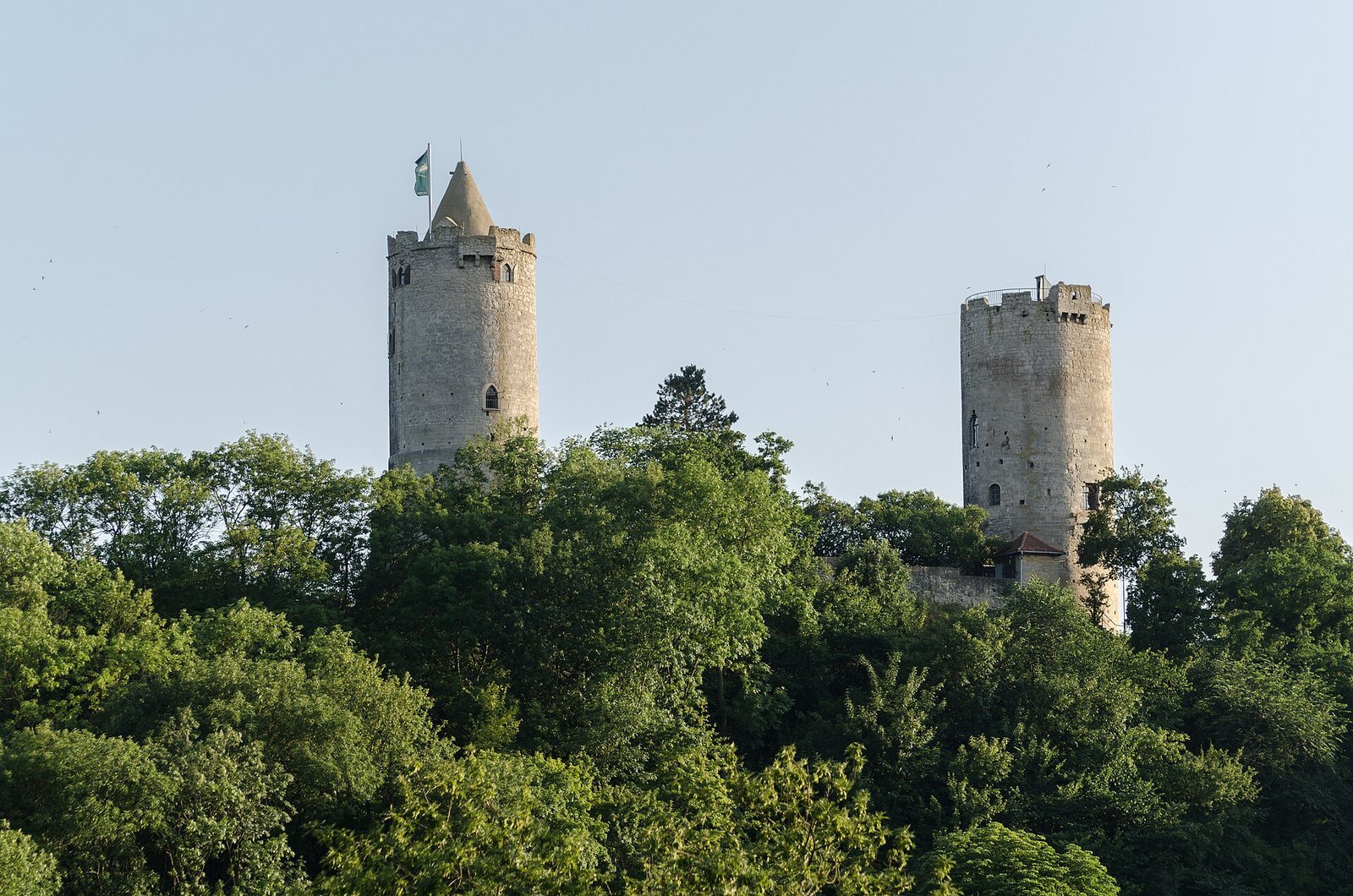
The killers ran. Techow was arrested five days after the murder. Kern and Fischer hid in Burg Saaleck, a castle above the Saale. When the police came, on 17 July, Kern was shot and Fischer killed himself; Gumbel, writing that autumn, gives the 18th. A day after their deaths the Reichstag passed the Law for the Protection of the Republic. It banned anti-republican groups and meetings and set up a special court. The Reichsrat had approved it by 48 votes to 10, and it came into force on 21 July. The DHM notes that it was used mainly against the left.
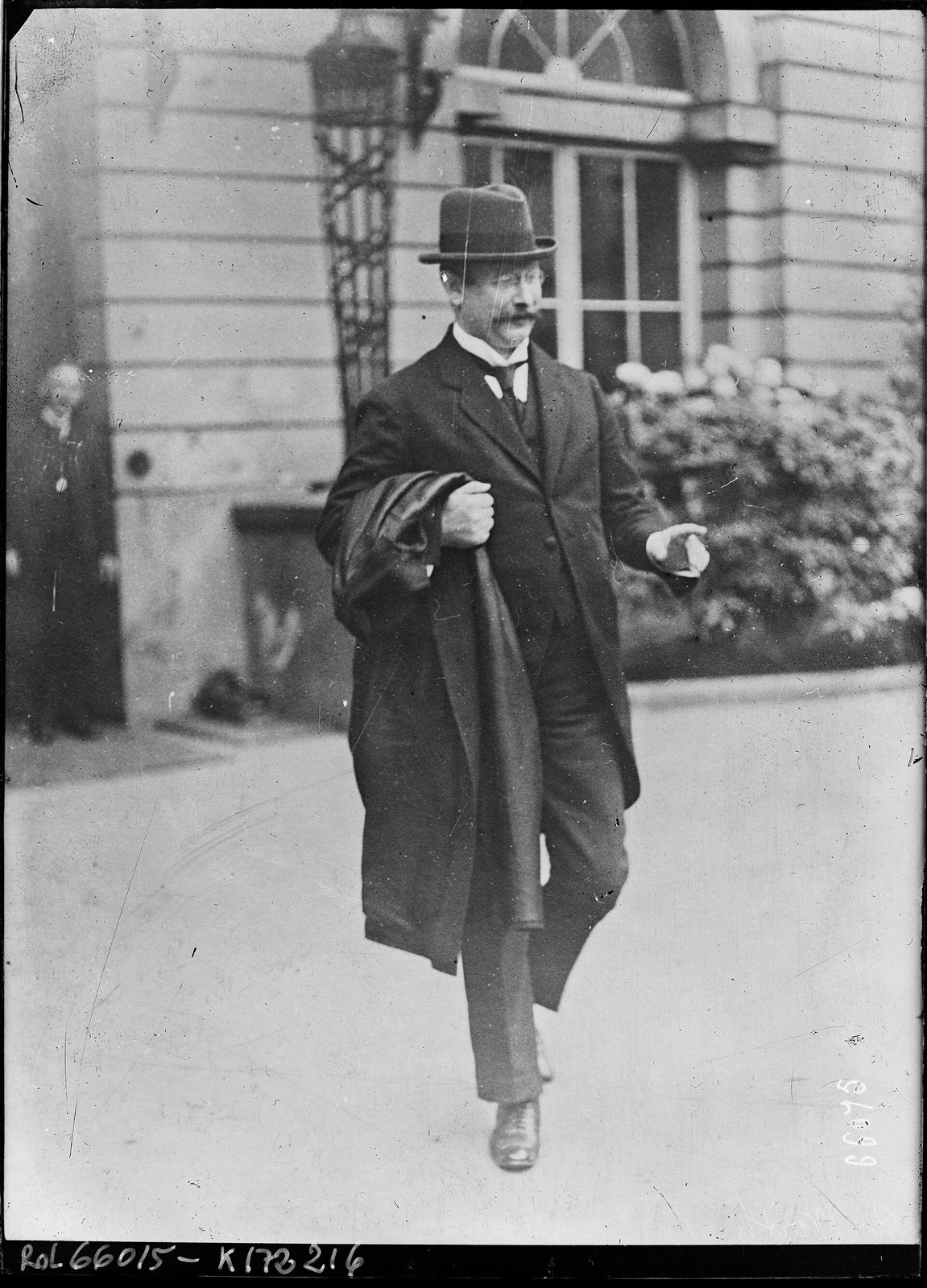
Joseph Wirth, Reich chancellor, in 1921.Photo: Agence Rol, 1921. Wikimedia Commons. Public domain.
Burg Saaleck near Naumburg, 2015. Kern and Fischer hid in the castle; they died there on 17 July 1922.Photo: Tilman2007, 2015. Wikimedia Commons. CC BY-SA 3.0.
The Reichstag vote, 18 July 1922
One linear scale of the 409 votes cast. Source: the Bundestag's history archive.
24 June to 14 October 1922: one linear scale of days
Days counted from the murder. The dark band is the trial in Leipzig. Every mark opens its source.
04Leipzig, October 1922
The court could not prove a plot
The case went to the Staatsgerichtshof zum Schutze der Republik, the special court the new law had created. It sat in the Reichsgericht building in Leipzig from 3 October to 14 October. More than a dozen people had been identified as involved.
On 14 October, 112 days after the murder, Ernst Werner Techow, the driver, was sentenced to 15 years in a penitentiary for aiding the murder. Ernst von Salomon, of the Consul, for aiding the murder, got 5 years.
The court could not prove that the Organisation Consul had planned the murder, and it never settled whether the killers had backers. Two days after the verdict, Gumbel dated the preface of his book, with the Rathenau sentences already in its last row.
The Reichsgericht building in Leipzig, where the Staatsgerichtshof tried the case in October 1922; photographed in 2010.Photo: Andreas Praefcke, 2010. Wikimedia Commons. CC BY 3.0.
The defendants in Leipzig, October 1922, numbered on the print; Ernst von Salomon is 1 and Ernst Werner Techow 2 (Spaarnestad archive caption; GHDI).Photo: Unknown photographer, 1922. Spaarnestad Photo SFA022003686. Wikimedia Commons. Public domain.
05The house and the curve
A stone in the curve
In June 1923 the Reich government took over Rathenau's house as a museum, his study kept as it was on the day he died. After 1933 the Nazis closed the memorial in his house and renamed the streets that bore his name.
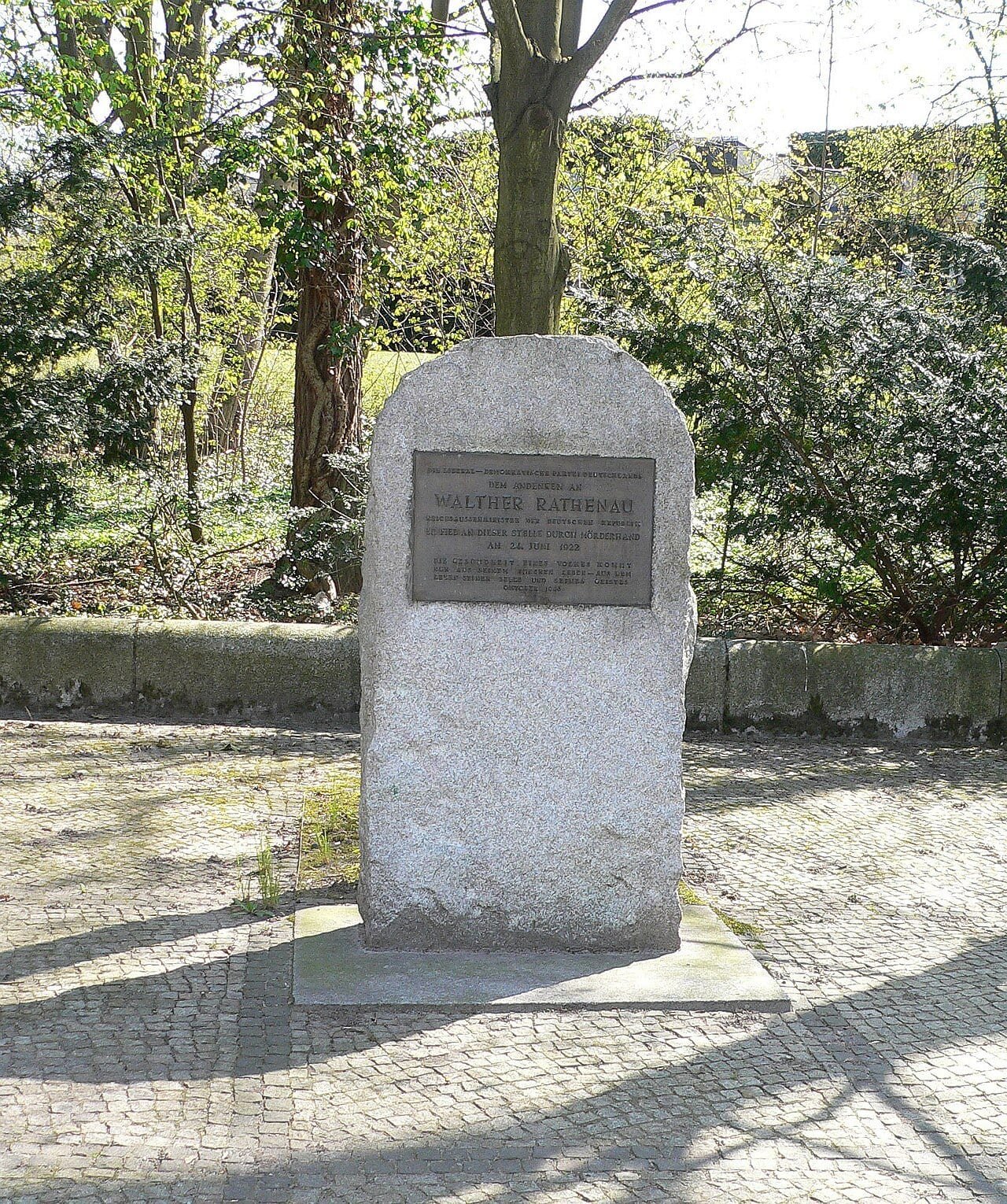
In October 1946 the Liberal-Demokratische Partei set a granite stone in the curve of the Koenigsallee. Its plaque reads: “Er fiel an dieser Stelle durch Mörderhand am 24. Juni 1922”, he fell at this spot by a murderer's hand. His grave at Oberschöneweide is an honorary grave of the city of Berlin.
The memorial stone in the curve of the Koenigsallee at Erdener Straße, set up in October 1946. Its plaque reads: “Er fiel an dieser Stelle durch Mörderhand am 24. Juni 1922” (He fell at this spot by a murderer's hand on 24 June 1922).Photo: Peter Kuley, 2010. Wikimedia Commons. CC BY-SA 3.0.
Rathenau's study in his house, kept as it was on the day of his murder when the Reich government made the villa a museum, June 1923 (Bundesarchiv caption).Photo: Bundesarchiv, Bild 102-00097 / Unknown author / CC BY-SA 3.0 de
Gumbel's list ended with the foreign minister. Of its 354 killings by the right, he counted one that the courts had punished in full.
Press & citation
Use this Berlinfographic
Free to publish under CC BY 4.0 — in print, online, on Wikipedia and in teaching, commercially or not — with credit to Berlinfographics and a link to this page.
Ready-to-use image
The infographic as one image: headline, key figures, chart, sources and credit, 2,400 × 1,350 px PNG. Please use it unedited.
Berlinfographics (berlinfographics.com), CC BY 4.0
Citation
Berlinfographics (2026). “The murder of Walther Rathenau, 1922”. Berlin Experiences. https://berlinfographics.com/walter-rathenau-assassination/
Wikipedia
{{cite web |title=The murder of Walther Rathenau, 1922 |url=https://berlinfographics.com/walter-rathenau-assassination/ |website=Berlinfographics |publisher=Berlin Experiences |date=2026-11-09 |access-date=2026-11-09}}
Every figure comes from the sources listed above; tap any underlined figure in the story to see its source.
Photographs in the story and in the ready-to-use images are not ours and keep the licences named in their captions and credits — keep those credits when you republish. The CC BY 4.0 licence covers our infographics, charts, texts and design.
Our infographics, charts and texts are licensed CC BY 4.0: free to republish, including commercially, with credit to Berlinfographics and a link. Photographs keep their own licences, named in each caption. How to credit