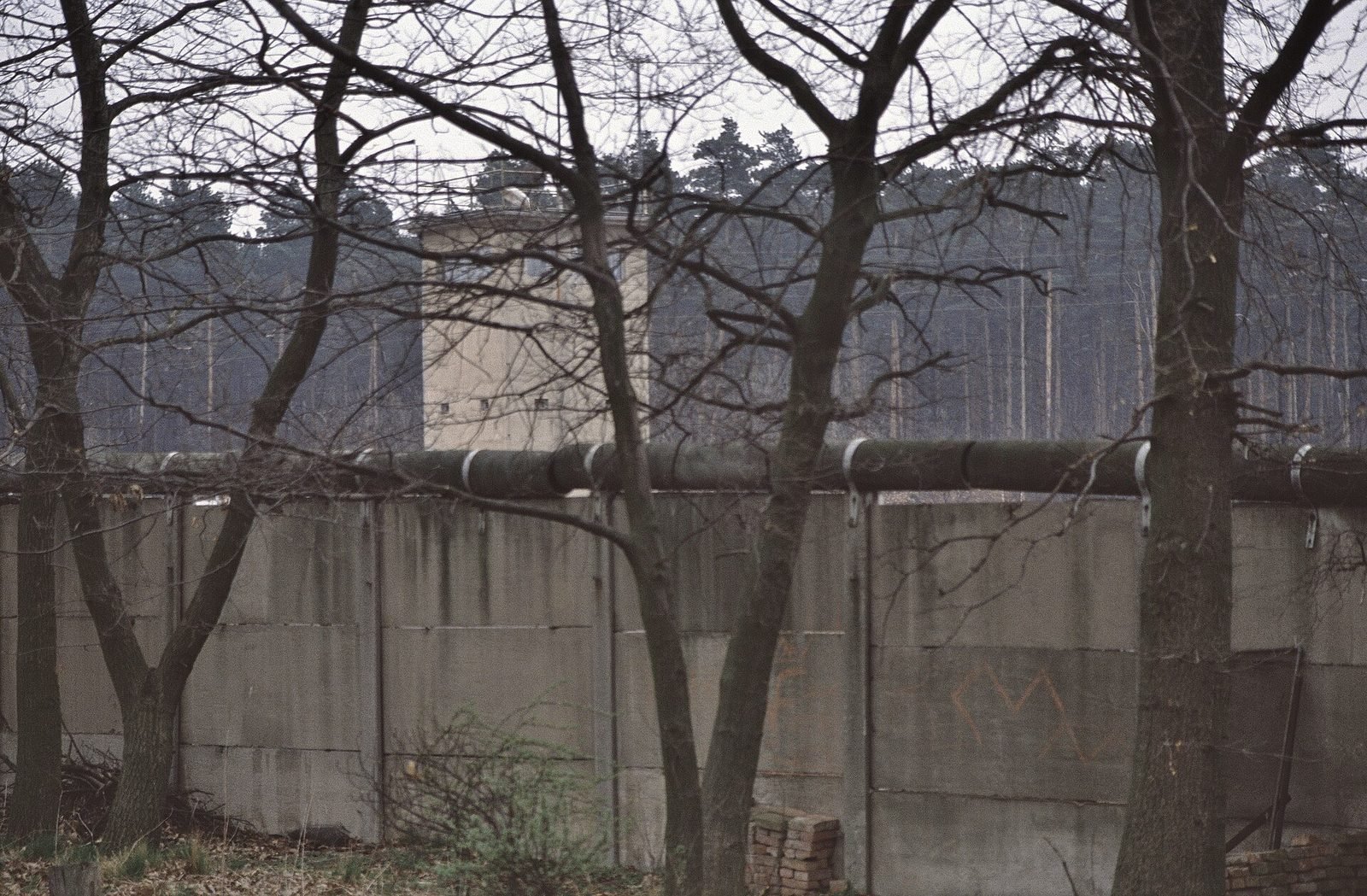
Bernhard-Beyer-Straße, the corridor road to Steinstücken, with the Wall on both sides, April 1989.Photo: Aad van der Drift, 1989. Wikimedia Commons. CC BY 2.0.
Islands outside the island
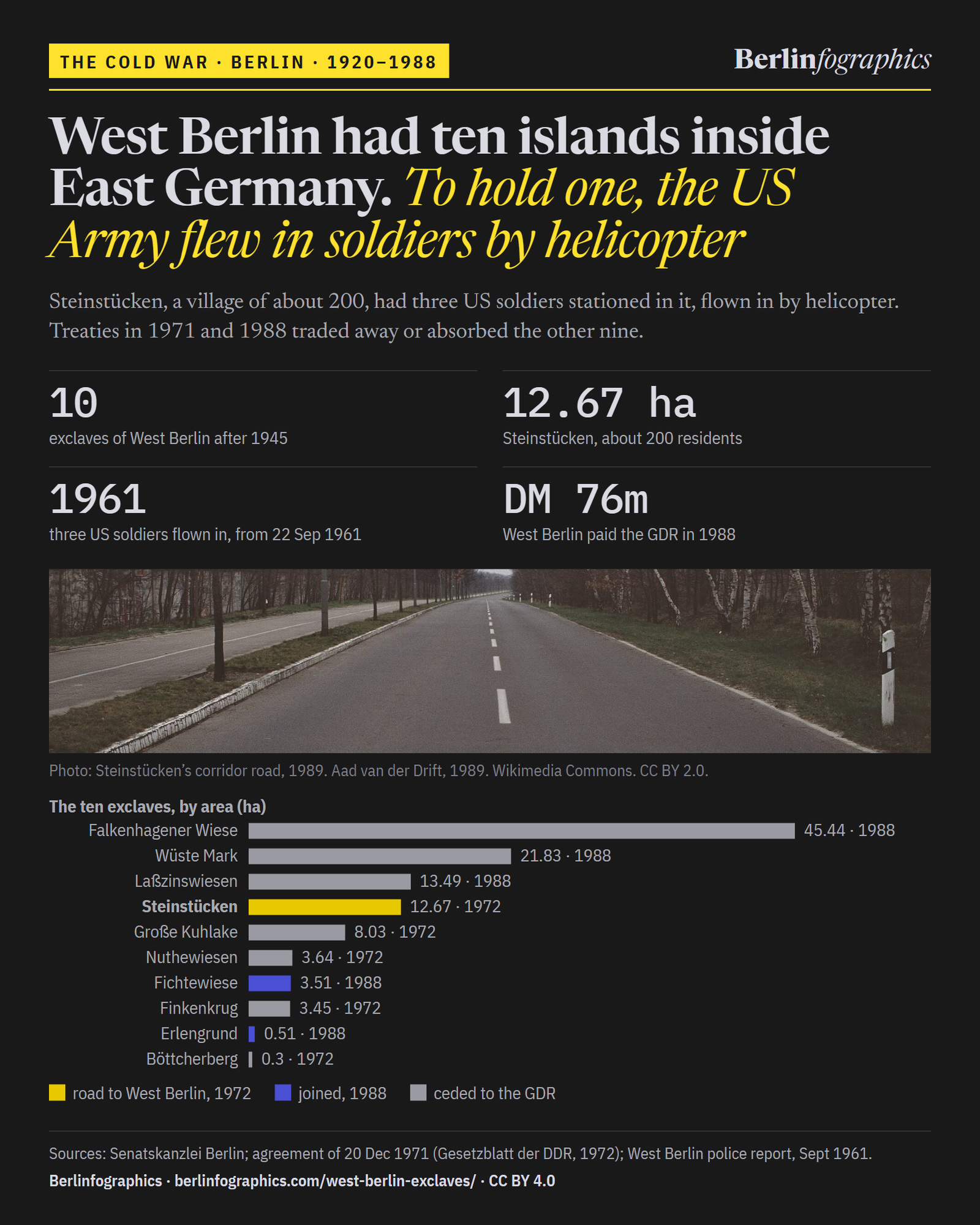
Steinstücken, a village of about 200 people, lay in GDR territory south of Wannsee. From 22 September 1961 three US soldiers were stationed there, flown in by helicopter. Treaties in 1971 and 1988 traded seven of the rest to the GDR and joined two to West Berlin.
01Greater Berlin, 1920–1945
When Greater Berlin was formed on 1 October 1920, some of the land it took in did not touch the new city at all: meadows, fields, a forest parcel, two allotment colonies and one village. The Senate counts ten such exclaves, together about 112.9 ha.
After the war the Allies drew their sectors along the old borough lines. Every exclave belonged to a western borough, Spandau or Zehlendorf, so in 1945 all of them became pieces of West Berlin lying inside the Soviet zone, and from 1949 inside the GDR.
Only one of them had people living on it: Steinstücken, 12.67 ha, about 200 residents.
The ten exclaves, by area, and what became of them
West Berlin and its ten exclaves
Circles are drawn to each exclave’s true area at its position (OSM or Wikidata; Große Kuhlake, Finkenkrug, Nuthewiesen and Böttcherberg approximate); no open dataset holds their outlines. The Wall and border strip are the 1989 line from Geoportal Berlin.
1 October 1920 – 1988
Each circle on the map is one exclave, drawn at its true area and placed from OpenStreetMap or Wikidata. The biggest, the Falkenhagener Wiese, was 45.44 ha of meadow. The smallest, at Böttcherberg, was 0.3 ha.
18 October 1951 · the end of May 1952
On 18 October 1951 GDR police occupied Steinstücken. The United States protested, and they withdrew four days later. From the end of May 1952 its residents could reach their homes only by a 1 km road under GDR control; visitors had to prove they had a second home there.
From 22 September 1961
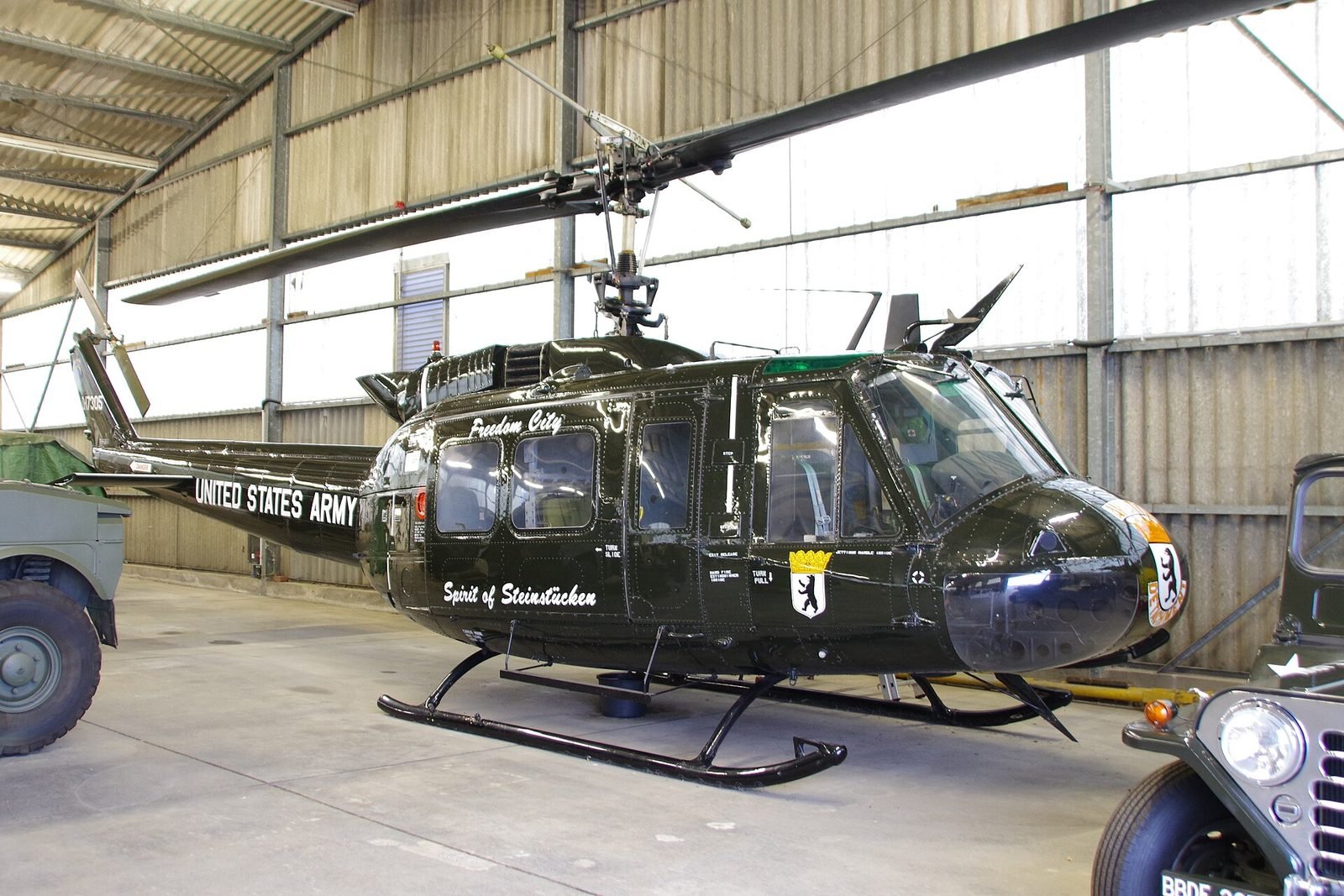
After the Wall went up, the US Army posted three soldiers in the village. West Berlin police recorded their arrival at about 16.40 on 22 September 1961: “flown in by a helicopter”. Helicopters connected them to the rest of West Berlin, from a landing site in the village.
20 December 1971 · opened 30 August 1972
The Four-Power Agreement of 3 September 1971 allowed the enclave problems to be solved “by exchange of territory”. West Berlin’s Senate and the GDR signed on 20 December 1971. The GDR ceded a strip about 1 km long and 20 m wide beside the railway, with the road: 2.3 ha. It opened on 30 August 1972, with a bus, the 118.
In force 3 June 1972
In the same agreement West Berlin gave up 15.6 ha: Finkenkrug, Große Kuhlake, Böttcherberg, part of the Nuthewiesen and a strip at Eiskeller. It received 17.1 ha: the corridor, the north part of Frohnau cemetery and 10.7 ha around Eiskeller. For the difference the Senate paid DM 4 million.
Eiskeller, 1961
Eiskeller, a few farms in the Spandau forest, was joined to West Berlin only by a lane about 4 m wide and 800 m long; accounts disagree on whether the lane itself was West Berlin land. In September 1961 Erwin Schabe, 12, said GDR police had stopped him on his way to school, and a British armoured car was sent to take him. In 1994 he admitted that he had made the story up.
1920 – 1988
The Fichtewiese and Erlengrund colonies, 3.51 ha and 0.51 ha, lay just beyond the Wall in Spandau. Only West Berliners named on a yearly list for the GDR border guards could ring at a call post; the guards opened a gate, and a second post checked papers after a 50-metre path. Someone wrote beside the gate: “Erich Honecker 2 x klingeln”.
Signed 31 March 1988 · in force 1 July 1988
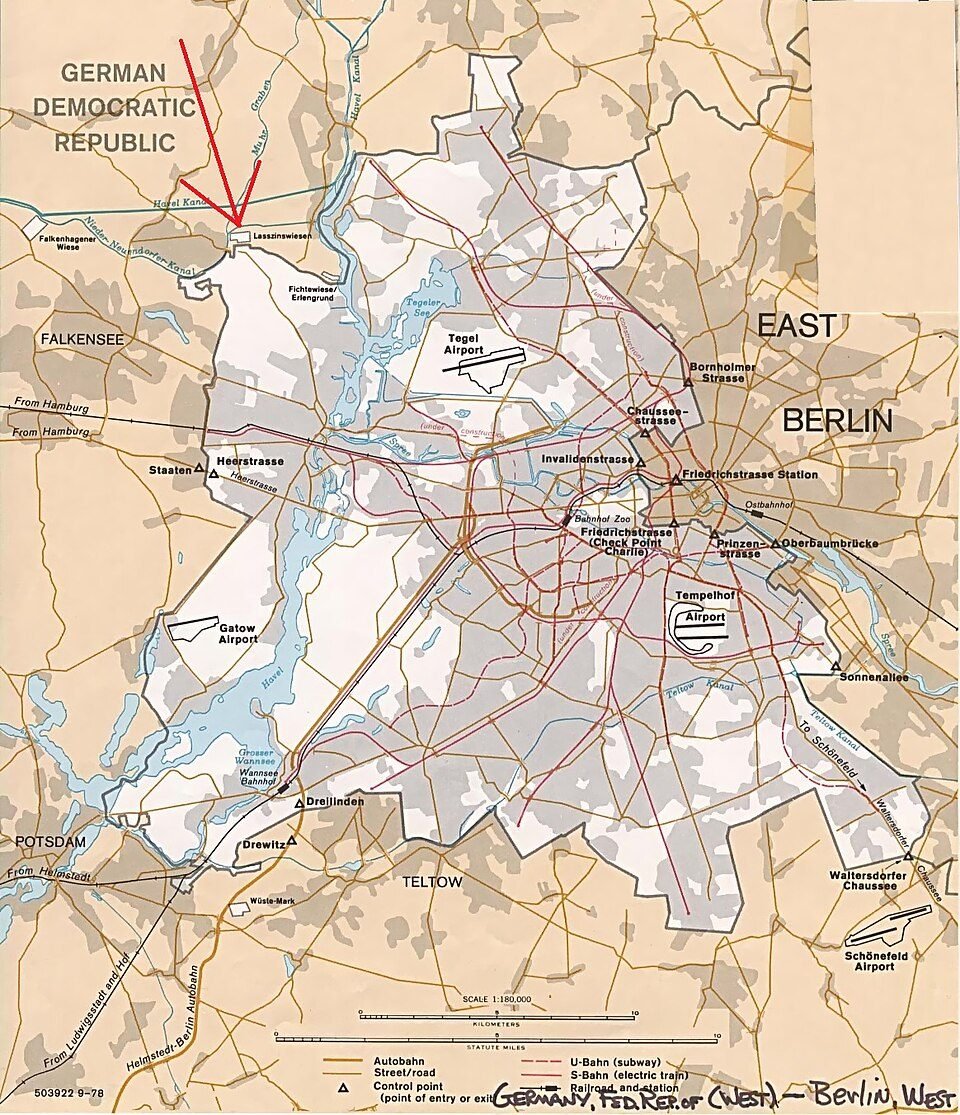
The GDR took the last three exclaves, the Falkenhagener Wiese, the Laßzinswiesen and Wüste Mark: 80.8 ha together. West Berlin received 14 parcels along its borders, 96.7 ha, among them the land that joined the Fichtewiese and Erlengrund to Spandau, and paid DM 76 million. West Berlin grew by 9.4 ha.
1 July 1988
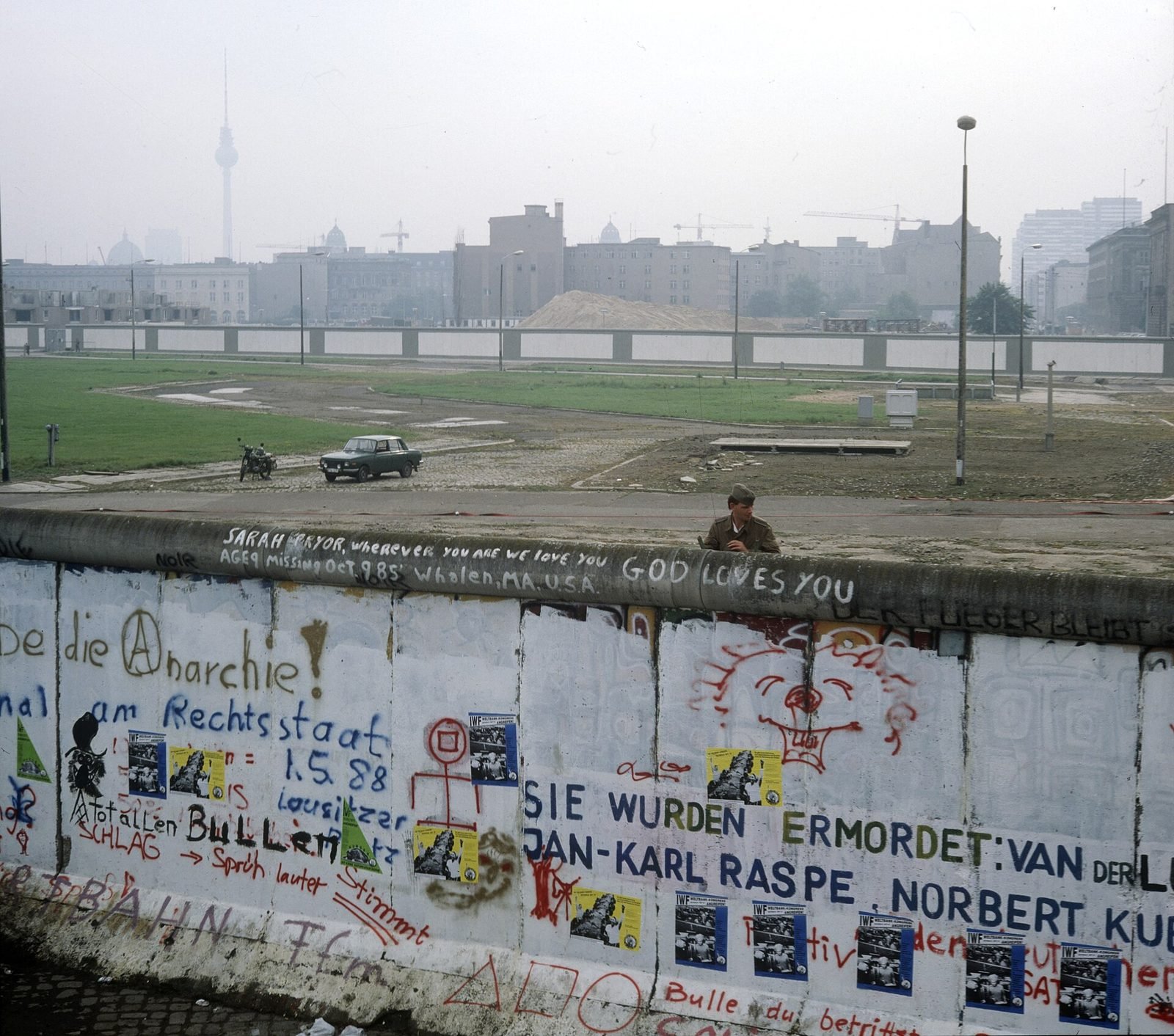
The exchange also gave West Berlin the Lenné-Dreieck, about 4 ha of East Berlin land on the western side of the Wall at Potsdamer Platz. Protesters had occupied it since 25 May 1988. When West Berlin police cleared it on 1 July 1988, more than 180 of them climbed the Wall into East Berlin.
02Steinstücken, 1961–
The helicopters did not replace the road: the people of Steinstücken still drove in and out through GDR checkpoints. What came by air were the three American soldiers, flown in and out. The memorial on their landing site recalls, in the Senate’s words, “the Allies’ protective role”.
When the flights ended is not settled. The Senate says the landing strip was used until the end of 1976; US Army aviation accounts end the regular link in September 1971, before the road opened. The memorial is two rotor blades set upright in concrete.
The helicopter years: the sources disagree on the end


03Three agreements, 1971–1988
Three agreements between West Berlin’s Senate and the GDR settled the exclaves. Two were swaps in which the land changing hands came out close to even, and in both the Senate paid the GDR in Deutschmarks on top: DM 4 million in 1971, DM 76 million in 1988.
In between, on 21 July 1972, it bought 8.5 ha of East Berlin railway land at the former Potsdamer Bahnhof outright, for DM 31 million.
What each agreement moved, in hectares, and what West Berlin paid
The 1988 figure to the GDR is the Senate’s 96.7 ha less West Berlin’s net gain of 9.4 ha. The 1971 areas are the agreement’s own, rounded to a tenth of a hectare.

04Wüste Mark and the Laßzinswiesen
Wüste Mark, 21.83 ha of arable land south of Zehlendorf, was farmed for decades by the Wendt family with GDR permission: mostly rye, also potatoes. Der Spiegel reported in March 1988 that the Senate had not told them of the coming exchange, and that the father died of a heart attack days after he heard.
The Laßzinswiesen, 13.49 ha of meadow north of Spandau, were, in Der Spiegel’s words, “inaccessible from the West” until then. Both went to the GDR on 1 July 1988, with the Falkenhagener Wiese.

05Potsdamer Platz, 1 July 1988
The Lenné-Dreieck, about 4 ha between the Tiergarten and Potsdamer Platz, had belonged to the Mitte borough since 1920, and so to the Soviet sector, but lay on the western side of the Wall, fenced off and empty. The 1988 exchange gave it to West Berlin’s Tiergarten borough from 1 July 1988.
Protesters against a road planned across it occupied the ground on 25 May 1988. When the police came at the handover, more than 180 of them escaped over the Wall to East Berlin, and left the GDR soon after through the ordinary checkpoints.

West Berlin began with ten islands outside its walls. By 1988 it had none: one got a road, two were joined up, seven were signed away.
Press & citation
Free to publish under CC BY 4.0 — in print, online, on Wikipedia and in teaching, commercially or not — with credit to Berlinfographics and a link to this page.
Ready-to-use image
The infographic as one image: headline, key figures, chart, sources and credit, 2,400 × 1,350 px PNG. Please use it unedited.
Download landscape (PNG)
Square format
A 1:1 version for social media and narrow columns, 1,800 × 1,800 px.
Download square (PNG)
Portrait 4:5
For Instagram and LinkedIn feeds, 1,620 × 2,025 px.
Download portrait (PNG)Credit line
Berlinfographics (berlinfographics.com), CC BY 4.0
Citation
Berlinfographics (2026). “West Berlin’s exclaves, 1945–1988”. Berlin Experiences. https://berlinfographics.com/west-berlin-exclaves/
Wikipedia
{{cite web |title=West Berlin’s exclaves, 1945–1988 |url=https://berlinfographics.com/west-berlin-exclaves/ |website=Berlinfographics |publisher=Berlin Experiences |date=2026-11-09 |access-date=2026-11-09}}
Our infographics, charts and texts are licensed CC BY 4.0: free to republish, including commercially, with credit to Berlinfographics and a link. Photographs keep their own licences, named in each caption. How to credit
Topics: The Second World War · Cold War Berlin · Nazi Berlin · Persecution & the Holocaust · Weimar Berlin · Prussia & the Kaiserreich · Architecture & the built city · Culture, science & society · Reunified Berlin · Unusual facts
Contact: info@berlinfographics.com · Press: press@berlinfographics.com · Imprint · Privacy