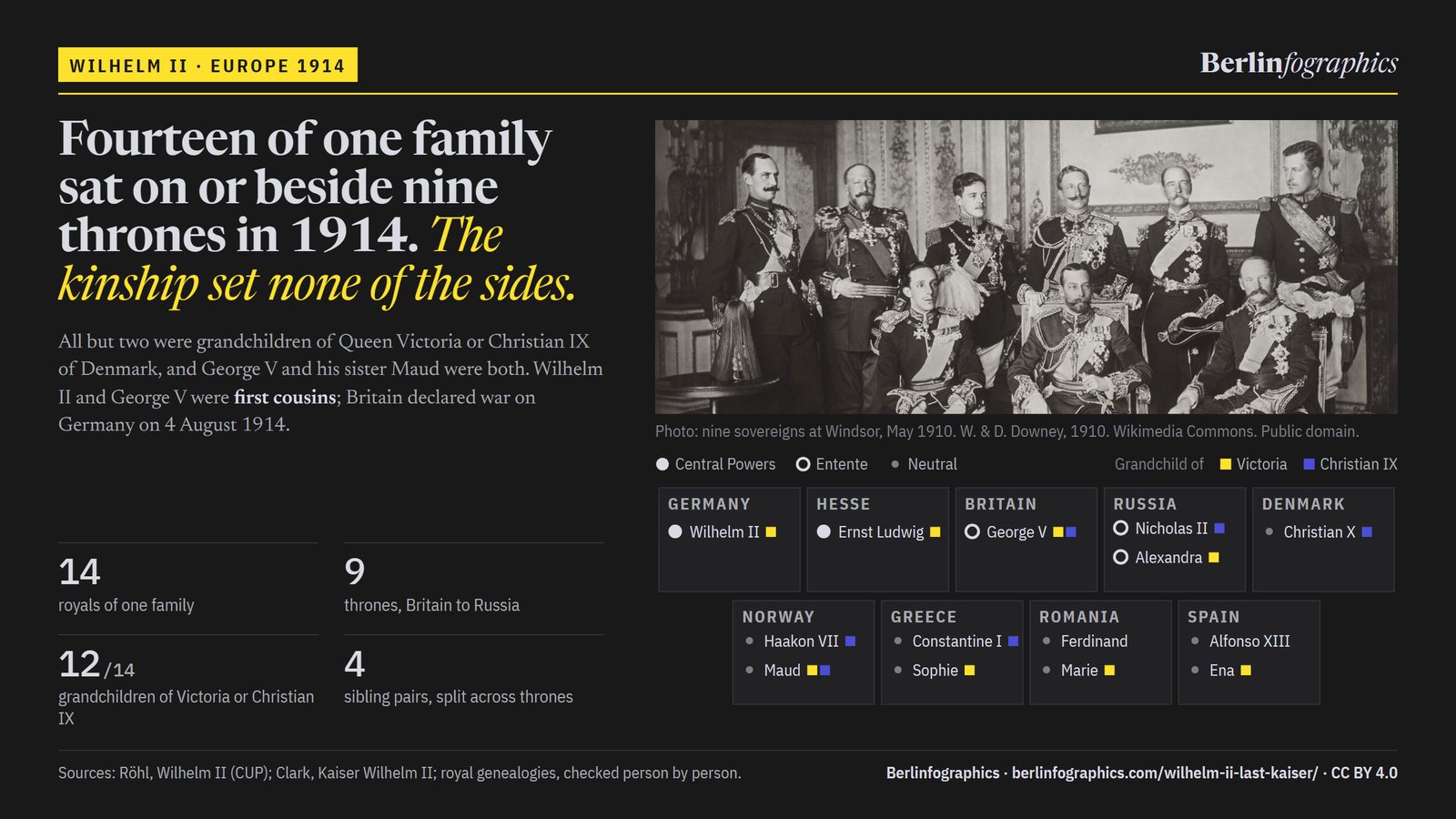
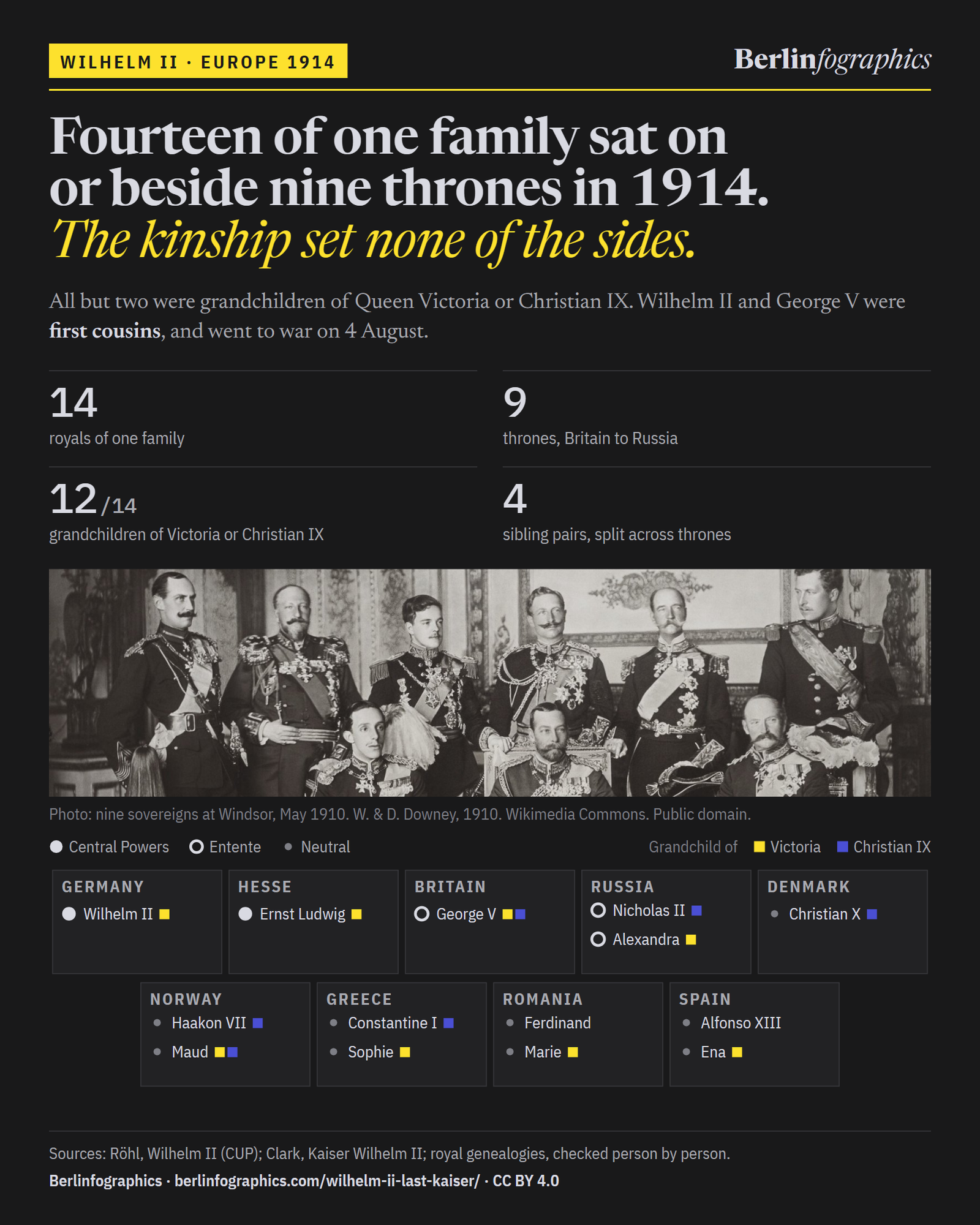
Nine reigning monarchs at Windsor for the funeral of Edward VII, 20 May 1910. Standing: Haakon VII of Norway, Ferdinand of Bulgaria, Manuel II of Portugal, Wilhelm II, George I of Greece, Albert I of Belgium. Seated: Alfonso XIII of Spain, George V, Frederick VIII of Denmark.Photo: W. & D. Downey, 1910. Wikimedia Commons. Public domain.
The last Kaiser
All but two were grandchildren of Queen Victoria or of Christian IX of Denmark. Wilhelm II, the last German Emperor, and George V of Britain were first cousins. Within a week of 1 August 1914 their countries were at war.
01Windsor and Copenhagen
Queen Victoria (1819–1901) is the grandmother of this story through five of her children; Christian IX of Denmark (1818–1906), through four of his. By 1914, eight of Victoria’s grandchildren and six of Christian’s sat on or beside a throne.
Two of them belonged to both families: George V of Britain and his sister Maud, Queen of Norway, children of Edward VII and Alexandra of Denmark. Only two of the fourteen, Ferdinand of Romania and Alfonso XIII of Spain, descended from neither house, and both had married Victoria’s granddaughters.


Read across the four and the argument makes itself: the lines of the family and the lines of the war are different lines.
The fourteen, 1 August 1914
1 August 1914
On the day Germany declared war on Russia, these were the kings, queens, emperors and empresses of nine European countries, with Romania’s heirs, who came to the throne that October. The same people sit in the same places through every step below. Only the lines change.
Queen Victoria’s grandchildren
Her lines run through five of her children, from Wilhelm II in Berlin to Ena, Victoria Eugenie, Queen of Spain. Two lines through the same child are brother and sister.
① Victoria, Princess Royal · ② Edward VII · ③ Alice · ④ Alfred, Duke of Edinburgh · ⑤ Beatrice
Christian IX’s grandchildren
The Danish king’s grandchildren held the thrones of Denmark, Norway, Russia, Greece and Britain. George V and his sister Maud were grandchildren of Victoria and of Christian IX at once: their mother was his daughter Alexandra.
① Frederick VIII · ② Alexandra · ③ Dagmar · ④ George I of Greece
Brothers and sisters
Sophie and Wilhelm II; George V and Maud; Alexandra and Ernst Ludwig; and Christian X and Haakon VII. Every pair was split between two different thrones.
Marriages
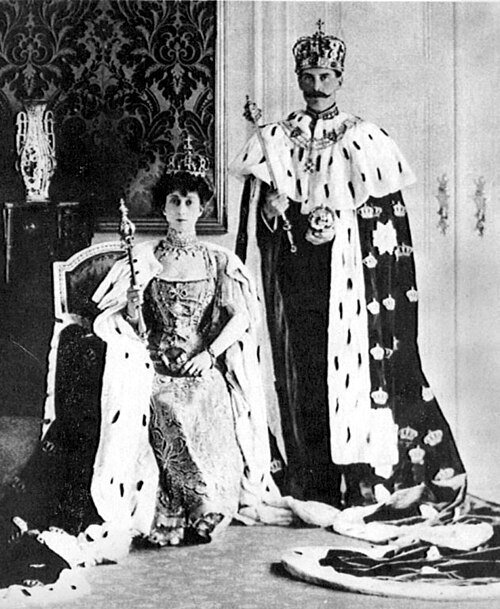
Nicholas II married Victoria’s granddaughter Alexandra, Ernst Ludwig’s sister; Haakon VII married Maud; Constantine I married Wilhelm’s sister Sophie. In each, a grandchild of one house married a grandchild of the other. Ferdinand and Alfonso married into Victoria’s family from outside both.
The first week of August 1914
Germany and Hesse fought for the Central Powers; Britain and Russia for the Entente; the other five stayed neutral. Wilhelm II and George V were first cousins. Britain declared war on Germany on 4 August 1914. Wilhelm and Nicholas, whose empires went to war first, were only third cousins.
By the end of the war
Romania joined the Entente, 27 August 1916; Greece joined the Entente, June 1917. Nicholas II and Alexandra were killed at Yekaterinburg. Constantine was forced out of Greece, Ernst Ludwig deposed in Hesse, and Wilhelm was living in the Netherlands.
02Berlin and Potsdam
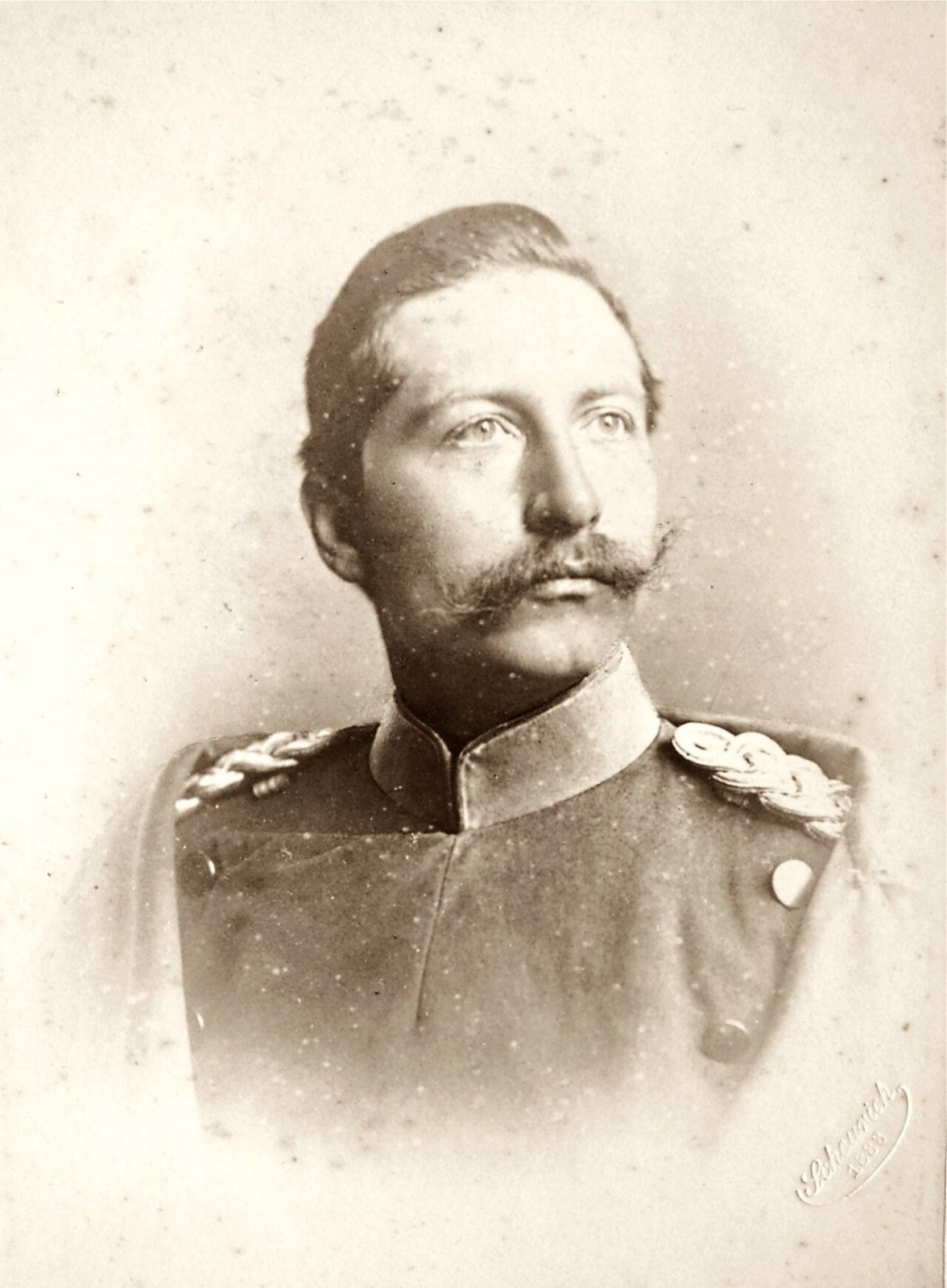
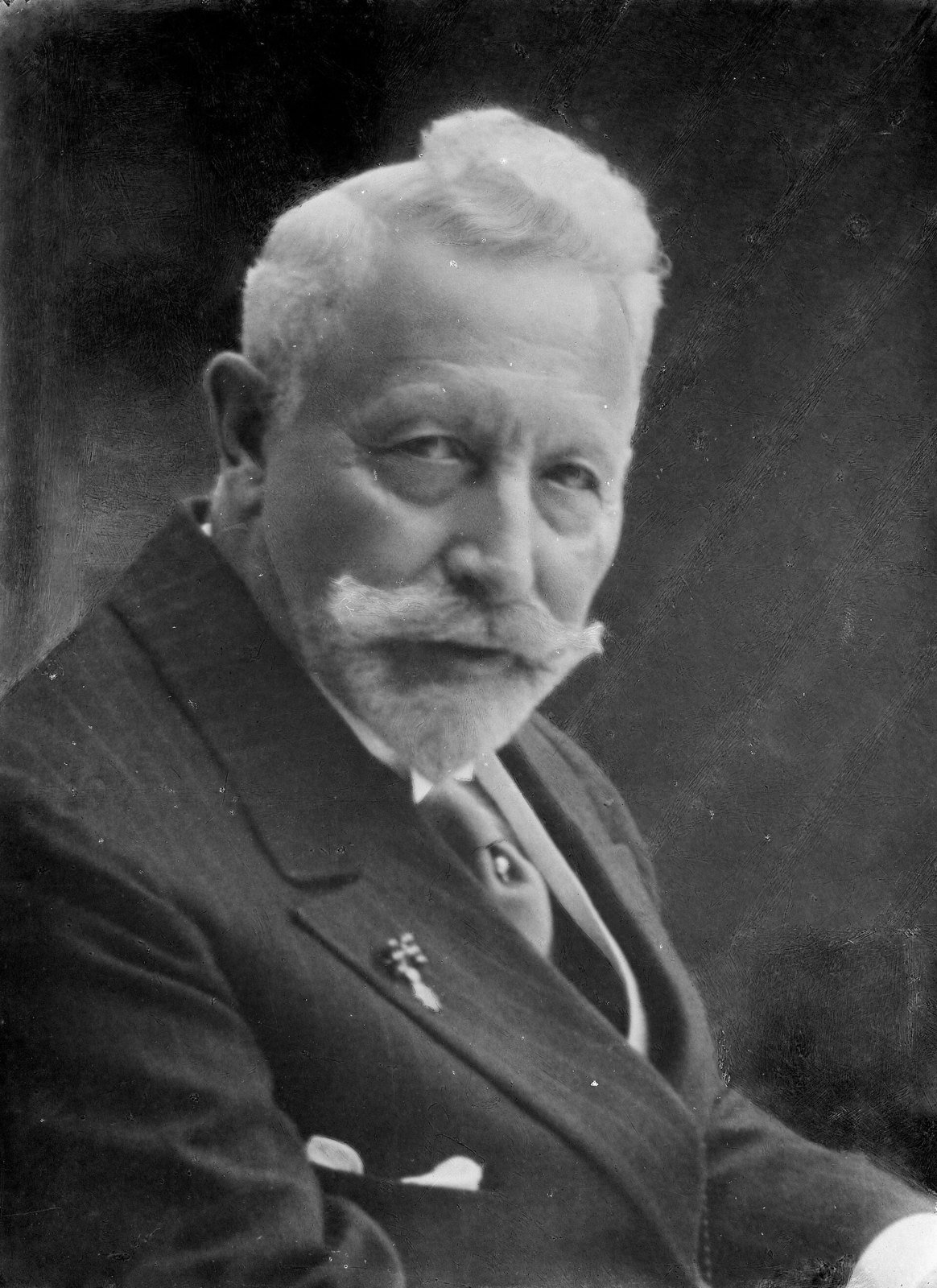
Wilhelm II was born with a paralysed left arm, came to the throne at twenty-nine, dismissed the man who had built the empire within two years, and spent the next twenty-eight talking. He lost much of his authority in 1908, ten years before he lost the throne, and he lived long enough to see the state that replaced him replaced in turn.
The life, 1859–1941, to scale


Wilhelm was born in Berlin on 27 January 1859 in the breech position. The obstetrician Eduard Arnold Martin pulled the left arm down to free him and tore the nerves at the shoulder — the injury now called Erb's palsy. The arm never grew properly. For the rest of his life it was about fifteen centimetres shorter than his right.
The treatments the court ordered are recorded in the family's own papers. From six months old a hare was killed twice a week and the warm carcass bound around the arm. Electric current was applied before he was two. From about four he was put in a stretching frame for the twisted neck the same injury had caused. His tutor Georg Hinzpeter later made him ride one-handed until he could stay on.
What was never recorded is the arm itself. In formal photographs the left hand rests on a sword hilt, or holds a pair of white gloves to make the arm look longer; his coats were cut with the left pocket raised.


The Daily Telegraph printed it on 28 October 1908. In it Wilhelm told British readers “You English are mad, mad, mad as March hares”, said he was in a minority in his own country in wanting friendship with Britain, claimed he had sent Queen Victoria a plan of campaign during the Boer War, and said the new German fleet was built against Japan rather than Britain. In the Reichstag that November, deputies of every party attacked him. No law was passed. No power was formally taken away. What changed was that his ministers stopped treating his opinions as instructions, and Bülow was out of office by the following summer. Wilhelm reigned for another ten years with steadily less of the personal rule he had spent twenty years building.
03Berlin and St Petersburg, summer
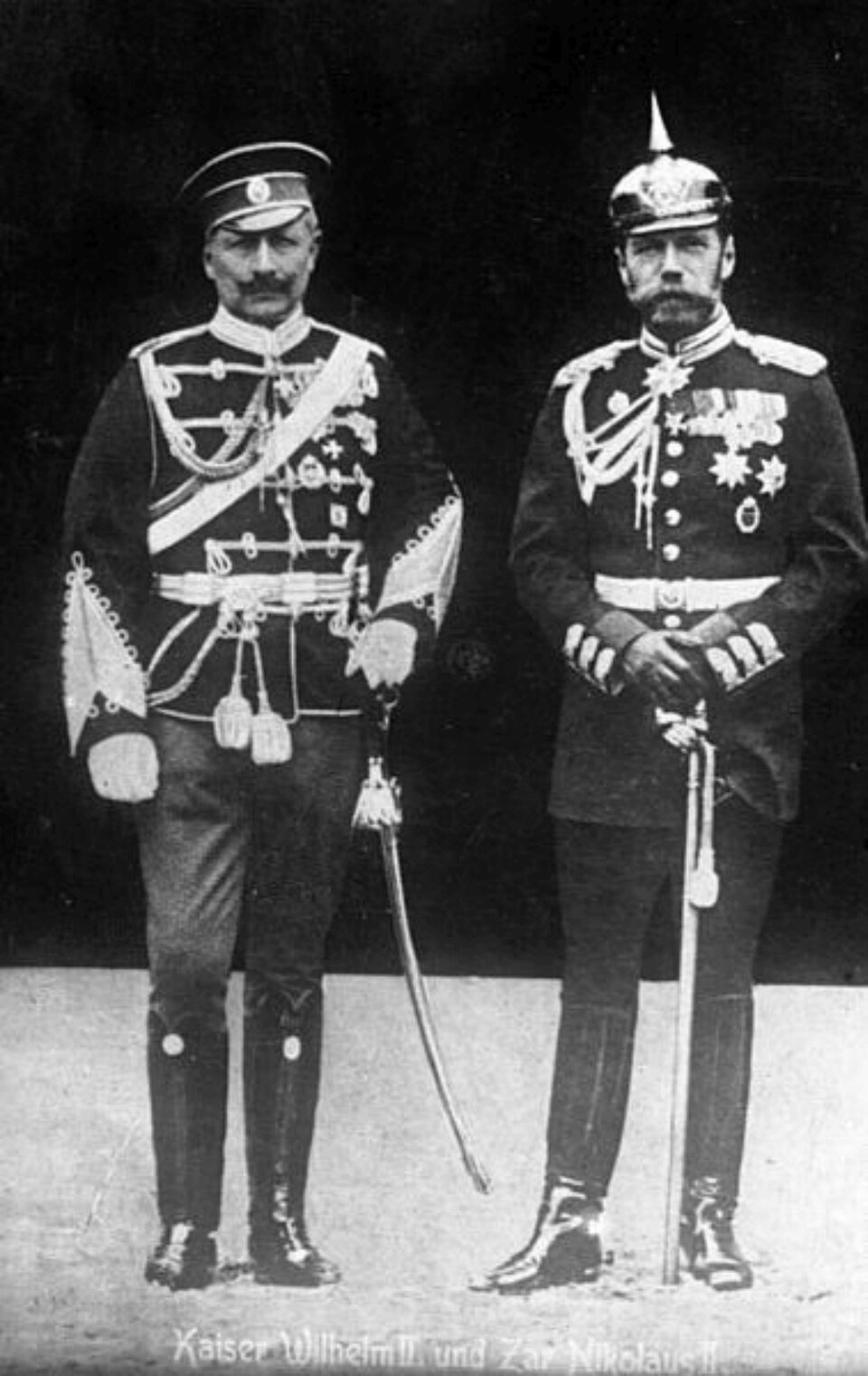
Between 29 July and 1 August 1914 Wilhelm II and Nicholas II sent each other ten telegrams. They wrote in English and signed them “Willy” and “Nicky”.
“I foresee that very soon I shall be overwhelmed by the pressure forced upon me and be forced to take extreme measures which will lead to war.”
Nicholas II to Wilhelm II, 29 July 1914
“It would be right to give over the Austro-Servian problem to the Hague conference.”
Nicholas II to Wilhelm II, 29 July 1914
“Immediate affirmative clear and unmistakable answer from your government is the only way to avoid endless misery.”
Wilhelm II to Nicholas II, 1 August 1914
Russia cancelled its general mobilisation on 29 July and ordered it again the next day. Germany declared war on Russia on 1 August 1914; Britain on Germany on 4 August 1914. The two men were third cousins.


04Spa, Berlin, Eijsden, Amerongen
By the autumn the army, not the Kaiser, was running Germany. On 9 November 1918, at Spa, it told him it would no longer follow him. He did not sign until 28 November 1918, in exile.


Article 227 of the Treaty of Versailles arraigned him for “a supreme offence against international morality and the sanctity of treaties”. Queen Wilhelmina had granted him asylum, and in January 1920 the Dutch government refused the Allies' demand to hand him over. He was never tried.
05Doorn, the Netherlands
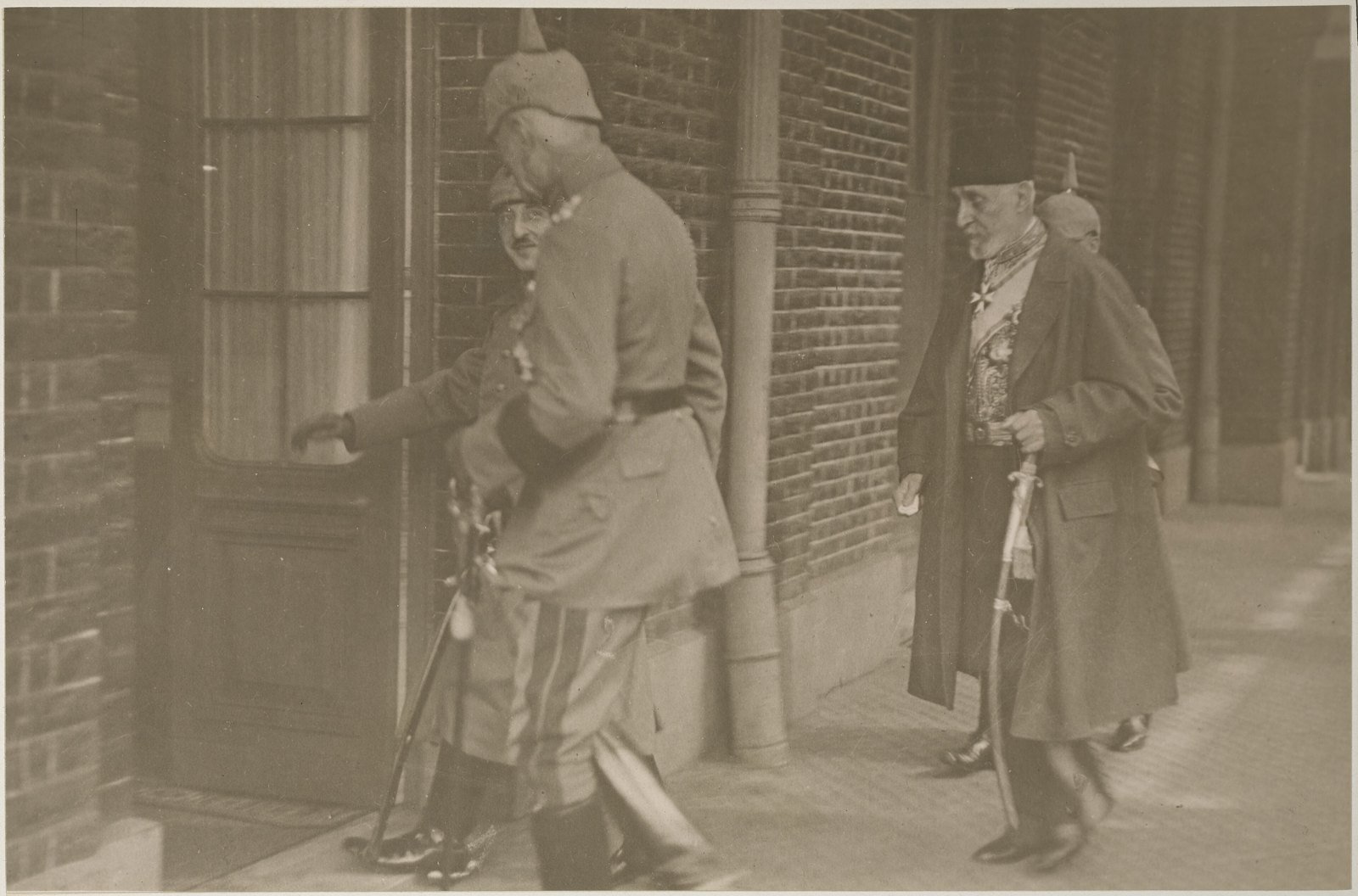
Wilhelm spent eighteen months at Amerongen, then moved into Huis Doorn, which he had bought in 1919, in May 1920. He stayed twenty-one years. He read, wrote his memoirs, and cut firewood most mornings. He never accepted that the army had not betrayed him.


From exile he wrote what he had never said from the throne.
To Field Marshal August von Mackensen on 2 December 1919 he described the Germans who deposed him as “egged on and misled by the tribe of Juda whom they hated, who were guests among them”, and wrote: “Let no German ever forget this, nor rest until these parasites have been destroyed and exterminated from German soil.”
To the American writer Poultney Bigelow in 1927: “Press, Jews & Mosquitoes … are a nuisance that humanity must get rid of in some way or another. I believe the best would be gas.”
These are private letters, published by his biographer John Röhl.
He praised the German victories of 1940 and was angry that Hitler would not restore the monarchy. He died at Doorn on 4 June 1941, aged eighty-two. His will of 1933 said he would be buried in Germany only if the monarchy had been restored by then, and it had not, so he was buried at Doorn on 9 June. He had asked for no Nazi emblems. Hitler sent a wreath and swastika flags, and Arthur Seyss-Inquart, the Reich Commissioner for the occupied Netherlands, attended.

The family that filled nine thrones had no seat at the quarrel that started the war. The lines of the family and the lines of the war were different lines.
Press & citation
Free to publish under CC BY 4.0 — in print, online, on Wikipedia and in teaching, commercially or not — with credit to Berlinfographics and a link to this page.
Ready-to-use image
The infographic as one image: headline, key figures, chart, sources and credit, 2,400 × 1,350 px PNG. Please use it unedited.
Download landscape (PNG)
Square format
A 1:1 version for social media and narrow columns, 1,800 × 1,800 px.
Download square (PNG)
Portrait 4:5
For Instagram and LinkedIn feeds, 1,620 × 2,025 px.
Download portrait (PNG)Credit line
Berlinfographics (berlinfographics.com), CC BY 4.0
Citation
Berlinfographics (2026). “Wilhelm II and the family on nine thrones, 1914”. Berlin Experiences. https://berlinfographics.com/wilhelm-ii-last-kaiser/
Wikipedia
{{cite web |title=Wilhelm II and the family on nine thrones, 1914 |url=https://berlinfographics.com/wilhelm-ii-last-kaiser/ |website=Berlinfographics |publisher=Berlin Experiences |date=2026-11-05 |access-date=2026-11-05}}
Our infographics, charts and texts are licensed CC BY 4.0: free to republish, including commercially, with credit to Berlinfographics and a link. Photographs keep their own licences, named in each caption. How to credit
Topics: The Second World War · Cold War Berlin · Nazi Berlin · Persecution & the Holocaust · Weimar Berlin · Prussia & the Kaiserreich · Architecture & the built city · Culture, science & society · Reunified Berlin · Unusual facts
Contact: info@berlinfographics.com · Press: press@berlinfographics.com · Imprint · Privacy