Berlinfographicsby Berlin Experiences

The office of the Minister for State Security in Haus 1 of the former Stasi headquarters, Berlin-Lichtenberg, now part of the Stasimuseum. Directive 1/76 went out in the Minister’s name.Photo: Anagoria, 2012. Wikimedia Commons. CC BY 3.0.

Zersetzung

The Stasi wrote down how to break a person without making an arrest. In 2019 Germany offered its victims €1,500.

Richtlinie Nr. 1/76, dated 1 January 1976, told East Germany’s secret police how to ruin opponents without a trial: wreck their reputation with half-truths, organise failure at work, sow mistrust among friends. Nobody knows how many people it hit.

1 Jan 1976
Richtlinie Nr. 1/76 is issued in the Minister’s name
7 + 5
forms and means of Zersetzung the directive lists
~5,000
people lastingly harmed: an estimate from 2007, not a count
€1,500
offered once to victims, on application, from 29 Nov 2019
01East Berlin, January 1976

A secret rule book for ruining a life

After the 1972 Basic Treaty the GDR won diplomatic recognition, joined the UN and signed the Helsinki Final Act. Mass arrests no longer fitted the image it wanted abroad; repression was to look quieter. The Stasi adapted. Its Richtlinie Nr. 1/76, on the development and handling of operational cases, set out in section 2.6 how to deal with opponents without putting them on trial. Zersetzung was meant for cases where an arrest did not seem politically opportune, as “a relatively independent way of closing an operational case”.

The order was a classified state secret, marked GVS MfS 008-100/76. It ran to 61 sheets and is now held by the Bundesarchiv as BArch, MfS, AGM, Nr. 198, Bl. 307-367. Section 2.6 names the goal in one sentence:

Opponents were to be “split up, paralysed, disorganised and isolated”.„zersplittert, gelähmt, desorganisiert und isoliert“Richtlinie Nr. 1/76, section 2.6.1

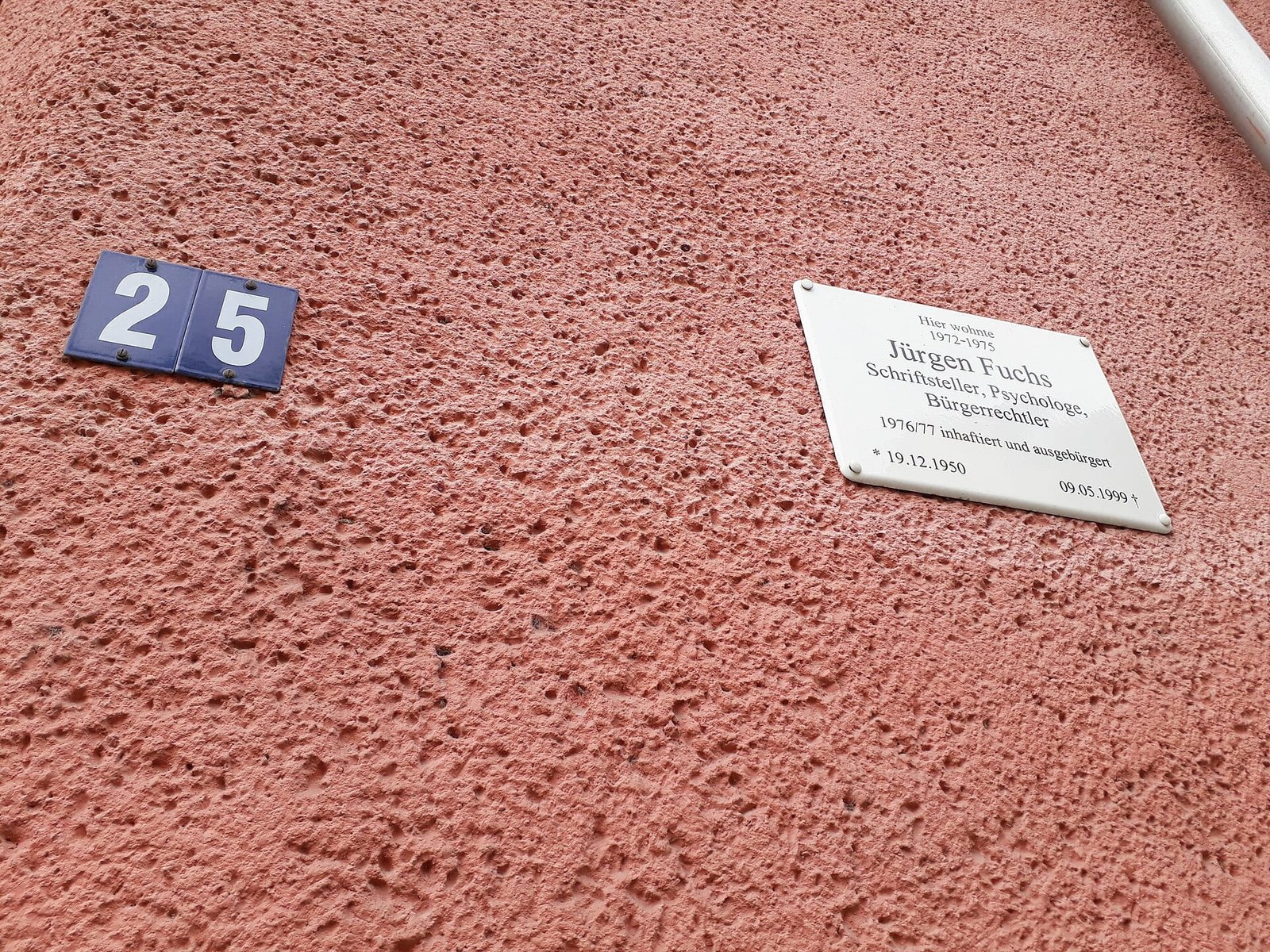
The tools were to be used “to be applied creatively and case by case”, and the work was to be done first and foremost by informers. The writer Jürgen Fuchs, imprisoned in 1976–77 and then expelled to the West, called it “quiet terror”, leiser Terror.

Richtlinie Nr. 1/76 · 2.6.2GVS

Forms of Zersetzung (7)

  1. Ruin reputation: systematically discrediting a person’s public reputation, standing and prestige, by mixing true, checkable and discrediting facts with untrue but believable claims that cannot be disproved.
  2. Organise failure: systematically organising failures at work and in public life, to undermine self-confidence.
  3. Undermine beliefs: undermining convictions tied to ideals and role models, and creating doubt about one’s own future.
  4. Sow mistrust: creating mistrust and mutual suspicion within groups.
  5. Stoke rivalries: creating and stoking rivalries within groups by exploiting members’ personal weaknesses.
  6. Tie them up: keeping groups busy with their own internal problems, to curb their activity.
  7. Keep them apart: cutting members of a group off from one another in place and time, for instance by job postings far away.

Proven means and methods (5)

  1. Plant informers: bringing in and deploying informers (IM), under cover stories.
  2. Letters & photos: anonymous or pseudonymous letters, telegrams and phone calls; compromising photographs, for instance of real or staged meetings.
  3. Spread rumours: deliberately spreading rumours about particular people.
  4. Let it be seen: targeted indiscretions, or faking the exposure of Stasi surveillance.
  5. Summon them: summoning people to state offices or organisations on believable or unbelievable pretexts.

Section 2.6.2 of the directive, translated and condensed. The German wording is quoted in the steps below.

A small white plaque on a rough red rendered wall beside a blue house number 25.
The plaque for the writer Jürgen Fuchs at Lutherstraße 25, Jena: “1976/77 imprisoned and expatriated”. Fuchs called Zersetzung “quiet terror”.Photo: Aschroet, 2017. Wikimedia Commons. CC0.

Richtlinie Nr. 1/76, section 2.6.2: the toolbox

The forms and means of Zersetzung listed in Directive 1/76, and the measures of the 1983 plan against the Pankow peace circle that used them.

From Richtlinie Nr. 1/76, section 2.6.2, and the Pankow plan as published by the Stasi-Unterlagen-Archiv. Labels condensed.

A tall grey-brown office block with rows of windows behind a concrete forecourt.
Haus 1 of the former Stasi headquarters in Berlin-Lichtenberg, now the Stasimuseum.Photo: Angela Monika Arnold (=44Pinguine), 2015. Wikimedia Commons. CC BY 2.5.

Section 2.6.1 · the aim

Split them, paralyse them, isolate them

The directive turned the Stasi from arresting opponents to taking them apart. Groups were to be split, paralysed, disorganised and isolated, and their activity stopped before it happened.

Section 2.6.2 · against a person

Ruin the name, organise the failure

Against a person, the directive lists systematically discrediting a person’s public reputation, mixing true facts with believable lies, and systematically organising failures at work and in public life.

Section 2.6.2 · against a group

Turn friends into suspects

Against groups: mistrust and mutual suspicion, stoked rivalries, quarrels that kept members busy, and postings that kept them apart.

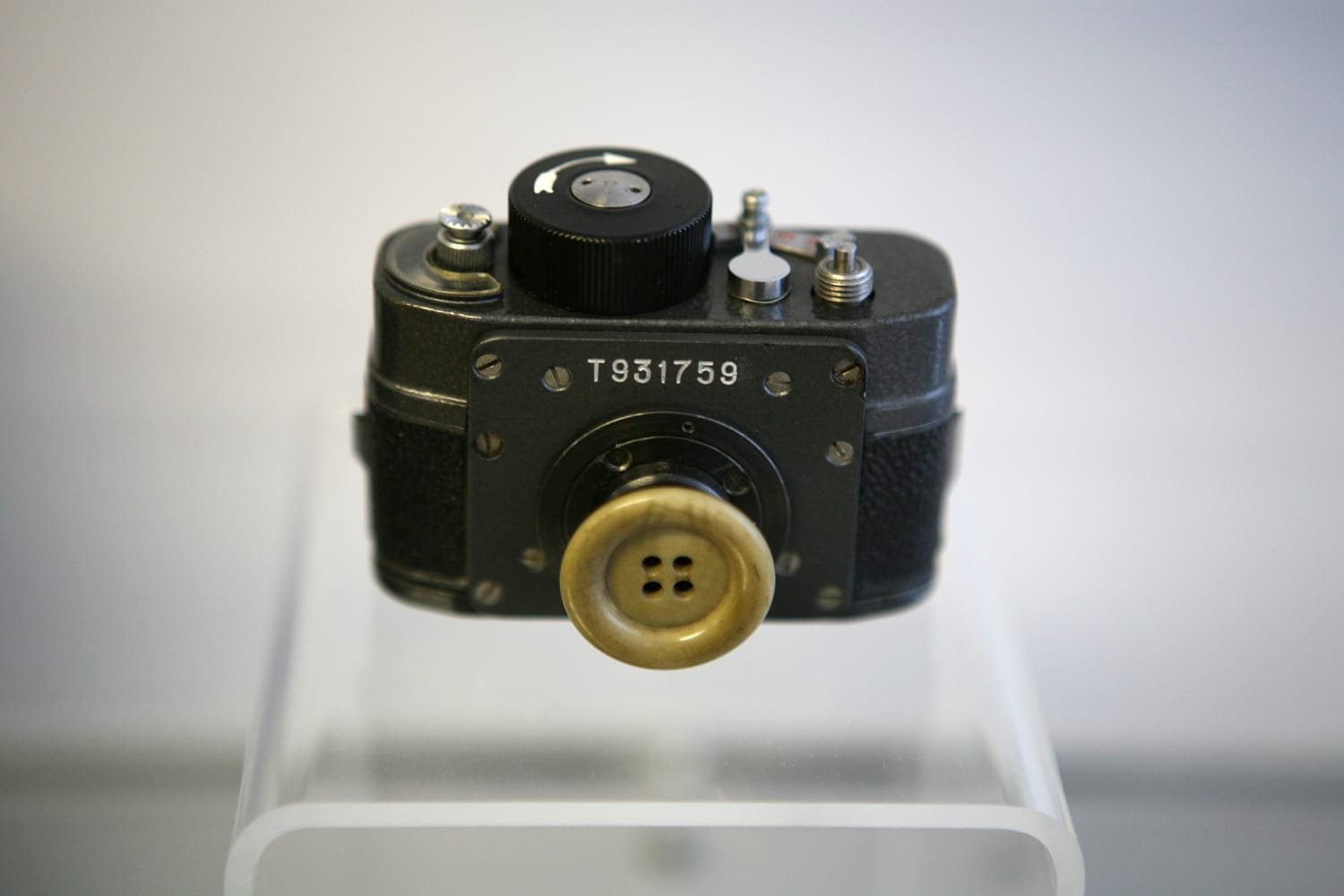
A small black camera on a clear stand with a brass coat button fixed over its lens.
A Stasi buttonhole camera in the Stasimuseum, Berlin: it was hidden in clothing, with a coat button screwed over the lens.Photo: Roi Boshi, 2008. Wikimedia Commons. Public domain.

Section 2.6.2 · the means

Letters, rumours, and being seen

Informers, anonymous letters and compromising photos, rumours, summonses on any pretext, and faked “exposure” of Stasi surveillance. Officers who entered a flat in secret sometimes left a sign on purpose.

A red-brick church with two slender spires behind fir trees, a tram line and a quiet street in front.
The old parish church in Pankow. The peace circle that the Stasi set out to break up in 1983 worked under the roof of the Pankow parish.Photo: Dguendel, 2013. Wikimedia Commons. CC BY 3.0.

Pankow · 9 August 1983

Plan for Zersetzung, OV “Virus”

A peace circle had formed in the Pankow parish in 1981. The plan sent 25–30 Stasi students to its open evenings, in 6 groups of 5, to argue until the regulars stayed away.

Pankow · measure 2

Break the marriage

An informer was to tell the husband of an alleged affair, a fake Jehovah’s Witness was to show parishioners faked photographs, and a female informer was to seduce the husband. The photos were to be “produced by retouching, copying and photomontage”.

Pankow · measure 3

A break-in that was a search

A secret search of a leading member’s flat, disguised as a burglary, to take the minutes this member kept of every meeting. Records and valuables were to be “stolen” too, to hide the purpose.

Pankow · measure 4

Take away the job

Another leading member was to be expelled from the ruling party and then removed from her job as a publisher’s editor. The archive’s verdict: in the short run the secret police succeeded: the group almost stopped working.

Portrait of a grey-haired man in a light blue shirt and an olive jacket.
Wolfgang Templin, civil-rights campaigner, in 2022.Photo: Rudolf H. Boettcher, 2022. Wikimedia Commons. CC BY-SA 4.0.

Wolfgang Templin · Berlin

Answers to ads he never wrote

Strangers kept turning up at Wolfgang Templin’s door, sure he had answered their small ads. Then deliveries of live chicks were announced and the police came to investigate his “business”. He went public, Der Spiegel ran a report, and the Stasi broke the measure off.

A man with a moustache in a dark parka with a fur-lined hood, pack ice behind him.
Siegfried Reiprich in 1987, on the way to the Georg von Neumayer research station in Antarctica.Photo: Siegfried Reiprich, 1987. Wikimedia Commons. CC BY-SA 3.0.

Siegfried Reiprich · Jena, 1976

Made to look like an informer

In November 1976 the Stasi arrested several people from a Jena case code-named “Pegasus”, but left Siegfried Reiprich free on purpose and spread word that he was its informer. The rumour held until the files were opened.

02Berlin, 1990–92

Most victims only found out when they read their files

Zersetzung was built to look like bad luck: a stalled career, a rumour, a friend who turned cold. The people it targeted had no way to prove who was behind it. That changed when crowds stormed the Stasi headquarters in Berlin on 15 January 1990.

A night crowd at a gate holding a hand-lettered banner and umbrellas.
The demonstration called by the Neues Forum outside the Stasi headquarters in Lichtenberg, 15 January 1990. The banner reads “Stasi into production. No extra pay, only a performance wage.”Photo: Bundesarchiv, Bild 183-1990-0115-026 / Uhlemann, Thomas / CC BY-SA 3.0 de
A dense crowd of people of all ages under a large banner.
At the demonstration at the headquarters on Normannen- and Ruschestraße (East German press agency photo dated 16 January 1990). The banner reads “Enough of the Stasi and SED dictatorship and Nazism”.Photo: Bundesarchiv, Bild 183-1990-0116-013 / Uhlemann, Thomas / CC BY-SA 3.0 de

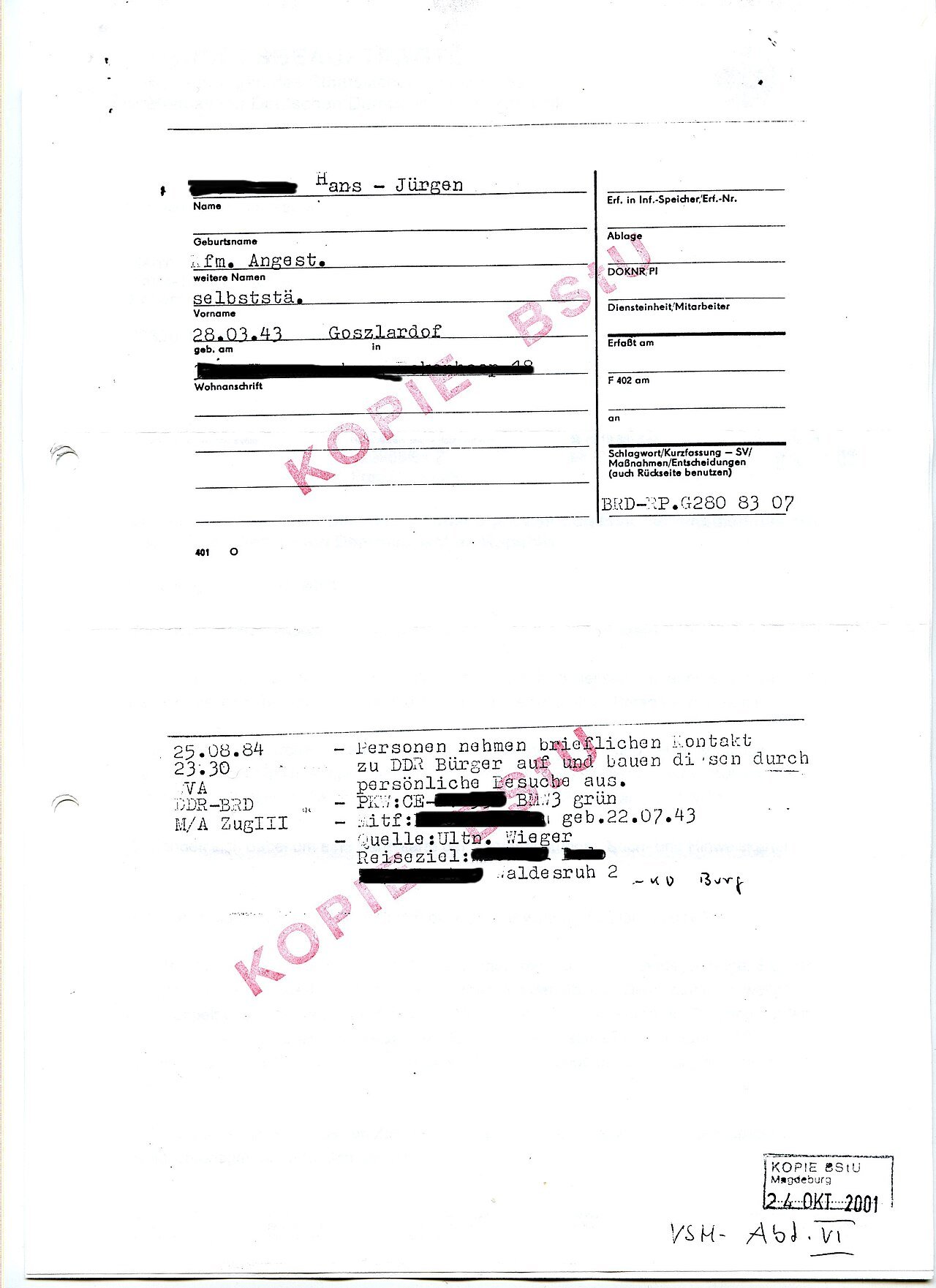
The Stasi Records Act came into force on 29 December 1991. On 2 January 1992 the first citizens could read their own files. Some found the plans made against them, and the cover names of the informers around them.

The rumour that Siegfried Reiprich had been a Stasi informer, planted in 1976, only fell apart once the files were opened. The records passed to the Bundesarchiv on 17 June 2021.

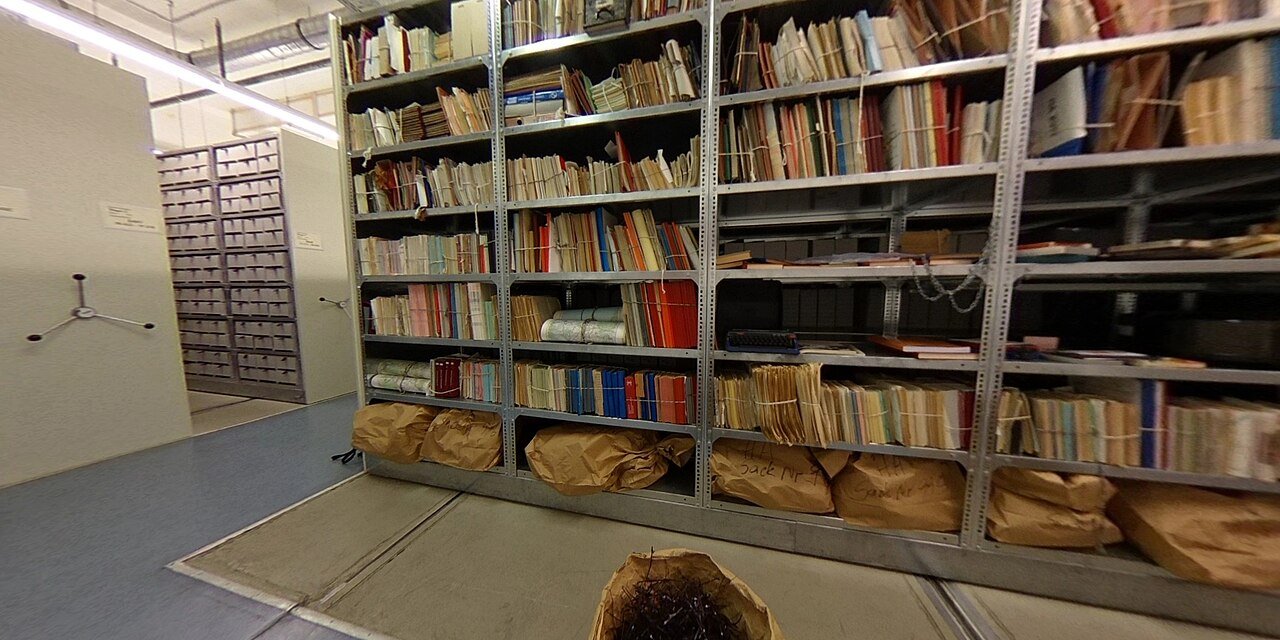
Grey metal shelving with file boxes and bound volumes, and brown paper sacks on the floor shelf.
The entrance of the Stasi records depot in Berlin-Lichtenberg: files on the shelves, and sacks of torn-up documents on the bottom row.Photo: Maximilian Schönherr, 2018. Wikimedia Commons. CC BY-SA 4.0.
A photocopied index card and a typed report entry, several lines blacked out, stamped “Kopie BStU”.
What a person gets back from the archive: a copy of a Stasi index card and report entry, issued in 2001, with other people’s names blacked out under the Stasi Records Act.Photo: Hajotthu, Wikimedia Commons, CC BY 3.0.

03The count

How many people did it hit? Nobody kept count

There is no register of Zersetzung victims, and the numbers in circulation are estimates of different things. An expert report for the Bundestag put those affected at a four- to five-digit number (Sonja Süß, 1999). In 2007 the Saxon State Commissioner for the Stasi records estimated about 5,000 people who count as lastingly harmed.

A wider measure, people held back at work or in education, runs up to 200,000 (Bernd Eisenfeld, 2010). The figures are drawn on a log scale, so that a range of thousands and a range of hundreds of thousands both fit.

04Recognition

Former prisoners got a monthly pension in 2007. For Zersetzung, a one-off payment came in 2019

In 2007 the Bundestag gave former political prisoners a monthly payment, €250 a month at the start, for those held for at least six months. People who had been taken apart rather than locked up got nothing from it.

Only on 29 November 2019 did the law name Zersetzung outright, with a payment for a measure “aimed at Zersetzung”: €1,500, once. That was 43 years after the directive.

What the law now says. A person whose persecution is recognised and who was targeted by “a measure aimed at Zersetzung” can apply for a one-off payment of €1,500. It cannot be passed on to heirs.

The Stasi wrote down how to break people without a trial, and nobody kept count of whom it broke. It took 43 years for the law to name Zersetzung and offer its victims €1,500.

Press & citation

Use this Berlinfographic

Free to publish under CC BY 4.0 — in print, online, on Wikipedia and in teaching, commercially or not — with credit to Berlinfographics and a link to this page.

Zersetzung: the Stasi’s rule book for breaking people: ready-to-use landscape image

Ready-to-use image

The infographic as one image: headline, key figures, chart, sources and credit, 2,400 × 1,350 px PNG. Please use it unedited.

Download landscape (PNG)
Zersetzung: the Stasi’s rule book for breaking people: square version

Square format

A 1:1 version for social media and narrow columns, 1,800 × 1,800 px.

Download square (PNG)
Zersetzung: the Stasi’s rule book for breaking people: portrait version

Portrait 4:5

For Instagram and LinkedIn feeds, 1,620 × 2,025 px.

Download portrait (PNG)

Credit line

Berlinfographics (berlinfographics.com), CC BY 4.0

Citation

Berlinfographics (2026). “Zersetzung: the Stasi’s rule book for breaking people”. Berlin Experiences. https://berlinfographics.com/zersetzung-toolbox/

Wikipedia

{{cite web |title=Zersetzung: the Stasi’s rule book for breaking people |url=https://berlinfographics.com/zersetzung-toolbox/ |website=Berlinfographics |publisher=Berlin Experiences |date=2026-11-09 |access-date=2026-11-09}}