Berlinfographicsby Berlin Experiences

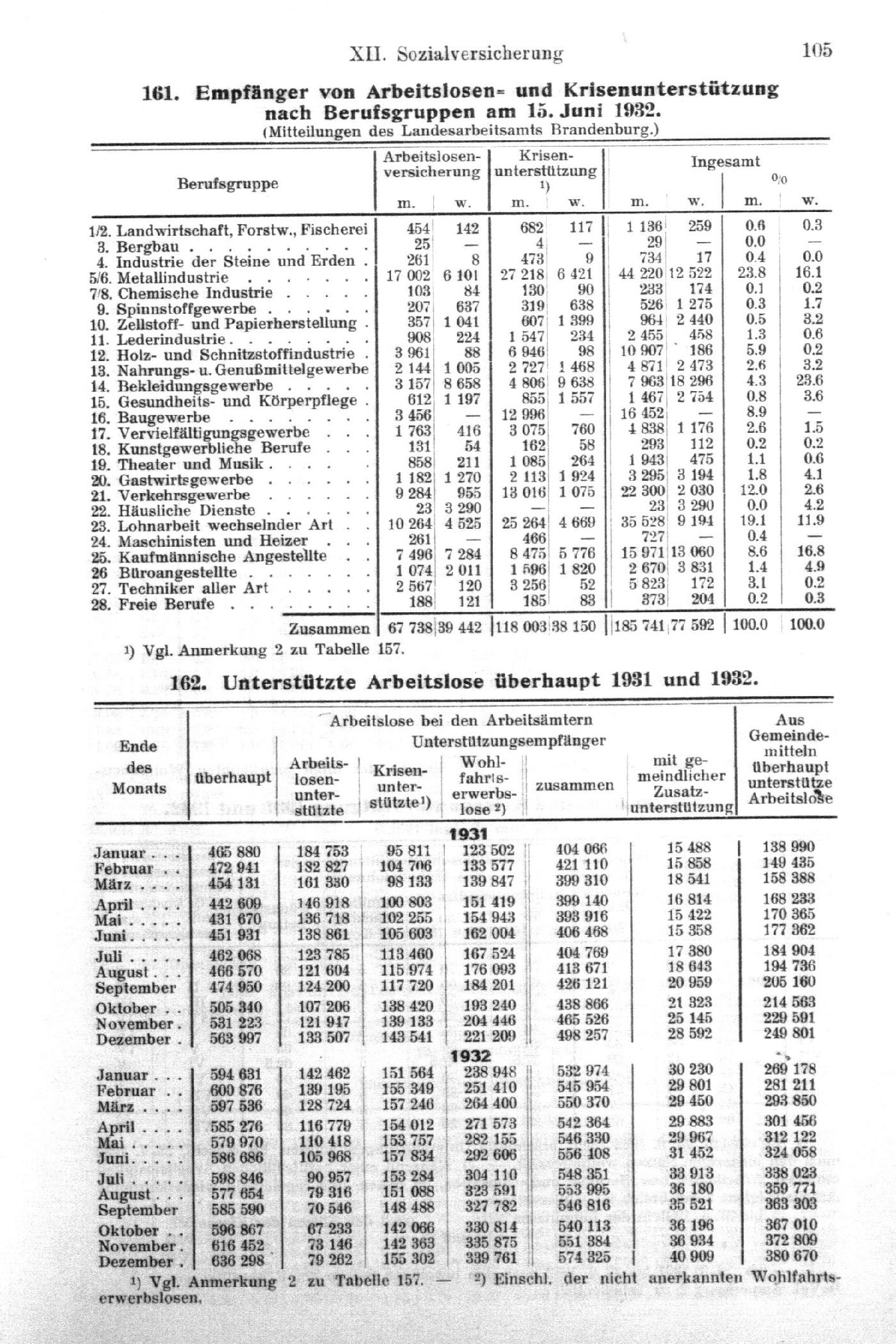
Savers crowd the doors of the city savings bank in Berlin on 13 July 1931, the day the Danatbank closed its counters. The archive caption reads “Im Kampf um ihre Spareinlagen!” (“Fighting for their savings!”).Photo: Bundesarchiv, Bild 102-12023 / Georg Pahl / CC BY-SA 3.0 de · behind it, the yearbook page of 1933’s counts

The Depression

At the end of January 1933, the month Hitler became chancellor, 654,878 Berliners were registered unemployed: 155 in every 1,000 people in the city

Berlin’s statistical office counted the unemployed at the city’s labour exchanges at the end of every month. Its tables, month by month from 1931 to 1933, follow the slump through a bank crash, a transport strike and the elections of 1932 to its peak, in the month Hitler took power.

654,878
registered unemployed in Berlin, end of January 1933
155per 1,000
inhabitants out of work that month, counting children and the old
13%
of them drawing unemployment insurance; most lived on crisis relief or city welfare
28.6%
for the Nazi Party in Berlin, 31 Jul 1932, against 37.3% across Germany

01The city’s own count

Every month, a number

The figures here are the city’s own. Each month the Statistisches Amt der Stadt Berlin printed how many people were registered as out of work at the nine Berlin labour exchanges on the last day of the month, and who supported them.

At the end of January 1931 the count stood at 465,880. Two years later it was 654,878, the highest of the 36 months the yearbooks give. The yearbook divided that into a rate for the whole population, babies and pensioners included:

155

registered unemployed for every 1,000 inhabitants of Berlin, end of January 1933

1,000 dots, 155 lit. Source: Statistisches Jahrbuch der Stadt Berlin 1934, table 167.

A printed statistics page in German with two tables of figures, headed “167. Unterstützte Arbeitslose überhaupt 1933”.
Page 124 of the city’s statistical yearbook for 1934. Table 167 counts the unemployed at Berlin’s labour exchanges at the end of every month of 1933, with the rate per thousand inhabitants beneath. January heads the column.Document: Statistisches Amt der Stadt Berlin, 1934. Zentral- und Landesbibliothek Berlin. Public domain.

Registered unemployed in Berlin, end of each month

The number of unemployed registered at the Berlin labour exchanges at the end of each month, January 1931 to December 1933, on a linear scale from zero.

One dot per month: the unemployed registered at the Berlin labour exchanges on the last day of each month, January 1931 – December 1933. Linear scale from zero; lines only join the monthly counts. Source: Statistisches Jahrbuch der Stadt Berlin 1933 and 1934.

An elderly woman in a headscarf and a young man eat soup at a long table with a white cloth and a soup tureen; a woman sits behind them.
A Wärmehalle in Neukölln, January 1931.Photo: Bundesarchiv, Bild 102-11020 / Unknown author / CC BY-SA 3.0 de

January 1931

465,880 out of work

That was the count at the end of January 1931. Heinrich Brüning had been chancellor since 30 March 1930, pushing a deflationary policy for a balanced budget through with the president’s emergency-decree powers.

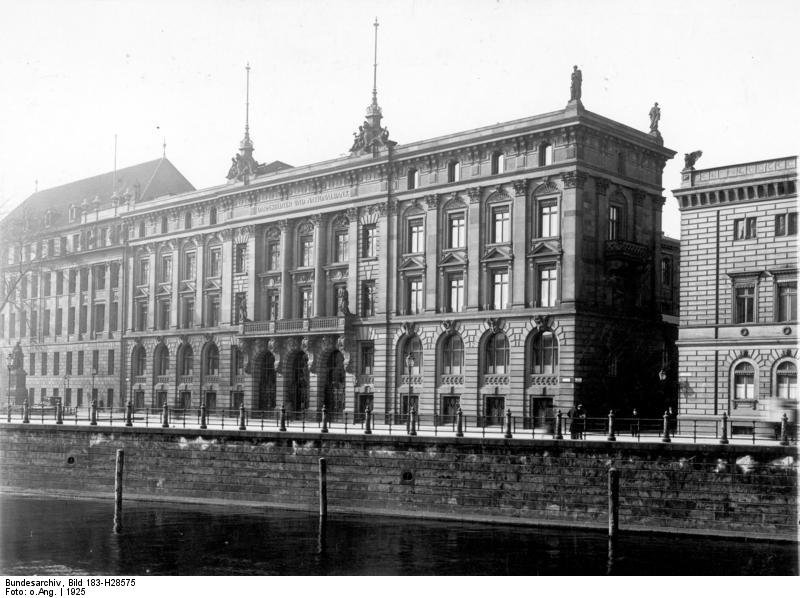
A large ornate stone office building with a mansard roof, seen across a canal.
The Danatbank’s head office, Schinkelplatz, 1925.Photo: Bundesarchiv, Bild 183-H28575 / Unknown author / CC BY-SA 3.0 de

13 July 1931

The Danatbank shuts its doors

The Danatbank closed its counters on 13 July, and the government declared 14 July and 15 July bank holidays. At the end of the month 462,068 Berliners were registered unemployed.

Two men in evening dress talking on a sofa beside a small table with flowers, 1931.
Hans Luther (Reichsbank) and Heinrich Brüning, 1931.Photo: Erich Salomon, 1931. Wikimedia Commons. Public domain.

30 May 1932

Brüning goes

The count had passed 600,000 for the first time in February 1932, at 600,876. Brüning resigned on 30 May, a month in which 579,970 were out of work.

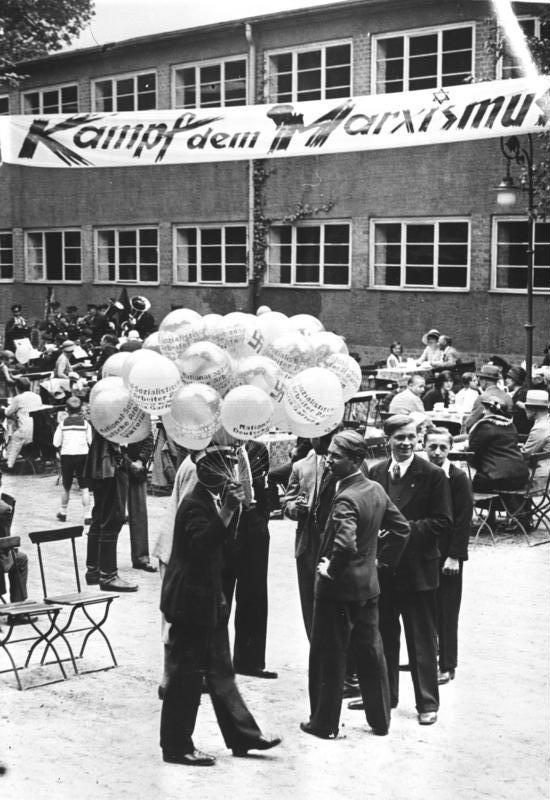
Men in suits stand in a beer garden holding a bunch of balloons printed with swastikas, under a long banner reading Kampf dem Marxismus.
Nazi campaign in Berlin, 1932: a propaganda scene, shown as a record.Photo: Bundesarchiv, B 145 Bild-P046281 / Weinrother, Carl / CC BY-SA 3.0 de

31 July 1932

The Nazi Party comes first in Berlin

It took 28.6% of the city’s vote, far below its 37.3% across Germany. The Social Democrats and Communists each had 27.3%. That month’s count: 598,846.

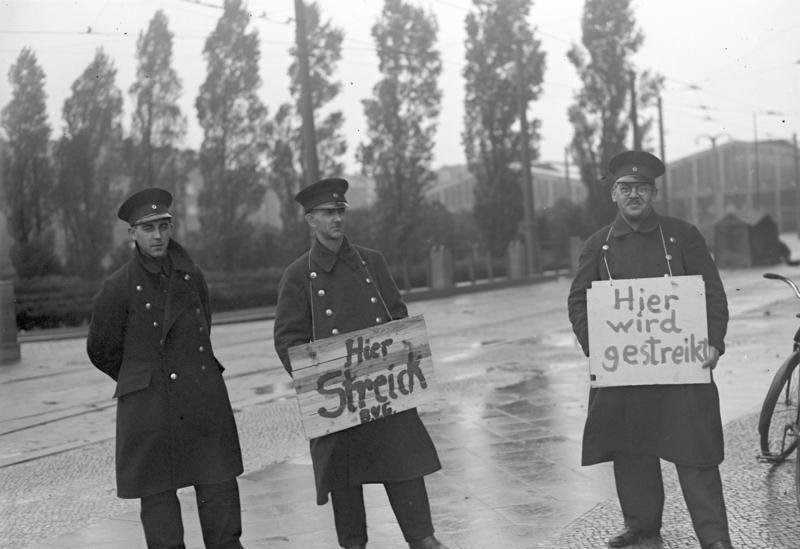
Three men in uniform coats and caps stand on a wet street, two wearing placards reading Hier wird gestreikt and Hier Streik.
Strike pickets at the Müllerstraße tram depot, November 1932.Photo: Bundesarchiv, Bild 102-13991 / Unknown author / CC BY-SA 3.0 de

3 November – 7 November 1932

The trams stop

The Communist RGO and the Nazi NSBO called out the BVG’s workers against a cut of two pfennigs an hour. Police bullets killed three people. At the election of 6 November the KPD came first in Berlin with 31.0%.

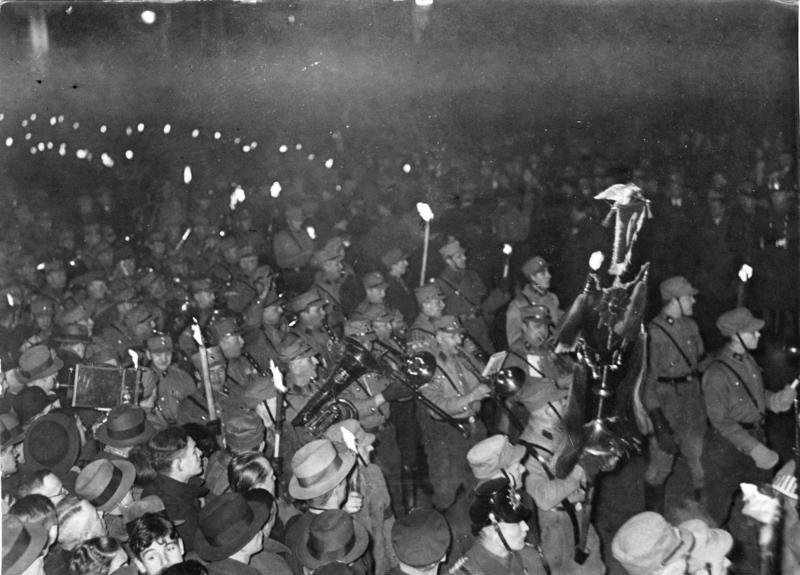
At night, a column of uniformed men carrying flaming torches marches past a crowd, lit by the torches.
The torchlight parade on Wilhelmstraße, 30 January 1933.Photo: Bundesarchiv, Bild 102-02985A / Unknown author / CC BY-SA 3.0 de

30 January 1933

The peak, and Hitler

Hindenburg appointed Hitler chancellor, and that evening Nazi torchlight parades marched through the Brandenburg Gate. At the end of the month the count reached 654,878, its highest.

A printed statistics page in German with two tables of figures, headed “167. Unterstützte Arbeitslose überhaupt 1933”.
The yearbook’s 1933 table, page 124.Document: Statistisches Amt der Stadt Berlin, 1934. Zentral- und Landesbibliothek Berlin. Public domain.

December 1933

Still above where it started

By December the count was down to 520,356. That was still more than the 465,880 of January 1931.

03Berlin, July 1931

The summer the banks closed

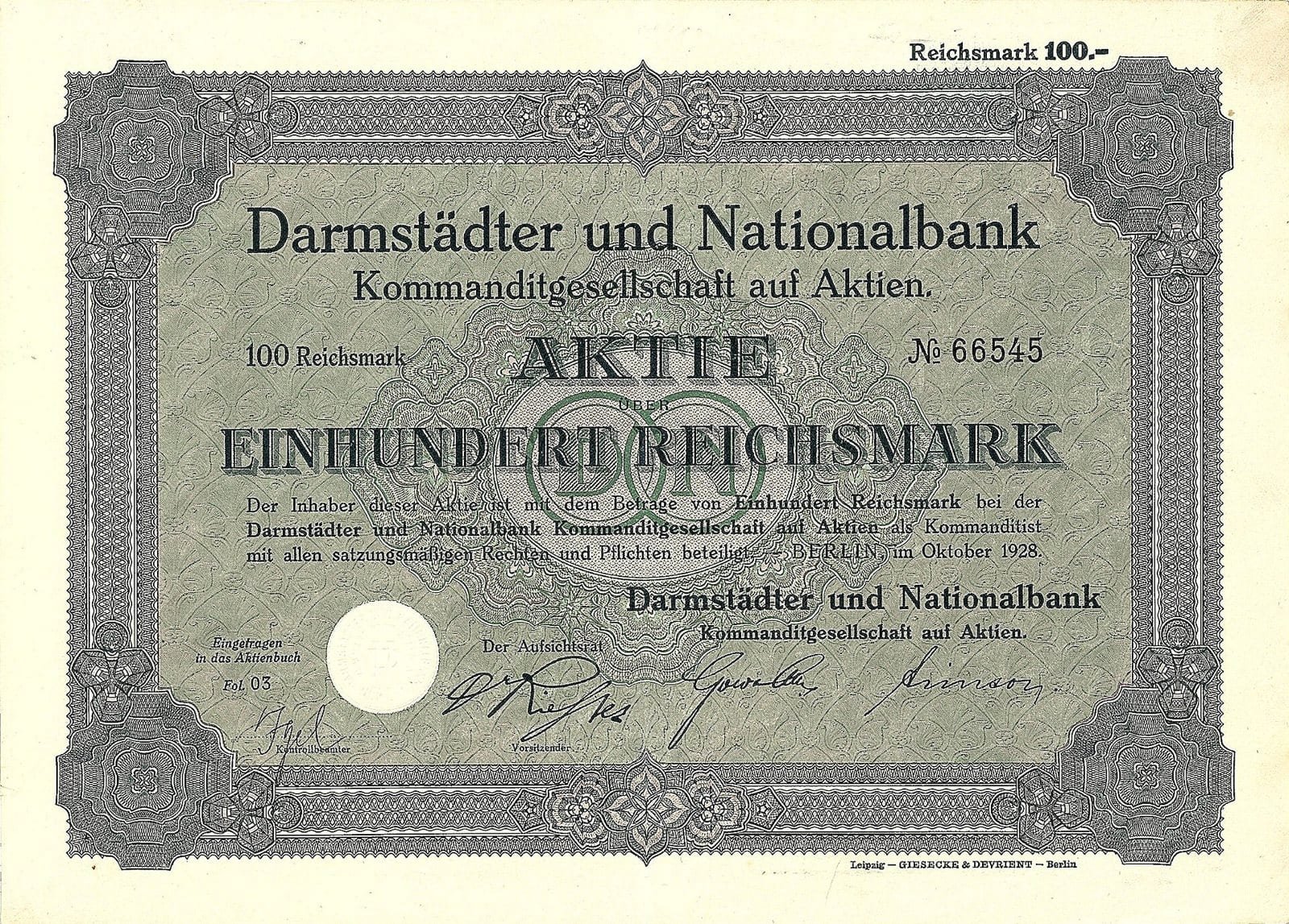
In July 1931 the crisis reached the banks. The Darmstädter und Nationalbank, the Danatbank, with its head office on the Schinkelplatz in Berlin, announced that it would close its counters on 13 July 1931. The same day savers crowded the doors of the city savings bank, in the photograph at the top of this story.

The Reich government declared 14 July and 15 July general bank holidays. At the Reichsbank sat Hans Luther, its president since 11 March 1930. For the rest of 1931 Berlin’s count rose every month, from 462,068 in July to 563,997 in December.

A green engraved share certificate headed “Darmstädter und Nationalbank, Kommanditgesellschaft auf Aktien”, “Aktie, Einhundert Reichsmark”.
A Danatbank share certificate for 100 Reichsmark, issued in Berlin in October 1928.Document: Darmstädter und Nationalbank, 1928. Wikimedia Commons. CC0.
Two men in evening dress talking on a sofa beside a small table with flowers, 1931.
Hans Luther, president of the Reichsbank from March 1930, with Chancellor Heinrich Brüning, photographed by Erich Salomon in 1931.Photo: Erich Salomon, 1931. Wikimedia Commons. Public domain.

04The ballot box

Berlin voted Nazi less than Germany did, every time

As the count rose, so did the Nazi vote in Berlin: 1.6% in 1928, 14.6% in September 1930, 28.6% in July 1932. But at every election it stayed below the party’s share across Germany.

In November 1932, days after the BVG strike, the Nazi vote in Berlin fell to 26.0% and the Communists came first with 31.0%. It was the last free Reichstag election. Twelve weeks later Hindenburg made Hitler chancellor.

All eight Weimar elections in Berlin →

Share of the vote in Berlin, Reichstag elections 1928–1932

NSDAP (Nazi Party)NSDAP across GermanyKPD (Communists)SPD (Social Democrats)

Greater Berlin. Linear scale from zero. Source: Statistisches Jahrbuch der Stadt Berlin and Statistik des Deutschen Reichs, via wahlen-in-deutschland.de.

Hindenburg, in a long dark coat, stands at the top of the Reichstag steps among men in uniform and in civilian coats.
Paul von Hindenburg (centre) leaving the Reichstag in 1925, the year he was elected president. As president he appointed Hitler chancellor on 30 January 1933.Photo: Agence Rol, 1925. Via Wikimedia Commons (Public domain).

Berlin never gave the Nazi Party even its national share of the vote. The party took power anyway, in the month the city’s count of the unemployed peaked.

Press & citation

Use this Berlinfographic

Free to publish under CC BY 4.0 — in print, online, on Wikipedia and in teaching, commercially or not — with credit to Berlinfographics and a link to this page.

Berlin in the Depression, 1931–1933: ready-to-use landscape image

Ready-to-use image

The infographic as one image: headline, key figures, chart, sources and credit, 2,400 × 1,350 px PNG. Please use it unedited.

Download landscape (PNG)
Berlin in the Depression, 1931–1933: square version

Square format

A 1:1 version for social media and narrow columns, 1,800 × 1,800 px.

Download square (PNG)
Berlin in the Depression, 1931–1933: portrait version

Portrait 4:5

For Instagram and LinkedIn feeds, 1,620 × 2,025 px.

Download portrait (PNG)

Credit line

Berlinfographics (berlinfographics.com), CC BY 4.0

Citation

Berlinfographics (2026). “Berlin in the Depression, 1931–1933”. Berlin Experiences. https://berlinfographics.com/berlin-depression-1929/

Wikipedia

{{cite web |title=Berlin in the Depression, 1931–1933 |url=https://berlinfographics.com/berlin-depression-1929/ |website=Berlinfographics |publisher=Berlin Experiences |date=2026-11-09 |access-date=2026-11-09}}