BundestagTwenty-one federal elections · 1949–2025
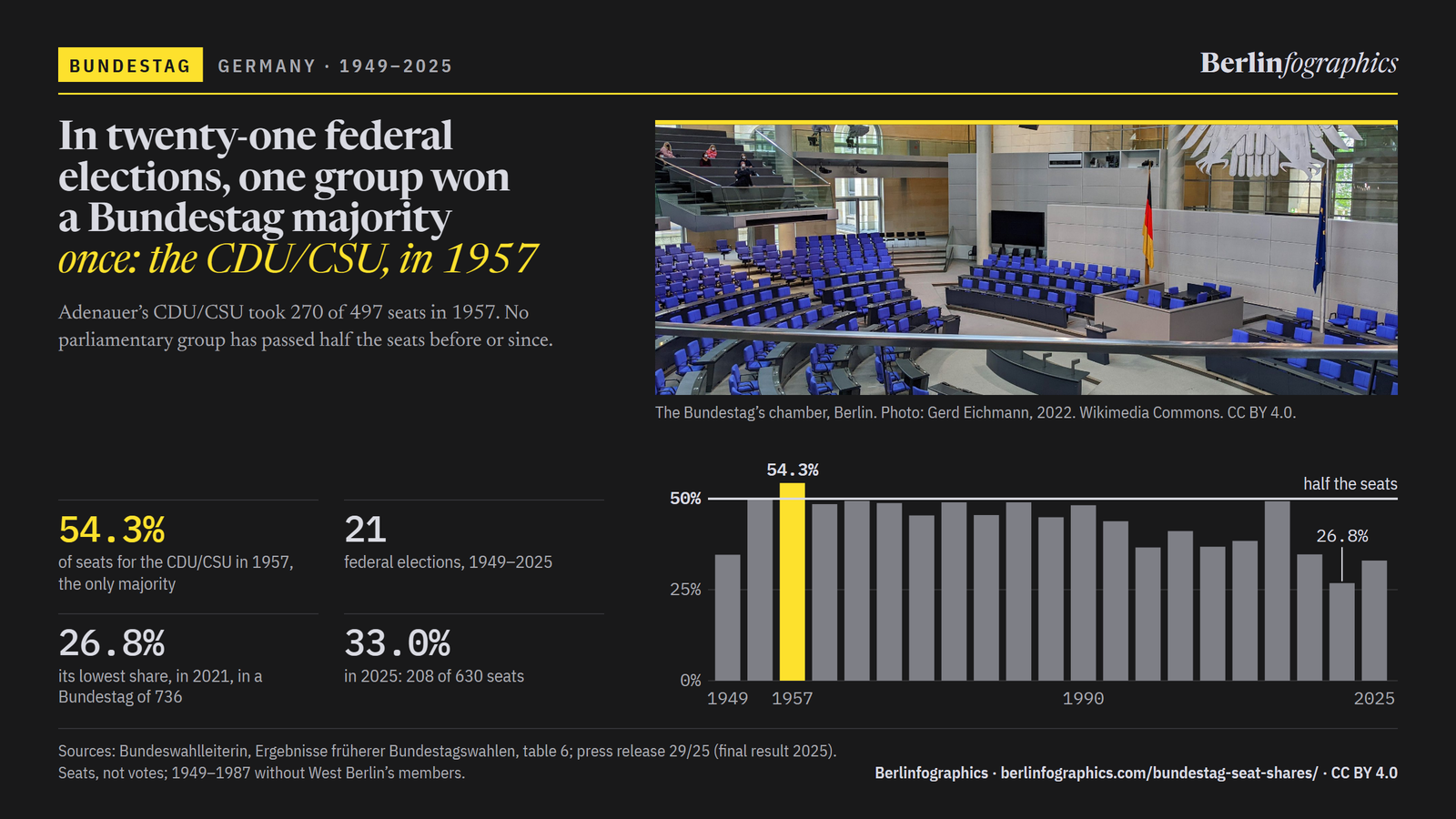
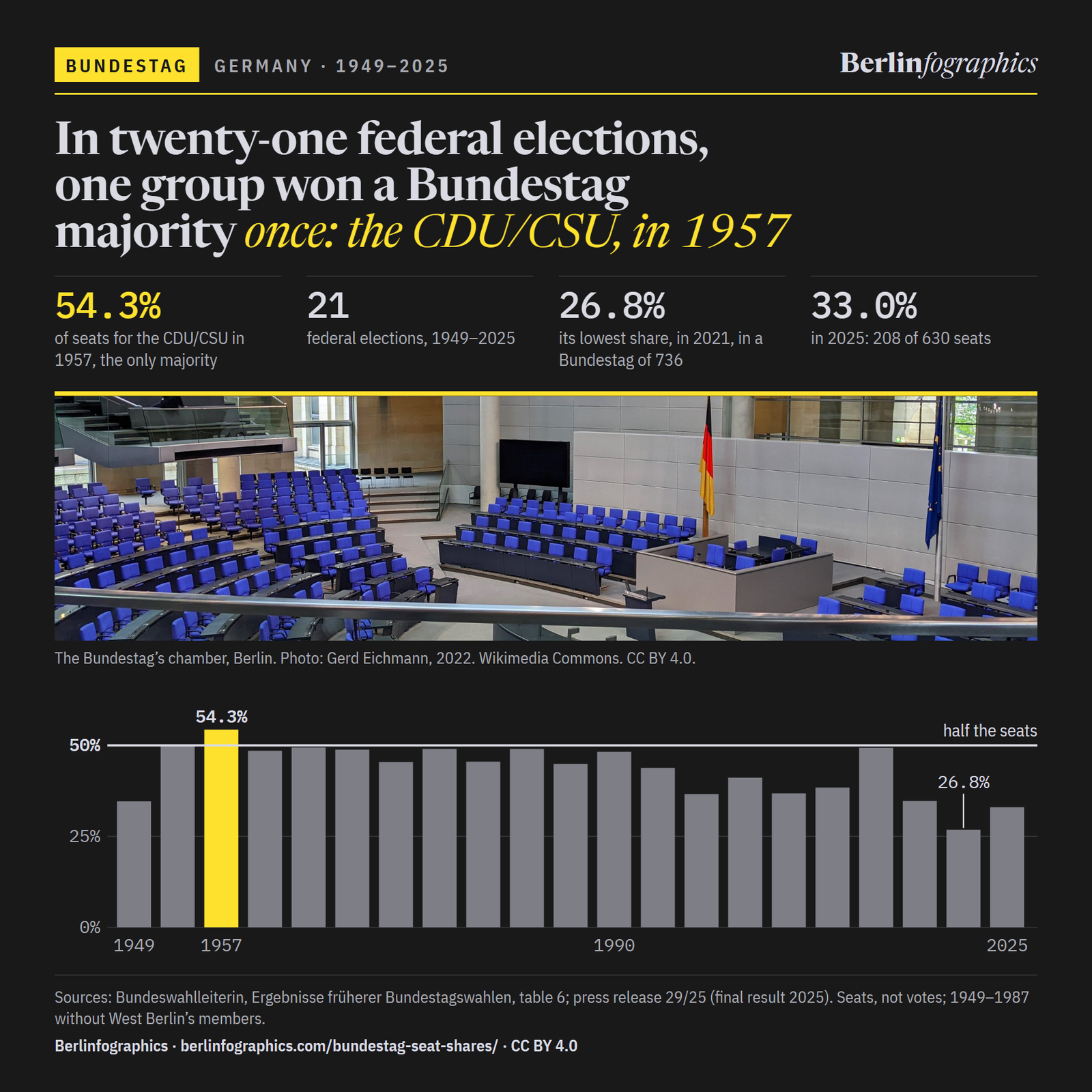
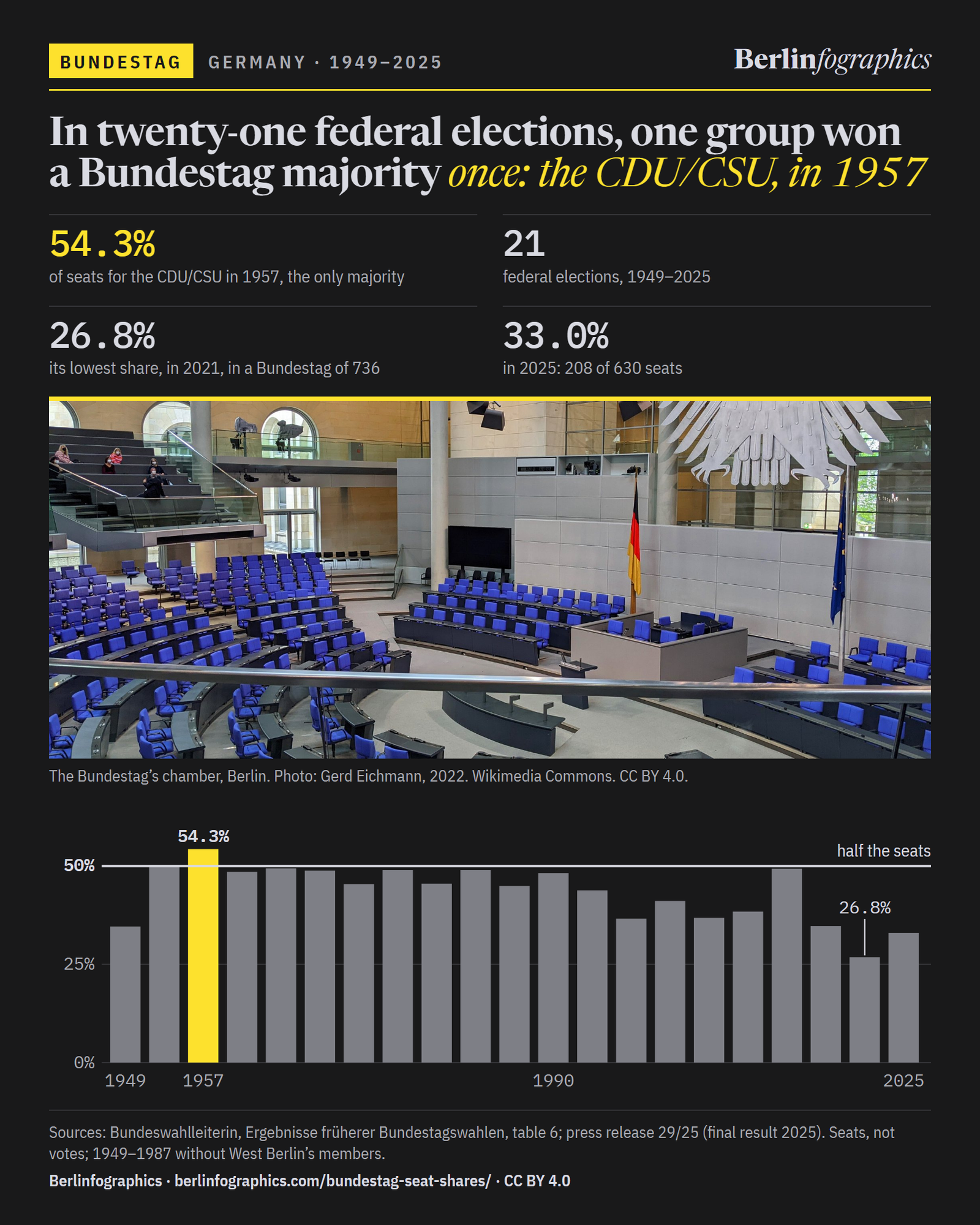
Germans have elected a new Bundestag twenty-one times since 1949. Just once, in 1957, did one group take more than half the seats: 270 of 497 seats, 54.3%. Every other result left the largest group needing partners.
Scroll through every Bundestag
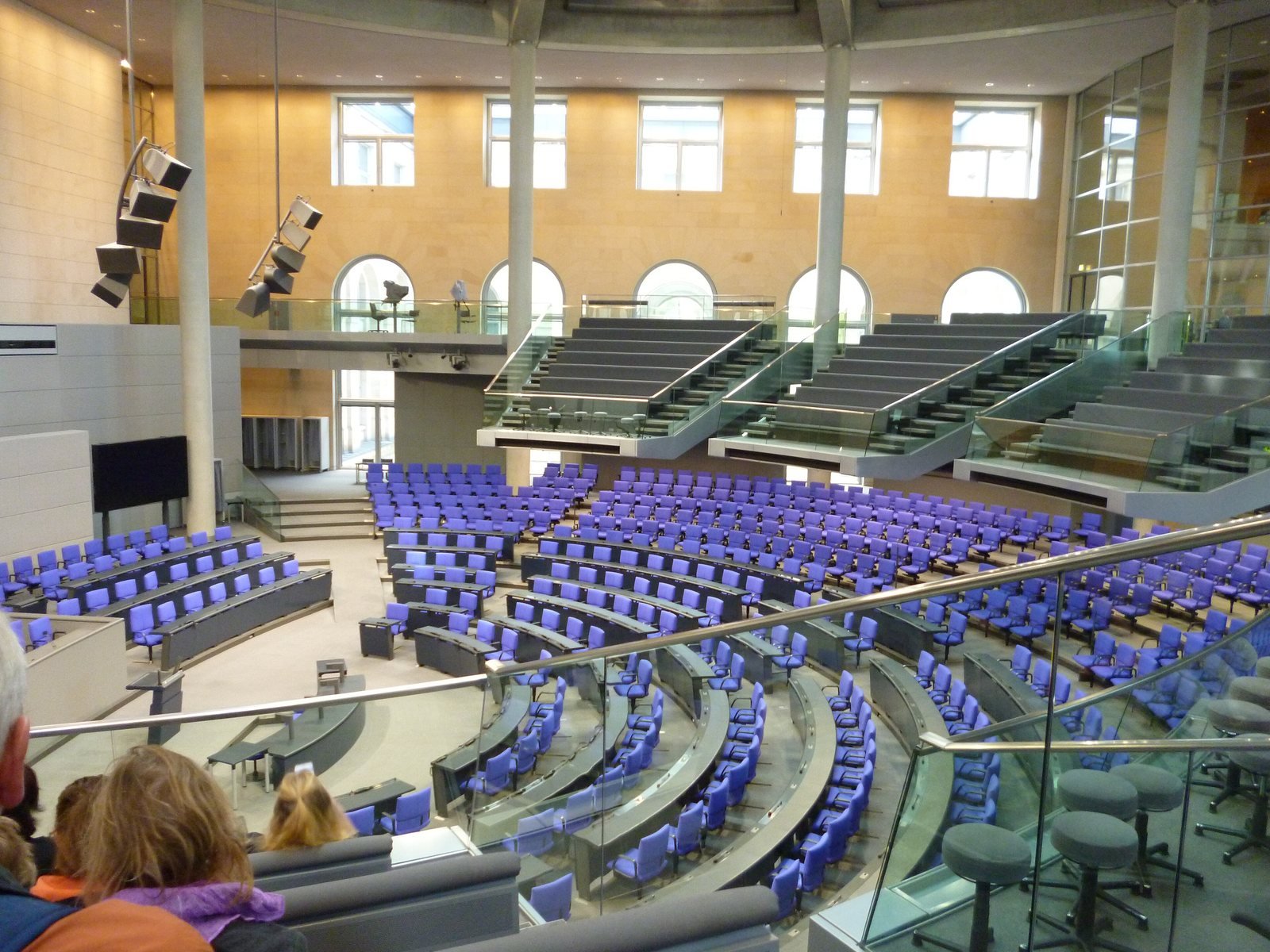
The plenary chamber of the Bundestag in the Reichstag building, Berlin, April 2022, under the federal eagle.Gerd Eichmann, 2022. Wikimedia Commons. CC BY 4.0.
01The only majority
The CDU and its Bavarian sister party, the CSU, sit in the Bundestag as one parliamentary group, the CDU/CSU; the CSU stands for election only in Bavaria. In 1957, under Konrad Adenauer, that group won 270 of 497 seats: 54.3%, an absolute majority.
No group had done it before, in 1949 or 1953, and none has done it since. The CDU/CSU’s worst result came in 2021: 26.8% of the seats. At the last election, in 2025, it won 33.0%, and still leads the government.

02Every Bundestag, seat by seat
Each row is one Bundestag, as long as it had seats, from 402 in 1949 to 736 in 2021. Yellow is the CDU/CSU, grey everyone else. The white mark is a majority: one seat more than half. Scroll, and the Republic votes.
03West Berlin’s members
From 1949 to 1987 the official results list the members for Berlin (West) separately, in brackets, and the rows above leave them out. In 1957 there were 22 of them. Put them back, and the CDU/CSU held 277 of 519 seats, 53.4%: still a majority, and still the only one.
CDU/CSU seats in 1957, against a majority

04Seats and power
Measured against half the chamber, the CDU/CSU has been above the line once and within one point of it three times. But in the Bundestag, coalitions decide who governs. After fourteen of the twenty-one elections the chancellor came from the CDU, after the other seven from the SPD, and the size of the CDU/CSU’s share did not decide which.
CDU/CSU seat share above or below half, percentage points, and the chancellor’s party after each election

05A growing chamber
Every Bundestag has had a different size. Overhang and equalisation seats, added on top of the standard size by the electoral law, pushed it to 709 in 2017 and 736 in 2021, the largest it has ever been. The electoral reform of 2023 fixed it at 630 seats, starting with the election of 2025.
Seats in each Bundestag, with the CDU/CSU’s share
06The Bundestag today
The 2025 Bundestag has 630 members; a majority is 316. The CDU/CSU’s 208 are the most of any group, but less than two-thirds of a majority. With the SPD’s 120, Friedrich Merz’s coalition holds 328, 52.1%: twelve seats more than it needs. This is still the latest federal election: the next must be held between 26 January 2029 and 25 March 2029.
The 2025 Bundestag, one dot per seat

In twenty-one elections, German voters have handed one group a majority of the Bundestag only once, in 1957. Every other time, a majority had to be built from partners.
The chancellors these parliaments elected, from Adenauer to Merz: Germany’s federal chancellors.
Press & citation
Free to publish under CC BY 4.0 — in print, online, on Wikipedia and in teaching, commercially or not — with credit to Berlinfographics and a link to this page.
Ready-to-use image
The infographic as one image: headline, key figures, chart, sources and credit, 2,400 × 1,350 px PNG. Please use it unedited.
Download landscape (PNG)
Square format
A 1:1 version for social media and narrow columns, 1,800 × 1,800 px.
Download square (PNG)
Portrait 4:5
For Instagram and LinkedIn feeds, 1,620 × 2,025 px.
Download portrait (PNG)Credit line
Berlinfographics (berlinfographics.com), CC BY 4.0
Citation
Berlinfographics (2026). “One majority in 21 elections: the CDU/CSU in the Bundestag, 1949–2025”. Berlin Experiences. https://berlinfographics.com/bundestag-seat-shares/
Wikipedia
{{cite web |title=One majority in 21 elections: the CDU/CSU in the Bundestag, 1949–2025 |url=https://berlinfographics.com/bundestag-seat-shares/ |website=Berlinfographics |publisher=Berlin Experiences |date=2026-11-07 |access-date=2026-11-07}}
Our infographics, charts and texts are licensed CC BY 4.0: free to republish, including commercially, with credit to Berlinfographics and a link. Photographs keep their own licences, named in each caption. How to credit
Topics: The Second World War · Cold War Berlin · Nazi Berlin · Persecution & the Holocaust · Weimar Berlin · Prussia & the Kaiserreich · Architecture & the built city · Culture, science & society · Reunified Berlin · Unusual facts
Contact: info@berlinfographics.com · Press: press@berlinfographics.com · Imprint · Privacy