Berlinfographicsby Berlin Experiences

The Oberbaumbrücke over the Spree, between Friedrichshain and Kreuzberg, 2009.Photo: Andreas Praefcke, 2009. Wikimedia Commons. CC BY 3.0.

Bridges · Berlin and Venice

However you count them, Berlin has more than twice as many bridges as Venice.

Venice’s count runs from 355 to 435. Berlin’s Senate counts about 913 bridge sites, or about 1,047 structures, and that leaves out the railway, which owns more bridges in the city than the Senate does.

355–435
bridges in Venice, by the two counts that exist
~913
bridge sites in the Berlin Senate’s care
~1,047
structures, when each separate part is counted
1,136
more bridges in Berlin owned by the railway
01The claim

Berlin’s own government says it has more than twice as many bridges as Venice

“More bridges than Venice” is one of the things every Berliner knows. The city’s Senate department for transport prints it too. Its 2023 flyer on bridge repairs opens with this line:

“Berlin has many bridges — in fact more than 1,100, more than twice as many as Venice.”Senate department for the environment and transport, 2023 (translated)

The same department’s website is more careful. The exact number, it says, depends on how you count and whose bridges you count. Venice has the same problem. Its two published counts are 355 and 435.

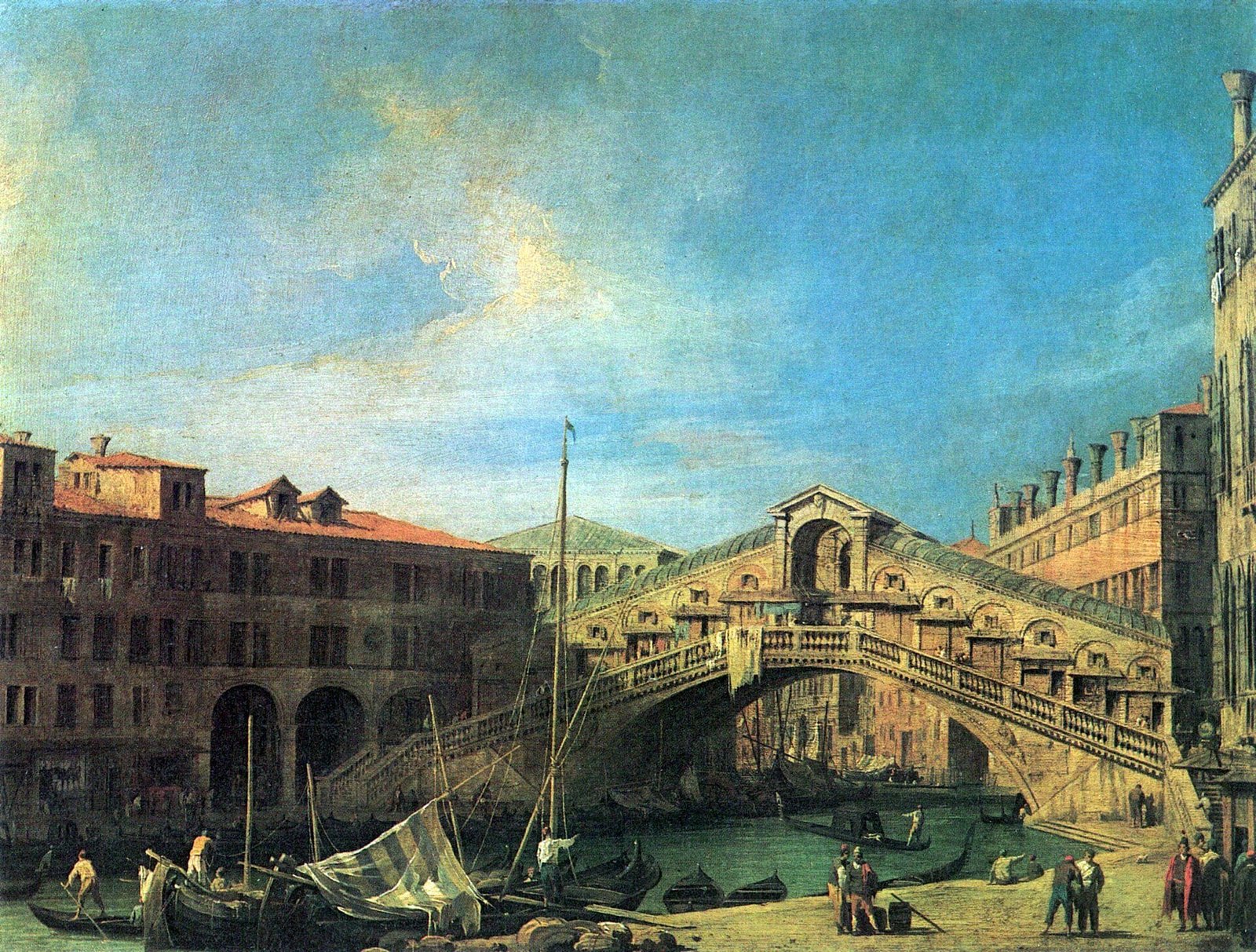
An oil painting of a broad canal crowded with gondolas and boats, crossed by a single white stone arch bridge with shops along its top, palaces on both banks.
Venice: the Grand Canal and the Rialto bridge from the south, painted by Canaletto about 1727.Canaletto, about 1727. Wikimedia Commons. Public domain.

02Who counts what

Berlin’s railway owns more bridges than the city does

No one body counts every bridge in Berlin. The Senate counts its own. The railway, the motorway company and the federal waterways administration each keep their own lists. Scroll through the counts, all drawn on one scale.

Bridges, one scale

Horizontal bars on one linear scale: Venice’s bridge counts, Berlin’s Senate counts, and the four public owners of Berlin’s bridges added together.
VeniceBerlin SenateRailwayMotorways, waterways
An oil painting of a broad canal crowded with gondolas and boats, crossed by a single white stone arch bridge with shops along its top, palaces on both banks.
Venice: the Rialto bridge, painted by Canaletto about 1727.Canaletto, about 1727. Wikimedia Commons. Public domain.

Venice · Insula spa, for the Comune di Venezia

355 bridges the city looks after

Insula, the company Venice set up to maintain its canals and bridges, gave the city 355 bridges in 2008. Most are brick arches, with power, gas and water lines under their steps.

Venice · Università Ca’ Foscari

Or 435, joining 121 islands

Venice’s university, Ca’ Foscari, counts 435 bridges linking the 121 islands of the historic centre. The difference is mostly a question of which small or private bridges count.

Berlin · the Senate · June 2025

About 913 bridge sites

Berlin’s Senate looks after the road bridges and the bridges in parks. It counts about 913 bridge sites, filing every part of a bridge under one name and number.

Berlin · the Senate · June 2025

Or about 1,047 structures

Count each separate deck and ramp and the same bridges come to about 1,047. Behind one familiar name, the Senate says, there can be as many as four separate structures.

Berlin · DB InfraGO (Deutsche Bahn) · 2026

The railway owns even more

None of the railway’s bridges are in the Senate’s count. The federal government listed 1,136 bridges owned by Deutsche Bahn’s infrastructure company in Berlin in 2026. That is more than the Senate’s whole list.

Berlin · four public owners

About 2,500 entries in four lists

Add the motorway company’s 261 bridge structures and the federal waterways’ 62. The four lists hold about 2,500 entries, each counted its owner’s way. U-Bahn and private bridges are in none of them.

However you count

Still more than twice Venice

Take Berlin’s smallest count, 913 sites, and Venice’s largest, 435. Berlin still has more than twice as many. Its 1,047 structures against Venice’s 355 come to almost three times.

03The map

Five bridges, from the old centre to the Potsdam border

Berlin’s bridges follow its water: the Spree through the centre, the Havel along the west, and the canals between. The five in this story stand on that water, four of them in the inner city and one, the Glienicker Brücke, on the Havel at the city’s edge.

Berlin’s districts, rivers and lakes, and the five bridges

District boundaries, rivers and lakes, and the bridges’ positions: OpenStreetMap.

04Five bridges

In 1945, German troops blew up two of Berlin’s best-known bridges themselves

The five bridges below cover more than three centuries of crossings. In the last weeks of the war German troops blew most of the middle arch out of the Oberbaumbrücke, the Wehrmacht blew up the Glienicker Brücke, and the Moltkebrücke was fought over as the Soviet army attacked the Reichstag.

Five bridges, one time scale

Present bridge builtEarlier bridge, or rebuiltFirst bridge on the site (hollow: about)Pedestrians only, at the WallTaken down for the U-Bahn✕ Blown up or fought overRepaired or reopened

05Jungfernbrücke

The last bridge that lifted for sailing barges, finished in 1798

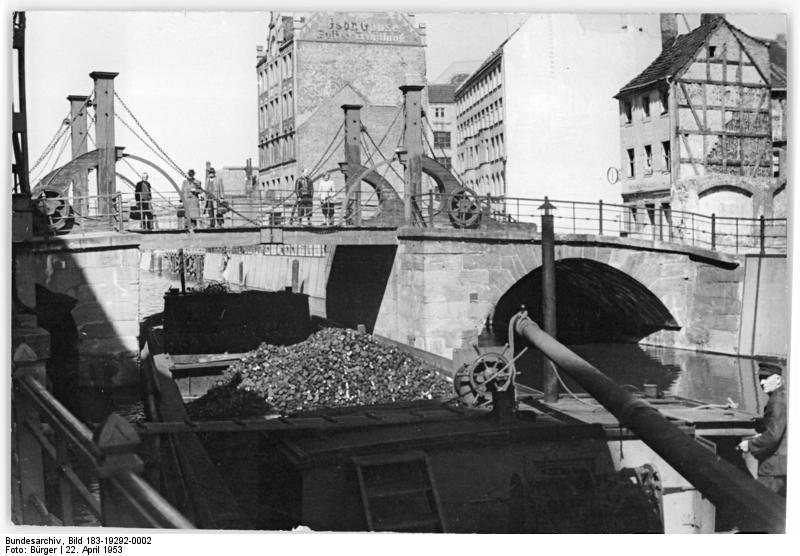
The Jungfernbrücke on the Friedrichsgracht has two sandstone arches and a middle opening whose wooden flaps were raised on iron chains, rollers and counterweights, so that barges with masts could pass. Bridges like it were once common in Berlin. The Landesdenkmalamt calls it the last example of the type. It no longer moves: in 1937–39 its flaps were replaced with fixed steel girders.

A black-and-white photograph of a low stone bridge with iron lifting frames above its centre; a barge loaded with coal or rubble lies beneath it.
A barge passes under the Jungfernbrücke, 22 April 1953. The lifting gear stands above the middle opening.Bundesarchiv, Bild 183-19292-0002 / Bürger / CC BY-SA 3.0 de
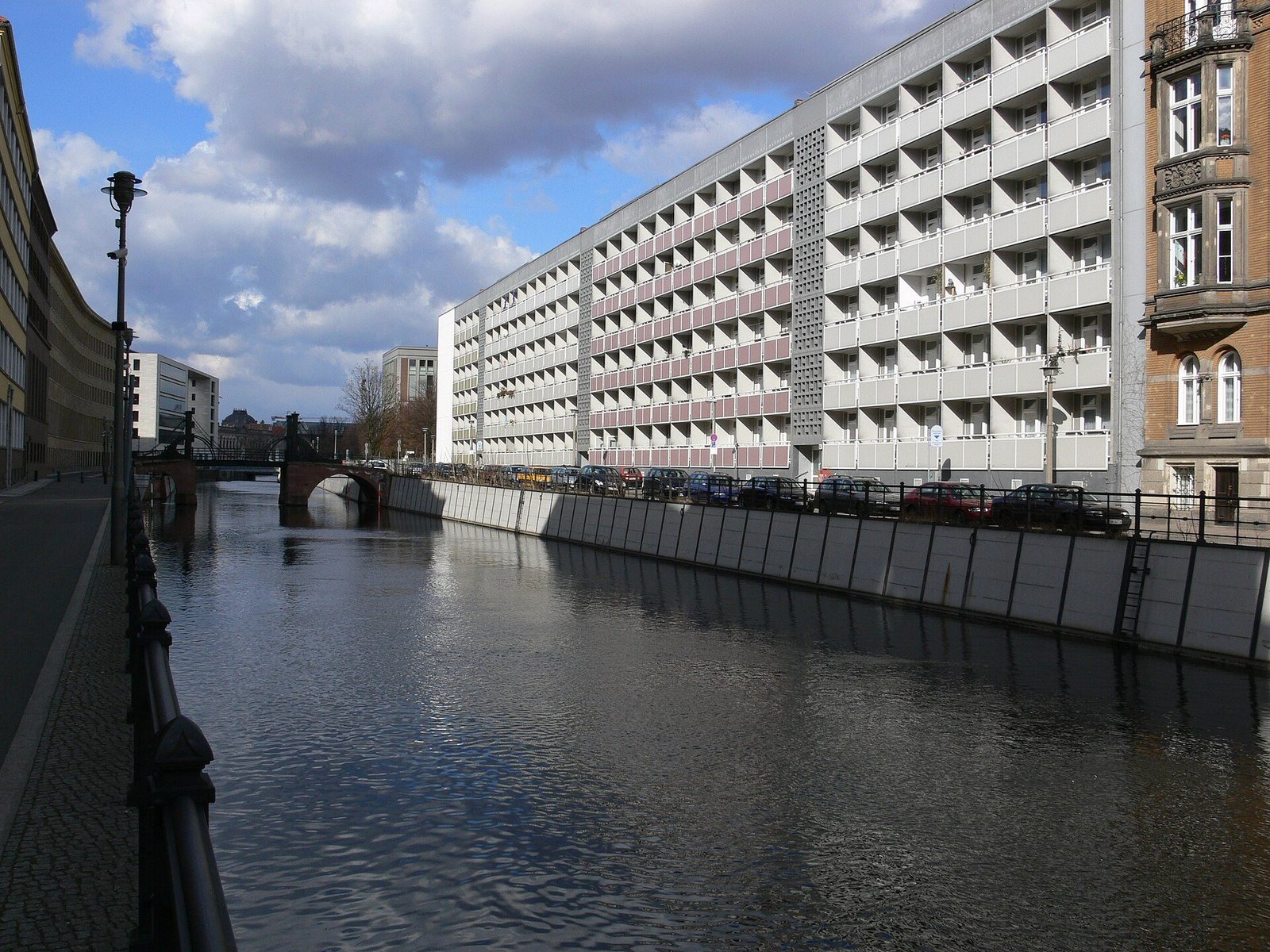
A straight city canal between a railing and a long modern block of flats; a small bridge with white lifting frames is visible far down the canal.
The Friedrichsgracht canal in Mitte, 2006, with the Jungfernbrücke in the distance.Photo: Andreas Praefcke, 2006. Wikimedia Commons. CC BY 3.0.

06Otto Stahn

One architect shaped three of Berlin’s landmark bridges in nine years

Between 1888 and 1897 the architect Otto Stahn gave Berlin the Moltkebrücke and the Oberbaumbrücke, and the look of the new Weidendammer Brücke. No photograph of Stahn himself has a free licence, so his bridges stand in for him here.

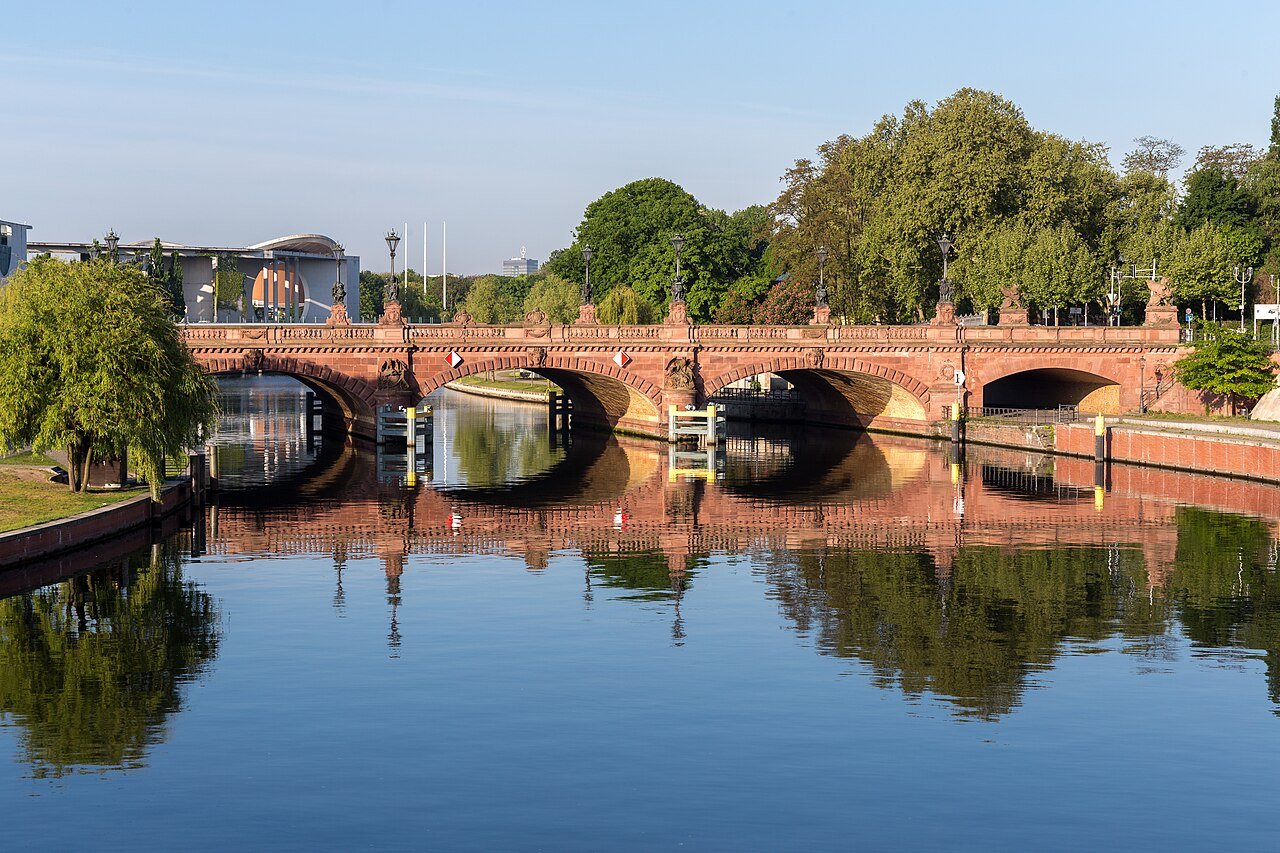
A red sandstone bridge of three arches reflected in still water, trees and modern buildings behind it.
The Moltkebrücke over the Spree at dawn, 2015.Ansgar Koreng, 2015. Wikimedia Commons. CC BY 3.0 de.
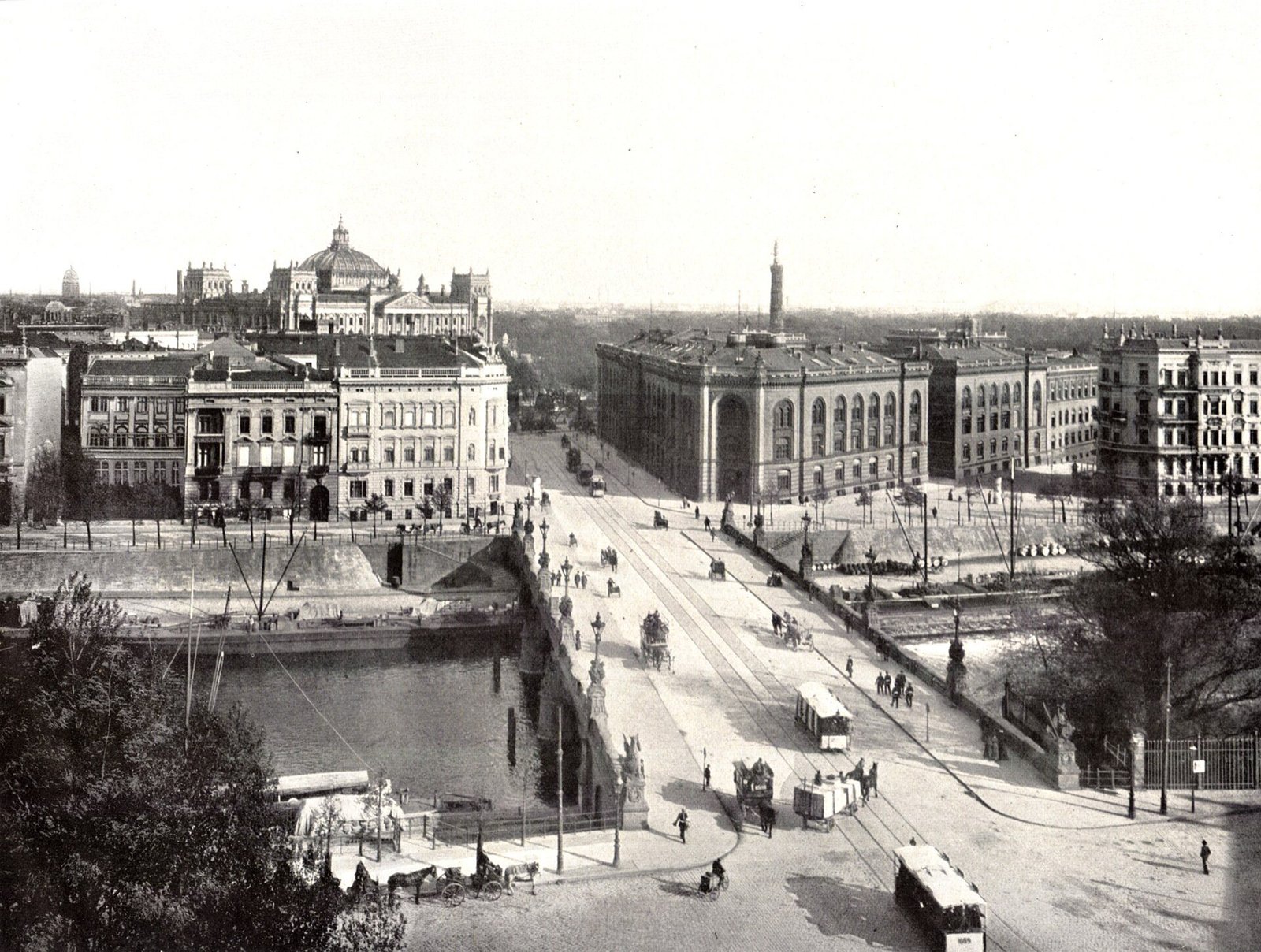
A black-and-white photograph from above of a broad stone bridge with lamp standards and horse-drawn trams, large public buildings beyond.
The Moltkebrücke about 1900, with the General Staff building on the right.Unknown photographer, about 1900. Wikimedia Commons. Public domain.
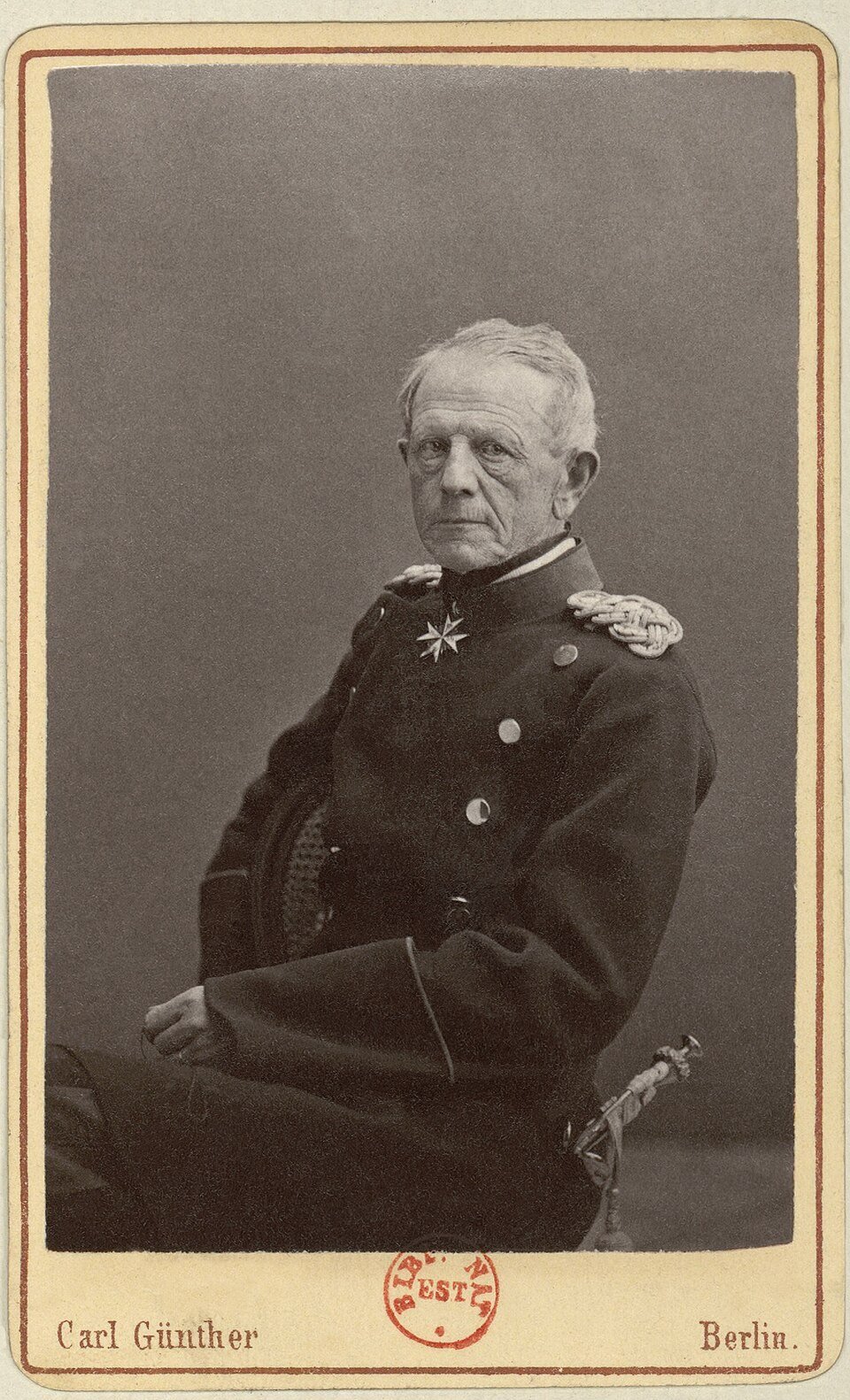
A studio photograph of an elderly, clean-shaven officer in a dark uniform with a cross at his collar, seated.Helmuth von Moltke, the Prussian chief of staff the bridge is named afterCarl Günther, about 1870. Bibliothèque nationale de France (Gallica), via Wikimedia Commons. Public domain.

Moltkebrücke, 1888–91. Faced in red Main sandstone and covered in sculpture celebrating Moltke’s victories. It was fought over in the last days of the war, as the Soviet army attacked the Reichstag from Moabit, and repaired by 1947. The Race to Berlin follows that advance.

A black-and-white street photograph of a wide bridge with ornate railings and lamp standards, horse-drawn carriages and pedestrians crossing.
The new Weidendammer Brücke carrying Friedrichstraße over the Spree, photographed by Waldemar Titzenthaler in 1898.Waldemar Titzenthaler, 1898. Wikimedia Commons. Public domain.
A crowned eagle in dark wrought iron, its wings spread in scrolled ironwork, on a bridge railing.
One of the wrought-iron Prussian eagles on the Weidendammer Brücke, 2007.Beek100, 2007. Wikimedia Commons. Public domain.

Weidendammer Brücke, 1895–97. Friedrichstraße has crossed the Spree here since 1674. Stahn designed the new bridge’s look, with wrought-iron eagles on both arches. It was taken down in 1914 so the north–south U-Bahn could be dug beneath it, and reopened in 1922 with its old railings.

07Oberbaumbrücke

Built to look like a city gate, the Oberbaumbrücke became a border crossing for 28 years

In 1724 a wooden toll bridge stood here, and at night its passage was closed with a tree trunk: the “Oberbaum”. Berlin’s Customs Wall tells that story. Stahn’s brick bridge of 1893–96 was given towers, pointed arches and battlements to look like a fortified city gate. It opened for the 1896 trade exhibition in Treptow, which The Berlin Trade Exhibition covers.

Road and elevated railway run on two levels; Berlin’s first U-Bahn line crossed it from 1902. In the last weeks of the war German troops blew most of its middle arch away, but the bridge did not fall.

From 1961 to 1989 it was a checkpoint that only pedestrians could use. Cars and the U-Bahn crossed again from 9 November 1994.

A black-and-white photograph of a uniformed guard checking a document held out by a woman, with two boys and another woman in winter coats beside her.
West Berliners show their papers to an East German border guard at the Oberbaumbrücke crossing, 29 March 1972, the first morning of new visiting rules.Bundesarchiv, Bild 183-L0329-0023 / Rainer Mittelstädt / CC BY-SA 3.0 de

08Glienicker Brücke

Before it was the Bridge of Spies, the Wehrmacht blew it up

The road between Berlin and Potsdam has crossed the Havel here since about 1680. A stone bridge by Karl Friedrich Schinkel, built 1831–34, was replaced by the present steel bridge in 1905–07.

An oil portrait of a dark-haired man in a dark coat and white cravat.Karl Friedrich Schinkel, architect of the earlier stone bridgeCarl Joseph Begas, 1826. Wikimedia Commons. Public domain.

In April 1945 the Wehrmacht blew it up, and it was repaired in 1947–49. Renamed the “Bridge of Unity” and closed to ordinary traffic, it became the place where East and West exchanged agents. The Bridge of Spies tells who crossed.

Crowds and small East German cars on the road leading onto a green steel truss bridge, autumn trees on both sides.
The Glienicker Brücke across the Havel between Berlin and Potsdam, November 1989.Gavin Stewart, 1989. Wikimedia Commons. CC BY 2.0.
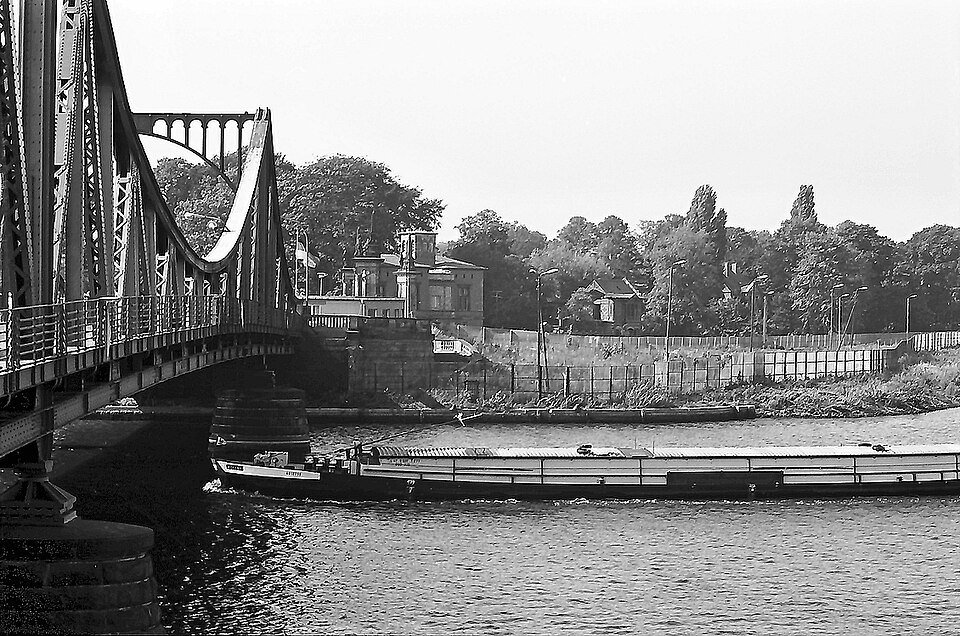
A black-and-white photograph of a steel truss bridge over a river, a long barge passing beneath it.
The Glienicker Brücke from the West Berlin bank, 26 September 1982.Willy Pragher, 1982. Wikimedia Commons. CC BY 4.0.

How many bridges Berlin has depends on who is counting.

Count them any honest way, and Berlin still has more than twice as many as Venice.

Press & citation

Use this Berlinfographic

Free to publish under CC BY 4.0 — in print, online, on Wikipedia and in teaching, commercially or not — with credit to Berlinfographics and a link to this page.

Berlin’s Bridges: ready-to-use landscape image

Ready-to-use image

The infographic as one image: headline, key figures, chart, sources and credit, 2,400 × 1,350 px PNG. Please use it unedited.

Download landscape (PNG)
Berlin’s Bridges: square version

Square format

A 1:1 version for social media and narrow columns, 1,800 × 1,800 px.

Download square (PNG)
Berlin’s Bridges: portrait version

Portrait 4:5

For Instagram and LinkedIn feeds, 1,620 × 2,025 px.

Download portrait (PNG)

Credit line

Berlinfographics (berlinfographics.com), CC BY 4.0

Citation

Berlinfographics (2026). “Berlin’s Bridges”. Berlin Experiences. https://berlinfographics.com/berlin-bridges/

Wikipedia

{{cite web |title=Berlin’s Bridges |url=https://berlinfographics.com/berlin-bridges/ |website=Berlinfographics |publisher=Berlin Experiences |date=2026-11-09 |access-date=2026-11-09}}