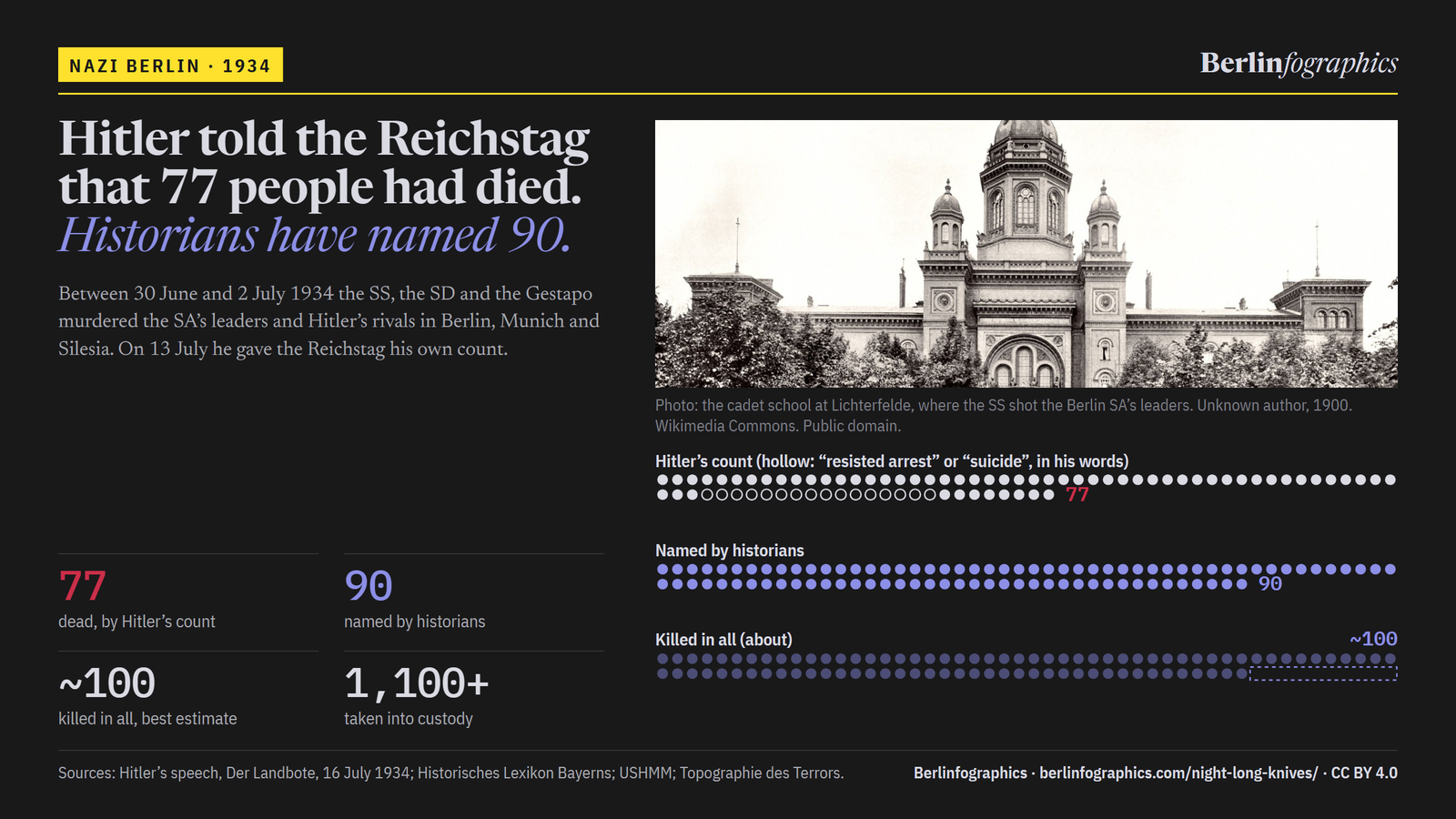
The Prussian cadet school at Lichterfelde, about 1900. The SS took the buildings over in 1933; on 30 June 1934 the leaders of the Berlin SA were brought here and shot.Unknown author, 1900. Wikimedia Commons. Public domain.
The purge · 1934
Between 30 June and 2 July 1934 the SS, the SD and the Gestapo murdered the leaders of the SA and men Hitler counted as rivals, in Berlin, Munich and Silesia. Then he gave the Reichstag his own count, and called himself the nation’s supreme judge.
0130 June – 2 July 1934
The purge was carried out by the police, the Gestapo and the SS, with logistical support from the Reichswehr. Berlin was one of its three centres. The map follows it from the Gestapo’s headquarters to the places where its victims died.
Berlin, 1934
30 June · Prinz-Albrecht-Straße 8
The Gestapo had kept its own prison in the cellar here since the summer of 1933. On 30 June it arrested Gregor Strasser, who had given up all his party offices, in Berlin; SS men shot him.
Lichterfelde
The SS had taken over the cadet school in 1933. Karl Ernst, head of the Berlin SA, and his circle were brought here and murdered. The site has housed the Bundesarchiv since 1995.
30 June · Wilhelmstraße 79/80
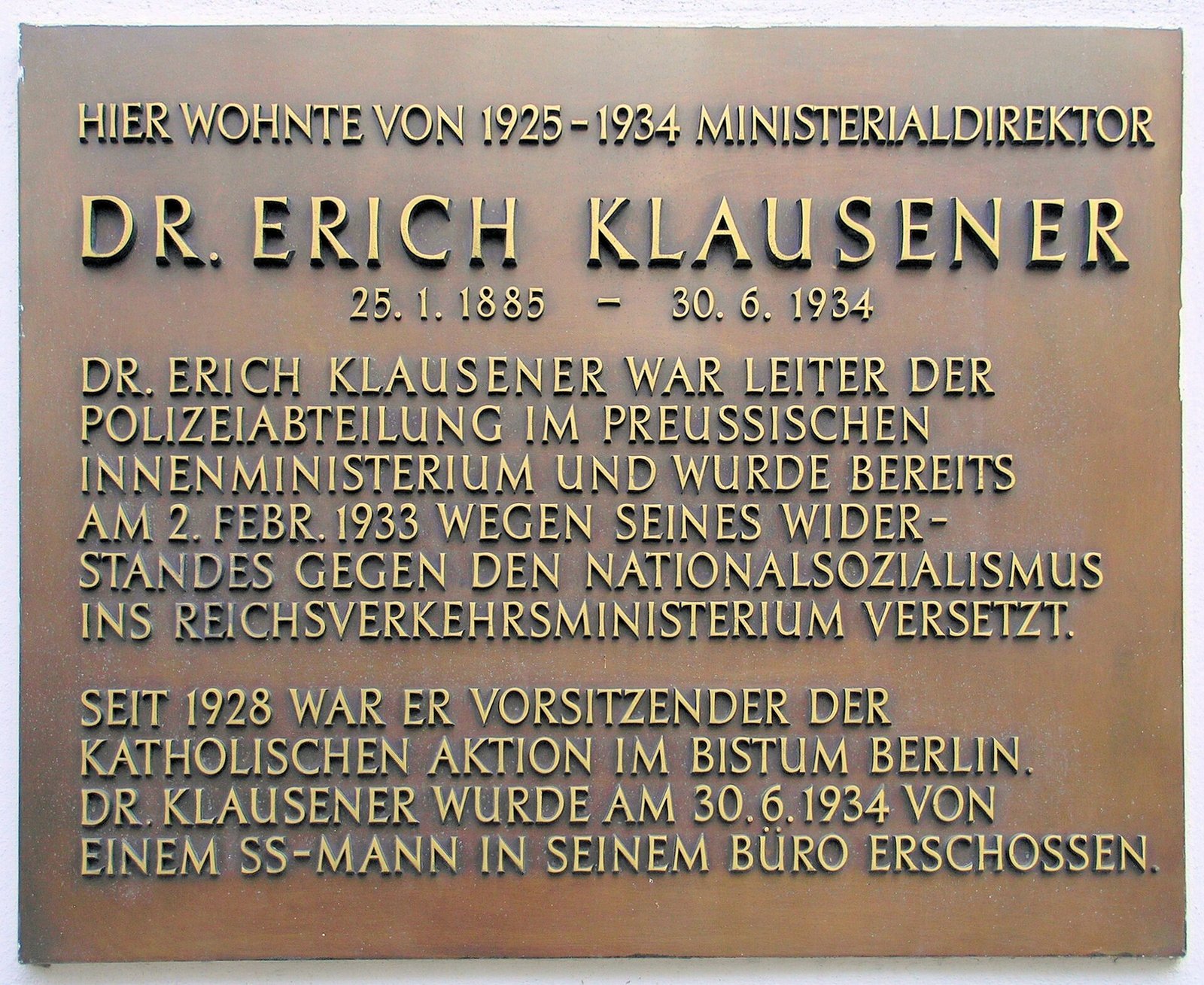
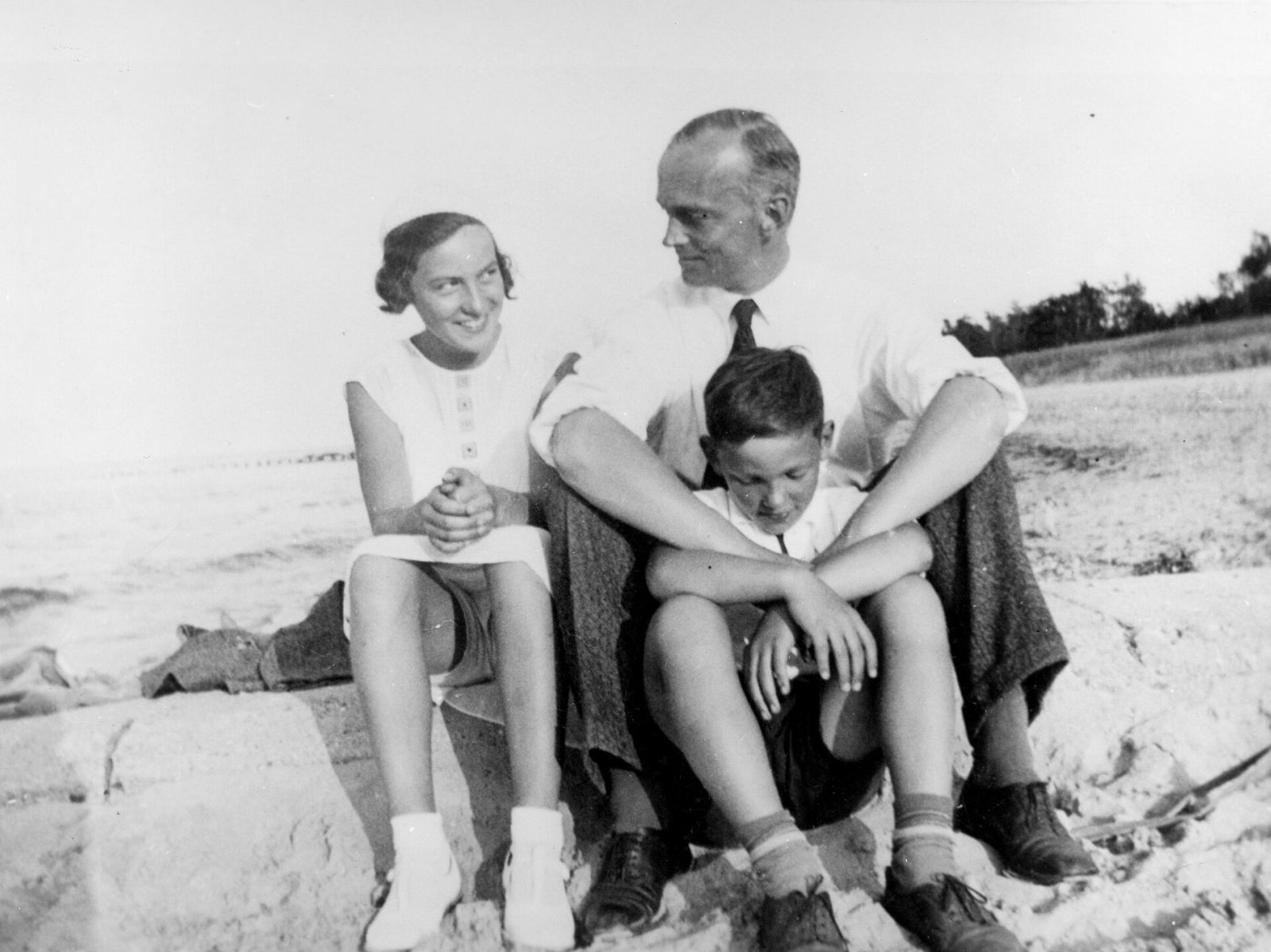
Klausener had led Catholic Action in Berlin since 1928, and the regime had moved him to the minor Reich Transport Ministry, at Wilhelmstraße 79/80. The SS shot him in his office.
Von Papen’s staff
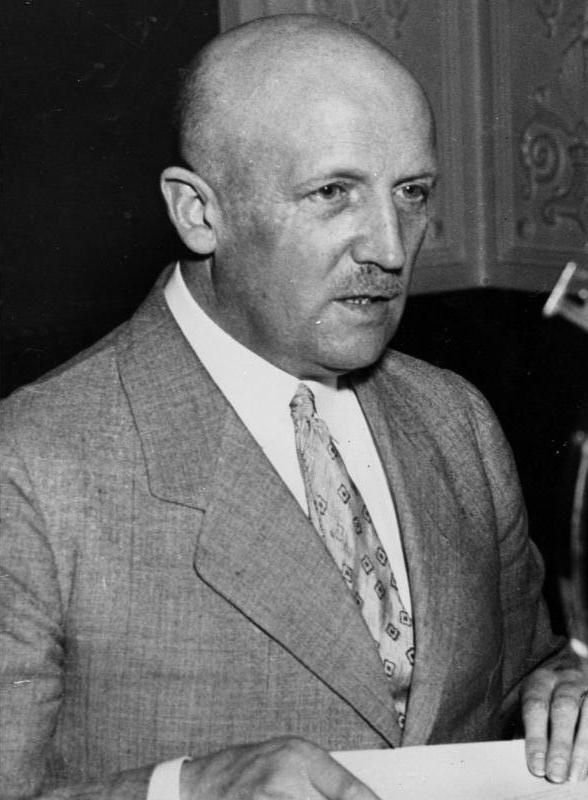
Vice-Chancellor Franz von Papen survived; his closest colleagues, Herbert von Bose and Edgar Jung, were murdered. Jung was shot near Oranienburg, on 30 June or 1 July.
30 June · Neubabelsberg
Kurt von Schleicher had been Chancellor until January 1933. He was shot in his villa in Neubabelsberg, together with his wife Elisabeth, just outside Berlin.
Spichernstraße 15
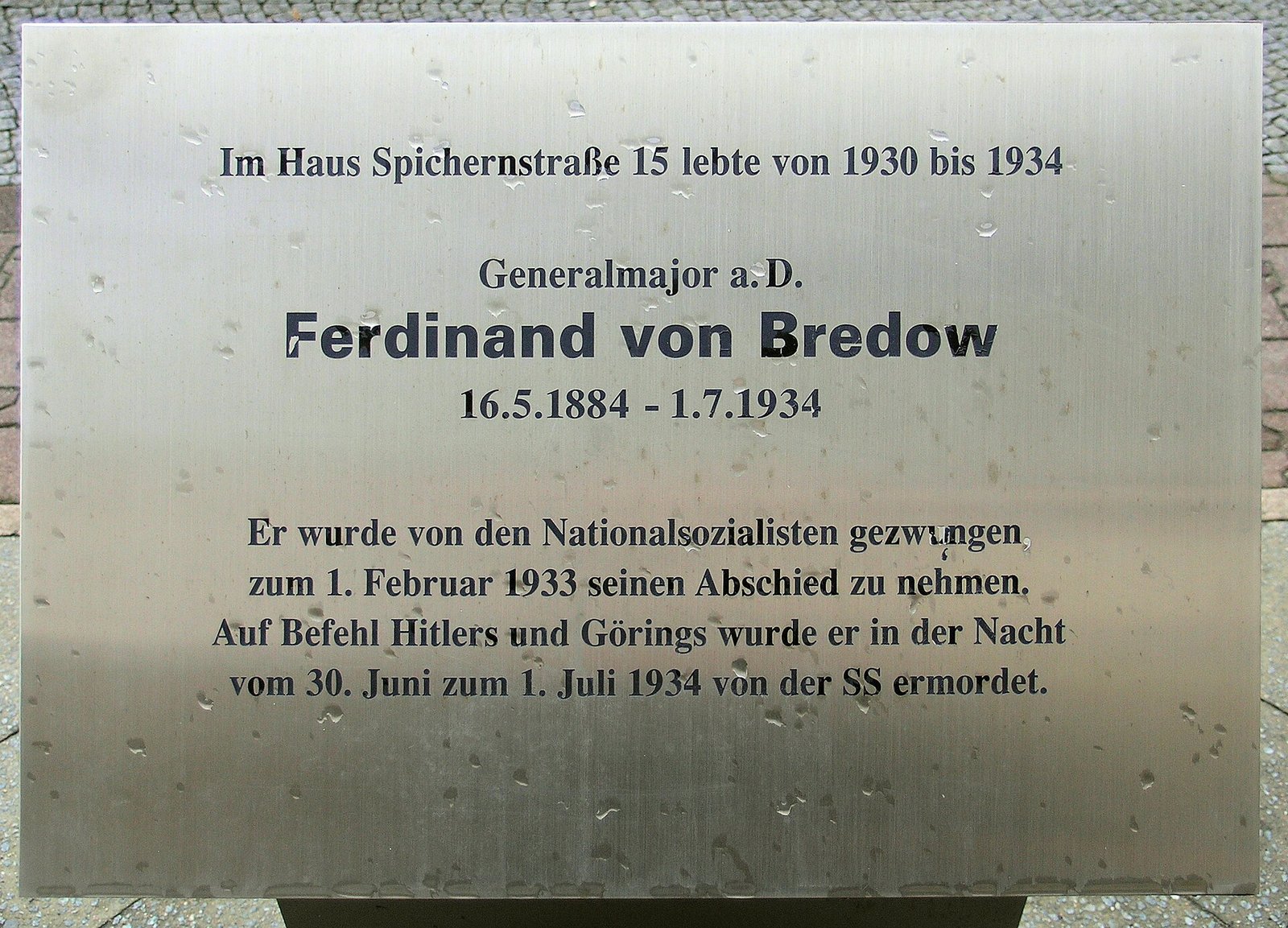
The retired major-general lived here from 1930 to 1934. His plaque says the SS murdered him on the night of 30 June to 1 July 1934, “on the orders of Hitler and Göring”.
Munich, Dachau, Silesia
The other centres were Munich and Silesia. Ernst Röhm, chief of staff of the SA, was shot in Stadelheim prison, Munich, on 1 July. Gustav von Kahr, Bavaria’s state commissioner in 1923, was taken to Dachau on 30 June and shot.
02Counting the dead
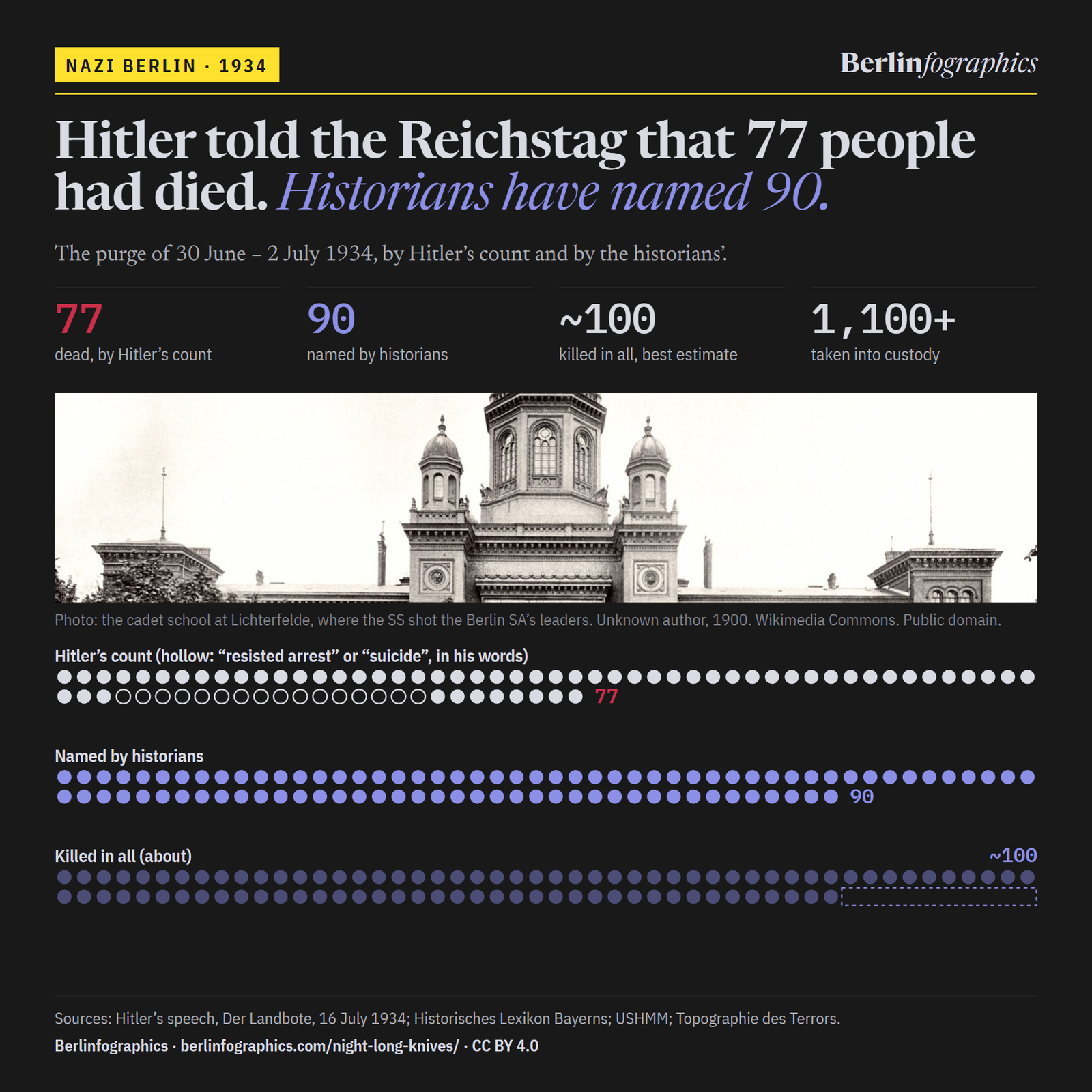
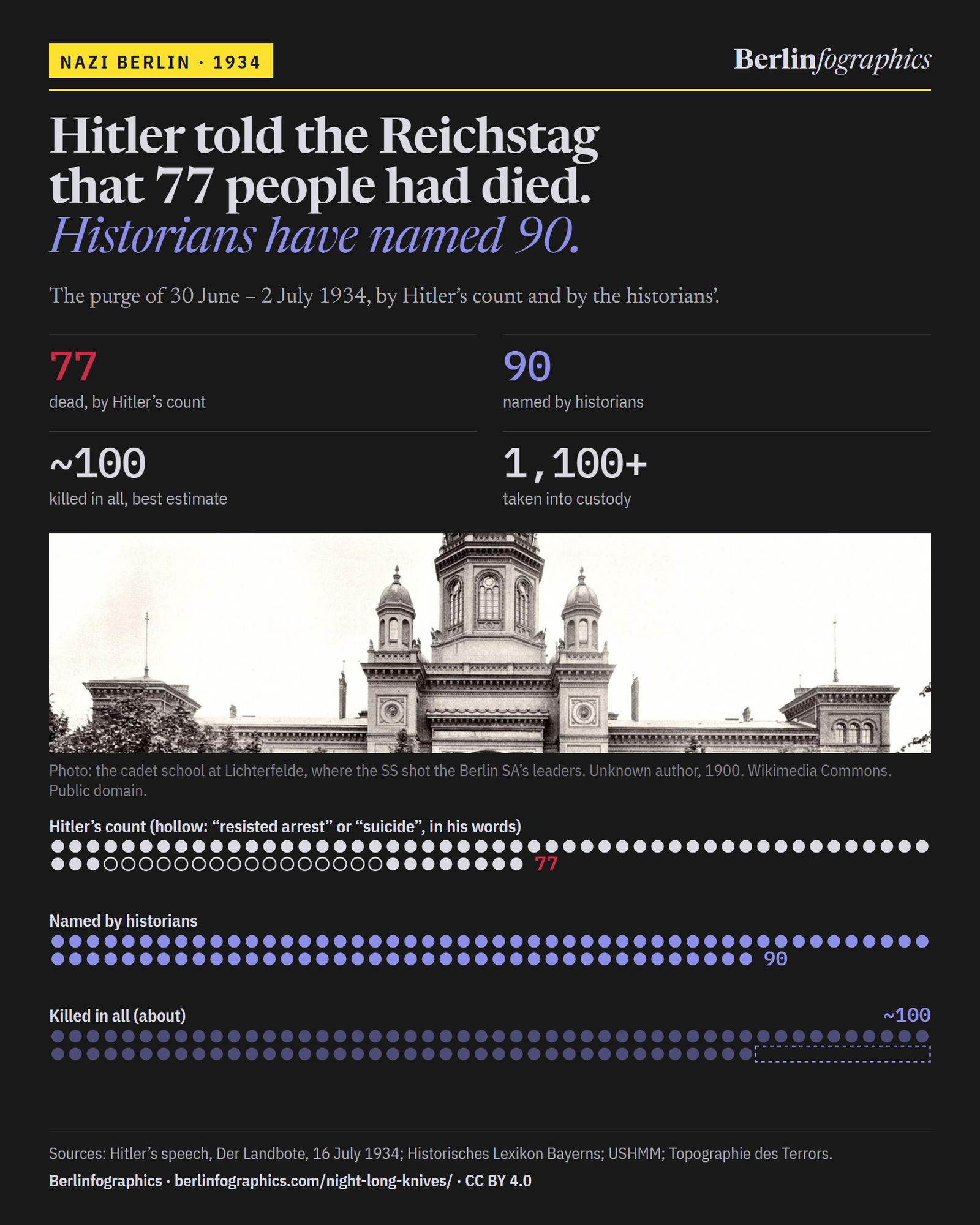
On 13 July 1934, in a speech broadcast from the Reichstag, Hitler listed the dead by category. Some, he said, had “resisted arrest”; others had taken their own lives. Historians have since identified 90 people by name, and think that about 100 were killed in all. Among them were 50 senior SA leaders, and political rivals with nothing to do with the SA.
„zum obersten Gerichtsherrn des deutschen Volks“Hitler declared himself “the supreme judge of the German people” in the same speech
Each dot is one person
Hitler’s categories, as his speech was printed: 19 senior SA leaders, shot; 31 SA leaders and members, shot; 3 SS leaders, shot “as accomplices”; 13 “resisted arrest”; 3 “suicide”; 5 party members outside the SA, shot; 3 SS men, shot for mistreating prisoners (Der Landbote, 16 July 1934). The Historisches Lexikon Bayerns counts 89 or 90 named; USHMM and the Topographie des Terrors give 90. Higher totals circulate online, but no institution or historian checked for this story gives one, so none is drawn. A further 1,100 and more people were taken into custody.
0330 June – 2 August 1934
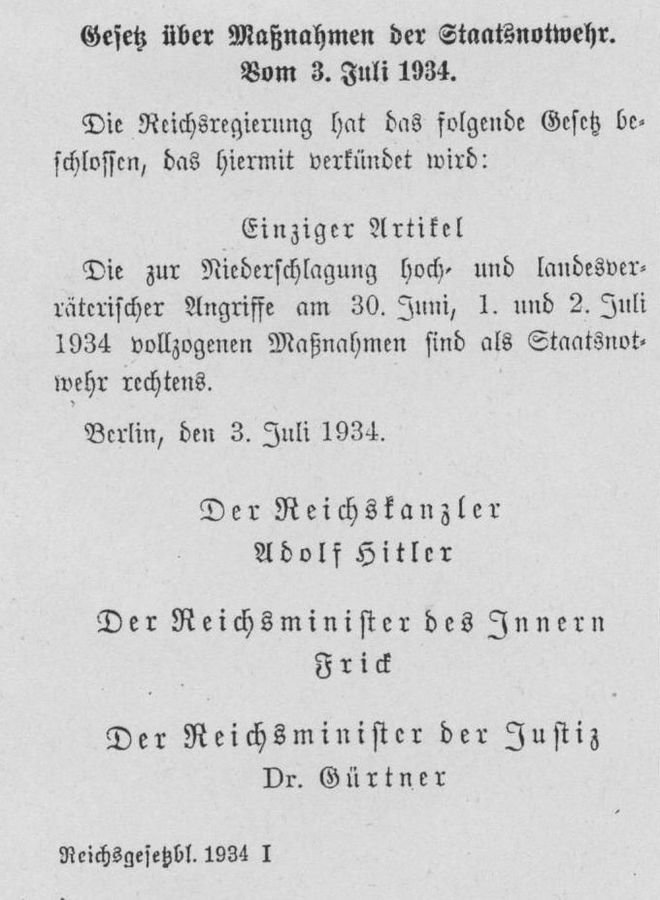
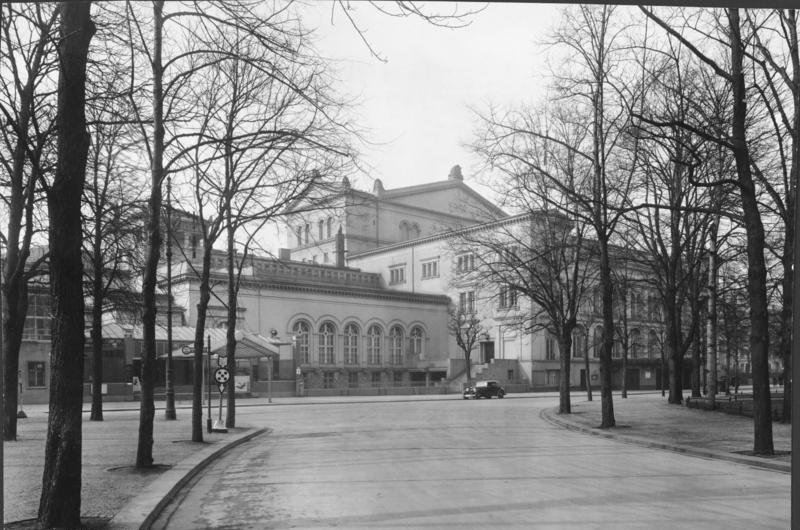
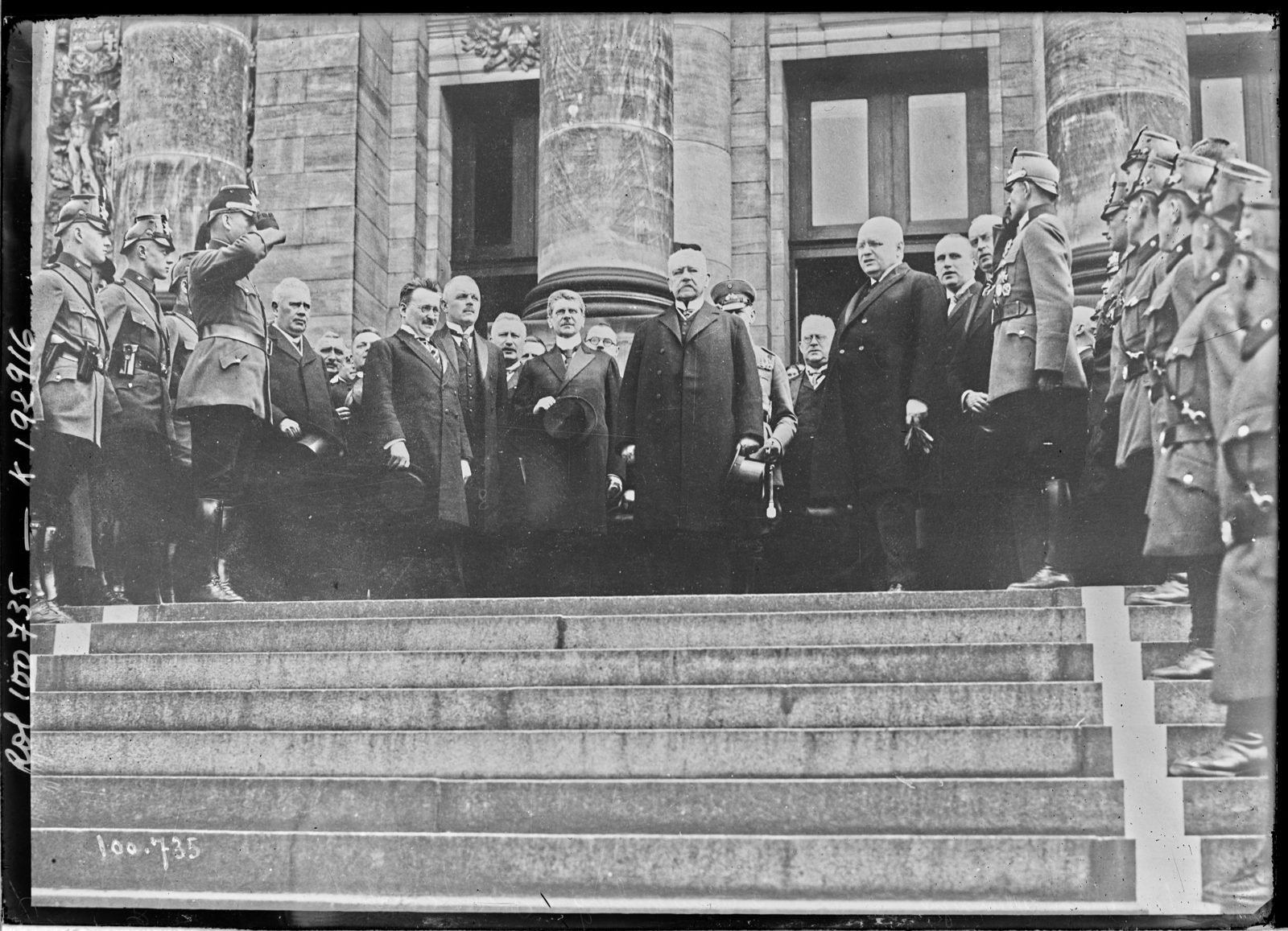
On 3 July 1934 a law of one sentence declared the measures of the three days “lawful as emergency defence of the state”. President Hindenburg signed a telegram thanking Hitler. Hitler spoke to the Reichstag in the Kroll Opera; on 20 July 1934 he made the SS independent of the SA. When Hindenburg died on 2 August 1934, the Reichswehr was sworn to Hitler in person the same day.
One line per day


04Afterwards
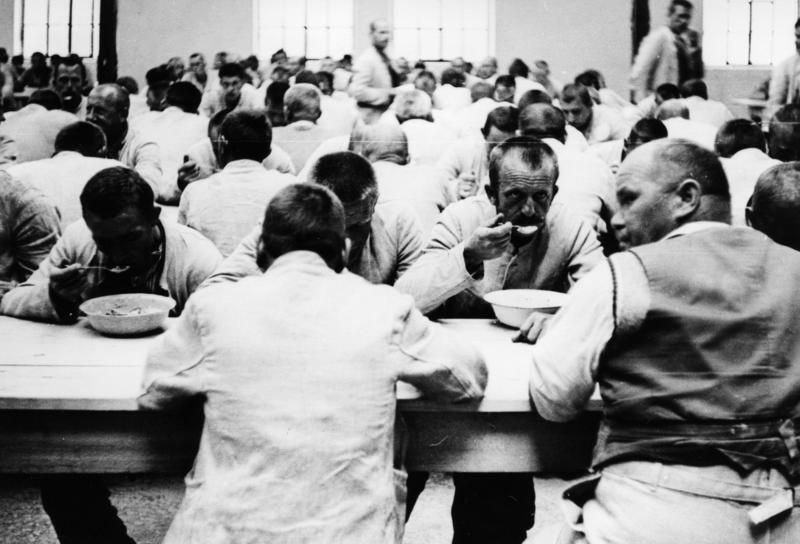
At the Columbia-Haus, the Gestapo prison and concentration camp in Tempelhof, in 1935, after the intensified raids in connection with the “Röhm affairs” and harsher punishment under paragraph 175, many homosexual men were brought in, at times half of all the prisoners.

The camp was dissolved in November 1936, its prisoners moved to Sachsenhausen. Georg Seibert’s memorial has stood at the corner of Columbiadamm and Golßener Straße since 1994.
After the war the killings came to court. The first such trial was against the former SS leader Kurt Gildisch. In 1957 the Landgericht München tried Michael Lippert and Josef “Sepp” Dietrich, who had commanded the SS Leibstandarte, for the murder of Röhm and other SA leaders.
Hitler told the Reichstag that 77 had died, and named himself their judge.
Historians have named 90. They think about 100 were killed.
Press & citation
Free to publish under CC BY 4.0 — in print, online, on Wikipedia and in teaching, commercially or not — with credit to Berlinfographics and a link to this page.
Ready-to-use image
The infographic as one image: headline, key figures, chart, sources and credit, 2,400 × 1,350 px PNG. Please use it unedited.
Download landscape (PNG)
Square format
A 1:1 version for social media and narrow columns, 1,800 × 1,800 px.
Download square (PNG)
Portrait 4:5
For Instagram and LinkedIn feeds, 1,620 × 2,025 px.
Download portrait (PNG)Credit line
Berlinfographics (berlinfographics.com), CC BY 4.0
Citation
Berlinfographics (2026). “The Night of the Long Knives, Berlin 1934”. Berlin Experiences. https://berlinfographics.com/night-long-knives/
Wikipedia
{{cite web |title=The Night of the Long Knives, Berlin 1934 |url=https://berlinfographics.com/night-long-knives/ |website=Berlinfographics |publisher=Berlin Experiences |date=2026-11-09 |access-date=2026-11-09}}
Our infographics, charts and texts are licensed CC BY 4.0: free to republish, including commercially, with credit to Berlinfographics and a link. Photographs keep their own licences, named in each caption. How to credit
Topics: The Second World War · Cold War Berlin · Nazi Berlin · Persecution & the Holocaust · Weimar Berlin · Prussia & the Kaiserreich · Architecture & the built city · Culture, science & society · Reunified Berlin · Unusual facts
Contact: info@berlinfographics.com · Press: press@berlinfographics.com · Imprint · Privacy