Berlinfographicsby Berlin Experiences

The obelisk on the former roll-call ground at Sachsenhausen, with its column of red triangles, between two poplars. The GDR raised it for the national memorial it opened here on 22 April 1961.Photo: randreu, 2014. Wikimedia Commons. CC BY 3.0.

The camp badges

A cloth triangle sorted every prisoner in the camps. Of the pink-triangle men one study traced, more than half died

The SS key had seven columns and four rows. In the one study that compared categories, 53.0% of the men with the pink triangle whose fate is known died, against 40.5% of political prisoners and 34.7% of Jehovah’s Witnesses.

>200,000
people held in Sachsenhausen, 1936–1945, by the memorial’s count
53.0%
of pink-triangle prisoners whose fate is known died, in Lautmann’s table (of 661)
~200
men with the pink triangle murdered at the Klinkerwerk, summer 1942
75yrs
from liberation until the Bundestag recognised the black and green triangles as victims
01The SS key

The SS drew its prisoners as a chart

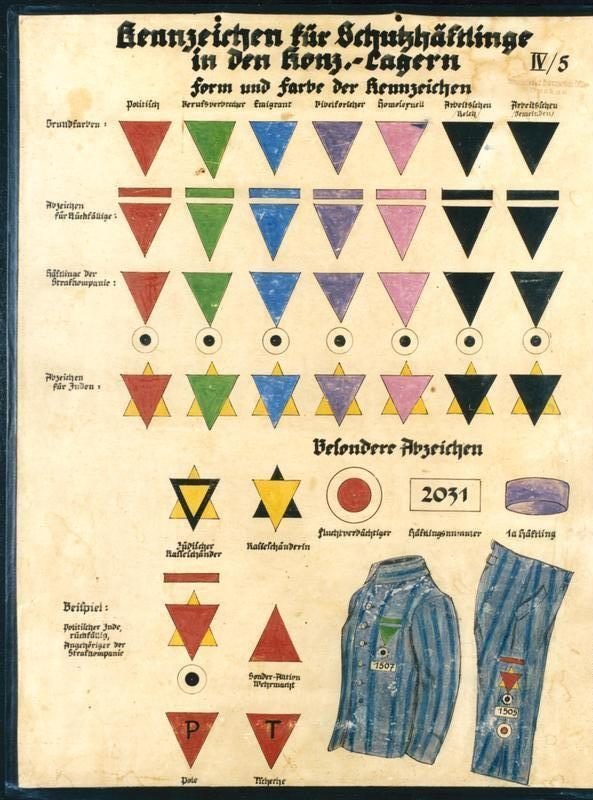
From 1937–38 the SS marked every concentration-camp prisoner with a cloth triangle, sewn onto the jacket and the trousers, beside the prisoner’s number. Its colour named the reason the SS gave for the arrest.

A hand-coloured SS chart in the Bundesarchiv sets the system out in 7 columns and 4 rows: a colour for each category, then marks for repeat prisoners, for the punishment company and for Jews. The categories were the SS’s own. Prisoners were often put in a group arbitrarily, and often did not see themselves in it.

The plan was that a prisoner’s supposed offence could be read at once from the badge.

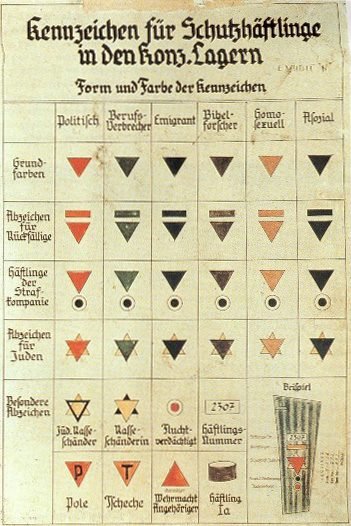
The key changed from camp to camp and over the years. A second copy has six columns, with a single “asozial” column where the Bundesarchiv chart has two black “Arbeitsscheu” ones. Neither shows the brown triangle that some camps later used for Sinti and Roma.

A faded printed chart of the same prisoner markings in a ruled grid of six columns, with a striped sleeve as the example at bottom right.
Another copy of the key, held by USHMM: six columns, with a single “asozial” column in place of the two “Arbeitsscheu” columns, and stamped “Exhibit N”. The markings varied between camps and over time.Image: Chart of prisoner markings, c. 1938, author unknown. United States Holocaust Memorial Museum. Wikimedia Commons. Public domain.
A hand-coloured chart headed in Gothic script. Rows of inverted triangles in red, green, blue, violet, pink and two black columns; below them the same with a bar above, with a ringed dot below, and over a yellow triangle forming a star; then special marks, letters P and T, and a striped prisoner jacket and trousers.
“Kennzeichen für Schutzhäftlinge in den Konz.-Lagern”: the SS chart of prisoner markings, in colour, held by the Bundesarchiv, which dates it 1936/44. Seven columns of categories, four rows of modifiers, special marks, and a jacket and trousers as the example. It shows no brown triangle.Image: Bundesarchiv, Bild 146-1993-051-07 / unknown author. Wikimedia Commons. CC BY-SA 3.0 de.

Reading the key

The SS chart of prisoner markings, redrawn: seven columns of coloured inverted triangles (red, green, blue, violet, pink and two black), in four rows — the plain badge, with a bar above for repeat prisoners, with a dot below for the punishment company, and over a yellow triangle forming a star for Jewish prisoners. Each step of the story lights up one part.

The Bundesarchiv chart, redrawn: 7 columns × 4 rows. At right, the chart’s own example.

02Sachsenhausen, 1936–45

In Sachsenhausen, one colour was singled out for murder

More than 200,000 people were held at Sachsenhausen, north of Berlin, between 1936 and 1945. Political opponents, Jews, Sinti and Roma, men persecuted as homosexual, Jehovah’s Witnesses, so-called career criminals and “asocials” all wore their colours here (memorial and USHMM).

On the canal at Oranienburg the SS built a brickworks, the Klinkerwerk, and drove up to 2,000 prisoners a day to work there. In summer 1942 it used the site for a targeted killing of the men with the pink triangle: about 200 were murdered.

A black-and-white photograph of men in striped prisoner clothing carrying loads along a narrow trench between earth banks and timber props.
Prisoners of Sachsenhausen at forced labour in the Klinkerwerk, the SS brickworks on the canal at Oranienburg, about 1940. Photographer unknown.Photo: Bundesarchiv, Bild 183-81950-0003 / unknown author. Wikimedia Commons. CC BY-SA 3.0 de.
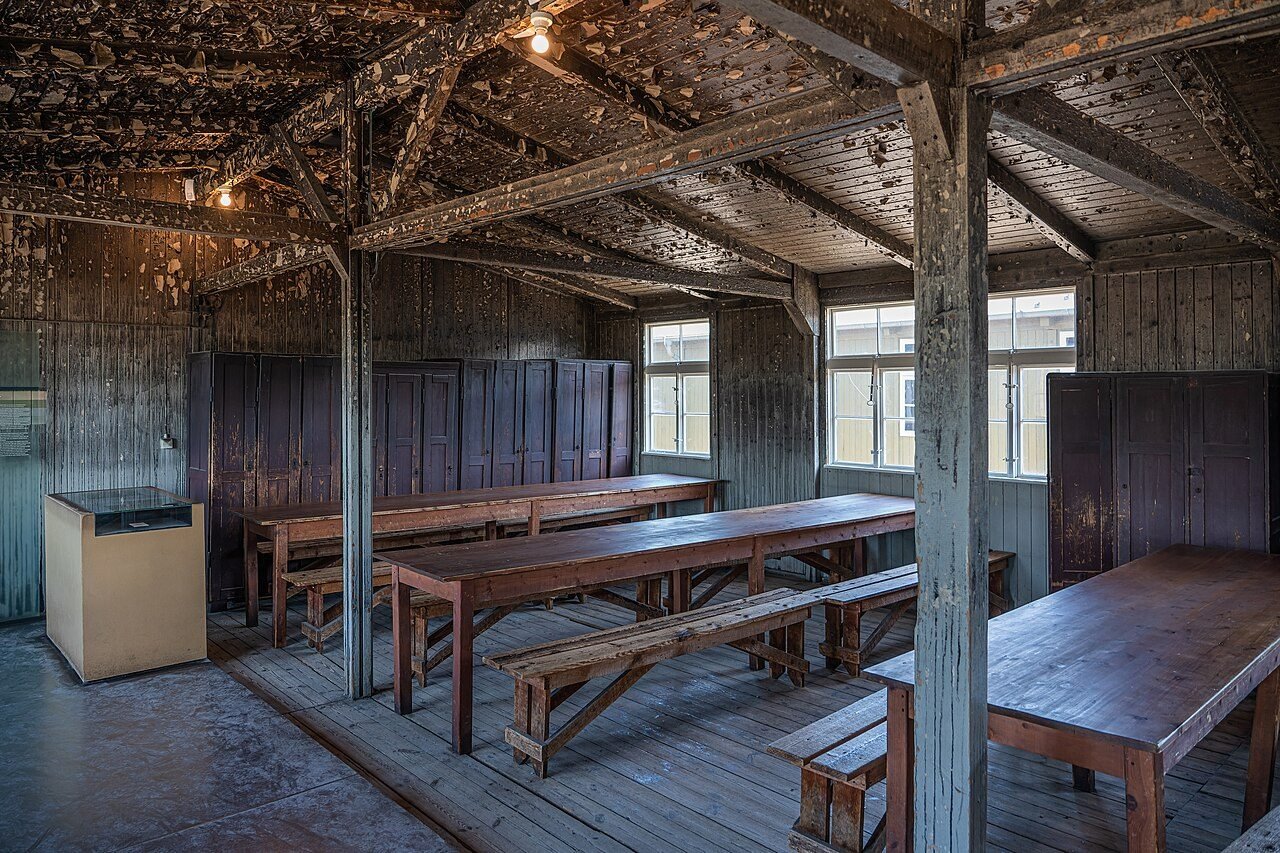
A wooden barrack interior with long tables, benches and a timber roof truss, lit by windows.
The day room of a prisoner barrack, Sachsenhausen memorial, 2024.Photo: A.Savin / Wikimedia Commons / Free Art License

The camp was liberated on 22 April 1945; Soviet and Polish troops found about 3,000 sick prisoners left behind.

More from Sachsenhausen: the liberation of the camps, one by one · Operation Bernhard, the forgery workshop in two of its barracks

03Counting the dead by colour

The one study that counted the dead by colour

The sociologist Rüdiger Lautmann sifted the surviving camp records for every prisoner registered as homosexual, about 1,500 men. He compared them with about 750 Jehovah’s Witnesses and 200 political prisoners. He called it “a complete survey of the quite incomplete documents”.

Of the men whose fate he could establish, 53.0% of the pink triangles died, against 40.5% of the red and 34.7% of the violet. His text rounds these to 60, 41 and 35 per cent; the chart shows his table.

The pink triangles also vanished fastest. After a year, one in two had left, and three in four of their deaths came in that first year. Of the political prisoners, two in three still there; of the Witnesses, four in five still there.

No study gives comparable rates for the green, black, blue or brown triangles, or for Jewish prisoners, who, USHMM writes, received the most brutal treatment of all. So the charts draw only these three.

04After the camps

Some colours waited decades to be counted as victims

In 1961 the GDR opened its national memorial at Sachsenhausen; its obelisk carries red triangles. West Germany recognised the genocide of the Roma in 1982. Paragraph 175 was dropped in 1994, and its Nazi-era convictions were overturned in 2002.

In 2012 Berlin’s memorial to the murdered Sinti and Roma opened; the stone at its centre is a triangle, which its designer Dani Karavan said echoes the camp markings.

From liberation to recognition, 1945–2020

A linear time axis; each mark at its year, in the colour of the triangle it concerns.

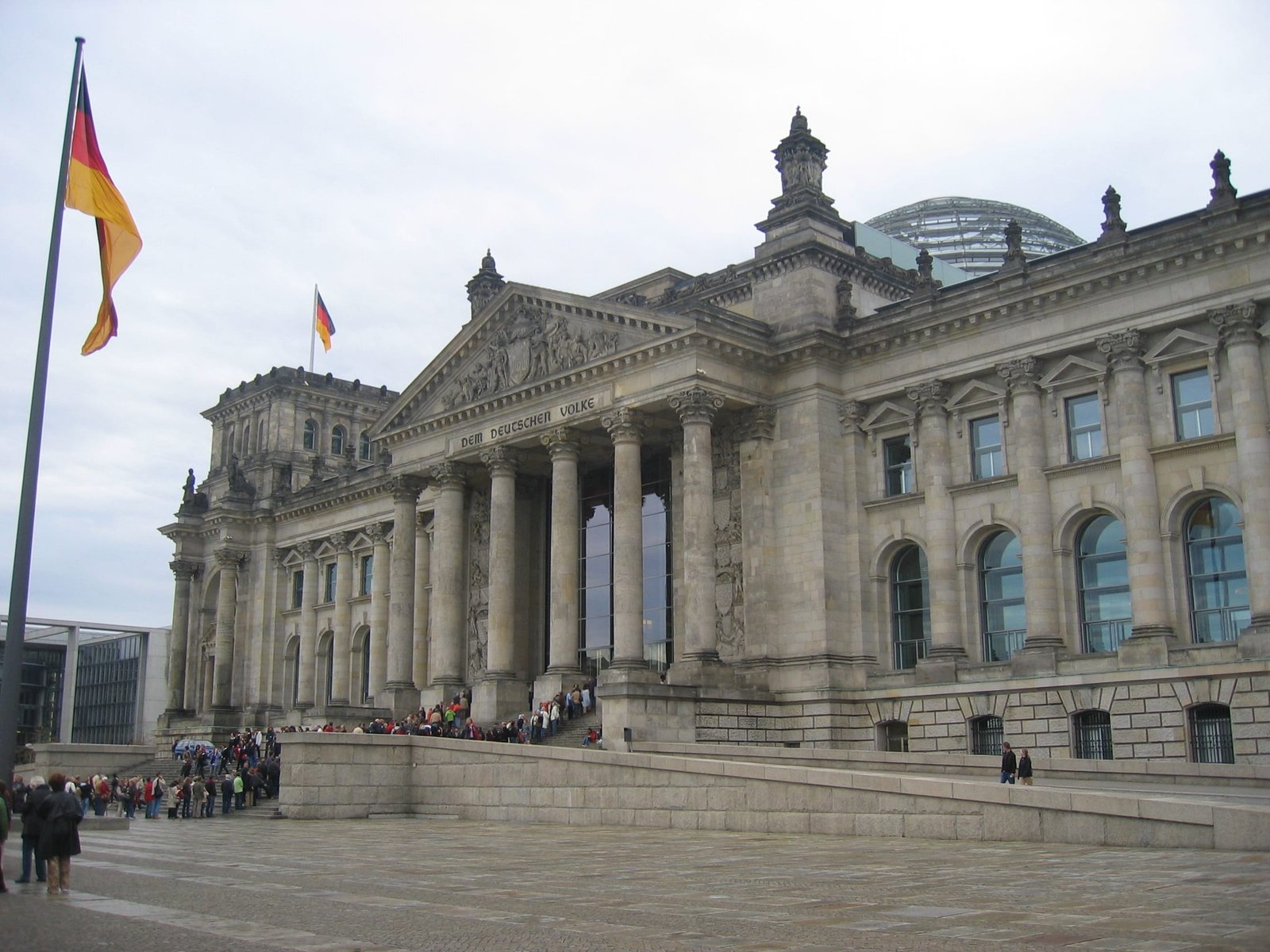
The neoclassical west front of the Reichstag with its glass dome, flags and visitors on the forecourt.
The Reichstag, seat of the Bundestag, 2006.Photo: Luukas, 2006. Wikimedia Commons. Public domain.

The black and the green triangles came last. Only on 13 February 2020 did the Bundestag recognise the people the Nazis persecuted as “asocials” and “career criminals” as victims, 75 years after Sachsenhausen was liberated.

The chart was drawn so that a guard could read a prisoner at a glance. Read today, it is a list of the people the regime set out to remove.

Press & citation

Use this Berlinfographic

Free to publish under CC BY 4.0 — in print, online, on Wikipedia and in teaching, commercially or not — with credit to Berlinfographics and a link to this page.

The Colours of the Camps: ready-to-use landscape image

Ready-to-use image

The infographic as one image: headline, key figures, chart, sources and credit, 2,400 × 1,350 px PNG. Please use it unedited.

Download landscape (PNG)
The Colours of the Camps: square version

Square format

A 1:1 version for social media and narrow columns, 1,800 × 1,800 px.

Download square (PNG)
The Colours of the Camps: portrait version

Portrait 4:5

For Instagram and LinkedIn feeds, 1,620 × 2,025 px.

Download portrait (PNG)

Credit line

Berlinfographics (berlinfographics.com), CC BY 4.0

Citation

Berlinfographics (2026). “The Colours of the Camps”. Berlin Experiences. https://berlinfographics.com/prisoner-triangles-key/

Wikipedia

{{cite web |title=The Colours of the Camps |url=https://berlinfographics.com/prisoner-triangles-key/ |website=Berlinfographics |publisher=Berlin Experiences |date=2026-11-09 |access-date=2026-11-09}}