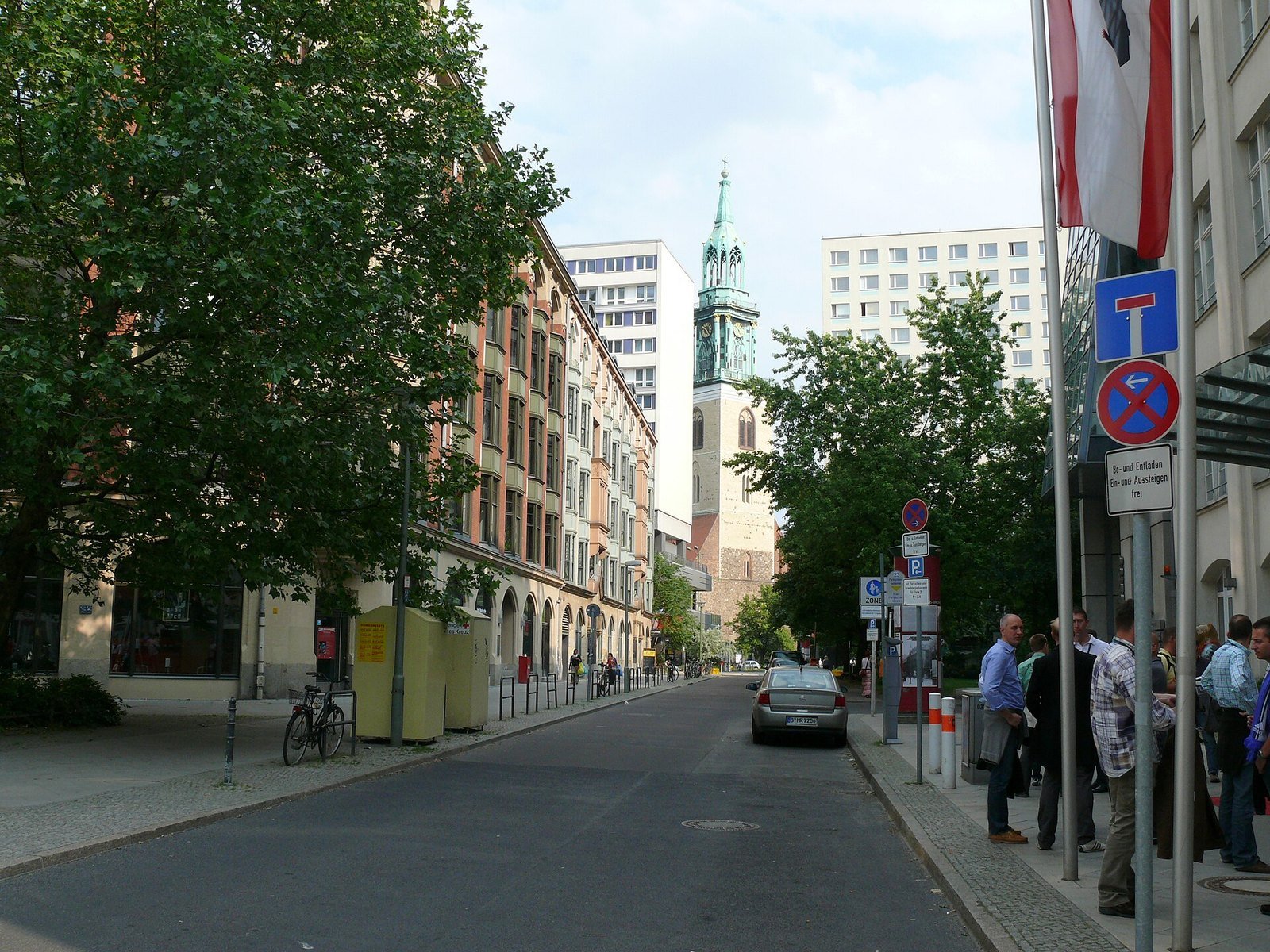
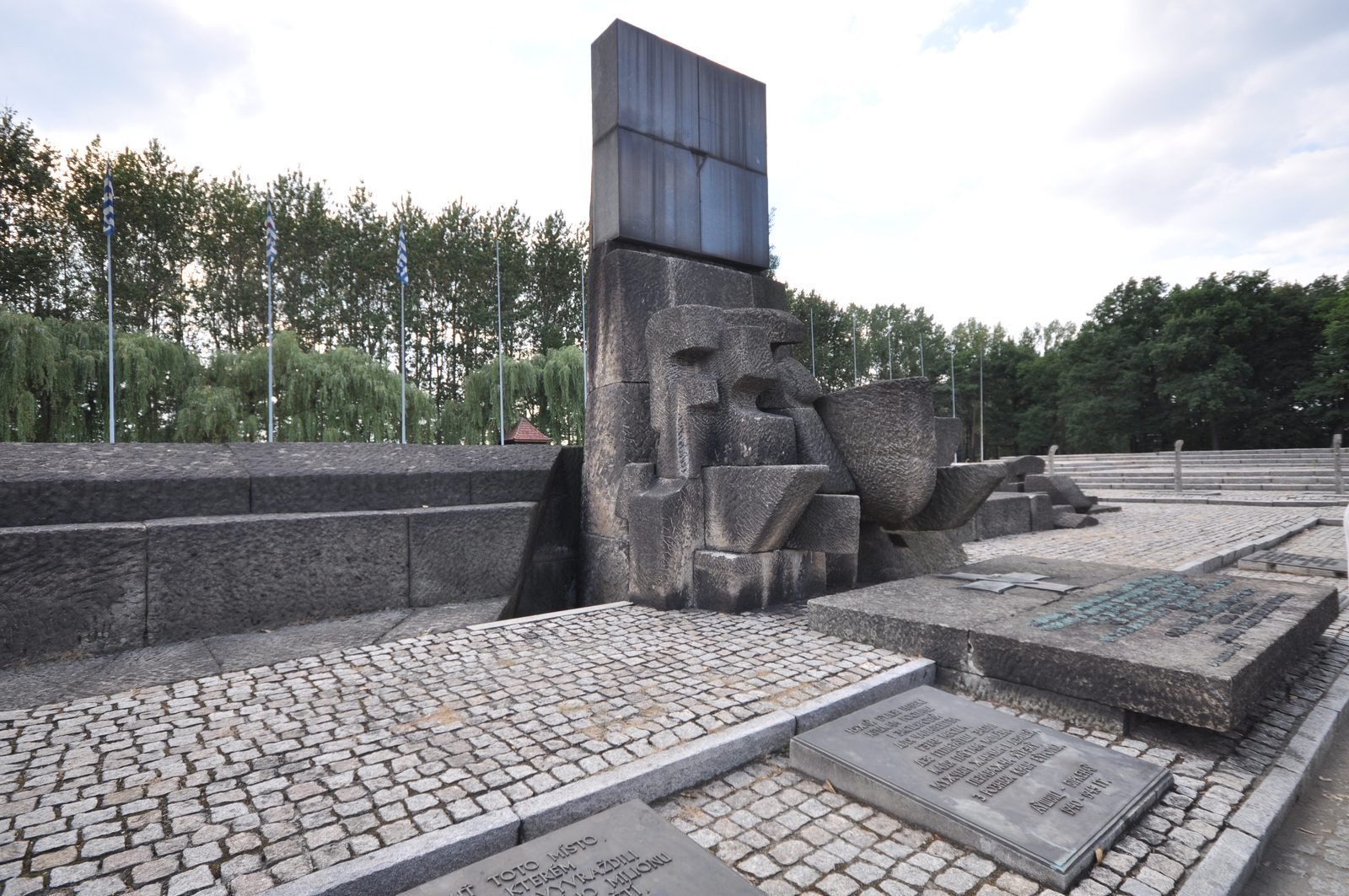
Ingeborg Hunzinger’s Block der Frauen, the memorial to the protest, beside Rosenstraße in Mitte. Photographed 2008.Niki Sublime from Boston, USA, 2008. Wikimedia Commons. CC BY 2.0.
Rosenstraße · 1943
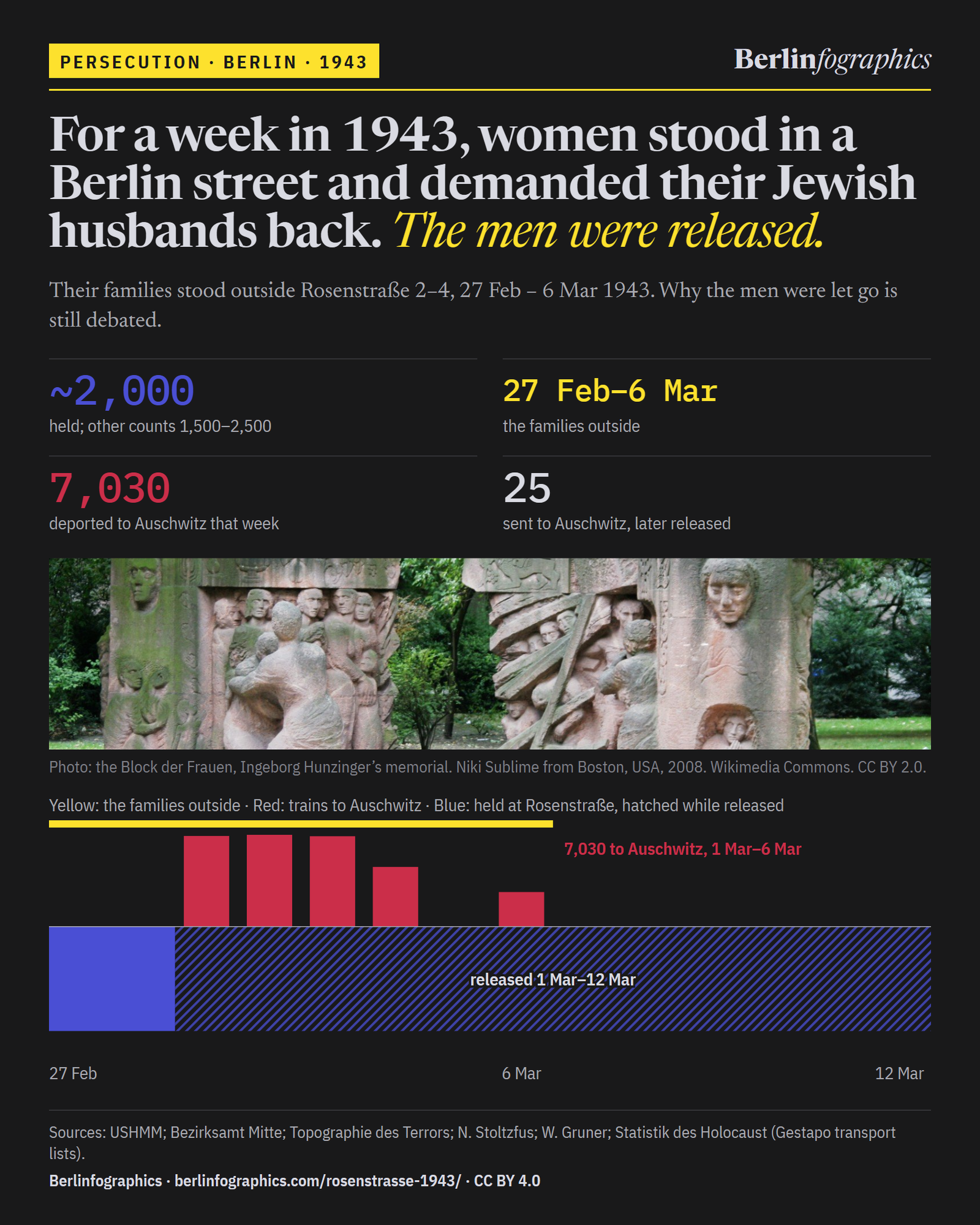
In the Gestapo’s last great roundup of Berlin’s Jews, the men with non-Jewish wives were held at Rosenstraße 2–4. Their families stood outside from 27 February 1943 to 6 March 1943. Historians still disagree about why the men were let go, and about how many people stood in the street.
01Rosenstraße, Mitte
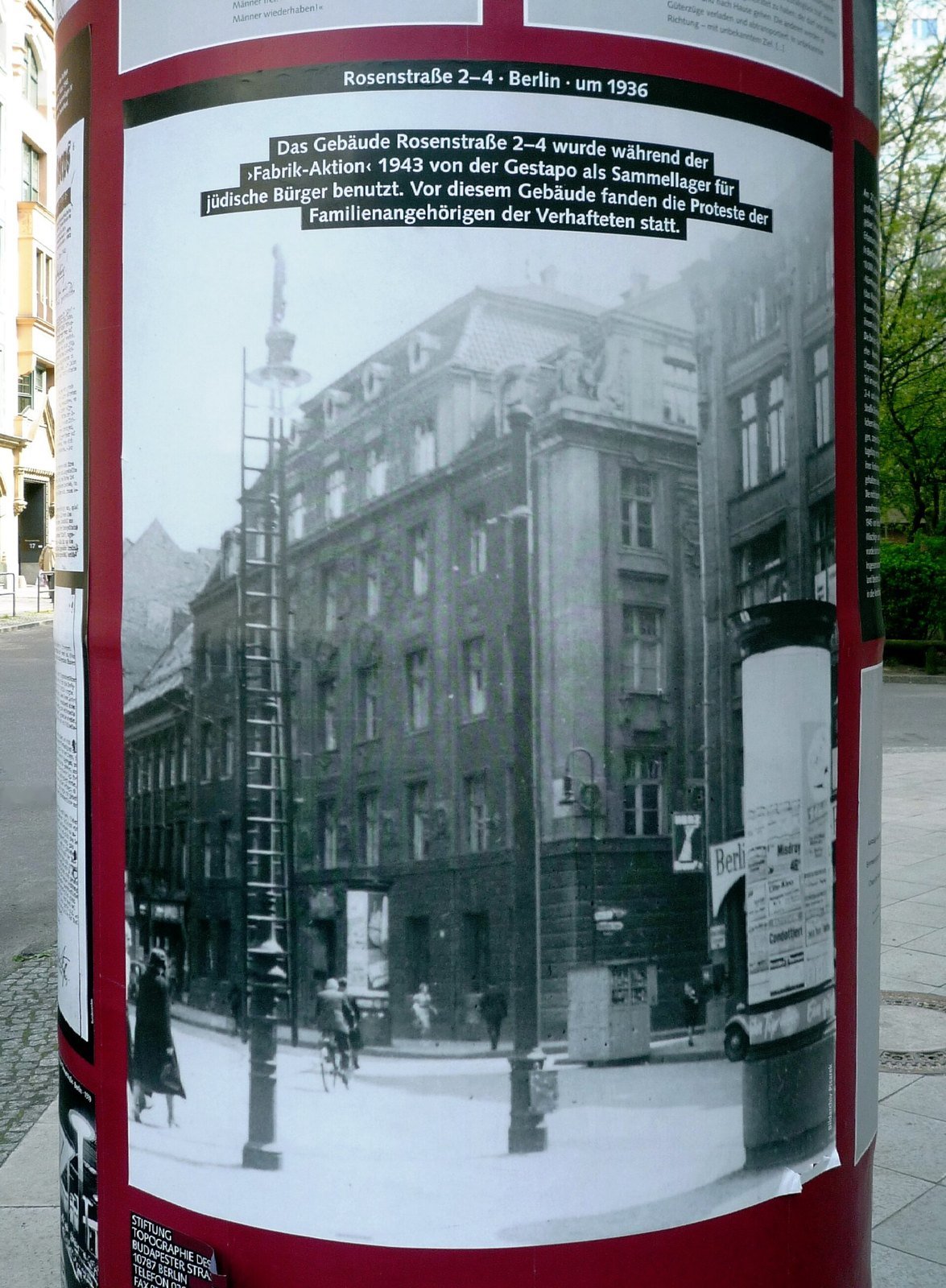
Berlin’s first synagogue stood at the corner of Rosenstraße and Heidereutergasse from 1714 until it was destroyed in the Second World War. Beside it, in 1905, the Jewish community put up its administration building, Rosenstraße 2–4.
By early 1943 most of Berlin’s Jews had been deported. Among those left were the Jews married to non-Jews, and their children: some 8,800 people in Berlin. At the Wannsee Conference in January 1942 the regime had put off acting against them until after the war was won.


0227 February – 12 March 1943
The chart shows one fortnight, day by day, on one scale of people. Above the line are the trains to Auschwitz. Below it are the people held at Rosenstraße 2–4.
One fortnight, one scale of people
27 February 1943
Before dawn the Gestapo began seizing the Jews still working in Berlin’s factories: the Fabrikaktion, or “factory action”. The estimates run from 8,000 to 11,000 people arrested; the Topographie des Terrors gives about 10,000.
Rosenstraße 2–4
Jews married to non-Jews, and the sons of such marriages, were held apart at Rosenstraße 2–4: about 2,000, by the USHMM’s count. The district’s memorial text gives 1,500 to 2,500.
27 Feb – 6 Mar 1943
From the evening of 27 February wives, daughters and other relatives gathered outside and called for the men. Police cordoned off the building. The women stayed, even when threatened with lethal force, until 6 March 1943.
1 Mar – 6 Mar 1943
The other Jews seized were not released. In the same days, 7,030 people left Berlin for Auschwitz in five transports. Berlin’s Jewish register fell from 27,281 at the end of February to 18,515 at the end of March.
1 Mar – 12 Mar 1943
The Gestapo checked each prisoner’s papers. By the USHMM’s account it let the first go on 1 March 1943 and the last on 12 March 1943. The district’s texts say the releases began on 6 March 1943. No daily count survives.
March 1943
25 of those held were sent to Auschwitz as protective-custody prisoners. According to Nathan Stoltzfus, within two weeks they too were released and sent to labour camps nearer Berlin.
03The numbers
No list of the prisoners and no count of the crowd survives in the sources used here. Each estimate below is drawn at its true value and labelled with its source. The two charts have different scales, but both start at zero.
How many were held at Rosenstraße 2–4
How many stood in the street
Gruner’s figure is as reported by Ulrich Kurzer in Der Freitag in 2003. Andreas-Friedrich wrote: “Sechstausend nichtjüdische Frauen drängten sich in der Rosenstraße” (“6,000 non-Jewish women crowded into Rosenstraße”). Gad Beck, who was held inside, thought her figure reasonable “not as the number protesting at one time, but as the sum total of all those who protested at one time or another”.
04The historians
The Bezirksamt Mitte leaves the question open: whether the protest alone led to the release, or other political calculations played a part. The two main readings are these.
Nathan Stoltzfus, Resistance of the Heart (1996) and later
The Gestapo meant to deport the men. The women’s protest, in the capital, weeks after Stalingrad, forced the regime to back down: Goebbels by March 6 ordered the release of intermarried Jews because of them
.
Wolf Gruner, Widerstand in der Rosenstraße (2005); the USHMM
Gruner points to an order of the Gestapo in Frankfurt an der Oder dated 24 February 1943: Jews in mixed marriages seized in the Fabrikaktion were lediglich erfasst und anschließend "in ihre Wohnung" entlassen werden
, only to be registered and then sent home. The USHMM agrees: In fact, the Gestapo never intended to deport "mixed-marriage" Jews and fully intended to incarcerate these Jews in forced-labor camps in the Reich
.
Neither reading takes away from the women. The USHMM, which doubts that the protest changed the outcome, writes that they could not know the Gestapo’s plans, and that “nothing detracts from the courage of those women”. Showing friendship to Jews in public had carried a threat of three months’ “protective custody” since 1941.
05After the week
The men were not free for long. German police came back for the released men and teenage boys the day after their release, and sent them to forced labour in Berlin and elsewhere. Gad Beck was among those held at Rosenstraße: “He was detained there until March 6, when the group was released following a demonstration.”
Other Jews from mixed marriages were held at the old people’s home in Große Hamburger Straße 26. The Gestapo office that ran the deportations was a few minutes away, in Burgstraße.


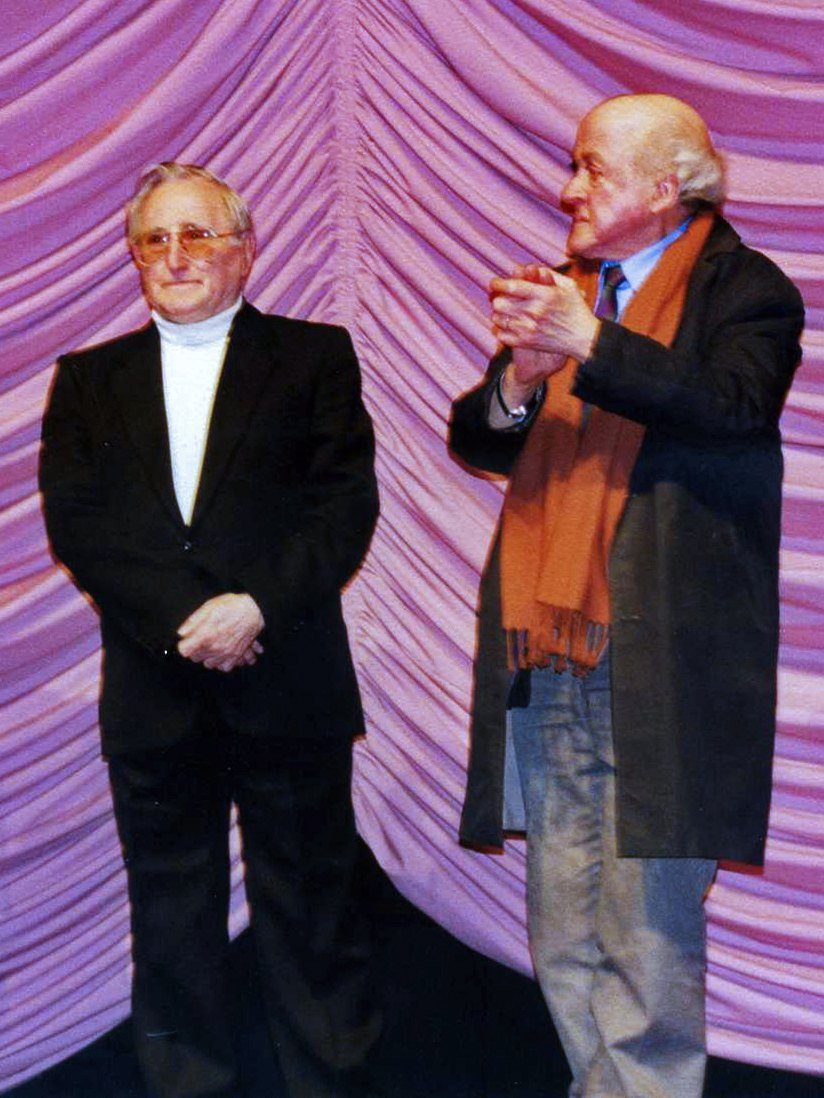
The memorial in the park beside the street is the work of Ingeborg Hunzinger (1915–2009), a communist and the daughter of a Jewish mother. It was set up in 1995. On the left, women wait and call out; in the middle, two women hold each other up; on the right, the families meet again.
GEBT UNS UNSERE MÄNNER WIEDER“GIVE US BACK OUR MEN”: one of the lines carved on the memorial
In the week the families stood in Rosenstraße, 7,030 Jews were taken from Berlin to Auschwitz.
The men held in the building their wives stood outside came home.
Press & citation
Free to publish under CC BY 4.0 — in print, online, on Wikipedia and in teaching, commercially or not — with credit to Berlinfographics and a link to this page.
Ready-to-use image
The infographic as one image: headline, key figures, chart, sources and credit, 2,400 × 1,350 px PNG. Please use it unedited.
Download landscape (PNG)
Square format
A 1:1 version for social media and narrow columns, 1,800 × 1,800 px.
Download square (PNG)
Portrait 4:5
For Instagram and LinkedIn feeds, 1,620 × 2,025 px.
Download portrait (PNG)Credit line
Berlinfographics (berlinfographics.com), CC BY 4.0
Citation
Berlinfographics (2026). “Rosenstraße, 1943”. Berlin Experiences. https://berlinfographics.com/rosenstrasse-1943/
Wikipedia
{{cite web |title=Rosenstraße, 1943 |url=https://berlinfographics.com/rosenstrasse-1943/ |website=Berlinfographics |publisher=Berlin Experiences |date=2026-11-09 |access-date=2026-11-09}}
Our infographics, charts and texts are licensed CC BY 4.0: free to republish, including commercially, with credit to Berlinfographics and a link. Photographs keep their own licences, named in each caption. How to credit
Topics: The Second World War · Cold War Berlin · Nazi Berlin · Persecution & the Holocaust · Weimar Berlin · Prussia & the Kaiserreich · Architecture & the built city · Culture, science & society · Reunified Berlin · Unusual facts
Contact: info@berlinfographics.com · Press: press@berlinfographics.com · Imprint · Privacy