Berlinfographicsby Berlin Experiences

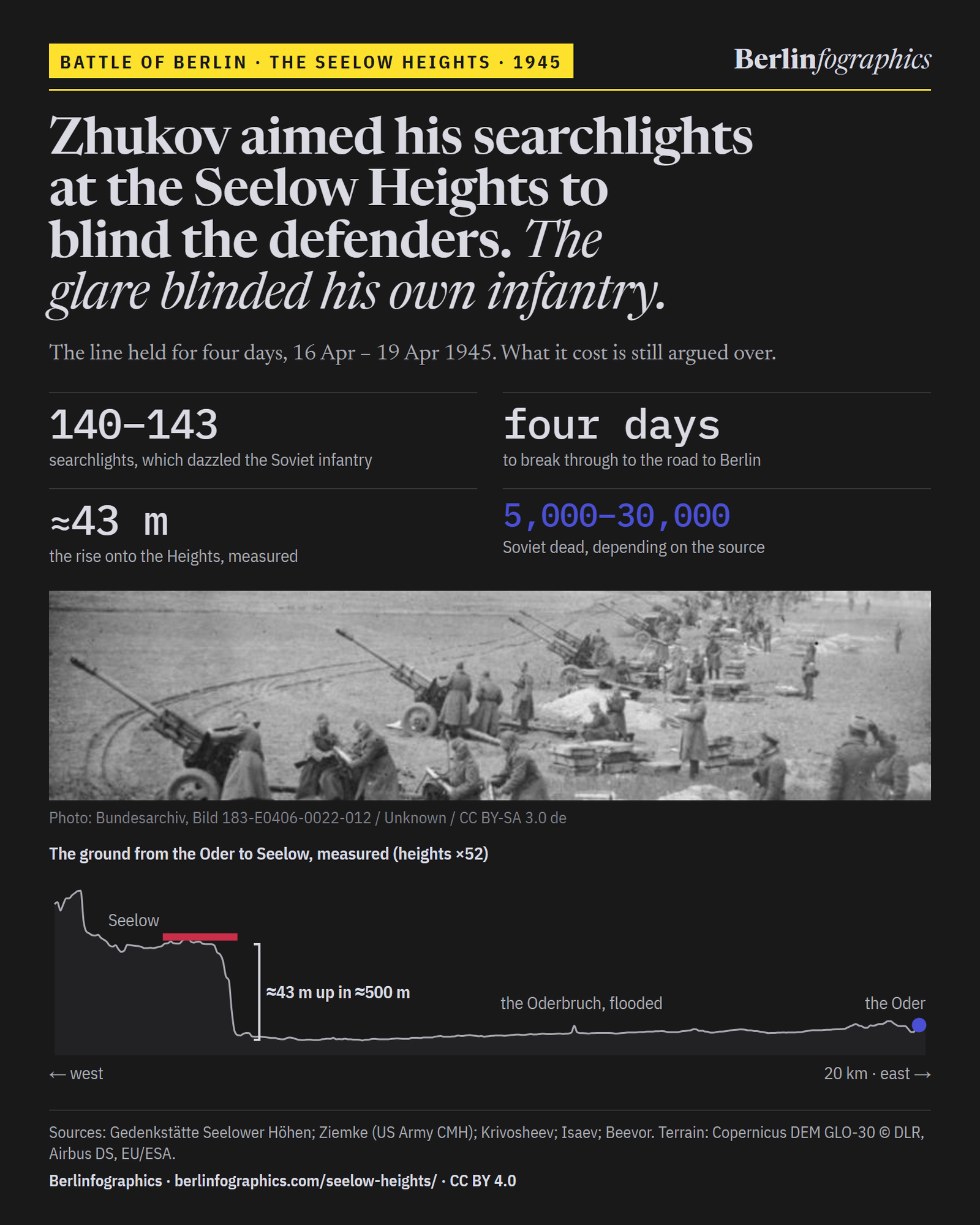
Soviet artillery before Berlin, April 1945. The Bundesarchiv caption does not record the exact place.Bundesarchiv, Bild 183-E0406-0022-012 / Unknown / CC BY-SA 3.0 de

The Seelow Heights · 16 April – 19 April 1945

Zhukov aimed his searchlights at the Seelow Heights to blind the defenders. The glare blinded his own infantry.

The last German line before Berlin ran along a low escarpment above the Oder. Zhukov’s front needed four days to break it, from 16 April to 19 April 1945. How many men it cost is still argued over, and the figure most often repeated was also the one the East German memorial put on its souvenir medal.

140–143
Soviet searchlights switched on at the start of the attack
four days
to break through, 16 April – 19 April
≈43 m
the rise from the valley floor onto the Heights, measured on the terrain model
5,000–30,000
Soviet dead, depending on whose count
01The ground

A wall above a swamp: the ground decided the first day

The section below is measured, not drawn: the European Copernicus elevation model, sampled along a straight line from the Oder through the memorial on the Heights. The positions laid over it are schematic; the sources describe them in kilometres and miles, not on a survey.

The ground from the Oder to Seelow, measured

A cross-section of the ground from the river Oder in the east to the plateau west of Seelow, drawn from satellite elevation data. The valley floor is flat and low for most of the way; then the ground rises steeply onto the Seelow Heights. Overlays, drawn schematically, show the Soviet start on the Oder, the flooded plain, the German main line on the heights, the barrage, the searchlights and where the attack stood at nightfall on the first day.
SovietWehrmachtGround, measured

Terrain: Copernicus DEM GLO-30 © DLR, Airbus DS, EU/ESA · places © OpenStreetMap contributors · positions schematic

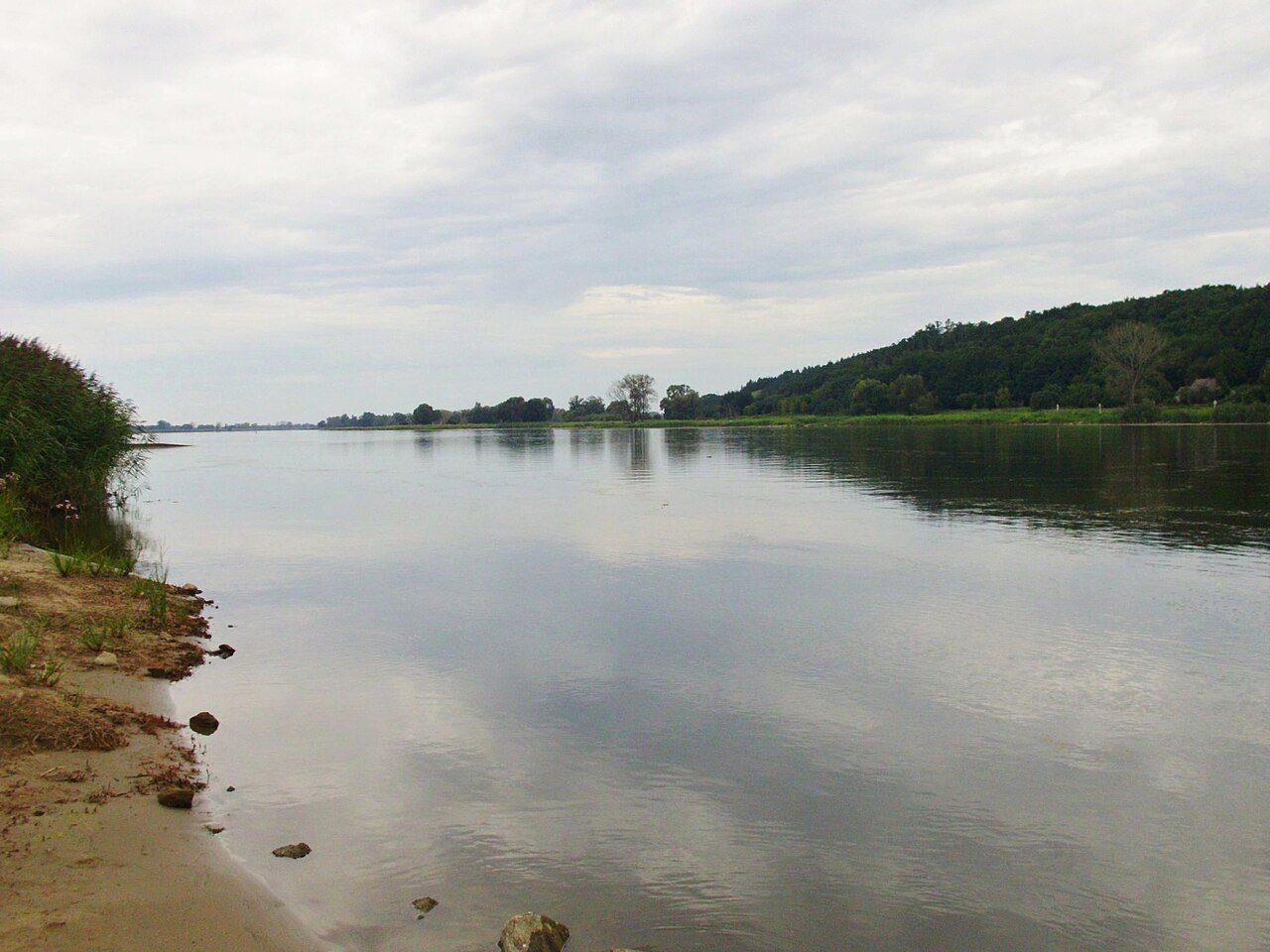
A broad, calm river between low banks, a wooded rise on the far side.
The Oder at Güstebieser Loose, north of the battlefield, 2012. By April 1945 the Red Army held bridgeheads on its west bank; the main attack came out of the one at Küstrin.Norbert Radtke (Dramburg), 2012. Wikimedia Commons. CC BY-SA 3.0.

East of Seelow

Across the Oder already

By April the Red Army held bridgeheads on the west bank of the Oder. Zhukov’s main force was to attack out of the one at Küstrin, straight toward Berlin.

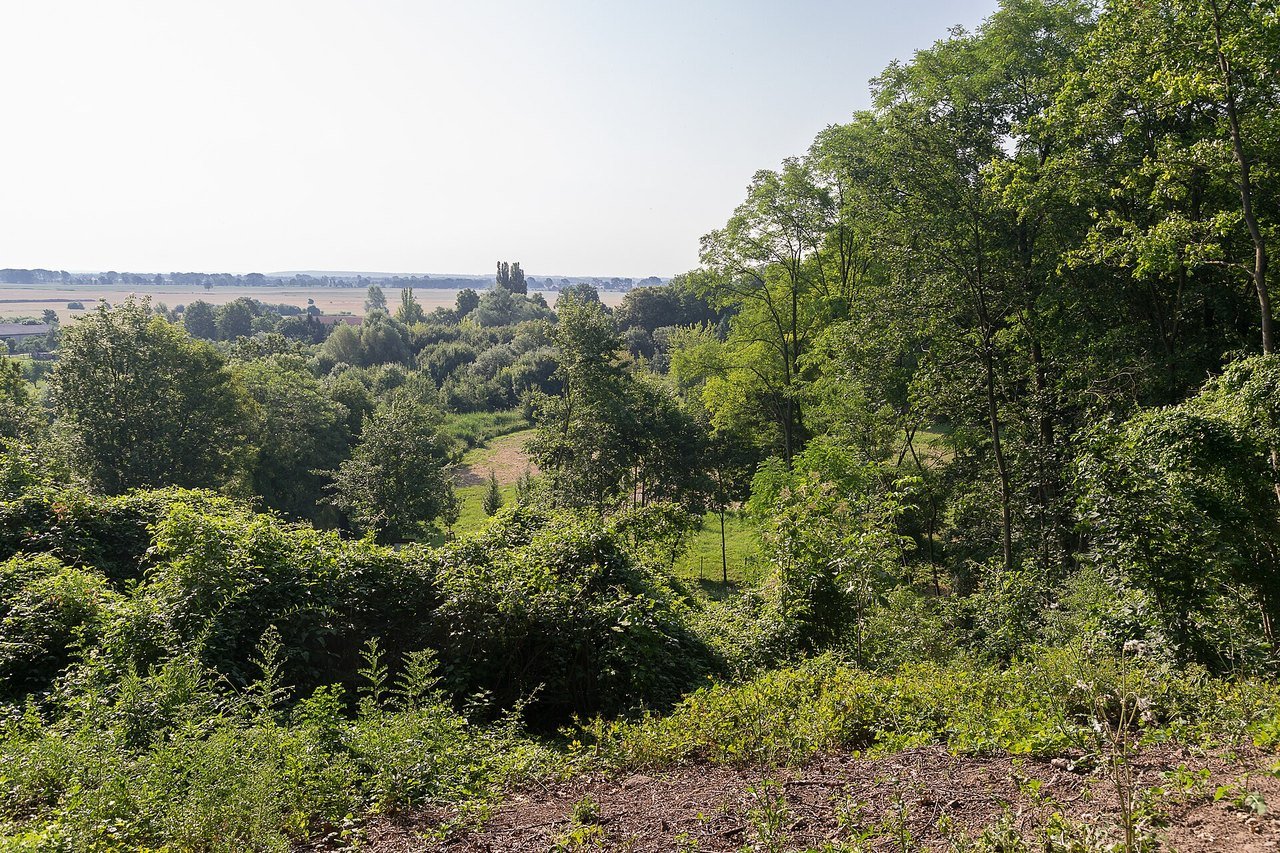
From a wooded height, a wide flat plain of fields stretches to the horizon.
The Oderbruch seen east from the Seelow Heights memorial, 2015: the flat valley floor the Soviet infantry had to cross.Tsungam, 2015. Wikimedia Commons. CC BY-SA 4.0.

The Oderbruch

A flat, flooded valley floor

Between the river and the Heights lies the Oderbruch, here about 7 m above sea level. The spring floodwaters had left it waterlogged.

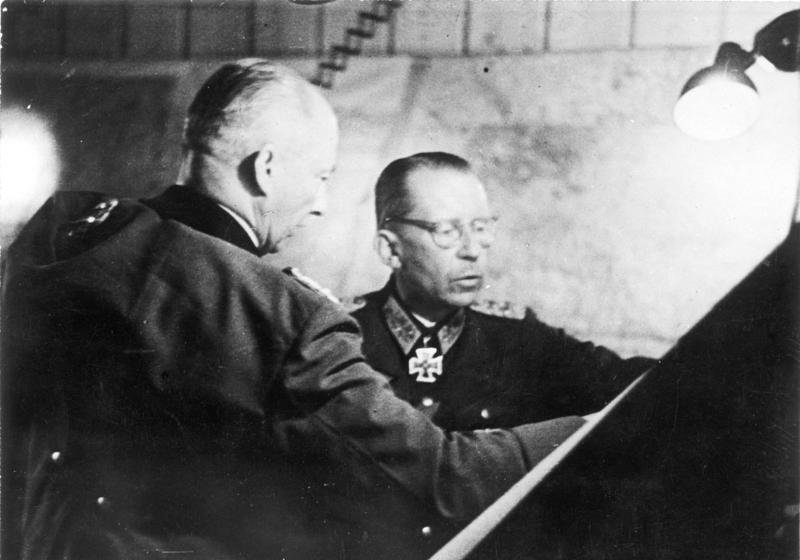
Two German generals bent over a wall map in a dim room; the one on the right wears glasses.
Gotthard Heinrici, who commanded Army Group Vistula.Bundesarchiv, Bild 146-1977-120-09 / Johannes Bergmann / CC BY-SA 3.0 de

The German side

The real line was further back

On Hitler’s order of 30 March, the main battle line was dug two to four miles behind the front. Most of the troops were taken out of the forward positions just before the barrage.

A heavy tracked howitzer with a long barrel crawls along a muddy road, soldiers riding on it, more guns behind.
Soviet 203 mm B-4 howitzers on the way to Berlin, April 1945.Aleksandr Ustinov, 1945. Mos.ru, via Wikimedia Commons. CC BY 4.0.

16 April, before dawn

The barrage

About 500,000 shells and mortar bombs fell in the opening barrage; 1,236,000 rounds by the end of the day. Much of it fell on forward positions that most of the troops had left.

A large military searchlight on a wheeled mount, its round lens facing the camera, on a plinth among shrubs.
The memorial’s searchlight is post-war; it was long shown as one of the originals.Assenmacher, 2014. Wikimedia Commons. CC BY-SA 3.0.

As the infantry moved off

The searchlights

140–143 anti-aircraft searchlights were turned on the German positions. The memorial’s record: “But the searchlight beams, reflected by dust and fog, dazzled and hindered the Soviet attackers.”

Three Soviet officers in greatcoats and peaked caps behind a parapet, binoculars resting in front of them; the man in the centre points ahead.
Chuikov (centre), 8th Guards Army, at his observation post at Seelow.Unknown author, 1945. Russian Ministry of Defence (mil.ru), via Wikimedia Commons. CC BY 4.0.

The escarpment

Then the ground stood up

On this line the ground climbs about 43 m in some 500 m. Chuikov’s 8th Guards Army attacked straight at it.

Soviet tanks and soldiers crowd a village street in front of a shop with a German sign.
Tanks and infantry of the 2nd Guards Tank Army during the Berlin operation, 1945.Unknown author, 1945. Wikimedia Commons. Public domain.

Nightfall, 16 April

Still below the Heights

Both tank armies were thrown in during the day and only added to the tangle. At nightfall the attacking divisions were all still in front of the German main battle line.

02The odds

About six to one in tanks, 49 to one in guns

The German 9th Army under Theodor Busse held the Oder front east of Berlin with 14 divisions, by the US Army’s official count. Zhukov’s front alone counted 908,500 men at the start of the operation. Hitler had promised Heinrici reinforcements and sent mostly untrained air force and navy men.

Above Busse stood Gotthard Heinrici, at the head of Army Group Vistula since March. Two days before the attack, a Soviet probe of five divisions and 200 tanks failed to take the Heights. Hitler’s order of the day to the Eastern Front, kept at the memorial, ended:

Berlin bleibt deutsch, Wien wird wieder deutsch und Europa wird niemals russisch.“Berlin stays German, Vienna will be German again and Europe will never be Russian.” The same order: “Whoever orders you to retreat is to be arrested at once and, if need be, shot on the spot, whatever his rank.”

Two German generals bent over a wall map in a dim room; the one on the right wears glasses.
Gotthard Heinrici (right) with Günther von Kluge before a wall map, 1943. From March 1945 Heinrici commanded Army Group Vistula, which held the Oder front.Bundesarchiv, Bild 146-1977-120-09 / Johannes Bergmann / CC BY-SA 3.0 de

Each pair is drawn on its own scale from zero. Tanks and artillery: the US Army’s official history. The three Soviet fronts that attacked toward Berlin together counted 2,500,000 men.

03The breakthrough

Zhukov was still below the Heights when Konev’s tanks were turned toward Berlin too

The fighting went on day and night. The days below follow the US Army’s official history, which draws on the German war diaries and the Soviet official account.

16 April

Day one

The barrage, the searchlights, and an attack that piled up in the mud. Both tank armies were thrown in; at nightfall the Germans still held their main line.

To the south: Konev’s infantry had crossed the Neisse on the first day, breaking in as deep as six miles.

17 April

Day two

A reserve army, the 47th, and both tank armies were thrown in against two small areas, southeast of Wriezen and at Seelow; two German reserve panzer divisions held them to minor gains.

To the south: the Stavka changed the plan on the second day and ordered the 3rd and 4th Guards Tank Armies to strike for Berlin as soon as they broke through.

18 April

Day three

Soviet armour broke in ten to 12 miles west of Wriezen and southwest of Seelow. The 9th Army held its front together through the day.

19 April

Day four

The southern group reached Müncheberg; the northern group, the 2nd Guards Tank Army in the van, broke through west of Wriezen. Next day, Hitler’s birthday, “the battle for Berlin was lost.”

The line runs from 16 April to 20 April on one scale. Stalin’s telephone threat to dismiss Zhukov, told on the sheet this story replaces, is not in the sources checked; the turn of Konev’s two tank armies is.

Portrait of Marshal Zhukov in uniform, his chest covered in medals.

Georgy Zhukov

Commanded the 1st Belorussian Front. His plan put the whole weight of the attack straight across the Oderbruch at the Heights.

Georgy Zhukov, commander of the 1st Belorussian Front, 1945. Grigory Vayl, 1945. Wikimedia Commons. Public domain.

Portrait of Marshal Konev in uniform with medals.

Ivan Konev

Commanded the 1st Ukrainian Front to the south. He crossed the Neisse on the first day; on the second, his tank armies were ordered to strike for Berlin.

Ivan Konev, commander of the 1st Ukrainian Front, 1945. Unknown author, 1945. Wikimedia Commons. Public domain.

Stalin in a pale marshal’s uniform, seated, at the Potsdam Conference.

Joseph Stalin

Head of the Stavka, the Soviet high command. By the Soviet official history, it was the Stavka that changed the plan on 17 April and set the two fronts racing for Berlin.

Joseph Stalin at the Potsdam Conference, August 1945. US Army Signal Corps, 1945. Library of Congress, via Wikimedia Commons. Public domain.

04The count

The Soviet dead at Seelow: one count is five times another

No agreed figure exists. The published counts measure different things: killed, missing, wounded, or all of them. Krivosheev’s official loss tables give no Seelow figure at all; they fold the battle into the operation that ran on to Berlin. Each bar is a source, not an estimate of the same number.

Losses at the Seelow Heights, by source

Bars on one linear scale for each published count of the losses at the Seelow Heights: Soviet killed and missing from the archive, all Soviet casualties from the archive, Soviet killed according to Beevor, the figure on a GDR souvenir medal, and German killed. A last state widens the scale to Krivosheev's figures for the whole Berlin operation of Zhukov's front.
SovietGermanMemorial medal
Portrait of Marshal Zhukov in uniform, his chest covered in medals.
Zhukov’s front kept the returns Isaev used.Grigory Vayl, 1945. Wikimedia Commons. Public domain.

Isaev, from the front’s archival returns

Killed and missing

The historian Aleksei Isaev, working from the 1st Belorussian Front’s own returns, counts 5,000 to 6,000 killed and missing.

Isaev

All casualties

Counting the wounded too, Isaev reaches about 20,000: a far larger number, but the same men.

Beevor

Killed

Antony Beevor’s history of the battle gives “just over” 30,000 killed: five times the archive’s count of the dead and missing.

GDR souvenir medal, 1980

On the memorial’s medal

The same figure was struck on a souvenir medal sold at the memorial in 1980: “30 000 gefallene sowjetische Helden”, thirty thousand fallen Soviet heroes.

Beevor

German killed

For the German side Beevor gives 12,000 killed. No archive count has been published for it.

Krivosheev, Zhukov’s front

Whole Berlin operation

For scale: over all 23 days from the Oder to the Elbe, Krivosheev’s tables give Zhukov’s front 37,610 dead and missing, and 179,490 casualties in all.

05The memorial

The memorial told its own version of the battle, and has since corrected it

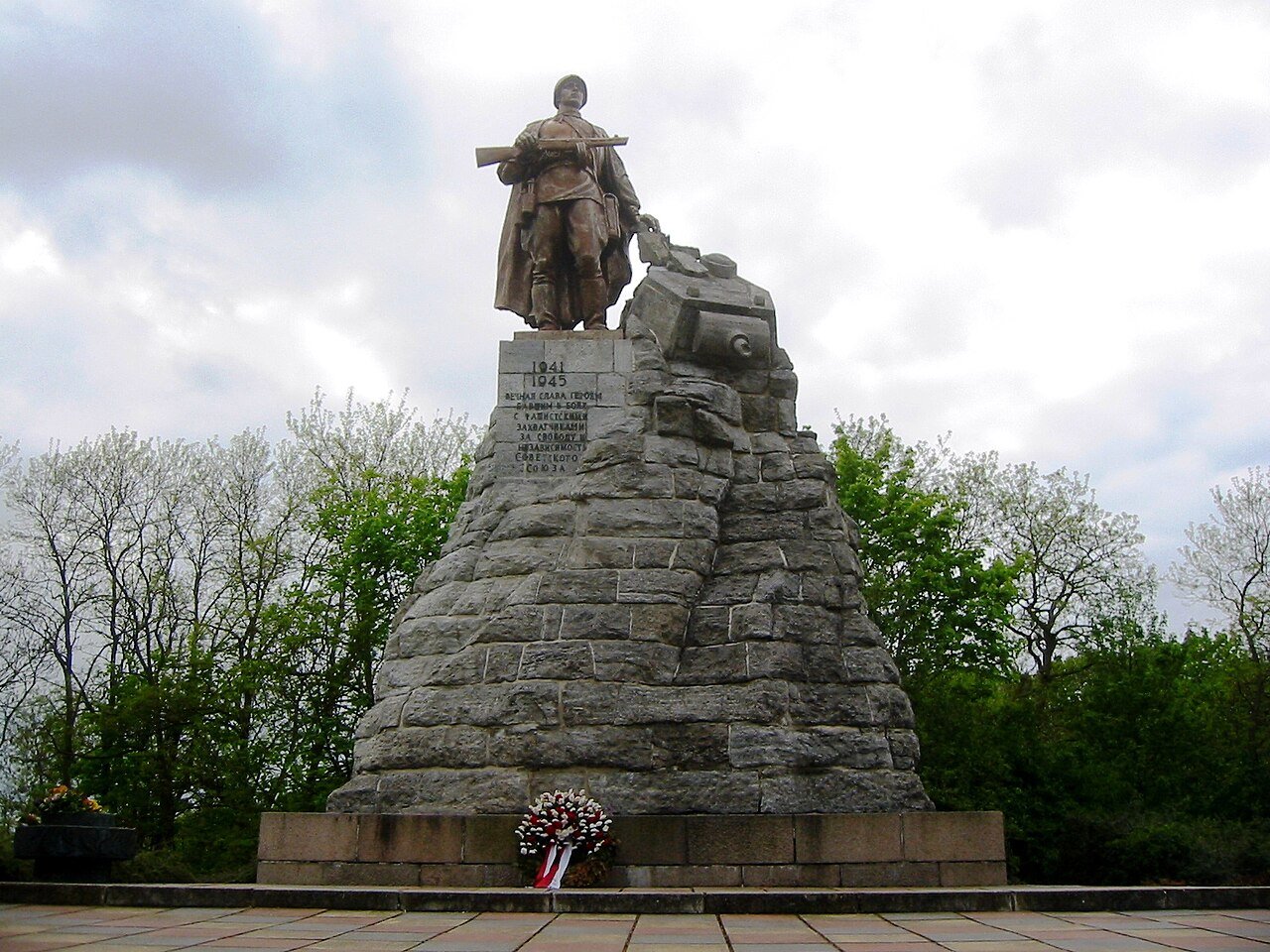
A Red Army soldier leans on the turret of a wrecked German tank on the crest at Seelow. Lev Kerbel and Vladimir Tsigal made him; he was unveiled on 27 November 1945, one of three victory monuments Zhukov ordered along the road to Berlin, at Küstrin, Seelow and Berlin-Tiergarten. Soviet war graves lie below him.

In 1972 the GDR built the memorial around him. The Federal Agency for Civic Education says plainly that it “glorified the Red Army’s victory over the Nazi regime”; a new exhibition, free of the old ideological brief, opened in 1995.

A bronze soldier with a submachine gun stands on a tall rough granite pedestal, a wreath at its foot.
The Soviet monument by Lev Kerbel and Vladimir Tsigal at the Seelow Heights memorial, 2014: a Red Army soldier leaning on the turret of a wrecked German tank.Assenmacher, 2014. Wikimedia Commons. CC BY-SA 3.0.
A large military searchlight on a wheeled mount, its round lens facing the camera, on a plinth among shrubs.
The searchlight at the Seelow Heights memorial, 2014. It is an APM-90, built after the war; until 1989 visitors were told it had been used in the battle.Assenmacher, 2014. Wikimedia Commons. CC BY-SA 3.0.

The searchlight beside the museum is the clearest case. It has stood there since 1977. It is an APM-90, built after the war to light military runways, and until 1989 visitors were told, wrongly, that it had shone in the battle. Under the GDR it lit the monument at ceremonies.

30 000 gefallene sowjetische Helden.“Thirty thousand fallen Soviet heroes”: the reverse of a souvenir medal sold at the memorial in 1980, now in its collection.

The medal’s figure is the same as Beevor’s, and five times the count of dead and missing from the Soviet front’s own returns. The memorial’s records today give the searchlight count as 140 and say plainly that the lights blinded the attackers.

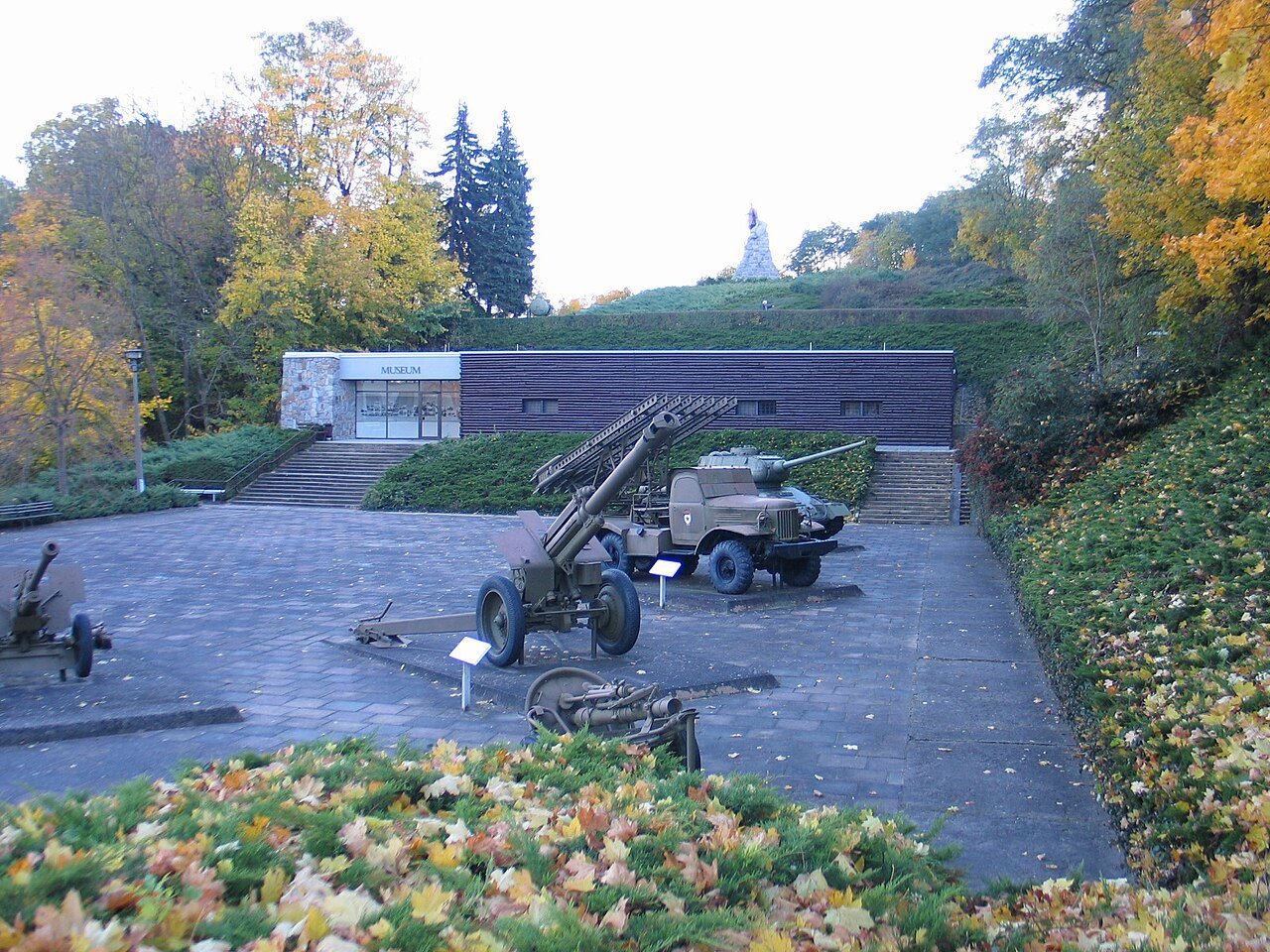
A low museum building with a flat roof behind a paved court with Soviet artillery pieces and a rocket launcher; a statue on a wooded slope above.
The memorial’s museum and the Soviet guns in its forecourt, 2010; the monument stands on the rise behind.Tregandin, 2010. Wikimedia Commons. CC BY 3.0.

The memorial’s collection also keeps a poster from its first exhibition, “The key to Berlin”: before the offensive, oversized keys were dropped by parachute over the 8th Guards Army, marked 1945 on one side and 1760 on the other, the year Russian troops had been handed the key of Berlin in the Seven Years’ War.

The Heights held for four days. Then the road to Berlin was open, and the battle for the city was lost before it began.

What it cost is still a matter of whose count you read.

Press & citation

Use this Berlinfographic

Free to publish under CC BY 4.0 — in print, online, on Wikipedia and in teaching, commercially or not — with credit to Berlinfographics and a link to this page.

The Seelow Heights, April 1945: ready-to-use landscape image

Ready-to-use image

The infographic as one image: headline, key figures, chart, sources and credit, 2,400 × 1,350 px PNG. Please use it unedited.

Download landscape (PNG)
The Seelow Heights, April 1945: square version

Square format

A 1:1 version for social media and narrow columns, 1,800 × 1,800 px.

Download square (PNG)
The Seelow Heights, April 1945: portrait version

Portrait 4:5

For Instagram and LinkedIn feeds, 1,620 × 2,025 px.

Download portrait (PNG)

Credit line

Berlinfographics (berlinfographics.com), CC BY 4.0

Citation

Berlinfographics (2026). “The Seelow Heights, April 1945”. Berlin Experiences. https://berlinfographics.com/seelow-heights/

Wikipedia

{{cite web |title=The Seelow Heights, April 1945 |url=https://berlinfographics.com/seelow-heights/ |website=Berlinfographics |publisher=Berlin Experiences |date=2026-11-09 |access-date=2026-11-09}}