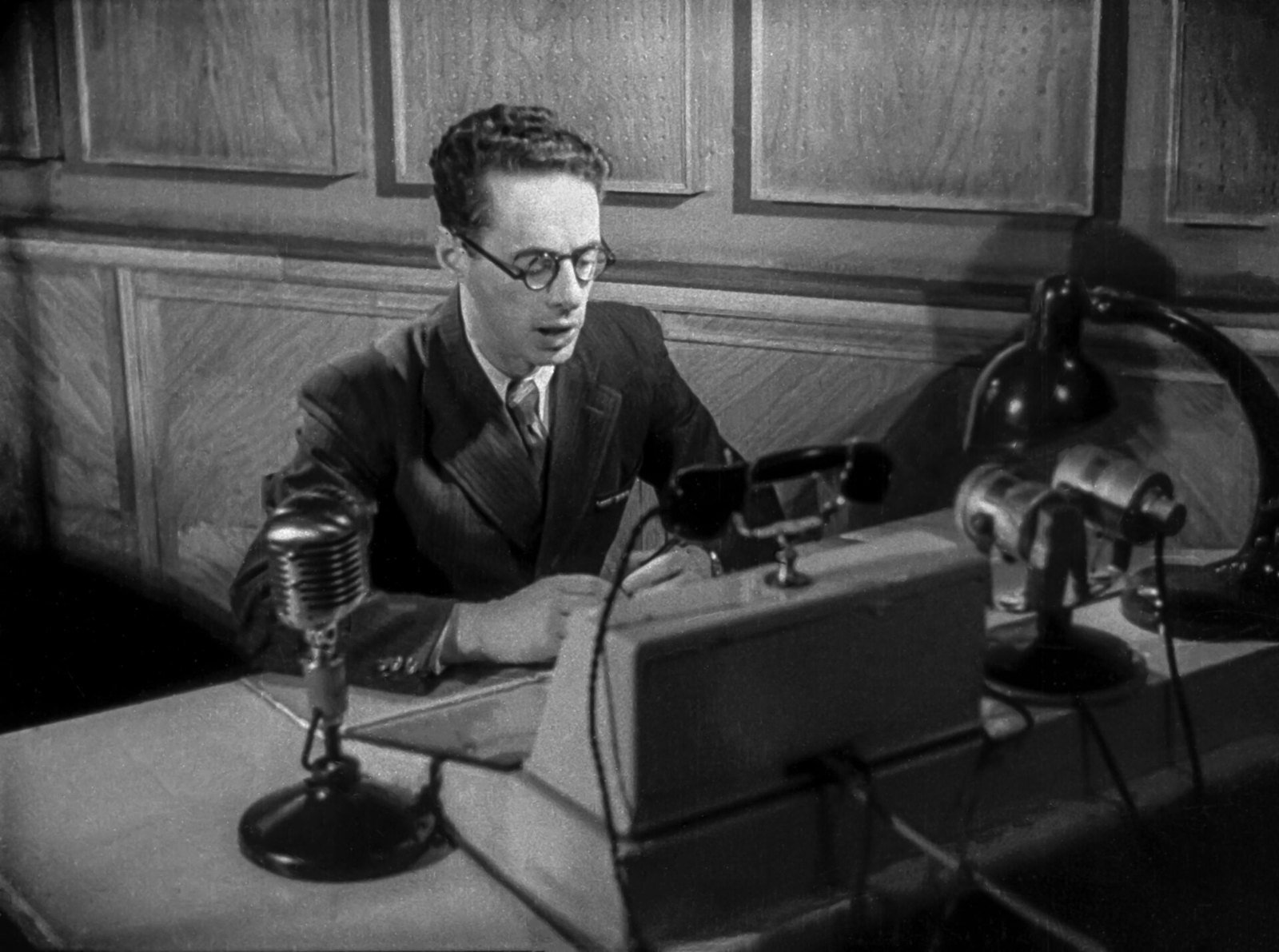
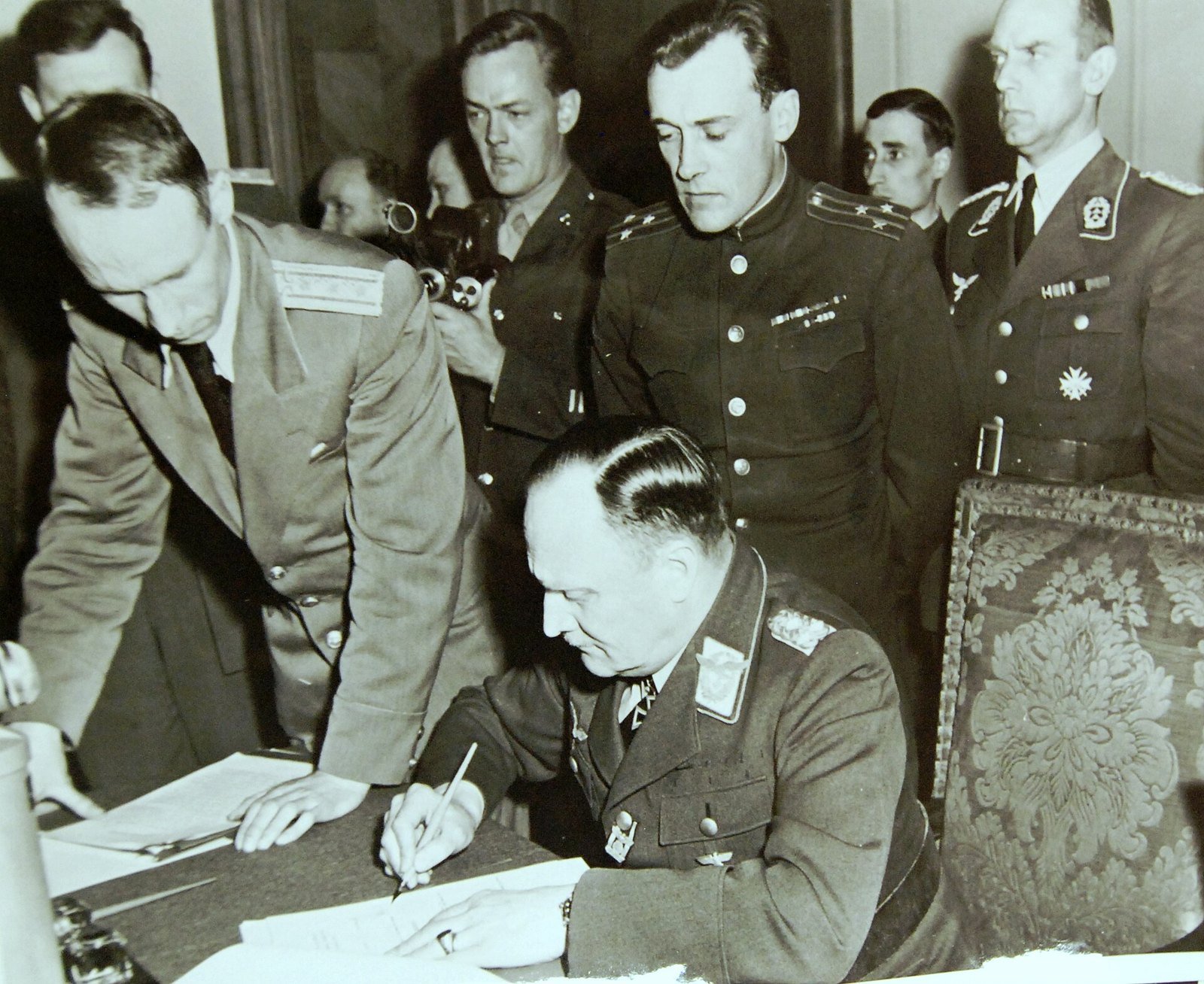
Field Marshal Wilhelm Keitel signs the Act of Military Surrender at the Soviet headquarters in Karlshorst, in the night of 8 to 9 May 1945. US Army photograph by Lt. Moore, in Adam Cuerden’s restoration.Lt. Moore, US Army Signal Corps, 1945 (NARA 111-SC-206292), restored by Adam Cuerden. Public domain.
Reims · Karlshorst · 7 May – 9 May 1945
The Wehrmacht signed its unconditional surrender at Reims in the small hours of 7 May 1945, and again, a night later, in a Berlin officers’ mess, before the same four Allies. The second document is dated 8 May. Exactly when it was signed is disputed by two hours, but on Moscow’s clocks every account falls on 9 May.
01The first signature
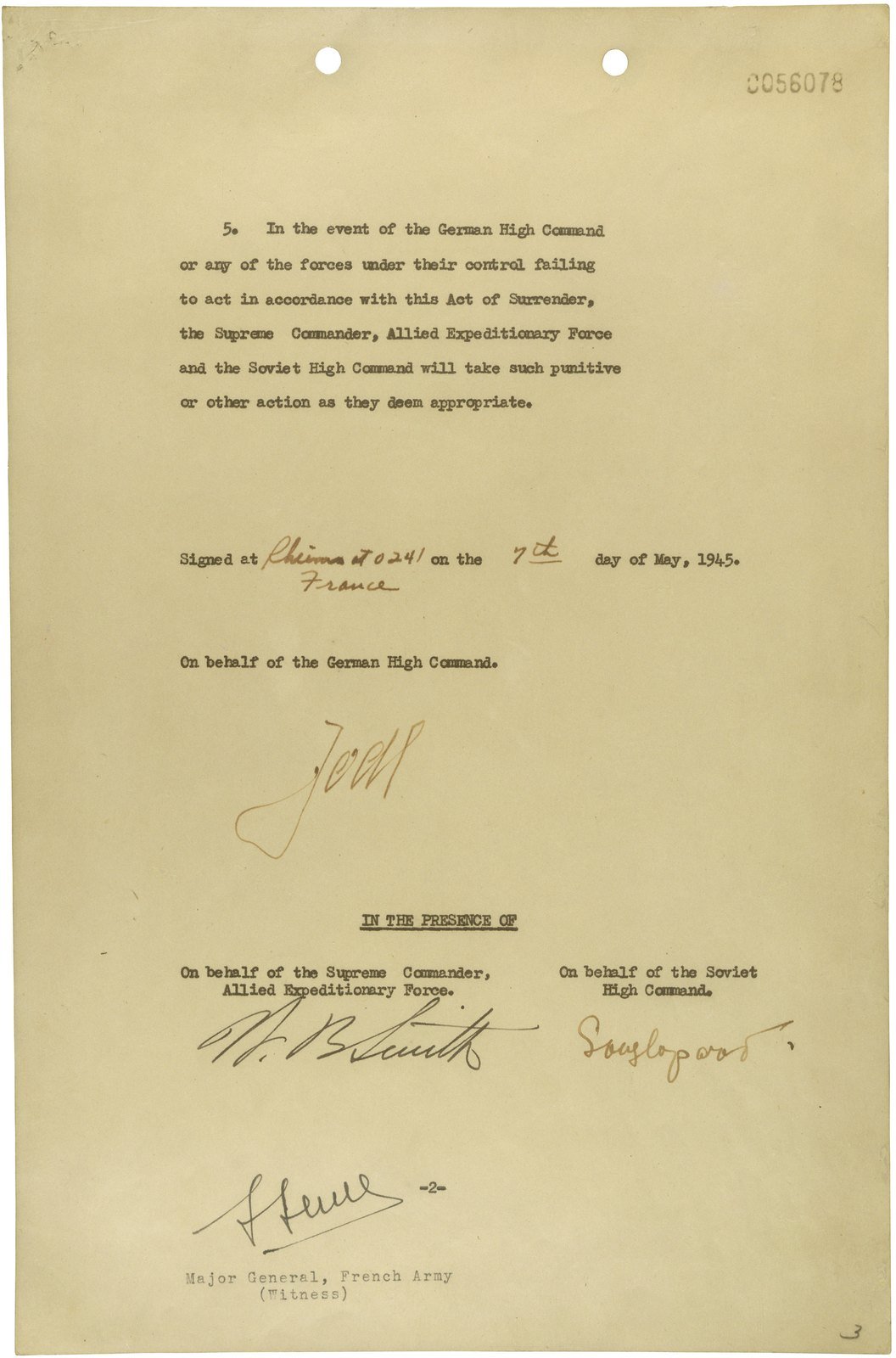
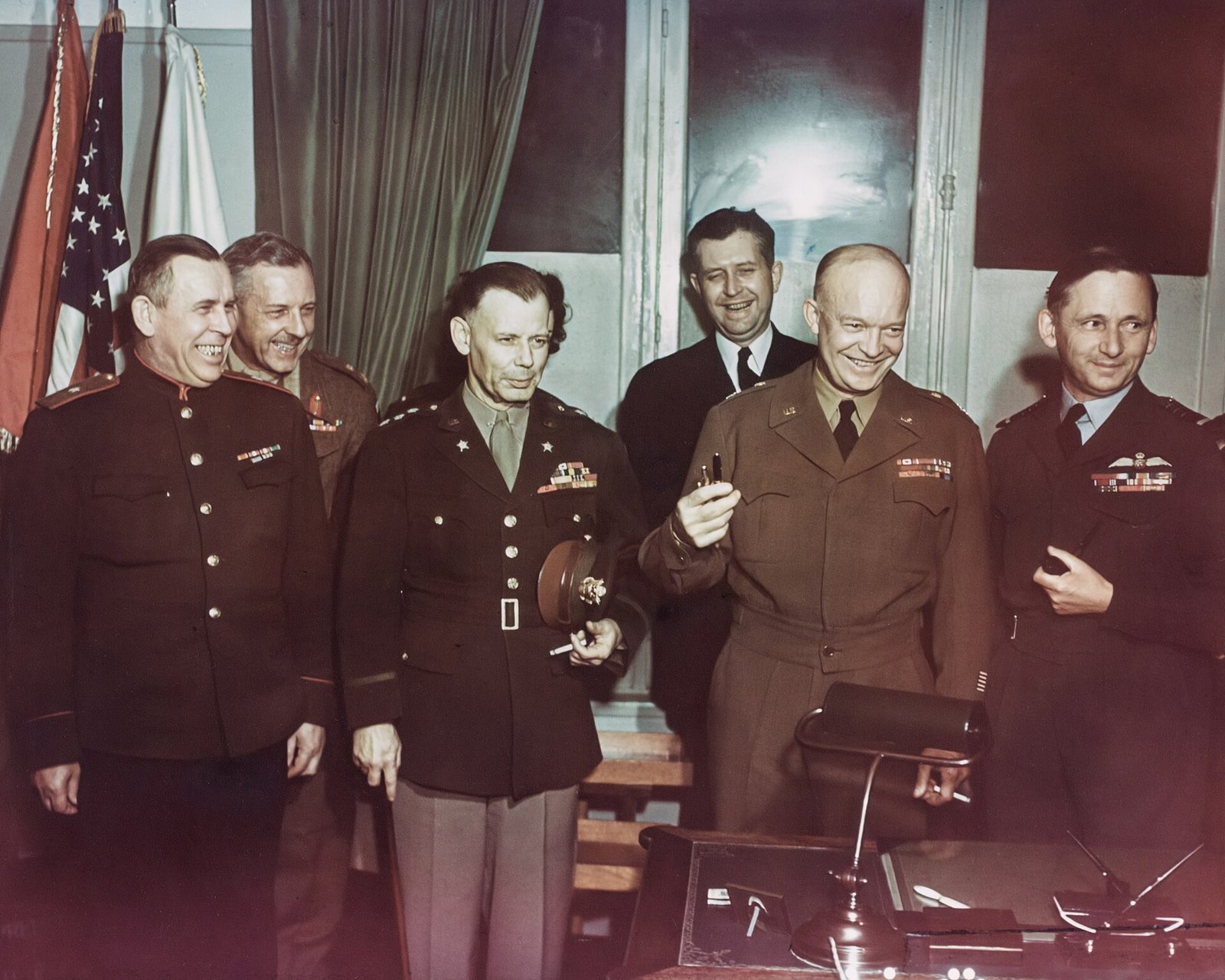
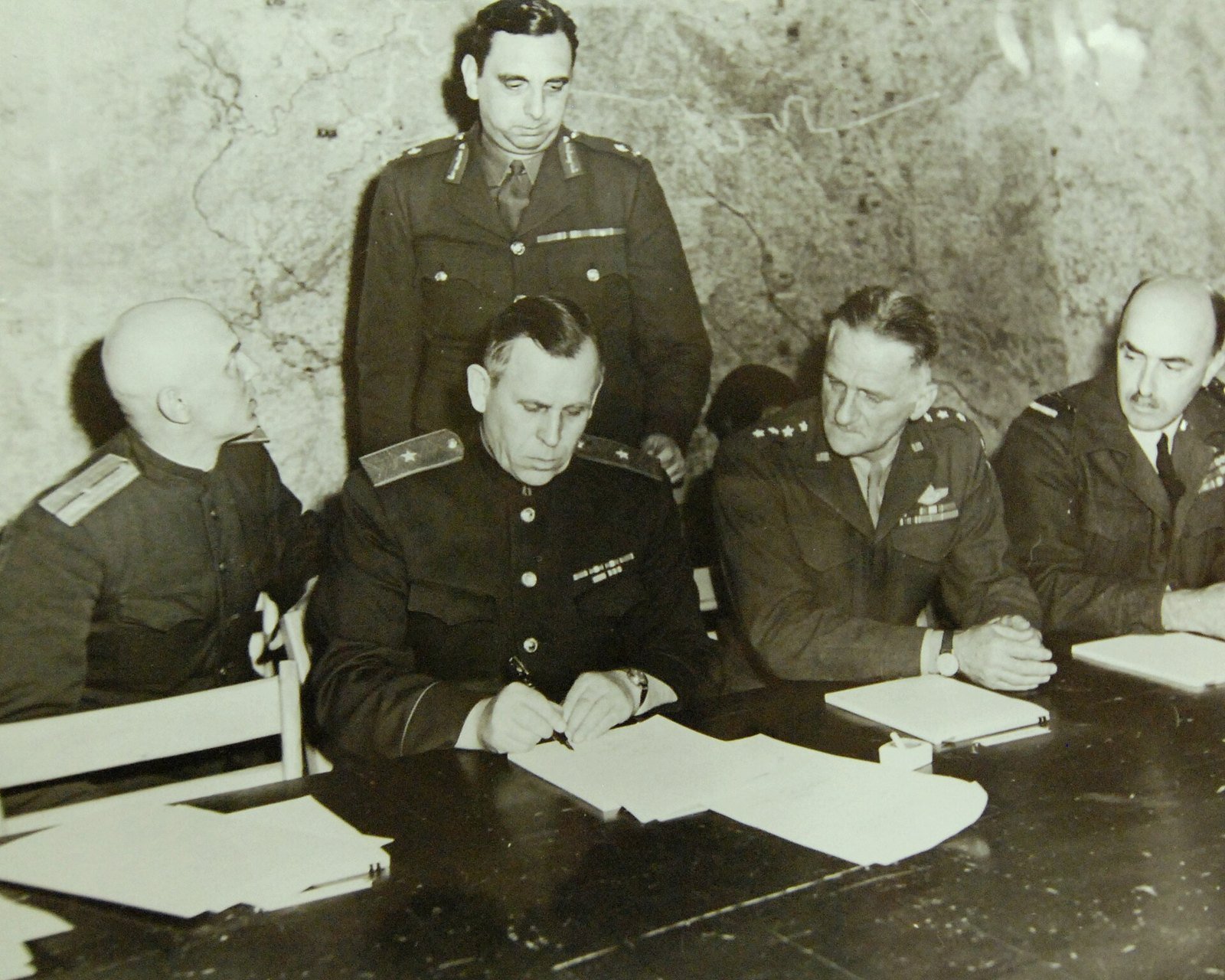
The first surrender was signed in a converted school in Reims, Eisenhower’s headquarters. Colonel General Alfred Jodl, for the German High Command put his name to it; Lieutenant General Walter Bedell Smith, for the Supreme Commander and Major General Ivan Susloparov, for the Soviet High Command signed beneath, with Major General François Sevez, French witness. It was not a Western surrender with a Soviet onlooker: both acts were signed before representatives of all the Allies.
Why sign a second time, then? Jodl was chief of staff, not a commander. At Reims the Germans also signed a protocol promising a ratification by the commanders of the Wehrmacht and its three services. The British in particular insisted on it. The two archives that tell the story read it differently:


02Two days on two clocks
Both acts name one clock, Central European Time. The axis below runs on it, with Moscow, two hours ahead in the conversions of both the Soviet and the museum account, marked underneath. Where the sources disagree, the mark is a range.
Reims to Karlshorst, 7 May – 9 May, on Central European Time
7 May · Reims
The act reads “at 0241” with no time zone. NARA calls it local time, and French clocks then ran an hour ahead of CET: so 01:41–02:41 CET.
7 May · Reims
The Soviet liaison general signs for the Soviet High Command. With him, Germany is committed to stop fighting everywhere.
8 May · Tempelhof
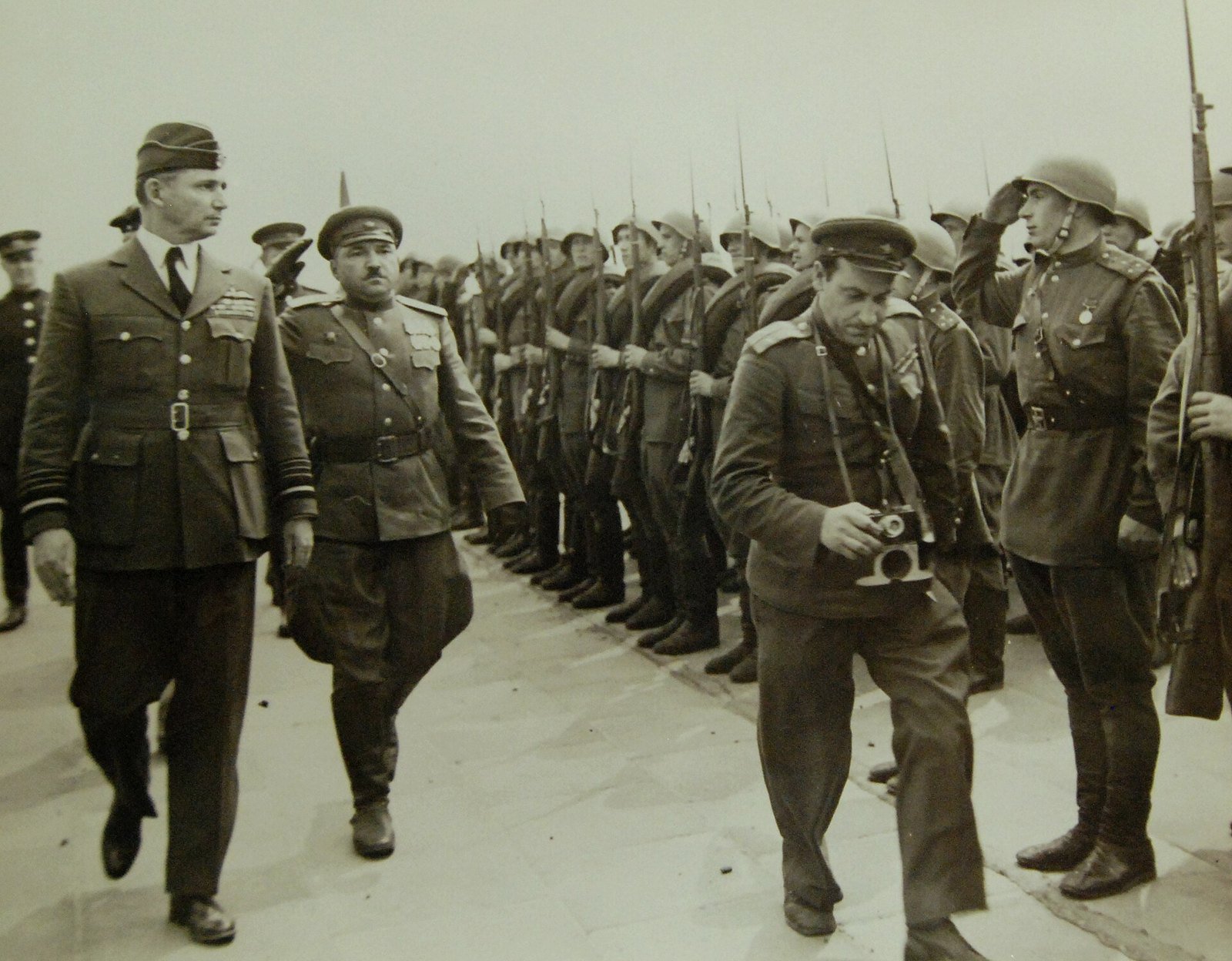
Vyshinsky lands in the morning, Tedder and Spaatz at midday, de Lattre in the afternoon. The Germans are flown in from Flensburg in an American aircraft. President Truman and Prime Minister Churchill announce the surrender.
8 May · 23:01 CET
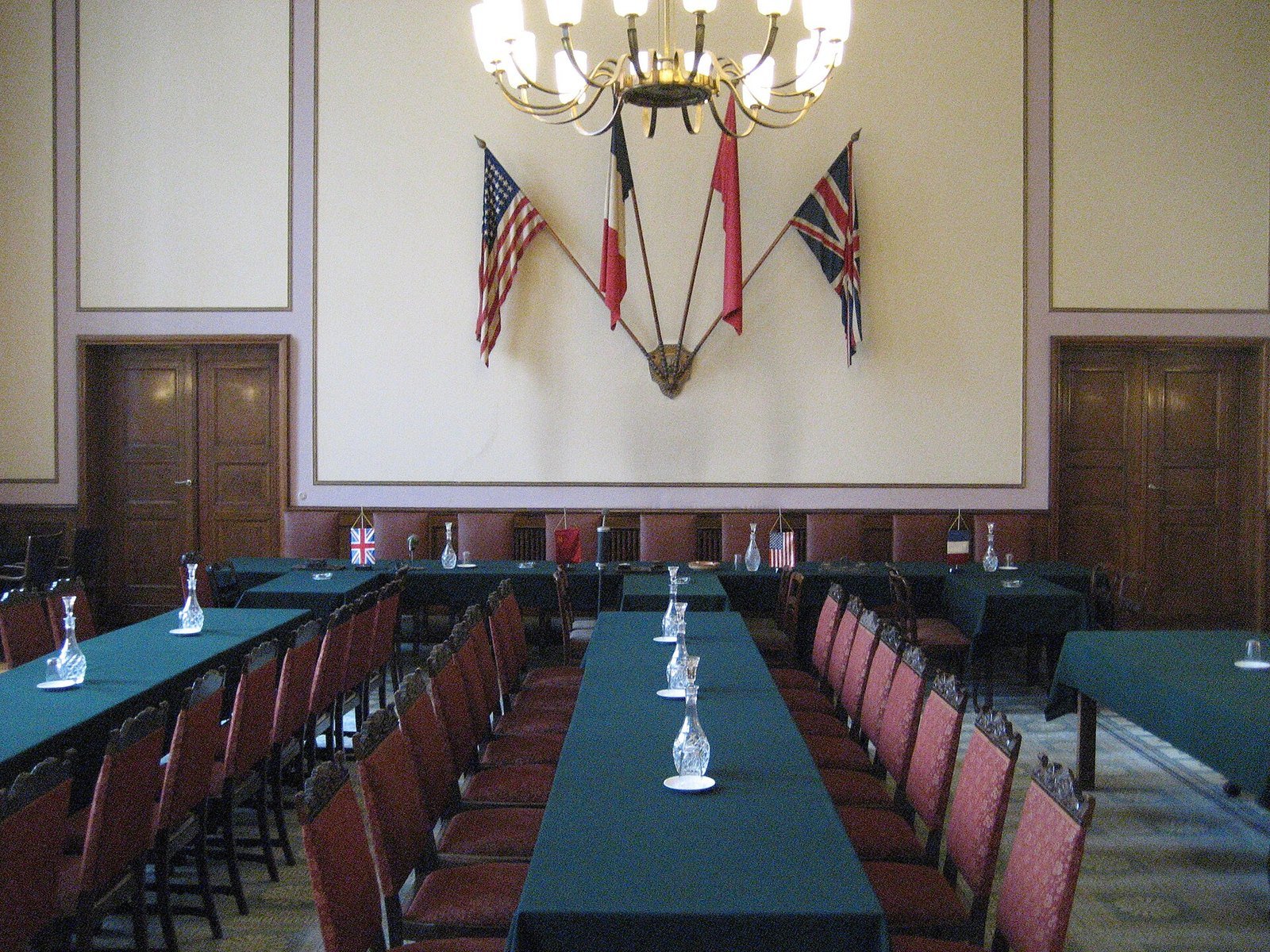
Both acts set the ceasefire for 23:01 CET, already 01:01 on 9 May in Moscow. In Karlshorst the hall is not ready: a Russian text has to be agreed by radio, and a French flag sewn from scraps.
Night of 8 May – 9 May
The official Soviet time is 22:43 CET, 00:43 in Moscow. The museum says about 00:45 on 9 May, 02:45 in Moscow. The ceremony took about 45 minutes.
9 May · Moscow
Moscow’s midnight had passed before either reading. Moscow announced the surrender only after Karlshorst, and 9 May counts there as the war’s official end.
03The paper
This is the American copy of the Berlin act, kept by the US National Archives. English, Russian and German; the English and Russian the only authentic texts. The date was written in by hand.
The Berlin act, signature page (US copy)
Act of Military Surrender, Berlin, 8 May 1945. U.S. National Archives, NAID 6943512. Public domain.
The date
“Signed at Berlin on the 8 day of May, 1945”: the day was filled in by hand. By the museum’s account, the ink went on after midnight.
For the German High Command
Wilhelm Keitel, Field Marshal, chief of the OKW, for the army. Zhukov watched him walk up: “His monocle fell and dangled on its cord; red blotches spread over his face.”
For the German High Command
Hans-Georg von Friedeburg, General-Admiral, for the navy. He had signed the surrender at Lüneburg Heath on 4 May and sat beside Jodl at Reims.
For the German High Command
Hans-Jürgen Stumpff, Colonel-General, for the Luftwaffe, standing in for its commander von Greim.
In the presence of
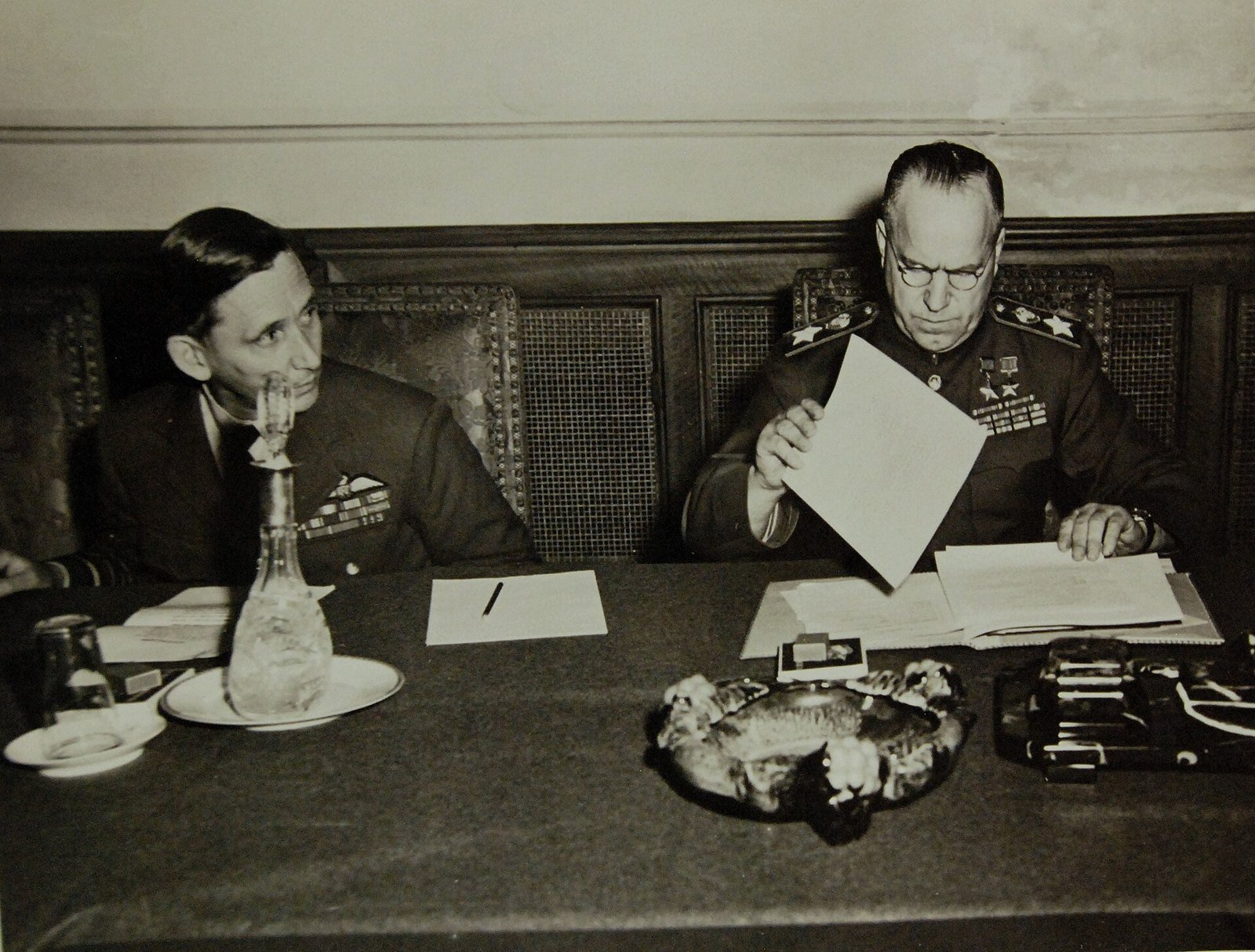
Arthur Tedder, Air Chief Marshal, for the Supreme Commander, Allied Expeditionary Force: Eisenhower’s deputy.
In the presence of
Georgy Zhukov, Marshal, for the Supreme High Command of the Red Army. On this American copy his signature has all but faded.
Witnesses
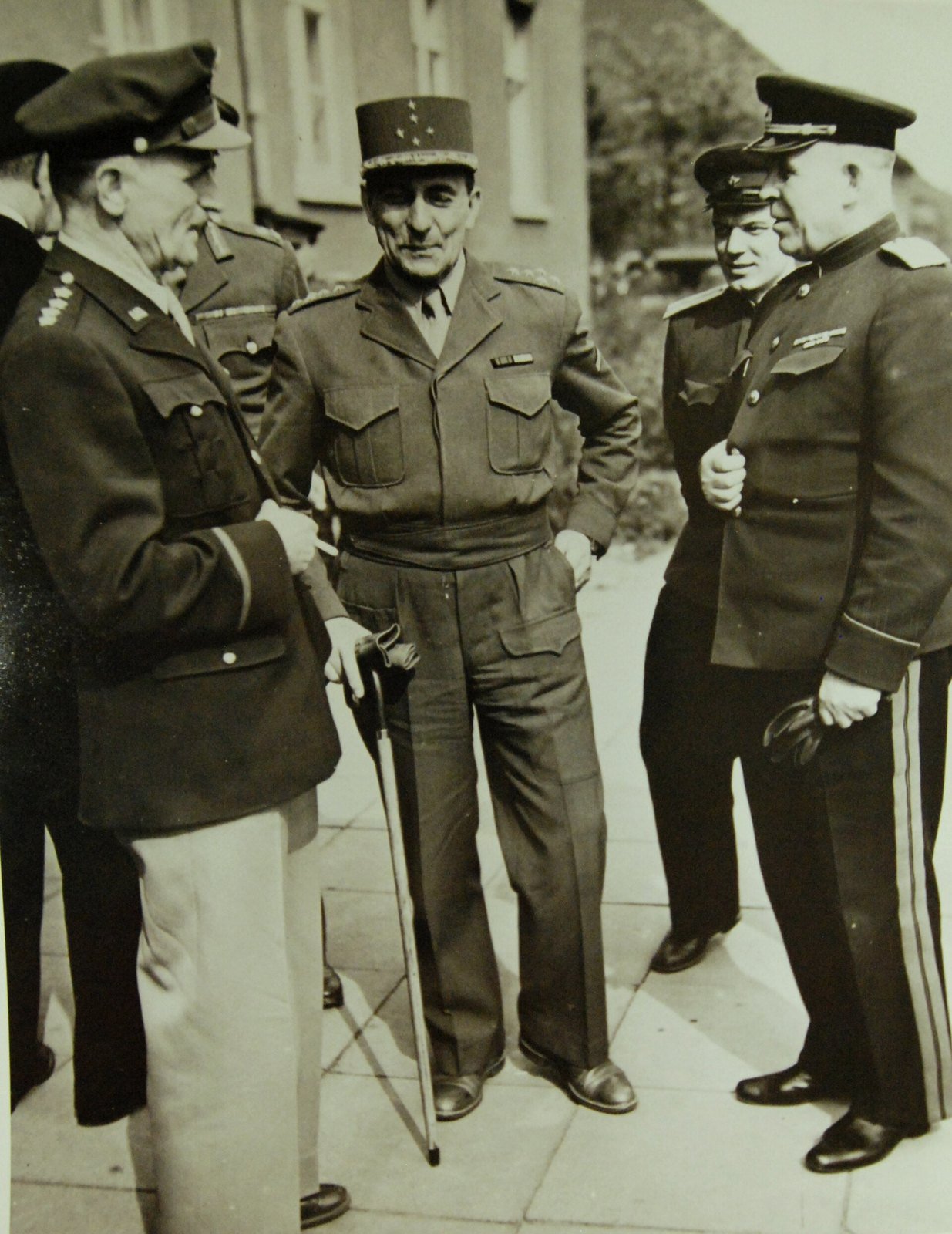
Jean de Lattre de Tassigny, General, First French Army, witness; Carl Spaatz, General, US Strategic Air Forces, witness. France now sat among the victors.
04Three tables, five days
Friedeburg sat at all three German surrenders of that week. Spaatz and Susloparov were at the table at Reims and again in Berlin. Each mark sits at its true time on one scale; the two signings are drawn across the hours their sources allow.
Who was at which table, 4 May – 9 May
Reims and Karlshorst are drawn across the range of their documented times; Lüneburg Heath is known by its date only. Presence is taken from the US Army captions and the acts.


05The house
The building went up in 1936/38 as the officers’ casino of the Wehrmacht’s Pionierschule I. Its hall survived the war intact; it is still there, and it is the heart of the museum. From 1945 to 1949 it was the seat of the head of the Soviet Military Administration in Germany.
The Soviet army opened its own museum here in 1967, the “Museum der bedingungslosen Kapitulation des faschistischen Deutschlands im Großen Vaterländischen Krieg 1941–1945”. After the troops left, a German–Russian association refounded it; it opened on 10 May 1995. Since 24 February 2022 only the Ukrainian flag flies outside, and the words “German-Russian” have gone from its name. Entry is free.

The house, year by year
Bars on one year scale. The casino was built 1936/38; the museum was founded in 1994 and has been run since 1997/98 by an association that also includes Ukrainian and Belarusian museums.


The surrender signed in Karlshorst says 8 May, the day London, Paris and New York celebrated. Moscow heard the news on 9 May, and keeps its Victory Day then.
“The surrender is sealed, the war is over.” — Konstantin Simonov, in the hall that night
Press & citation
Free to publish under CC BY 4.0 — in print, online, on Wikipedia and in teaching, commercially or not — with credit to Berlinfographics and a link to this page.
Ready-to-use image
The infographic as one image: headline, key figures, chart, sources and credit, 2,400 × 1,350 px PNG. Please use it unedited.
Download landscape (PNG)
Square format
A 1:1 version for social media and narrow columns, 1,800 × 1,800 px.
Download square (PNG)
Portrait 4:5
For Instagram and LinkedIn feeds, 1,620 × 2,025 px.
Download portrait (PNG)Credit line
Berlinfographics (berlinfographics.com), CC BY 4.0
Citation
Berlinfographics (2026). “Two surrenders, one date in dispute”. Berlin Experiences. https://berlinfographics.com/karlshorst-surrender/
Wikipedia
{{cite web |title=Two surrenders, one date in dispute |url=https://berlinfographics.com/karlshorst-surrender/ |website=Berlinfographics |publisher=Berlin Experiences |date=2026-11-09 |access-date=2026-11-09}}
Our infographics, charts and texts are licensed CC BY 4.0: free to republish, including commercially, with credit to Berlinfographics and a link. Photographs keep their own licences, named in each caption. How to credit
Topics: The Second World War · Cold War Berlin · Nazi Berlin · Persecution & the Holocaust · Weimar Berlin · Prussia & the Kaiserreich · Architecture & the built city · Culture, science & society · Reunified Berlin · Unusual facts
Contact: info@berlinfographics.com · Press: press@berlinfographics.com · Imprint · Privacy